Signal-Based Outbound: How to Build It, Wire It, and Actually Make It Work
Signal-based outbound turned 175 target accounts into 63 booked meetings for a RevOps team. That's a 36% meeting rate.
Here's the quick version if you're short on time. This approach means detecting buying signals, enriching contacts with verified data, and reaching out within minutes - not days. Three things matter most: pick one or two high-impact signals to start, make your data layer bulletproof because stale emails kill the entire motion, and measure signal-to-meeting conversion instead of emails sent. Everything below is the how.
What Signal-Based Outbound Actually Is
The Ehrenberg-Bass Institute's 95:5 rule frames the core problem: only about 5% of your target buyers are in-market at any given time. Traditional outbound sprays messages at the entire 100% and hopes to catch someone mid-cycle. A signal-driven approach flips that math - you watch for behavioral and contextual signals that indicate a buyer is entering that 5% window, then reach out with timing and relevance that cold email can't touch.
Some teams call this "warm outbound" and score accounts across three dimensions: fit, intent, and engagement. The framework is sound. But the execution layer is where most programs stall, because scoring accounts means nothing if the contact data is stale by the time a rep picks up the phone. That gap between signal detection and outreach is where pipeline goes to die.
Why Cold Outbound Is Dying
The numbers are ugly. According to compiled 2026 benchmarks, the average cold email reply rate sits at 3.43%. A Backlinko analysis of 12 million outreach emails found only 8.5% receive any reply - and that includes "not interested" and "unsubscribe me."
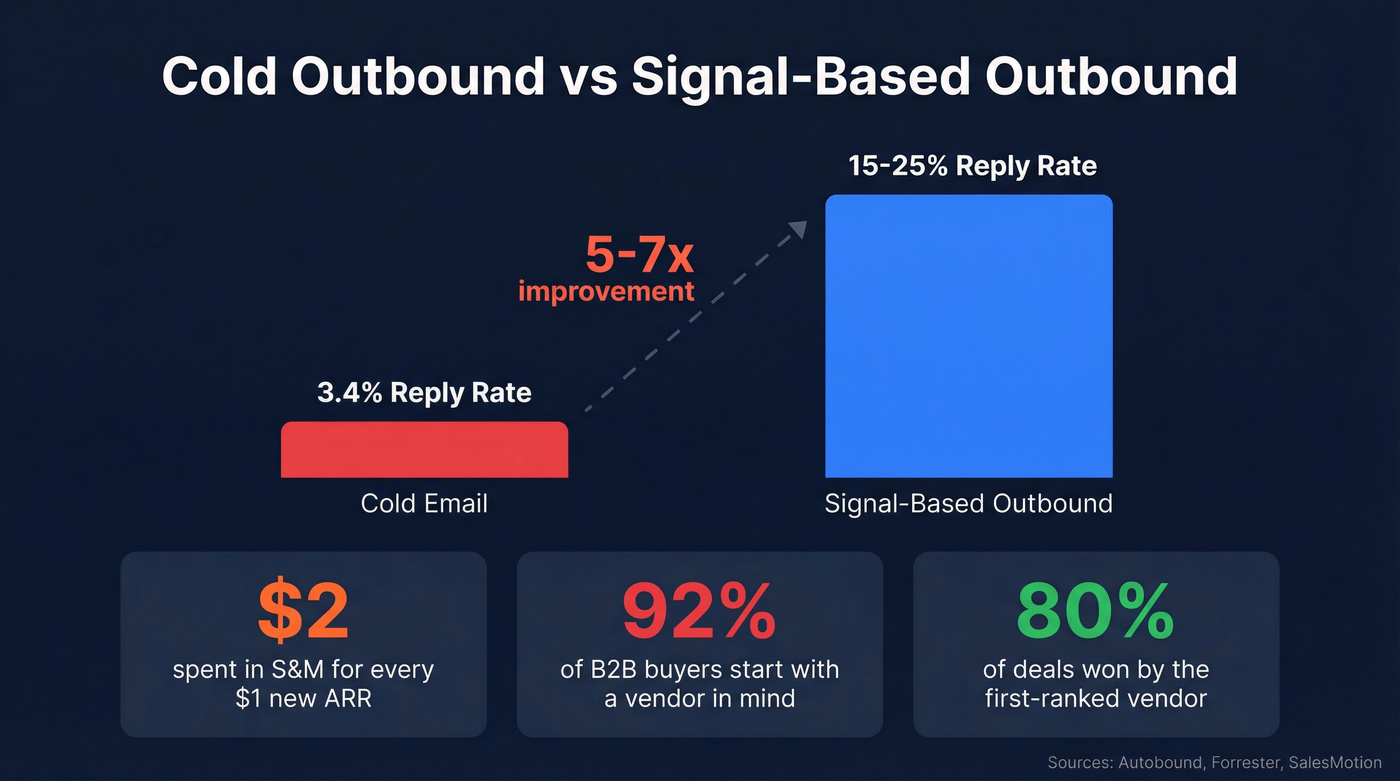
B2B companies now spend $2 in sales and marketing for every $1 of new ARR, up 14% from 2024. You're spending more to get less. And Forrester's data makes the stakes even clearer: 92% of B2B buyers start with at least one vendor in mind), and the vendor ranked first wins about 80% of the time. If you're not the first conversation, you're probably not in the conversation at all.
Signal-driven outreach consistently hits 15-25% reply rates. That's not a marginal improvement - it's a different category of motion entirely. A cold email to a VP who isn't evaluating anything is noise. The same email sent 20 minutes after their team visits your competitor's G2 page is a conversation.
Which Signals Matter Most
Not all signals are created equal. The difference between a pricing page visit and a webinar attendance is the difference between "they're buying now" and "they might buy someday." You need a tiering model with clear SLAs, or your team will treat every signal the same - which means treating none of them urgently.
| Signal Tier | Example Signals | Time to Act | Expected Response Rate |
|---|---|---|---|
| Tier 1 (Hot) | Pricing page visits, champion job changes | Within hours | 14-25% |
| Tier 2 (Warm) | New exec hires, funding rounds, job postings | Within days | 8-15% |
| Tier 3 (Nurture) | Blog consumption, social engagement | Ongoing nurture | 5-9% |
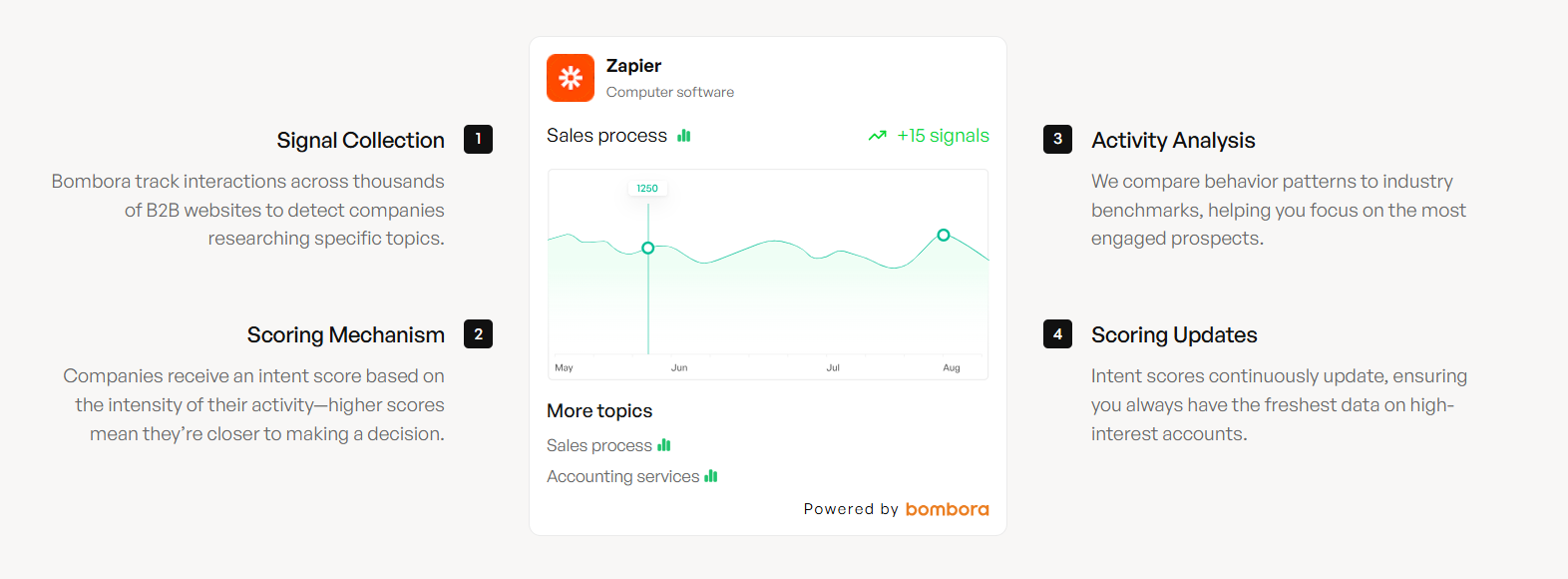
Tier 1 signals demand speed. Leadership-change outbound generates a 14% response rate versus 1.2% for standard cold calls - but only when you reach out during those first 100 days while newly hired execs are spending 70% of their budget. Wait two weeks and the advantage evaporates.
Here's the thing: signal stacking changes the math entirely. Accounts showing 3+ active signals convert at 2.4x the rate of single-signal accounts. A funding round alone is interesting. A funding round plus pricing page visits plus a champion who just joined from a customer account? That's a Tier 1 trigger, full stop.
The Signal-Led Outbound Stack
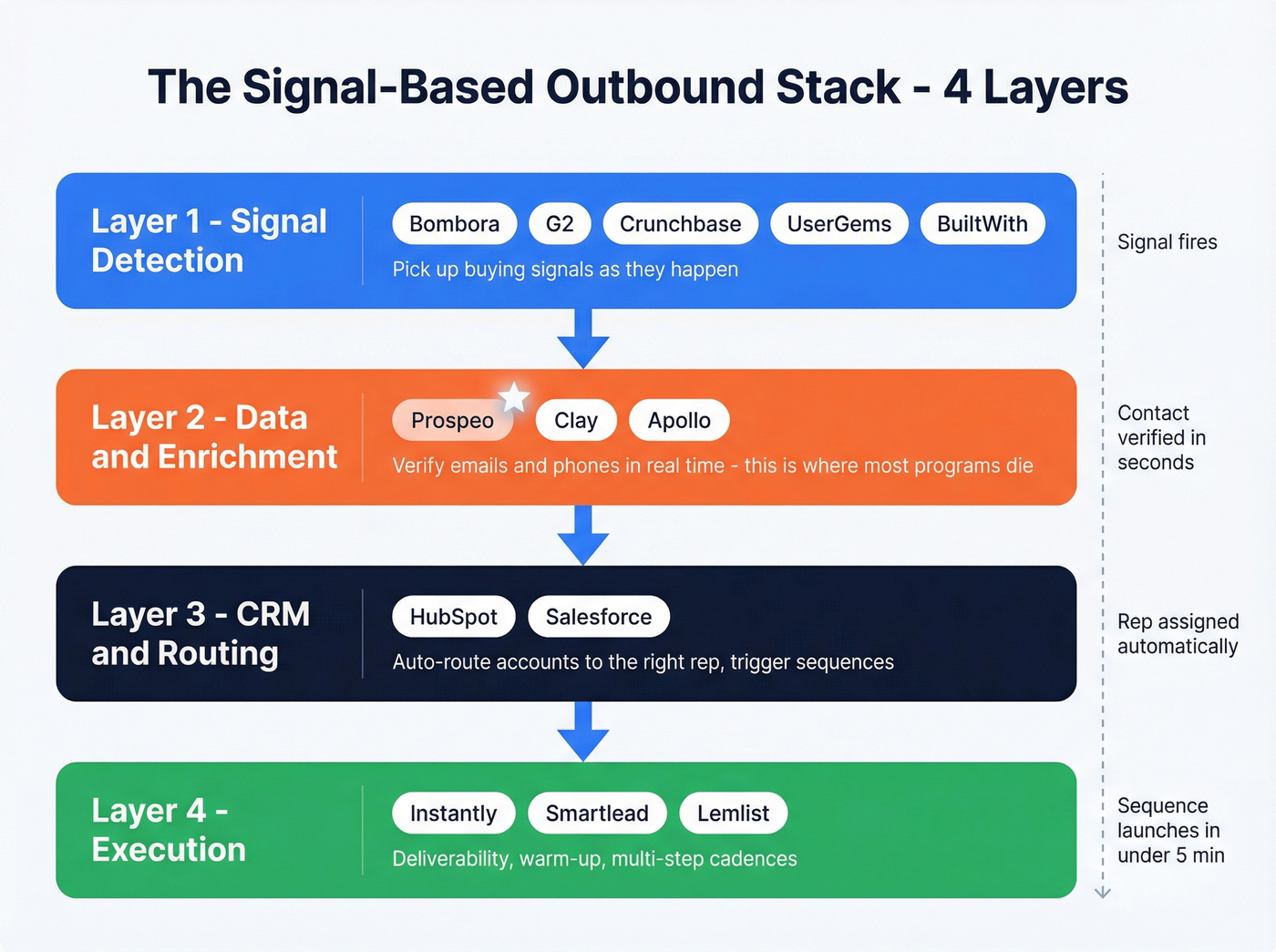
You don't need 10 tools. You need four layers, each doing one job well.
Signal Detection
This is where you pick up buying signals. Bombora covers intent data across the web. G2 tracks review-site research behavior. Crunchbase flags funding events. UserGems tracks champion movement. BuiltWith and Wappalyzer handle technographic signals.
Data and Enrichment
This is where most programs quietly die. And we've seen it firsthand - teams detect a perfect signal, pull up the contact, and the email is from 2022 or the phone number is disconnected. The signal was perfect. The data wasn't. The most common complaint on r/sales and RevOps communities isn't about signal quality. It's about B2B contact data decay killing the follow-through before a rep even picks up the phone.
Prospeo is our pick for this layer. It covers 300M+ professional profiles with 98% email accuracy, 125M+ verified mobile numbers with a 30% pickup rate, and a 7-day data refresh cycle - the industry average is six weeks. It bundles Bombora intent data across 15,000 topics with 30+ search filters covering buyer intent, technographics, job changes, and funding signals, so you're getting signal detection and enrichment in one platform. At roughly $0.01 per email with a free tier to start, it's a fraction of what enterprise platforms charge. Native integrations with Clay, Instantly, Smartlead, and Lemlist mean enriched contacts flow straight into execution without manual exports.

Clay (~$150-$800+/month depending on usage) is the best orchestration layer if you need waterfall enrichment across multiple providers. Apollo (~$49-$99+/user/month) works as a solid all-in-one for SMB teams that want database, sequencing, and basic signals in one tool.
CRM and Routing
HubSpot or Salesforce - whichever is your system of record. The key isn't the CRM itself but the automation triggers you build. When a signal fires, the CRM should route the account to the right rep and kick off the sequence automatically. No manual handoffs.
Execution
Instantly (~$30-$100/month), Smartlead (~$40-$100/month), or Lemlist (~$40-$100/month) for email sequencing. These tools handle deliverability, warm-up, and multi-step cadences. Pick based on volume needs and channel mix.

Signal-based outbound dies when the data layer fails. Prospeo pairs Bombora intent data across 15,000 topics with 98% verified emails and a 7-day refresh cycle - so when a Tier 1 signal fires, your enrichment returns accurate contacts, not dead ends.
Stop losing meetings to stale data. Start at $0.01 per email.
How to Wire It Together
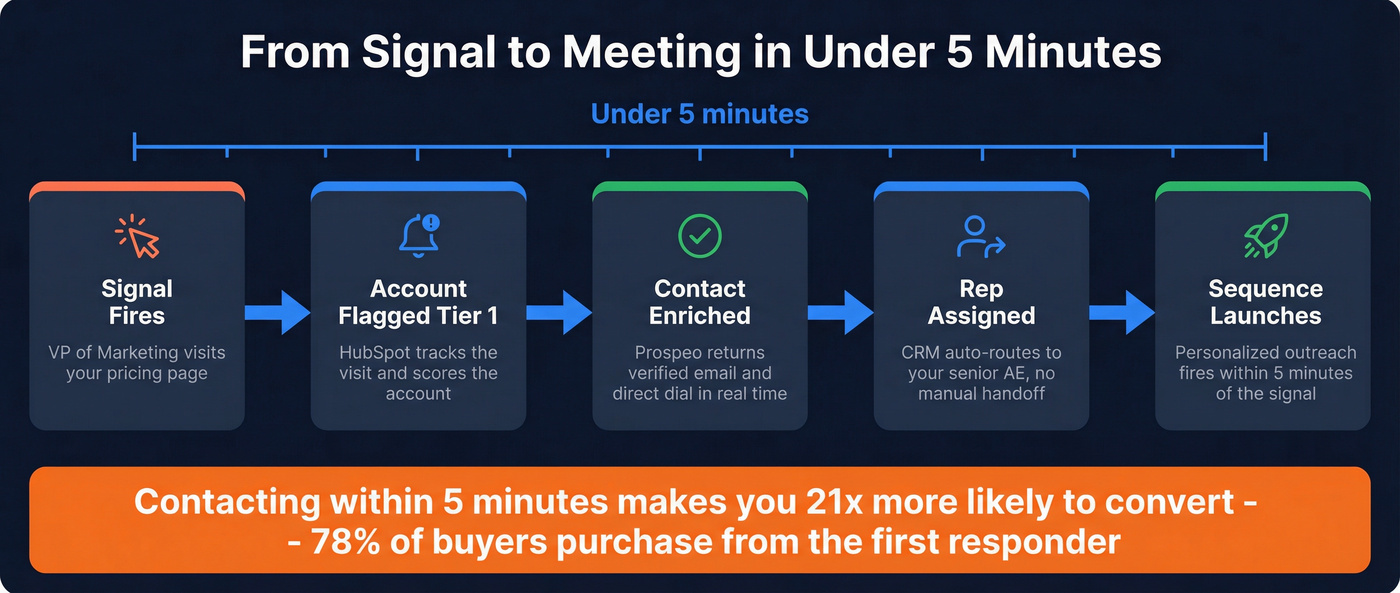
Let's walk through a real scenario. A target account's VP of Marketing visits your pricing page. HubSpot tracks the visit and flags the account as Tier 1. Your enrichment layer returns a verified email and direct dial in real time, so the sequence fires with accurate data - not a guess. The CRM routes the account to your senior AE. A personalized sequence launches within five minutes.
That five-minute window matters. Research shows contacting within five minutes makes you 21x more likely to convert) to an opportunity. And 78% of buyers purchase from the first responder.
This is exactly how GTMify hit that 63-meetings-from-175-accounts number. They targeted 16 personas across 8 functions, triggered personalized sequences within minutes of relevant signals, and used waterfall enrichment to ensure every contact had verified data before the sequence fired. It's the clearest proof that signal-driven outreach - when wired correctly - outperforms volume-based prospecting by an order of magnitude.
The Data Quality Gap Nobody Talks About
Look, we've tested dozens of enrichment workflows, and the pattern is always the same. Your intent platform lights up. A VP of Engineering at a Series B company just researched your category on G2. Your SDR pulls up the contact. The email is from 2023. The phone number is disconnected. By the time someone manually finds the right contact info, a competitor has already booked the demo.
This scenario plays out constantly, and it's why data quality is the single most underrated variable in any signal-driven motion. When the industry average refresh cycle is six weeks, that's an eternity if you're trying to act on a signal within hours.
The proof is in bounce rates. Meritt's sales team was running 35% bounce rates on their outbound before fixing their data layer - after switching to verified, fresh data, they dropped under 4% and tripled pipeline from $100K to $300K per week. Meanwhile, 12% of closed-won deals show direct G2 intent signal influence, but only when the data connecting signal to outreach is actually accurate.

Stacking signals means nothing if the phone number is disconnected. Prospeo delivers 125M+ verified mobiles with a 30% pickup rate and pipes enriched contacts directly into Instantly, Smartlead, or Lemlist - no manual exports, no delays.
Wire your signal-to-meeting pipeline in minutes, not weeks.
Scaling Without Losing Quality
The biggest objection you'll face isn't "does this work?" It's "why are we sending fewer emails?"
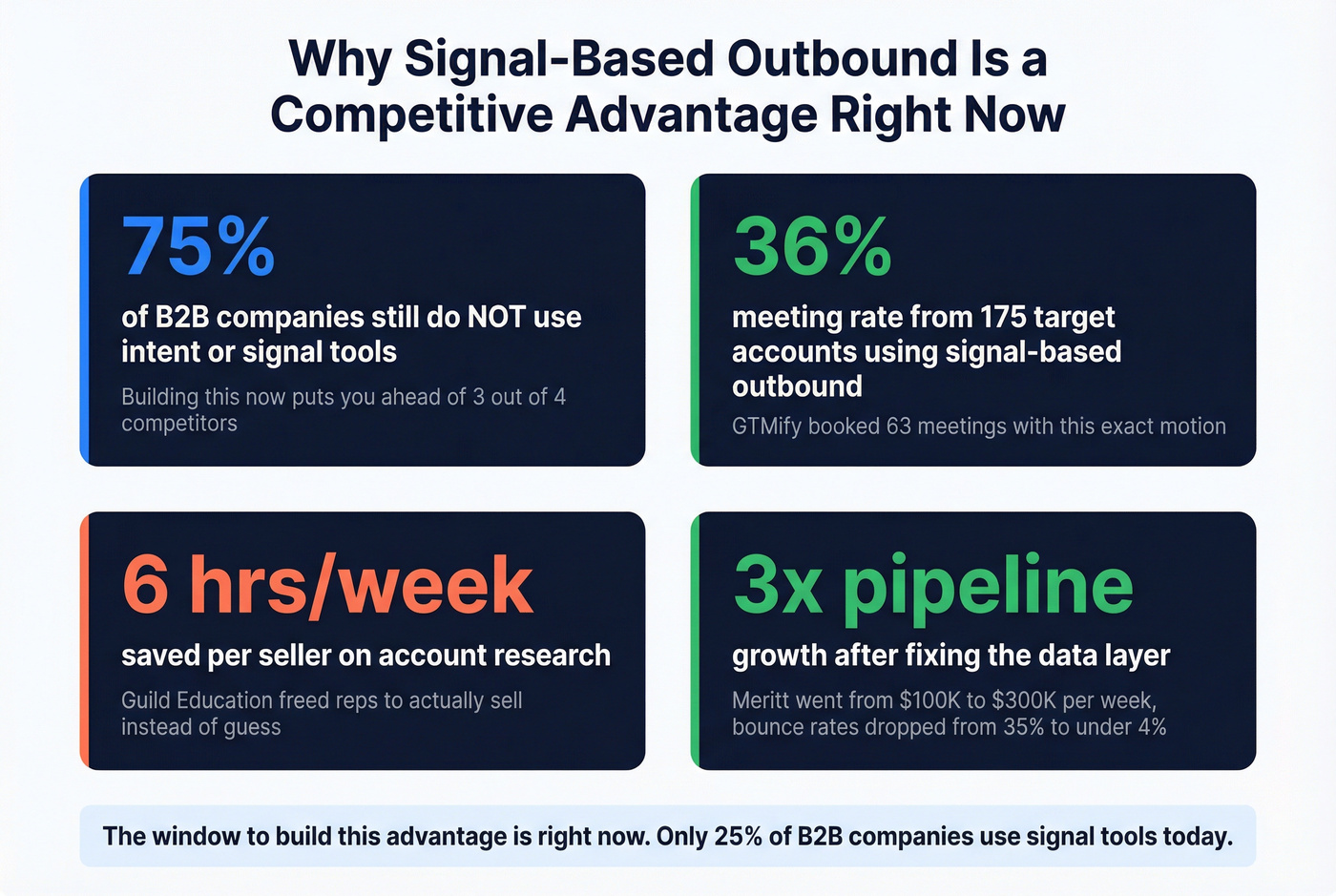
Volume anxiety is real. Reframe the conversation around signal-to-meeting conversion instead of emails sent. Guild Education saves roughly 6 hours per week per seller on account research alone by using signal-driven workflows - time that goes back into actual selling. When your reps are spending less time guessing and more time talking to buyers who are already in-market, the pipeline numbers speak for themselves.
Let's be honest: only 25% of B2B companies use intent or signal tools today. If your deal sizes are above $5K and you're still running pure cold outbound in 2026, you're leaving meetings on the table that a competitor with a $500/month signal stack is picking up. Building this motion now isn't just efficient - it's a genuine competitive advantage while 75% of the market is still spraying cold lists.
Skip this approach if your ACV is under $1K and your sales cycle is purely transactional. The ROI on signal infrastructure doesn't pencil out for $29/month products with self-serve funnels. For everyone else, the window to build this advantage is right now.
Signal-Based Outbound FAQ
How many signals do I need to start?
One. Start with a single high-impact signal - job changes or pricing page visits are the highest-converting entry points. Teams stacking 3+ signals see 2.4x higher conversion rates, but one well-executed signal beats five poorly wired ones every time. Get the workflow tight first, then layer.
Does this work for SMBs?
Yes, and it's more accessible than ever. You don't need a $50K intent platform. The full four-layer stack - signal detection, enrichment, CRM, and execution - can run on ~$200-$800/month for a small team. Prospeo's free tier covers early testing with 75 emails and 100 Chrome extension credits per month. The ROI math actually favors smaller teams because every meeting matters more when you're running targeted outreach instead of blasting cold lists.
What reply rates should I expect?
Generic cold email averages 1-3%. Basic personalization gets you to 5-9%. Signal-based outreach with proper timing and fresh data consistently hits 15-25%. The first seller to contact after a trigger event is 5x more likely to win the deal. The variable isn't the signal - it's the speed and data quality of your response.
What's the best free tool to start with?
Pair Prospeo's free tier with HubSpot's free CRM for routing and a free Instantly trial for sequencing. Total cost to validate the motion: $0. That's enough to test a signal-driven workflow on a small account list and prove the concept before investing in the full stack.