

Best Sales Sequences: What Actually Works in 2026
It's Monday morning. You sent 500 emails last week - open rate looks decent at 38%, but replies? Four. That's a 0.8% reply rate, and three of those four were "please remove me from your list."
The best sales sequences don't fail because of bad copy. They fail because of bad data. About 95% of cold emails fail to generate replies, and the fix isn't another subject line tweak or a cleverer CTA - it's everything upstream: who you're targeting, whether your emails actually land, and how you structure touches across channels. Here's what the 2026 data says works.
2026 Sequence Benchmarks
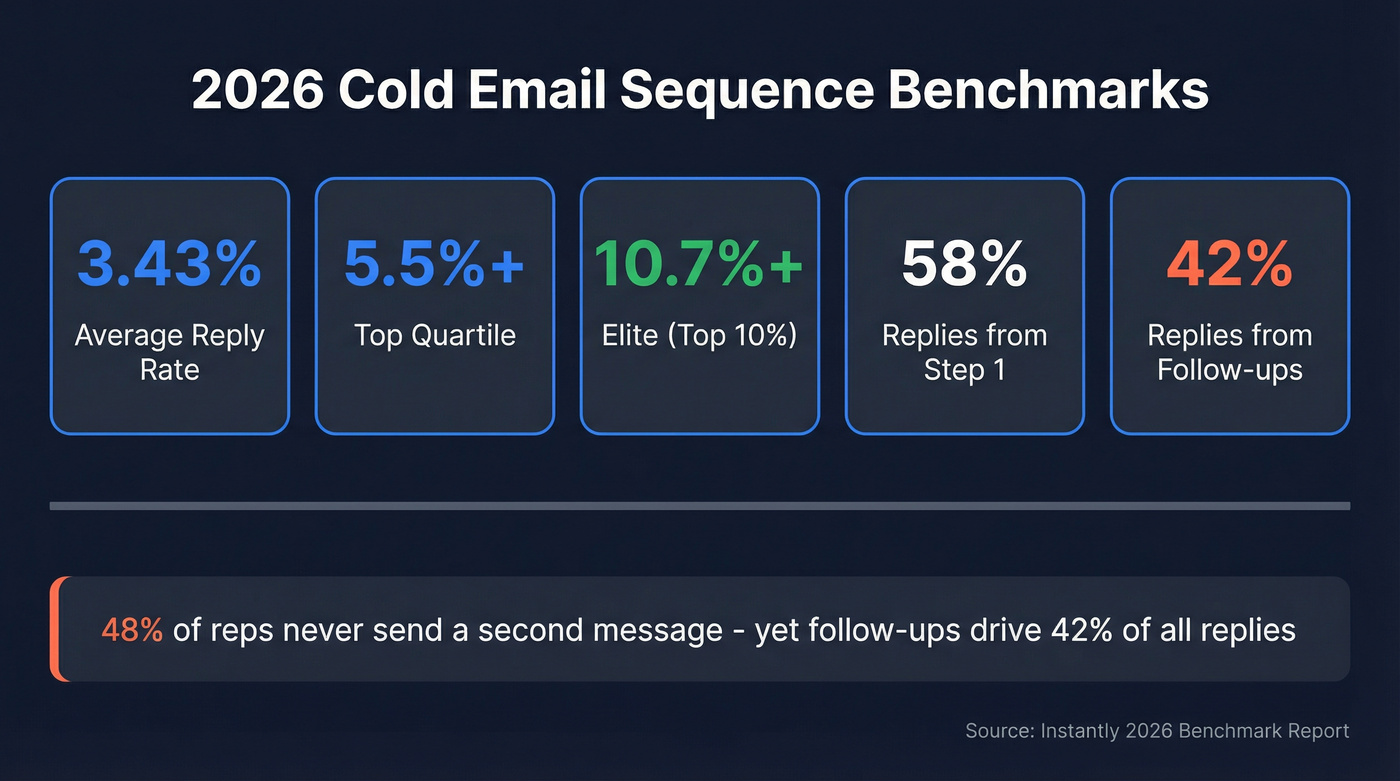
Instantly's 2026 benchmark report analyzed billions of cold email interactions. The numbers are humbling.
| Metric | Number |
|---|---|
| Avg reply rate | 3.43% |
| Top quartile | 5.5%+ |
| Elite (top 10%) | 10.7%+ |
| Replies from Step 1 | 58% |
| Replies from follow-ups | 42% |
Follow-ups generate 42% of all replies. They're not optional. And yet 48% of reps never send a second message. The gap between average and elite isn't copywriting talent - it's data quality, targeting precision, and sequence structure.
McKinsey's research validates this at the enterprise level: AI-powered sequencing improves revenue 5-8% and cuts cost to serve by 20-30%. Best-performing emails stay under 80 words with one clear CTA. Tuesday and Wednesday drive peak reply rates (see Best Time to Send Prospecting Emails). The cadence that works: launch Monday, follow up Wednesday, triage Friday.
Multichannel Sequence Template (20%+ Reply Rate)
The 30 Minutes to President's Club template drove 20%+ reply rates at Carta and Pave. It's the strongest publicly available outbound sequence we've found - and it doubles as a repeatable blueprint you can adapt to any vertical.
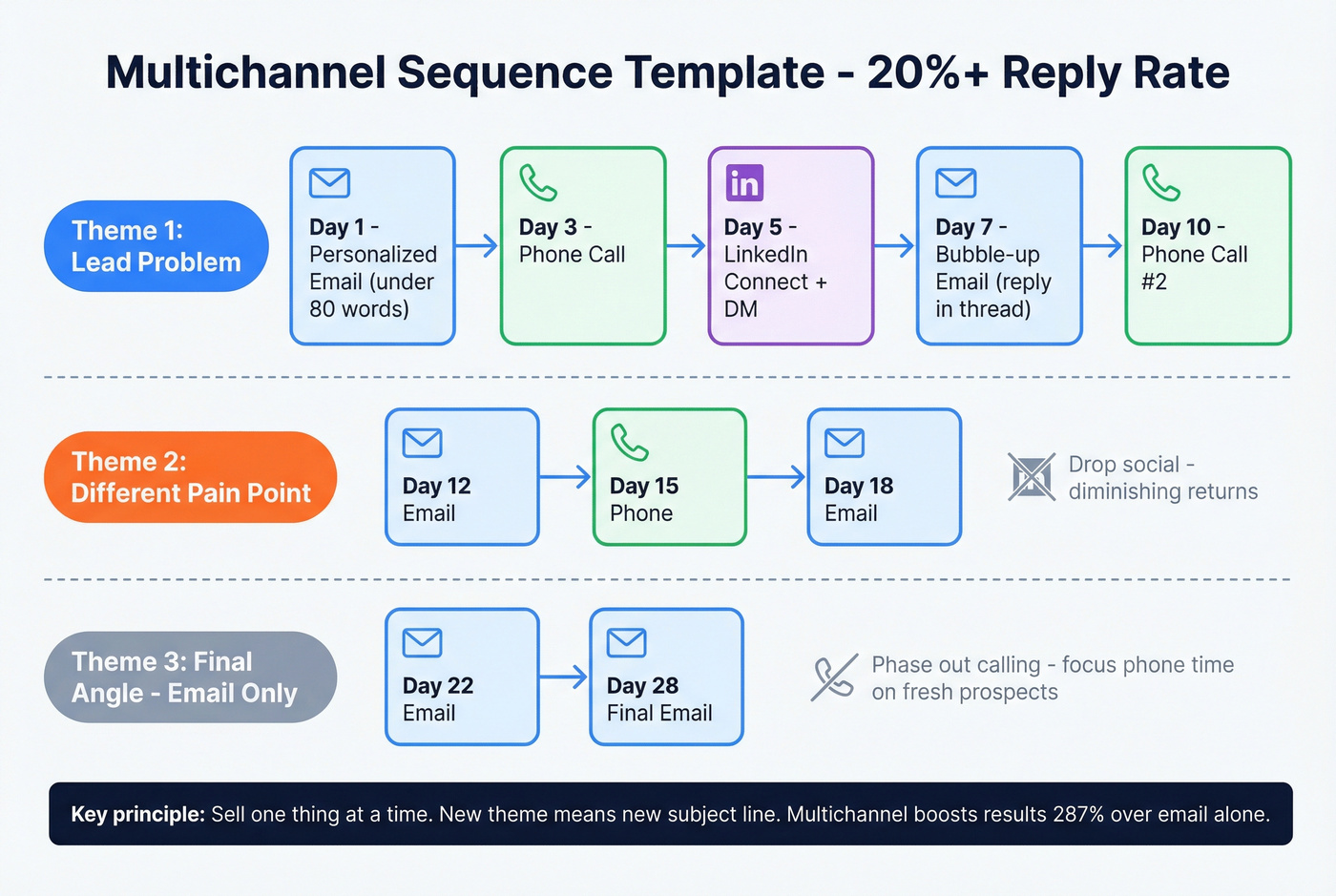
Theme 1 (Days 1-10): Lead with your strongest problem.
- Day 1: Personalized email, under 80 words (use a tighter sales email structure)
- Day 3: Phone call
- Day 5: Social touch - connection request plus a context-driven DM (borrow from social selling)
- Day 7: Bubble-up email, reply in-thread, keep it short
- Day 10: Phone call #2
Theme 2 (Days 12-20): Pivot to a different pain point. Repeat the channel mix but drop social. Diminishing returns hit hard by theme 2.
Theme 3 (Days 22-30): Final angle, email-only. Phase out calling here. Fresh prospects deserve your phone time more than stale ones.
The key principle: sell one thing at a time. When you change themes, change subject lines (see Words to Avoid in Email Subject Lines). Combining email with phone and social can boost results by 287% over single-channel sequences.
In practice, SMB teams usually run 5-8 touches over 2-3 weeks, while enterprise sequences often run 10-14 touches over 30+ days. The template above splits the difference - adjust the timeline based on your deal size. For teams that need to move fast, compress themes 1 and 2 into 14 days and skip theme 3 entirely; you'll capture the majority of replies without the long tail.
Let's talk about what comes next, because the static day-count sequence is already showing its age. One Deel AE used Amplemarket's AI-driven personalization to start conversations with 87% of recipients - not a typo (if you're evaluating options, see Amplemarket alternatives). The next evolution is signal-based triggering: launching touches based on job changes, funding rounds, or intent signals rather than arbitrary schedules (more on signal-based outbound).
One anti-pattern to kill immediately: the cutesy breakup email. "Did you get stuck under a rock?" doesn't make you memorable. It makes you annoying. If you're sending a final touch, give the prospect a real reason to say no. That's more likely to get a response than forced humor.

Signal-based sequences need real-time data. Prospeo refreshes 300M+ profiles every 7 days - not every 6 weeks - so your job change and intent triggers fire on contacts that actually exist. Meritt tripled pipeline to $300K/week after switching.
Stop sequencing dead emails. Start with data that's 7 days fresh.
The Data Quality Problem
None of the above matters if your emails don't land. With 16.9% of cold emails never reaching an inbox and bounce rates running 7-8%, you're burning domain reputation with every bad send. Once your sender score tanks, even your good emails start hitting spam (use an email deliverability checklist).
Here's the thing: if your average deal size is under $50K, data quality matters more than your sequencing tool. A $30/month sender with verified contacts will outperform a $100/user/month enterprise platform running on stale data every single time.
Prospeo catches this upstream. Its 5-step verification process filters out invalid addresses, spam traps, and honeypots before they torch your domain - with 98% email accuracy and a 7-day data refresh cycle (see B2B contact data decay). Meritt went from a 35% bounce rate to under 4% after switching, and their pipeline tripled from $100K to $300K per week. That's not a marginal improvement. That's a completely different business.

You just read that 16.9% of cold emails never reach an inbox. Prospeo's 5-step verification - with spam-trap removal, honeypot filtering, and catch-all handling - keeps bounce rates under 4%. At $0.01 per verified email, clean data costs less than one bounced send costs your domain.
Protect your sender reputation before your next sequence goes out.
Metrics That Actually Matter
Track these: Reply rate (your north star), meetings booked per sequence, and bounce rate - keep it around 3% or lower.
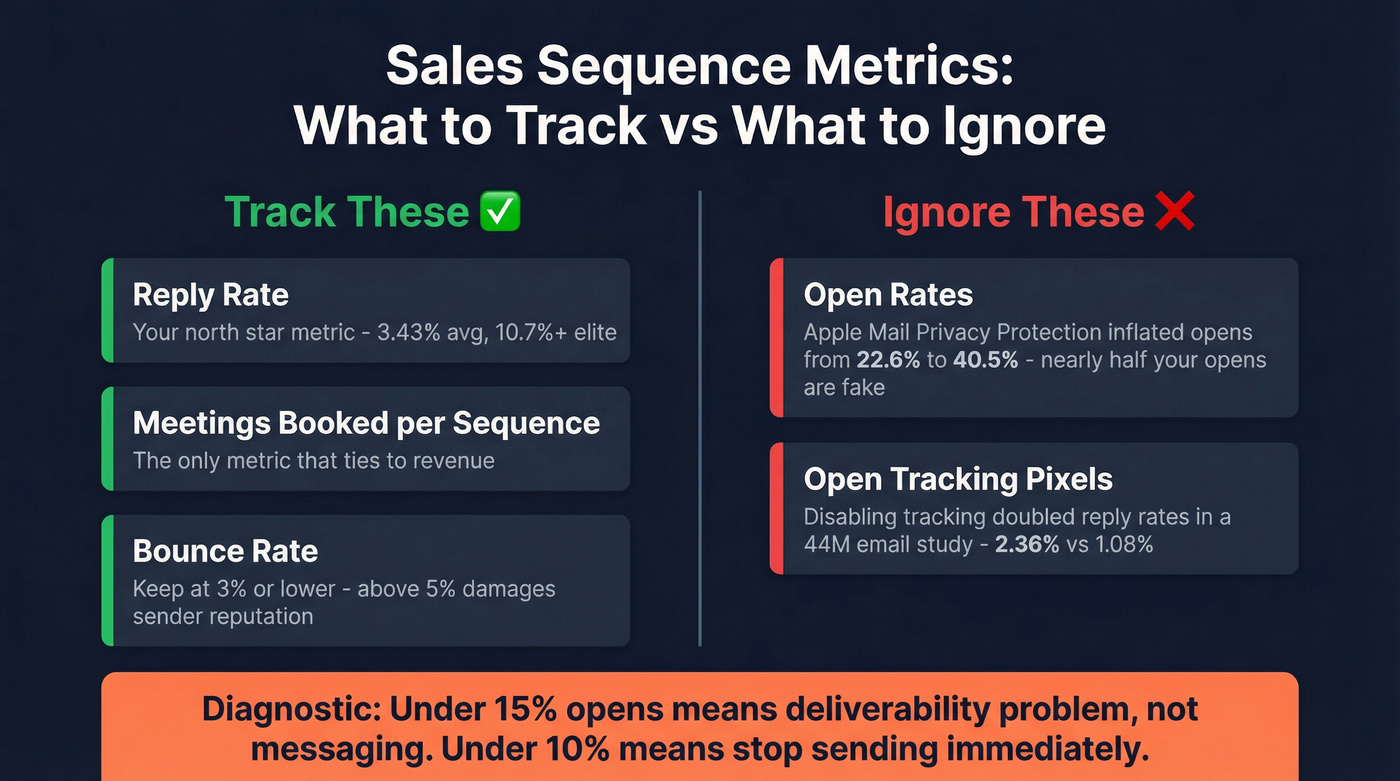
Ignore these: Open rates. Apple Mail Privacy Protection inflated opens from 22.6% to 40.5% in one documented case. Nearly half your "opens" are Apple's servers pre-fetching content, not humans reading your email (deep dive: does open tracking hurt cold email).
There's a more radical move worth testing. Snov.io analyzed 44 million emails and found that turning off open tracking entirely more than doubled reply rates - 2.36% vs 1.08%. Tracking pixels trigger spam filters. We've seen similar patterns in our own testing. If your opens look healthy but replies are dead, disable tracking for a week and compare.
Diagnostic threshold: if cold campaigns show under 15% opens, you have a deliverability problem, not a messaging problem. Under 10% means stop sending and investigate immediately.
Building Your Sequence Stack
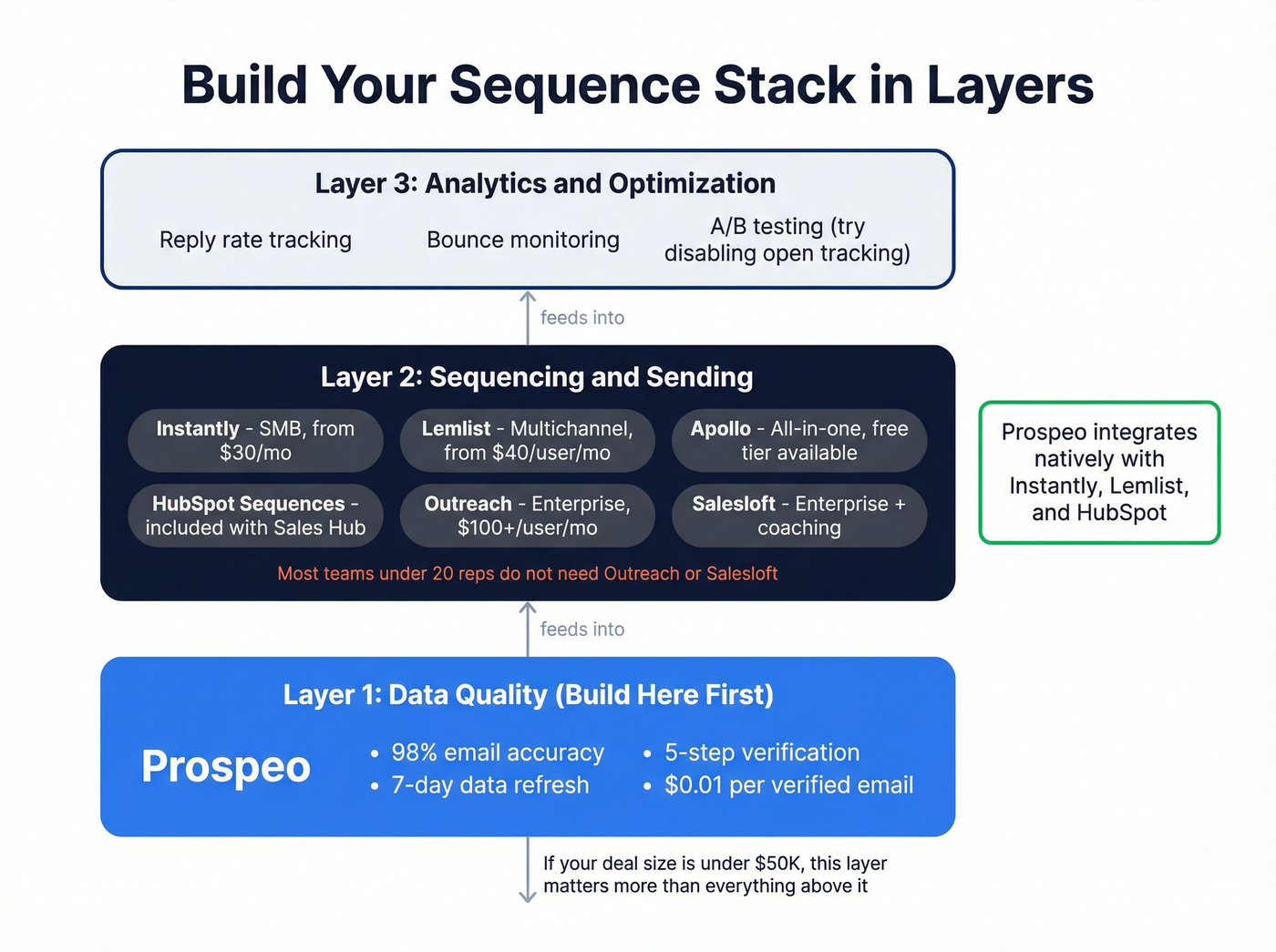
Build your stack in layers: data quality first, then sequencing, then analytics.
| Tool | Best For | Price Range |
|---|---|---|
| Instantly | SMB cold email | ~$30-$100/mo |
| Lemlist | Multichannel + personalization | ~$40-$100/user/mo |
| Apollo | All-in-one prospecting | Free tier; ~$49-$119/user/mo |
| HubSpot Sequences | Teams already in HubSpot | Included with Sales Hub |
| Outreach | Enterprise sequencing | Custom; often $100+/user/mo |
| Salesloft | Enterprise + coaching | Custom; often $100+/user/mo |
Most teams under 20 reps don't need Outreach or Salesloft. Outreach scores a 4.3/5 on G2 with 3,488 reviews, but users consistently flag pricing and a steep learning curve. Skip those unless you're running 50+ reps and need the coaching analytics.
Prospeo integrates natively with Instantly, Lemlist, and HubSpot - pair it with any of those for a stack that costs a fraction of enterprise platforms while outperforming on deliverability. We've found this combination makes multichannel outreach manageable even for lean teams without dedicated ops support.
FAQ
How many touchpoints should a sequence have?
Four to seven touches over 30 days is the sweet spot. Fewer than four means you're abandoning the 42% of replies that come from follow-ups. More than seven shows diminishing returns unless each touch adds new value or a different channel. Adjust based on your sales cycle length - enterprise deals warrant more touches spread over a longer window.
What's a good reply rate for cold outreach in 2026?
Average is 3.43%, top-quartile teams hit 5.5%+, and above 10% puts you in the elite top 10%. The gap comes down to data quality and targeting precision, not subject lines. Teams using verified data with 98%+ accuracy consistently land in that top tier because fewer bounces mean stronger sender reputation.
Should I turn off open tracking?
Yes, test it. Snov.io's analysis of 44 million emails showed reply rates more than doubled with tracking pixels disabled - 2.36% vs 1.08%. Tracking pixels trigger spam filters, and Apple Mail Privacy Protection makes open data unreliable anyway. Run a one-week A/B test. Most teams see immediate deliverability gains.
How do I stop my sales emails from bouncing?
Verify every email before sending. Bounce rates above 5% damage sender reputation and hurt future deliverability across all campaigns. Use a real-time verification tool with catch-all handling and spam-trap removal. Prospeo's 5-step verification keeps bounce rates under 4% for teams that previously ran 35%+ bounces - Meritt and Snyk both saw that exact turnaround.