

8 Multichannel Outreach Challenges That Kill Campaigns (and How to Fix Them)
A RevOps lead we know ran a multichannel sequence last quarter - email, phone, LinkedIn - and watched 34% of the emails bounce on day one. The phone numbers were worse. By the time the domain reputation tanked, LinkedIn touches were the only channel still working, and those can't carry a pipeline alone.
These are the multichannel outreach challenges nobody warns you about. Only 30% of teams report major success with multichannel, and the gap between "we do it" and "it actually works" is enormous.
Here's the thing: 95% of your prospects are out of market at any given moment. The whole point of multichannel is staying visible until they're ready. Campaigns using 3+ channels drive 287% higher purchase rates than single-channel - but only when the foundation holds. When it doesn't, you're just failing across more surfaces simultaneously.
The Short Version
Three root causes drive 80% of multichannel failures:
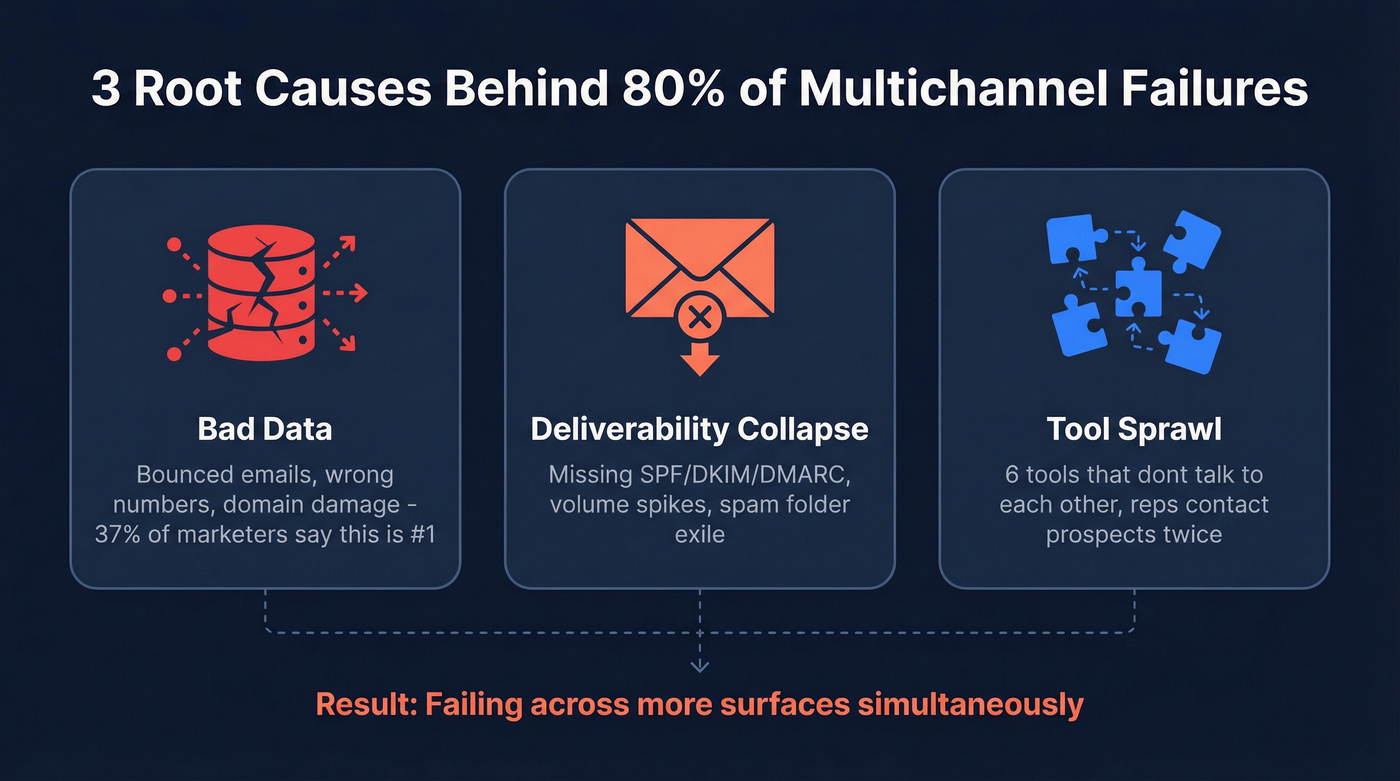
- Bad data. Bounced emails and wrong numbers cascade into domain damage and wasted rep time. Verify every list before any campaign launches. (If you want a deeper framework, start with data quality.)
- Deliverability collapse. Authentication gaps and volume spikes kill inbox placement. Set up SPF/DKIM/DMARC and warm up every new inbox slowly (use this email deliverability checklist).
- Tool sprawl. Six disconnected tools means nobody knows who's been contacted where. Consolidate to 2-3 integrated tools, not 6 that don't talk to each other (see a full B2B sales stack blueprint).
Everything else - personalization, attribution, messaging consistency - matters, but these three will sink you before you get to the nuance.

You just read it: 37% of marketers say data quality is their #1 multichannel challenge. Prospeo's 5-step verification delivers 98% email accuracy and 125M+ verified mobiles with a 30% pickup rate - so your emails don't bounce, your calls connect, and your domain reputation stays intact across every channel.
Stop poisoning your multichannel campaigns with bad data.
The 8 Challenges (and How to Fix Each)
1. Bad Data Poisons Every Channel
Nobody wants to talk about this one because it's unsexy. 37% of marketers cite data quality as their top multichannel challenge, and Gartner pegs the annual cost of poor data at $12.9M per organization. That number sounds abstract until you watch the chain reaction: bad emails bounce, bounces damage sender reputation, damaged reputation tanks deliverability, and suddenly your "multichannel" strategy is just LinkedIn and cold calls.

Bad data isn't a data problem. It's a revenue problem wearing a data costume. If you're seeing decay, start with B2B contact data decay benchmarks and fixes.
2. Email Deliverability Is Brutal Now
Deliverability rules shifted hard between 2024 and 2026:
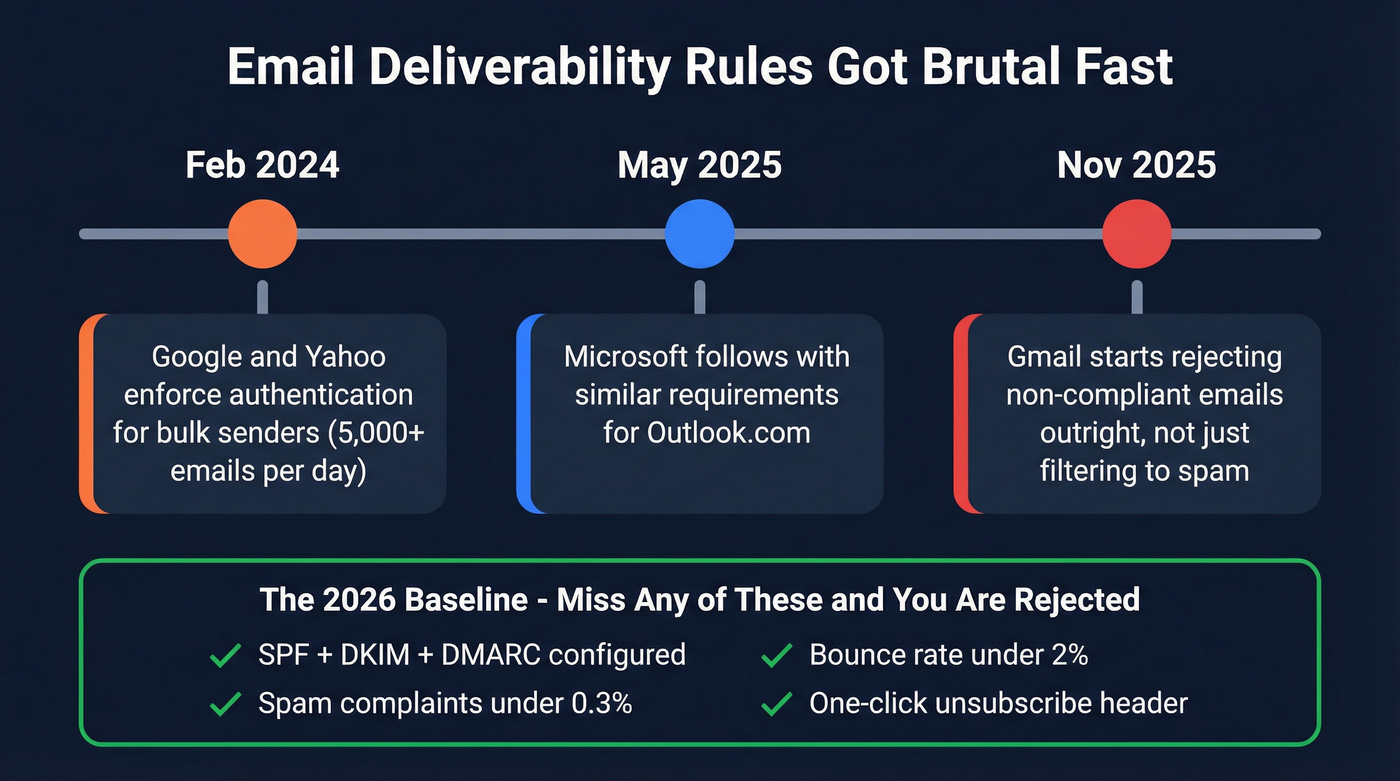
- Feb 2024: Google and Yahoo enforced authentication for bulk senders (5,000+ emails/day)
- May 2025: Microsoft followed with similar requirements for Outlook.com
- Nov 2025: Gmail started rejecting non-compliant emails instead of just filtering to spam
The baseline is now SPF, DKIM, and DMARC configured correctly, spam complaint rates under 0.3%, bounce rates under 2%, and one-click unsubscribe headers. Miss any of these and you'll end up rejected or shoved into spam. (If you need the technical setup, use this SPF, DKIM, DMARC guide.)
Warm up new inboxes at no more than 20 emails per day, monitor with Google Postmaster Tools and Microsoft SNDS, and treat deliverability as an ongoing discipline - not a one-time setup. We've seen teams nail the initial configuration and then blow it three months later with a sudden volume spike from a new campaign. For scaling safely, follow cold email volume best practices.
3. Personalization at Scale
The average cold email reply rate sits at 3.43%. LinkedIn messages pull 10.3% response rates. The difference? LinkedIn forces brevity and context. Email lets you be lazy - and most teams are. 86-90% of sales emails contain zero personalization elements. That's not a stat from 2019. That's now.
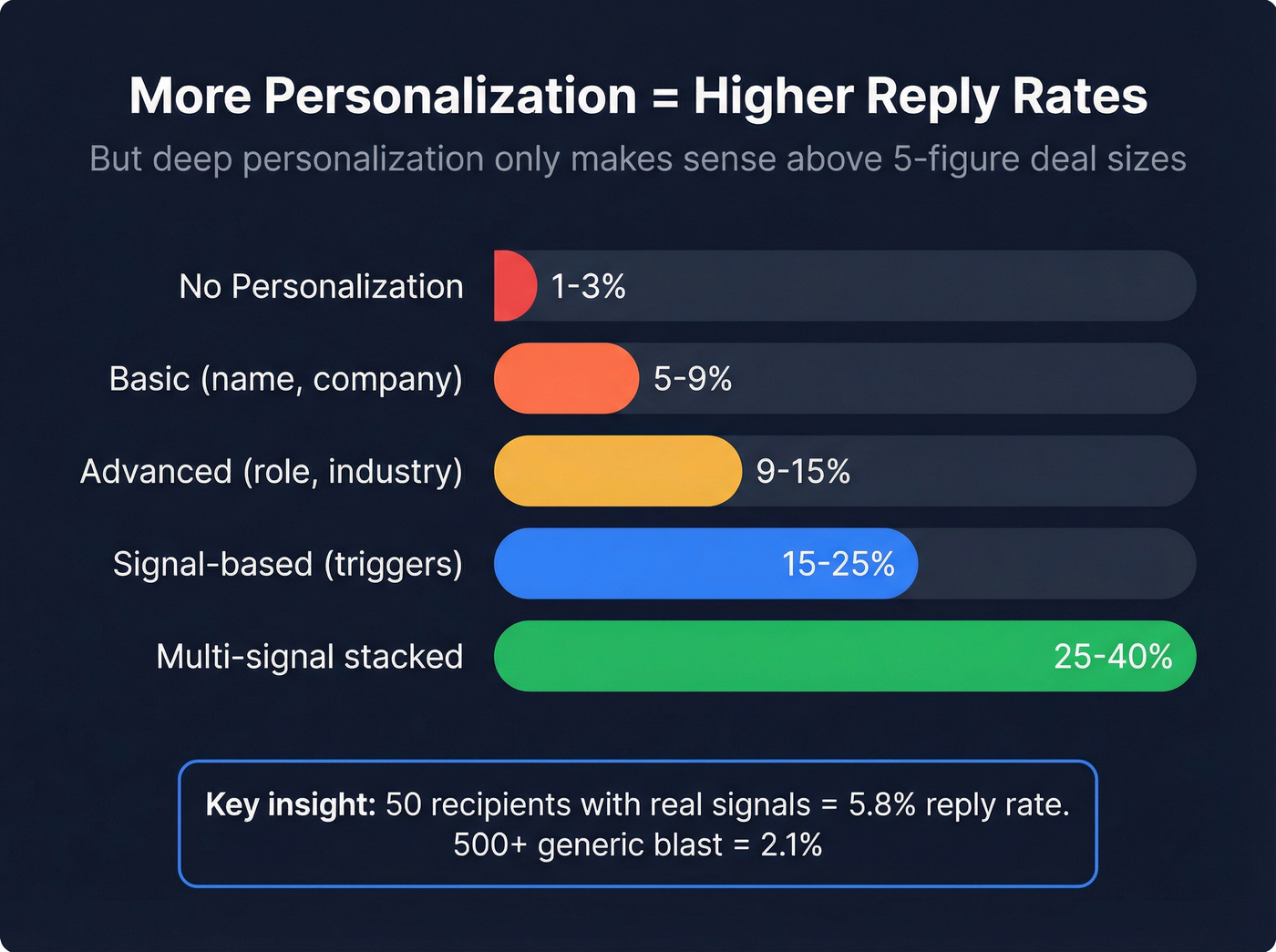
| Personalization Level | Expected Reply Rate |
|---|---|
| None | 1-3% |
| Basic (name, company) | 5-9% |
| Advanced (role, industry) | 9-15% |
| Signal-based (triggers) | 15-25% |
| Multi-signal stacked | 25-40% |
The catch: deep personalization doesn't scale the way most teams want. Belkins found that campaigns targeting 50 or fewer recipients averaged 5.8% response rates, while 500+ recipient blasts dropped to 2.1%. The fix isn't "personalize everything" - it's smaller batches with real signals. Funding rounds, job changes, tech stack shifts. Personalize the why you're reaching out, not just the first name. (More frameworks here: personalization in outbound sales.)
If your average deal size is under five figures, you probably don't need hyper-personalization. A well-segmented batch with one relevant signal per message will outperform a generic blast to 2,000 people every time - and it takes a fraction of the effort that full custom research does.
4. Attribution Is a Mess
Let's be honest: attribution in multichannel outbound is a problem you manage, not one you solve. A prospect sees your LinkedIn post, gets a cold email, takes a call, and books a demo through a retargeting ad. Which channel gets credit? The consensus on r/sales is that most teams just pick a model and live with the imperfection, because the alternative is analysis paralysis.
The practical workaround: track first-touch channel, last-touch channel, and require deal notes in your CRM. It's imperfect and everyone knows it. But waiting for a perfect attribution model before scaling multichannel is like waiting for perfect weather before leaving the house. If you want a clean setup, use CRM lead source tracking.
5. Platform Rules Keep Changing
What's safe right now:
- LinkedIn: 10-15 personalized connection requests per day with natural delays
- Email: authenticated domains, slow warm-up, engagement-based sending
- GDPR: legitimate interest as legal basis for B2B outreach, with transparency and opt-out honored
- CAN-SPAM: clear opt-out mechanism in every message
What gets you banned: automated LinkedIn scripts that send 300 generic invites in an hour. That risks account restrictions and can land you in a "low trust" bucket where fewer people see your messages. On email, sudden volume spikes and purchased lists are the fastest path to a blacklisted domain. If you get hit, follow this blacklist alert triage.
6. Prospect Fatigue and Overload
There's a meaningful difference between touchpoints and interruptions.
A 10-14 step sequence across email, phone, and social is the current benchmark - but only if each touch adds context or value. One tactic that works well: target people who've already engaged with your content before adding them to outbound sequences. They're warmer, and the outreach feels less random.
If your prospect is getting your email, your LinkedIn message, your call, and your retargeting ad all in the same 48-hour window, you're not doing multichannel - you're doing harassment with better tooling.
7. Tool Sprawl Kills Coordination
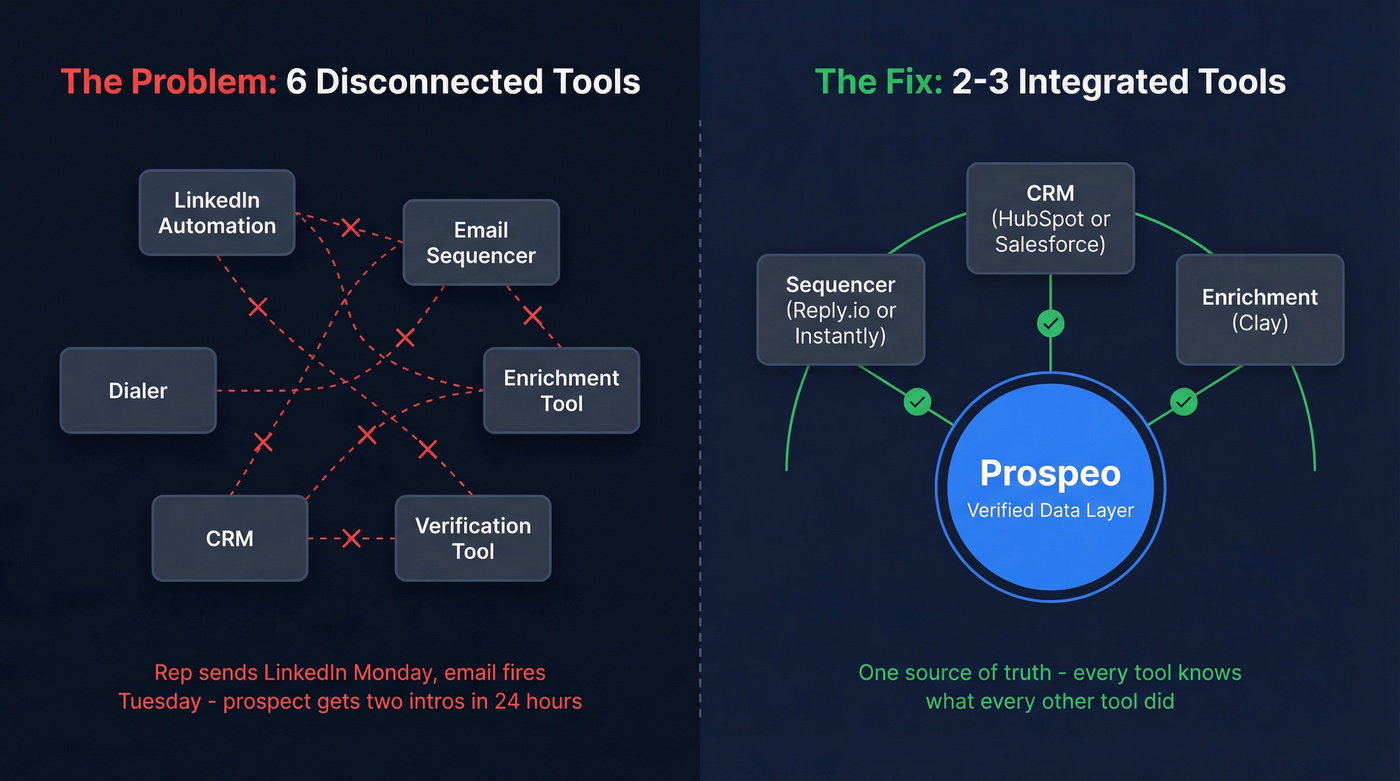
Here's a scenario we see constantly: a team runs LinkedIn automation through one tool, email sequences through another, a dialer through a third, and enrichment through a fourth. None of them share data. A rep sends a LinkedIn connection request on Monday, and the email sequencer fires a cold email Tuesday morning because it has no idea the LinkedIn touch already happened. The prospect gets two "Hey, wanted to introduce myself" messages in 24 hours from the same company, and you've already lost them.
| Tool | Best For | Channels | Starting Price |
|---|---|---|---|
| Prospeo | Data quality + verification | Data layer | Free; ~$0.01/email |
| Reply.io | Broadest multichannel | Email, LinkedIn, calls, SMS | ~$49/mo/user |
| Apollo | All-in-one prospecting | Email, LinkedIn, dialer, DB | Free; paid ~$49/mo |
| Instantly | Email scale | Email (unlimited inboxes) | ~$30/mo |
| Smartlead | Email infrastructure | Email (rotation + warmup) | $39/mo |
| Clay | Enrichment workflows | Data layer | ~$149/mo |
You need 2-3 tools that integrate, not 6 that don't. Prospeo connects natively with Salesforce, HubSpot, Smartlead, Instantly, Lemlist, Clay, Zapier, and Make - so clean, verified data flows directly into your sequencer without manual CSV gymnastics. If you're evaluating options, start with these sales prospecting platforms.
8. Inconsistent Messaging Across Channels
The most common mistake in multichannel automation is sending the same message across every channel without adapting to channel norms. A LinkedIn message should read differently than a cold email, which should read differently than a voicemail script.
Copy-paste across channels signals laziness, and prospects notice immediately. In our experience, the teams that perform best write channel-specific templates that share a core value prop but adjust tone, length, and CTA for each platform. Automate the logistics - scheduling, follow-up timing, list management - but never automate the thinking. If you need a starting point, use an outreach email template.
Skip this step if you're only running two channels. But the moment you add a third, inconsistent messaging becomes the silent killer of reply rates.
Fixing Multichannel Outreach Challenges Starts with Data
Most multichannel failures aren't strategy failures. They're data failures.
Your channel mix is probably fine. Your sequence structure is probably reasonable. But if 30% of your emails bounce and half your phone numbers are wrong, no amount of channel optimization will save you. The path to overcoming these multichannel outreach challenges starts with cleaning up the foundation before layering on more channels or more automation.
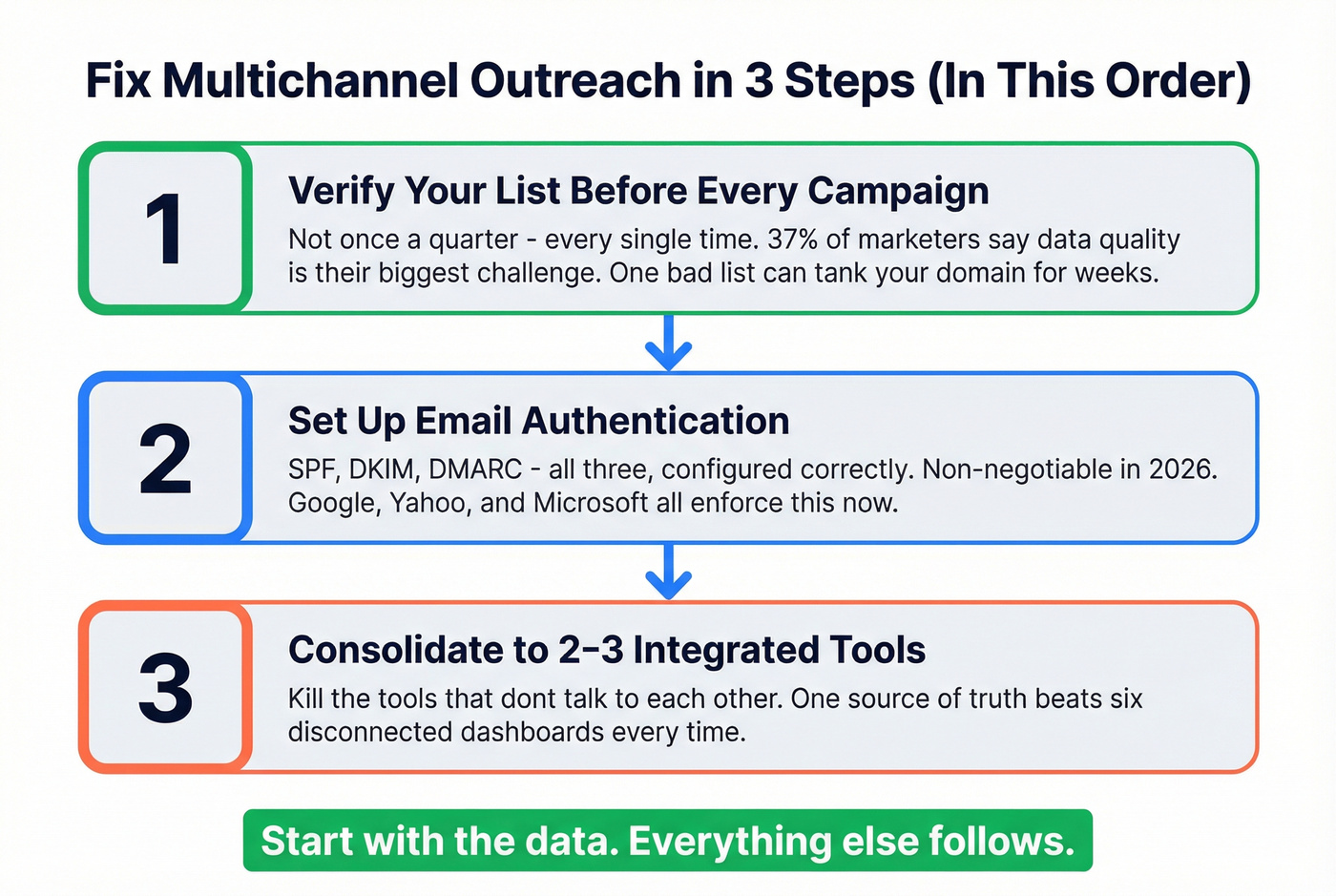
Three steps, in order:
- Verify your list before every campaign. Not once a quarter - every time. (Use an email ID validator if you're comparing tools.)
- Set up authentication. SPF, DKIM, DMARC. Non-negotiable in 2026.
- Consolidate your stack to 2-3 integrated tools. Kill the ones that don't talk to each other. Start with the data. Everything else follows.
Tool sprawl is killing your multichannel coordination. Prospeo consolidates prospecting, email verification, mobile numbers, and intent data into one platform - with native integrations for HubSpot, Salesforce, Instantly, Smartlead, and Lemlist. One source of truth, 30+ filters, data refreshed every 7 days.
Replace six disconnected tools with one accurate data platform.
FAQ
What's the biggest challenge in multichannel outreach?
Data quality. Bad contact data causes bounces, damages domain reputation, and tanks deliverability across every channel simultaneously. Gartner estimates poor data costs organizations $12.9M annually. Fix the data layer first - then optimize channels, messaging, and timing.
How many channels should a B2B outreach sequence use?
Three or more. Omnisend data shows campaigns using 3+ channels drive 287% higher purchase rates than single-channel efforts. A typical B2B sequence combines email, phone, and social across 10-14 steps spaced over 3-4 weeks.
How do you measure multichannel outreach ROI?
Track first-touch channel, last-touch channel, and require deal notes in your CRM for every opportunity. True multi-touch attribution is nearly impossible for outbound - manage it with a practical logging system rather than chasing a perfect model.
What's the best free tool for cleaning outbound data?
Prospeo offers a free tier with 75 verified emails and 100 Chrome extension credits per month - enough to test data quality on a small campaign. For teams running real sequences, 98% email accuracy and a 7-day refresh cycle prevent the bounce cascades that wreck multichannel campaigns.