

How to Build a Sales Campaign That Actually Works
Cold email reply rates dropped 15% year-over-year in the most recent large-scale study. The average B2B buying journey now stretches 192 days, 62 touchpoints and 6.3 stakeholders](https://saleshive.com/blog/benchmarks-digital-marketing-best-practices-2025/) deep. If you're still running a single-channel email blast and calling it a sales campaign, you're fighting with last decade's playbook.
The Short Version
- Start with clean data, not goals. Roughly 28% of B2B emails decay annually. Your campaign dies before it starts if your list is six months old.
- Go multi-channel. Single-channel campaigns convert 1-3%. Multi-channel outreach hits 4-7% and delivers 20% higher close rates with 25% shorter sales cycles.
- Run 17-21 days, 8-12 touches, front-loaded spacing. That's the sweet spot backed by cadence data and large-scale outreach benchmarks.
- Leave voicemails. They double reply rates on the associated email. Most reps skip them. Don't.
Now let's build the thing properly.
What Is a Sales Campaign?
A sales campaign is a time-bound, goal-driven outbound effort designed to convert pipeline into revenue. It has a defined audience, a specific objective, a cadence, and a kill date. It's not "doing outreach" - it's a structured push with measurable outcomes.
The distinction from a marketing campaign matters more than most teams realize. Marketing fills the top of the funnel. A structured outbound push works named accounts and contacts - the people you've decided to pursue. The average B2B deal now involves 13 stakeholders, and a coordinated sales effort reaches and converts those stakeholders in ways a marketing campaign never could, because marketing wouldn't even know their names. With 61.1% of marketing spend flowing to digital channels, the line between sales and marketing touchpoints blurs more every quarter, which makes a deliberate, sales-owned campaign structure even more essential.
| Dimension | Sales Campaign | Marketing Campaign | |---|---|---| | Ownership | Sales / SDR team | Marketing team | | Audience | Named accounts / contacts | Broad segments | | Primary goal | Revenue / meetings / pipeline | Awareness / leads / MQLs | | Timeframe | 2-12 weeks | Ongoing or quarterly | | Key metrics | Reply rate, meetings, velocity | Traffic, CPL, MQL volume | | Shared KPIs | Traffic-to-lead ratio, revenue, retention, cost per lead |
Why Most Campaigns Fail
Here's the thing: most outbound efforts don't fail because of bad messaging or weak offers. They fail because the data underneath them is rotten.
Your SDR team sent 5,000 emails. 1,400 bounced because the list was six months old. Your domain reputation tanks. Your next campaign - the one with the great copy - lands in spam. That's the cascade, and it starts with stale data. With 28% of B2B emails going invalid every year, a list you built in January is already about 14% degraded by July.
The other silent killer is timing. 57% of the buying journey is completed before a prospect ever talks to sales. If your campaign hits someone who already chose a vendor last month, no amount of personalization saves you. Situational targeting - job changes, funding rounds, intent signals - beats broad industry sprays every time.
How to Plan a Sales Campaign in 7 Steps
1. Set a Measurable Goal
"Generate more pipeline" isn't a goal. "Book 40 meetings with VP-level prospects at Series B SaaS companies in 21 days" is. Apply the SMART framework ruthlessly. McKinsey's research shows that systematic engagement processes drive 10-20% pipeline improvements - but only when teams know what they're measuring against.
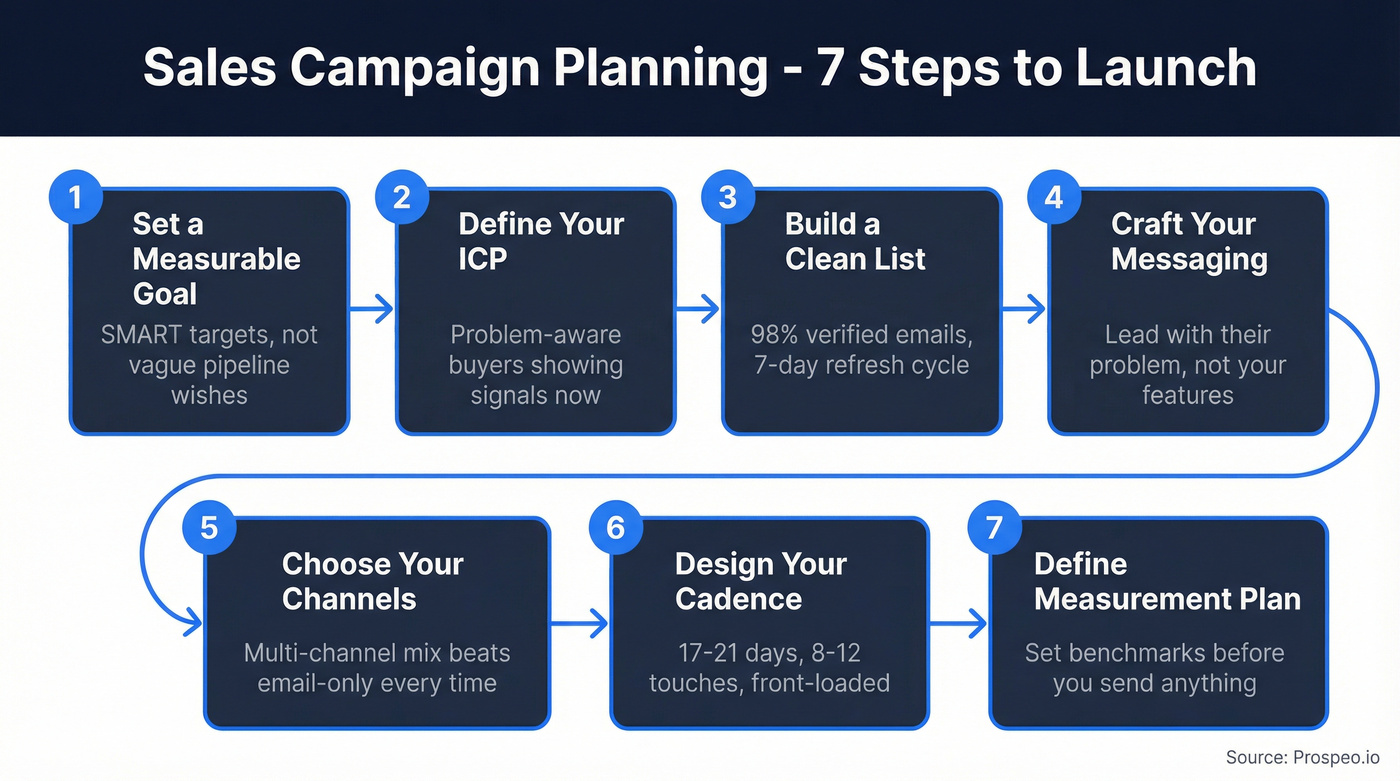
2. Define Your ICP and Target List
Stop targeting "companies with 50-500 employees in SaaS." That's a demographic, not an ICP. The best-performing campaigns we've seen target the problem-aware subset - prospects showing buying signals right now. Job changes, headcount growth, new funding rounds, and active research on relevant topics all outperform static firmographic targeting.
3. Build a Clean List
This is where campaigns live or die. With 28% annual email decay, every list older than 90 days is a liability. Relying on switchboard numbers instead of direct dials can reduce connect rates by up to 75%.
Prospeo covers 300M+ professional profiles with 98% email accuracy, verified through a proprietary 5-step process that handles catch-all domains, removes spam traps, and filters honeypots. The 7-day data refresh cycle means you're never working with stale records - the industry average is six weeks. For phone outreach, 125M+ verified mobile numbers deliver a 30% pickup rate, which is the difference between conversations and dead air.

4. Craft Your Messaging
Lead with the prospect's problem, not your features. Gong's data tells the real story: top-closing reps speak 43% of the time versus 65% for average performers. Your first email, your first call - they should be about the prospect's world, not yours. Only 5% of B2B buyers say salespeople exceed their expectations. The bar is underground. Clear it by listening more than you pitch.
5. Choose Your Channels
Don't default to email-only. Coordinated multi-channel campaigns convert at 4-7% versus 1-3% for email alone. Phone-only actually converts higher at 5-8%, but it doesn't scale. The right answer is always a mix - the specific blend depends on your audience, which we'll cover in the cadence section below. Layering channels so each touch reinforces the last is what separates a real campaign from a glorified email blast.
6. Design Your Cadence
The data points to a clear sweet spot: 17-21 days with 8-12 touchpoints. Front-load the spacing - 1-2 days between early touches, expanding to 3+ days later in the sequence. If you want templates you can copy, start with a sales cadence example.
7. Define Your Measurement Plan
Set benchmark targets before you send a single email. Know what "good" looks like for open rate, reply rate, meeting-booked rate, and pipeline velocity. If you can't measure it, you can't improve it - and you can't prove ROI to your VP of Sales when they ask why the team needs new tools next quarter.

28% of B2B emails decay every year, which means your sales campaign list is rotting while you write copy. Prospeo's 7-day data refresh cycle and 98% email accuracy keep your campaigns hitting real inboxes - not bouncing into oblivion.
Stop killing campaigns with dead data. Start with verified contacts.
Multi-Channel Cadence Blueprint
RAIN Group's research confirms what most experienced SDRs already know: it takes roughly 8 touches to get a meeting. The question isn't whether to do multi-touch. It's how to distribute those touches without spamming. (If you're building this into a sequencer, see our guide to AI in Sales Cadences.)
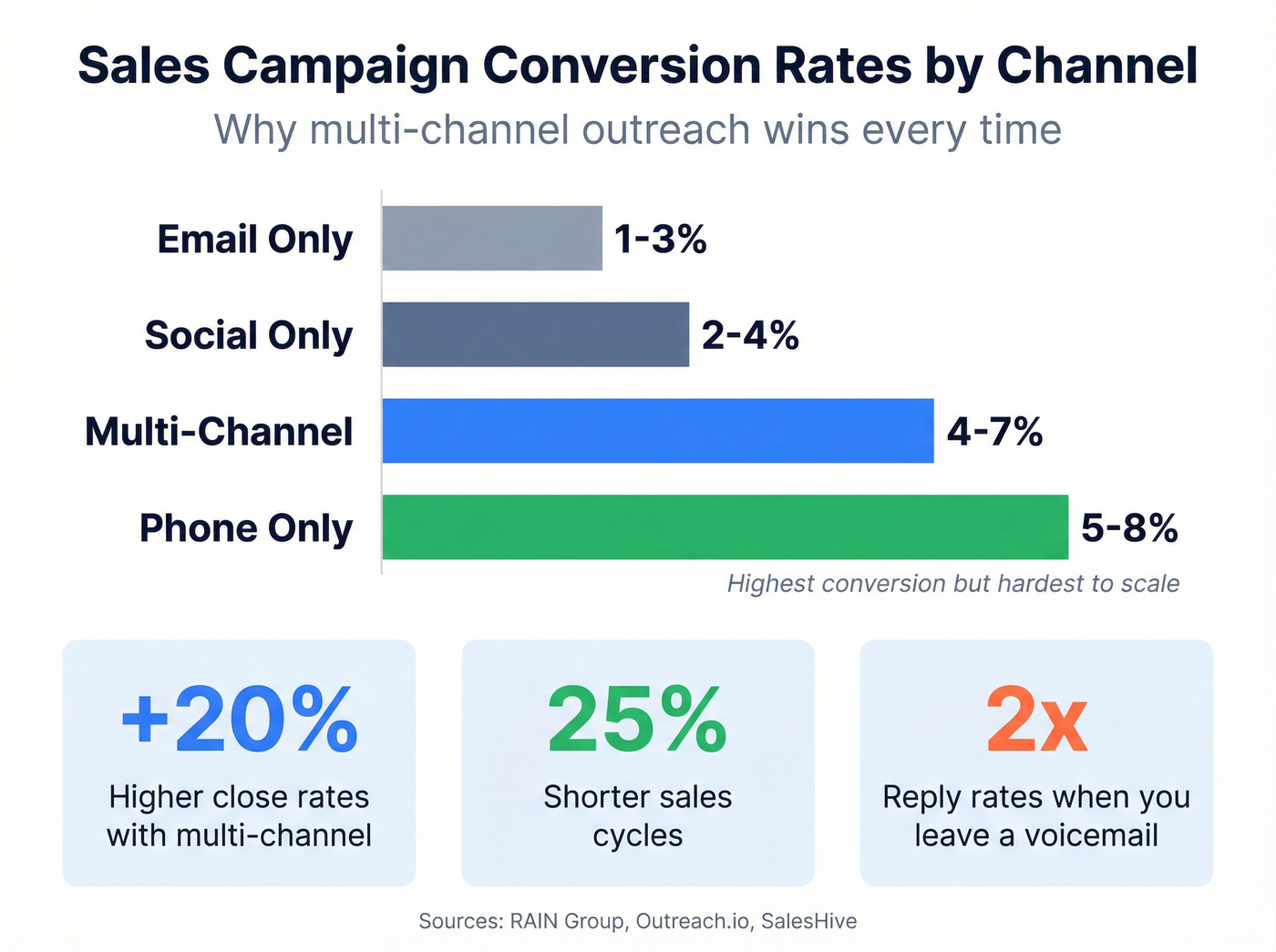
| Channel | Conversion Range | Best For |
|---|---|---|
| Email only | 1-3% | Scale, initial touch |
| Social only | 2-4% | Warm-up, relationship |
| Phone only | 5-8% | High-intent, decision-makers |
| Multi-channel | 4-7% | Full-funnel campaigns |
Multi-channel campaigns deliver 20% higher close rates and 25% shorter sales cycles than single-channel outreach. The distribution should roughly follow: email 40-50% of touches, phone 20-30%, social 15-25%, and video 5-10%. C-suite prospects respond better to phone and social. Mid-market managers are more email-responsive. Adjust accordingly.
Here's a concrete 3-week sequence adapted from PunchB2B's orchestration framework:
| Day | Channel | Action |
|---|---|---|
| 2 | Social | Connect request + personalized note |
| 4 | Social | Message with relevant case study |
| 8 | Reference social touch, share insight | |
| 10 | Phone | Call + voicemail referencing email |
| 15 | Social | Engage with their content |
| 17 | New angle, different value prop | |
| 19 | Phone | Final call + voicemail |
One stat that should change how you think about voicemail: leaving a voicemail doubles reply rates on the associated email, from 2.73% to 5.87%. Most reps skip voicemail because it feels pointless. The data says otherwise. If your team needs scripts, use these cold call voicemail scripts.
Days 1-7 are dense - you're establishing presence. Days 10-19 spread out, giving the prospect breathing room while maintaining momentum.
Campaign Types Worth Running
Not every outbound push is a cold blitz. The best sales orgs run multiple types simultaneously, and in our experience, the teams that diversify their campaign mix consistently outperform those running cold outbound alone.
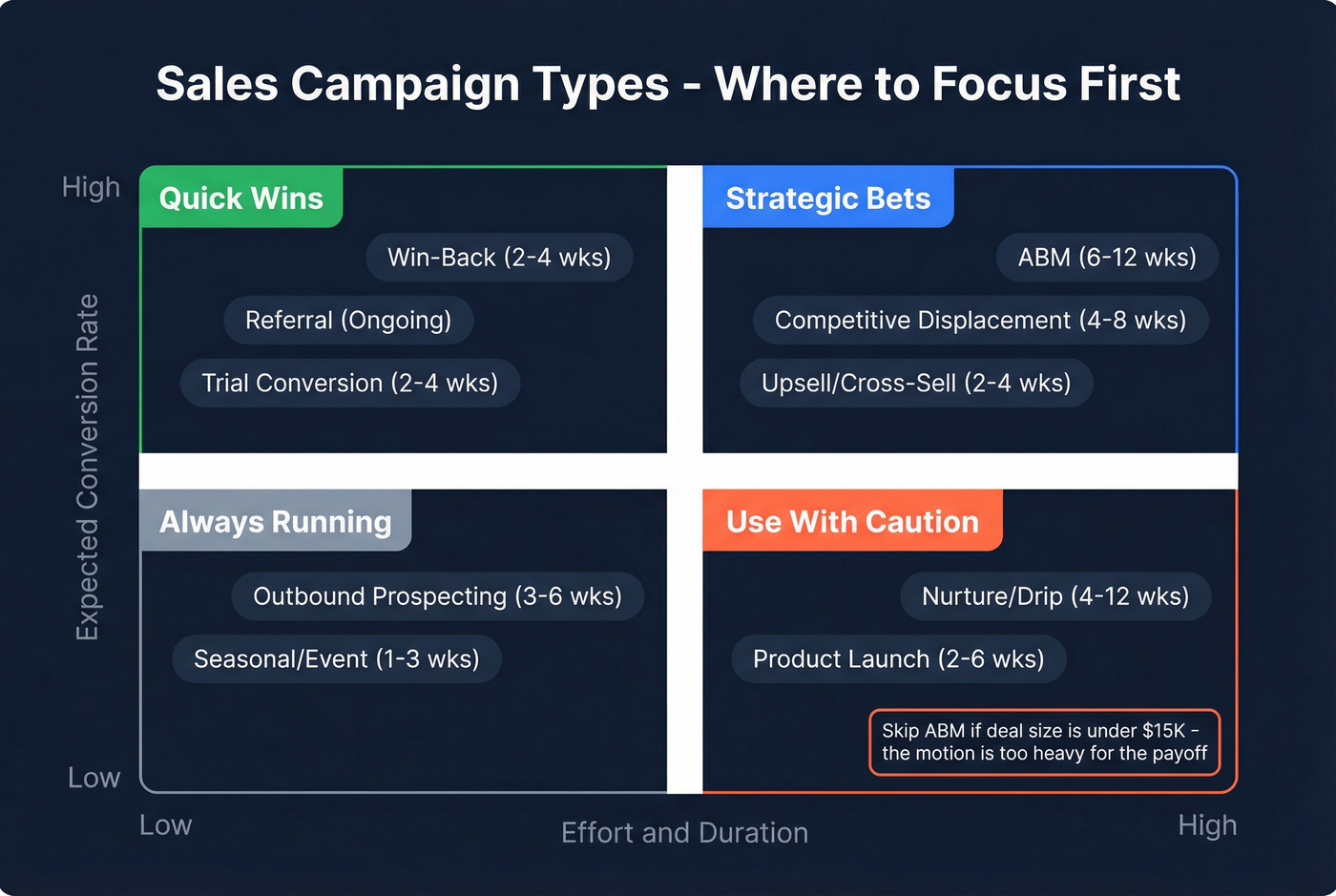
| Campaign Type | Goal | Duration | Best For |
|---|---|---|---|
| Outbound prospecting | New pipeline | 3-6 weeks | SDR teams, cold accounts |
| Nurture/drip | Warm stale leads | 4-12 weeks | Leads that went dark |
| ABM | Land target accounts | 6-12 weeks | Enterprise, high-value deals |
| Competitive displacement | Steal competitor users | 4-8 weeks | Known competitor customers |
| Win-back | Re-engage churned accounts | 2-4 weeks | Lost customers (6-12 months) |
| Seasonal/event | Capitalize on timing | 1-3 weeks | Trade shows, EOQ, budget cycles |
| Product launch | Drive adoption | 2-6 weeks | Existing + warm prospects |
| Upsell/cross-sell | Expand accounts | 2-4 weeks | CS + AE collaboration |
| Referral | Generate warm intros | Ongoing | Happy customers |
| Trial conversion | Free to paid | 2-4 weeks | PLG companies |
Skip ABM if your average deal size is under $15K - the motion is too heavy for the payoff. But you should absolutely have a win-back sequence running at all times. Win-back and competitive displacement campaigns often convert at 2-3x the rate of cold outbound because the prospect already understands the problem space. For a deeper ABM build, use an ABM account plan template.
Let's look at a real example. Unity saw a 29.9% win rate increase and 209% larger deal sizes after implementing systematic multi-stakeholder engagement through Clari. That's not a messaging tweak - it's a structural change to how they ran campaigns across buying committees.
Benchmarks - What Good Looks Like
You can't optimize what you don't measure against. Here are the most recent large-scale B2B benchmarks that should be taped to every SDR manager's monitor:
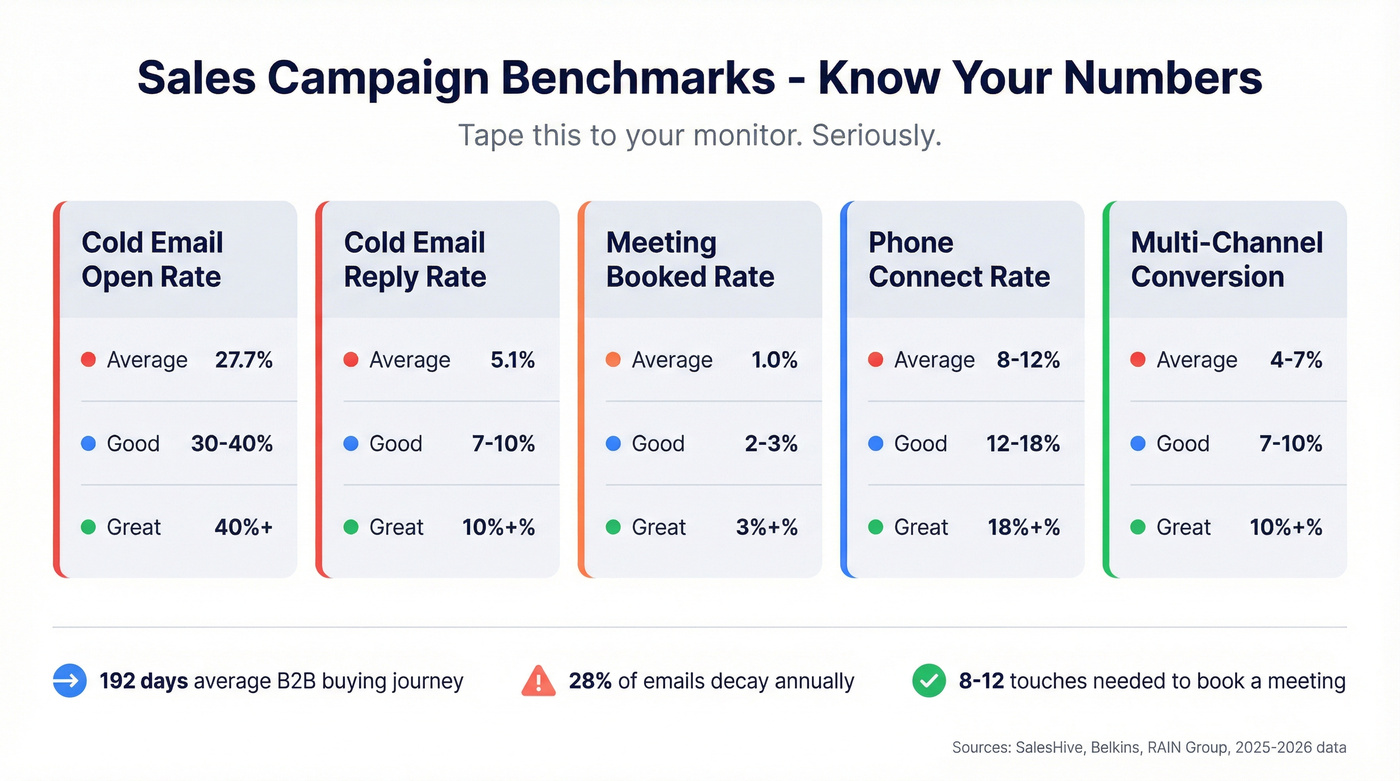
| Metric | Average | Good | Great |
|---|---|---|---|
| Cold email open rate | ~27.7% | 30-40% | 40%+ |
| Cold email reply rate | ~5.1% | 7-10% | 10%+ |
| Meeting-booked rate | ~1.0% | 2-3% | 3%+ |
| Phone connect rate | ~8-12% | 12-18% | 18%+ |
| Multi-channel conversion | 4-7% | 7-10% | 10%+ |
| Landing page conversion | ~1.8% | 3-5% | 5%+ |
Multi-channel campaigns consistently deliver 30%+ higher meeting conversion rates than single-channel approaches. That's not marginal - it's the difference between a campaign that justifies its cost and one that gets killed after two weeks.
To tie it all together, track pipeline velocity:
Pipeline Velocity = (Qualified Opportunities x Avg Deal Size x Win Rate) / Avg Sales Cycle Length
A quick example: 50 qualified opportunities x $25,000 average deal x 20% win rate / 90-day cycle = $2,778 in pipeline velocity per day. Run that calculation before and after each campaign. It's the single best metric for proving campaign ROI to leadership.
Five Mistakes That Kill Campaigns
1. Running on stale data. We've said it three times because it's that important. 28% annual decay means your "verified" list from Q1 is already degrading. Real-time email verification that catches catch-all addresses, spam traps, and honeypots isn't a nice-to-have - it's table stakes.
2. Single-channel reliance. Cold email reply rates dropped 15% year-over-year. If email is your only channel, you're fighting a losing trend. Add phone and social touches to every sequence.
3. Talking too much. Top closers speak 43% of the time. Average reps hit 65%. Your first email should be three sentences about their problem, not three paragraphs about your product. If you need a structure, follow a proven sales email structure.
4. Skipping voicemail. Doubles reply rates on the associated email. Takes 30 seconds. No excuse.
5. No measurement plan. If you didn't set benchmark targets before launch, you can't prove the campaign worked. And if you can't prove it worked, good luck getting budget for the next one.
Your Campaign Tech Stack
The best tool is the one your reps actually use. Consolidate when a platform covers 80%+ of your use cases. Sprawl when you need best-in-class at a specific layer. Check G2 and TrustRadius reviews before committing - vendor demos always look great, but peer reviews tell you what breaks at scale.
| Category | Tools | Price Range | What to Look For |
|---|---|---|---|
| CRM | Salesforce, HubSpot | $0-$150/user/mo | Pipeline tracking, reporting |
| Sales Engagement | Outreach, Salesloft, Instantly, Smartlead | $30-$200/user/mo | Multi-channel sequences, A/B testing |
| Intent Data | Bombora | $25K-$50K/yr standalone | Topic-level buying signals |
For comparison, a mid-market ZoomInfo contract runs $15-40K/year, and Apollo's paid plans start around $49-99/mo per user. Prospeo sits at roughly $0.01 per email with 98% accuracy and integrates natively with Salesforce, HubSpot, Instantly, Smartlead, Lemlist, and Clay - so it slots into whatever sequencer you're already running. If you're evaluating options, start with our roundup of sales prospecting platforms.
For SMB teams on a tight budget, you can run an effective stack for under $200/month total: HubSpot free CRM, Instantly or Smartlead for sequencing, and a free-tier data provider for contacts. Scale up from there as pipeline justifies the spend.
The playbook is simple: clean data, multi-channel cadence, and relentless measurement. Every successful sales campaign comes down to those three pillars. Everything else is optimization.
Multi-channel campaigns need direct dials, not switchboard numbers. Prospeo gives you 125M+ verified mobile numbers with a 30% pickup rate - plus 30+ filters for intent, job changes, and funding to target prospects who are actually buying right now.
Build the list your next sales campaign deserves for $0.01 per email.
FAQ
How long should a sales campaign run?
Most B2B outbound campaigns run 3-6 weeks, with a data-backed sweet spot of 17-21 days and 8-12 touchpoints for cold prospecting. ABM and nurture sequences targeting enterprise accounts perform better at 8-12 weeks due to longer buying cycles.
How many touchpoints does it take to book a meeting?
RAIN Group research shows roughly 8 touches on average. Multi-channel campaigns reach that number faster and convert 30%+ better than single-channel approaches. Front-load touches in the first week, then space them out.
What's a good cold email reply rate?
Current B2B benchmarks show roughly 5.1% average. Anything above 7% is strong; 10%+ is elite. Below 3%, check your data quality first - stale lists tank deliverability before messaging even matters.
What's the minimum tech stack needed?
Three tools: a CRM (HubSpot free tier works), a sequencer (Instantly or Smartlead from ~$30/mo), and a data provider with verified emails. Total cost under $200/month at the SMB tier.
How do I measure campaign ROI?
Use pipeline velocity: (Qualified Opportunities x Avg Deal Size x Win Rate) / Avg Sales Cycle Length. Calculate before and after each campaign. A team with 50 opportunities, $25K deals, and 20% win rate over 90 days generates $2,778/day in pipeline value.