

The ABM Account Plan Template Your Sales Team Will Actually Use
Twenty-eight percent of marketing budgets now go to ABM, and the average B2B deal involves roughly seven decision-makers. Yet most teams don't have a usable account plan for their highest-value targets - they've got a slide deck that gets opened once and forgotten. Here's the operational template that actually survives contact with reality.
Account Plan vs. Strategy Template
These get confused constantly. Your ABM strategy template governs the entire program - ICP definition, tier structure, budget allocation, team roles. Your account plan is the working document for a single target account. One is the playbook; the other is the game plan for Tuesday's opponent.
| Dimension | Strategy Template | Account Plan |
|---|---|---|
| Scope | Entire ABM program | One target account |
| Audience | Marketing + sales leadership | Account team (AE, SDR, CSM) |
| Update cadence | Annually or biannually | Quarterly minimum |
Most teams build the strategy template first and never get to individual account plans. That's backwards - the account plan is where revenue actually happens.
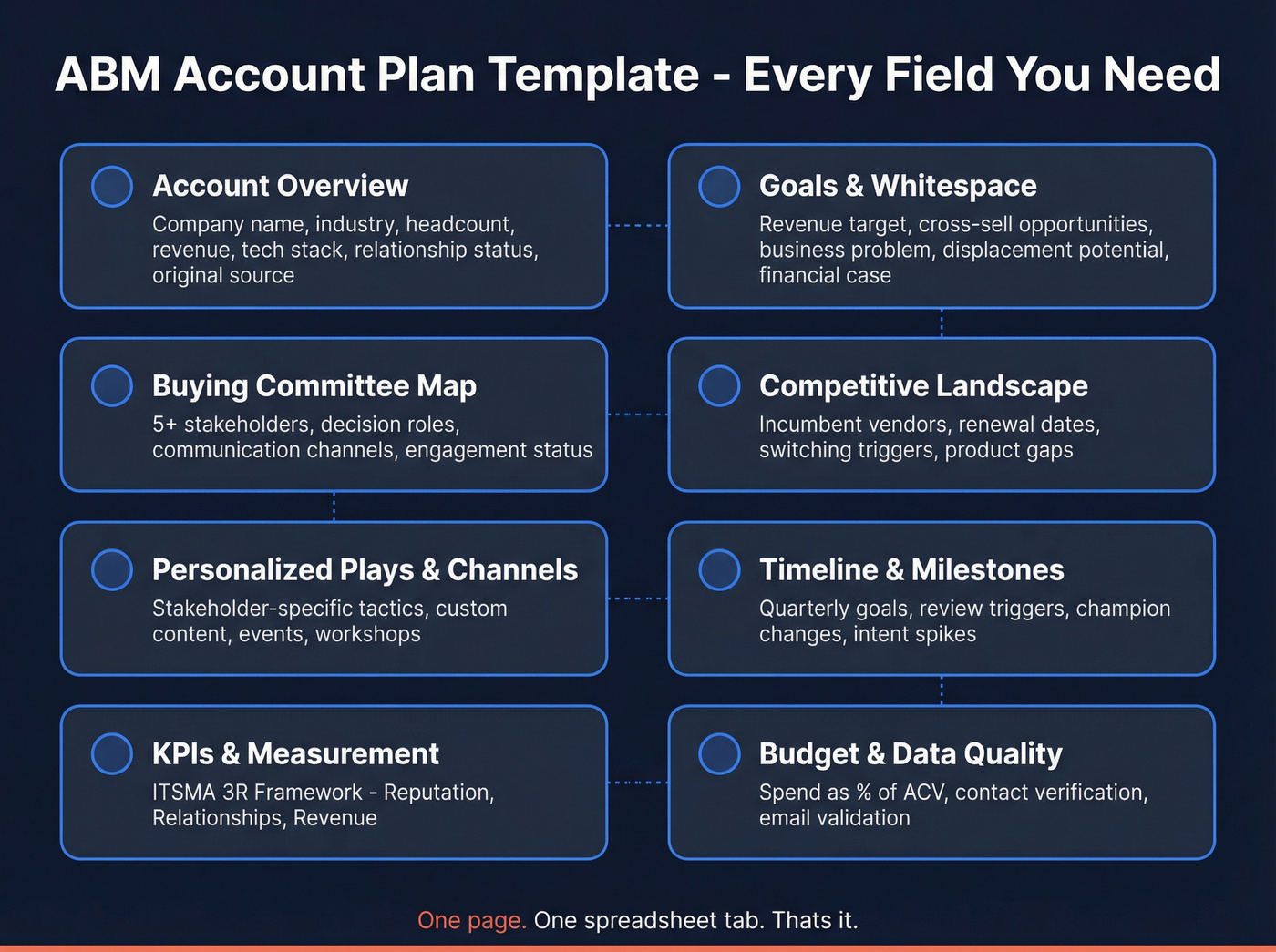
Every Field You Need
Account Overview
Company name, industry, employee count, annual revenue, tech stack - especially tools you'd replace or integrate with. Note the current relationship status: new target, existing customer, or churned. Include the original source that flagged them, whether that's an intent signal, inbound request, or sales nomination.
Goals & Whitespace
Define your expansion revenue target, cross-sell or upsell opportunities, and the specific business problem your solution addresses for this account. Map the whitespace: where are they spending on competitors or manual processes you could displace? This is where you build the financial case that justifies the time your AE will spend on a single account for the next two to four quarters.
Buying Committee Map
This is where most plans fail. Map at least five stakeholders, not just the one contact your AE knows. For each person, capture name, title, and decision role - champion, economic buyer, technical evaluator, blocker, or end user. Add preferred communication channel and current engagement status.
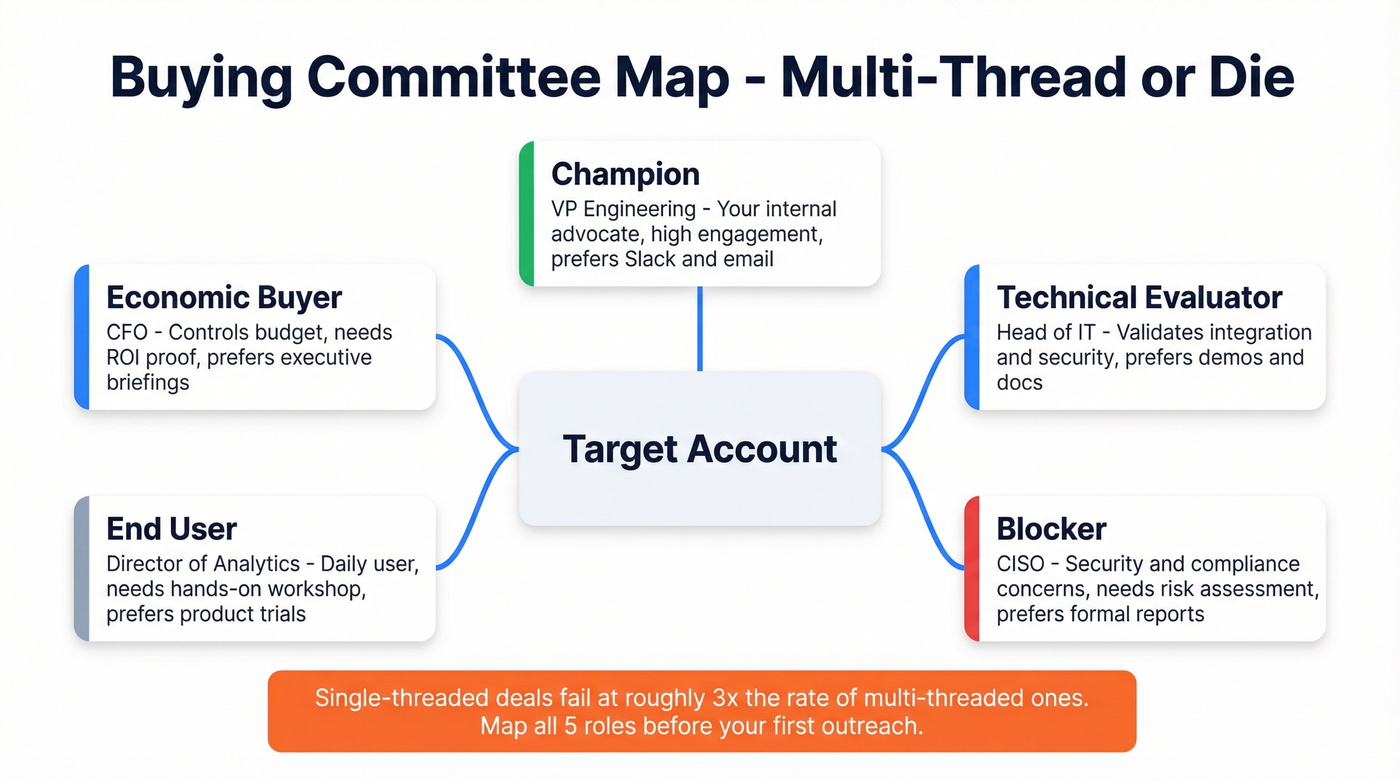
The ZoomInfo ABM playbook recommends multi-threading across the full committee from day one. We've seen deals stall for months because the champion left and nobody had a relationship with the economic buyer. Multi-threading isn't optional. It's insurance.
Competitive Landscape
List incumbent vendors, contract renewal dates if known, and switching triggers. A competitor's price increase, a product gap, or a leadership change can all create openings. If you don't know the renewal date, that's your first research task - not something to leave blank and hope for the best.
Personalized Plays & Channels
Map specific tactics to specific stakeholders. The CFO gets a custom ROI analysis. The VP of Engineering gets invited to a technical roundtable. End users get a hands-on workshop.
"Send nurture emails" isn't a play - it's a cop-out.
Timeline & Milestones
Set quarterly milestones with specific review triggers. Q1: "secure meetings with 3 of 5 committee members." Q2: "deliver custom business case to economic buyer." Update immediately when a champion leaves, a competitor enters, or intent signals spike.
KPIs & Measurement
Use the ITSMA 3R framework: Reputation (are we known in this account?), Relationships (how deep and wide?), and Revenue (pipeline created, deal velocity, closed-won). Track all three. Revenue alone misses the leading indicators that tell you whether a deal is actually progressing or just sitting in your CRM looking pretty.
Budget & Data Quality
Budget your 1:1 ABM spend as a percentage of expected ACV. N.Rich's heuristic: 1% for $50K-$150K ACV accounts, 3% for $150K-$300K, 5% for $300K+. A $200K deal justifies $6,000 in account-specific spend.
Then verify your data. Every email and phone number in your buying committee map needs to be real before you launch a single play. Prospeo's 5-step verification catches invalid emails in bulk with 98% accuracy on a 7-day refresh cycle, so your first touchpoint isn't a bounce notification.

Filled-Out Example
Here's what a completed plan looks like for a fictional company, Acme Analytics, targeting GlobalCorp:
| Field | Example Data |
|---|---|
| Account | GlobalCorp (financial services, 2,400 employees, $380M revenue) |
| Relationship | New target, identified via intent surge |
| Goal | Land $220K ACV platform deal, displace legacy BI tool |
| Whitespace | Manual reporting costs ~$500K/yr; no real-time dashboards |
| Committee | VP Engineering (champion), CFO (economic buyer), Head of IT (technical eval), Director of Analytics (end user), CISO (blocker - security concerns) |
| Competitors | Incumbent: Tableau (contract renews Q3). Trigger: price increase + missing real-time capability |
| Plays | Executive dinner for CFO + VP Eng; custom ROI report; intent-triggered display ads; technical workshop for Analytics team |
| Timeline | Q1: secure 3 meetings. Q2: deliver business case. Q3: align with Tableau renewal. Q4: close. |
| KPIs | Reputation (brand awareness survey), Relationships (4/5 committee engaged), Revenue ($220K pipeline by Q2) |
| Budget | 3% of $220K ACV = $6,600 |

Your buying committee map is the most critical section of any ABM account plan - and the most fragile. One bounced email to a CFO kills your credibility. Prospeo's 5-step verification delivers 98% email accuracy on 300M+ profiles, refreshed every 7 days, so every stakeholder in your plan has a verified contact before you launch a single play.
Map the full committee. Verify every contact. Launch with confidence.
How to Adapt by Tier
Use the full template for 1:1 ABM on your top 10-25 accounts. Every field matters. Every stakeholder gets mapped.
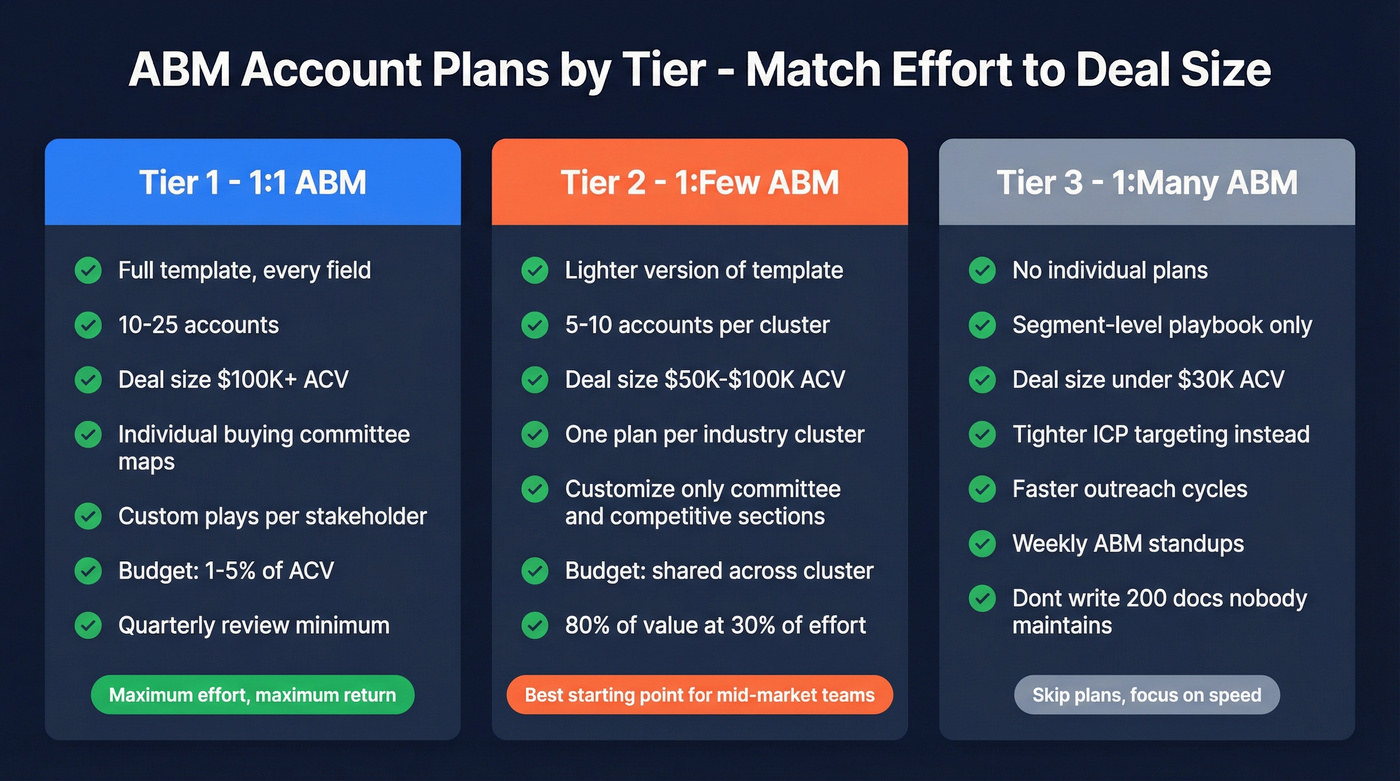
Use a lighter version for 1:few ABM on account clusters. Group 5-10 similar accounts by industry, build one plan per cluster, and customize only the buying committee and competitive sections per account. This is where most mid-market teams should start - it's 80% of the value at 30% of the effort.
Skip individual plans entirely for 1:many. At scale, you need a segment-level playbook, not 200 documents nobody will maintain. Weekly ABM standups keep even lighter-touch tiers on track; in our experience, teams that hold these standups close deals measurably faster than those who set-and-forget.
Here's the thing: if your average deal size is under $30K, you probably don't need individual account plans at all. Put that energy into tighter ICP targeting and faster outreach cycles instead.
5 Mistakes That Kill Account Plans
Most account plans fail for the same reasons. They're too complicated to maintain, they're built around a single contact, and they're executed with bad data. Here are the five we see most often.
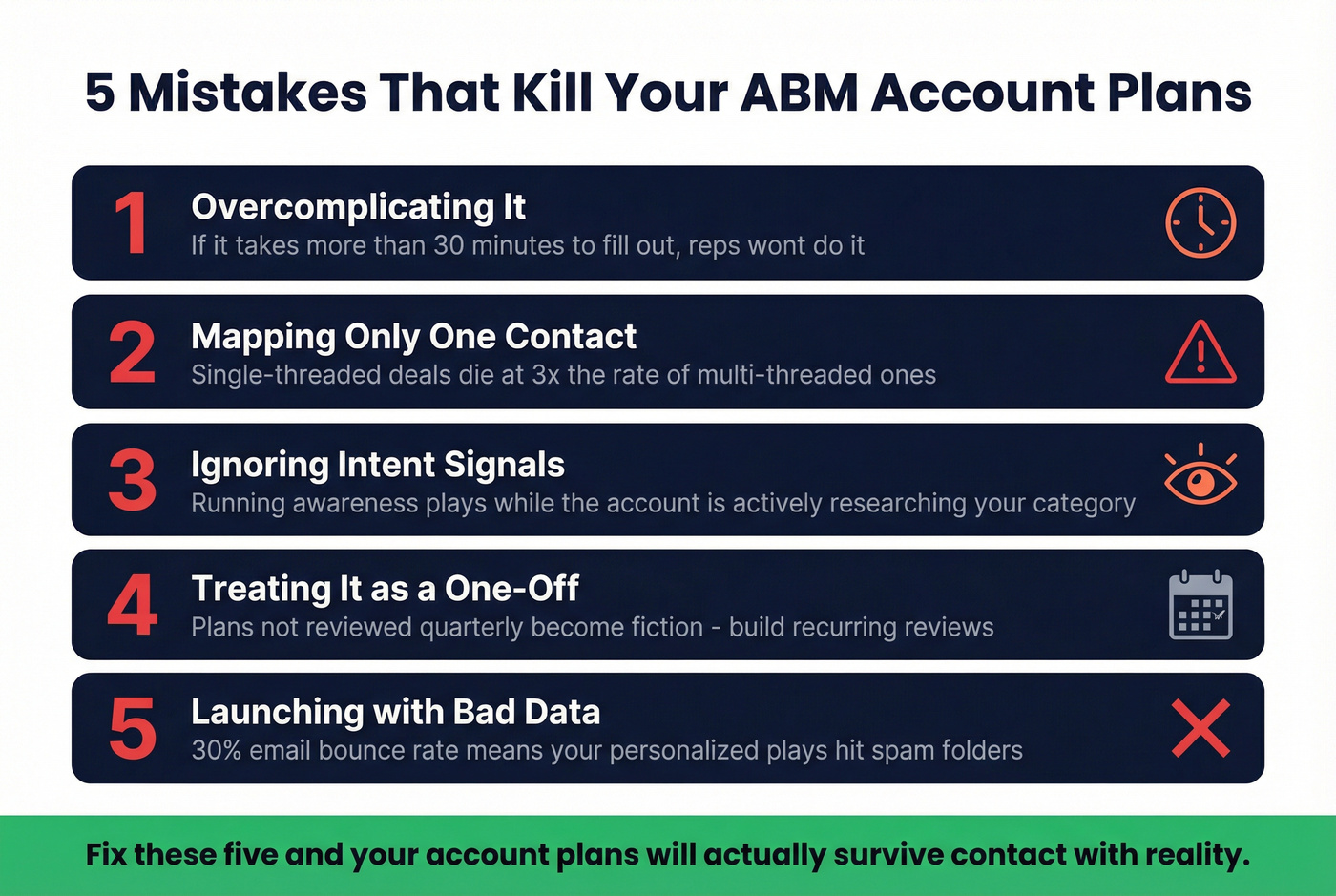
Overcomplicating it. If it takes more than 30 minutes to fill out, your reps won't do it. One page. One spreadsheet tab. That's it.
Mapping only one contact. One champion leaving shouldn't kill a six-month engagement. Map the full committee - the consensus on r/sales is that single-threaded deals die at roughly 3x the rate of multi-threaded ones, and that tracks with what we've seen.
Ignoring intent signals. If the account is actively researching your category and you're still running "awareness" plays, you're leaving pipeline on the table. Layer buying signals directly into your committee research so you know who's in-market before you pick up the phone.
Treating it as a one-off. Plans that aren't reviewed quarterly become fiction. Build a recurring review into your ABM standup.
Launching with bad contact data. If 30% of your emails bounce, your personalized plays hit spam folders instead of inboxes. Verify contacts before you execute - tools like Prospeo catch invalid emails in bulk with 5-step verification that includes catch-all handling and spam-trap removal, so your first send actually lands.
Multi-threading across 5+ stakeholders per account means you need 5+ verified emails and direct dials - not guesses. Prospeo gives you 143M+ verified emails and 125M+ mobile numbers with 30+ filters to find the exact decision-makers in your target accounts, at $0.01 per email.
Stop leaving buying committee fields blank. Fill them with verified data.
Best Format for Your Plan
Let's be honest - the format matters less than you think. Google Sheets is the right default. It's fast, collaborative, and every sales team already knows it. Smartsheet offers free ABM template downloads if you want a head start. PowerPoint works for presenting to leadership, but nobody updates a slide deck weekly. Pick the tool your team will actually open on Monday morning.
FAQ
What's the difference between an ABM account plan and a strategy template?
The strategy template governs your entire ABM program - ICP, tiers, budget, team roles. The account plan is the operational document for one target account. Build the strategy first, then create individual plans for each Tier 1 account.
How many accounts need individual plans?
Only your Tier 1 accounts - typically 10-25 high-value targets where deal sizes exceed $100K ACV. Tier 2 gets cluster-level plans grouped by industry or use case. Tier 3 runs from a segment-level playbook, not individual documents. If you're writing 50+ individual plans, you're spending more time planning than selling.
How often should I update an account plan?
Review quarterly at minimum. Update immediately when a champion leaves, a competitor enters, or intent signals spike. Teams that hold weekly ABM standups catch these changes 2-3 weeks faster than those relying on scheduled reviews alone.
What tools do I need to run account plans?
A spreadsheet, a CRM like HubSpot or Salesforce, and a contact verification tool to make sure your buying committee data is accurate. You don't need a $50K ABM platform to run effective 1:1 plans - a verified contact list and a disciplined review cadence will get you further than most enterprise software.