

SimilarTech Prospecting Review: Does It Still Work in 2026?
You installed the SimilarTech Prospecting extension, clicked the icon on a prospect's website, and got a blank screen. Refreshed. Tried again. Nothing.
You're not missing anything. The tool is struggling, and you're not the only one noticing. Here's what's actually going on with SimilarTech in 2026 - and what to use instead.
What Is SimilarTech Prospecting?
SimilarTech started as a useful idea: look up any company's tech stack, compare competitor technologies side by side, search for companies using specific tools, and build contact lists based on technology signals. It also offered alerts when a target company changed technologies - a powerful trigger for displacement-play outreach.
Now branded "A Similarweb Company," SimilarTech covers 100M+ websites, 20M+ companies, and a decade of historical data. For many users, the Chrome extension became the main interface: visit any site, click the icon, see what they're running under the hood.
The concept is sound. The execution in 2026 tells a different story.
30-Second Verdict
Use SimilarTech if you already have a paid account, you're getting value from tech-change alerts, and you don't need verified contact data.
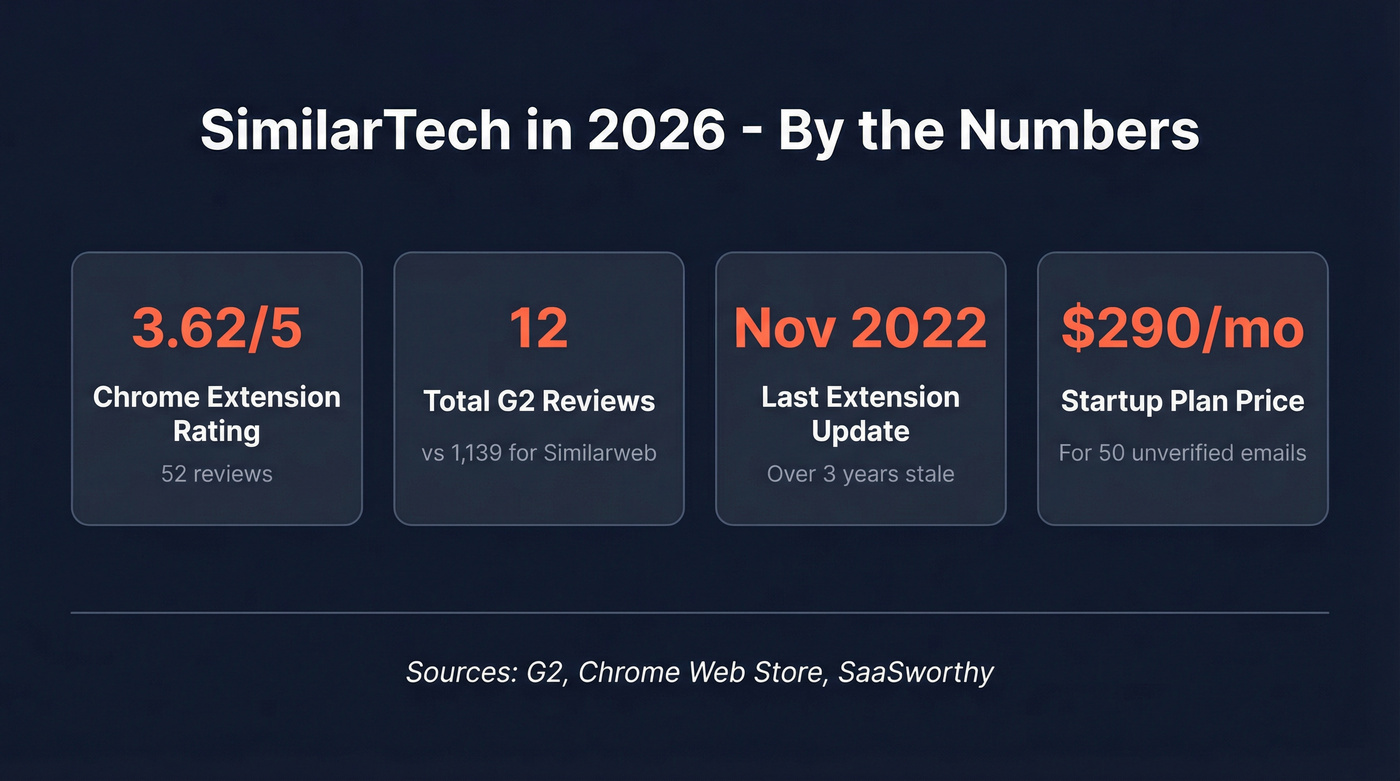
Skip SimilarTech if you need a reliable Chrome extension (last updated November 2022), accurate data (users tag "Inaccurate Data" as a con on G2), or verified emails and phone numbers for the people behind those tech stacks. SimilarTech's G2 rating sits at 4.2/5 from just 12 reviews - not exactly a ringing endorsement of active adoption.
Here's our take: most teams looking for technographic prospecting tools don't actually need a standalone tech-stack product. They need tech-stack data as one filter inside a broader prospecting workflow. Paying $200+/month for a single-purpose tool that can't give you contact data is a workflow tax you shouldn't accept in 2026.
Does It Still Work in 2026?
The Extension Problem
The SimilarTech Chrome extension has roughly 70,000 users and a 3.62/5 rating from 52 reviews. That rating tells a story, but the timestamp tells a bigger one: version 2.1.0, last updated November 8, 2022. The Firefox version? Last updated June 2020.
In our testing, the extension failed to load data on multiple sites - consistent with recent reviews describing blank screens, failures to load, and redirects requiring login. When the core interface for a prospecting tool hasn't been touched in over three years, that's not stability. It's maintenance mode.
Data Accuracy Concerns
Users tag "Inaccurate Data" as a SimilarTech con on G2. That's a problem for a tool whose entire value proposition is data. Reviewers also say Similarweb meets their needs better than SimilarTech and prefer Similarweb's feature roadmap direction.
The review volume gap is telling. Similarweb has 1,139 reviews at 4.5/5. SimilarTech has 12 at 4.2/5. Twelve. That's not a niche product with a loyal following - it's a product most people have moved past.
The Similarweb Factor
SimilarTech's own homepage now cross-sells Similarweb Sales Intelligence features: territory planning, lead scoring, prospecting, ABM, buyer intent.
Similarweb pushed a major data update in July 2024, adding 30M+ new websites, algorithm updates aligned with the GA4 transition, and improved bot filtering. That investment clearly went into the Similarweb platform. How much flows back into standalone SimilarTech? Based on the stale extension and thin review volume, not much. The standalone product's best features are being absorbed into Similarweb Sales Intelligence, and what remains is running on inertia.
SimilarTech Pricing
SimilarTech doesn't publish pricing on its website. The best anchors come from G2's entry-level listing at $200/month and a 2021 SaaSworthy snapshot of their tiered plans.
| Plan | Price | Users | Reports | Emails/mo | Tech Alerts |
|---|---|---|---|---|---|
| BASIC (G2 entry-level) | $200/mo | - | - | - | - |
| Startup | $290/mo | 1 | 10 | 50 | 2 |
| Professional | $12K/yr | 2 | Unlimited | 100 | 10 |
| Premium | $36K/yr | 5 | Unlimited | 200 | 20 |
| Enterprise | Custom | Custom | Custom | Custom | Custom |
At $290/month for a single user with 50 emails and 2 alerts, you're paying a premium for technographic data you can get elsewhere - often with more coverage and a free tier to start. The Startup plan also caps you at 1,000 websites per report and 3 exports, which limits any serious prospecting workflow.

SimilarTech charges $290/month for 50 unverified company emails and zero direct dials. Prospeo gives you technographic filters plus 143M+ verified emails at 98% accuracy and 125M+ verified mobiles - starting at $0.01 per email. No annual contracts.
Go from tech-stack signal to booked meeting without switching tools.
What SimilarTech Gets Right
Credit where it's due.
Tech-stack intelligence as a prospecting signal remains genuinely valuable. Knowing a prospect runs Shopify Plus or just switched from HubSpot to Marketo is actionable intel that generic firmographic data can't match. One TrustRadius reviewer called it a tool that "saves days of research" for competitive analysis and vendor selection, and the Similarweb data ecosystem behind it is massive - 100M+ websites, 20M+ companies, 4M+ apps. The raw data assets are strong.
The problem isn't the concept. It's the execution and the product's trajectory.
Where SimilarTech Falls Short
Extension reliability is a dealbreaker. A Chrome extension last updated in 2022 that frequently fails to load data isn't a minor inconvenience - it's the primary user interface breaking.
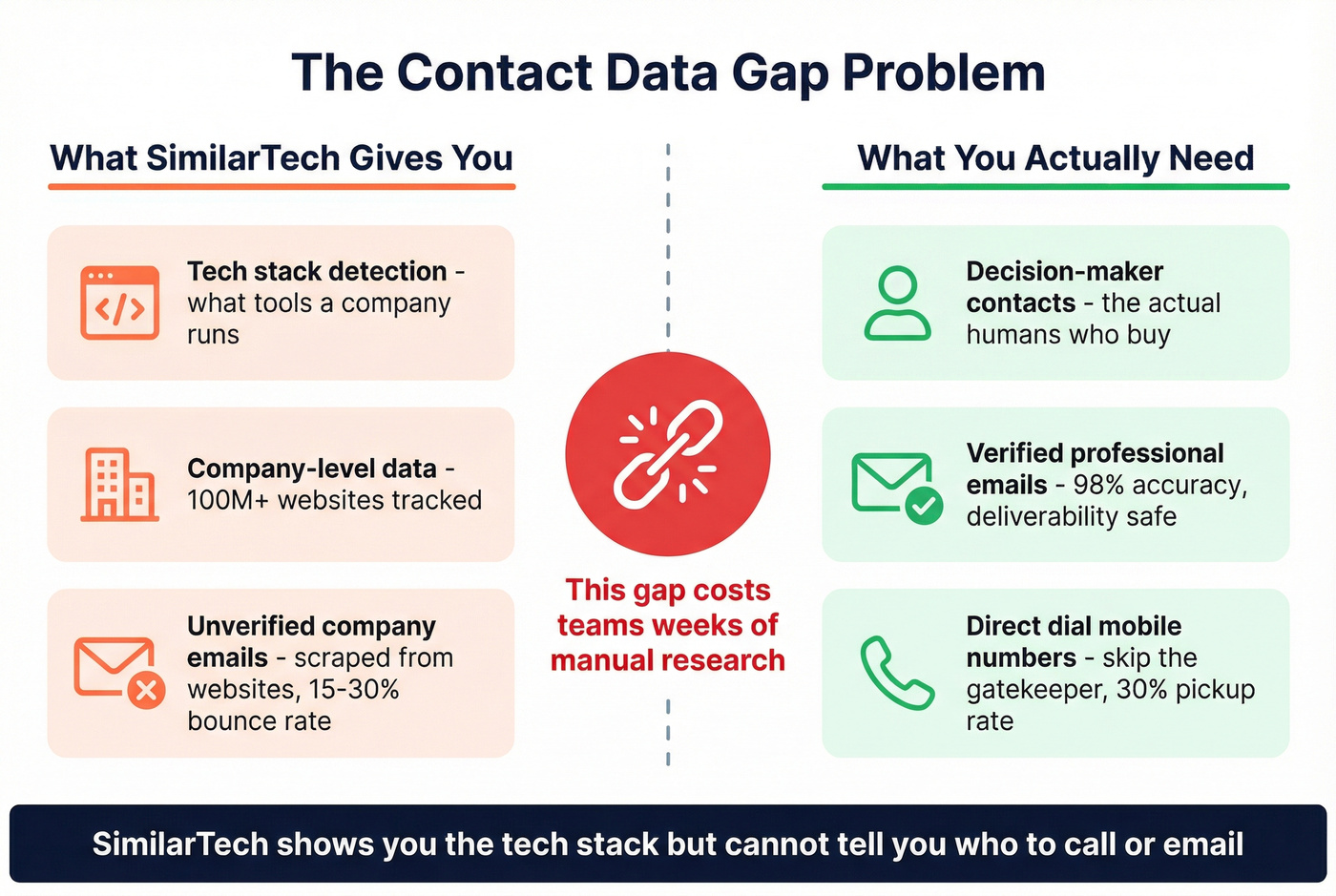
Data accuracy gets flagged by users. When reviewers tag "Inaccurate Data" as a con for a data product, that undermines the entire value proposition.
The contact-data gap is the real problem. SimilarTech tells you what tech a company uses. It doesn't give you verified emails or direct dials for the decision-makers at that company. The "emails" in their plans are company contact emails scraped from websites - not individually verified professional addresses with accuracy guarantees. For outbound teams who care about deliverability, that distinction matters: unverified company emails typically bounce at 15-30%, destroying sender reputation.
Pricing opacity at this stage feels like a red flag, and 12 total reviews on G2 isn't a sample size - it's a warning sign about adoption.
Better Alternatives Compared
The real question isn't which tech-stack tool to use. It's how you go from knowing a company's tech stack to booking a meeting with their decision-maker.
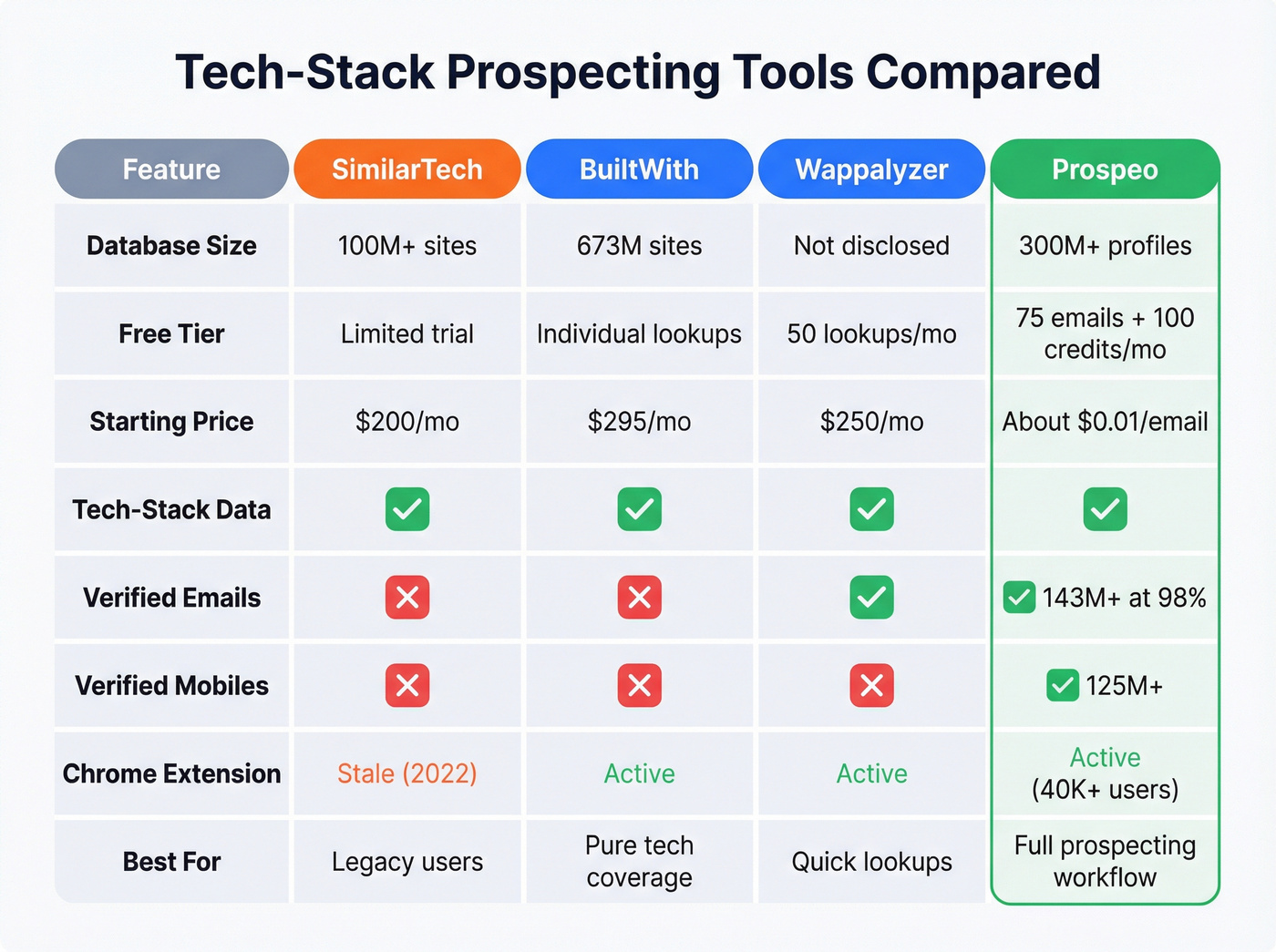
| Feature | SimilarTech | BuiltWith | Wappalyzer | Prospeo |
|---|---|---|---|---|
| Database | 100M+ sites | 673M sites | Not disclosed | 300M+ profiles |
| Free trial / free tier | Try for free | Individual lookups | 50 lookups/mo | 75 emails + 100 credits/mo |
| Entry price | ~$200/mo | $295/mo | $250/mo | ~$0.01/email |
| Tech-stack data | Yes | Yes | Yes | Yes (via filters) |
| Email verification | No | No | Yes | Yes (143M+, 98%) |
| Verified mobiles | No | No | No | Yes (125M+) |
| Data refresh | Unknown | Weekly | Not disclosed | 7 days |
| Chrome extension | Stale (2022) | Active | Active | Active (40K+ users) |
| Best for | Legacy users only | Pure tech coverage | Quick lookups | Full prospecting workflow |
BuiltWith
BuiltWith is the heavyweight for pure technographic coverage: 673M websites, 111,904 technologies tracked, and history going back 41 years. The free tier lets you look up individual sites forever - no account required. That alone makes it more accessible than SimilarTech.
Paid plans start at $295/month for Basic (2,000 domain uploads), $495/month for Pro (20,000 uploads), and $9,950/year for Team. If all you need is "show me every company running Salesforce in North America," BuiltWith is the strongest pure-play option. It won't give you contact data, though - that's a separate problem you'll need another tool to solve.
Wappalyzer: Good for Spot Checks, Not Scale
Wappalyzer works best as a lightweight complement, not a primary prospecting tool. The genuine free tier - 50 technology lookups plus 50 email verifications per month - is enough to test the workflow before committing. Pro runs $250/month (5,000 lookups), Business $450/month, and Enterprise $850+/month.
One quirk worth knowing: API credits expire after 60 days on subscription plans, so you can't stockpile them. For teams that need occasional tech lookups with some verification, Wappalyzer hits a useful middle ground. For serious prospecting volume, you'll outgrow it fast.
If you're comparing options in this category, see our full breakdown of Wappalyzer alternatives.
Prospeo
SimilarTech tells you what tech a company uses. Prospeo tells you who to contact at that company - with verified email and direct dial, and technographic filters built right into the search.
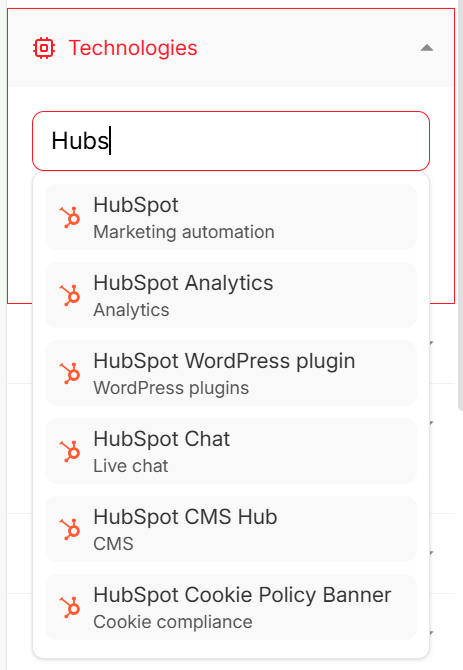
The B2B database covers 300M+ professional profiles with 30+ search filters, including technographics powered by Wappalyzer data and live job posting signals. Filter by technology stack, layer on job title, company size, funding stage, and buyer intent from 15,000 Bombora topics - then export verified contacts directly. The numbers: 143M+ verified emails at 98% accuracy, 125M+ verified mobile numbers with a 30% pickup rate, all on a 7-day data refresh cycle. The free tier gives you 75 emails and 100 Chrome extension credits per month, and paid plans run about $0.01 per email with no contracts.
We've run these numbers across dozens of client workflows, and the pattern is always the same: teams waste weeks stitching together a tech-stack tool, a contact database, and an email verification service. One platform that collapses all three steps eliminates that overhead entirely.
From Tech Stack to Pipeline
Knowing a company runs Magento or just switched from Intercom to Zendesk is only valuable if you can act on it. Here's the workflow that actually converts technographic signals into pipeline.
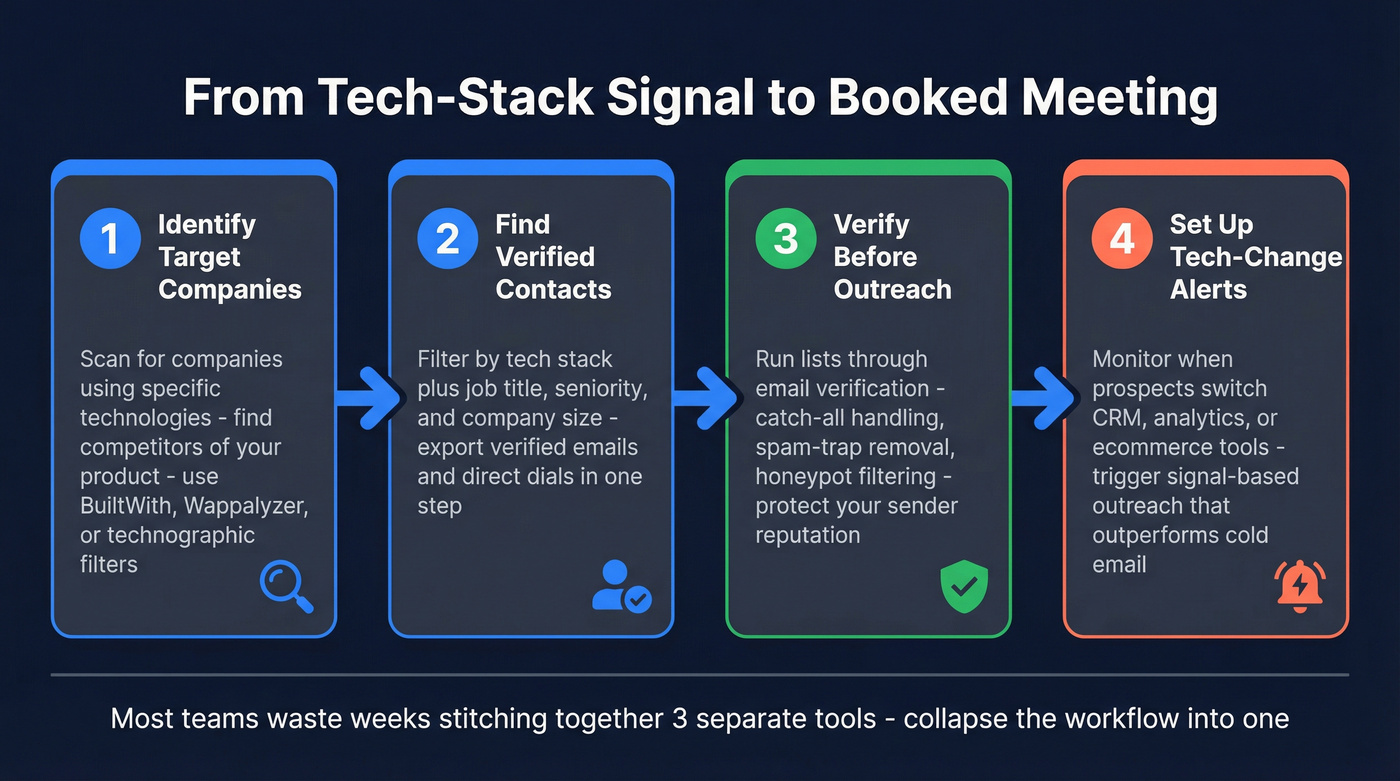
Step 1: Identify target companies by technology. Use BuiltWith for broad scans, Wappalyzer for quick lookups, or technographic filters in your contact database to find companies running specific tools. The best displacement plays start when you discover someone using your competitor's product - that's the signal that turns a cold list into a warm one.
Step 2: Find verified contacts for decision-makers. This is where most tech-stack tools hit a wall. Filter by technology plus job title, seniority, and company size. Export verified emails and direct dials in one step. No second tool, no CSV juggling.
Step 3: Verify before outreach. Even pulling from a verified database, run your list through verification before loading it into your sequencer. Catch-all domain handling, spam-trap removal, and honeypot filtering protect your domain reputation - which is worth more than any single campaign.
Step 4: Set up tech-change alerts. When a prospect switches their CRM, analytics platform, or ecommerce stack, that's a buying signal. Signal-based outreach consistently outperforms generic cold outreach because you're reaching prospects at the exact moment they're evaluating alternatives. Build alerts around the technologies your product displaces, and timing does the heavy lifting for you.
If you want to operationalize this, use a signal-based outbound approach and track intent signals alongside technographics.
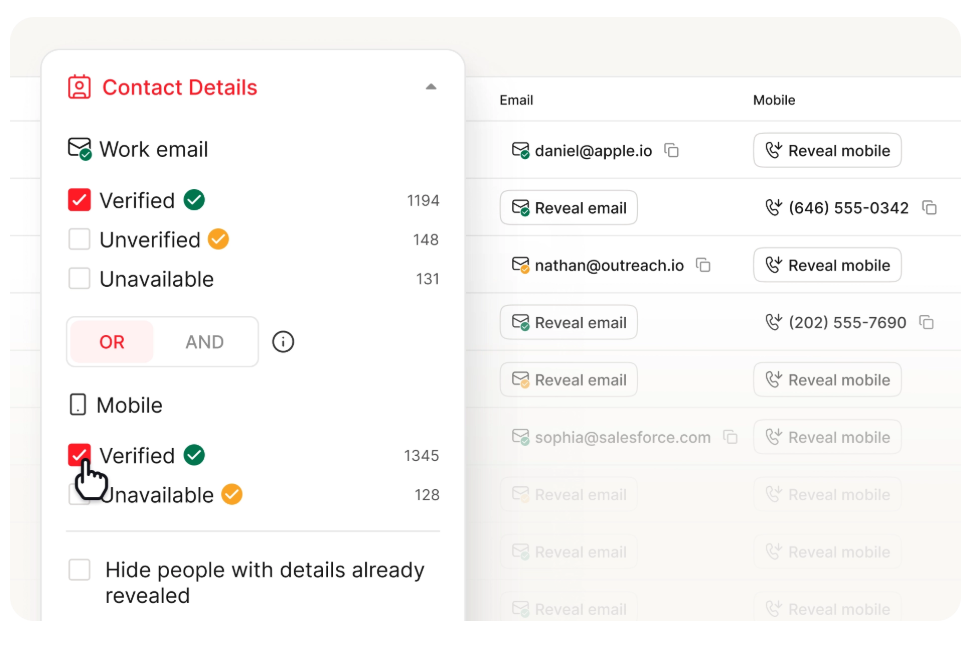
Tech-stack data is only valuable if you can reach the decision-makers behind it. Prospeo combines technographic filters with 300M+ profiles, 98% email accuracy, and a 7-day data refresh - so you prospect on live signals, not stale data from 2022.
Stop researching tech stacks you can't act on.
FAQ
Is SimilarTech Prospecting free?
No. Entry-level pricing starts around $200/month, with published tiers from 2021 ranging up to $36,000/year. Even individual lookups require a paid account - unlike BuiltWith, which offers free lookups indefinitely, or Prospeo, which includes 75 free emails and 100 Chrome extension credits monthly.
Is the SimilarTech Chrome extension still active?
It's still available with roughly 70,000 users, but it was last updated November 2022 and carries a 3.62/5 rating. Recent reviews describe frequent failures to load data and redirects requiring login. The Firefox version hasn't been updated since June 2020.
What's the best SimilarTech alternative?
For pure technographic data, BuiltWith leads with 673M websites and free individual lookups. For tech-stack filtering plus verified contact data in one platform, Prospeo covers 300M+ profiles with 98% email accuracy and 125M+ verified mobiles - no second tool needed.
Does SimilarTech provide verified emails?
Paid plans include limited email credits (50-200/month), but these are company contact emails scraped from websites - not individually verified professional addresses. For outbound teams who care about deliverability, that distinction matters: unverified company emails typically bounce at 15-30%, destroying sender reputation.
Is SimilarTech the same as Similarweb?
SimilarTech is now branded "A Similarweb Company." Its best features are migrating into Similarweb Sales Intelligence. The standalone product shows signs of maintenance mode - stale extension, no public pricing, and just 12 G2 reviews total.