

B2B Identity Resolution Isn't What You Think It Is
Most identity resolution content online is written for B2C marketers stitching together cookie trails and device graphs. If you're in B2B sales or RevOps, a lot of it is useless. B2B identity resolution isn't about matching a consumer across their phone, laptop, and smart TV - it's about mapping a person to the right account, deduplicating them across three systems, and confirming you can actually reach them before you burn a sequence.
Here's the thing: you need three layers working together. A visitor identification tool to see who's hitting your site. An account-matching and dedup process to resolve contacts to the correct entity. And a verification layer to confirm emails and direct dials before you activate outbound. Let's break down how each layer works, what it costs, and how to build the workflow.
What Identity Resolution Means in B2B
In B2C, identity resolution means linking a person's devices into one profile for retargeting. In B2B, it means connecting a human being to the right account in your CRM, at the right level of the account hierarchy, with verified contact data attached - a "golden record" that sales can actually act on.
The tooling, data models, and failure modes are completely different. A B2C identity graph cares about devices. A B2B identity graph cares about organizational relationships: who works where, which entity they bill through, and whether the "account" in your CRM is a holding company, a business unit, or a regional office.
Why B2B Is Harder Than B2C
"Account" doesn't mean one thing. A single customer might exist in your systems as an Ultimate Parent, a Billing Entity, an Engagement Unit, and a User Group - all simultaneously. Practitioners describe a six-layer account model that most B2B CDPs need to support: Ultimate Parent, Billing Entity, Executive Team, Engagement Unit, Support Org, and User Group. If your resolution process doesn't know which layer matters for a given workflow, your TAM models are built on sand.
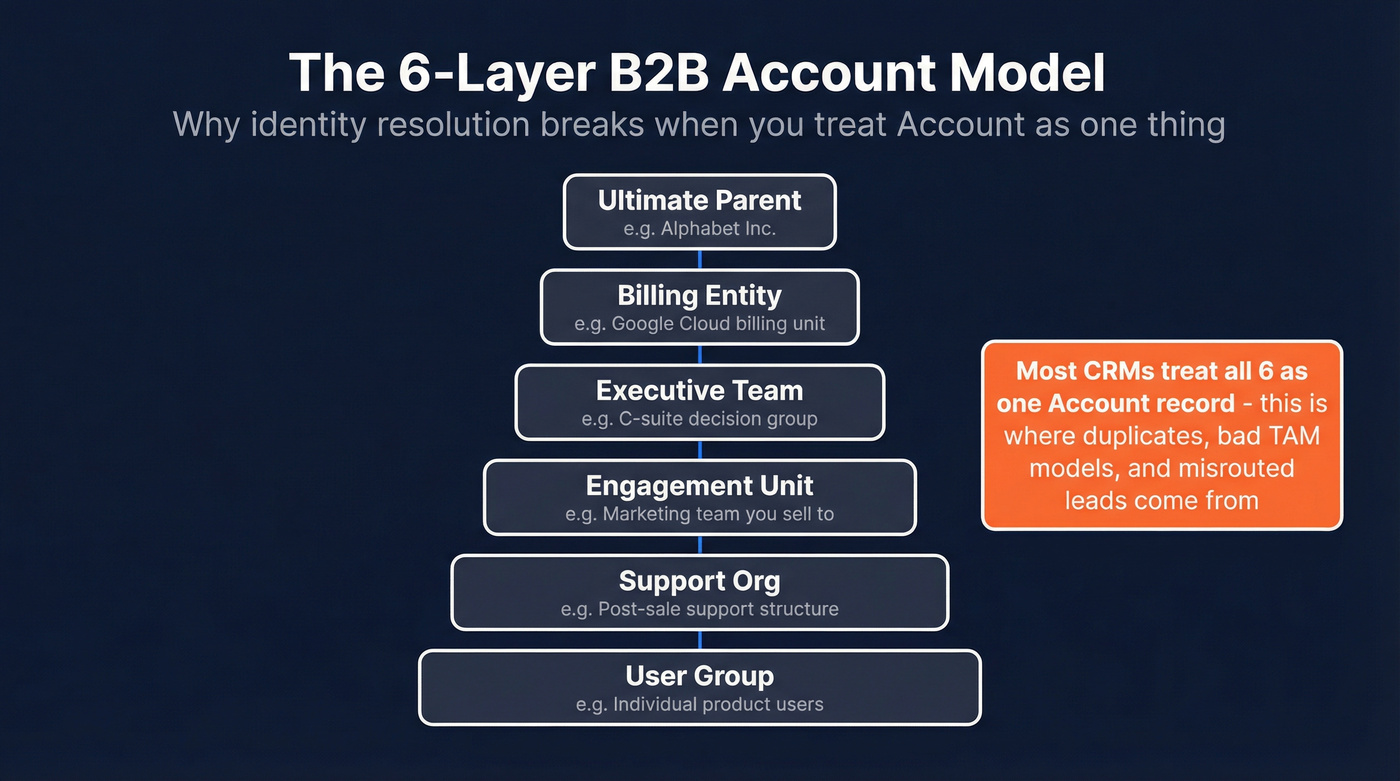
The data quality problem compounds this. Roughly 80% of companies report inaccurate CRM data, about 40% of contact data goes stale every year, and poor data quality costs companies 15-25% of annual revenue. You're resolving identities against a foundation that's actively decaying. RevOps practitioners will tell you the same thing: duplicates account for 15-30% of most contact databases, remote work has killed IP-based office targeting, and signal loss from cookie deprecation is only accelerating. We've seen this firsthand across customer accounts - the decay is real and it's relentless.
Deterministic vs. Probabilistic Matching
Every identity resolution system uses one or both approaches:
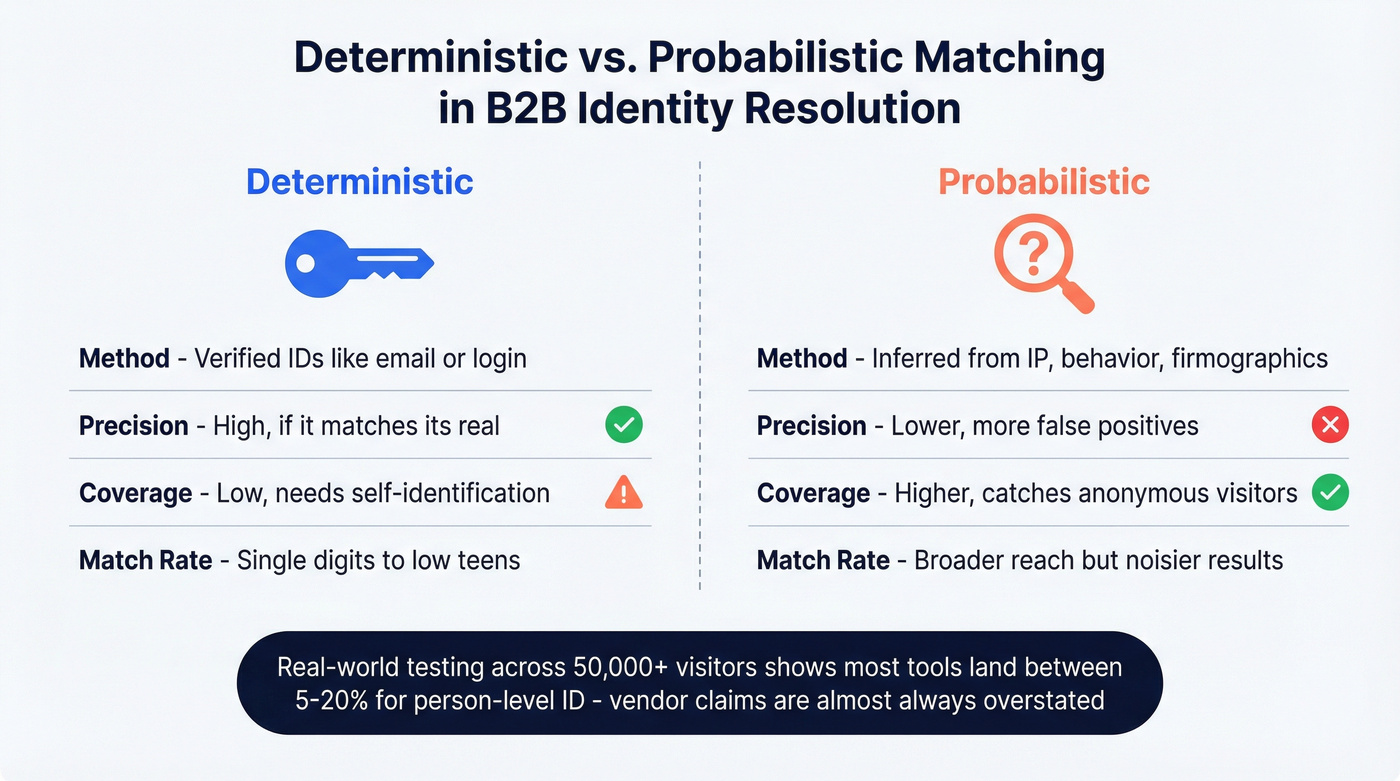
| Deterministic | Probabilistic | |
|---|---|---|
| Method | Verified IDs like email or login | Inferred from IP, behavior patterns |
| Precision | High - if it matches, it's real | Lower - more false positives |
| Coverage | Low - needs self-identification | Higher - catches anonymous visitors |
| Match rate | Often single digits to low teens | Broader reach, but noisier results |
Vendors overstate match rates. Almost universally. In practice, independent testing across 50,000+ visitors shows most tools land between 5-20% for person-level identification. Company-level identification runs higher, but "we know Acme visited your pricing page" is far less actionable than knowing exactly who at Acme visited.
If you're not running a true enterprise ABM motion, you probably don't need a $50K+/year platform doing probabilistic matching. A visitor ID tool plus a solid verification layer will get you most of the value at a fraction of the cost. The consensus on r/sales and r/RevOps threads backs this up - mid-market teams consistently report better ROI from stacking lightweight tools than from buying a monolithic suite.

Your identity graph is only as good as the contact data at the end of it. Prospeo's 300M+ profiles are refreshed every 7 days - not every 6 weeks - so resolved contacts actually connect. At 98% email accuracy and $0.01/email, you stop burning sequences on stale data.
Resolve identities all you want - Prospeo makes sure they're reachable.
Where It Fits in Your GTM Stack
Identity resolution isn't a standalone tool. It's a layer in your signal stack:
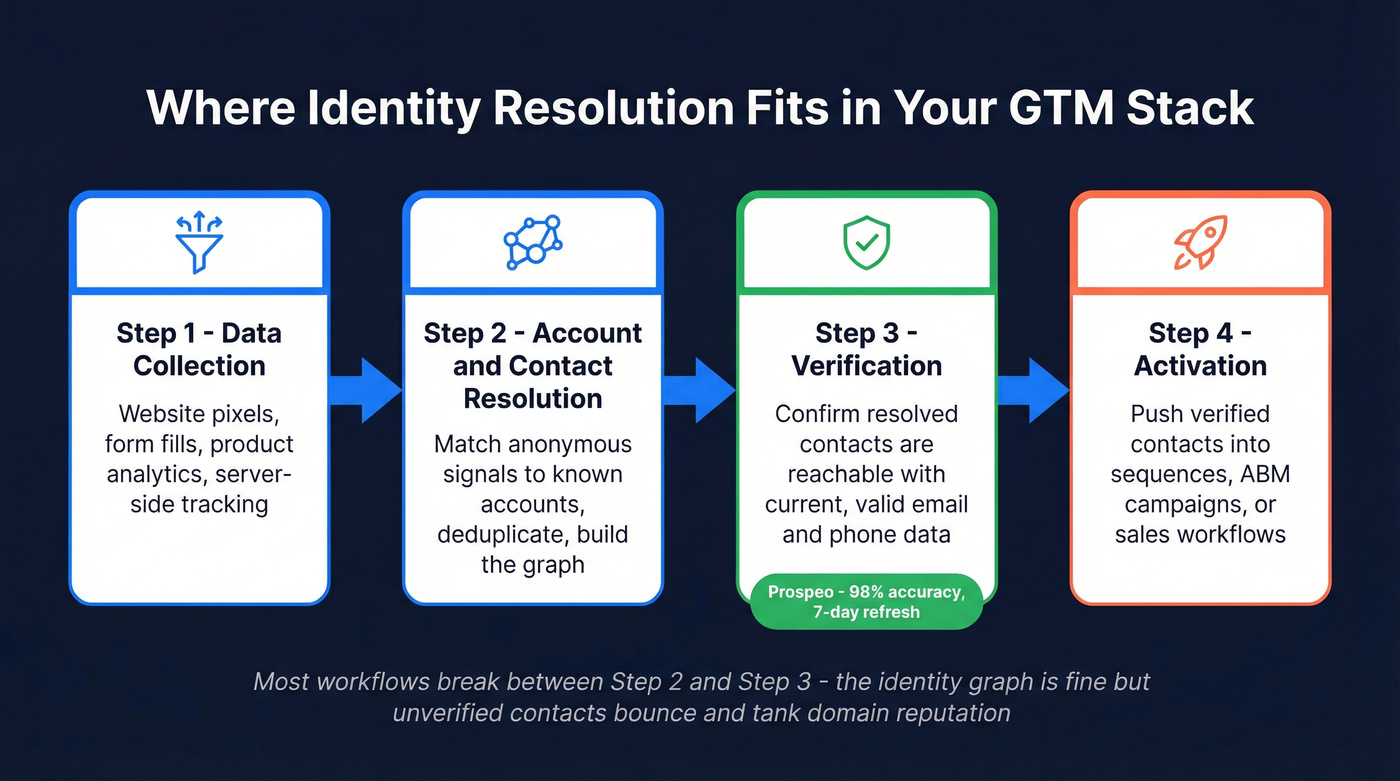
- Data collection - website pixels, form fills, product analytics, server-side tracking, server-side tracking
- Account and contact resolution - matching anonymous signals to known accounts and contacts, deduplicating, building the graph
- Verification - confirming resolved contacts are reachable with current, valid data
- Activation - pushing verified contacts into sequences, ABM campaigns, or sales workflows
Attribution models are only as accurate as the resolved identities underneath them. About 67% of B2B companies already use server-side tracking to improve data quality at the collection layer, and warehouse-native approaches through Snowflake or Databricks are gaining traction for teams that want to own their identity graph rather than renting it from a CDP. Snowflake's guide to identity resolution is worth reading if you're considering this path.
Once you've resolved the account and contact, you still need verified data to actually reach them. This is where most workflows fall apart - the identity graph says "Jane Smith, VP Marketing at Acme" but the email bounces because she changed jobs six weeks ago.
What It Costs in 2026
We've seen mid-market teams spend $500-$2,000/month across two or three tools in this stack. Here's how pricing breaks down:
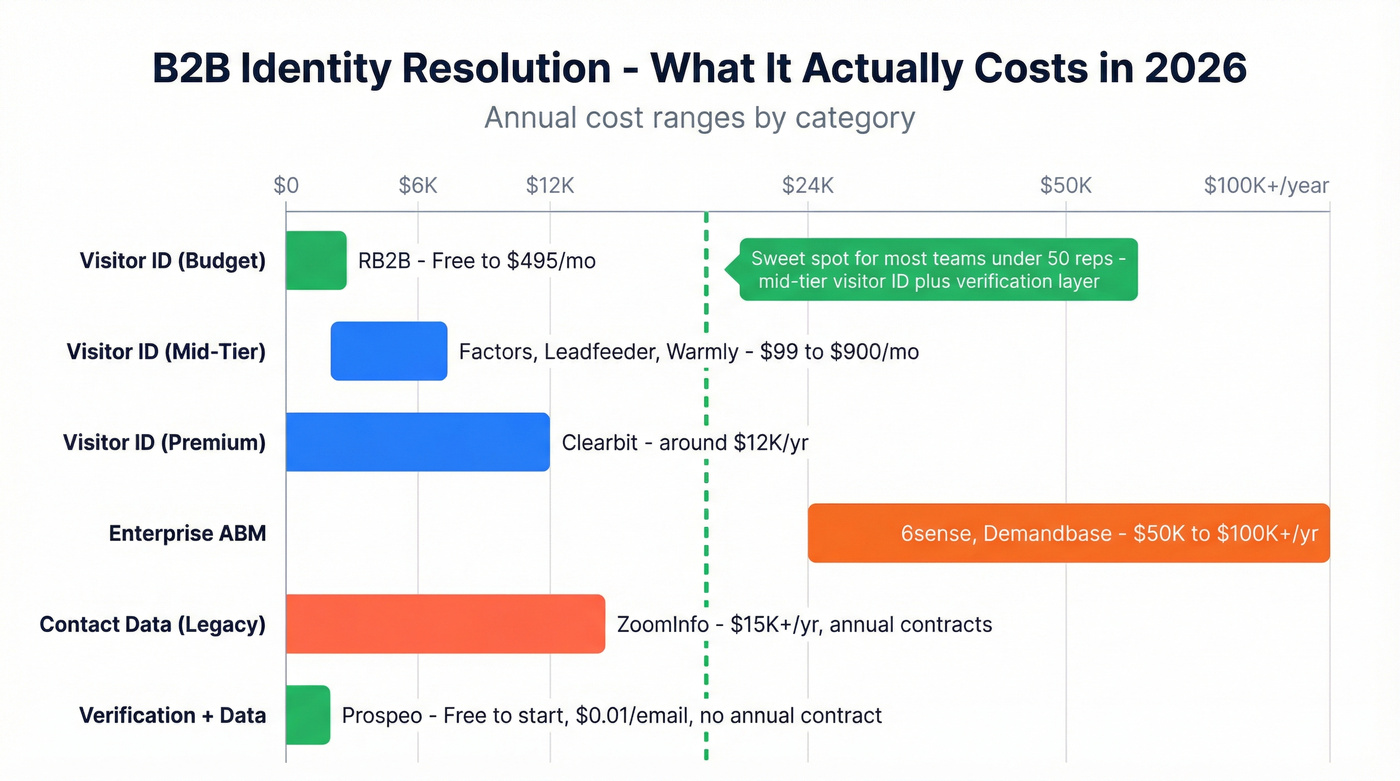
| Category | Tool | Starting Price | What You Get |
|---|---|---|---|
| Visitor ID (budget) | RB2B | Free / $495/mo | Person-level ID attempts, 5-15% ID rate |
| Visitor ID (mid) | Factors | $99-$499/mo | Company-level ID, up to 64% of companies |
| Visitor ID (mid) | Leadfeeder | ~$139/mo+ | Company-level ID, 10-15% ID rate |
| Visitor ID (mid) | Warmly | ~$900/mo | Company + person, 10-20% ID rate |
| Visitor ID (premium) | Clearbit | ~$12,000/yr | Company + enrichment, 15-20% ID rate |
| Enterprise ABM | 6sense / Demandbase | $50,000+/yr | Full ABM + intent |
| Contact data | ZoomInfo | $15,000+/yr | Large DB, annual contracts |
| Verification + data | Prospeo | Free / ~$0.01/email | 98% accuracy, 7-day refresh, 300M+ profiles |
The range runs from about $99/month for basic visitor identification to $100K+/year for enterprise ABM suites with full intent data. For most teams under 50 reps, the sweet spot is a mid-tier visitor ID tool paired with a verification layer that actually keeps data fresh.
Privacy and Compliance
GDPR requires explicit consent for non-essential data processing - cumulative fines have hit EUR 5.88B and climbing. CCPA/CPRA penalties run up to $7,988 per intentional violation. The ICO's guidance on fingerprinting is worth reviewing; they called Google's fingerprinting policy "irresponsible," and if a regulator uses that word publicly, take the hint.
Server-side tracking is a more compliant path forward because it centralizes consent enforcement and lets you anonymize data before forwarding it to third-party tools. Skip any vendor that can't clearly explain their consent framework - it's not worth the risk. The IAB's state privacy law tracker is a good resource for staying current on US state-level requirements.
Implementation Checklist
- Audit your CRM - deduplicate contacts and standardize account hierarchies before adding new tooling
- Define your account model - parent company, billing entity, or business unit? Pick one primary level for resolution
- Choose a visitor ID tool matched to your budget and traffic volume
- Set up account-to-contact matching - fuzzy matching on name, domain, and title gets you most of the way there
- Verify resolved contacts before activating - confirm emails and direct dials so you're not sequencing stale data
- Monitor match rates monthly - if rates drop 10%+ quarter over quarter, your data hygiene has a leak somewhere
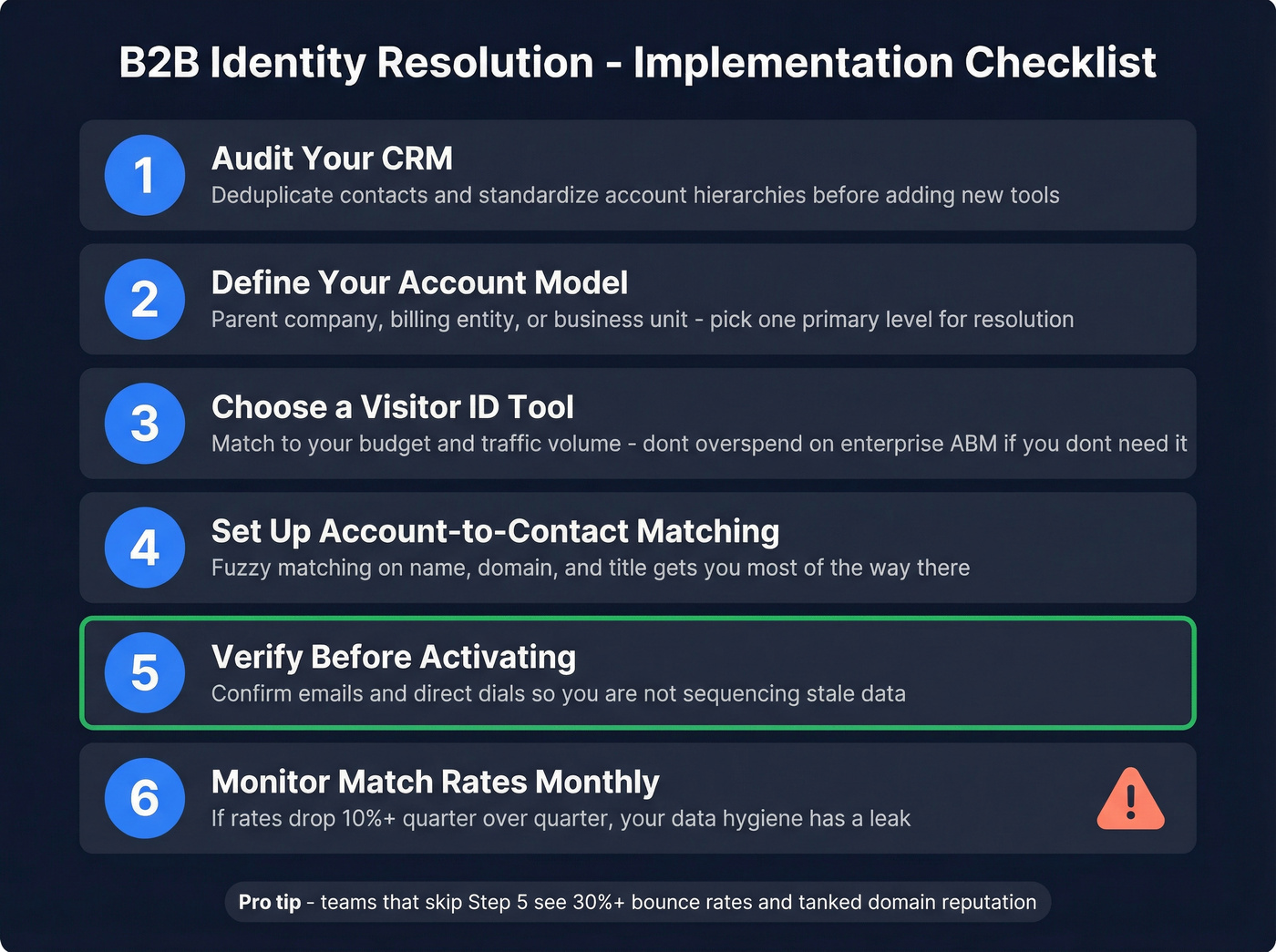
Here's a scenario we see constantly: a team spends $40K on a visitor ID platform, resolves 15% of traffic to person-level contacts, then sequences all of them without verification. Bounce rates spike to 30%+, domain reputation tanks, and suddenly even their good emails aren't landing. The identity graph was fine. The verification step was missing.
B2B identity resolution only delivers ROI when the resolved contacts are reachable. Build the verification step into your workflow from day one - not as an afterthought. If you want a deeper dive on data decay and how fast records go stale, see contact data goes stale every year.
Most identity resolution workflows break at the verification layer. Prospeo fills that gap with 143M+ verified emails, 125M+ verified mobiles, and a 5-step verification process that catches stale records before they hit your sequences. No annual contracts, no sales calls.
Close the last mile of your identity resolution stack for $0.01 per email.
FAQ
What's the difference between identity resolution and entity resolution?
Identity resolution links data points to a single person. Entity resolution is broader - it matches companies, products, or any entity across datasets. In B2B, you need both: entity resolution to unify account records, identity resolution to map contacts to those accounts.
Can visitor ID tools resolve to a specific person?
Most resolve only to the company level. A few attempt person-level identification, but real-world rates land between 5-20%. You'll need a separate verification layer to turn company-level matches into actionable contacts with confirmed emails and direct dials.
How accurate are vendor-claimed match rates?
Overstated, almost universally. Independent tests show 5-20% person-level identification rates across 50,000+ visitor samples. Ask any vendor for a proof-of-concept on your own traffic before signing an annual contract. If they won't do it, that tells you something.
Do I need a dedicated platform for B2B identity resolution?
Enterprise ABM platforms like 6sense and Demandbase bundle identity resolution with intent data and orchestration, but mid-market teams often achieve comparable results by combining a visitor ID tool, a CRM dedup process, and a verification layer - at a fraction of the cost. Start lean, then upgrade if your deal sizes justify the spend.