

How to Build a Prospecting Workflow That Actually Books Meetings
A RevOps lead described their SDR team's day like this: "Finding contacts, verifying them, enriching data, loading into sequences, tracking responses, following up - it's a full-time job before anyone even picks up the phone." Manual research eats 10-15 minutes per lead. Multiply that across 50 prospects and you've burned half a day before a single email goes out.
The problem isn't effort. It's the lack of a repeatable prospecting workflow.
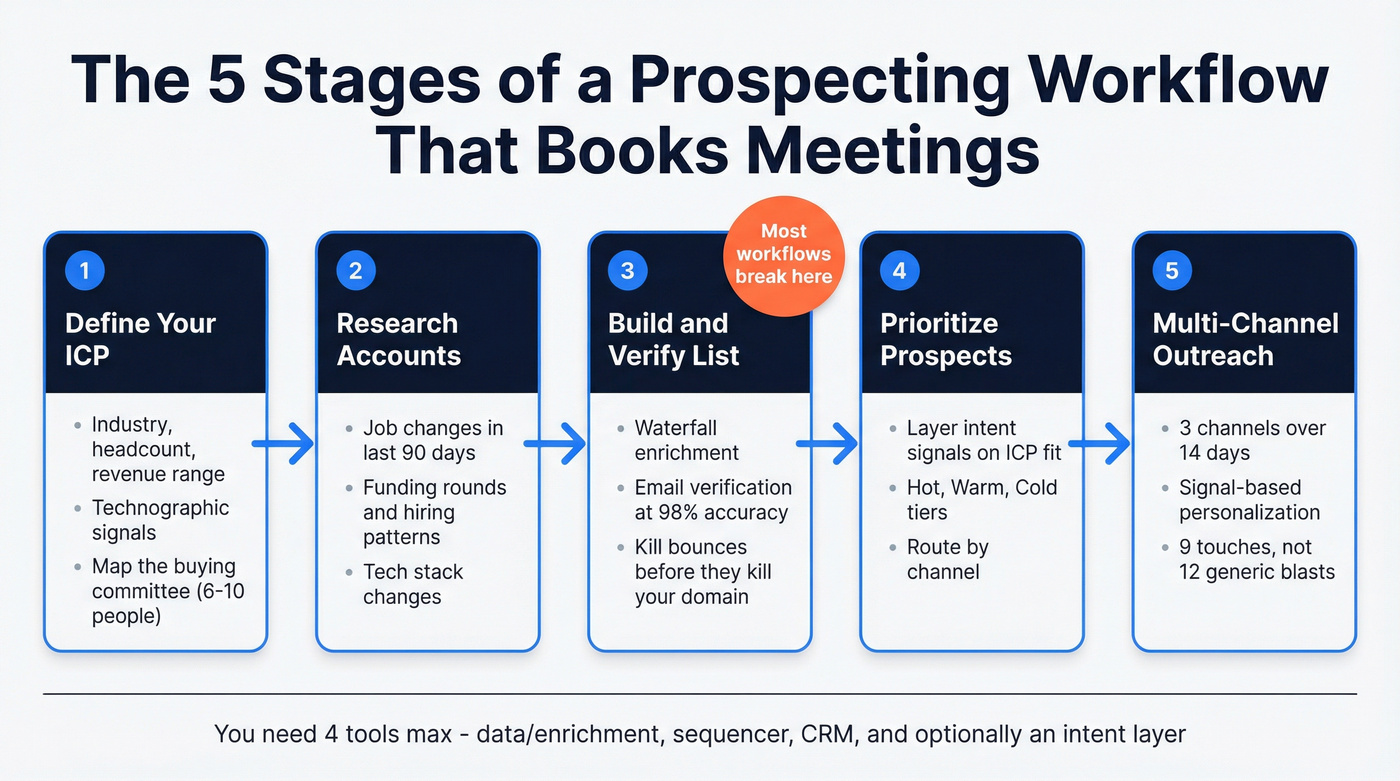
A sales prospecting workflow has five stages: ICP definition, account research, list building, prioritization, and outreach. Most systems break at stage three because of bad data. You need four tools max - a data/enrichment platform, a sequencer, a CRM, and optionally an intent layer.
What Is a Prospecting Workflow?
A prospecting workflow is a repeatable sequence that moves a name from "unknown" to "qualified pipeline" through defined stages: research, list building, prioritization, and outreach. It's the operating system your SDRs run on every day.
Here's a distinction worth getting right early. Leads show interest - they downloaded something, visited your pricing page. Prospects are researched, ICP-qualified, and sales-owned. Inbound workflows prioritize speed-to-lead. Outbound systems prioritize research depth and personalization. Different motions, different cadences, same underlying structure. (If you want the clean definitions, see prospecting vs lead generation.)
The 5 Stages of Sales Prospecting
Stage 1 - Define Your ICP
Everything downstream depends on this. A tight ICP includes two to three firmographic criteria like industry, headcount, and revenue range, plus at least one technographic signal - a specific CRM, cloud provider, or competitor tool in the stack. Gartner's research shows a typical B2B purchase involves 6-10 decision-makers, which means you need to map the buying committee, not just the VP.
Modern data platforms let you filter by buyer intent, technographics, job changes, and headcount growth directly. Use those filters to validate your ICP before building a single list. (More on the data types in firmographic and technographic data.)
Stage 2 - Research Accounts
This is where automation earns its keep. A rep can realistically handle 300-500 prospects and 20-30 quality touches per day manually. With the right tooling, research on 50 contacts drops from two hours to 15 minutes.
The 4-7 minute research checklist per account: Check for job changes in the last 90 days, recent funding rounds, tech stack changes, and hiring patterns in the department you sell into. These signals become your personalization fuel for stage five. (If you need a tighter template, use a pre call research checklist.)
Let's be honest, though: the workflow usually isn't the problem - the data is.
Stage 3 - Build and Verify Your List
This is where most prospecting systems break. Teams spend hours building a list of 200 accounts, then blast emails without verifying a single address. The result: bounce rates north of 30%, domain reputation destroyed, and marketing's nurture campaigns become collateral damage.
Verification isn't optional - it's a dedicated workflow stage. Waterfall enrichment, checking multiple providers sequentially, is now standard via tools like Clay. But coverage without accuracy is expensive noise. Prospeo handles verification at scale with 98% email accuracy across 143M+ verified emails and a 7-day data refresh cycle versus the industry's six-week average. At roughly $0.01 per lead, you're spending $2 to verify a 200-contact list. Pair it with Clay's waterfall logic for coverage, and your enrichment layer is locked down. (If you're comparing options, see email ID validators.)

Stage 4 - Prioritize Your Prospects
Not every verified contact deserves the same effort. Layer intent signals on top of your ICP fit score - topic surges, ad engagement, and website visits. Teams using intent and signal data see 47% better conversion rates. (For a scoring playbook, use ABM account prioritization or a simpler lead prioritization model.)
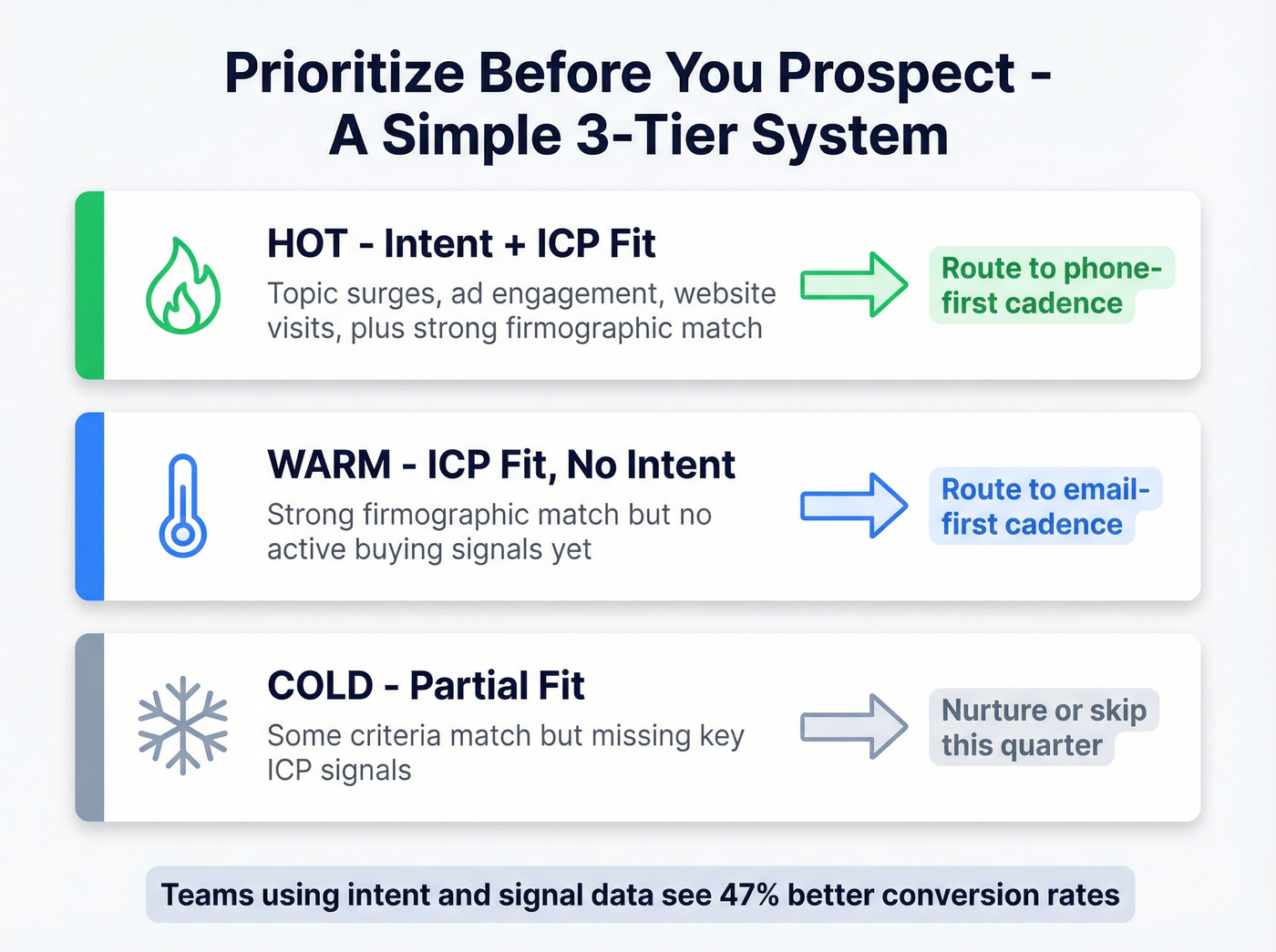
A simple three-tier system works: hot (intent + ICP fit), warm (ICP fit, no intent), and cold (partial fit). Route hot leads to phone-first cadences, warm to email-first. Skip this step and you'll burn your best reps' time on accounts that were never going to buy this quarter.
Stage 5 - Multi-Channel Outreach
Now you're actually selling. Cold calling benchmarks sit at a 16.6% connect rate with 8 attempts needed to reach a prospect, and calling between 4-5pm outperforms morning slots by 71%. Cold email reply rates hover around 3-5% for generic outreach, but signal-personalized messages can hit 15-25%. (If you want a tighter system, see cold calling and prospecting and personalization in outbound sales.)
The gap between those two numbers is your entire system paying off.
14-Day Prospecting Cadence
43% of buyers who take meetings say it's acceptable for sellers to contact them five or more times. LinkedIn InMail acceptance jumps 46% when you reference a shared commonality. Five well-timed touches to verified contacts beat 12 generic touches to a bought list every time. Establish clear rules of engagement - who owns which accounts, when to escalate, how many touches before a breakup - so your team stays aligned and nobody double-taps the same prospect. (Need examples? Use a sales cadence example.)
| Day | Channel | Action | Notes |
|---|---|---|---|
| 1 | Personalized cold email | Reference a signal | |
| 2 | Phone | Call + voicemail | 4-5pm local time |
| 3 | Social | Connect + comment | Find commonality |
| 5 | Follow-up (new angle) | Don't repeat Day 1 | |
| 7 | Phone | Second call attempt | Morning slot |
| 8 | Social | Engage their content | Like/comment first |
| 10 | Value-add (case study) | No ask, just give | |
| 12 | Phone | Third call attempt | Reference voicemail |
| 14 | Breakup email | Clear, respectful close |
Nine touches, three channels, 14 days. At roughly 10 calls per hour, the phone blocks alone take about 20 minutes per prospect across the full cadence. Adjust timing based on your ICP's responsiveness.

Stage 3 is where workflows die - bad data, bounced emails, burned domains. Prospeo's 5-step verification delivers 98% email accuracy across 143M+ verified addresses, refreshed every 7 days. At $0.01 per email, verifying a 200-contact list costs less than a coffee.
Stop breaking your workflow at list building. Fix the data layer first.
Tool Stack by Budget
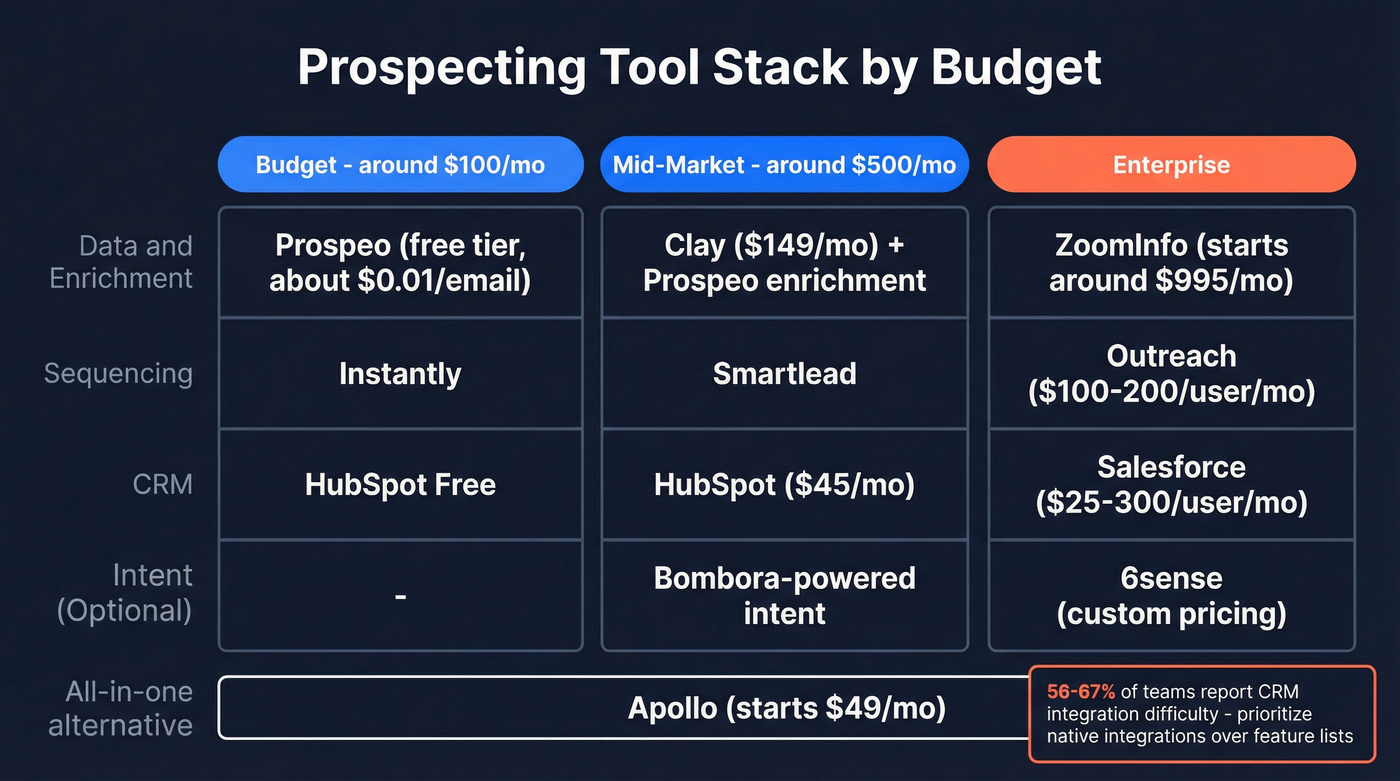
You need four to five tools that talk to each other, not 15. The goal is keeping every stage connected so data flows without manual re-entry. Here's what that looks like across three budget tiers: (If you're building from scratch, start with a B2B sales stack.)
| Workflow Stage | Budget (~$100/mo) | Mid-Market (~$500/mo) | Enterprise |
|---|---|---|---|
| Data & Enrichment | Prospeo (free tier / ~$0.01/email) | Clay ($149/mo) + enrichment | ZoomInfo (starts ~$995/mo) |
| Sequencing | Instantly | Smartlead | Outreach ($100-200/user/mo) |
| CRM | HubSpot (free) | HubSpot ($45/mo) | Salesforce ($25-300/user/mo) |
| Intent (optional) | - | Bombora-powered intent | 6sense (custom pricing) |
| All-in-one alt | Apollo (starts at $49/mo) | Apollo | Apollo |
Apollo is the default recommendation in every "prospecting tools" listicle, and it deserves a spot here. But once you're closing deals above $25K ACV, teams often outgrow all-in-one databases and move to a dedicated enrichment layer plus a separate sequencer - because the data has to be right. We've seen teams make that switch and book 35% more meetings simply because bounce rates dropped from 30%+ to under 5%.
Here's the uncomfortable stat nobody in the tool stack conversation talks about: 56-67% of sales teams report CRM integration difficulty as a major friction point. The best tool stack in the world is useless if your data doesn't flow cleanly into Salesforce or HubSpot. Prioritize native integrations over feature lists when choosing vendors. (If you're cleaning up the mess, start with CRM hygiene.)
A 14-day cadence only works when every touch reaches a real person. Prospeo gives you 143M+ verified emails, 125M+ direct dials with a 30% pickup rate, and 30+ filters to nail your ICP - from buyer intent to tech stack to headcount growth. That's stages 1 through 5, covered.
Build the prospecting workflow that actually books meetings.
Where AI Fits in SDR Prospecting
81% of sales teams are experimenting with AI, and AI-using teams are 1.3x more likely to see revenue growth. The real productivity gains: 2-3 hours saved daily and prospect research cut by 40-60%. (If you're operationalizing it, see prospect research automation.)
AI compresses your workflow. It doesn't fix bad ICP definition or missing verification. The best use cases right now are research automation, message personalization at scale, and signal-based prioritization. If your list is 30% bounced, AI-written emails just bounce faster.
Where AI truly shines is helping teams manage prospects at scale - automating the repetitive enrichment and scoring steps so reps focus on conversations, not spreadsheets. But treat it as an accelerant, not a replacement for the five stages above.
Three Mistakes That Kill Pipeline
1. Skipping verification. Snyk's 50-person AE team went from 35-40% bounce rates to under 5% after adding a verification step. Meritt saw the same pattern - 35% bounce down to under 4%, pipeline tripled from $100K to $300K per week. Every unverified email damages your domain for every future campaign. This one's non-negotiable.
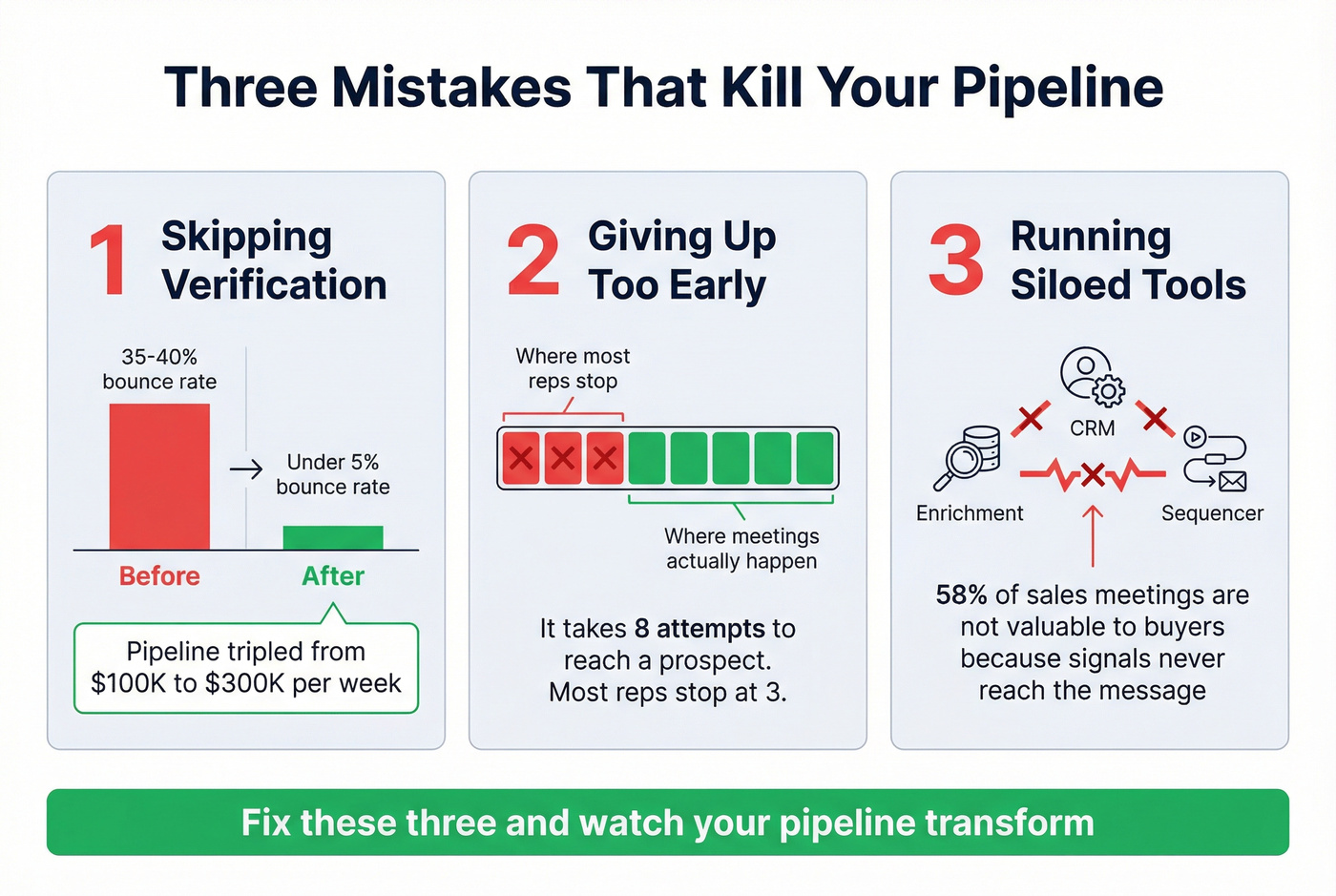
2. Giving up too early. It takes 8 attempts to reach a prospect. Most reps stop at three. Look - three emails and a shrug isn't a cadence. It's a waste of the research you already did.
3. Running siloed tools. Generic messaging is the obvious third mistake, but the sneakier killer is tool fragmentation. When your enrichment data doesn't sync to your CRM, and your CRM doesn't feed your sequencer, reps waste time on manual data entry instead of selling. 58% of sales meetings aren't valuable to buyers - often because the signals gathered in research never made it into the actual message. The consensus on r/sales backs this up: most broken pipelines aren't a messaging problem, they're a data plumbing problem.
FAQ
How many touches should a prospecting cadence have?
Eight to twelve touches over 14-21 days across email, phone, and social. 43% of buyers say five or more contacts is acceptable. Most reps quit after three - that's leaving pipeline on the table.
What's the biggest mistake in outbound prospecting?
Skipping email verification. Unverified lists produce 30-40% bounce rates, which tanks domain reputation and kills deliverability for every future campaign. Verification costs roughly $0.01 per lead. Domain recovery takes months.
How much does a prospecting tool stack cost?
A functional stack starts under $100/month with free-tier tools for data and CRM. Enterprise stacks with ZoomInfo and Outreach run $15-40K/year depending on seat count and data volume.
How do I build an outbound prospecting workflow from scratch?
Start with a clearly defined ICP, then work through the five stages sequentially: research, list building, verification, prioritization, and multi-channel outreach. Treat each stage as a distinct step with its own quality gate - don't move contacts forward until the data is clean and scored.