

Cold Calling and Prospecting: A Data-Backed System for Booking More Meetings
It's 9:47 AM on a Tuesday. You've got a list of 200 names, a script your manager wrote six months ago, and a connect rate hovering around 4%. By noon, you'll have left 40 voicemails and talked to three humans - one of whom hung up before you finished your name. The problem isn't your pitch. It's your data, your timing, and the first 10 seconds after someone picks up. Fix those three inputs and cold calling and prospecting stop feeling like a lottery.
The industry-average cold call success rate is 2.3%. That's roughly 209 dials per booked appointment. But teams running verified contact data, signal-based targeting, and tested openers hit 5-8%. The gap between those numbers isn't talent - it's system.
One distinction before we get into it: prospecting is the full workflow of identifying targets, researching them, building lists, and reaching out across channels. Cold calling is the highest-converting channel within that workflow. 59% of senior executives actually prefer phone as the initial contact method, a reminder that the phone hasn't lost its edge despite the rise of email and social selling. This guide covers both: the prospecting system that feeds your call list, and the techniques that turn dials into meetings.
The Numbers at a Glance
- Best days to call: Tuesday through Thursday. Skip Friday entirely.
- Best times: 10 AM-12 PM and 2-5 PM in the prospect's time zone. Late afternoon outperforms morning by 71%.
- Best opener: "How have you been?" - 6.6x success lift over generic intros.
- Daily target: 52-60 dials, with 8-10 attempts per lead before moving on.
- Data layer: Verified mobiles and emails. Teams using verified databases see answer rates jump to 13.3%.
- Talk-to-listen ratio: You speak less than 40% of the call.
- Goal of call one: Sell the meeting, not the product.
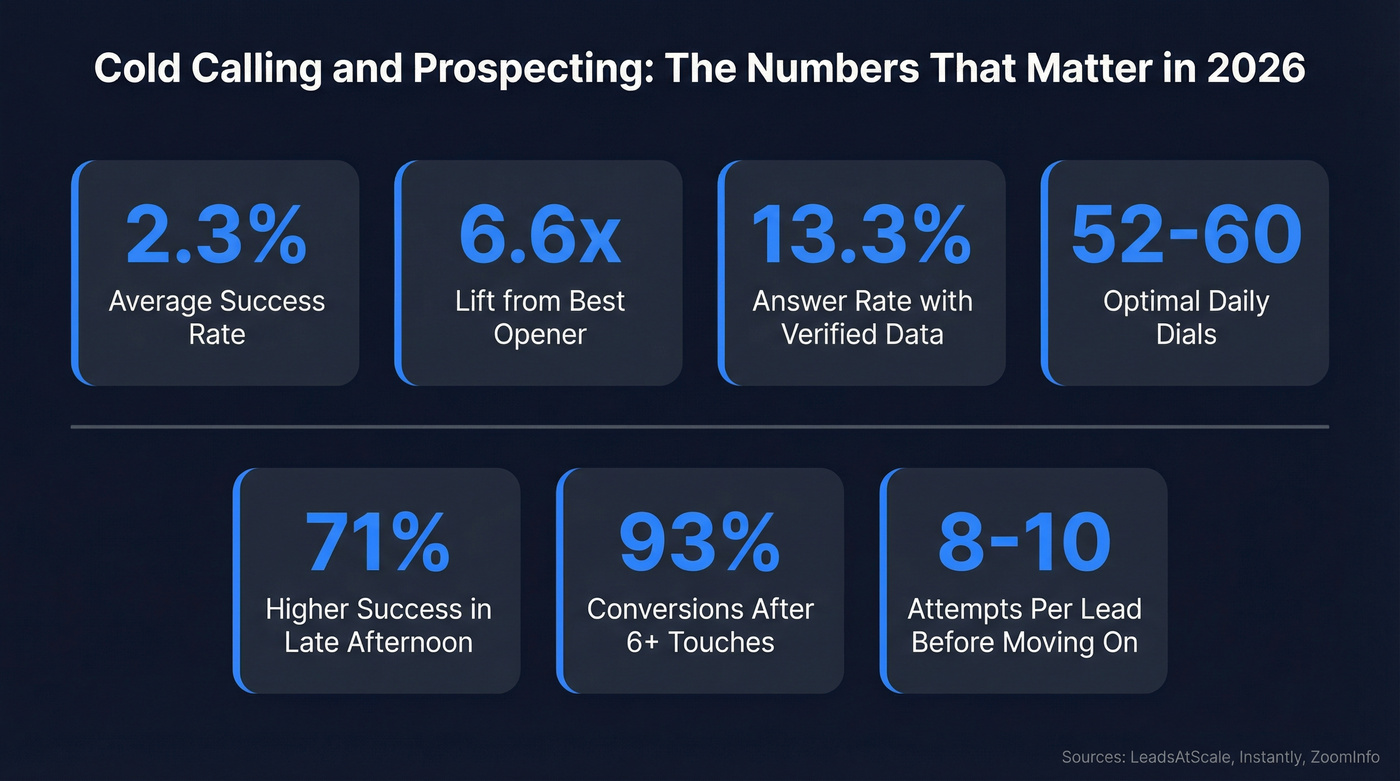
Everything below unpacks the why and how behind each of these.
2026 Benchmarks Worth Knowing
Before you change anything about your process, you need to know where the baseline sits. These benchmarks draw from LeadsAtScale's 2026 analysis, Instantly's benchmark study, and ZoomInfo's call-volume data on best days to dial.
| Metric | Benchmark |
|---|---|
| Success rate (avg) | 2.3% |
| Dials per day | 52-60 |
| Voicemails unreturned | ~90% |
| Connect rate (top teams) | 16.6% |
| Success rate (top performers) | 6.7% |
| Attempts per lead | 8-10 |
| Conversions after 6+ touches | 93% |
Tuesday and Wednesday alone produce 44% of all demos booked. Tuesday is the single best day. Friday is the worst across every metric - connect rate, demo volume, and positive sentiment all crater.
Late afternoon calls have 71% higher success rates than morning calls. If you're front-loading your dials before 10 AM, you're leaving meetings on the table. The sweet spot is 10 AM-12 PM and 2-5 PM in the prospect's local time zone. Call during lunch and you're competing with a sandwich. Call at 4:45 PM on a Friday and you're competing with the weekend.
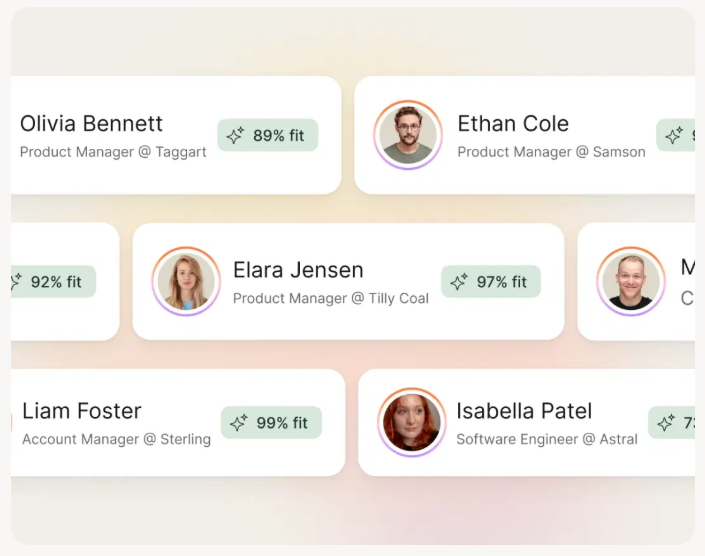
Here's the number that should reshape your prospecting stack: teams using verified contact databases see their answer rate climb to 13.3% - nearly triple the typical 4-6% connect rate on unverified lists. The single highest-impact thing you can do isn't rehearse your script. It's clean your data.
Cell phone numbers outperform office lines by 3-5x on connect rates. Verified mobile numbers are the foundation of any serious outbound strategy.
The Pre-Call System
Most reps skip straight to dialing. That's why most reps hover around 2%.
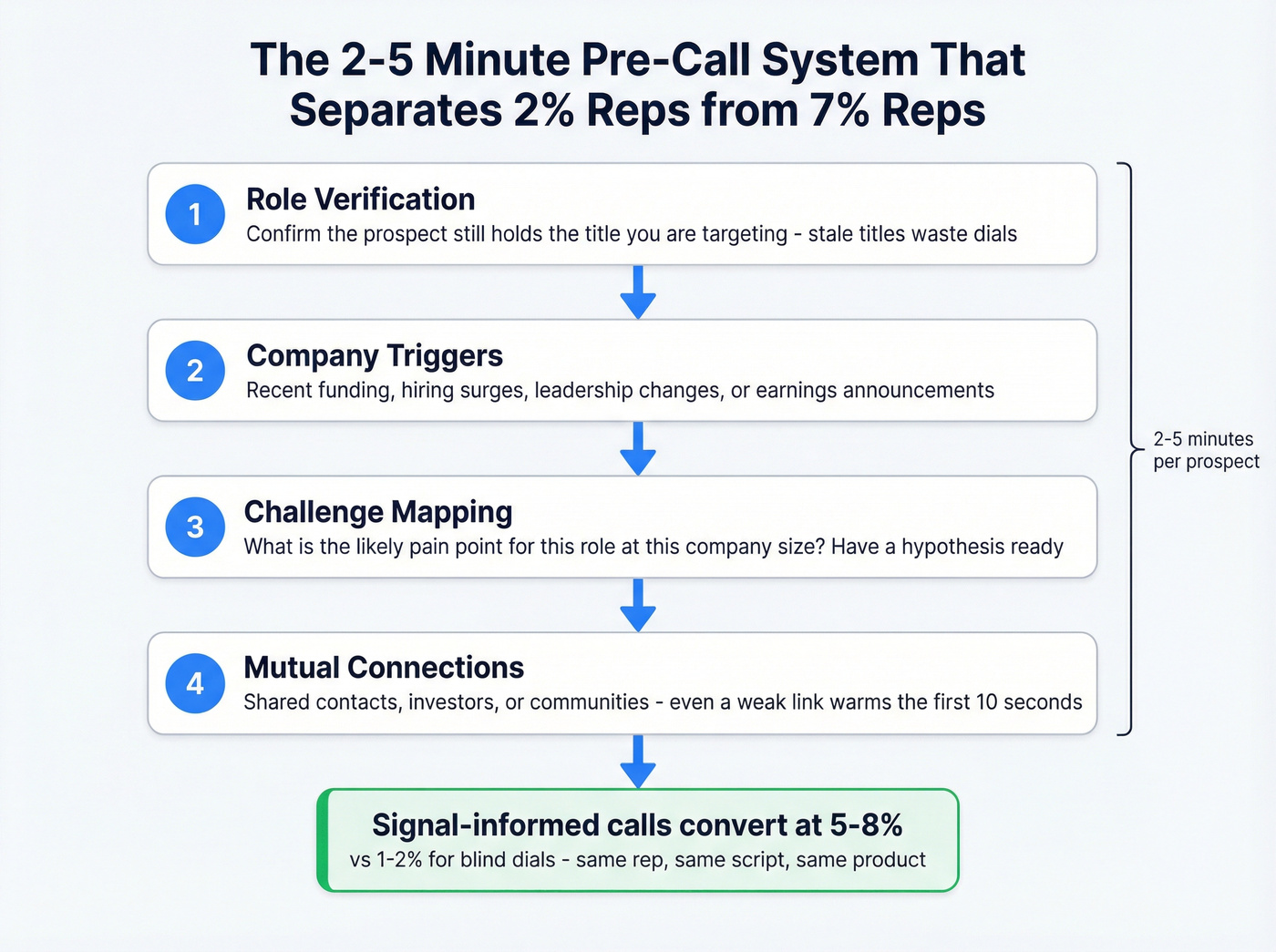
The 2-5 minutes you spend before each call are the highest-ROI minutes in your day. Some frameworks recommend 10-20 minutes per prospect, but that math doesn't work at 50+ dials per day. Two to five minutes is the sweet spot - enough to find a trigger, not so much that you're researching instead of dialing.
Here's the checklist that separates 2% reps from 7% reps:
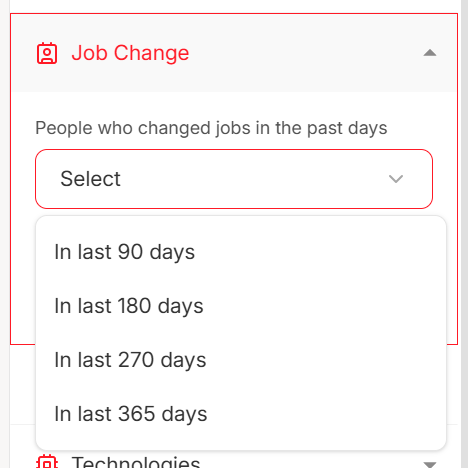
- Role verification: Confirm the prospect still holds the title you're targeting. People change jobs constantly - stale titles waste dials.
- Company triggers: Check for recent funding, hiring surges, leadership changes, or earnings announcements. These are your conversation starters.
- Challenge mapping: What's the likely pain point for someone in this role at this company size? Have a hypothesis before you dial.
- Mutual connections: Any shared contacts, investors, or communities? Even a weak connection warms the first 10 seconds.
Signal-informed calls convert at 5-8% versus 1-2% for blind dials. That's a 3-4x difference from the same rep, same script, same product - just better targeting. If you want a deeper workflow, use this pre-call research playbook.
We've seen this play out firsthand. Meritt, a sales team that switched to verified data, tripled their connect rate to 20-25% and saw their bounce rate drop from 35% to under 4%. The difference between a 4% and 13% connect rate is entirely a data problem - not a skills problem. (If you're seeing decay, this B2B contact data decay guide breaks down the benchmarks.)
The 3-Minute Call Framework
Keep your initial call under three minutes. That's not a suggestion - it's a structural constraint that forces you to be sharp.
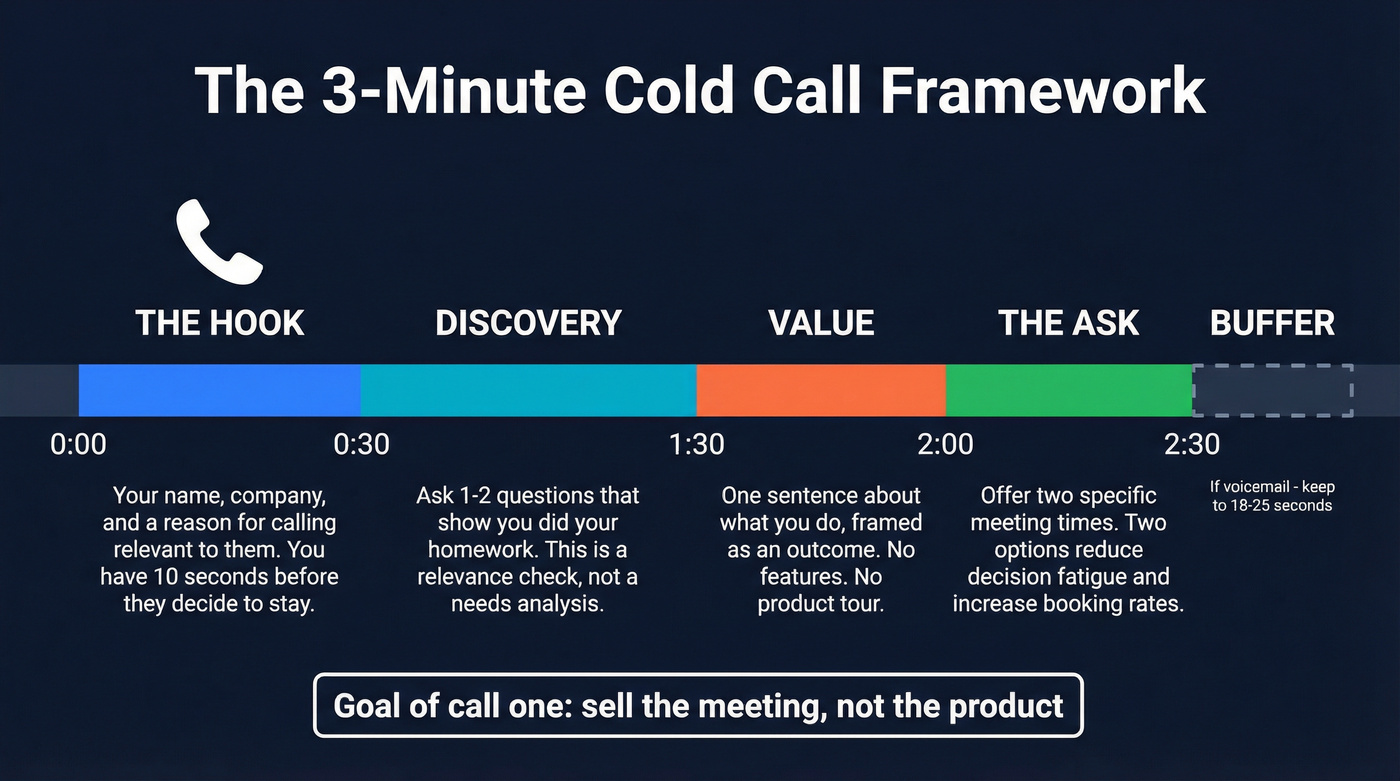
0:00-0:30 - The Hook. Your opener, your name, your company, and a reason for calling that's relevant to them. No throat-clearing. You have 10 seconds before they decide whether to stay on the line. (More options here: sales pitch opening lines.)
0:30-1:30 - Discovery. Ask one or two questions that demonstrate you've done your homework. "I noticed you're scaling the SDR team - are you finding it harder to maintain connect rates as you add reps?" This isn't a needs analysis. It's a relevance check. If you need prompts, borrow from these open-ended sales questions.
1:30-2:00 - Value. One sentence about what you do, framed as an outcome. Not features. Not a product tour. "We help teams like yours cut list-building time by 80% while tripling connect rates."
2:00-2:30 - The Ask. Offer two specific meeting times. "Would Thursday at 2 PM or Tuesday at 10 AM work for a 15-minute call?" Two options reduce decision fatigue and increase booking rates.
If you hit voicemail, keep it to 18-25 seconds. Name, company, one sentence of value, callback number. Longer voicemails don't get returned - they get deleted faster. For templates, see these cold call voicemail scripts.
Scripts That Actually Work
Openers With Data Behind Them
Your first sentence determines whether the next two minutes happen.
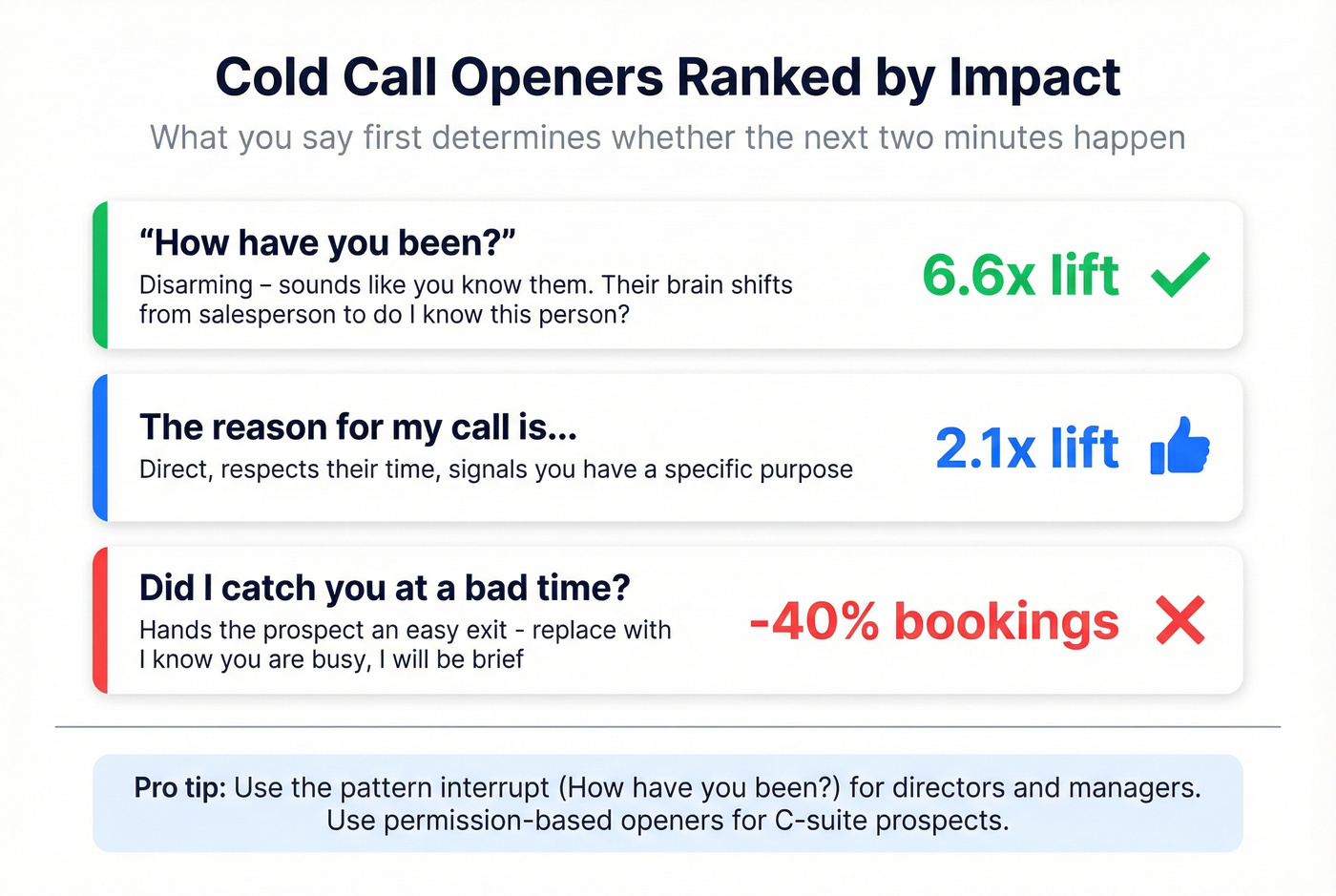
"How have you been?" delivers a 6.6x success lift. It works because it's disarming - it sounds like you know the person. The prospect's brain shifts from "salesperson" to "do I know this person?" and that buys you five more seconds.
"The reason for my call is..." delivers a 2.1x lift. It's direct, it respects their time, and it signals that you have a specific purpose.
"Did I catch you at a bad time?" kills meeting bookings by 40%. It hands the prospect an easy exit. Replace it with: "I know you're busy, I'll be brief - calling because..."
The permission-based opener works best on C-suite prospects, in our experience: "Mind if I take 30 seconds to tell you why I'm calling? Then you decide if it's worth continuing." It gives them control, which paradoxically makes them more likely to listen. For directors and managers, the pattern interrupt ("How have you been?") consistently outperforms.
Trigger-Based Scripts
Instead of calling cold, you call with context tied to a specific business event. This is the technique that separates top performers from the pack. (If you want to operationalize this, start with signal-based outbound.)
- Leadership change: "I saw you just stepped into the VP Sales role at [Company]. Teams in transition usually inherit a tech stack they didn't choose - is that the case for you?"
- Hiring surge: "You've posted 12 SDR roles in the last month. When teams scale that fast, data quality usually becomes the bottleneck. Is that something you're running into?"
- Funding round: "Congrats on the Series B. Most post-funding teams we work with are trying to ramp pipeline 3x without 3x the headcount."
- Competitive displacement: "I noticed [Competitor] just raised prices. A few of their customers have reached out to us - wanted to see if that's on your radar too."
These scripts convert at 5-8% because they demonstrate relevance before you ask for anything. The prospect knows you didn't pull their name from a random list.
Getting Past Gatekeepers
The cleanest approach we've seen: ask for the prospect by first name. "Hi, is Sarah available?" If the gatekeeper pushes back, use: "I'm following up on an email I sent last week." Simple, confident, and it sounds like an expected call rather than a cold one.
The better play, though, is to skip the gatekeeper entirely. Verified direct dials bypass the front desk altogether - which is why mobile number quality matters more than any gatekeeper script you'll ever memorize.

The article says it clearly: teams using verified contact databases see answer rates climb to 13.3% - triple the average. Prospeo gives you 125M+ verified mobile numbers with a 30% pickup rate, refreshed every 7 days. At $0.01 per email and 98% accuracy, bad data stops burning your dials.
Stop dialing dead numbers. Start every call with verified data.
Phone Outreach Across the Funnel
A common misconception is that cold calls only matter at the top of the funnel. In reality, you should be using the phone at every stage: re-engaging stalled deals, nudging prospects who went dark after a demo, and accelerating closed-won timelines by calling champions the day before a decision meeting.
Phone works at the top because it creates a human connection that email can't replicate. It works in the middle because a two-minute call can uncover a blocker that would take five email exchanges to surface. And it works at the bottom because urgency is best communicated through tone, not text.
If you're only dialing net-new prospects, you're underusing the most versatile channel in your stack.
Handling Objections - The LARA Framework
When a prospect says "I'm not interested," most reps either argue or fold. Both are wrong.
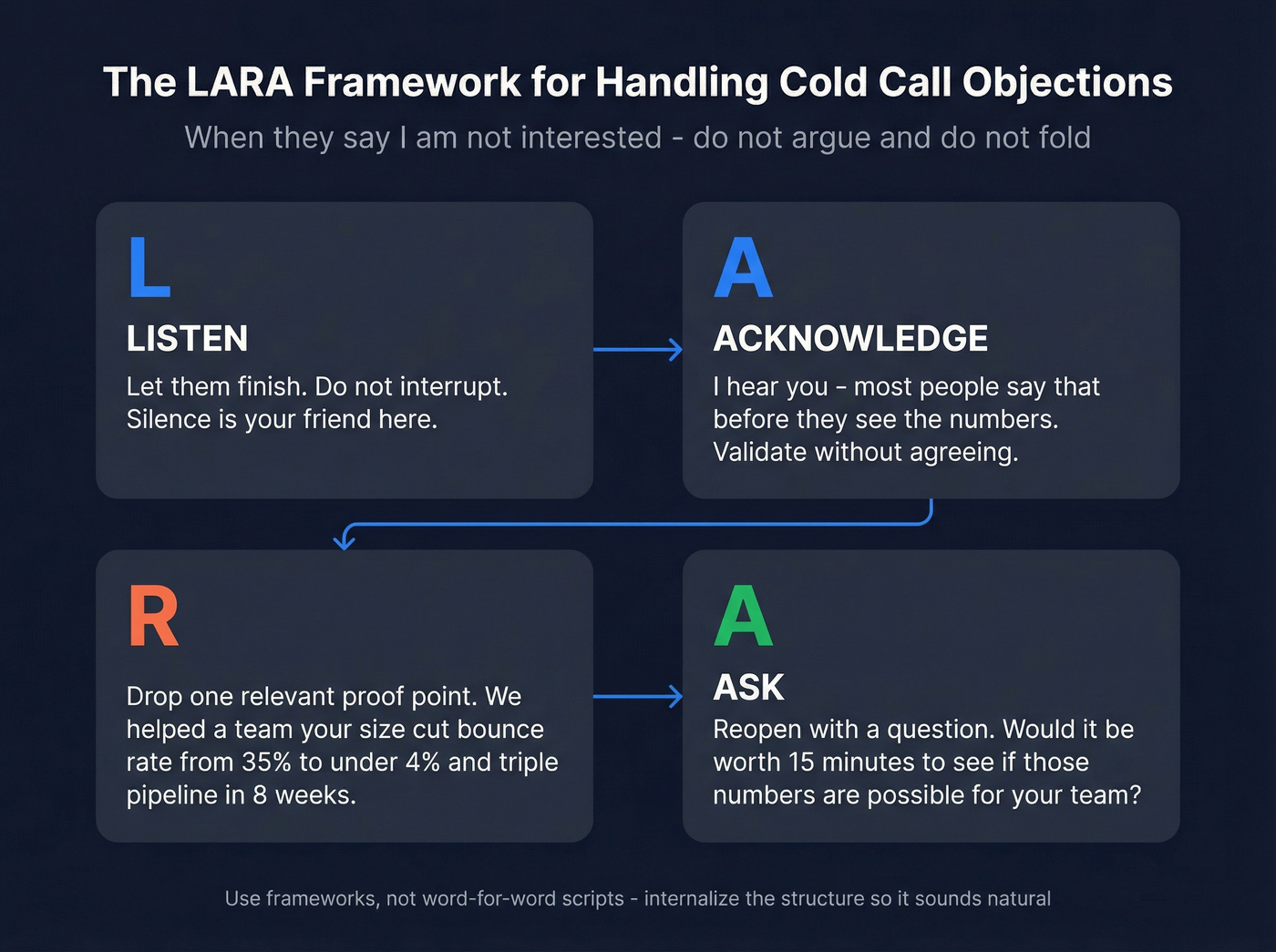
Listen - Let them finish. Don't interrupt.
Acknowledge - "I hear you - most people say that before they see the numbers." This validates their position without agreeing with it.
Respond - Drop one relevant proof point. "We helped a team your size cut their bounce rate from 35% to under 4% and triple their pipeline in 8 weeks."
Ask - Reopen with a question. "Would it be worth 15 minutes to see if those numbers are possible for your team?"
Use frameworks, not word-for-word scripts. The goal is to internalize the structure so it sounds natural, not rehearsed.
Mistakes That Kill Conversations
Here's the thing - most of these mistakes come from the same root cause: not enough preparation and too much talking.
"Is this Bob?" Use an assumptive opener instead: "Hi Bob, this is [Name] from [Company]." Asking if it's Bob triggers defensiveness and signals you don't actually know who you're calling.
"Did I catch you at a good time?" Replace with "I know you're busy, I'll be brief." The first version gives them permission to hang up.
Sounding scripted. Practice your scripts until they sound like conversation. Record yourself. If you sound like you're reading, you are. (This cold call tonality guide helps.)
Selling the product on call one. Sell the meeting. That's it. Every second you spend on features is a second the prospect is looking for an exit.
Talking too much. Aim for a 40/60 ratio. If you're speaking more than 40% of the call, you're pitching, not discovering.
Using stale data. Verify before dialing. Dead numbers, wrong titles, and departed employees don't just waste time - they destroy your confidence. After 20 bad dials, even good reps start phoning it in. If you want a KPI framework, start with prospect data accuracy.
Quitting after 1-2 attempts. 93% of conversions happen after 6+ follow-ups. The benchmark is 8-10 attempts per lead. Most reps give up after two. That's barely trying.
Building a Multichannel Cadence
Multichannel sequences outperform single-channel by 2.5x. Phone creates 3x more pipeline per touch than email, and prospects who take a call are 5x more likely to meet than those who only respond to email. But email and social touches warm the prospect before you dial, and that warmth matters.
A solid cadence runs 7-10 touchpoints over 30-45 days:
- Day 1: Email - personalized, trigger-based
- Day 2: Call attempt #1 + voicemail
- Day 4: Social touch - comment or connection request
- Day 6: Call attempt #2
- Day 8: Email #2 - different angle
- Day 11: Call attempt #3 + voicemail
- Day 15: Email #3 - case study or proof point
- Day 20: Call attempt #4
- Day 30: Final email
Your follow-up email is only as good as the address it's sent to. A 98% email accuracy rate keeps your bounce rate under 2% and your domain reputation intact. Prospeo handles this with a 7-day refresh cycle, so you're not sending to addresses that went stale three months ago. If you're tightening the email side too, use these cold email tactics.
On the deliverability side, warm up new domains for 2-3 weeks before sending. Set up SPF, DKIM, and DMARC. Cap cold emails at 30-40 per inbox per day. One bad week of bounces can tank a domain's reputation for months.
The 2026 Outbound Tech Stack
You need three things: a dialer, a data provider, and a sequencer. Here's what's worth your money:
| Category | Tool | Starting Price | Notes |
|---|---|---|---|
| Data | Prospeo | Free tier / ~$0.01/email | 125M+ mobiles, 30% pickup rate, 98% email accuracy |
| Data | Apollo | ~$49/user/mo | Large database, ~79% email accuracy |
| Data | ZoomInfo | ~$15K-$40K+/year | Enterprise-grade, high cost |
| Dialer | Allo | $18/user/mo | Lightweight, affordable |
| Dialer | Aircall | $30/user/mo (3-user min) | More integrations, AI add-ons |
| Dialer | Kixie | ~$35/user/mo | Power dialer focus |
| Sequencer | Instantly | ~$30/mo | Cold email + deliverability |
| Sequencer | Smartlead | ~$39/mo | Multi-inbox rotation |
| Recording | Gong | ~$100+/user/mo | Call coaching, pattern analysis |
| Recording | Avoma | ~$49/user/mo | Recording + AI summaries |
Apollo's database is massive, but email accuracy sits around 79%, which means higher bounce rates and more wasted dials. ZoomInfo is the enterprise standard, but a 10-seat contract with mobile numbers runs $25-40K/year - serious money for a team that just needs clean data and direct dials.
Let's be honest: ZoomInfo is still the most complete all-in-one platform. But most teams don't need all-in-one. They need accurate emails, working phone numbers, and a way to sequence outreach. You can build that stack for under $100/user/month with Prospeo for data, Aircall or Allo for dialing, and Instantly or Smartlead for sequencing. Save the enterprise contract for when you actually have enterprise problems. If you're comparing options, start with these sales prospecting platforms.
Signal-informed calls convert at 5-8% vs 1-2% for blind dials. Prospeo's 30+ filters - buyer intent, job changes, funding, headcount growth - let you build call lists loaded with triggers. Meritt tripled their connect rate to 20-25% after switching. Same team, better data.
Turn 52 daily dials into meetings, not voicemails.
Compliance Essentials
This isn't optional. One TCPA violation can cost more than your entire quarter's pipeline.
- TCPA (US): Maintain an internal Do Not Call list. Honor opt-out requests immediately. Document everything.
- GDPR (EU/UK): B2B cold calling can be done under legitimate interest, but you need to document your rationale and offer a clear opt-out.
- FTC regulations: Follow telemarketing rules, including caller ID requirements and time-of-day restrictions.
- Internal hygiene: Scrub your lists against DNC registries before every campaign. Use GDPR-compliant data providers that enforce opt-outs globally. For a practical outbound view, see GDPR for sales and marketing.
Real talk: compliance feels like friction until you get the letter. Then it feels like the most important process you never built.
FAQ
How many cold calls should I make per day?
52-60 dials is the benchmark for a full-time SDR. Fifty calls to verified numbers outperform 100 calls to a stale list every time. Track connect rate and meetings booked, not just dial count.
What's the best time to cold call?
Tuesday through Thursday, between 10 AM-12 PM and 2-5 PM in the prospect's time zone. Tuesday and Wednesday produce 44% of all demos, and late afternoon outperforms morning by 71%. Skip Friday - it's the worst day across every metric.
Is cold calling and prospecting still effective in 2026?
Yes. 69% of B2B buyers accept cold calls, 59% of senior executives prefer phone for initial contact, and signal-informed calling converts at 5-8%. The channel isn't dead - lazy, unresearched dialing is. Data quality and timing separate 2% reps from 7% reps.
What tools do I need for outbound prospecting?
A dialer (Allo or Aircall, from $18/user/mo), a verified data provider (free tier available, 98% email accuracy, 125M+ mobile numbers), and a sequencer for multichannel follow-up (Instantly or Smartlead, from ~$30/mo). Add a recording tool like Gong once you're past 20 calls per day.
How do I handle "I'm not interested" on a cold call?
Use the LARA framework: Listen fully, Acknowledge their position, Respond with one relevant proof point, then Ask a question that reopens the conversation. Never argue - redirect. The goal isn't to overcome the objection; it's to earn 30 more seconds of curiosity.