

How to Cold Email Investors (And Actually Get Replies)
Stop chasing warm intros. Mapistry cold-emailed Jason Lemkin and raised a $2.5M seed round. Factmata's founder cold-emailed Mark Cuban and walked away with $500K across two checks. If you're wondering how to cold email investors effectively, the answer is simpler than you think - substance over ceremony.
Before You Write: Investor Outreach Checklist
Nail these three things first:
- Use Michael Seibel's 3-sentence structure. What you do, why they should care, what you want. That's the entire email.
- Lead with traction, not your backstory. Specific traction numbers like MRR and growth rate get 2.8x more replies than vague, generic pitching.
- Verify every email address before sending. One bad batch can tank your domain reputation for weeks.
What Reply Rates to Expect
Cold investor emails average a 1-5% reply rate. That's the baseline - and honestly, it's brutal. But specific tactics multiply that number fast.
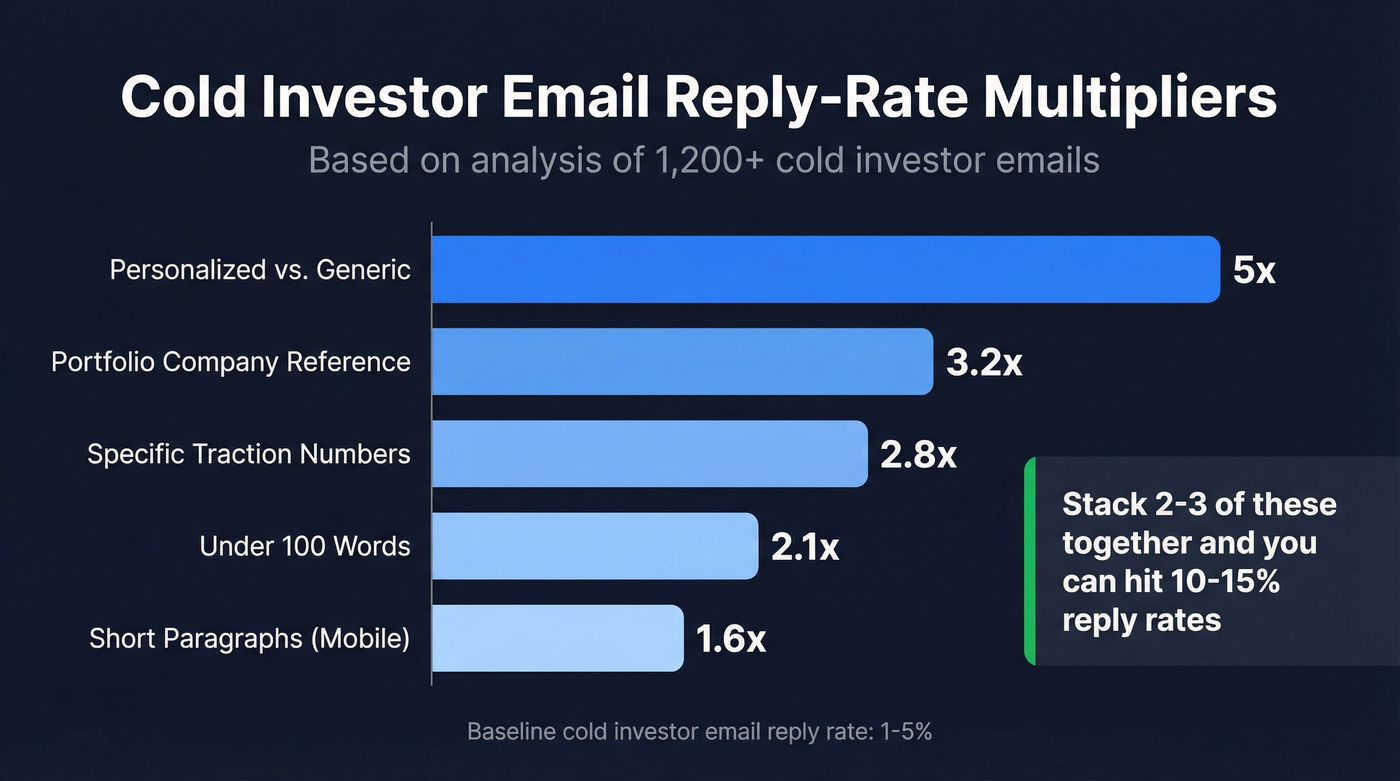
An analysis of 1,200+ cold investor emails found these response-rate multipliers:
| Tactic | Reply-Rate Multiplier |
|---|---|
| Personalized vs. generic | 5x |
| Portfolio company reference | 3.2x |
| Specific traction numbers | 2.8x |
| Under 100 words | 2.1x |
| Short paragraphs (mobile) | 1.6x |

Stack two or three of these together and you're looking at 10-15% reply rates. We've seen founders combine personalization with traction numbers and consistently land in that range, which is the difference between 50 emails producing zero conversations and 50 emails producing five real ones. The pattern behind every cold email win is always the same: short, specific, personalized.
The 3-Sentence Framework
Michael Seibel, YC partner, receives hundreds of emails daily. He reads about 250 and responds to roughly 50. His recommended structure is brutally simple:
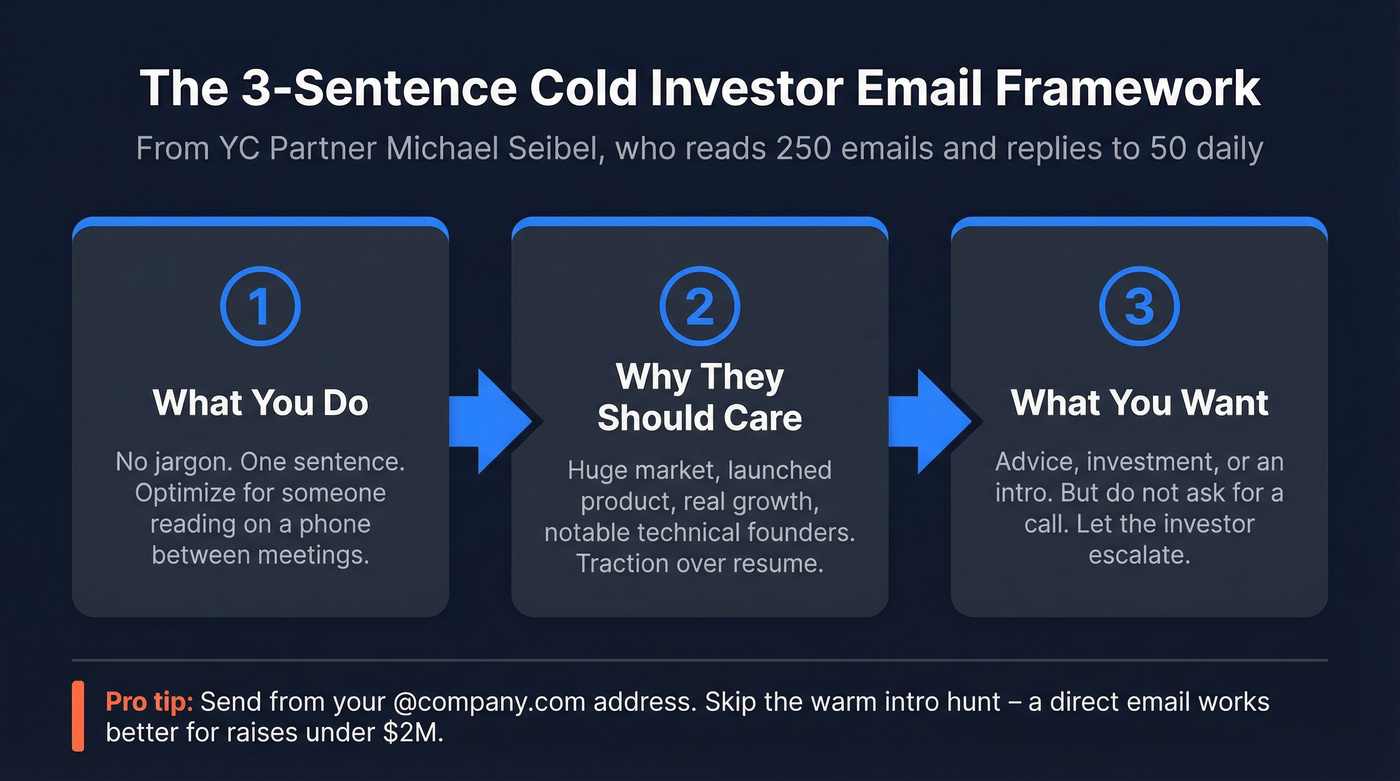
- What you do. No jargon. Optimize for someone reading on a phone between meetings.
- Why they should care. Huge market, launched product, real growth, notable technical founders. Seibel doesn't care about your resume, awards, or personal story at this stage - he cares about what you've built and whether it's working.
- What you want. Advice, investment, an intro - but don't ask for a call. Let the investor escalate. If they're interested, they'll suggest the meeting themselves.
Seibel also says founders waste too much time hunting warm intros when a direct email works better. Send from your @company.com address, keep it short, and let the traction speak.
Templates You Can Steal
Replace every bracket. Investors can smell a template from the first line.
Template 1: The Traction Bomb
Subject: [Company] - $[X]K MRR, [X]% MoM growth
Hi [First Name],
[Company] is [one sentence: what you do + for whom]. We're at $[X]K MRR growing [X]% month-over-month with [key proof point: customers, waitlist, partnerships].
We're raising a [$X] [stage] round - here's a 2-min Loom (no login required) and our deck. Would love your take.
[Your name]
Template 2: Thesis Alignment
This one uses the 3.2x multiplier from referencing a portfolio company. It works because it proves you've done your homework - and investors notice that immediately.
Subject: [Sector] thesis - [stage] startup
Hi [First Name],
Saw your investment in [portfolio company] - we're solving [adjacent problem] for [market]. [One traction sentence with specific numbers.]
Raising [$X] at [stage]. Here's a quick demo. Happy to share more if it fits your thesis.
[Your name]
Both templates stay around 100 words, lead with category and traction, and include a Loom demo link. A 2-minute walkthrough alongside your deck removes friction and shows you've built something real. Use these as starting points, then customize every line for the specific person you're reaching.

You're sending 50 cold emails to investors - you can't afford a single bounce. Prospeo's 5-step verification catches spam traps, honeypots, and invalid addresses before they torch your domain. 98% email accuracy at ~$0.01/email. Free tier covers your first outreach batch.
Verify your investor list before you hit send.
Subject Lines That Get Opened
A Belkins study of 5.5 million emails found that personalized subject lines hit 46% open rates vs. 35% without - and reply rates doubled from 3% to 7%. The 2-4 word sweet spot and question formats also hit 46%, so brevity and personalization are equally powerful. Beyond 9 words, opens drop to around 35%.
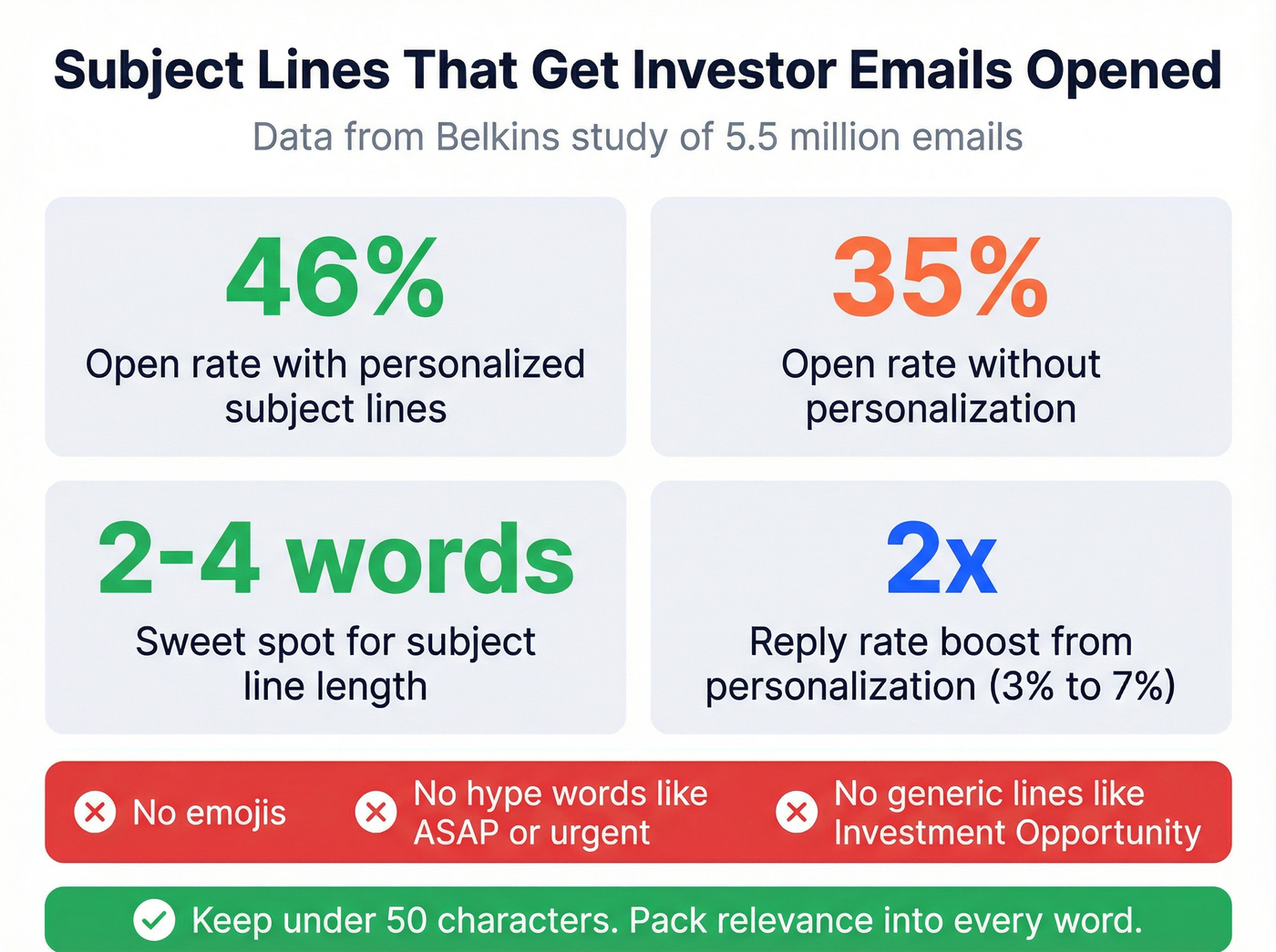
For investor emails, Thunder.vc recommends packing relevance into under 50 characters. Skip generic lines like "Investment Opportunity" - those get deleted on sight. No emojis. No hype language. Words like "ASAP" and "urgent" push open rates below 36%.
Here's the thing: if you're raising under $2M at pre-seed, you don't need a warm intro strategy. You need 50 well-crafted cold emails and a verified list. Warm intros are a luxury. Cold fundraising outreach is a skill, and skills compound.
Find and Verify Investor Emails
Start with Crunchbase to build your target list - filter by stage, sector, and recent activity. For investor-specific databases, Gritt.io maintains 45,000+ investor profiles with roughly 25,000 verified emails at plans from EUR40-150/mo.
Here's where most founders blow it: they find an email and hit send without verifying. If your bounce rate crosses 2%, email providers start filtering you to spam. The domain reputation damage from one bad batch takes weeks to recover from, and your follow-ups never land either.
We've watched founders torch their sender reputation in a single afternoon by skipping this step. Upload your investor list to Prospeo before sending - its 5-step verification flags invalid addresses, catches spam traps, honeypots, and filters honeypot addresses that would silently wreck your deliverability. At 98% email accuracy and a free tier covering 75 emails/month, it's sized right for a focused first outreach batch.
Founders lose weeks of fundraising momentum to domain reputation damage from one unverified batch. Prospeo flags catch-all domains, removes spam traps, and verifies every address in seconds - so your traction-packed cold emails actually reach investor inboxes. 75 free verifications/month, no credit card required.
Protect your sender reputation. Verify every investor email first.
Deliverability Checklist
Your email copy doesn't matter if it lands in spam. Before you send a single fundraising email:
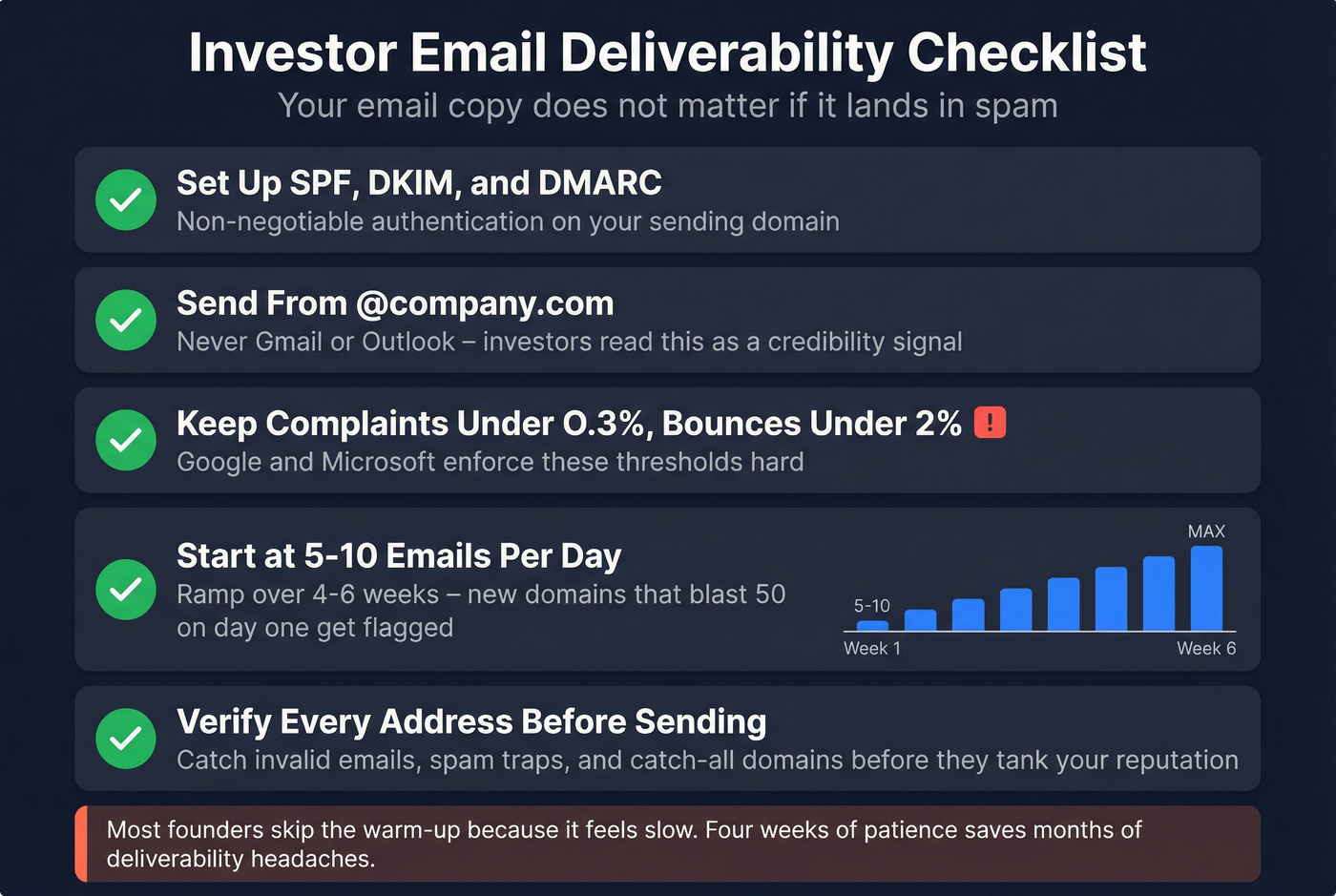
- Set up SPF, DKIM, and DMARC on your sending domain. Non-negotiable.
- Send from @company.com, never Gmail or Outlook. Investors read this as a basic credibility signal.
- Keep spam complaints under 0.3% and bounces under 2%. Google and Microsoft enforce these thresholds hard.
- Start at 5-10 emails per day. Ramp over 4-6 weeks. New domains that blast 50 emails on day one get flagged immediately.
- Verify every address before sending. Catch invalid emails, spam traps, and catch-all domains before they tank your reputation.
Let's be honest - most founders skip the warm-up period because it feels slow when you're trying to close a round. But we've seen too many outreach campaigns die on day three because the domain got flagged. Four weeks of patience saves months of deliverability headaches.
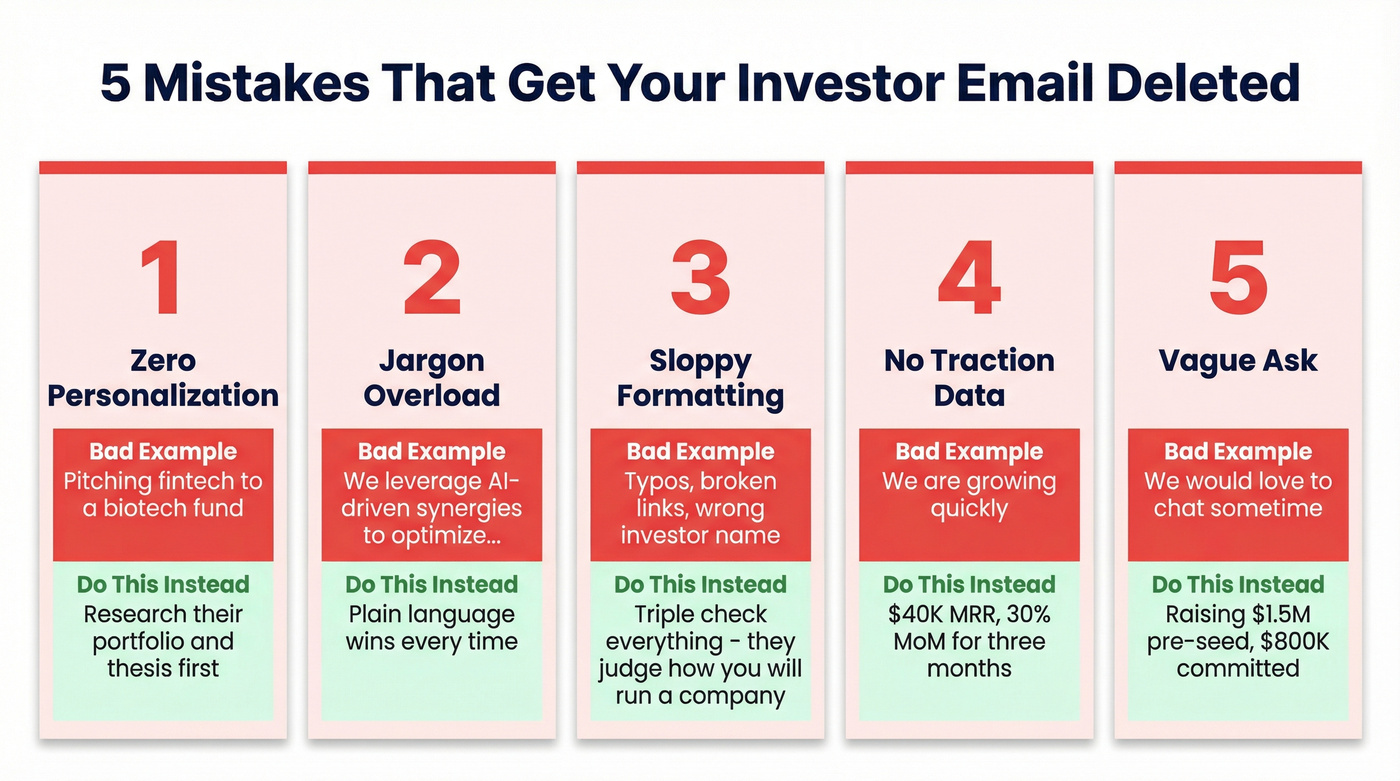
5 Mistakes That Get You Deleted
- Zero personalization. Pitching a fintech startup to a biotech-focused fund? Binned instantly. Research the investor's portfolio and thesis before you write a word.
- Jargon-filled problem statements. If your first sentence requires a glossary, you've lost them. Plain language wins every time.
- Grammar and formatting errors. Investors read typos, broken links, and wrong names as signals of how you'll run a company. Fair or not, that's the reality.
- No traction data. "We're growing quickly" means nothing. "$40K MRR, 30% MoM for three months" means everything.
- Vague ask. "We'd love to chat sometime" is easy to ignore. "Raising $1.5M pre-seed, $800K committed" gives them something concrete to act on.
One overlooked tip: batch your sends by investor type. Angels, micro-VCs, and institutional funds all respond to different signals. Tailor your traction line accordingly - an angel cares about the founder story and early product love, while a Series A fund wants to see a repeatable go-to-market motion.
FAQ
How long should a cold email to investors be?
Under 150 words, ideally closer to 100. Emails under 100 words get 2.1x more replies than longer ones. Three sentences is the sweet spot - anything longer signals you haven't distilled your pitch.
How many follow-ups should I send?
Send one follow-up at day 5-7 with a new data point - a new customer, a metric milestone, or a press mention. Don't just "bump" the thread; add value. After two unanswered follow-ups, move on to the next investor on your list.
Should I approach angel investors differently than VCs?
Yes. When reaching out to angels, lean into personal connection and product vision - angels often invest in founders they believe in. VCs want market size, defensibility, and a path to fund-returning outcomes. Adjust your traction line and ask accordingly.
How do I find and verify an investor's email?
Start with Crunchbase to identify targets by stage and sector, then run addresses through a verification tool before sending. Bounces above 2% damage your domain reputation and push future emails to spam - verification at 98% accuracy eliminates that risk before it starts.