

Best Sales Signals Platforms for 2026 (12 Picks)
A RevOps lead we know ran a three-tool bake-off last quarter. The sales signals platform with the deepest intent model surfaced 200 "in-market" accounts in week one. SDRs jumped on them - and 34% of the emails bounced because the contact data was four months stale. The cheapest tool in the test, the one nobody expected to win, had a 3% bounce rate and booked more meetings by day ten. Signals don't matter if you can't reach the people behind them.
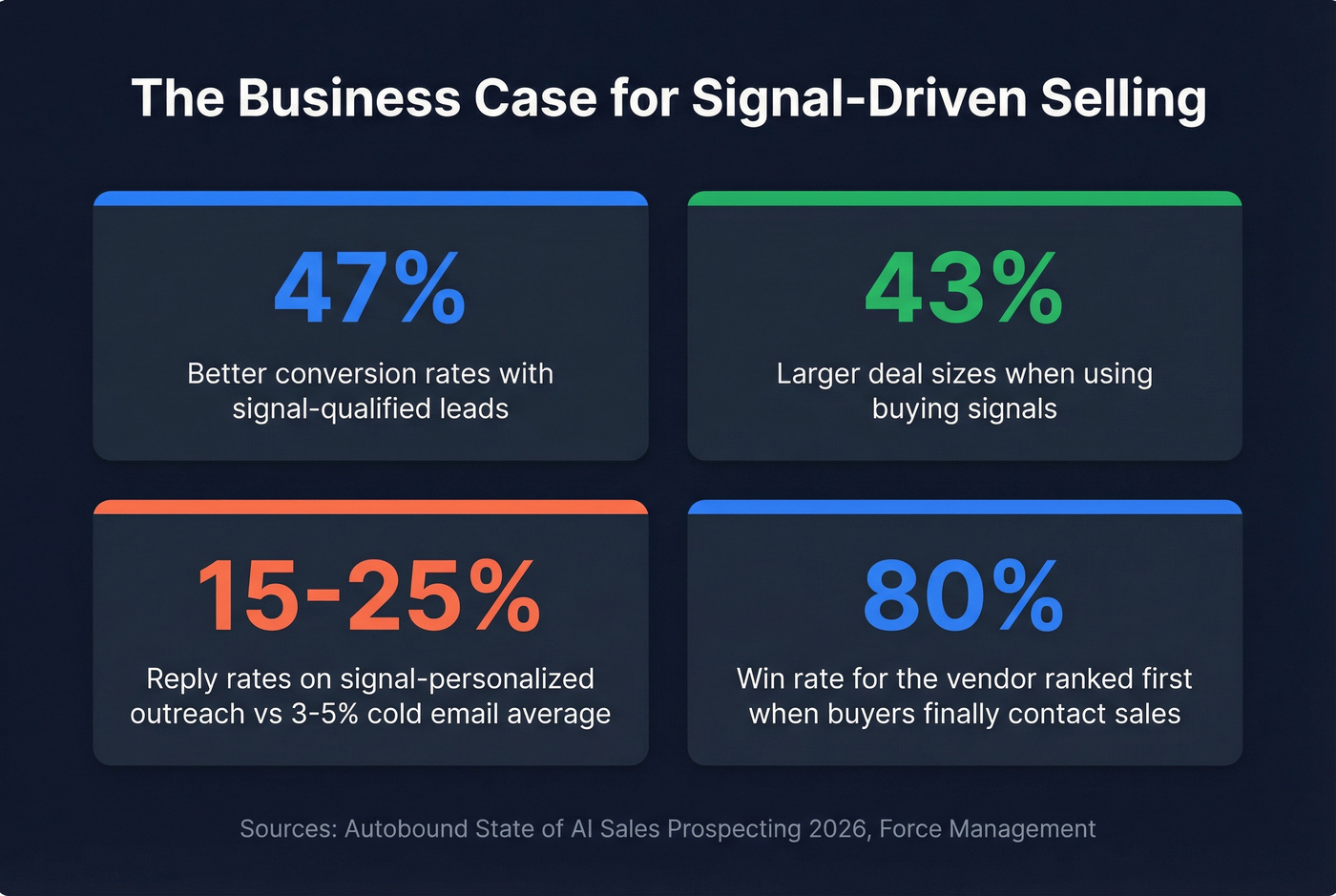
Buyers now contact sales roughly 61% through their decision process, and the vendor ranked first late in that process wins about 80% of the time. Teams acting on signal-qualified leads see 47% better conversion rates and 43% larger deal sizes. Signal-personalized outreach pulls 15-25% reply rates compared to the 3-5% cold email average. That's not a marginal improvement - it's a different sport entirely.
The question isn't whether you need sales signals. It's which platform gives you signals you can actually act on.
Our Picks
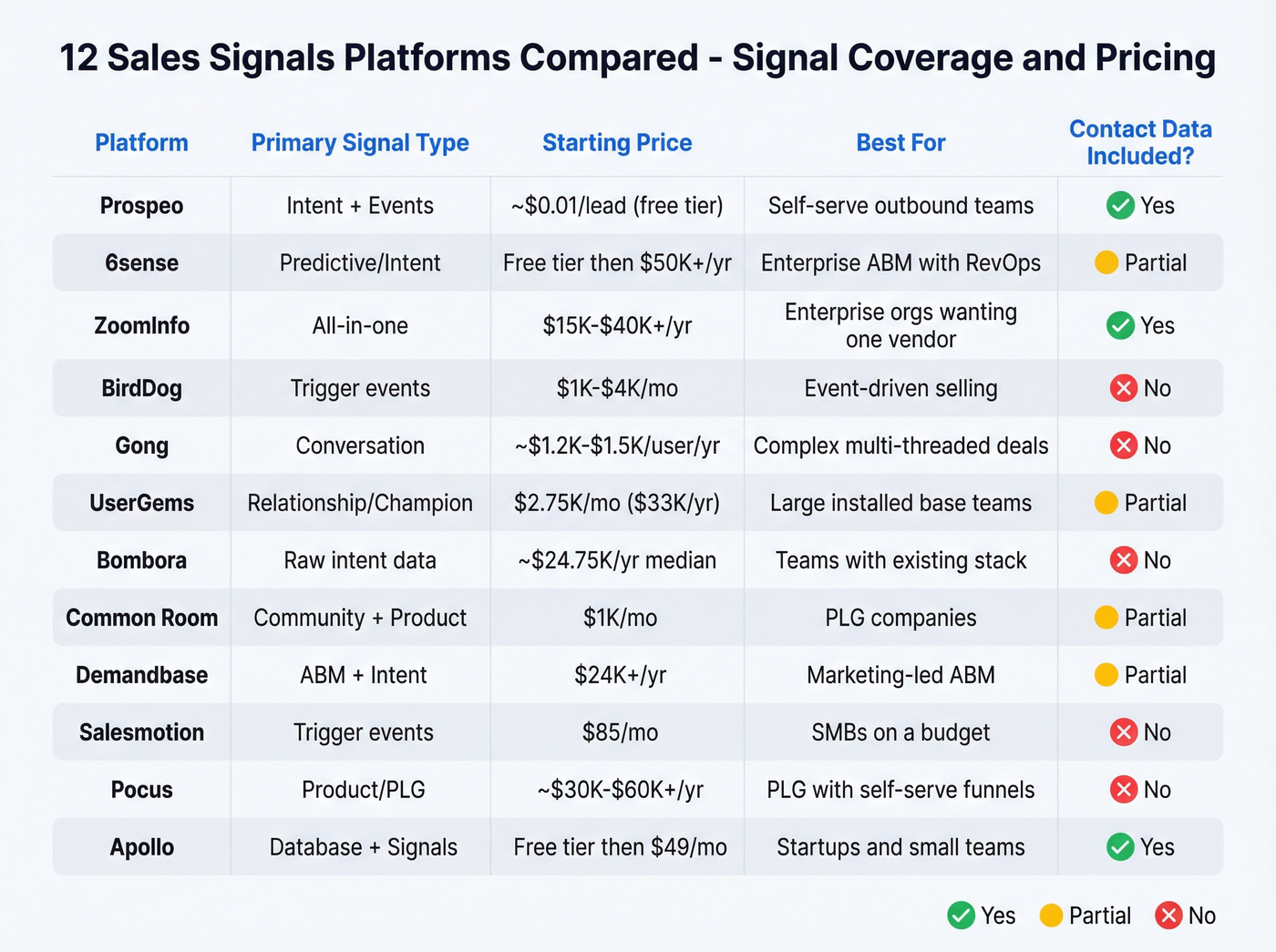
| Use Case | Pick | Why |
|---|---|---|
| Intent signals + verified contacts (self-serve) | Prospeo | 15,000 Bombora intent topics + 300M+ professional profiles at ~$0.01/lead |
| Enterprise ABM signal orchestration | 6sense | Deep predictive model with free tier entry - budget $50K+/yr for real use |
| Trigger/event signals on a budget | Salesmotion | Real-time business event monitoring from $85/mo, unlimited users |
| Conversation signals | Gong | 300+ AI signal types from live sales calls and emails |
What Is a Sales Signals Platform?
A sales signals platform monitors behavioral, firmographic, and contextual data to tell you which accounts are likely to buy - and when to reach out. ZoomInfo frames this as the intersection of contact data, firmographics, technographics, buyer intent, and trigger events. That's a useful framework, but the category now extends well beyond database lookups.
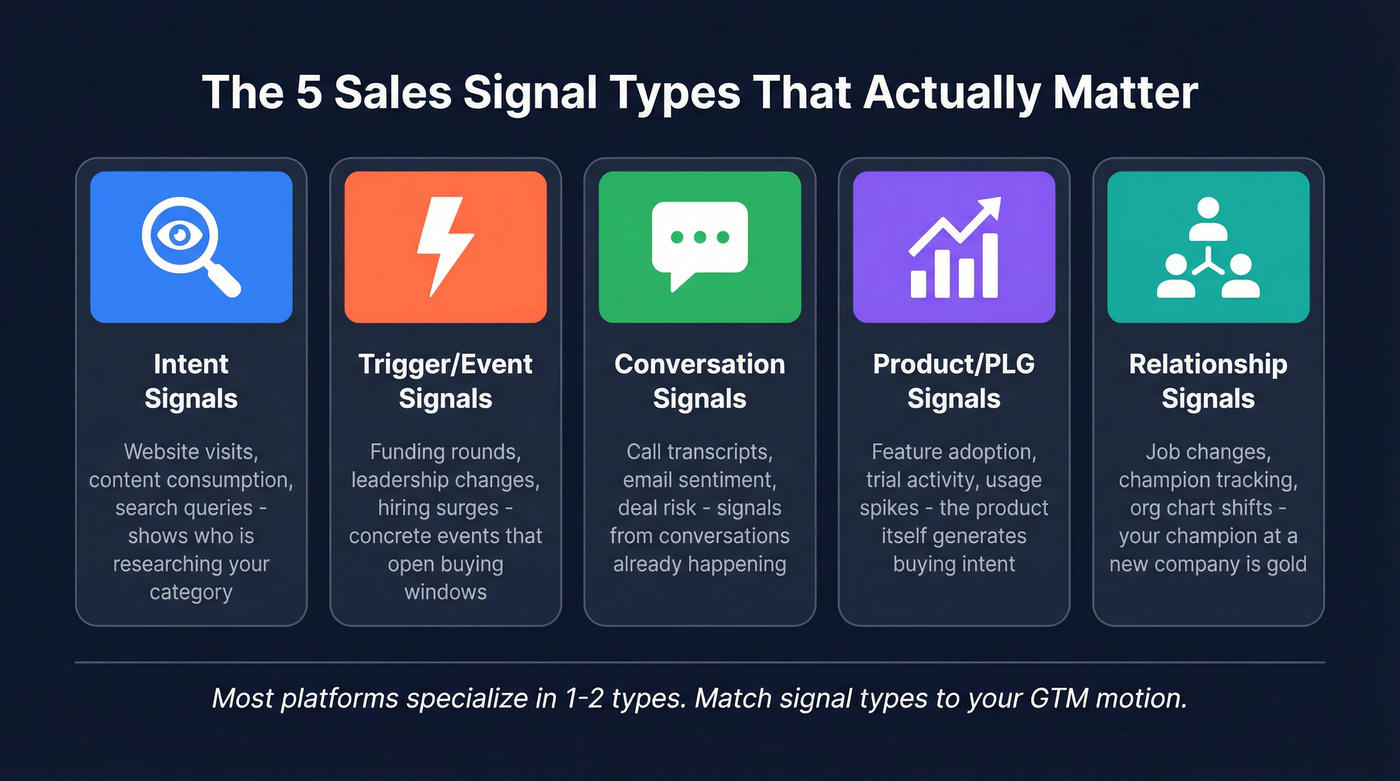
Five signal types actually matter:
Intent signals - website visits, content consumption, search queries. These tell you an account is researching your category. A dedicated intent detection tool can track this activity across thousands of B2B sites simultaneously.
Trigger/event signals - funding rounds, leadership changes, hiring surges, earnings surprises. Concrete business events that create buying windows. (If you want the ops playbook, see track sales triggers.)
Conversation signals - call transcripts, email sentiment, deal risk indicators. Gong owns this space. The signals come from conversations you're already having, not external monitoring.
Product-usage/PLG signals - feature adoption, trial activity, usage spikes. Critical for product-led companies where the product itself generates buying intent.
Relationship signals - job changes, champion tracking, org-chart shifts. When your champion moves to a new company, that's one of the highest-converting signals in B2B.
Traditional company-level intent data is noisy - it tells you a company is researching, but not who or why. That noise is exactly why pairing signals with contact-level verification matters. Most platforms specialize in one or two of these categories. The few that try to cover all five tend to do none of them exceptionally well. Match signal types to your GTM motion - don't buy the platform with the longest feature list.
12 Best Signal-Based Selling Tools for 2026
Prospeo - Intent Signals + Verified Contacts
Prospeo is the rare platform where buying signals and verified contact data live in the same self-serve tool. Layer 15,000 Bombora intent topics with 30+ search filters - job changes, headcount growth, technographics, funding events - and you're building lists of in-market buyers with verified ways to reach them.
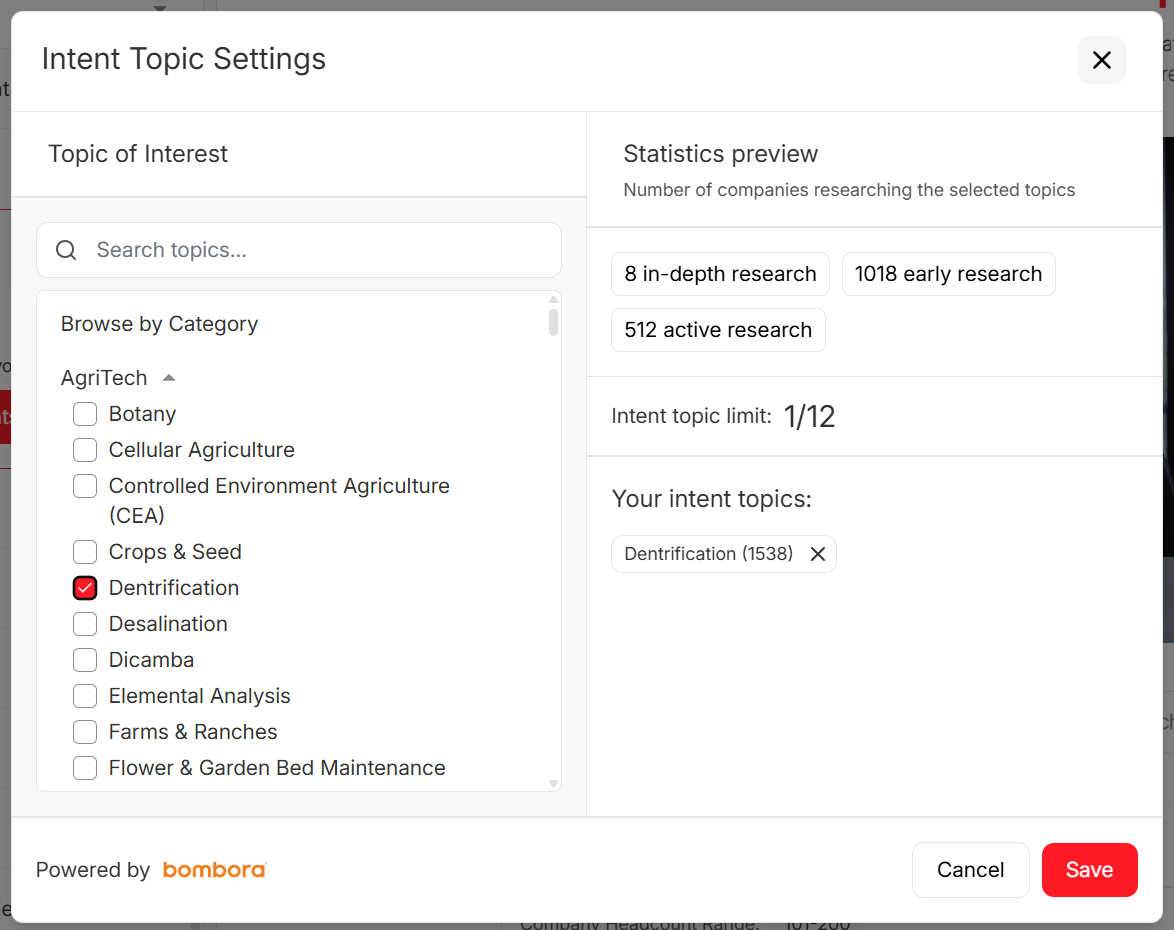
The database covers 300M+ professional profiles, 143M+ verified emails, and 125M+ verified mobile numbers, all on a 7-day refresh cycle. Email accuracy sits at 98%, and mobile pickup rates run 30% across regions. Snyk's sales team saw bounce rates drop from 35-40% to under 5% after switching, with AE-sourced pipeline climbing 180%.
Pricing is the standout: ~$0.01 per lead, free tier with 75 emails per month, no annual contracts. For context, that's roughly 90% cheaper per lead than ZoomInfo. Where ZoomInfo bundles signals inside a $15K+ annual contract, Prospeo gives you intent data and verified contacts on a self-serve, pay-as-you-go model. Best for teams that need to detect buying signals and act on them immediately - without waiting for a procurement cycle. (If bounce rate is your pain point, pair this with an email validator.)
6sense - Predictive ABM Orchestration
6sense's predictive AI model is genuinely impressive. It scores accounts by buying stage, surfaces anonymous web visitors through its identification engine, and recommends next-best actions - all powered by a machine learning engine trained on billions of intent signals. The free tier is real: 50 data credits per month, company and people search, sales alerts, and a Chrome extension. That's enough to evaluate the product before committing budget.

The problem is the gap between the free tier and a real deployment. Paid plans bundle predictive dashboards, Sales Copilot, and AI-recommended actions, but expect to budget $50K-$120K+ per year for a mid-market implementation. You'll also need RevOps support to configure scoring models and integrate with your CRM and sequencer. (If you're comparing vendors, this 6sense vs ZoomInfo breakdown helps.)
Where 6sense wins over ZoomInfo: predictive account scoring and anonymous visitor identification are more sophisticated. Where ZoomInfo still wins: database breadth and simpler onboarding. 6sense is best suited for teams with dedicated RevOps resources and at least 50 reps. Skip it if you don't have someone tuning the models full-time.
ZoomInfo - All-in-One Enterprise Data
ZoomInfo remains the default. 500M+ contact profiles, 100M+ company profiles, and 1B+ buying signals processed monthly. It bundles intent data, trigger events, technographics, and a full engagement suite under one roof.
Here's the thing: you're paying for all of it whether you use it or not. Typical annual investment runs $15K-$40K+ depending on users, credits, and add-ons - and that's before you add modules. The most common complaint on r/sales? Price - specifically, paying for features you never activate.
At roughly $1 per lead, the per-contact cost is steep for high-volume outbound teams. (If you're building a lean stack instead, start with this sales prospecting platforms guide.)
Use this if you're an enterprise org already embedded in the ZoomInfo ecosystem and need one vendor for everything. Skip it if you're a Series A company or an outbound agency where data accuracy and cost-per-lead matter more than platform breadth.
BirdDog - Real-Time Business Events
BirdDog monitors news, earnings filings, job postings, and company websites for trigger events - then delivers them to your CRM, Slack, or Teams with sourced context. The company reports 900% revenue growth in 2025 and a 2X win rate for customers.
Pricing starts at $1,000/month and runs around $4,000/month for a team of 25 reps. Best for teams that sell on business events like M&A, leadership changes, or expansion announcements. Compared to ZoomInfo's trigger events, BirdDog goes deeper on real-time monitoring but doesn't include a contact database - you'll need a separate data provider.
Gong - Conversation Signals
Gong extracts 300+ AI signal types from sales calls and emails - deal risk, competitor mentions, pricing objections, champion sentiment, next-step commitments.
It's not a prospecting tool. It's a deal intelligence layer that tells you what's happening inside active opportunities. Pricing runs ~$1,200-$1,500 per user per year at enterprise scale. Best for mid-market and enterprise teams running complex, multi-threaded sales cycles. Gong only captures signals from conversations you're already having, so pair it with an intent or trigger tool for full-funnel coverage.
UserGems - Champion Tracking
UserGems tracks when your champions, closed-won contacts, and power users change jobs, then surfaces them as warm leads at their new company. A former buyer who already trusts your product is 3-5X more likely to purchase again - making this one of the highest-converting signal types in B2B. (For templates and timing, use this job change sales outreach playbook.)
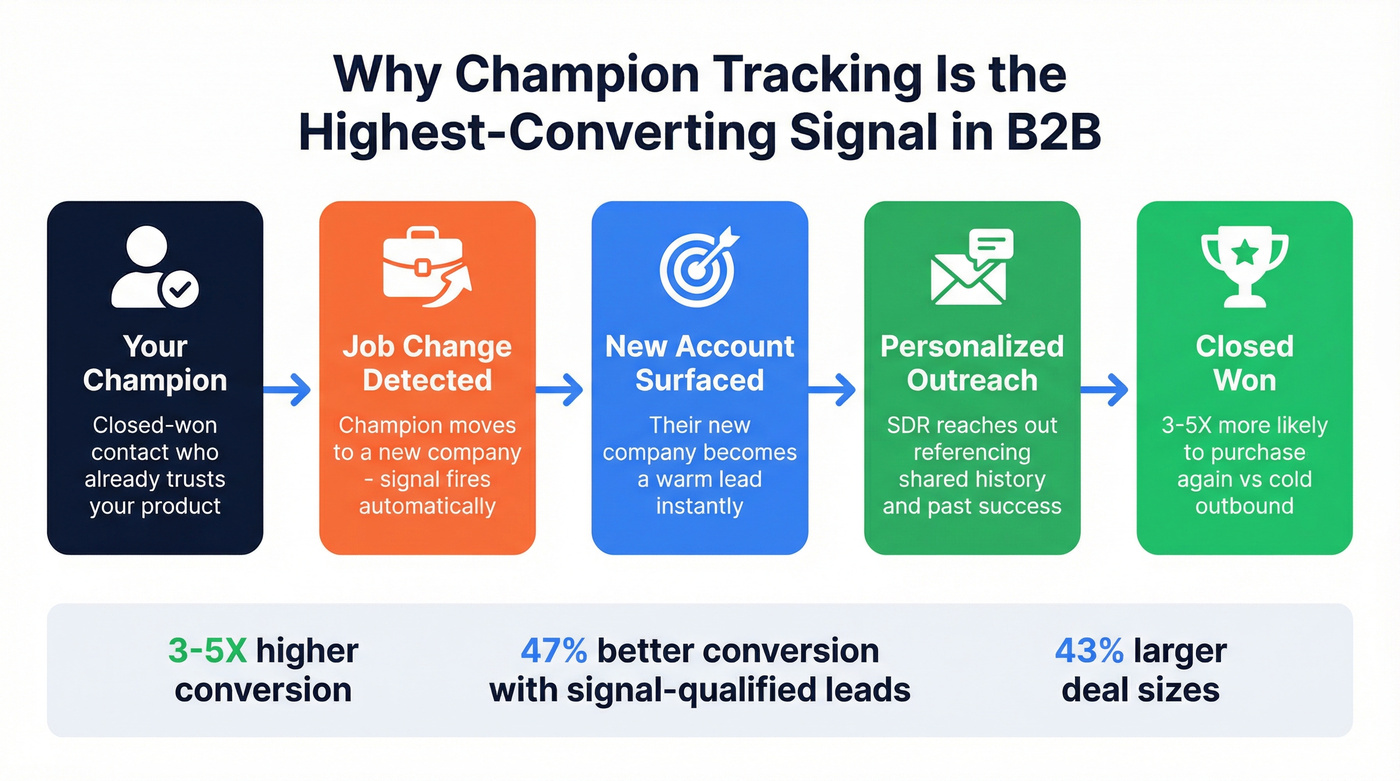
Core tier runs $2,750/mo ($33K/yr) plus a $3K implementation fee. Advanced is $5,750/mo; Elite hits $10,000/mo. All tiers include a revenue guarantee - 1X closed-won ROI on Core, or your money back. UserGems stands out because it focuses on a single, high-intent data point and executes it exceptionally well. Best for teams with a large installed base and long sales cycles. At $36K+ all-in for Core, it's a tough sell for teams under 20 reps.
Bombora - Raw Intent Data at Scale
Bombora runs one of the biggest intent data cooperatives in B2B. Company Surge tracks topic-level research activity across thousands of B2B websites.
The median buyer pays $24,750/year based on 34 Vendr purchases, with a range from $12K to $80K+. Enterprise deployments can hit $100K-$300K. Annual contracts only.
Best for teams that want raw intent data piped into their existing stack. Bombora delivers company-level signals only - no contact-level data included. You'll need a separate provider to turn "Company X is researching your category" into a verified email for the VP of Engineering. (If you're trying to operationalize this, see how to measure intent data.)
Common Room - Community & Product Signals
Common Room aggregates signals from community platforms, product usage, GitHub activity, job changes, and hiring trends. Starter plan runs $1,000/month (annual) for 35K contacts and 2 seats, including 240K IP enrichments per year. Team and Enterprise tiers are custom-priced.
Best for PLG companies tracking community engagement and product adoption signals. Less useful for outbound-first teams without a community or product-led motion.
Demandbase - Enterprise ABM + Intent
Enterprise ABM suite with intent data. Starts around $24K/year; enterprise deployments run $50K-$150K+. Best for large marketing-led ABM programs. Overlaps heavily with 6sense - if you're evaluating both, the decision usually comes down to which vendor's predictive model your team trusts more and which integrates better with your existing martech. (More on ABM planning: account-based marketing plan.)
Salesmotion - Budget-Friendly Event Signals
Monitors business events like funding rounds, hiring surges, and leadership changes from $85/month. Unlimited users on team plans. This is the most accessible entry point for event-driven selling on our list, and the best option for SMBs that want trigger-based outreach without enterprise budgets.
Pocus - PLG Signal Orchestration
Designed for product-led growth teams. Combines product-usage data with CRM signals to surface sales-ready accounts. Custom pricing, estimated ~$30K-$60K+ per year. Best for PLG companies with self-serve funnels where product data is the primary buying signal.
Apollo - Database + Engagement
Large contact database with built-in sequencing and basic intent signals. Free tier available; Professional runs $99/user/month (annual). Best for early-stage teams wanting an all-in-one outbound tool. The data quality doesn't match specialized providers - we've seen email accuracy around 79% - but the price-to-feature ratio is hard to beat when you're just getting started.
Notable Mentions
Three platforms appear frequently in sales signals conversations but didn't make our 12 because they're engagement platforms with signal features, not signal-first tools. Salesloft and Outreach both surface deal and engagement signals, but their core value is sequencing and workflow - signals are a secondary layer. Momentum captures signals from Salesforce and Slack to automate deal workflows, and Unify aggregates intent data into a unified outbound orchestration layer. If you already run one of these for engagement, their signal features are probably enough. For teams that need signals as the primary capability, the 12 tools above are purpose-built for it.

Intent signals paired with stale contacts is the most expensive mistake in outbound. Prospeo combines 15,000 Bombora intent topics with 300M+ profiles verified on a 7-day refresh cycle - 98% email accuracy, 30% mobile pickup rate. Snyk's 50 AEs dropped bounce rates from 35% to under 5% and grew pipeline 180%.
Detect buying signals and reach verified buyers in the same platform - at $0.01/lead.
Signal Coverage Matrix
Not every platform covers every signal type. This matrix breaks trigger/event signals into subcategories so you can see exactly where each tool delivers:
| Tool | Web Intent | Funding | Hiring | Leadership | M&A / Earnings | Conversation | Product-Usage | Job-Change |
|---|---|---|---|---|---|---|---|---|
| 6sense | ✓ | ✓ | ✓ | ✓ | - | - | - | ✓ |
| ZoomInfo | ✓ | ✓ | ✓ | ✓ | ✓ | - | - | ✓ |
| BirdDog | - | ✓ | ✓ | ✓ | ✓ | - | - | - |
| Gong | - | - | - | - | - | ✓ | - | - |
| UserGems | - | - | - | - | - | - | - | ✓ |
| Bombora | ✓ | - | - | - | - | - | - | - |
| Common Room | - | - | ✓ | - | - | - | ✓ | ✓ |
| Demandbase | ✓ | ✓ | - | ✓ | - | - | - | - |
| Salesmotion | - | ✓ | ✓ | ✓ | ✓ | - | - | - |
| Pocus | - | - | - | - | - | - | ✓ | - |
| Apollo | ✓ | - | - | - | - | - | - | ✓ |
Pricing Comparison
| Tool | Starting Price | Enterprise Range | Contract |
|---|---|---|---|
| Prospeo | Free (75 emails/mo) | ~$0.01/lead, scales | No contract |
| 6sense | Free (50 credits/mo) | $50K-$120K+/yr | Annual |
| ZoomInfo | ~$15K/yr | $25K-$60K/yr | Annual |
| BirdDog | $1,000/mo | ~$4,000/mo (25 reps) | Annual |
| Gong | ~$1,200/user/yr | $1,500/user/yr | Annual |
| UserGems | $2,750/mo + $3K impl. | $10,000/mo | Annual |
| Bombora | ~$25K/yr (median) | $100K-$300K/yr | Annual |
| Common Room | $1,000/mo | Custom | Annual |
| Demandbase | ~$24K/yr | $50K-$150K+/yr | Annual |
| Salesmotion | $85/mo | Custom | Monthly avail. |
| Pocus | ~$30K/yr est. | $60K+/yr | Annual |
| Apollo | Free tier | $99/user/mo (Pro) | Monthly avail. |
The spread is enormous. You can start with Salesmotion for under $100/month, or you can spend six figures on 6sense or Demandbase. The right budget depends entirely on your signal strategy and team size - not on which vendor has the best sales deck.
Why Signals Fail Without Clean Data
Here's a scenario we've seen play out dozens of times. An intent signal fires: "Company X is researching your category." The SDR pulls up the account, finds the VP of Marketing in the database, and fires off a personalized email referencing the research topic. The email bounces. The VP left four months ago.
The signal was real. The data was dead.
This is the dirty secret of the signals category. Most platforms refresh contact data every 4-6 weeks. Some are worse. By the time an intent signal reaches your SDR, the contact behind it has often changed roles, left the company, or switched email addresses. The signal was accurate - the execution failed because the data layer couldn't keep up.
Data freshness is the evaluation criterion nobody discusses in signal platform comparisons, and it should be the first thing you ask about. A 7-day refresh cycle means that when a signal fires, the contact data is current - not six weeks stale. We've seen teams cut bounce rates from 35%+ to under 5% just by switching their data layer. The gap between "signal detected" and "meeting booked" is almost always a data quality problem, not a signals problem.
Most sales signals platforms charge $15K+ before you see a single intent topic. Prospeo gives you intent data, job change alerts, technographics, and 30+ filters on a self-serve, no-contract plan. Layer buyer signals with verified emails and direct dials - no procurement cycle required.
Stop paying enterprise prices for signals you can act on today.
How to Choose the Right Platform
Before you demo anything, answer five questions.
What signal types matter for your GTM motion? If you're running outbound into cold accounts, intent and trigger signals matter most. For PLG teams, product-usage signals are the priority. Don't buy a conversation intelligence tool when you need intent data. (If you're building the motion, start with signal-based outbound.)
Does it include verified contact data, or do you need a separate provider? Most signal platforms surface accounts, not contacts. If you're buying Bombora or 6sense, budget for a data provider on top. (This is where B2B contact data decay quietly kills ROI.)
What's the real cost per actionable signal? A $50K intent platform that surfaces 500 accounts per month costs $100 per signal. A $1K/month trigger tool that surfaces 200 events costs $5 per signal. Do the math before you sign.
How fresh is the data? Ask every vendor for their refresh cycle SLA. If they can't give you a number, assume it's six weeks or worse. Reddit threads on r/sales are full of teams who bought a signals tool and then discovered the contact data underneath was months stale.
Can your reps actually use it? 6sense is powerful, but it needs a dedicated admin. Salesmotion is self-serve from day one. Match the tool's complexity to your team's operational maturity - the signal-to-action gap widens fast when reps can't navigate the platform without RevOps hand-holding.
Let's be honest: if your average deal size is under $10K, you probably don't need a dedicated signals platform at all. You need clean data, a basic trigger feed, and a disciplined outreach process. The platform is just plumbing. Start with a clear signal strategy and build the stack around it - not the other way around.
FAQ
What's the difference between intent data and a sales signals platform?
Intent data is one type of sales signal - it tracks online research behavior like content downloads and search queries. A sales signals platform is the broader category that includes trigger events, conversation intelligence, job changes, and product-usage data. Intent data tells you someone's researching; the full platform tells you why they're likely to buy and when to act.
Do I need a signals tool AND a separate data provider?
Usually, yes. Most signal-focused tools surface accounts but don't include verified contact data. Without verified contacts, signals are interesting information you can't act on. Prospeo, ZoomInfo, and Apollo bundle both - check the signal coverage matrix above to see which include verified emails and direct dials alongside signal data.
What's a realistic budget for signal intelligence software?
Self-serve tools start at $85/month or free. Mid-market intent platforms run $25K-$60K/year. Enterprise ABM suites like 6sense and Demandbase cost $50K-$150K+ annually. Match your budget to your signal strategy and team size, not the vendor's packaging.
How do I measure ROI on a signals platform?
Track three metrics: reply rate on signal-triggered outreach vs. cold, time-to-first-meeting for signal-sourced accounts, and pipeline generated per dollar spent. Signal-personalized outreach typically achieves 15-25% reply rates versus 3-5% cold - that delta is your ROI proof point.
Can small teams use sales signals without enterprise budgets?
Absolutely. Salesmotion starts at $85/month with unlimited users. Prospeo's free tier includes 75 verified emails plus intent data access. 6sense offers 50 free credits monthly. You don't need a six-figure budget - you need a clear process for acting on signals and clean enough data to actually reach the people behind them.