

Cold Email vs Spam: The Line Is Thinner Than You Think
Spamhaus - the organization behind the blocklists inbox providers actually pay attention to - published a position piece with a headline that should make every outbound team squirm: "Cold emailing, as it's practiced today, is spam." Not some of it. Not the lazy stuff. Cold emailing as practiced today. Hunter.io's analysis of 11 million cold emails puts the average reply rate at 4.1%, which means 95.9% get ignored and a meaningful chunk get reported. So where does the cold email vs spam line actually fall?
It's thinner than most sales teams want to admit, and it has almost nothing to do with your subject line.
The Short Answer
Legally, cold email is permitted in the US under CAN-SPAM - no prior consent required. The EU is stricter under GDPR.
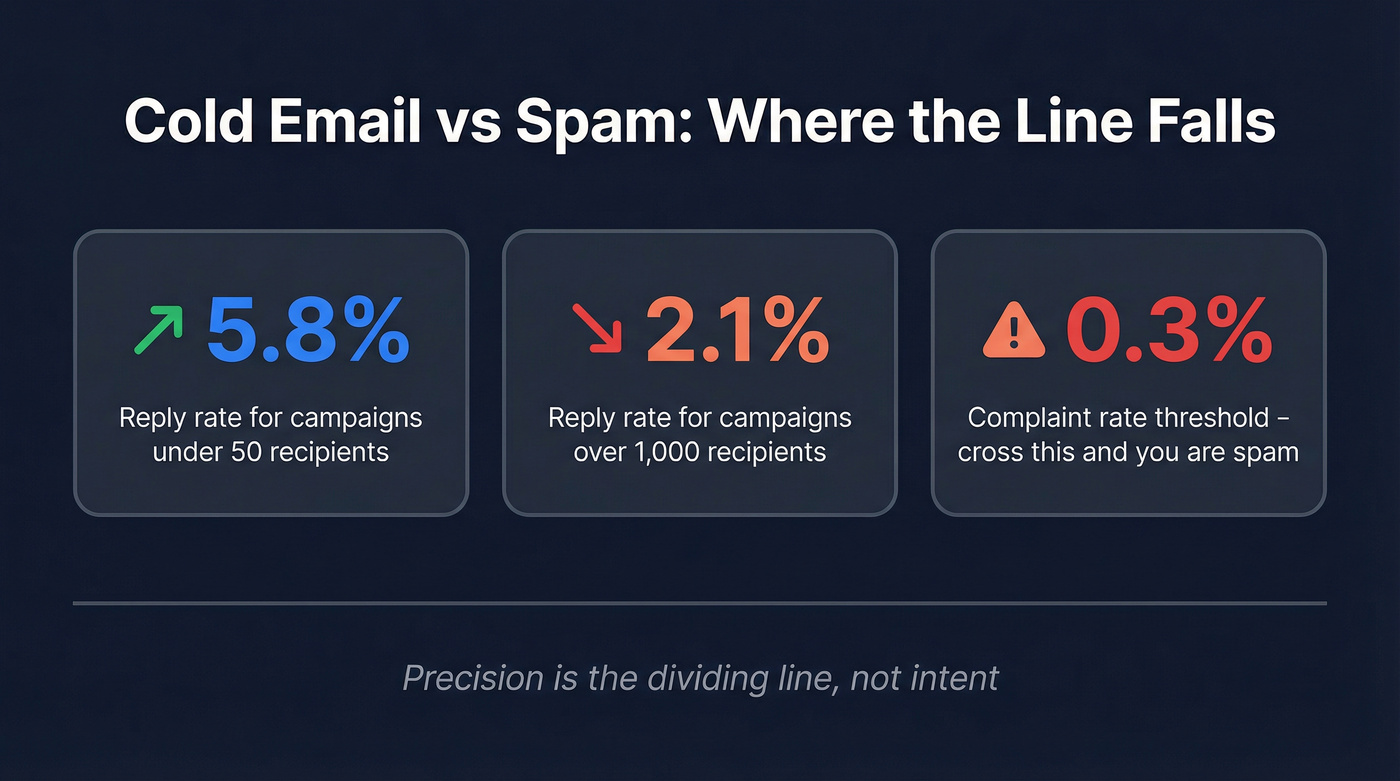
Practically, the difference between cold outreach and spam comes down to data quality and targeting. Campaigns sent to fewer than 50 recipients average a 5.8% reply rate vs 2.1% for 1,000+ blasts. Precision is the dividing line.
Operationally, you cross into spam territory the moment your complaint rate hits 0.3%. Inbox providers enforce this regardless of what you intended.
What Actually Separates Cold Email From Spam
| Dimension | Cold Email | Spam |
|---|---|---|
| Intent | Relevant offer to a fit buyer | Bulk promotion, any recipient |
| Targeting | Researched ICP, small batches | Scraped lists, mass sends |
| Personalization | Role/company-specific | Generic or faked tokens |
| Compliance | CAN-SPAM/GDPR compliant | Ignores or evades rules |
| Data source | Verified, current addresses | Purchased/scraped lists |
| Follow-up | Respectful cadence, opt-out | Relentless, no easy exit |
The table looks clean, but here's the uncomfortable truth: 71% of decision-makers who ignore cold email say the reason is "lack of relevancy." Not that it's unsolicited - that it's irrelevant. And yet 61% of decision-makers still prefer email over phone or social outreach. They want to hear from you. They just want it to matter.
Most cold outreach fails the targeting test, which means it functionally behaves like spam even when the sender thinks otherwise. Is cold emailing the same as spam? Not inherently. But the gap closes fast when relevance disappears.
Why Most Cold Email IS Spam
Spamhaus uses the industry-standard definition of spam as Unsolicited Bulk Email - and the key word is bulk. When cold outreach is automated, scaled, and sent in large batches with substantively identical content, it crosses the line.
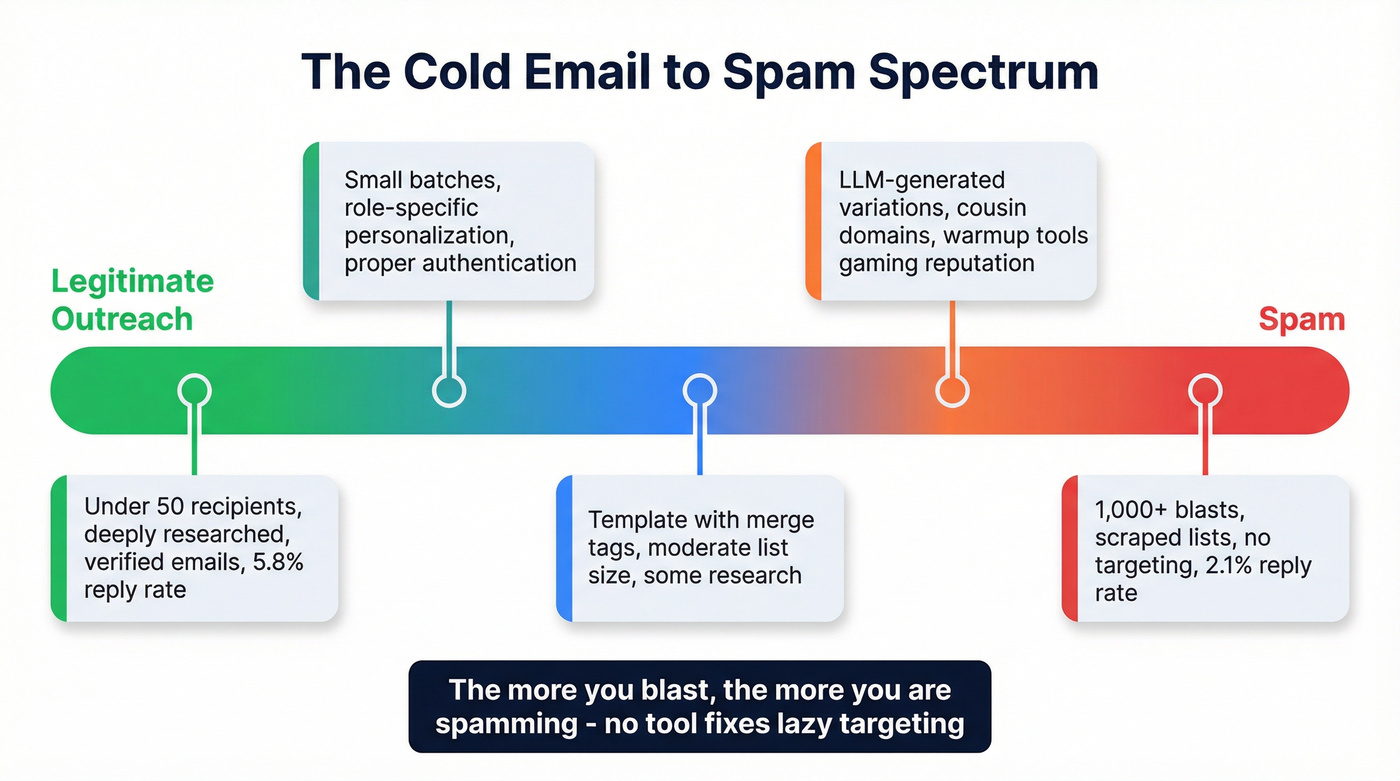
Here's what anti-spam authorities are seeing in the wild: LLM-generated template variations designed to dodge filters, cousin domains mimicking a company's real domain, warmup tools generating fake engagement to game sender reputation. The rise of AI-generated outreach - where entire campaigns get created and sent without human oversight - has accelerated the problem. These tactics exist because senders know their email would get filtered otherwise. That tells you everything about where it falls on the spectrum.
The data is blunt. Campaigns targeting 50 or fewer recipients hit a 5.8% reply rate. Scale to 1,000+ and it drops to 2.1%. The more you blast, the more you're spamming - no tool fixes lazy targeting. And the worst offenders aren't the obvious Nigerian-prince operators. They're the SDR teams blasting 5,000 contacts a week with "personalized" merge tags and calling it outreach.

The difference between cold email and spam starts with your data. Prospeo's 5-step verification removes spam traps, honeypots, and dead mailboxes - the exact triggers that push you onto blocklists. At 98% accuracy and a 7-day refresh cycle, your list never goes stale.
Clean data is the only thing standing between outreach and spam.
Compliance Rules You Can't Ignore
CAN-SPAM Basics
US law doesn't require consent for commercial email. It requires honesty:
- Accurate "From" name, email, and domain
- Non-deceptive subject lines (no fake "Re:" or "Fwd:")
- A valid physical mailing address
- A visible, functioning unsubscribe mechanism
- Opt-out requests honored within 10 business days
Violations run up to $46,517+ per email. Per email, not per campaign.
Gmail & Yahoo's Bulk Sender Rules
Since February 2024 - and still actively enforced in 2026 - Gmail and Yahoo require a separate layer that hits cold emailers hard:
- SPF + DKIM + DMARC authentication
- One-click unsubscribe headers
- Spam complaint rates below 0.3%
- Unsubscribe processing within 2 days
For EU outreach, GDPR requires "legitimate interest" - a defensible reason for contacting that specific person, transparency about data sources, and an easy opt-out. If you're selling internationally, get legal advice. The fines aren't theoretical.
How to Keep Cold Email Out of the Spam Folder
Even with perfect copy, inbox placement isn't guaranteed. Deliverability is a chain, and every weak link compounds.
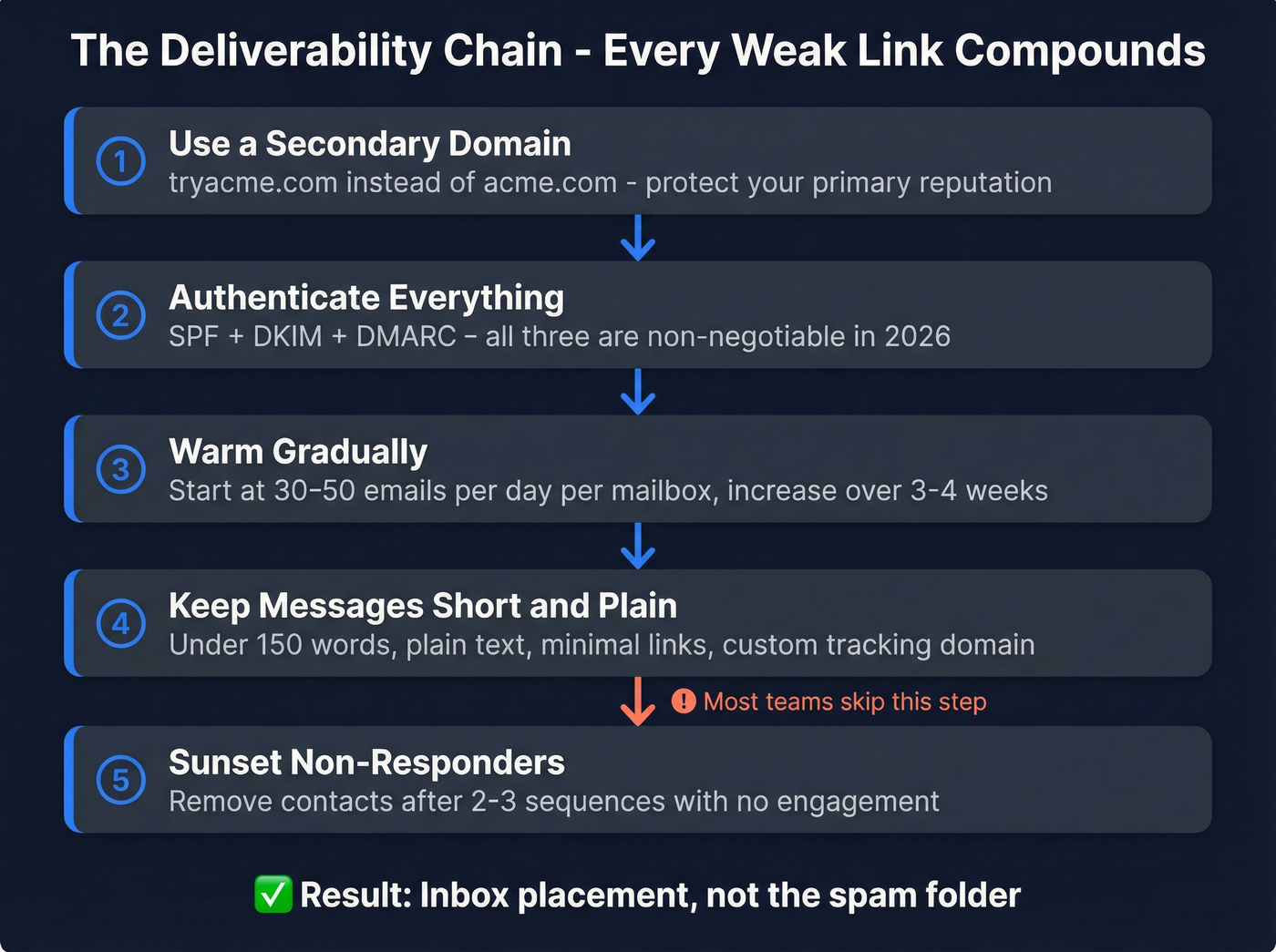
1. Use a secondary domain. Never send cold outreach from your primary domain. One bad campaign can tank years of reputation. Set up a dedicated outreach domain - tryacme.com instead of acme.com - and warm it separately (see automated email warmup).
2. Authenticate everything. SPF, DKIM, DMARC. All three are non-negotiable in 2026. Without them, Gmail and Yahoo won't even consider delivering your email (use this SPF, DKIM, DMARC setup reference).
3. Warm gradually. Start at 30-50 emails per day per mailbox. Increase over 3-4 weeks. Sudden volume spikes trigger throttling fast (more in cold email volume best practices).
4. Keep messages short and plain. Plain text is typically safer for deliverability than heavy HTML. Keep emails under 150 words, minimize links, skip images, and use a custom tracking domain (details: email deliverability checklist).
5. Sunset non-responders. If a contact hasn't engaged after 2-3 sequences, remove them. Continuing to email unresponsive addresses trains inbox providers to treat you as unwanted - and that's exactly how legitimate outreach becomes spam in the eyes of every filter (build a safer cadence with sales sequences).
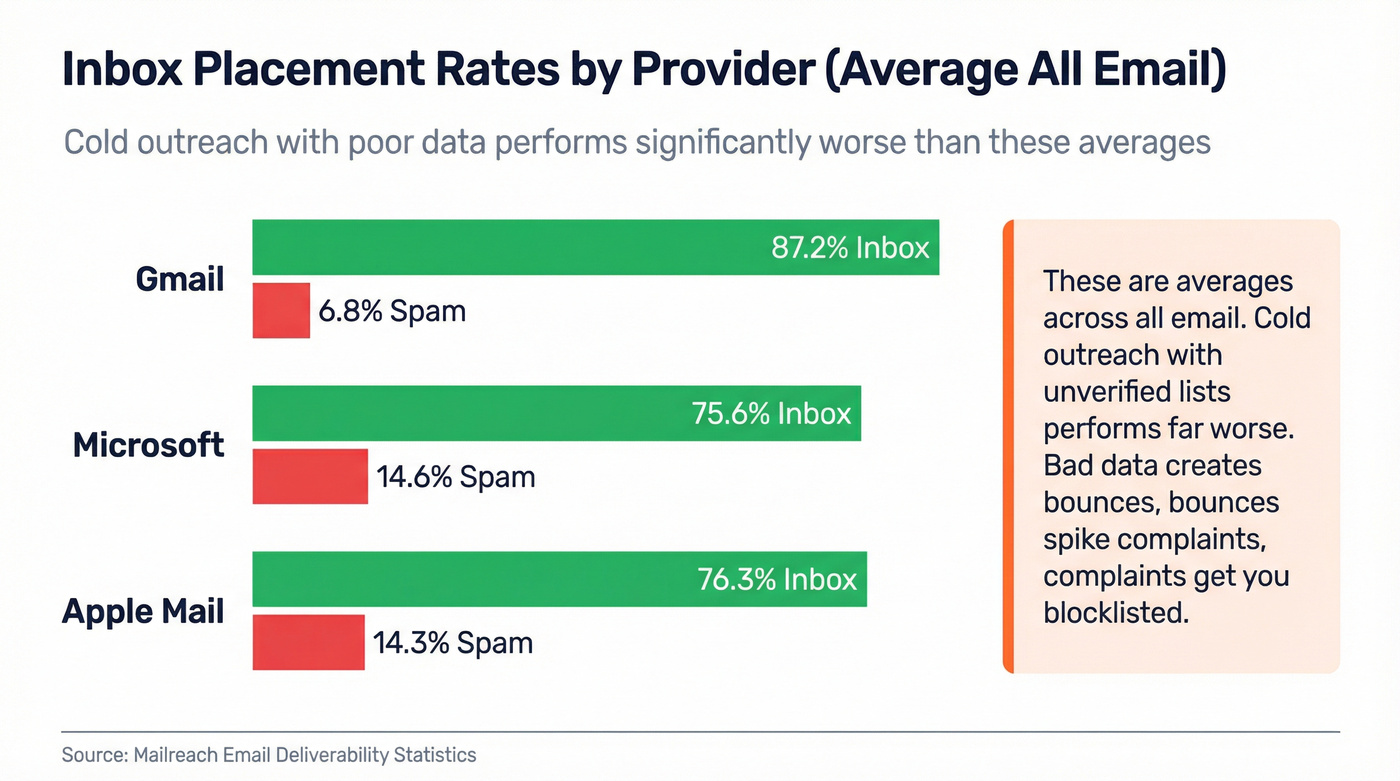
The inbox placement numbers show how tight the margins are. Gmail delivers 87.2% to inbox, with 6.8% going to spam. Microsoft is harsher at 75.6% inbox, 14.6% spam. Apple Mail lands at 76.3% inbox with 14.3% spam. Those are averages across all email - cold outreach with poor data performs significantly worse.
Look, none of the above matters if your list is bad. Bad data creates bounces. Bounces spike complaints. A high complaint rate gets you blocklisted. And once you're blocklisted, your messages are spam - technically, operationally, and reputationally (use this blacklist alert triage flow).

If your bounce rate is high, you're not sending cold email. You're sending bulk junk with better intentions.
Data Quality Is the Whole Game
We've watched teams agonize over subject lines and send-time optimization while sitting on contact lists that are 30% dead addresses. That's like tuning the engine on a car with no wheels.
Before any campaign goes out, verify every address. Prospeo's 5-step verification catches spam traps, honeypots, and dead mailboxes - the exact signals that trigger blocklisting. At 98% email accuracy on a 7-day refresh cycle, you're not sending to addresses that went stale three months ago. Stack Optimize built to $1M ARR using that data, maintaining 94%+ deliverability with under 3% bounce rates and zero domain flags across all clients.
Let's be honest about the cold email vs spam debate: it's a distraction. The real question is whether your data is good enough to earn inbox placement. If it is, you're doing cold email. If it isn't, you're spamming - no matter how clever your copy is or how noble your intentions are.
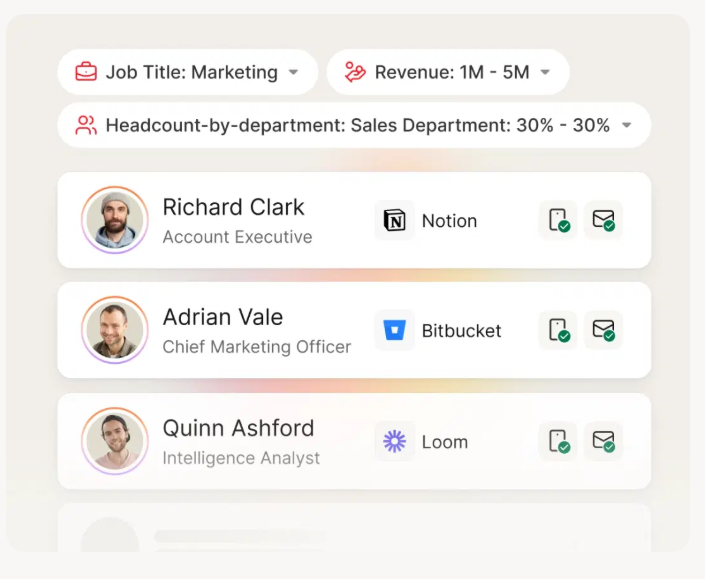
Campaigns under 50 recipients hit 5.8% reply rates. Prospeo's 30+ filters - buyer intent, technographics, headcount growth, funding - let you build hyper-targeted lists that stay small and relevant. Precision targeting at $0.01 per verified email.
Send fewer emails to better prospects. Book more meetings.
FAQ
Is cold email illegal?
No, not in the US. CAN-SPAM regulates commercial email but doesn't require prior consent - you follow the rules (accurate headers, opt-out, physical address) or you pay per-email fines up to $46,517. The EU requires legitimate interest under GDPR for B2B outreach. Either way, compliance isn't optional.
Are cold emails spam?
Not by default. Spam is unsolicited bulk email - the key distinction is targeting and relevance. A well-researched message to a verified contact who fits your ICP is legitimate outreach. A templated blast to thousands of scraped addresses is spam regardless of what you call it. The line comes down to list quality and whether the recipient has a plausible reason to care.
How many cold emails can I send per day?
30-50 per mailbox per day on a properly warmed domain. Exceeding that on a new domain is the fastest way to get flagged. Scale by adding mailboxes, not by cranking volume on one. Most teams running 5+ mailboxes through tools like Smartlead or Instantly stay well under provider thresholds.
What's the best way to prevent bounces that trigger spam flags?
Verify every address before sending using a multi-step verification tool. Prospeo's 5-step process - including catch-all handling, spam-trap removal, and honeypot filtering - delivers 98% accuracy. In our experience, teams switching from unverified lists typically see bounce rates drop from 30%+ to under 4%, which keeps complaint rates well below the 0.3% threshold.