

The 10 Best Email ID Validators in 2026
Most email ID validators claim 97-99% accuracy. The most-cited public benchmark that actually tested a bunch of them? The best tool hit 70%. That gap between marketing and reality is costing you bounced emails, burned domains, and wasted credits.
Here are the 10 validators worth your time - with real accuracy data, not vendor fairy tales.
Our Picks (TL;DR)
| Pick | Tool | Best For | Price |
|---|---|---|---|
| 🥇 | Prospeo | B2B prospecting + verification | ~$0.01/email |
| 🥈 | Bouncer | Best pure bulk verifier | $7/1K emails |
| 🥉 | ZeroBounce | Full deliverability suite | From $49/mo ($99/mo for ONE plan) |
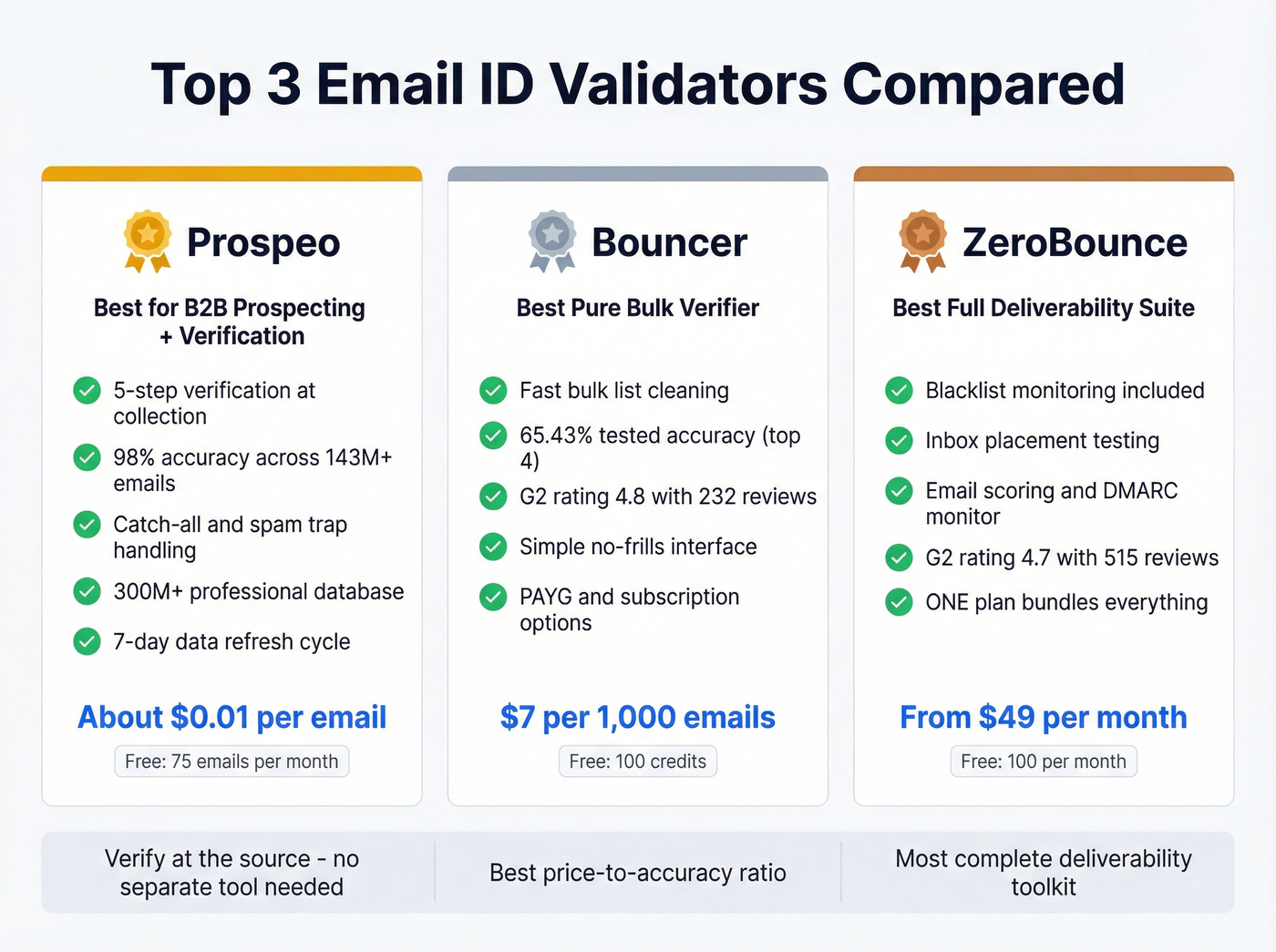
Prospeo wins for B2B teams because emails are verified at collection - no separate cleaning tool needed. Bouncer is the price-to-accuracy sweet spot for list cleaning. ZeroBounce bundles blacklist monitoring, inbox placement testing, and email scoring for teams that want the full deliverability picture.
What Is an Email ID Validator?
"Email ID" is the standard term for an email address in many APAC and South Asian markets - it means the same thing. An email ID validator checks whether an address is real, active, and safe to send to without actually delivering a message. You'll also hear these called an email verifier or email checker depending on the platform. The underlying technology is identical.
These tools exist because email lists decay fast. People change jobs, companies restructure, inboxes get abandoned. Sending to dead addresses tanks your sender reputation, which means even your emails to valid contacts start landing in spam.
Why Validation Matters
You exported 5,000 leads from your CRM, loaded them into your sequencer, and hit send. Four hundred bounce. Your ESP flags your domain. The next three campaigns land in spam folders instead of inboxes. That's not a hypothetical - it's a Tuesday for teams that skip validation.
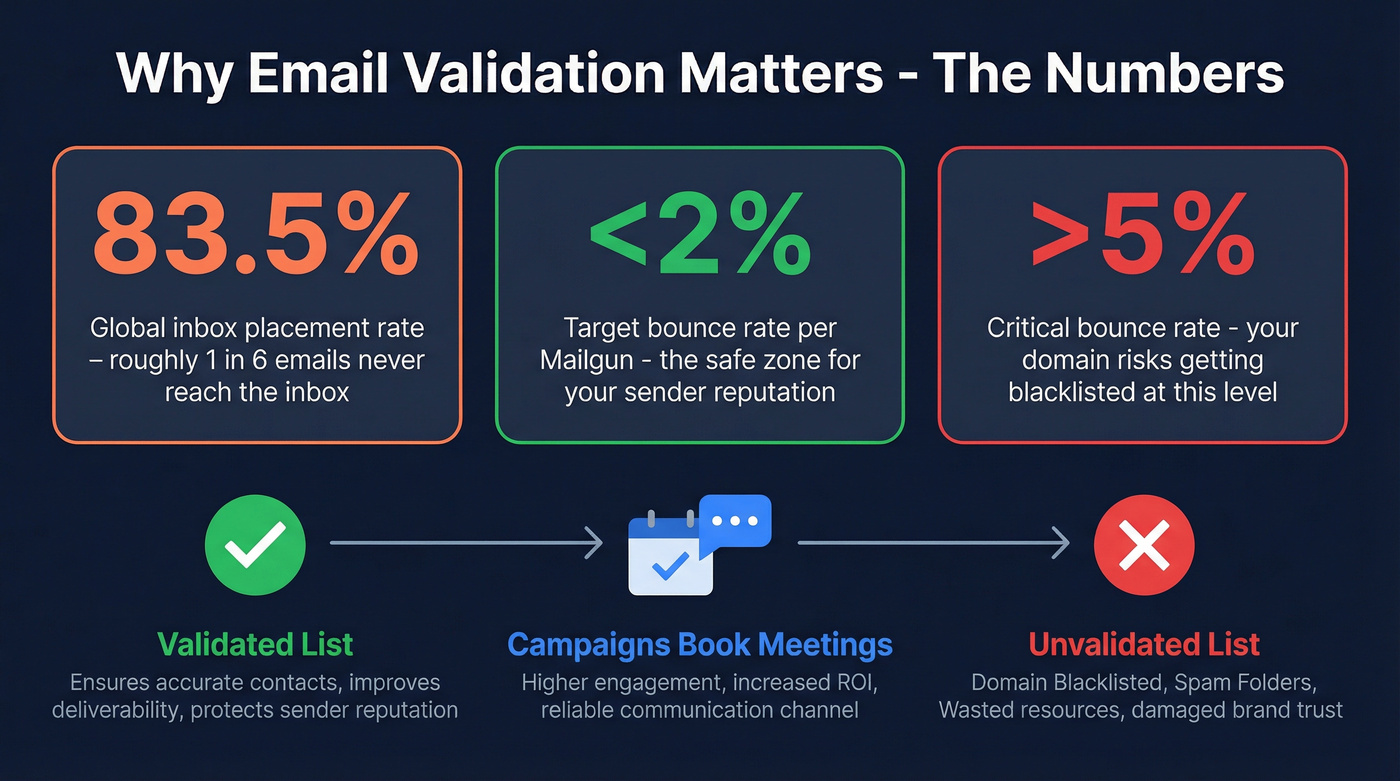
Global inbox placement sits at roughly 83.5%, meaning about 1 in 6 legitimate emails never reaches the inbox. Mailgun's guidance sets the target at under 2% bounce rate - anything above 5% is critical territory. Hard bounces damage your reputation immediately; soft bounces become hard bounces if they persist. The gap between "we validated our list" and "we didn't bother" is the difference between a campaign that books meetings and one that gets your domain blacklisted.
How Email Validation Works
Every validator runs the same core process, whether it takes milliseconds or minutes.
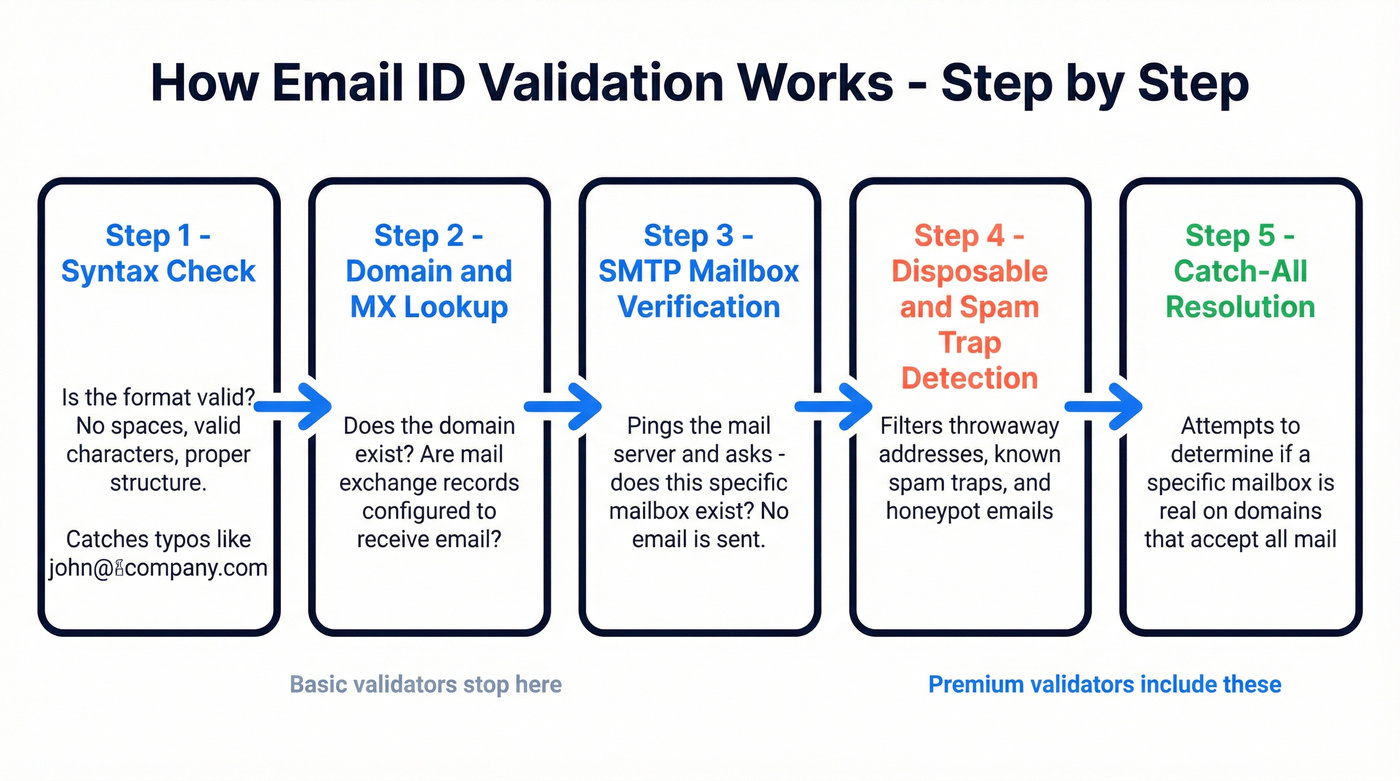
Step 1 - Syntax check. Is the email formatted correctly? No spaces, valid characters, proper domain structure. This catches typos like "john@@company.com" instantly.
Step 2 - Domain and MX lookup. Does the domain exist? Does it have mail exchange records configured to receive email? No mail server behind the domain means the address is dead regardless of what comes before the @.
Step 3 - SMTP mailbox verification. The validator pings the mail server and asks, "Does this specific mailbox exist?" - without sending an email. This is where real verification happens, and where things get complicated.
Better tools add disposable email detection, spam trap filtering, and catch-all resolution. Catch-all domains accept mail to any address, making it impossible to confirm whether a specific mailbox is real. Cheaper tools return these as "unknown" and still charge you the credit - the most common complaint we've seen across email marketing communities, and a legitimate reason to pay more for a better tool.

Most validators charge you credits for catch-all unknowns. Prospeo's 5-step verification handles catch-all domains, spam traps, and honeypots before an email ever touches your list - 98% accuracy across 143M+ verified emails at ~$0.01 each.
Stop cleaning lists you shouldn't have to clean. Verify at the source.
What to Look For
Not all validators are equal, and the feature set matters more than the marketing page. Here's the thing: real accuracy diverges from claimed accuracy on catch-all domains and enterprise mail servers. If a tool returns "unknown" for every catch-all domain, you're paying for non-answers. The best tools attempt resolution.
Beyond accuracy, you need bulk support and speed (cleaning 10,000 contacts before Thursday's campaign, not one at a time), API access for real-time verification on forms and CRM workflows, and GDPR compliance if you're touching EU contacts. Pricing model matters too - pay-as-you-go works for sporadic use; subscriptions win at consistent high volume. G2 and Capterra ratings with 200+ reviews are a decent signal. Anything under 100 reviews is too thin to trust.
The 10 Best Email ID Validators
| Tool | Free Tier | PAYG (/1K) | Monthly Start | G2 Rating |
|---|---|---|---|---|
| Bouncer | 100 credits | $7 | $24/mo | 4.8 (232) |
| Prospeo | 75 emails/mo | ~$0.01/email | Credit-based | - |
| ZeroBounce | 100/mo | ~$7.50 | $49-$99/mo | 4.7 (515) |
| NeverBounce | 1,000 trial | $8 | PAYG only | - |
| Clearout | 100 credits | $5-$15 | $21/mo | 4.7 (307) |
| Hunter | - | Bundled | $49/mo | - |
| Verifalia | 25/day | $5-$15 | ~$9/mo | - |
| Email Hippo | 100/day | $5-$15 | Varies by tier | - |
| Mailmeteor | Free single | Free | Free | - |
| EmailListVerify | - | ~$4-8 | PAYG | - |
Bouncer
Bouncer is the tool we'd hand to someone who just needs to clean a list and get on with their day. No deliverability suite, no inbox placement tests - just fast, accurate bulk verification at $7 per 1,000 emails.
The free tier gives you 100 credits to test, and subscriptions start at $24/mo for recurring plans. Bouncer scored 65.43% in Hunter's public benchmark - which sounds low until you realize the best tool in that test hit 70%. The G2 rating of 4.8 across 232 reviews is one of the strongest in this category.
Use this if you need a reliable bulk verifier without paying for features you won't use. Skip this if you need verification built into a prospecting workflow.
Prospeo
Most teams buy a data tool, export contacts, then pay a second tool to verify those contacts. Two subscriptions, two workflows, and a gap where bad data slips through.
Prospeo's 5-step verification runs at the point of collection - catch-all handling, spam-trap removal, and honeypot filtering happen before an email ever hits your list. The result is 98% email accuracy across 143M+ verified emails, refreshed on a 7-day cycle. For context, the industry average refresh is six weeks. Pricing runs about $0.01 per email on a credit-based model, with 75 free emails per month. No contracts, no sales calls. For B2B outbound teams, you prospect and verify in a single step across a 300M+ professional profile database with 30+ search filters - one tool instead of two, one bill instead of two, and no data decay between finding and sending.
ZeroBounce
ZeroBounce is the validator you pick when verification alone isn't enough. Beyond bulk cleaning, it bundles blacklist monitoring, inbox placement testing, email scoring, and a DMARC monitor. The ONE plan at $99/mo includes 25,000 validations plus the full deliverability toolkit.
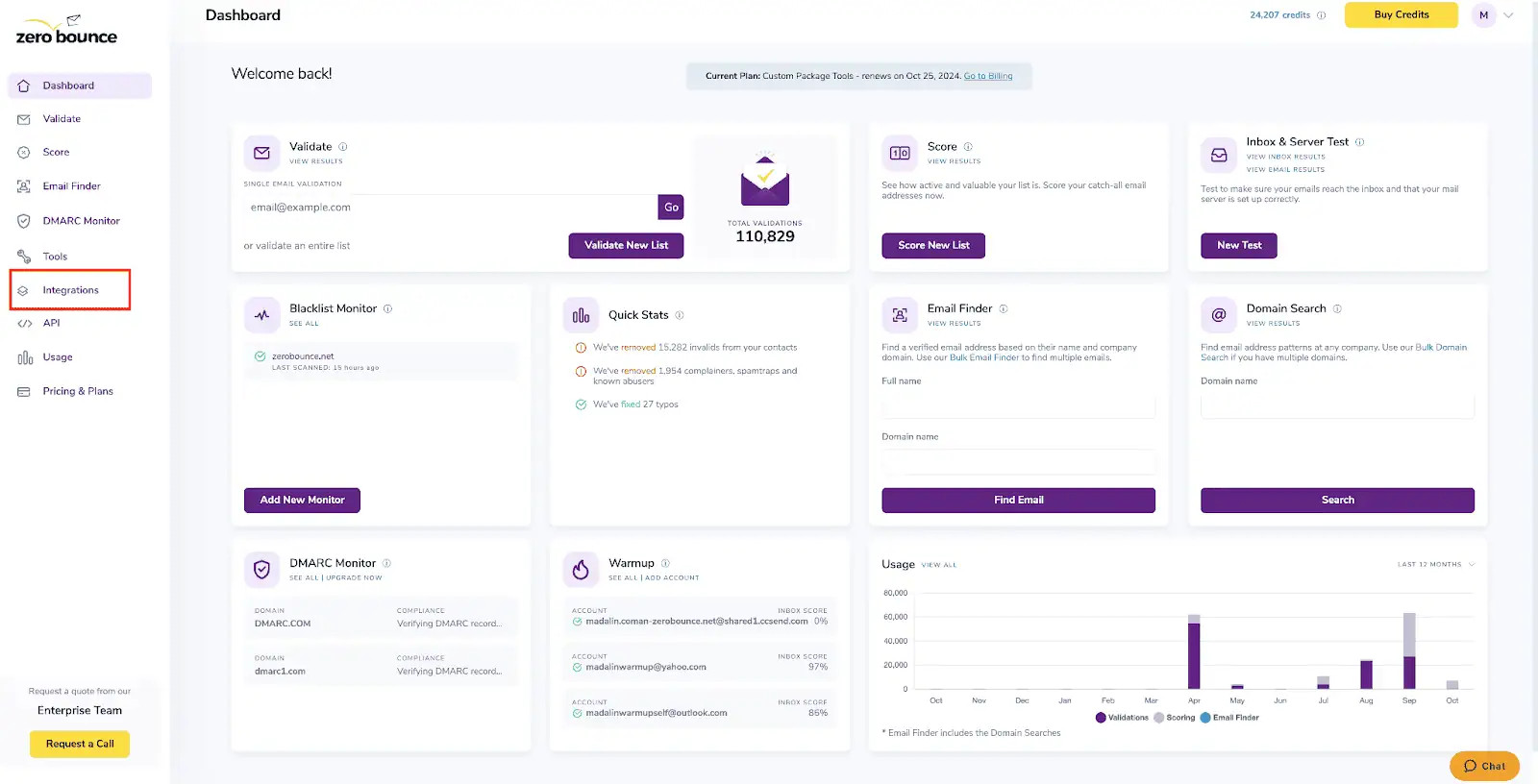
The free tier gives you 100 validations per month. PAYG starts around $7.50 per 1,000. ZeroBounce scored 60.70% in Hunter's benchmark - middle of the pack on raw accuracy. But the deliverability extras make it the right choice for marketing teams who care about the full email delivery chain. G2 rating of 4.7 across 515 reviews gives it the deepest review base in the category.
Why it wins: Most complete deliverability suite at this price. Key tradeoff: You're paying for a suite. If you only need verification, Bouncer does it for much less.
NeverBounce
NeverBounce is pure PAYG - no monthly subscription, just credits. Volume discounts are aggressive: $8/1K at the low end drops to $5/1K at 10,000 and $2.50/1K at a million emails. It integrates with 80+ platforms, making it solid for complex martech stacks. Scored 63.17% in Hunter's benchmark. Best for high-volume teams who want simple, no-commitment pricing.
Clearout
Clearout delivered one of the best accuracy scores in public benchmark testing - 68.37%, second only to Hunter itself. Subscriptions start at $21/mo, making it a budget option that doesn't sacrifice quality. It also ships a large feature set including catch-all resolution, spam trap detection, and a Google Sheets add-on. G2 rating of 4.7 across 307 reviews.
If Bouncer is the reliable workhorse, Clearout is the underpriced contender that deserves more attention. In our experience, it's one of the most overlooked tools in this space.
Hunter
Hunter's verifier checks email syntax, domain information, and server response - and it also cross-references checked addresses against Hunter's own B2B database. It's bundled into Hunter's email-finding platform starting at $49/mo.
The interesting wrinkle: Hunter ran the benchmark everyone else is measured against, and Hunter came out on top at 70.00%. They disclosed a potential bias - test emails were sourced using Hunter activity patterns - but it's still the best public methodology and dataset write-up available. If you're already using Hunter for email finding, the built-in verification is convenient. As a standalone verifier, you're often overpaying compared to Bouncer or Clearout.
Verifalia
A straightforward address checker with a free tier of 25 verifications per day. Paid plans start around $9/mo. Good for simple, conservative day-to-day checks. Nothing flashy, nothing broken.
Email Hippo
Operating since 2009, Email Hippo offers a free email address verifier capped at 100 daily verifications. It groups results into OK, Bad, and Unverifiable, and positions its paid products across bulk verification (CORE), API verification (MORE), and fraud-prevention intelligence (INSIGHT/ASSESS). Paid pricing generally sits in the $5-$15 per 1,000 range.
Mailmeteor
Mailmeteor's Email Checker is free, requires no sign-up, and validates an email address in seconds. It runs 15+ checks including format, DNS, MX records, and SMTP verification. One email at a time, so it's strictly for spot-checking - not list cleaning.
EmailListVerify
Budget bulk verifier with PAYG pricing starting around $4-8 per 1,000 emails. It's the "cheap and cheerful" option for high-volume cleaning when cost is the primary concern. Don't expect premium catch-all handling.
Accuracy Benchmarks
Let's be honest about the accuracy problem in this market. Most tools' marketing pages say 97-99%. The most-cited public benchmark tells a very different story.
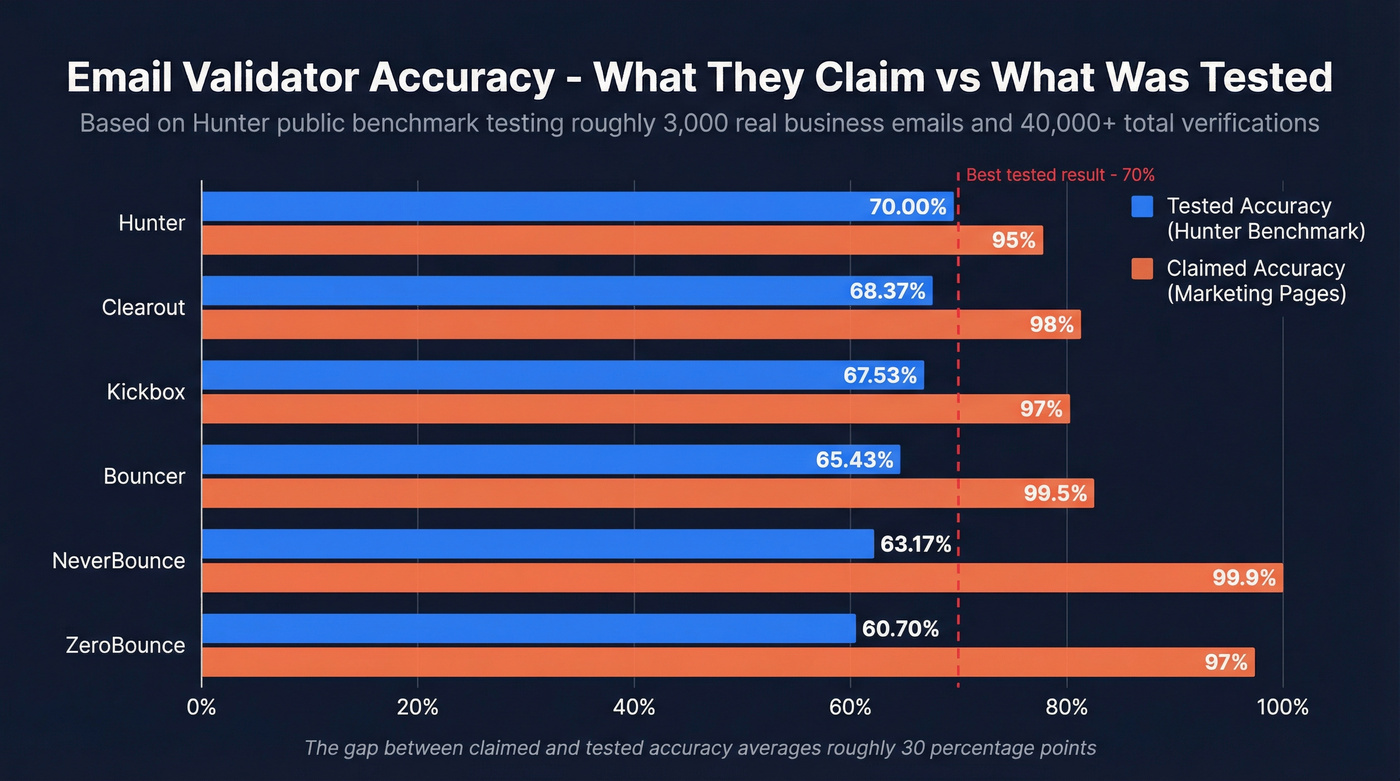
Hunter tested 15 email verifiers using ~3,000 real business emails segmented by company size, running 40,000+ total verifications. All tools ran inside Clay with bulk mode and default settings.
| Tool | Benchmark Accuracy | Claimed Accuracy |
|---|---|---|
| Hunter | 70.00% | 95%+ |
| Clearout | 68.37% | 98%+ |
| Kickbox | 67.53% | 97%+ |
| Bouncer | 65.43% | 99.5% |
| NeverBounce | 63.17% | 99.9% |
| ZeroBounce | 60.70% | 96-98% |
| Snov.io | 31.20% | 98%+ |
The fact that so many tools claim 97-99% while the best benchmarked score is 70% tells you everything about this market's honesty problem. Snov.io at 31.20% is a particularly stark reminder that vendor claims are meaningless without independent testing.
Hunter disclosed a potential bias - test emails were sourced through Hunter's own activity patterns. Fair enough. But even accounting for that, it's the best public benchmark available. Accuracy drops hardest on mid-market and enterprise domains, where stricter mail server configurations return more "unknown" results. This is exactly where catch-all handling matters most.
Which Validator Should You Use?
Look, if your deal sizes are under five figures, you probably don't need a $99/mo deliverability suite. A $7/1K bulk verifier handles 90% of use cases. Save the money for better copy.
Spot-checking a single email? Mailmeteor or Verifalia. Both are free, require no signup, and handle one-off checks fast.
Cleaning a list before a campaign? Bouncer or Clearout. Best price-to-accuracy ratio in the market. Upload your CSV, get results in minutes, pay roughly $5-$15 per 1,000 emails depending on volume.
Full deliverability suite? ZeroBounce bundles verification with blacklist monitoring, inbox placement testing, and email scoring. Worth it for high-volume marketing teams running campaigns where inbox placement is everything.
B2B outbound prospecting? Prospeo. Prospect and verify in one workflow - 300M+ professional profiles, 98% accuracy, ~$0.01/email. Stop paying twice.
High-volume API integration? NeverBounce or EmailListVerify. Both offer aggressive volume discounts - NeverBounce drops to $2.50/1K at the million-email tier, and EmailListVerify starts even cheaper.
On a shoestring budget? Skip this if you're tempted by the cheapest no-name verifier on AppSumo. We've seen teams burn their primary domain trying to save $20 on verification. The cost of domain recovery dwarfs any savings.
If you're scaling outbound, pair validation with an email deliverability checklist and a plan for how to prevent email blacklisting before you ramp volume.
You just read that the best public benchmark hit 70% accuracy. Prospeo skips the validation-after-export problem entirely - emails are verified during collection across 300M+ profiles, refreshed every 7 days. One tool, one bill, zero bounce surprises.
Replace your data tool and your validator with a single platform.
FAQ
Is an email ID validator the same as an email verifier?
Yes - the terms are interchangeable. "Email ID" is the standard term for an email address in many APAC and South Asian markets. Whether a tool calls itself an email verifier, email checker, or email address validator, they all check deliverability without sending a message using the same syntax, domain, and SMTP verification pipeline.
Can email validators detect catch-all addresses?
Most basic tools can't - they return catch-all domains as "unknown" and still charge you the credit. Premium validators invest in catch-all resolution algorithms that reduce unknowns by 30-50%, giving you more actionable results per dollar spent. The consensus on r/coldoutreach is that catch-all handling is the single biggest differentiator between cheap and premium validators.
What's a good bounce rate?
Under 2% per Mailgun's deliverability guidance. Above 5% is critical territory that damages your sender reputation. If you're consistently above 3%, verify your lists more aggressively or shorten your re-verification cycle to every 30 days.
How often should I re-verify my email list?
Every 30-90 days for active lists. Email addresses decay at roughly 2-3% per month. For B2B outbound in fast-moving industries like SaaS, lean toward 30 days - a 90-day-old list can have 5-8% decay, enough to push you past the 2% bounce threshold. HubSpot's email marketing guide recommends regular list hygiene as a baseline practice.
Do I need a separate validator if I use a B2B data platform?
Not always. Some platforms verify emails at collection on a weekly refresh cycle, so data stays fresh without a second tool. If you're sourcing emails from web scraping, purchased lists, or opt-in forms, a standalone validator is essential - those sources have no built-in verification. Litmus's State of Email report consistently highlights list quality as the top factor in deliverability outcomes.