

How to Turn Signals Into Pipeline (Without Drowning in Noise)
A RevOps lead we know ran the numbers last quarter: 500 "high-intent" accounts flagged by their intent provider, half the phone numbers disconnected, a third of the emails bouncing. The team had signals. What they didn't have was pipeline.
That's the signal-to-pipeline gap nobody talks about. Companies are spending $2 in S&M to earn $1 of new ARR - a 14% jump from the prior year - and most of that waste happens between "signal detected" and "meeting booked." Meanwhile, 87% of B2B companies now use AI in demand generation, and marketing contributes nearly 50% of pipeline. The tooling has never been better. The execution gap has never been wider.
This playbook covers the scoring model, tool stack, and anti-patterns that separate teams who convert signals into sales from teams who just collect them.
The Short Version
Converting signals to pipeline works when you nail five layers: collect signals, verify contact data, enrich accounts, score by urgency, and activate outreach. Most teams skip the verify step and wonder why their signal-triggered sequences bounce.
Start with one high-impact signal - pricing page visits or job changes - build one complete workflow from detection through follow-up, and expand from there. Autobound's platform data shows accounts with 3+ active signals convert at 2.4x the rate of single-signal accounts. Keep that number in mind as you read.
What Signal to Pipeline Actually Means
This isn't intent data with a rebrand. It's the full operational chain: detecting a buyer signal, confirming you can actually reach that buyer, and activating outreach fast enough to matter.
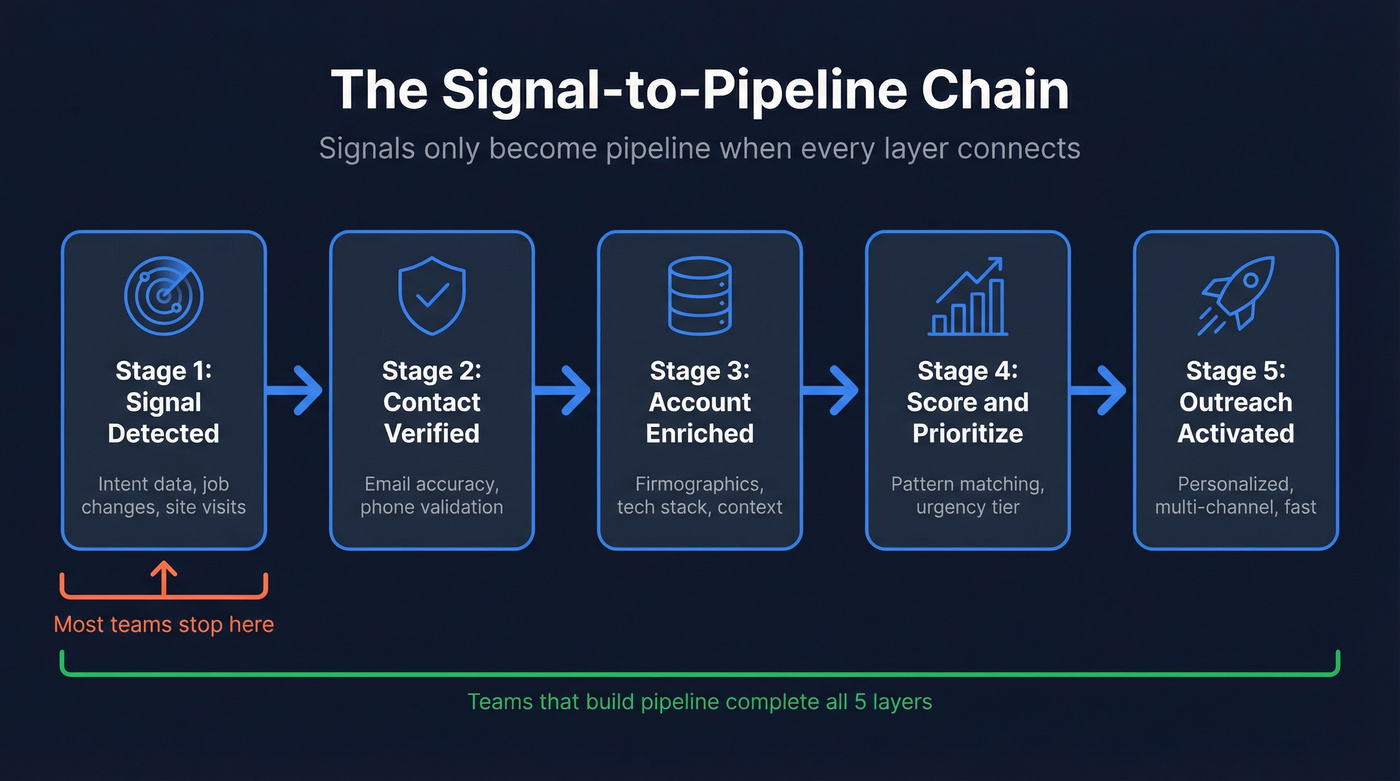
Intent data is one input - third-party content consumption tracked across publisher networks. Trigger selling focuses on discrete events like funding rounds or job changes. Signal-based selling layers all of these together and acts on patterns, not individual data points. 95% of buyers aren't actively solution-seeking at any given moment. Signals help you find the 5% who are in-market before your competitors do, but only if the data chain from detection to outreach actually holds together.
The 7 Types of Buyer Signals
Not all signals carry equal weight. Bombora's seven-type framework is the most practical taxonomy we've come across:
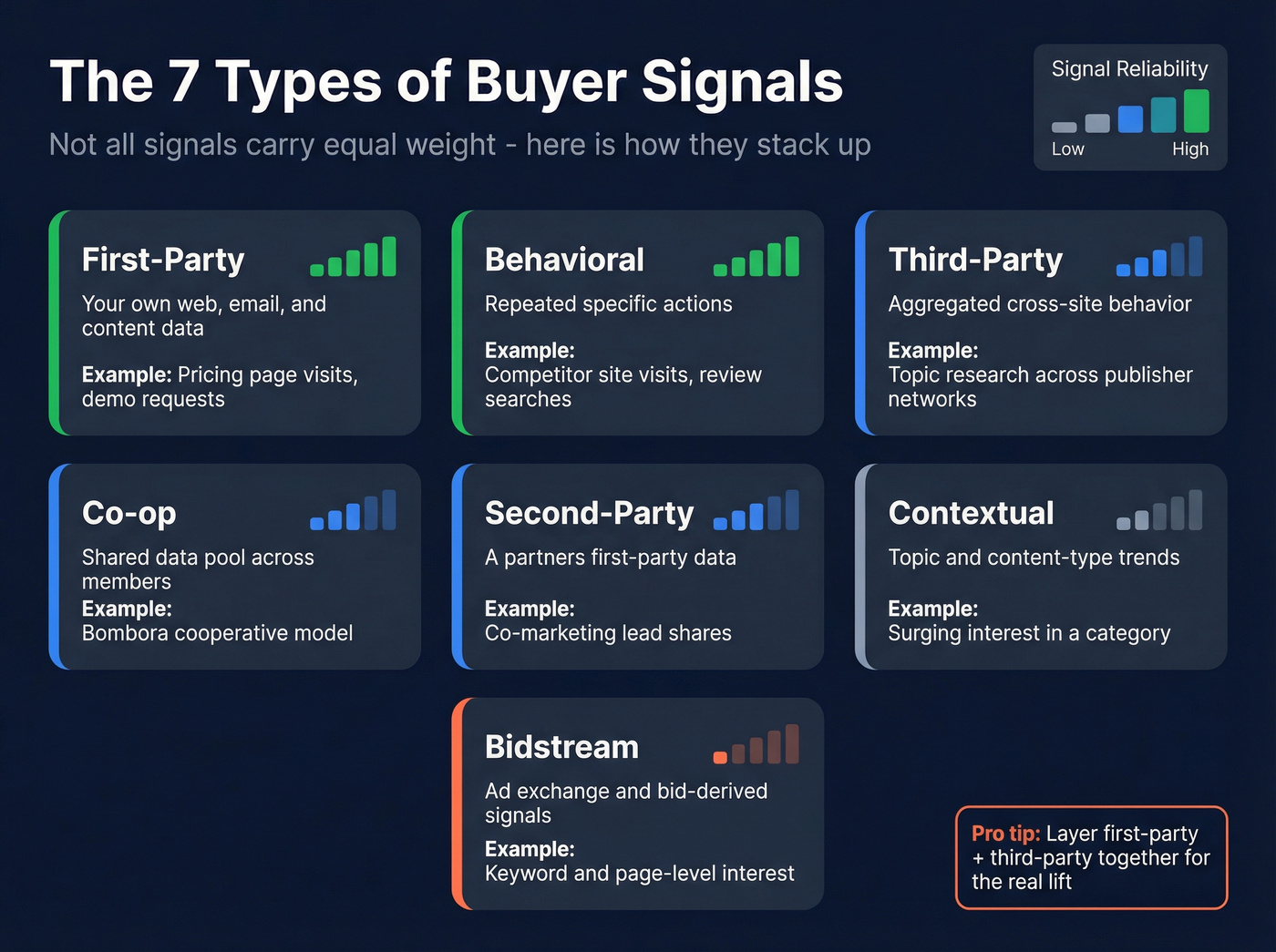
| Signal Type | What It Is | Example |
|---|---|---|
| First-party | Your own web/email/content data | Pricing page visits, demo requests |
| Second-party | A partner's first-party data | Co-marketing lead shares |
| Third-party | Aggregated cross-site behavior | Topic research across publisher networks |
| Co-op | Shared data pool across members | Bombora's cooperative model |
| Bidstream | Ad exchange/bid-derived signals | Keyword and page-level interest |
| Behavioral | Repeated specific actions | Competitor site visits, review searches |
| Contextual | Topic/content-type trends | Surging interest in a category |
76% of B2B marketers report higher ROI from intent-driven campaigns. In practice, that ROI comes from combining sources - not from buying a single intent feed and calling it done. Layering first-party and third-party signals together is where the real lift happens.
A quick note on bidstream data: it's cheap and voluminous, but the signal-to-noise ratio is brutal without contextual enrichment on top.
4 Patterns That Predict Pipeline
Raw signals are just activity. Patterns predict pipeline. Here are four worth building scoring rules around.
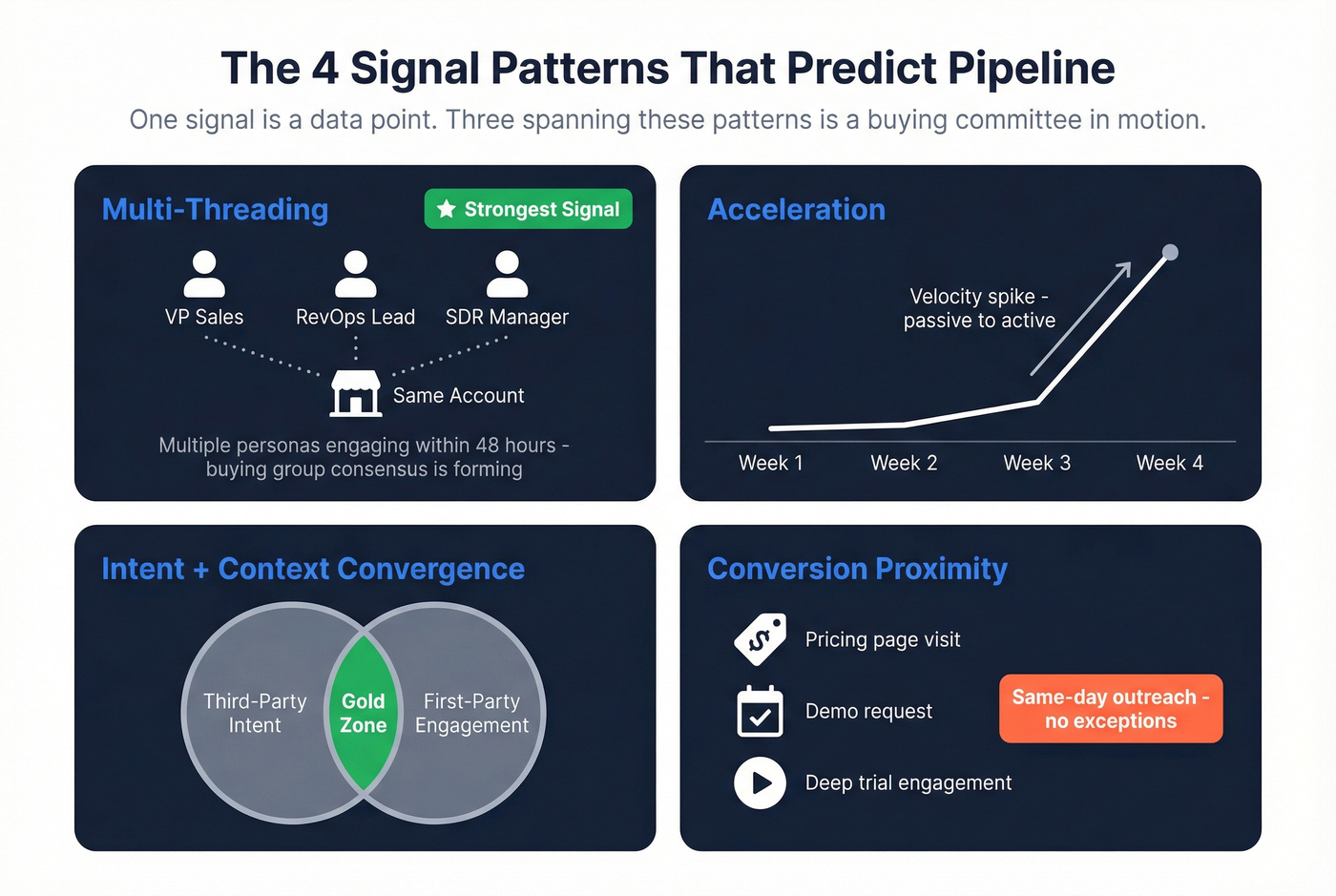
Multi-threading. Multiple personas from the same account engaging in a short window - the VP of Sales, a RevOps lead, and an SDR manager all hitting your site within 48 hours. Buying group consensus is forming. This is the strongest pattern on the list. (If you want the deeper breakdown, see Multi-threading.)
Acceleration. An account that visited twice a month suddenly visits five times in a week. That velocity spike - the shift from passive research to active evaluation - is unmistakable and demands immediate attention from your team.
Intent plus contextual convergence. Third-party intent becomes meaningful when it aligns with first-party engagement. Someone researching "sales engagement platforms" on external sites while also attending your webinar? That convergence is gold.
Conversion-proximity. Late-stage actions like pricing page visits, demo requests, and deep trial engagement. These demand same-day outreach. No exceptions.
One signal is a data point. Three spanning these patterns is a buying committee in motion.

You just read why the Verify layer is the gap killing signal-to-pipeline conversion. Prospeo closes it: 98% email accuracy, 125M+ verified mobiles with 30% pickup rates, and a 7-day data refresh cycle - 6x faster than the industry average. At ~$0.01/email, bad data stops being the bottleneck.
Stop letting bounced emails waste your best buying signals.
The 3-Tier Response Model
Here's the thing: the mistake most teams make is treating all signals equally. Either everything gets a same-day call or everything gets a nurture drip. A tiered model fixes this.
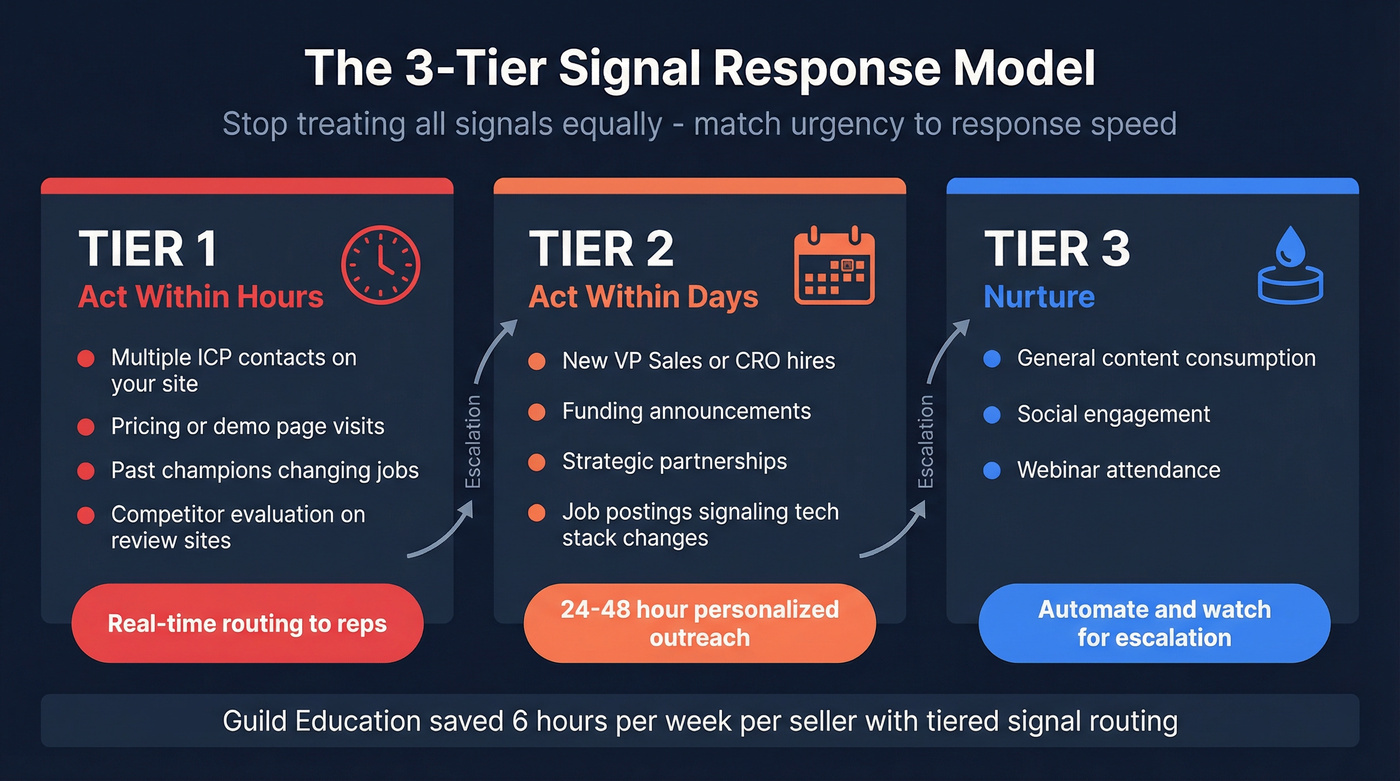
Tier 1 - Act within hours. Multiple contacts from the same ICP account visiting your site, pricing or demo page visits from target accounts, past champions changing jobs, competitor evaluation activity on review sites. These demand real-time routing to reps. No weekly digest. No batch processing.
Tier 2 - Act within days. New exec hires at VP Sales, CRO, or RevOps level. Funding announcements. Strategic partnerships. Job postings that signal tech stack changes. A 24-48 hour response window works here, and it gives reps time to personalize without losing the moment.
Tier 3 - Nurture. General content consumption, social engagement, webinar attendance. Automate the follow-up and watch for escalation into Tier 1 or 2.
Guild Education reported saving 6 hours per week per seller on account research after implementing tiered signal routing. The savings come from reps knowing exactly which accounts need attention now versus next week - not from working less, but from working on the right accounts.
The 5-Layer Stack (With Pricing)
Most guides on this topic talk about signals and scoring but ignore the plumbing between detection and outreach. The layer everyone forgets - Verify - determines whether your signals actually convert. Here's the full breakdown:
| Layer | What It Does | Tools | Typical Cost |
|---|---|---|---|
| Collect | Detect buyer signals | Bombora, 6sense, G2 | Bombora $2-5K/mo; 6sense $30-100K+/yr |
| Verify | Confirm contact data | Prospeo, ZoomInfo | ~$0.01/email; $15-40K/yr |
| Enrich | Add account context | Clay, Apollo | $149/mo; from $49/user/mo |
| Score | Prioritize by urgency | HubSpot, Salesforce | Free CRM; ~$25/user/mo |
| Activate | Trigger outreach | Smartlead, Instantly, Lemlist | $39/mo; $30/mo; $59/mo |
Collect is where most teams start and stop. Bombora runs $2-5K/month for co-op intent data. 6sense and Demandbase sit at the enterprise end, $30-100K+ annually, bundling intent with account identification and orchestration. G2 buyer intent runs $15-25K/year and is powerful if your category has active review traffic.
Verify is the layer that separates teams with pipeline from teams with bounced sequences. Let's be honest: if your average deal size sits below $25K, you probably don't need a $40K/year data platform. What you need is accurate contact data at a price that doesn't eat your margin. Prospeo delivers 98% email accuracy and 125M+ verified mobile numbers with a 30% pickup rate, all on a 7-day data refresh cycle - the industry average is six weeks. At roughly $0.01 per lead versus $1 per lead at ZoomInfo, the unit economics aren't close. One customer, Meritt, saw their pipeline triple from $100K to $300K per week while bounce rates dropped from 35% to under 4%. (If you’re pressure-testing vendors, compare options in email verification and prospect data accuracy.)
Enrich adds the context reps need to personalize. Clay at $149/month is the workflow darling - it chains enrichment sources together and plays nicely with almost everything. Apollo's free tier gets you started with 270M+ contacts, and paid plans from $49/user/month unlock more credits.
Score doesn't require a new tool. HubSpot's free CRM handles basic lead scoring. Salesforce from ~$25/user/month gives you more sophisticated scoring rules. Build scores around the four signal patterns above, not just demographic fit. (If you need a framework, use an ABM lead scoring model.)
Activate is the last mile. Smartlead from $39/month, Instantly from $30/month, and Lemlist from $59/month all handle multi-channel sequences. The tool matters less than the speed - Tier 1 signals need to hit a rep's queue within hours, not sit in a weekly report. (More on building this motion in signal-based outbound.)
The winning formula for teams under $50K/year in tooling budget: one signal source, one verification layer, one outbound engine, one CRM. Total cost under $500/month if you're scrappy about it.
5 Mistakes That Kill Results
1. Treating all signals as equal. A student downloading an ebook looks identical to a VP evaluating your product if you're only tracking content consumption. Without layering firmographic and demographic fit data on top of intent, you're chasing what Demandbase CEO Gabe Rogol calls "a list of businesses that basically have a pulse."
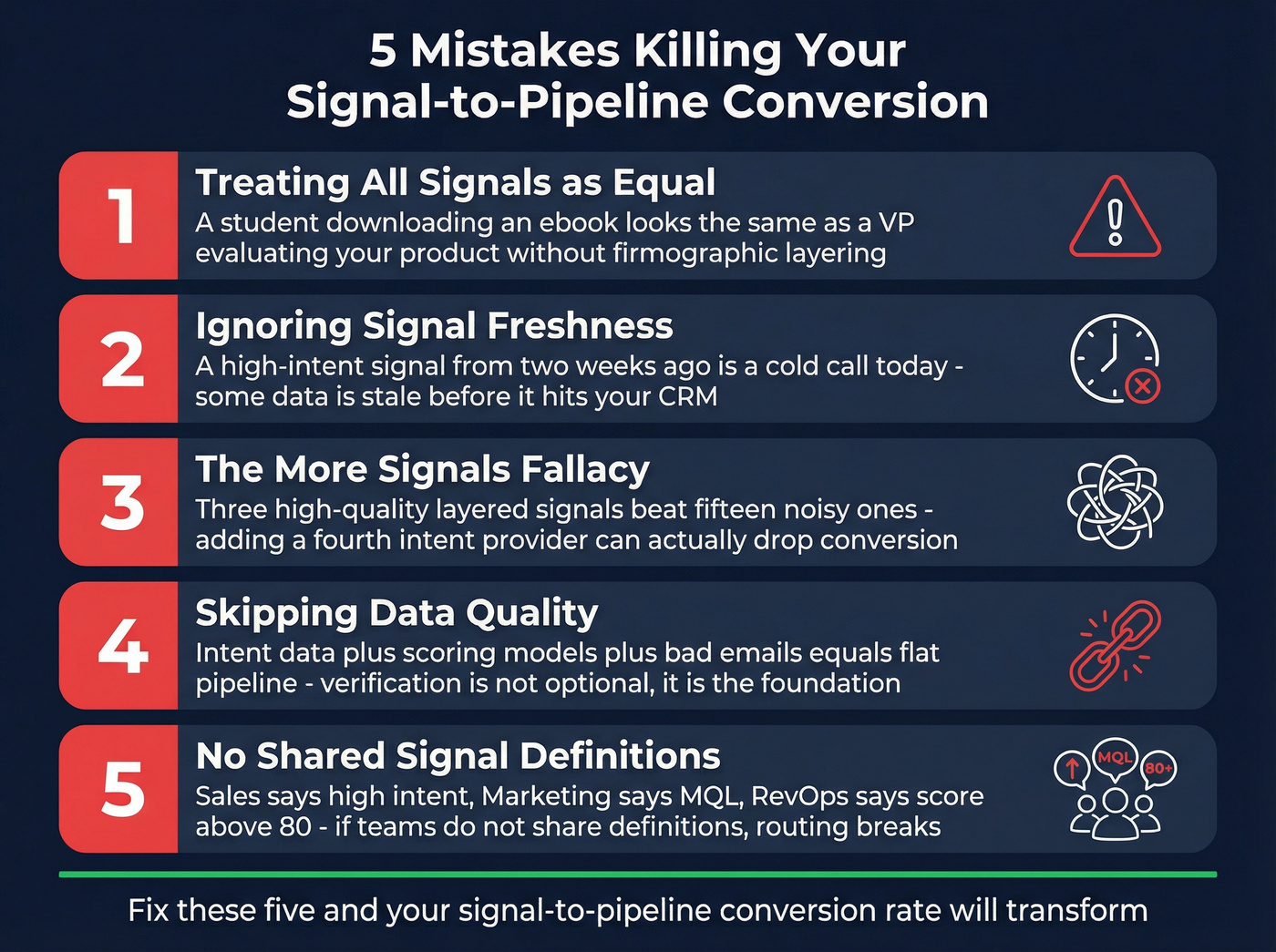
2. Ignoring signal freshness. Third-party intent varies wildly by provider network coverage and categorization methodology. Some data is weeks old by the time it reaches your CRM. A "high-intent" signal from two weeks ago is a cold call today.
3. The "more signals" fallacy. Look, collecting every signal from every source creates rep chaos, not clarity. Signals don't scale linearly in value. Three high-quality, layered signals beat fifteen noisy ones every time. We've watched teams add a fourth intent provider and see conversion rates actually drop because reps couldn't distinguish real buying patterns from statistical noise.
4. Skipping data quality. We've seen this pattern repeatedly: a CRO invests in intent data, builds scoring models, launches signal-triggered sequences - and pipeline stays flat because a huge chunk of outreach hits bad emails and disconnected phones. Real-time email verification and weekly data refreshes aren't optional. They're the hygiene that makes everything else work. (If you’re seeing decay, start with B2B contact data decay and CRM hygiene.)
5. No shared signal definitions. Sales calls a pricing page visit "high intent." Marketing calls it "MQL." RevOps calls it "engagement score > 80." If your teams don't share definitions, your routing rules break. Define signals once, review monthly, and make the taxonomy visible to everyone. Skip this step if you enjoy watching your SDRs and demand gen team argue about lead quality in Slack.
Tier 1 signals demand same-day outreach. That only works if you can actually reach the buyer. Prospeo's 300M+ profiles, 143M+ verified emails, and real-time verification mean your signal-triggered sequences land in inboxes - not bounce folders. Teams using Prospeo book 26% more meetings than ZoomInfo users.
Turn detected signals into booked meetings before your competitors even verify the email.
Measuring Performance
Four metrics tell you whether your signal-to-pipeline motion is working:
Signal-to-meeting rate. What percentage of signal-triggered outreach converts to a booked meeting? Below 5% means your signals are too noisy or your data quality is off. Above 10% and you're in strong territory.
Signal-to-pipeline rate. Of meetings booked from signals, how many create qualified pipeline? This catches the "lots of meetings, no real opportunities" failure mode that plagues teams who optimize for volume over fit.
Average response time to Tier 1 signals. Measure in hours, not days. If your average exceeds 6 hours, fix your routing before you buy another signal source. The consensus on r/sales is that speed-to-lead matters more than message quality for initial outreach - and the data backs it up.
False positive rate. What percentage of "high-intent" accounts turn out to be irrelevant? Above 30% means your scoring model needs recalibration. The benchmark: signal-personalized outreach hits 18% response rates versus the 3-5% cold email average.
FAQ
What's the difference between intent data and signal-based selling?
Intent data is one input - third-party content consumption across publisher networks. Signal-based selling layers multiple signal types (first-party, behavioral, contextual) and acts on patterns rather than individual data points. Intent data alone produces noise; layered signals produce pipeline.
How many signals should trigger outreach?
Accounts with 3+ active signals convert at 2.4x the rate of single-signal accounts. One signal is a data point. Three spanning first-party and third-party sources is a pattern worth acting on immediately.
What's the minimum viable stack?
One signal source (Bombora, G2, or your own website analytics), one verification tool for confirmed emails and mobiles, and one CRM or sequencer to activate outreach. Three tools, five layers covered - total cost under $500/month.
How fast should I respond to high-intent signals?
Tier 1 signals - pricing page visits from ICP accounts, multi-contact engagement, past champions changing jobs - demand outreach within hours. Response rates drop sharply after 24 hours. Build routing rules that alert reps in real time, and track average response time as a core KPI.