

7 B2B Sales Best Practices Backed by 2026 Data
61% of B2B buyers now prefer a rep-free buying experience. That's not a trend - it's a structural shift. Win rates have cratered to 17-20%, sales cycles are up 38% since 2021, and up to 70% of reps missed quota last year. And yet 75% of software buyers plan to increase spend this year. The money is there. It's going to sellers who match how buyers actually buy, not sellers running the same blast-a-list, book-a-demo, pitch-features playbook that stopped working three years ago.
If you implement three things from this article, make them these: multi-thread every deal over $50K, adopt a real qualification framework, and fix your contact data before you fix anything else. Everything else is optimization.
Selling Techniques That Move Win Rates
Define an Ideal Account Profile, Not Just an ICP
Most teams have an ICP. Fewer have an Ideal Account Profile - and the distinction matters.
An ICP tells you which companies could buy. An IAP tells you which accounts are high-value right now, based on signals like tech stack changes, headcount growth, funding rounds, and buying intent. It's the difference between a static list and a living target. Companies with a formal, documented sales process see 18% more revenue growth than those winging it, and that starts with knowing exactly who you're going after.
Operationalize your IAP with 30+ filters - buyer intent, technographics, job change signals, department headcount, funding, revenue - so you move beyond basic firmographics. The goal is to shrink the gray area between "good fit" and "great fit" before a rep ever picks up the phone. This single shift, narrowing your target before scaling outreach, prevents wasted effort across every downstream motion.
Multi-Thread Every Deal Over $50K
Buying committees aren't getting smaller. The average B2B deal now involves 10-11 stakeholders, and 74% of buying groups show unhealthy internal conflict during the decision process. If you're single-threaded into one champion, you're betting your deal on someone who might not even have the political capital to push it through.
The data is unambiguous. Analysis across 1.8M opportunities shows that closed-won deals have 2x as many buyer contacts as lost deals. For deals over $50K, multi-threading boosts win rates by 130%.
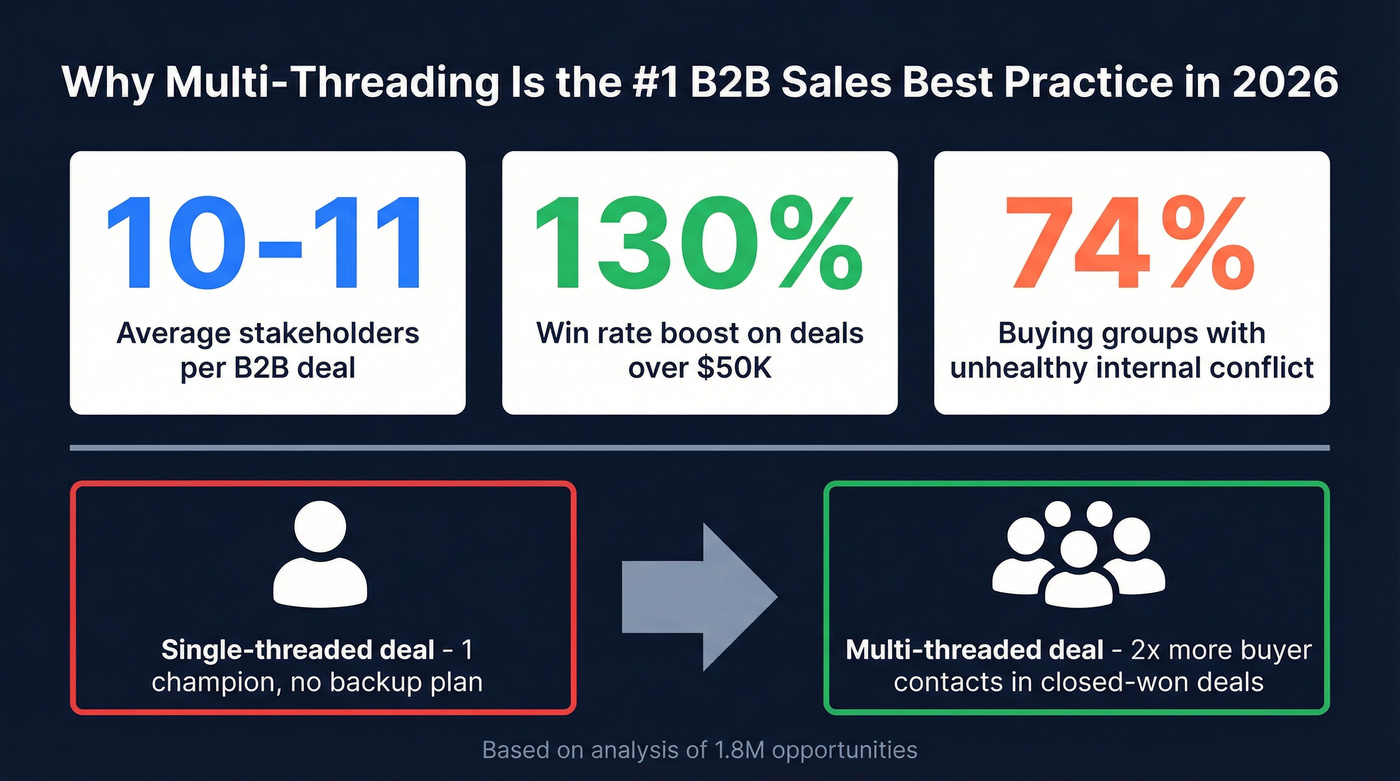
Winning deal teams are 67% larger on the internal side too - more SEs, more executives, more people helping the champion build consensus. If you're not mapping the full buying committee and assigning owners to each stakeholder, you're leaving money on the table. Of all the B2B selling techniques we've tested and tracked, multi-threading consistently delivers the highest measurable lift. (If you want the full breakdown, see what is multithreading in sales.)
Pick a Methodology and Use It
Here's the thing: it almost doesn't matter which methodology you pick. What matters is that you have one, your team knows it, and it shows up in your deal reviews. Strategy drives tactics - you can't coach multi-threading or discovery skills if there's no shared framework underneath.
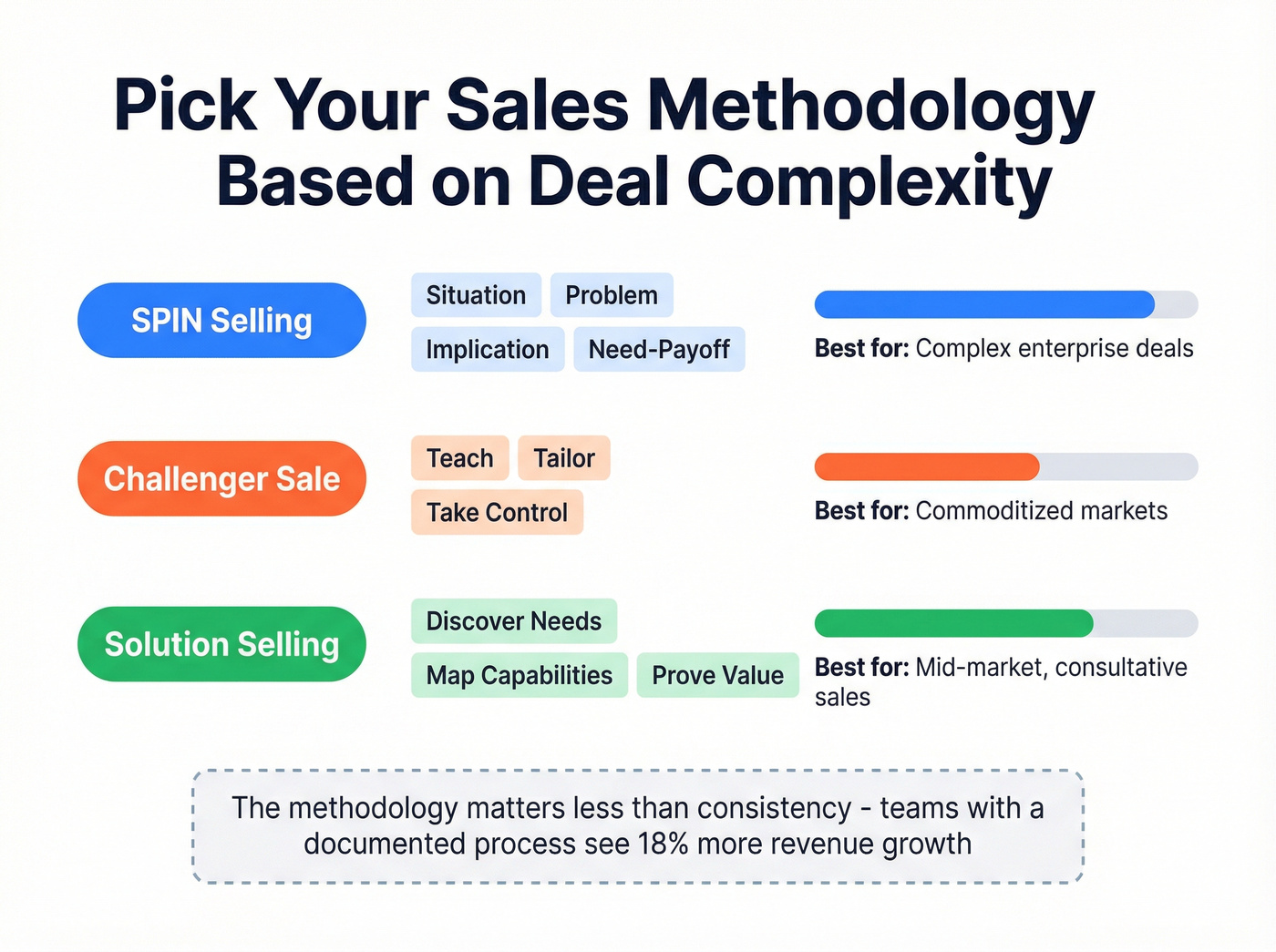
| Methodology | Best For | Core Idea |
|---|---|---|
| SPIN Selling | Complex enterprise | Structured pain discovery |
| Challenger Sale | Commoditized markets | Teach, tailor, take control |
| Solution Selling | Mid-market, consultative | Map capabilities to needs |
Pick the one that matches your deal complexity and market. Then reinforce it in every pipeline review, every 1:1, every call debrief. Build a conversation map - documented talk tracks by persona and deal stage - so the methodology translates to actual calls, not just a slide deck that dies after onboarding. The best B2B selling techniques share one trait: they give reps a repeatable structure for navigating complex deals.
Fix Your Data Before Your Process
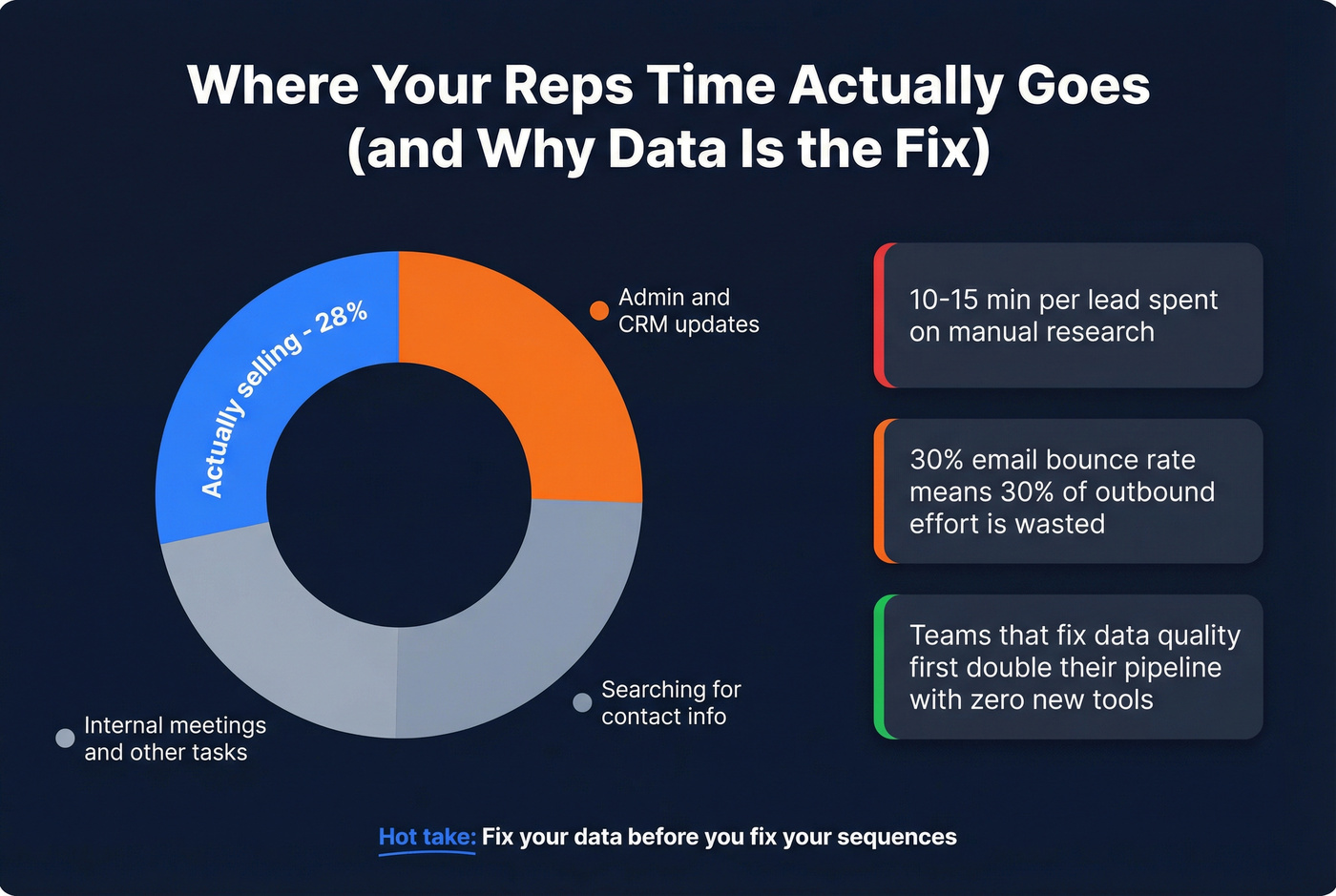
Reps spend 28% of their week actually selling. The rest goes to admin, research, and chasing down contact information that should've been in the CRM already. Manual research can eat 10-15 minutes per lead. Multiply that across a 50-person sales team and you're burning thousands of hours a quarter on work a machine should handle.

Our hot take: Most teams spend months optimizing sequences, cadence timing, and subject lines when the real problem is a 30% bounce rate. We've watched teams double their pipeline just by fixing data quality - no new playbook, no new tool stack, just accurate contact information on a fast refresh cycle. Data hygiene is the most underrated lever in B2B sales, and the consensus on r/sales backs this up: the threads about "my emails aren't getting replies" almost always trace back to garbage data, not bad copy. (If you want a practical system, start with CRM hygiene and B2B contact data decay.)
Use AI Where It Actually Helps
A ZoomInfo survey of 1,000+ GTM professionals found that 45% of sellers use AI at least weekly - but 42% barely touch it. Among the weekly users, the results are hard to ignore: 81% report shorter deal cycles, 80% see higher win rates, and 73% close bigger deals.
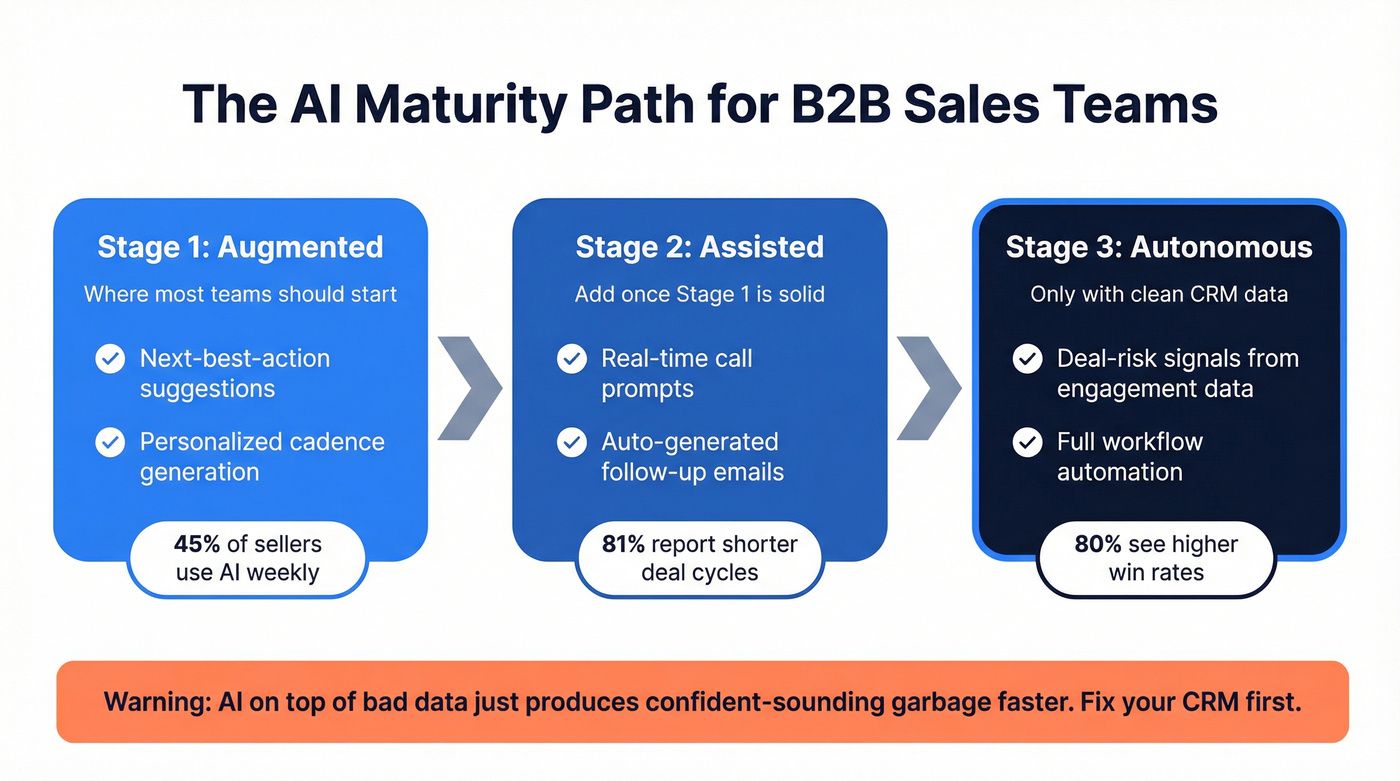
Right now, 7 in 10 sellers rely on general-purpose AI tools like ChatGPT for tactical tasks, and 4 out of 5 cite data inaccuracy and poor integration as the biggest obstacles. That's why BCG's maturity model matters. Don't try to go from zero to autonomous overnight.
Start with augmented workflows: next-best-action suggestions, personalized cadences. Move to assisted capabilities like real-time call prompts and auto-generated follow-ups. Then build toward autonomous workflows once the foundation is solid. Here are four use cases that pay off immediately:
- Call summarization and auto-logged CRM notes
- Deal-risk signals flagged from buyer engagement patterns
- AI roleplay for rep coaching and objection handling
- Auto-generated follow-up emails based on call transcripts
Pick two, get reps comfortable, then expand. Skip this if your CRM data is a mess - AI on top of bad data just produces confident-sounding garbage faster. (For a deeper build, see AI CRM data entry automation and AI sales analytics.)
Treat Outbound as a System
Outbound isn't a channel. It's a performance system with measurable inputs and outputs. A study of 55,000+ dials found a 16.6% connect rate. It takes an average of 8 attempts to reach a prospect. The best calling window? 4-5 p.m., which performs 71% better than late morning.
Cold email reply rates for well-targeted sequences run 3-8%, depending on your ICP and deliverability hygiene. But here's what separates teams that scale outbound from teams that burn out on it: multi-channel sequences outperform single-channel by 20-50% in meeting rate. That means coordinating calls, emails, and social touches into a single cadence with clear KPIs, weekly reviews, and constant iteration. Your email finder and dialer should feed the same workflow, not operate as disconnected tools. (If you need a blueprint, use an outbound sales engine and a prospecting workflow.)
Let's be honest - most outbound teams aren't failing because of strategy. They're failing because their tools don't talk to each other and their data decays faster than they can refresh it.
Enable the Decision, Don't Push the Pitch
Buyers spend just 17% of their purchase journey with any supplier - and only 5-6% with any single rep. Every interaction has to earn its place. Gartner's research shows that providing concise, decision-enabling information increases ease of purchase by 2.8x.
The era of urgency manipulation is over. Map your approach to where the buyer actually is: discovery-stage conversations need different content than evaluation-stage conversations. Mutual action plans beat artificial deadlines. Data-backed proposals beat "this offer expires Friday." The job isn't to push a pitch - it's to make the buying committee confident enough to say yes. (Related: what is a pitch slap.)

You just read that reps spend 28% of their week selling and the rest chasing bad data. Prospeo's 30+ filters - buyer intent, technographics, job changes, funding, headcount growth - let you build your Ideal Account Profile in minutes, not hours. 98% email accuracy. 7-day refresh. $0.01 per lead.
Stop optimizing sequences on top of a 30% bounce rate.
What to Stop Doing
If you're doing any of these, stop today:
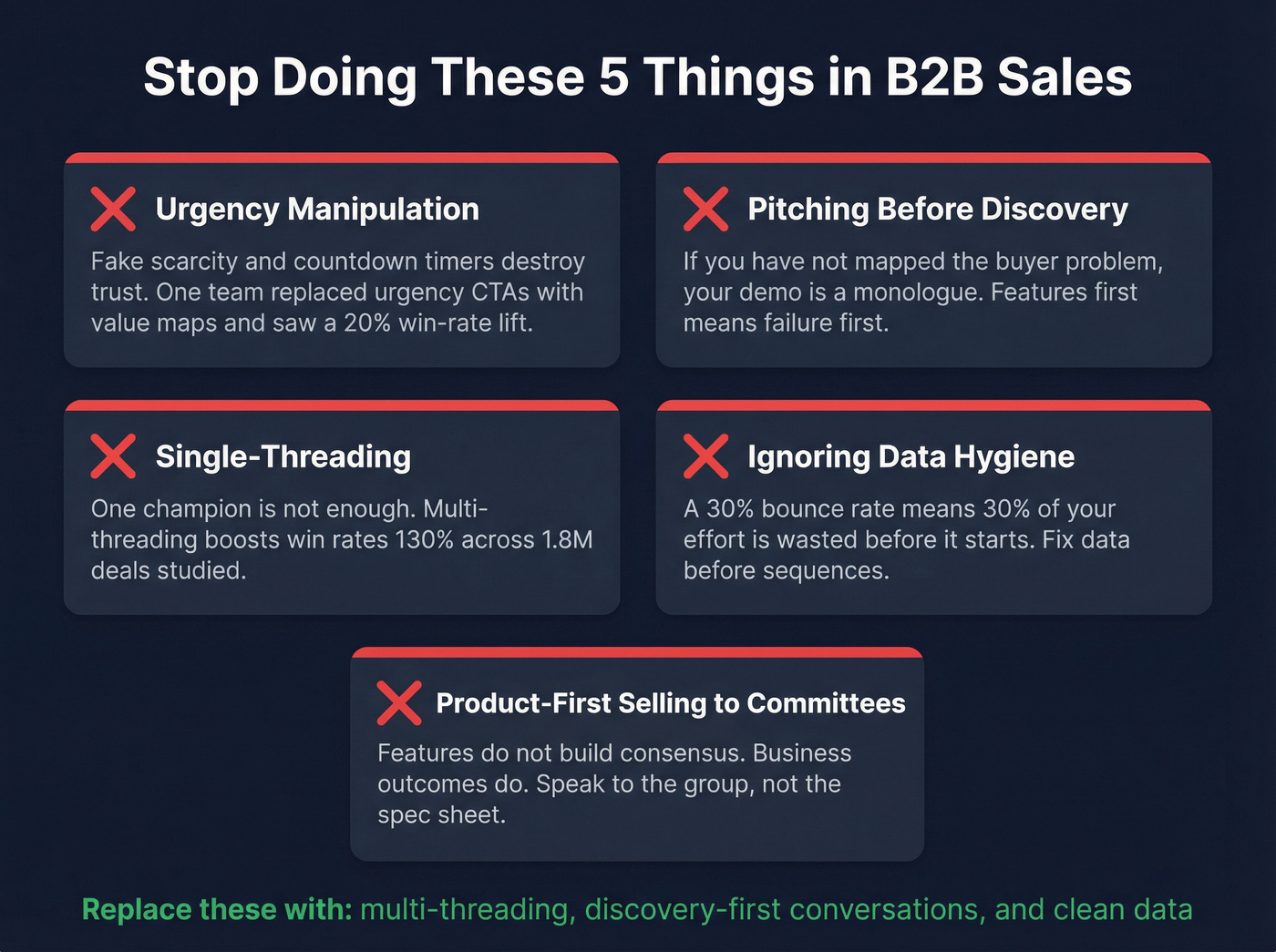
- Urgency manipulation - fake scarcity, countdown timers, "limited seats." One Head of Sales at LinkBuilder.io replaced urgency-based CTAs with tailored value maps and saw a 20% win-rate lift over two quarters.
- Pitching before discovery - if you haven't mapped the buyer's problem, your demo is a monologue. No amount of selling tips will save a conversation that starts with features instead of pain.
- Single-threading - one champion isn't enough for any deal with a committee. The 130% win-rate boost from multi-threading isn't theoretical; it's measured across 1.8M opportunities.
- Ignoring data hygiene - a 30% bounce rate means 30% of your outbound effort is wasted before it starts. The most common complaint in practitioner communities is that teams optimize everything except the data feeding their sequences.
- Product-first selling to committees - features don't build consensus. Business outcomes do.
Start With Three Things
You don't need to overhaul your entire sales org tomorrow. Multi-thread every deal over $50K. Pick a qualification framework and actually use it. And fix your contact data - because none of the other B2B sales best practices matter if your emails bounce and your dials go to voicemail.
If your average deal size is modest, you probably don't need a $40K/year data platform. But you still need accurate emails and direct dials. The teams that nail these three techniques in 2026 will outperform the ones chasing the next shiny methodology every quarter.
Multi-threading 10+ stakeholders per deal means you need verified contact data for the entire buying committee - not just your champion. Prospeo gives you 300M+ profiles with direct dials and verified emails so you can map and reach every decision-maker without burning hours on manual research.
Reach the full buying committee, not just the one person who replies.
FAQ
What's the biggest change in B2B sales in 2026?
Buyers have taken control. 61% now prefer a completely rep-free buying experience, and the average deal involves 10-11 stakeholders with 74% showing unhealthy internal conflict. Every rep interaction must earn its place by enabling a confident decision, not just delivering a pitch.
How can I improve win rates on complex deals?
Multi-thread your deals - for opportunities over $50K, engaging multiple stakeholders boosts win rates by 130%. Adopt a qualification framework like SPIN or Challenger and enforce it in pipeline reviews. Then fix your contact data quality, because bad emails and wrong numbers silently destroy every outbound motion you run.
What tools help with B2B sales prospecting?
Start with a CRM like Salesforce or HubSpot, a data platform with verified contacts and a fast refresh cycle, and an AI tool for call summaries and deal-risk signals. Layer in intent data to prioritize accounts showing active buying signals, and make sure your email finder and dialer feed the same workflow so nothing falls through the cracks.