

VerifyEmailAddress.org Review: Is It Safe in 2026?
You pasted an email into VerifyEmailAddress.org, got a green checkmark, fired off your cold email - and it bounced. Then the next one bounced. Then your ESP flagged your domain. You spent the next two weeks warming it back up instead of closing deals.
You're not alone. Email databases decay roughly 22.5% per year, which means a significant chunk of any list you verified six months ago is already dead. A "verified" result from a tool that only checks two of six verification steps is barely better than guessing - and the consequences aren't just wasted sends. A bounce rate above 2% triggers spam filters. Hit a spam trap and your domain reputation tanks overnight. Rebuilding takes weeks of warm-up sends, throttled volume, and lost pipeline.
As one Reddit user in r/Emailmarketing put it: the tool "works without sign-up for quick checks, but results are basic and not always reliable for large or sensitive email lists." That's a generous summary.
Here's what this free checker actually does - and what it misses.
What You Need (Quick Version)
Before the deep dive, here's the short answer based on what you're trying to do:
- Free one-off checks (no signup): VerifyEmailAddress.org works for quick gut checks. Just know it only reliably runs 2 of 6 verification steps, with partial coverage of a few others. A green checkmark doesn't mean the email won't bounce.
- Accurate bulk verification on a budget: MillionVerifier (~$3.70/1K) or Bouncer ($45/10K, 99.5%+ accuracy) give you real verification at scale without breaking the bank.
What Is VerifyEmailAddress.org?
VerifyEmailAddress.org has been around since 2010, making it one of the oldest free email verification tools on the web. The pitch is simple: paste an email address into the browser, hit verify, get a result. No signup. No credit card. No account.
It's one of those old-school web tools that looks simple because it is. The interface hasn't changed much since the early 2010s, and that's both its charm and its problem.
For bulk verification, the site redirects you to BulkEmailVerifier.com, which offers 100 free credits and then switches to a token-based pricing model. The actual dollar amounts? Not published anywhere. You'll need to sign up and request a quote - frustrating when every competitor lists pricing on their homepage.
The tool processes over 1,000 emails per minute for bulk jobs, which is respectable. But speed isn't the issue here.
The issue is what it's actually checking. On Serchen's alternatives index, VerifyEmailAddress.org scores a 26 out of 100 with zero user reviews. ZeroBounce scores 75. That gap tells you everything about where the industry has moved in the 16 years since this tool launched.
It still gets mentioned in Reddit threads as a go-to free tool - one r/sales user listed it alongside Hunter.io in their free sales stack. For zero-friction, zero-cost spot checks, it has a loyal niche. But "free and easy" isn't the same as "accurate and safe." (If you're comparing options, see our list of email verifier websites.)

VerifyEmailAddress.org skips catch-all detection - the #1 reason "verified" emails still bounce. Prospeo runs a 5-step verification process with catch-all handling, spam-trap removal, and honeypot filtering built in. The result: 98% email accuracy across 143M+ verified addresses, refreshed every 7 days.
Stop rebuilding domain reputation. Start with emails that actually land.
How Email Verification Actually Works - The 6-Step Process
Most people think email verification is binary: valid or invalid. It's not. A proper verification runs through six distinct steps, and skipping any of them introduces risk. In our experience testing verifiers for B2B outbound, catch-all detection is the single biggest accuracy differentiator - and it's the step most free tools skip entirely.

Step 1: Syntax validation. Does the email follow the name@domain.com format? This catches typos like missing @ signs or double dots. Every tool does this.

Step 2: Domain and MX record verification. Does the domain exist? Does it have mail exchange records configured to receive email? Again, table stakes.
Step 3: SMTP mailbox test. This is where it gets real. The tool opens an SMTP connection to the mail server and asks, "Does this specific mailbox exist?" It closes the connection without actually sending an email. Many servers limit or block this kind of probing, so results vary - especially on enterprise domains with strict security configurations.
Step 4: Risk screens. Flag role-based addresses (info@, support@, sales@), known spam traps, and other high-risk patterns. Sending to a spam trap can tank your sender reputation overnight. (If you're troubleshooting bounces, see 550 Recipient Rejected.)
Step 5: Catch-all domain detection. This is the big one. A catch-all server accepts email for any address at its domain - real or fabricated. The detection method: generate a random fake address at the domain, SMTP-verify it, and if the server says "250 OK" to a clearly nonexistent mailbox, it's catch-all. Without this step, "verified" emails on catch-all domains are a coin flip.
Step 6: Disposable and temporary email detection. Flags throwaway addresses from services like Guerrilla Mail or Temp Mail that expire within hours.
Here's the thing: VerifyEmailAddress.org reliably handles steps 1-2, partially covers steps 3-4 and 6 (it does basic SMTP checks, flags some spam traps, and catches disposable emails), but skips step 5 entirely. Modern tools run all six steps with full depth. That gap - especially the missing catch-all detection - is the difference between a 95% accuracy claim and actually keeping your bounce rate under 2%. (For a full walkthrough, see how to verify an email address.)
Honest Pros and Cons
What It Does Well
Give credit where it's due. VerifyEmailAddress.org has survived 15+ years for a reason:

- Zero friction. No signup, no account, no credit card. Paste an email, get a result. That's genuinely rare.
- Instant browser-based checks. No software to install, no extension to add. Works on any device.
- Unlimited free single verifications. Most competitors cap their free tier at 25-100 checks. This tool doesn't.
- Disposable email detection - it catches throwaway addresses, which is more than some free tools offer.
- Role-based account checks - flags addresses like info@ and support@ that tend to have low engagement.
- 15+ years of uptime. The site has been running since 2010 without disappearing, which is more than you can say for half the free tools that pop up and vanish.
What's Missing
And here's where it falls apart for anyone doing serious outbound:
- No catch-all detection. An estimated 20-30% of B2B domains use catch-all configurations. Without detection, every "verified" email on those domains is unreliable. This alone disqualifies the tool for B2B prospecting at scale.
- No spam trap filtering. Hit a spam trap and your domain reputation takes weeks to recover.
- Zero integrations. No Zapier, no HubSpot, no Mailchimp, no Salesforce. If you're running any kind of automated workflow, this tool doesn't plug in. (If integrations matter, start with email finder CRM integration.)
- No reporting or analytics. You get a result. That's it. No dashboards, no SMTP response codes, no sorting.
- Undisclosed bulk pricing. The site mentions "one-time checks and monthly plans" but publishes zero dollar amounts.
- Missing modern features. No AI verification, no Yahoo/AOL disabled-account detection, no anti-greylisting, no Google Sheets add-on.
The Two Red Flags - Accuracy and Data Security
The Accuracy Problem
Here's a stat that should make you uncomfortable: Hunter.io ran the most rigorous public benchmark of email verifiers, testing 15 tools against 3,000 real business emails. The best tool scored 70% real-world accuracy. Not 99%. Not 97%.

Seventy percent.
Every verifier markets 99% accuracy. Real-world performance tells a different story, especially on mid-market and enterprise domains with strict mail server configurations.
VerifyEmailAddress.org wasn't included in Hunter's benchmark - or any other public benchmark we've found. When a tool has been around since 2010 and no independent tester has bothered to include it, that's not a good sign. The accuracy claims that do exist are contradictory: 95% in one comparison, 97% in another, and neither source explains their testing methodology.
But the real accuracy killer is the catch-all gap. When 20-30% of B2B domains are configured as catch-all, and your verifier can't detect them, a chunk of your "verified" list is essentially unverified. The server said "250 OK" to every address - real or fake. You're flying blind on those domains.
The industry threshold is clear: keep your bounce rate below 2%. Top performers target hard bounces under 1%. A tool that skips catch-all detection can't reliably get you there. (More on this in our guide to email deliverability.)
Data Security Concerns
This is the part that doesn't get enough attention with free verifiers.
VerifyEmailAddress.org's data security practices are undisclosed. Its GDPR compliance status is contradictory across sources - "N/A" according to one, "GDPR, CCPA" according to another. No public privacy policy has been found on the site.
Compare that to ZeroBounce, which holds SOC 2 Type 2, ISO-27001, GDPR, CCPA, and HIPAA certifications. (If you need the legal/operator view, see GDPR for Sales and Marketing.)
Look - every free verifier says "we don't store your data." Almost none publish a privacy policy that proves it. When you paste an email into a free web tool, you're trusting that tool with your prospect data. If you're verifying client lists, you could be violating your own data processing agreements without knowing it.
For one-off personal checks, the risk is low. For business use with any compliance requirements, undisclosed security practices should be a dealbreaker.
Who Should Use It (And Who Shouldn't)
Use It If:
- You need a quick one-off check before sending a single cold email and don't want to create an account anywhere
- You're a freelancer spot-checking a handful of addresses manually
- You want zero friction - no signup, no credit card, no commitment

Skip It If:
- You're verifying a list of 1,000+ leads before a campaign
- You need reliable B2B verification where 20-30% of domains are catch-all
- You require integrations with your CRM, email platform, or automation tools
- Data security compliance matters to your organization
- You're spending real money on outbound and can't afford a 5%+ bounce rate
I've seen teams burn through sender reputation because they trusted a free tool's green checkmark on a 5,000-contact list. The cost of a proper verifier is a rounding error compared to the cost of rebuilding domain reputation. (If you're fixing reputation issues, start with what is domain reputation.)
If your deals are typically under $5K and you're sending fewer than 50 cold emails a month, VerifyEmailAddress.org is probably fine. But the moment you're running real outbound campaigns - even small ones - the $24-$45 for a proper verifier pays for itself on the first campaign that doesn't bounce.
Better Alternatives for Email Verification in 2026
Prospeo - Best for B2B Teams Who Need Verified Emails
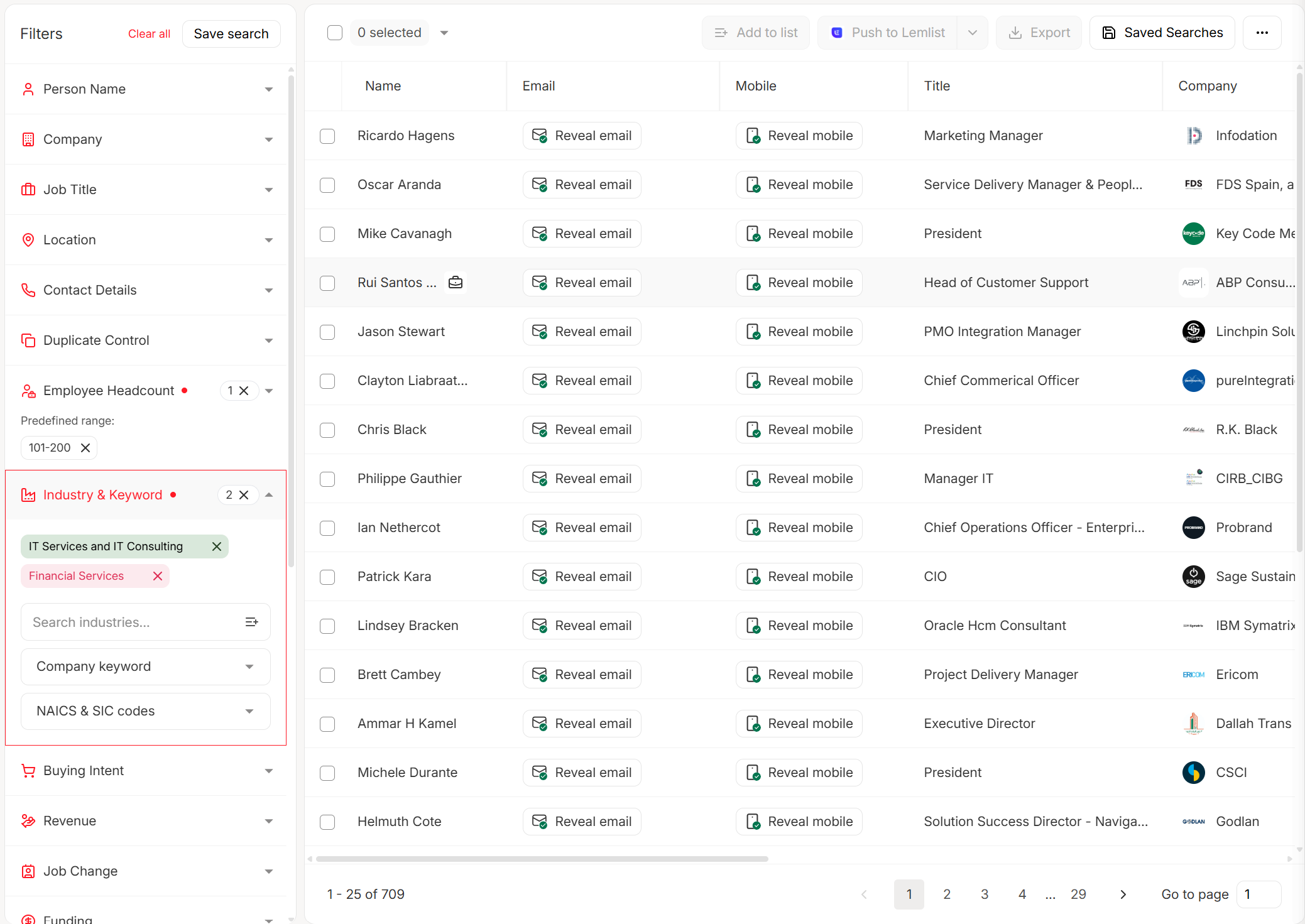
Most people searching for email verifiers are solving the wrong problem. If you're doing B2B outbound, you don't just need to verify emails you already have - you need to find verified emails in the first place. Prospeo collapses that into one step: search across 300M+ professional profiles with 30+ filters, and every result comes back through a 5-step verification process with catch-all handling and spam-trap removal. 98% email accuracy. Data refreshes every 7 days - the industry average is 6 weeks. Chrome extension with 40K+ users. GDPR compliant with DPAs available. (For more options, see our roundup of B2B email lookup tools.)
ZeroBounce - Best for Compliance-Heavy Teams
ZeroBounce is the tool you pick when your legal team has opinions about data handling. SOC 2 Type 2, ISO-27001, GDPR, CCPA, HIPAA - it checks every compliance box that VerifyEmailAddress.org leaves blank. The accuracy guarantee is 99.6% with a money-back promise, the most aggressive guarantee in the space. Their Verify+ feature detects disabled Yahoo and AOL accounts, a niche capability that matters if your list skews consumer or SMB.
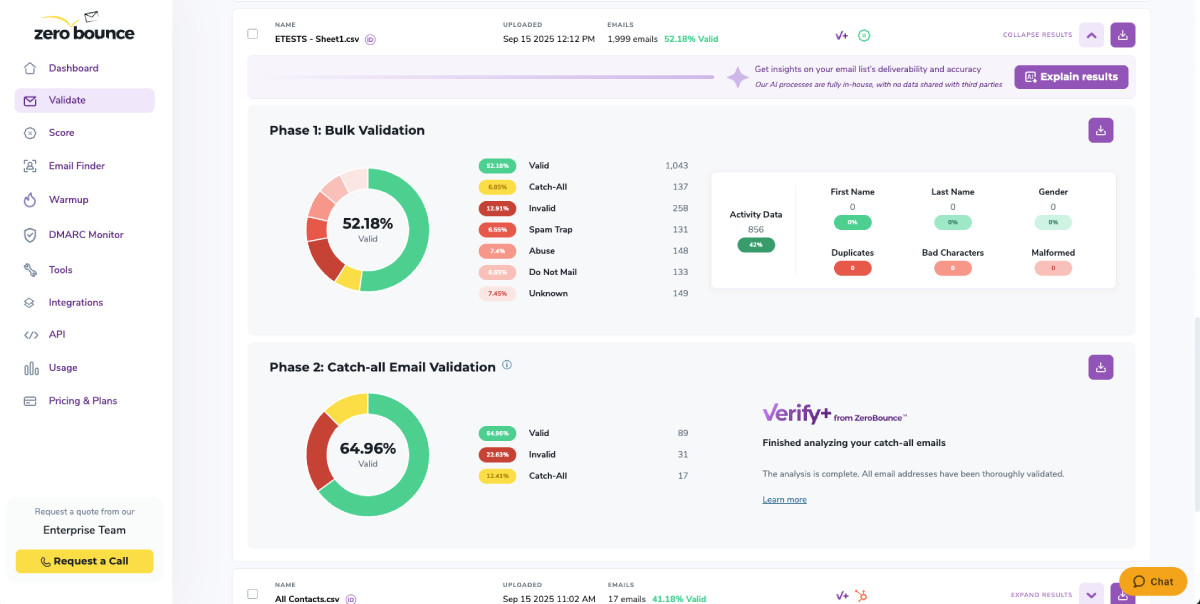
Forty-five integrations cover most CRM and email platform combinations. Pricing runs $99/mo for 25K credits on the ONE plan (which bundles warmup, DMARC monitoring, and blacklist monitoring) or $64/10K on pay-as-you-go. Free tier: 100 verifications/month.
If you're in healthcare, finance, or any regulated industry, this is the default choice.
Bouncer - Best Accuracy Per Dollar
We've run lists through both Bouncer and ZeroBounce. Bouncer's accuracy-per-dollar is hard to beat.
| Details | |
|---|---|
| Why it wins | 99.5%+ accuracy at $45/10K verifications |
| Key tradeoff | Verifier only - won't help you build a prospect list |
| Compliance | SOC 2 and GDPR compliant |
| Extras | Real-time API, Zapier integration, Google Sheets add-on |
| Pricing | 100 free credits, then $45/10K. No hidden modules. |
Capterra rates it 4.9 across 233 reviews. G2: 4.8 across 232 reviews. Those are exceptional scores for a verification tool.
Hunter.io - Best Free Tier for Verification + Outreach
Hunter runs the most transparent operation in the space. They published the only rigorous public accuracy benchmark, tested 15 tools, and scored highest at 70% - while openly acknowledging their own testing bias. That kind of honesty is rare.
- Free tier: 100 verifications/month
- Paid: $149/10K
- Best for: Small teams who want find + verify + send without juggling three subscriptions
- Watch out for: The gap between their marketing claim (98%) and their own benchmark result (70%)
MillionVerifier - Cheapest Bulk Option
Price: ~$3.70 per 1,000 verifications. That's roughly 10x cheaper than Hunter and half the price of EmailListVerify. Claims 99%+ accuracy. No free tier, but at under four bucks per thousand, the barrier is negligible. Best for large list cleaning jobs where you're processing tens of thousands of contacts and every fraction of a cent matters.
Emailable - Fastest Processing
250 free credits. $50/10K. 99%+ accuracy. Acquired multiple verification companies (including TheChecker, DataValidation, and Trumail), giving it one of the largest processing infrastructures in the space. SOC 2 Type II and GDPR compliant. A solid mid-range option if you want compliance and speed without ZeroBounce's premium pricing.
EmailListVerify - Budget Runner-Up
$24/10K makes this the second-cheapest option after MillionVerifier. 100 free credits to test. 97% accuracy claim. No frills, no extras - just straightforward bulk list cleaning for budget-conscious teams doing periodic hygiene passes.
Verifalia - Best for Developers
25 free verifications per day. Credit-based pricing where credits never expire. 99% accuracy. Quality levels (Standard, High, Extreme) let you trade credits for deeper verification - Extreme costs 4x but catches more edge cases. 6,000+ integrations. EU GDPR compliant. The developer's choice for building verification into custom workflows.
Pricing Comparison Table
Email marketing returns $36 for every $1 spent. A proper verification tool costs pennies per email. The math isn't complicated - but pricing is all over the map:
| Tool | Free Tier | Cost/10K | Accuracy | Catch-All Detection |
|---|---|---|---|---|
| VerifyEmailAddress.org | Unlimited single | ~$30-100 (est.) | 95-97% (unverified) | No |
| Prospeo | 75/mo | ~$100* | 98% | Yes |
| ZeroBounce | 100/mo | $64 | 99.6% | Yes |
| Bouncer | 100 credits | $45 | 99.5% | Yes |
| Hunter.io | 100/mo | $149 | ~70% (benchmarked) | Yes |
| MillionVerifier | None | $37 | 99%+ | Yes |
| Emailable | 250 credits | $50 | 99%+ | Yes |
| EmailListVerify | 100 credits | $24 | 97% | Yes |
| Verifalia | 25/day | ~$50-80 | 99% | Yes |
VerifyEmailAddress.org is the only tool on this list that doesn't publish bulk pricing. It's also the only one without catch-all detection. Those two facts together tell you everything about where it sits in the market in 2026. (If you're looking specifically for no-cap tools, see unlimited email verifiers.)
Free tools check syntax and MX records. That's steps 1 and 2 out of 6. Prospeo's proprietary email infrastructure covers all six - including catch-all detection and spam-trap filtering - so your bounce rate stays under 2%. Teams using Prospeo cut bounce rates from 35%+ to under 4%.
Get 100 free credits and see what real verification looks like.
FAQ
Is VerifyEmailAddress.org safe to use?
Its data security practices aren't disclosed, and GDPR compliance status is contradictory across sources. For one-off checks with non-sensitive addresses, the risk is low. For bulk verification of client or prospect data, use a tool with documented compliance like ZeroBounce (SOC 2 Type 2, HIPAA) or Prospeo (GDPR compliant, DPAs available).
Is VerifyEmailAddress.org accurate?
Accuracy claims range from 95-97%, but no independent benchmark has tested it. The tool checks syntax and MX records but skips catch-all detection entirely. Since 20-30% of B2B domains use catch-all configurations, "verified" emails on those domains can still bounce - making real-world accuracy significantly lower than advertised.
Can I verify emails for free without signing up?
Yes - VerifyEmailAddress.org lets you run unlimited single checks with no account required. For deeper verification with catch-all detection, Verifalia offers 25 free checks per day and Hunter.io provides 100 per month. Prospeo's free tier includes 75 emails plus 100 Chrome extension credits monthly, and finds emails for you rather than just verifying ones you already have.
What's the difference between email verification and email validation?
Validation checks format and syntax - is this structured like a real email address? Verification confirms the mailbox exists and can receive mail via SMTP checks, catch-all detection, and spam-trap filtering. Most modern tools do both. VerifyEmailAddress.org primarily validates rather than deeply verifying at the SMTP and catch-all level.
How often should I re-verify my email list?
Every 3-6 months minimum. Email databases degrade approximately 22.5% per year due to job changes, company closures, and abandoned accounts. Before any major campaign, run a fresh verification pass - even if the list was "clean" last quarter. Catch-all domain statuses can change too, so recheck those every 60-90 days.