Growbots vs HubSpot (2026): Limits, Pricing & Best Fit
Growbots vs HubSpot in 2026: compare sequence limits, throttles, pricing, and best-fit use cases - plus stack tips and a data layer to improve results.
12 min readProspeo Team
Growbots vs HubSpot (2026): Which One Fits Your Outbound Motion?
If your outbound feels "stuck," it's usually not your copy. It's the bottleneck you picked without realizing it.
HubSpot makes the bottleneck governance (great) and throughput (not great). Growbots makes the bottleneck throughput (simple) and governance (your problem).
Here's the hook: most teams don't need a new sequencer. They need a clearer decision about what system owns outreach, what system owns truth, and what system owns data.
30-second verdict (Growbots vs HubSpot)Choose Growbots if... you want outbound to run like a production line: built-in prospecting, sequencing, deliverability tooling, and a shared-inbox workflow. It's best for SMB/mid-market teams that care more about "launch campaigns fast and keep volume steady" than perfect CRM purity. What breaks first is governance - without strict rules, statuses and ownership get messy once multiple reps touch the same accounts. Pricing is driven by messages/day plus database credits under its post-June 5, 2024 model.
Choose HubSpot if... you want your CRM to be the truth: clean lifecycle stages, deal reporting, tasks, and rep workflow in one place. It's best when RevOps wants tight attribution and managers live in pipeline dashboards. What breaks first is throughput: HubSpot Sequences caps at 500/day per Professional seat or 1,000/day per Enterprise seat (rolling 24 hours), and bulk enrollment is throttled.
Use both if... HubSpot is non-negotiable as your system of record, but you need a dedicated outbound execution layer. Do it only if you're willing to enforce dedupe rules, field mapping, and "one system owns outreach status."
Skip both if... your real problem is list quality (bounces, stale titles, wrong accounts). Fix the data first, then pick the sender/CRM.
Growbots vs HubSpot in one sentence each (and what they're not)
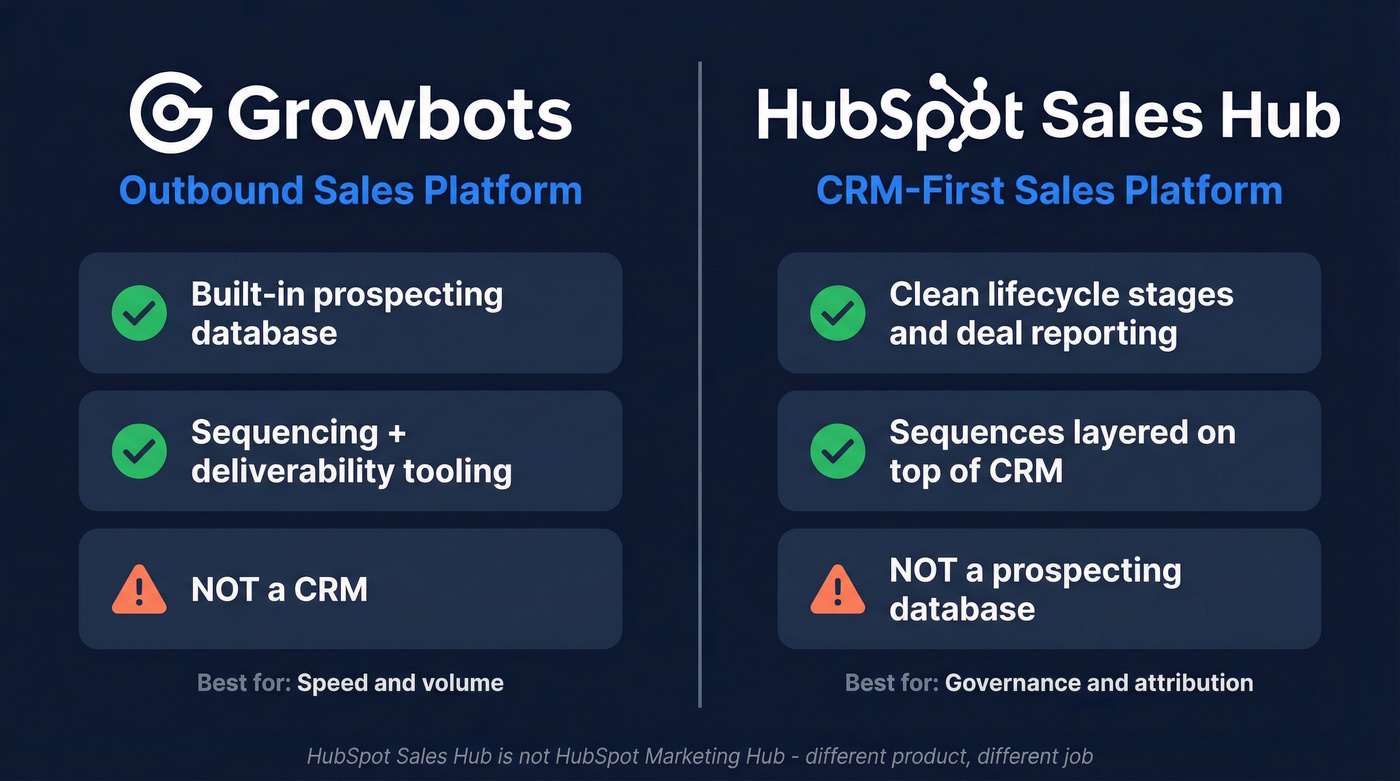
Growbots is an outbound sales platform that bundles prospecting + sequencing + deliverability tooling (and a Concierge done-for-you route ) into one UI--it's not a CRM.
Growbots vs HubSpot identity and role comparison
HubSpot Sales Hub is a CRM-first sales platform with sequences layered on top. It doesn't include a built-in prospecting database like Growbots; teams usually add data via imports, integrations, or add-ons.
One clarification that saves teams hours: HubSpot Sales Hub isn't HubSpot Marketing Hub.
Marketing Hub is for marketing emails, landing pages, forms, and automation. Sales Hub is where reps live: deals, tasks, sequences, calling, meetings.
Growbots vs HubSpot: at-a-glance comparison (ops reality, not checkboxes)
Workflow reality
Growbots
HubSpot Sales Hub
"Center of gravity"
Outbound engine
CRM system of record
Built-in prospecting DB
Yes
No
Daily send cap model
Per inbox/day (tiered)
Per seat/day (tiered)
Sequence send limits
Up to 20/100/500 per inbox/day (by plan)
500/day (Pro) or 1,000/day (Ent) per seat (rolling 24h)
Enrollment throttles
Not the main bottleneck
3 emails/min bulk enrollment throttle
Sending identity
Shared inbox workflows supported
Sequences require a connected personal inbox (not a team inbox)
Free-plan constraints
3 sequences, 5 steps max
Free CRM doesn't include Sequences (requires Pro/Ent seats)
CRM sync depth
Lists HubSpot bi-sync on its pricing grid
Native (it is the CRM)
Pricing driver
messages/day + credits (if using DB)
Seats + onboarding
Credits behavior
Rollover for post-June 5, 2024 subscriptions
HubSpot Credits reset monthly
Credits behavior
Rollover for post-June 5, 2024 subscriptions
HubSpot Credits reset monthly
Three takeaways that matter once you're running real volume:
If you need speed and volume, HubSpot's throttle + seat caps become your governor. It's a CRM first, sequencer second.
If you need governance, Growbots needs rules. Without them, you'll create duplicates and conflicting statuses across systems.
Template portability is a hidden cost. HubSpot's sticky: moving sequence templates out later is annoying and error-prone.
What users consistently like (and complain about)
We've tested both styles of setup (CRM-first and outbound-first) across teams that look great on paper and still struggle in week two.
Growbots: People love the "all-in-one outbound" feel. Complaints cluster around packaging/pricing confusion and the work required to keep data + statuses clean at scale.
HubSpot Sales Hub: People praise reporting and the unified CRM workflow. The loudest complaints are cost creep (seats/hubs) and hitting limits when outbound volume ramps.
Look, neither of these is a magic wand. If your targeting's sloppy, you'll just scale sloppy faster.
Decision framework: CRM-first vs outbound-first vs paired stack
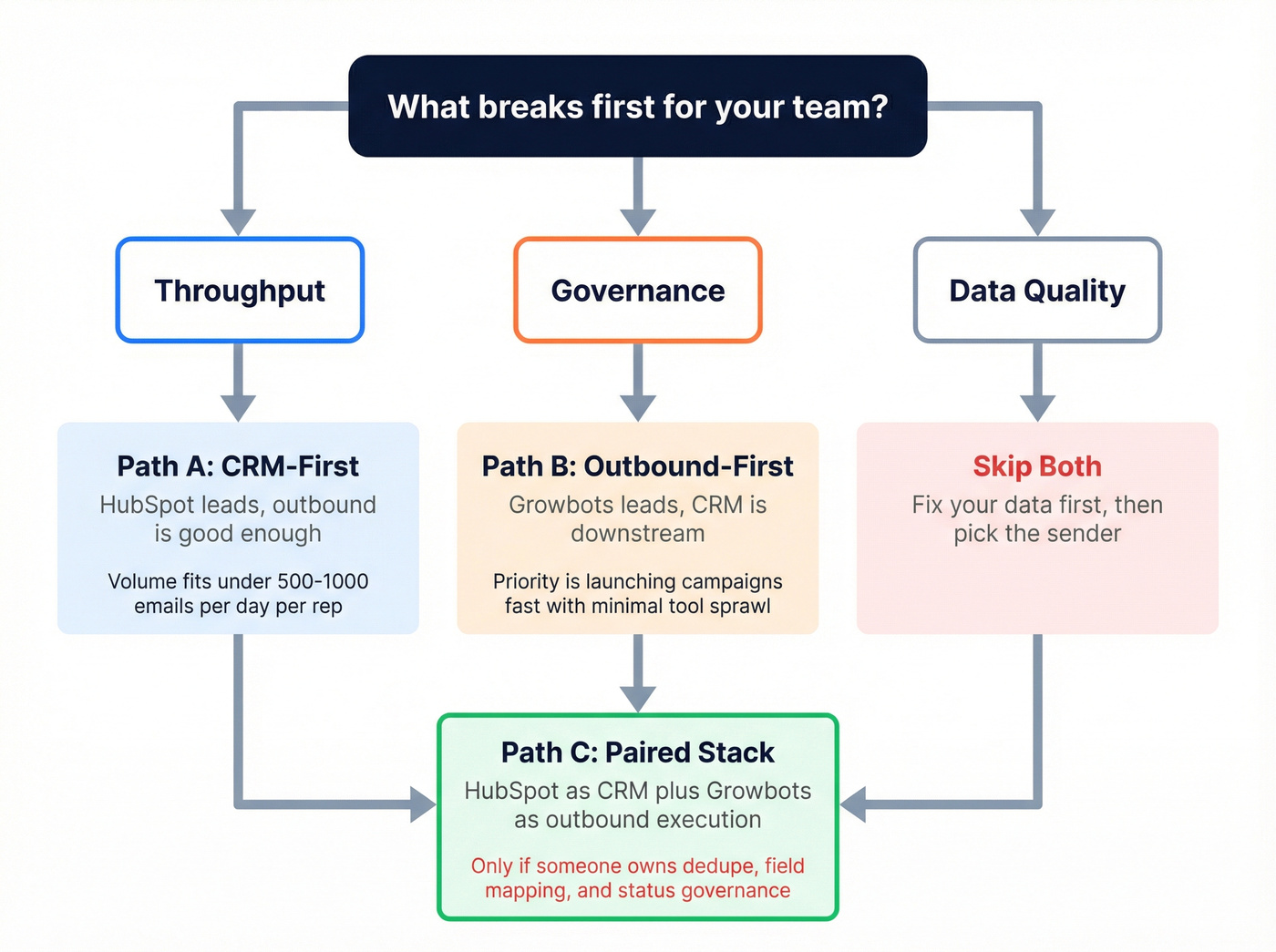
Pick based on what breaks first for your team: throughput, governance, or data quality.
Decision flowchart for choosing CRM-first outbound-first or paired stack
Path A: CRM-first (HubSpot leads, outbound is "good enough")
Choose this if you want clean lifecycle stages, deal reporting, and rep workflow inside one system - and your outbound volume fits inside HubSpot's limits.
What breaks first: throughput. When an SDR manager wants consistent 800-1,200 sequence emails/day across a small team, HubSpot becomes a math problem (seats) and an ops problem (enrollment throttles), even if your deliverability and copy are solid.
Path B: Outbound-first (Growbots leads, CRM is downstream)
Choose this if your #1 goal is getting outbound running with minimal tool sprawl: prospecting + sequencing + warm-up in one UI.
What breaks first: governance. The moment you care about strict attribution, lifecycle definitions, and "one source of truth," you need discipline - or you'll drown in status drift.
Path C: Paired stack (HubSpot as CRM + Growbots as outbound execution)
Choose this if HubSpot's non-negotiable as the system of record, but you need outbound volume and workflow control beyond what HubSpot Sequences comfortably supports.
What breaks first: sync loops and duplicates. I've seen teams spend two weeks arguing about "why HubSpot's creating dupes" only to find the real cause was an import with placeholder emails plus a second list uploaded by a different rep with aliases.
Three hard rules (do/don't):
Don't use HubSpot Sequences as your primary engine if you need more than ~700 automated emails/day per rep. You'll fight caps and throttles instead of improving targeting.
Don't run a paired stack if nobody owns field mapping + dedupe + status governance. If "everyone owns it," nobody owns it.
Don't buy your way out of volume with seats if your average deal size is small. Strong opinion: it's one of the fastest ways to end up with a bloated stack and the same pipeline.
Limits that matter in Growbots vs HubSpot: sequences, throttles, and daily caps
HubSpot's limits are strict and predictable. Growbots' limits are operationally simple. Both are fine - until you scale.
HubSpot Sequences: the real ceilings
Daily sequence send limit: 500/day per Professional seat and 1,000/day per Enterprise seat, measured on a rolling 24-hour window.
Bulk enrollment throttle: 3 emails per minute when enrolling in bulk.
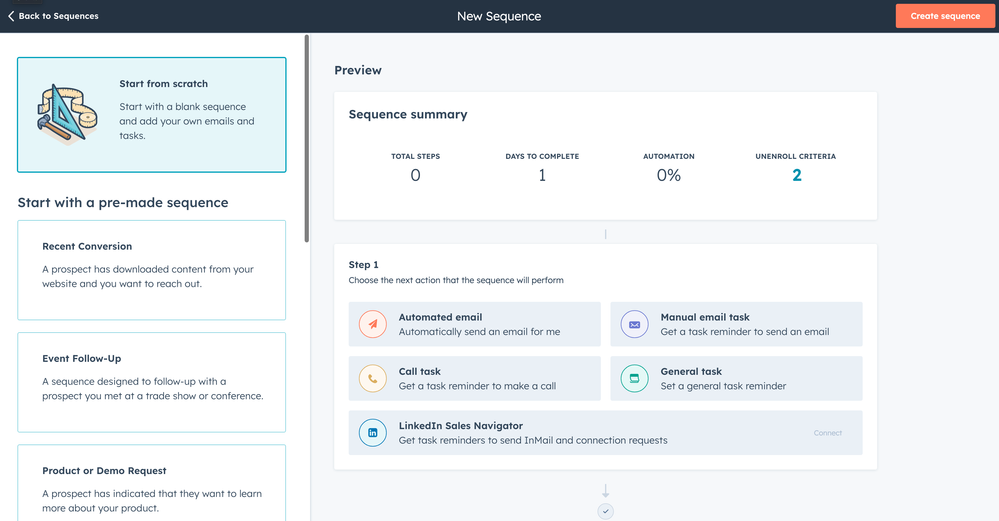
Sending identity constraint: Sequences send from a connected personal inbox (not a team inbox).
Daily send limits comparison between Growbots tiers and HubSpot tiers
The bulk throttle is what burns teams. You can "have capacity" on paper and still waste hours babysitting enrollments, especially if your reps are trying to load lists at the same time on Monday morning.
Growbots: per-inbox daily limits by tier
Growbots' pricing grid shows operational limits:
Freemium: up to 20/day per email
Starter Outreach: up to 100/day per email
Pro Outreach: up to 500/day per email
Freemium also caps you at 3 sequences and 5 max steps, while paid tiers go unlimited.
Growbots scales like an outbound shop thinks: inboxes × daily cap, not seats × permissions.
You just read that the real bottleneck is usually data quality - not your sequencer. Prospeo's 300M+ profiles refresh every 7 days (not 6 weeks), with 98% email accuracy and 125M+ verified mobiles. Whether you run HubSpot, Growbots, or both, clean data is the layer that makes everything else work.
Professional: $90/seat (annual) or $100/seat (monthly) + $1,500 onboarding
Enterprise: $150/seat/month + $3,500 onboarding
That's list pricing; plenty of teams negotiate depending on seats and hubs. But the budgeting reality stays the same: you buy seats, not outbound volume.
Growbots' newer model (post-June 5, 2024) is driven mainly by messages/day. You choose:
Route: Free, All-In-One, or Concierge
Package level (Starter vs Pro)
Prospect source (their database vs your upload)
Credits (if you pull new prospects from their database)
Important nuance: Growbots' help docs for post-June 5, 2024 subscriptions say credits roll over. Older packaging behaved more like monthly resets, which is why you'll still see conflicting references floating around.
What teams actually pay (useful ranges, not fantasy numbers)
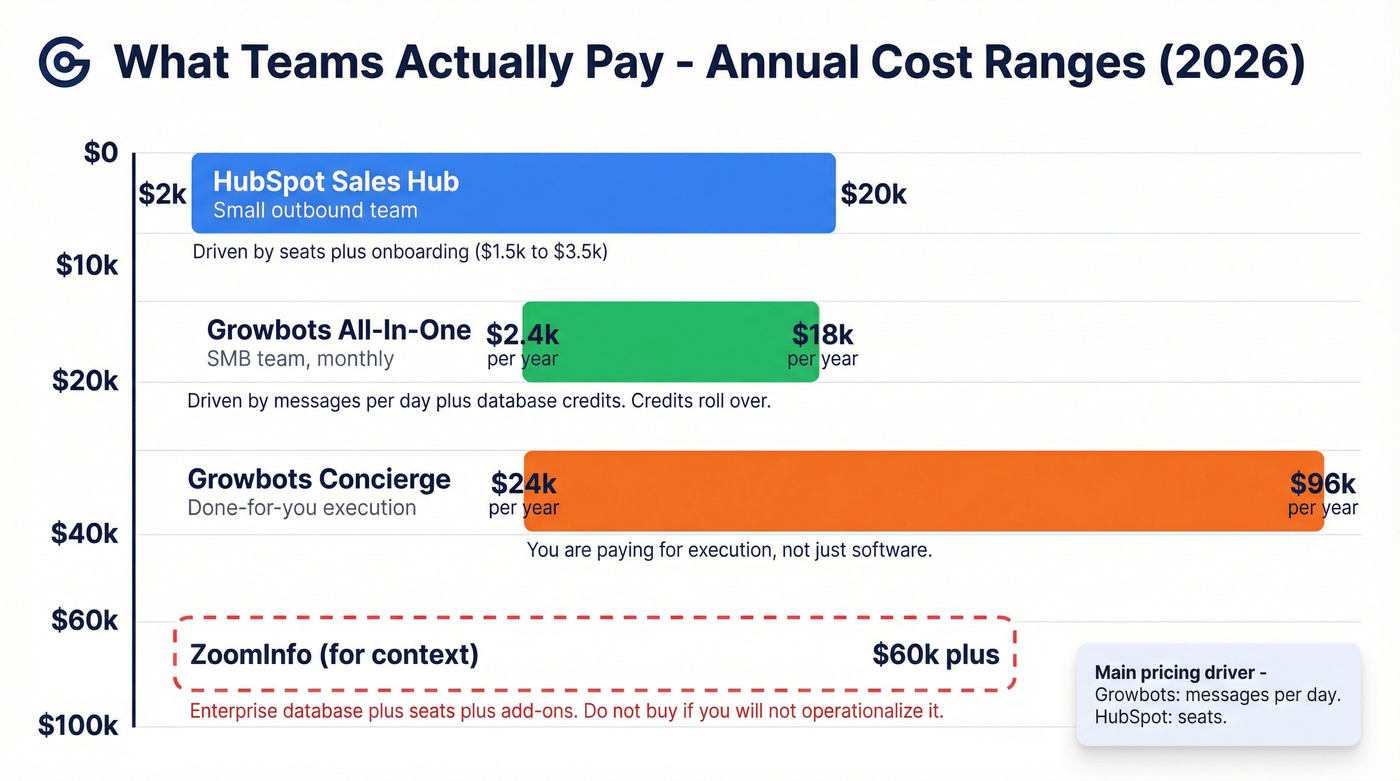
HubSpot Sales Hub (small outbound team): $2k-$20k/year once you include seats + onboarding.
Growbots All-In-One: most SMB teams land around $200-$1,500/month, depending on messages/day and database usage.
Growbots Concierge: commonly $2k-$8k/month because you're paying for execution, not just software.
Pricing comparison ranges for Growbots HubSpot and ZoomInfo
And for context: ZoomInfo's still the heavyweight for "big database + enterprise workflows," but it's also a $40k-$60k/year conversation once you add seats and common add-ons. If you're not going to operationalize it, don't light that money on fire.
Mini-table: pricing model difference
Pricing reality
Growbots
HubSpot Sales Hub
Main driver
messages/day
seats
Data access
credits (if DB)
add-on tools
Onboarding fees
$0-$2k range
$1.5k / $3.5k
Entry point
Free plan
Starter $9/seat
Credit behavior
rollover (post-June 5, 2024 subs)
resets monthly
Integration reality if you use both (HubSpot ↔ Growbots)
If you run HubSpot + Growbots together, integration quality becomes your hidden platform. It feels fine - until duplicates and stage chaos show up.
Integration architecture diagram for HubSpot and Growbots paired stack
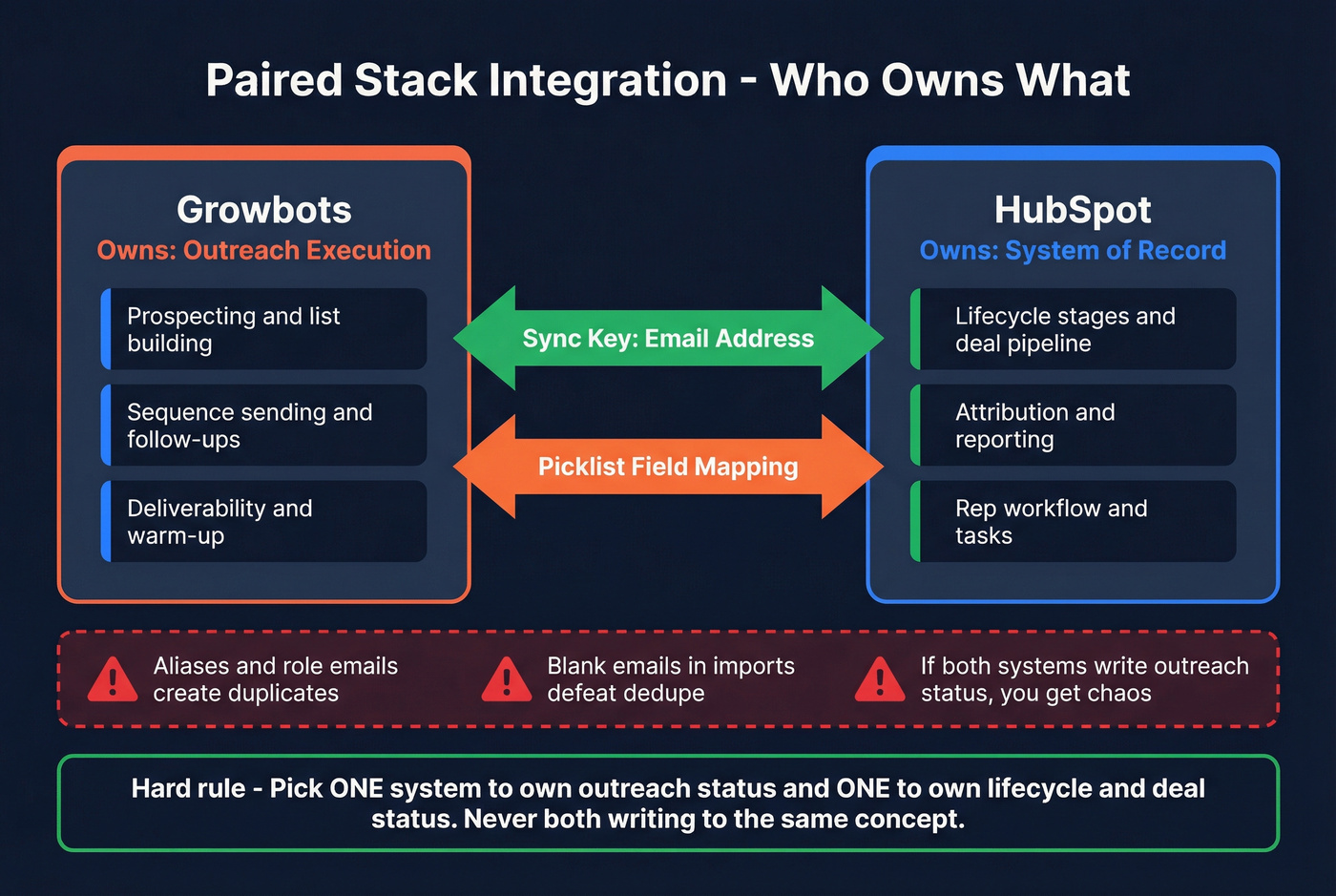
Dedupe: email is the key
Growbots dedupes against HubSpot by email address. That's the right key.
Where teams mess it up:
Aliases and role emails create edge cases.
Imports with blank/placeholder emails defeat dedupe and create duplicates.
Picklist mapping: where sync projects go to die
You'll map Growbots actions/stages into a HubSpot picklist field for status tracking, and sometimes map HubSpot changes back.
Rule: pick one system to own "outreach status" and one to own "lifecycle/deal status." If both write to the same concept, you'll create a bi-sync loop and spend your Fridays debugging ghosts.
Task sync behavior (the part ops teams forget)
Growbots can push tasks into HubSpot when a sequence step is a task. That's powerful - if you test edge cases:
pauses/skips
bounces
ownership reassignment mid-sequence
One practical note: Growbots' integration documentation is older, so expect UI drift. Focus on behavior, not screenshots.
Templates, portability, and lock-in (the hidden workflow tax)
Nobody budgets time for moving messaging between tools. They should.
HubSpot: you can't export sequence emails via the UI for easy import elsewhere. If you move off HubSpot for outbound later, you're doing copy/paste archaeology.
Workaround: send the email to yourself, open the web version, and copy the HTML via page source.
Real risk: reused HTML can carry tracking artifacts, which creates misattribution and "phantom engagement" in reporting.
Growbots: less template lock-in because it's not trying to be your marketing email builder. Still, keep a source-of-truth doc for copy blocks, tokens, and compliance language.
Deliverability context + what breaks first at scale
Deliverability's the tax you pay for scaling outbound. Benchmarks put average inbox placement around 84%--meaning about one in six emails doesn't land in the inbox. Microsoft domains are tougher: 75.6% inbox placement with 14.6% going to spam.
What breaks first at scale is boring - and predictable:
Bounce rate spikes -> domain reputation drops -> reply rates fall off a cliff
Spam complaints creep up -> inbox placement tanks (especially on Microsoft)
Stale titles/accounts -> personalization backfires
Duplicate contacts -> multiple reps hit the same person -> you look sloppy
One real scenario we keep seeing: a team ramps from 50 to 250 sends/day, reply rate holds for a week, then collapses. They assume "the tool stopped working." In reality, they added a second list source, didn't verify emails, and their bounce rate quietly doubled; by the time anyone noticed, the domain reputation was already sliding and every metric downstream looked worse.
If you've outgrown both: 3 realistic third options
Apollo (best "one tool" alternative for lean teams)
Apollo's the practical middle ground when you want a large database + sequencing without paying enterprise prices. It's strongest for SMB teams that need list building, enrichment, and outbound in one place, and can live with "good enough" governance.
Expect ~$49-$119/seat/month for common paid tiers, plus credits depending on how aggressively you pull data. Choose Apollo when your main pain is prospecting volume and you want a single UI; skip it if you need strict CRM governance or you're already standardized on HubSpot workflows.
Reply (best for teams that want sequencing depth without CRM baggage)
Reply is a dedicated sales engagement platform that shines when you want more sequencing control than HubSpot but don't need a full prospecting database like Growbots/Apollo. It's a clean fit for teams that already have data sources and just want execution: multichannel sequences, team management, and reporting.
Budget ~$60-$150/user/month depending on plan and add-ons. Choose Reply when HubSpot feels cramped for outbound, but you don't want to rebuild your entire stack around an "all-in-one" database.
Outreach (best for enterprise governance + engagement at scale)
Outreach is what you buy when outbound's a core revenue system and you need enterprise-grade controls: roles, analytics, coaching workflows, and deep engagement reporting across big teams. It solves the "HubSpot sequences are too small" problem decisively - but it's not priced for dabbling.
Budget ~$1,200-$2,500/user/year (often more once packaged), typically on annual contracts. Choose Outreach when you have RevOps capacity and real volume; skip it if you're still figuring out ICP and messaging.
Recommended stacks (what I'd trial first)
Trial 1: HubSpot Sequences workflow fit (CRM-first reality check)
Run this for 7 days with 1-2 SDRs:
Build one real sequence and enroll a real list
Stress-test bulk enrollment against the 3 emails/min throttle
Confirm you're fine with the personal inbox requirement
Success criteria after 7 days:
Reps can enroll without babysitting throttles
Managers can coach from activity + pipeline views
You're not already planning "seat math" to hit volume targets
Trial 2: Growbots Free plan limits (outbound-first reality check)
Use Free to validate the workflow:
3 active campaigns, up to 5 steps
Warm-up tooling
Up to 20/day per email (enough to test deliverability + messaging)
If the team likes the "outbound engine" feel, you'll know quickly whether messages/day pricing matches how you budget.
Trial 3: Prospeo as the data accuracy + freshness layer (feed either tool)
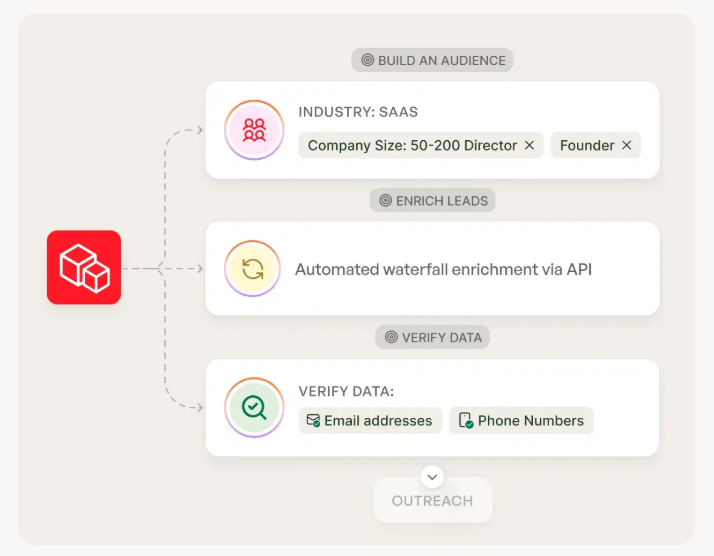
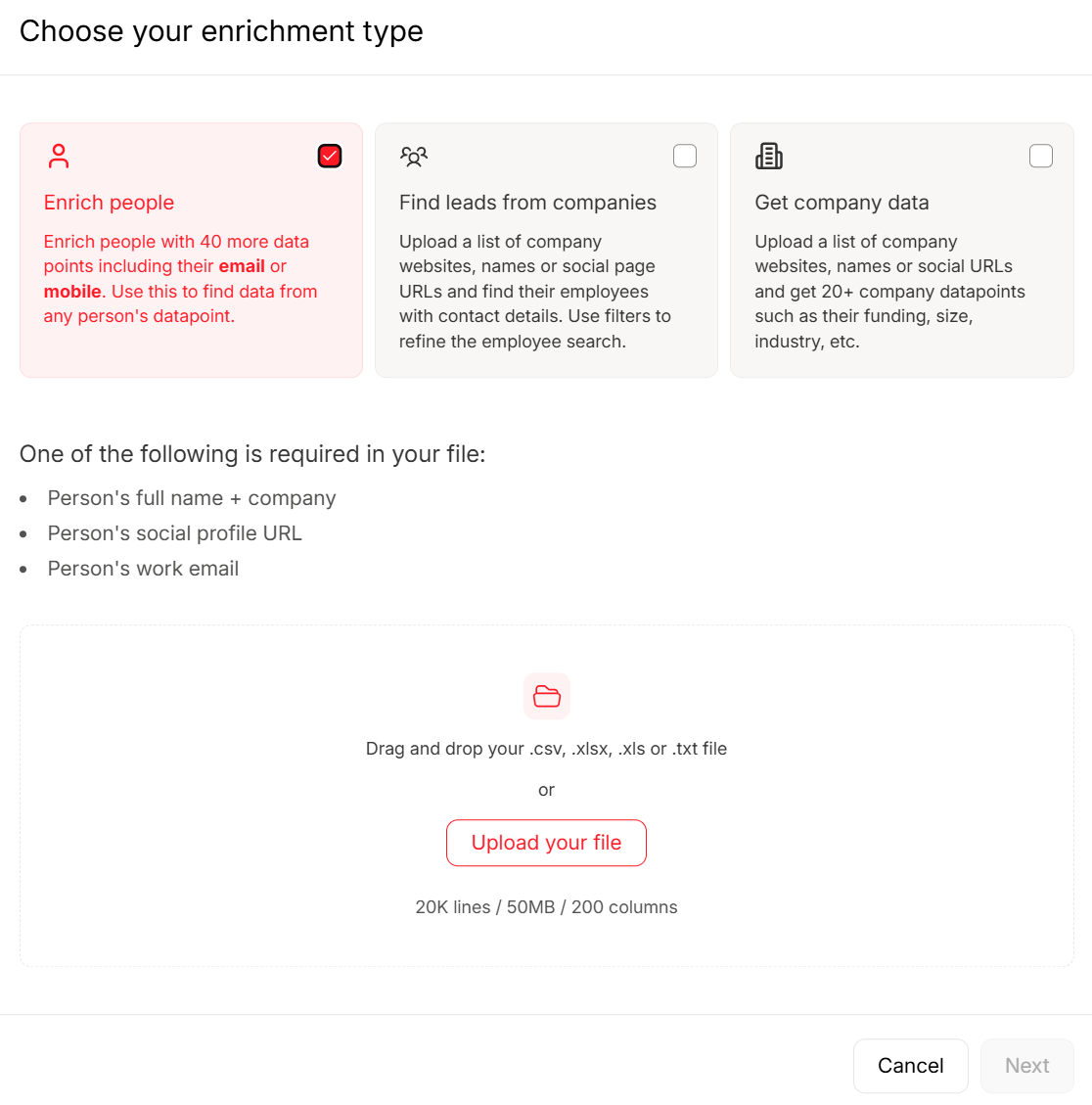
Prospeo (The B2B data platform built for accuracy) is the cleanest way I've found to stop outbound from lying to you: 300M+ professional profiles, 143M+ verified emails, 125M+ verified mobile numbers, and 98% verified email accuracy on a 7-day refresh cycle (the industry average is about 6 weeks). It also does CRM and CSV enrichment with 50+ data points, an 83% enrichment match rate, and a 92% API match rate, so HubSpot doesn't stay half-empty while reps complain that "the CRM's useless."
If you're prioritizing who to hit first, you can layer intent across 15,000 Bombora topics and then push the clean list into whatever outbound tool you're running.
If you want a neutral "how do users rate these" snapshot before you trial, G2's Growbots vs HubSpot Sales Hub comparison is a quick skim. If you're still deciding what kind of prospecting source you need, compare options in a business contacts database roundup.
Fighting HubSpot's 500/day caps or Growbots' governance headaches? Neither tool solves the upstream problem: stale contacts, bounced emails, and wrong titles. Prospeo enriches your CRM with 50+ data points per contact at a 92% match rate - and syncs natively with HubSpot and Salesforce.
Stop scaling bad data. Enrich your pipeline for $0.01 per email.
Summary: how to choose Growbots vs HubSpot in 2026
If you want your CRM to stay pristine and reporting to be the source of truth, HubSpot's the safer default - just accept that outbound volume is governed by seat-based caps and enrollment throttles.
If you want outbound execution to run like a factory (prospecting + sequencing + deliverability in one place), Growbots gets you there faster, but you'll need rules to prevent status drift and duplicates.
Growbots vs HubSpot really comes down to whether you're optimizing for governance or throughput - and whether your data's clean enough to scale either one. If you want a broader framework for the category decision, see Sales Execution Platform vs CRM and how to choose a sales engagement platform.
FAQ
Can HubSpot Sales Hub replace Growbots for outbound?
HubSpot can replace Growbots when your team's rep-led, you don't need built-in prospecting, and your outbound volume stays under 500-1,000 automated emails per seat per day. If you need shared-inbox workflows or a prospecting database inside the same tool, Growbots is usually the better outbound execution layer.
What are HubSpot Sequences send limits in 2026?
HubSpot Sequences caps automated sequence emails at 500/day per Professional seat and 1,000/day per Enterprise seat, measured on a rolling 24-hour period. Bulk enrollment is throttled to 3 emails per minute, which often becomes the real limiter when you're trying to enroll large lists quickly.
Why does Growbots pricing look different on G2/Capterra vs their site?
Growbots has legacy pricing references floating around, while its newer model (post-June 5, 2024) is driven by messages/day plus credits. Some public pages also contradict credit rollover behavior; Growbots' help docs for post-June 5, 2024 subscriptions say credits roll over, while older packaging behaved more like monthly resets.
What's a good free data tool to improve results in either platform?
Prospeo's free tier includes 75 emails/month plus 100 Chrome extension credits and focuses on accuracy (98% verified email accuracy) and freshness (7-day refresh cycle). It's a strong first step to reduce bounces and duplicates before you scale sequences, and it plugs into common workflows via CSV, API, and native integrations.
Should I use Growbots and HubSpot together (and what can break)?
Using both works well when HubSpot's your system of record and Growbots runs outbound execution, but you must control governance to avoid messy data. Expect the main failure modes to be duplicate contacts (especially from imports), picklist mapping that creates sync loops, and noisy task sync when ownership changes mid-sequence.