

Sales Deck Storytelling: Frameworks That Win in 2026
It's Tuesday morning. You're 14 slides into a 28-slide demo, and the champion who invited you is checking Slack. The CFO joined late and left early. The follow-up email goes unanswered.
That deck didn't lose on features - it lost on narrative. Sales deck storytelling isn't a nice-to-have anymore; it's the difference between a deal that moves and one that stalls in "we'll circle back next quarter" purgatory. Even Andy Raskin's widely copied framework from 2016 needs a refresh for how buying committees actually decide today.
The Short Version
Start with Problem-Cost-Cause-Solution if you're building your first story-driven deck. It's the most prescriptive framework and the easiest to roll out across a team.
For enterprise deals with multiple stakeholders, use Raskin's updated "old worldview to new worldview" approach - especially when you need a CXO deck that lands with the entire buying committee.
Personalize every deck using real prospect data - tech stack, intent signals, growth stage. Enrich your prospect list before you write slide one.
Does Storytelling in Sales Decks Actually Work?
The numbers aren't subtle. DocSend audited their own sales deck and found only 17.5% of viewers reached the last page. Less than 40% made it halfway. The culprit: 16-20 slides asking prospects to study product features. After rebuilding the deck using a storytelling framework, 65.4% of prospects who opened the new deck clicked through to the last slide.
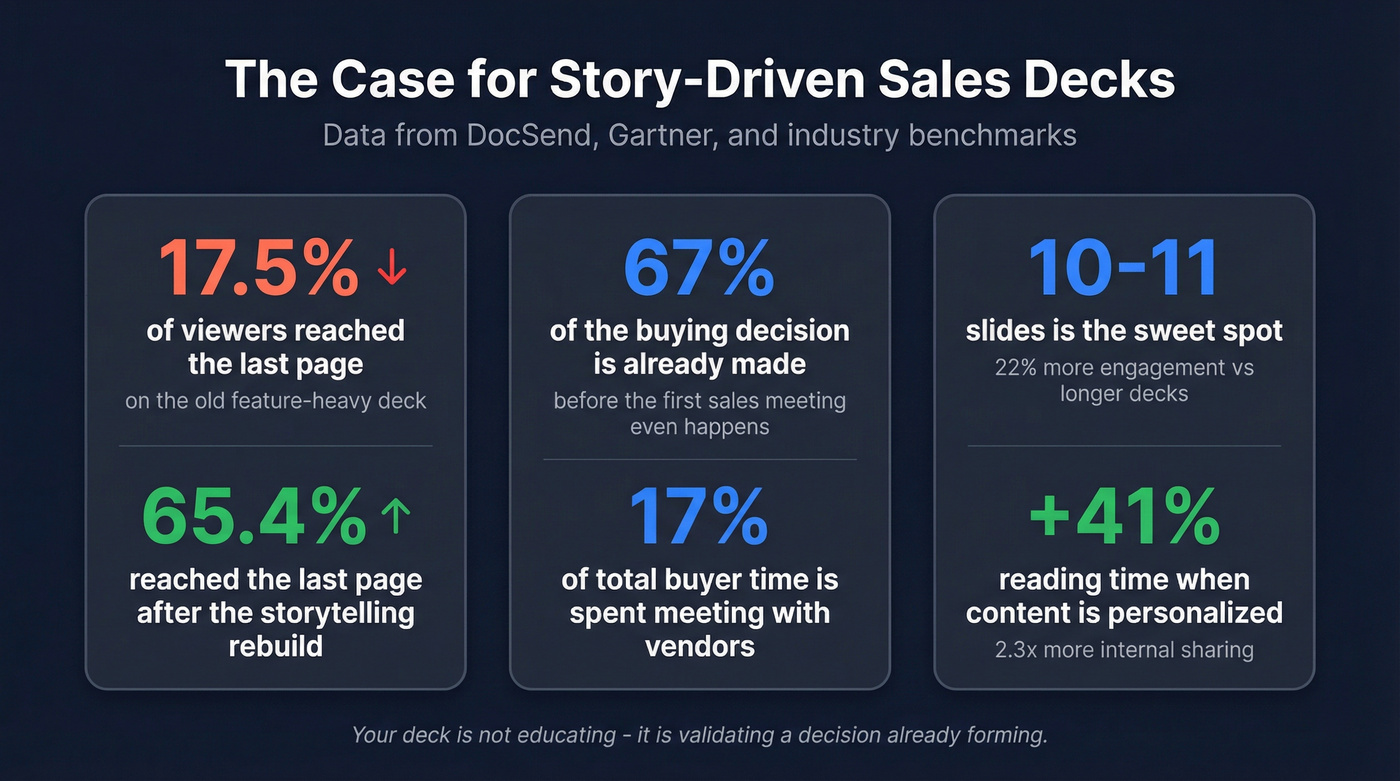
That's not an outlier. Buyers complete up to 67% of their decision-making before the first meeting, and Gartner's data shows only 17% of a buyer's total time goes to meeting with suppliers. Your deck isn't educating - it's validating a decision that's already forming. Narrative gives them something to latch onto. Decks limited to 10-11 slides see 22% more engagement than longer formats, and even a modest conversion lift compounds fast across a quarter's pipeline.
Why Stories Win: The Brain Science
Paul Zak's storytelling research links character-driven narratives with oxytocin release - the neurochemical tied to trust and empathy. When a prospect's brain produces oxytocin during your presentation, they're primed to cooperate rather than resist.
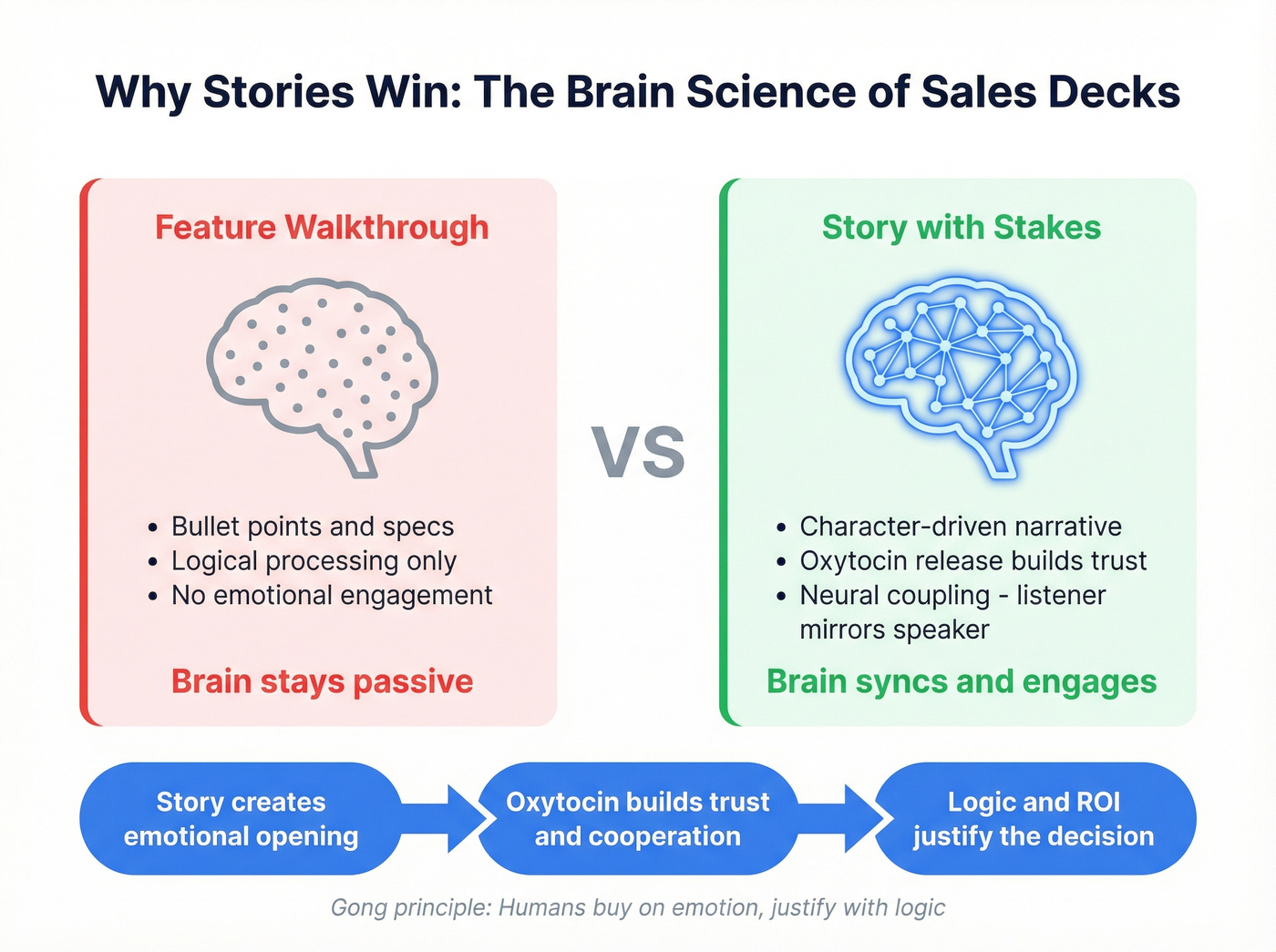
Uri Hasson's neural coupling research at Princeton found something even more striking: a listener's brain activity can begin to mirror the speaker's during storytelling, with neural patterns literally syncing up across both brains in real time. This doesn't happen during a feature walkthrough or a bullet-point recitation. It happens when someone tells a story with stakes.
Gong's sales methodology team distills this into a practical principle: humans buy on emotion and justify with logic. The ROI slide, the case study numbers, the feature comparison - those come after the story creates the opening.
4 Narrative Frameworks Compared
| Framework | Best For | Weakness |
|---|---|---|
| Raskin's Narrative Arc | Enterprise, multi-stakeholder | Takes time to master |
| Gong's Nexus Model | Competitive bake-offs | Requires strong POV |
| Before-After-Bridge | SMB, short cycles | Can feel simplistic |
| Problem-Cost-Cause-Solution | Mid-market, consultative | Needs strong data |
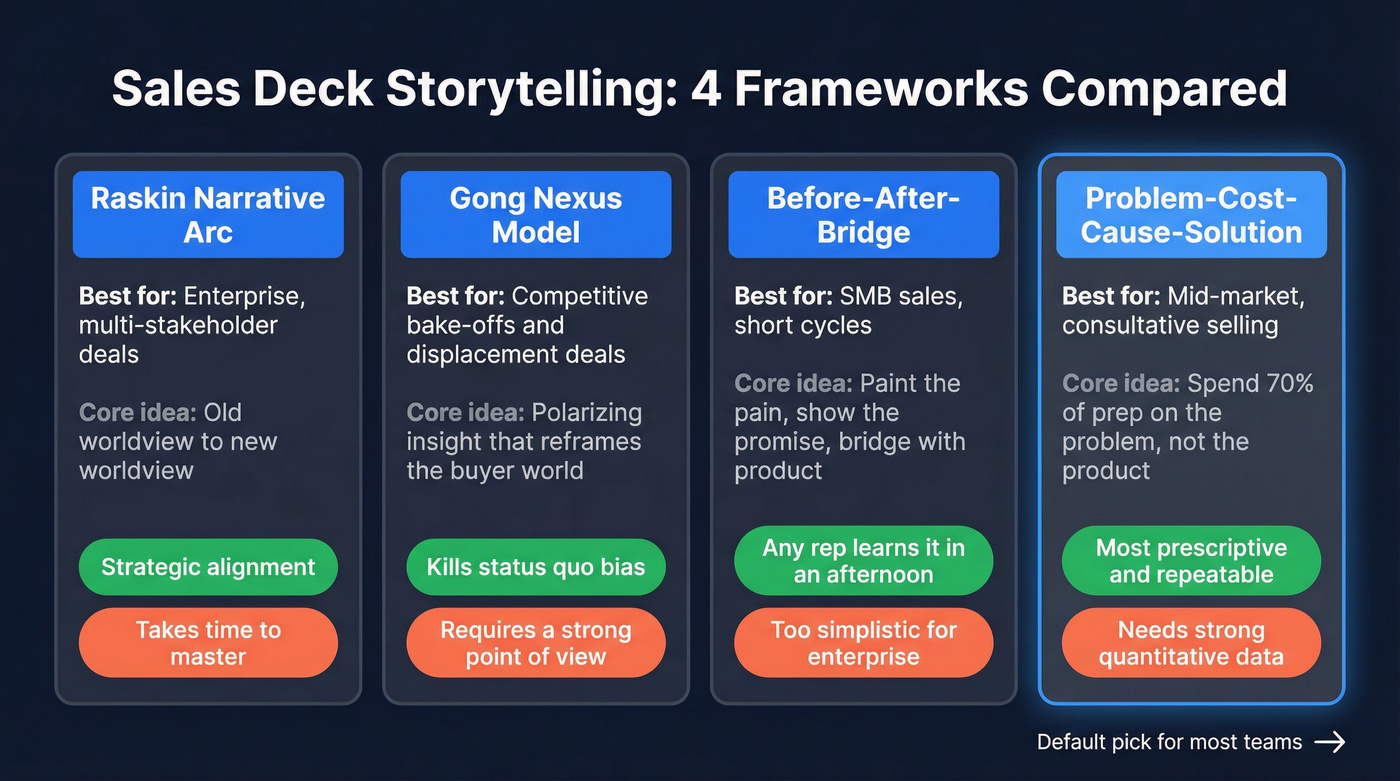
Default pick: Problem-Cost-Cause-Solution. It's the most prescriptive and the easiest to roll out across a team without weeks of training.
Andy Raskin's Narrative Arc (Updated)
Raskin's five-element narrative arc - big change, stakes, promised land, capabilities as "magic gifts," evidence - became the template behind the modern "big shift" B2B deck style.
But in a 2025 interview with Dylan Tweney, Raskin evolved the framework. He now frames the strongest narratives as "old worldview to new worldview" rather than "problem to solution." His critique of standard openers is sharp: he calls the typical "problem, I have the solution, here's why it's best" pitch the "arrogant doctor" approach. It breaks down in complex B2B because multiple stakeholders have different problems, and platform claims are impossible for buyers to validate in a 30-minute call.
Salesforce's "It's the end of software" narrative is the canonical example - it doesn't diagnose a problem, it declares a shift. Best for enterprise deals where you need alignment across a buying committee, and it's particularly effective when presenting to executives who care about strategic direction over feature lists.
Gong's Nexus Model
Gong's framework starts with what they call the Nexus - a polarizing insight that reframes the buyer's world. It's not "you have a problem." It's "the way you've been thinking about this is wrong, and here's why."
The key insight: for most sellers, the real competition is the status quo. Your slide deck isn't competing against another vendor's deck. It's competing against doing nothing. The Nexus makes inaction feel dangerous.
Best for displacement deals where the buyer already has a solution in place.
Before-After-Bridge
The simplest framework in the set. Paint the status quo, show the promised land, position your product as the bridge. Any rep can learn it in an afternoon.
Best for SMB sales and shorter cycles. Skip it for complex enterprise deals - it leaves too much context on the table.
Problem-Cost-Cause-Solution (7-Slide Template)
This is the framework we'll unpack slide-by-slide next. The emphasis on spending 70% of your time on the first three slides - Problem, Cost, Cause - is what separates it from a standard product walkthrough.

Slide 1 says "name the problem specific to their industry." You can't do that without real prospect data. Prospeo gives you tech stack, intent signals, headcount growth, and 50+ data points per contact - so every deck feels like it was written for one buyer.
Personalize every sales deck with data that's refreshed every 7 days.
The 7-Slide Template You Can Copy
Here's the Problem-Cost-Cause-Solution structure broken down slide by slide:
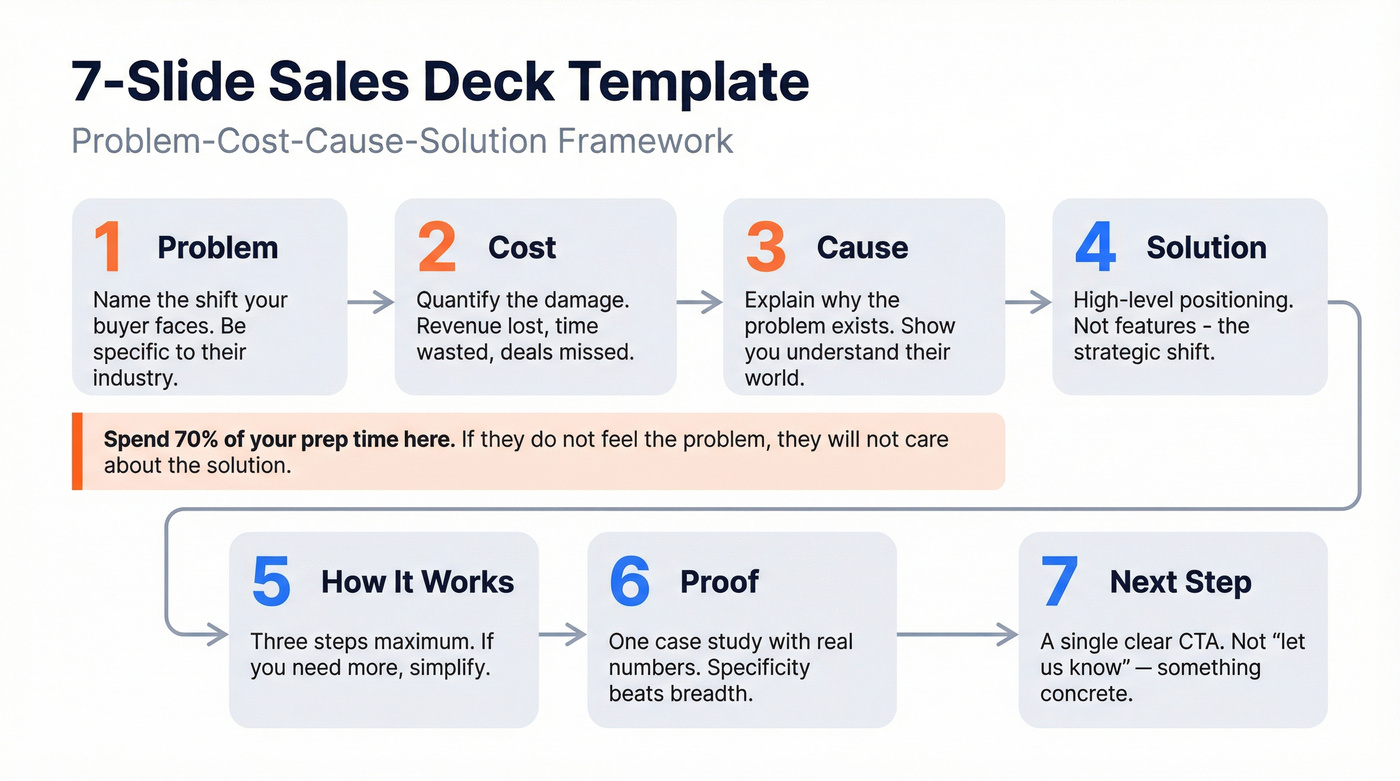
- Problem - Name the shift or challenge your buyer faces. Be specific to their industry.
- Cost - Quantify what this problem costs them. Revenue lost, time wasted, deals missed.
- Cause - Explain why the problem exists. Demonstrate you understand their world better than they do.
- Solution - High-level positioning of your approach. Not features - the strategic shift.
- How It Works - Three steps maximum. If you can't explain it in three steps, you're overcomplicating it.
- Proof - One case study with real numbers. Specificity beats breadth every time.
- Next Step - A single, clear CTA. Not "let us know your thoughts." Something concrete: "Let's run a pilot with your Q3 target accounts."
Spend 70% of your preparation time on slides 1-3. If the audience doesn't feel the problem, they won't care about the solution. We've seen teams restructure 40+ slide decks into 12 slides using this approach and close deals in the room that had been stalling for months. The extra slides weren't adding value - they were adding friction.
Sales Deck Examples That Nail It
Zuora built the deck that launched a thousand imitations. Their "big shift" narrative - subscription economy replacing ownership - doesn't mention the product until deep into the presentation. The pattern to steal: name an irreversible market shift and make your buyer feel like they're on the wrong side of it.
ChartMogul uses the "old way vs new way" pattern, which is one of the most effective B2B storytelling devices you can borrow. One slide shows the painful current state, the next shows the transformed state. It's visual, it's immediate, and it works across every industry. If you only steal one technique from this article, steal this one.
Reddit Ads takes a data-led approach: 70M monthly readers, 5B pageviews, 20 minutes average time-on-site. They let the numbers carry the narrative of an engaged audience that advertisers can't reach elsewhere. When your data is genuinely impressive, lead with it instead of burying it in an appendix.
Across all three, notice what's absent: feature comparison tables, competitive matrices, and pricing slides in the first half. The story comes first. Always.
5 Mistakes That Kill Your Narrative
Here's the thing about the 47-slide deck: it isn't thorough. It's a sign you haven't done the hard work of deciding what matters.
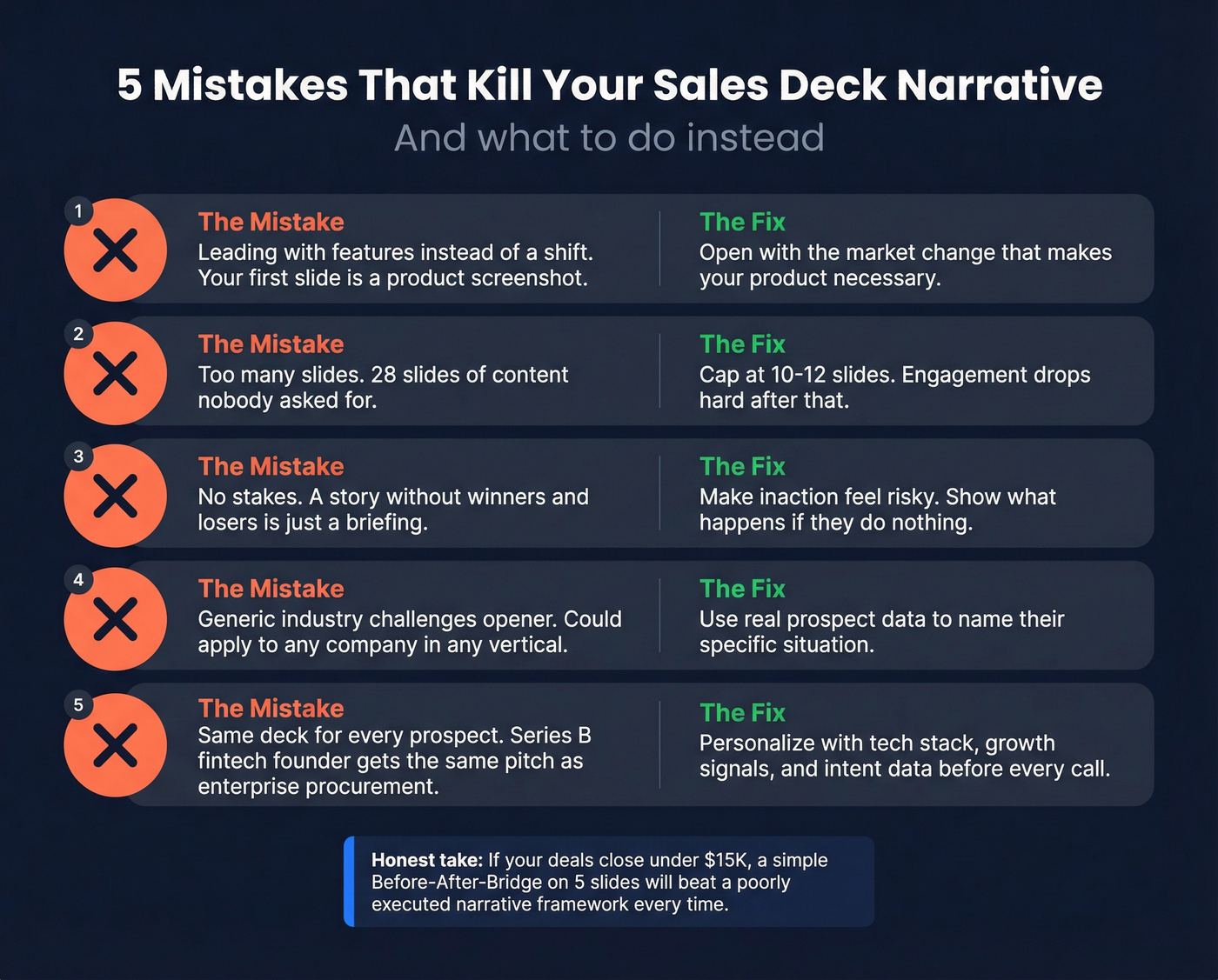
- Leading with features instead of a shift. If your first slide is a product screenshot, you've already lost the narrative.
- Too many slides. Engagement drops fast once you get past 12-15 slides. Cut ruthlessly.
- No stakes. A story without winners and losers isn't a story - it's a briefing. Make inaction feel risky.
- Generic "industry challenges" opener. If your opening slide applies to any company in any vertical, it's not doing its job. Rip it out.
- Telling the same story to every prospect. A deck that resonates with a Series B fintech founder won't land with an enterprise procurement team. Personalization bridges that gap.
Let's be honest: if your deals typically close under $15K, you probably don't need a 7-slide narrative arc. A strong Before-After-Bridge on 5 slides will outperform a poorly executed Raskin framework every time. Match the framework to the deal size.
Building a CXO Deck That Lands
Two-thirds of sales pros now use AI to understand buyer behavior and personalize outreach. Here's the workflow that turns narrative craft into a repeatable system - especially when you're presenting to senior leadership who have five minutes of patience and zero tolerance for fluff.
Step 1: Prospect research and data enrichment. You can't tell a story that resonates if you don't know the buyer's tech stack, growth signals, or what topics they're actively researching. Prospeo returns 50+ data points per contact, including intent signals across 15,000 topics and technographic data, so your "big shift" slide maps to something the buyer actually cares about. Pull this data before you touch a single slide.

Step 2: Narrative drafting with ChatGPT. Feed your prospect data into a prompt that follows the Problem-Cost-Cause-Solution arc. The AI drafts the narrative skeleton; you refine the insight and voice.
Step 3: Call insights from Gong. Pull objections, resonant phrases, and competitive mentions from recent calls with similar buyers. These feed directly into your deck's stakes and proof slides.
Step 4: Personalization at scale with Pitch AI. Generate slide drafts, batch-personalize using variables, and share via a digital sales room with engagement tracking. Track which slides prospects spend time on and iterate.
Personalized content boosts average reading time by 41% and gets shared internally 2.3x more often. That's the difference between a deck that gets forwarded to the CFO and one that dies in someone's inbox.
The best storytelling framework fails when your contact list is wrong. Prospeo delivers 98% email accuracy and 30% mobile pickup rates - so your perfectly crafted deck actually reaches the decision-makers on the buying committee.
Stop building decks for people you'll never reach. Start with verified contacts.
FAQ
How many slides should a sales deck have?
Aim for 7-12 slides. DocSend data shows engagement drops sharply past 12-15 slides, and decks with 10-11 slides see 22% more engagement. If you can't cut below 15, split into a core narrative deck and a follow-up appendix.
What's the difference between a sales deck and a pitch deck?
A pitch deck sells your company to investors and focuses on market size, traction, and team. A sales deck sells your product to a specific buyer and should be personalized to their pain points, buying stage, and competitive landscape.
Should I send my deck before or after the meeting?
Send it after, unless the buyer explicitly asks beforehand. If they do request it early, share a shortened 5-7 slide version that creates curiosity without giving away the full narrative - save the proof and CTA slides for the live presentation.
How do I personalize decks without spending hours per prospect?
Use an enrichment tool to pull tech stack, intent signals, and growth data in bulk, then feed that data into a templatized narrative framework. In our experience, teams using this workflow cut personalization time from 2+ hours to under 20 minutes per deck while boosting internal share rates significantly.