

Inside Sales Management: The Operator's Playbook for 2026
You just got promoted to frontline manager. Your team hit 62% of quota last quarter and the VP wants 85% by Q3. You've got a dozen tabs open, half of them useless listicles about "motivating your team." Here's what actually moves the needle.
Fewer than 50% of sales reps have hit quota annually since 2017. Meanwhile, 80% of B2B sales interactions now happen in digital channels. Managing an inside sales org isn't a subset of sales leadership anymore - it is sales leadership for most B2B companies. The sales enablement market is projected to grow from $4.2B to over $10.5B by 2030, and that investment is accelerating the shift to digital-first selling and coaching.
Quick diagnostic: If your team isn't hitting quota, audit three things in this order - data quality (are reps reaching real people?), compensation (does the math make sense?), and coaching cadence (are you inspecting pipeline weekly?).
Inside Sales vs. Outside Sales
The cost case for inside sales is straightforward. The question isn't whether to run an inside team - it's where the cutoff sits for your deal size.
| Metric | Inside Sales | Outside Sales |
|---|---|---|
| Cost per interaction | ~$50 | ~$308 |
| Ramp to productivity | 3-4 months | 6-9 months |
| Tech spend per rep/yr | $2-3k | $15-40k |
| Best-fit ACV band | $5k-$50k | $50k-$500k+ |
If your average deal is under $50k, an outside-heavy model is burning money. Even hybrid teams should default to inside motions for everything below that threshold. About 40% of high-growth teams run hybrid models - inside reps handle discovery and qualification, then hand off to field reps for enterprise closes. That's the right structure for most mid-market orgs.
KPIs That Actually Diagnose Problems
Most managers track too many metrics and act on too few. We keep coming back to this benchmark table - the numbers that actually tell you what's broken.
| KPI | Target | Red Flag |
|---|---|---|
| Touches per day | 80-100 | Below 50 |
| Lead response time | Under 5 min | Over 1 hour |
| Cold outreach reply rate | 8-12% | Below 3% |
| Meetings per month (SDR) | 10-20 | Below 6 |
| Pipeline coverage | 3-5x quota | Below 2x |
| Reps hitting quota | 70-80% | Below 50% |
Secondary metrics worth tracking: dials-to-conversation ratio, average call duration, and forecast accuracy. These are diagnostic - useful for coaching, not for weekly reporting.
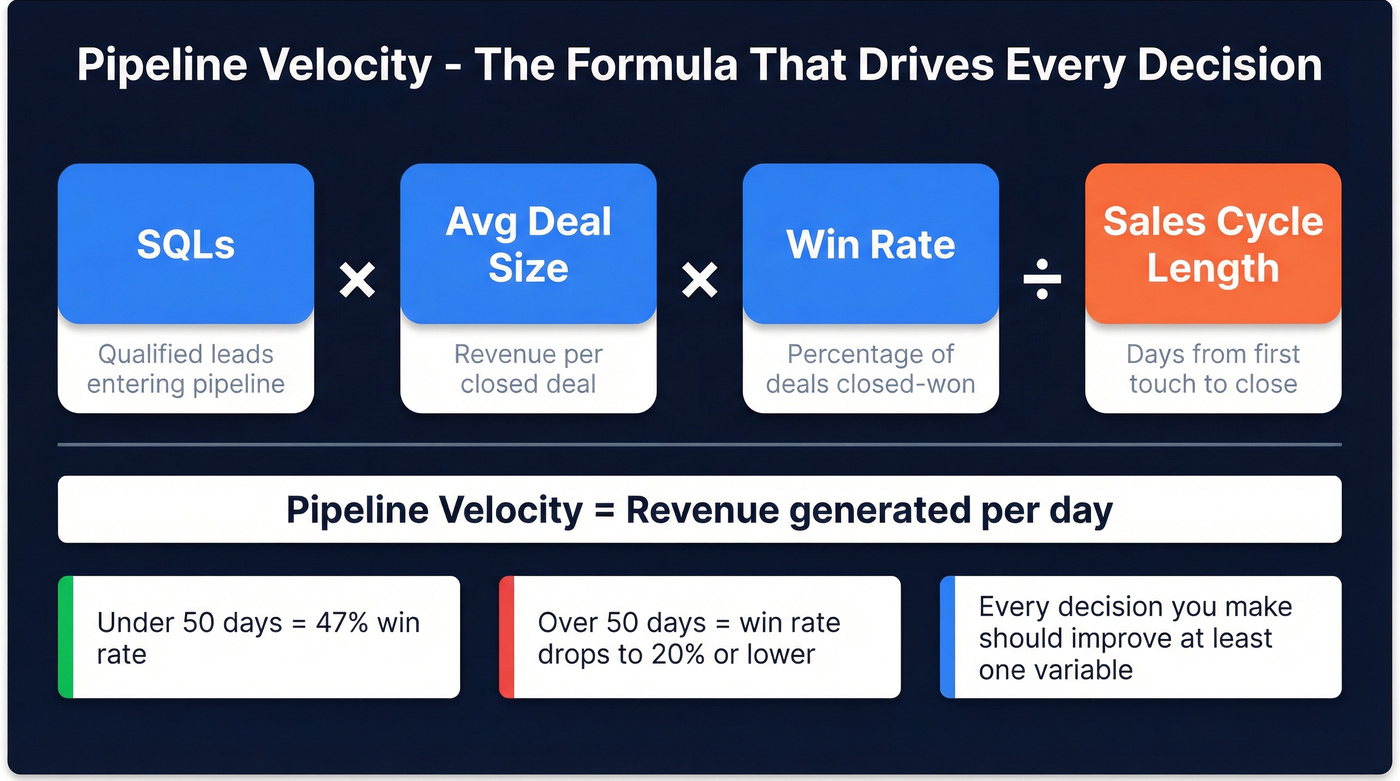
The formula that ties the primary KPIs together is pipeline velocity: (SQLs x Avg Deal Size x Win Rate) / Sales Cycle Length. Every decision you make should improve at least one of those four variables.
Here's what most managers miss - speed kills, in a good way. Opportunities closed within 50 days carry a 47% win rate. After 50 days, that drops to 20% or lower. Roughly 34% of revenue teams report sales cycles of 1-2 quarters, which means most inside sales orgs have a narrow window to win. If your cycle is stretching, the problem usually isn't closing skills. It's pipeline quality or qualification rigor upstream.
Hiring and Team Structure
Not every inside sales role is the same job. Sandler's framework breaks it into four functions: inbound qualify, inbound close, outbound appointment-setting, and outbound closing. Hiring a "closer" for a qualification role is one of the fastest ways to burn through headcount.
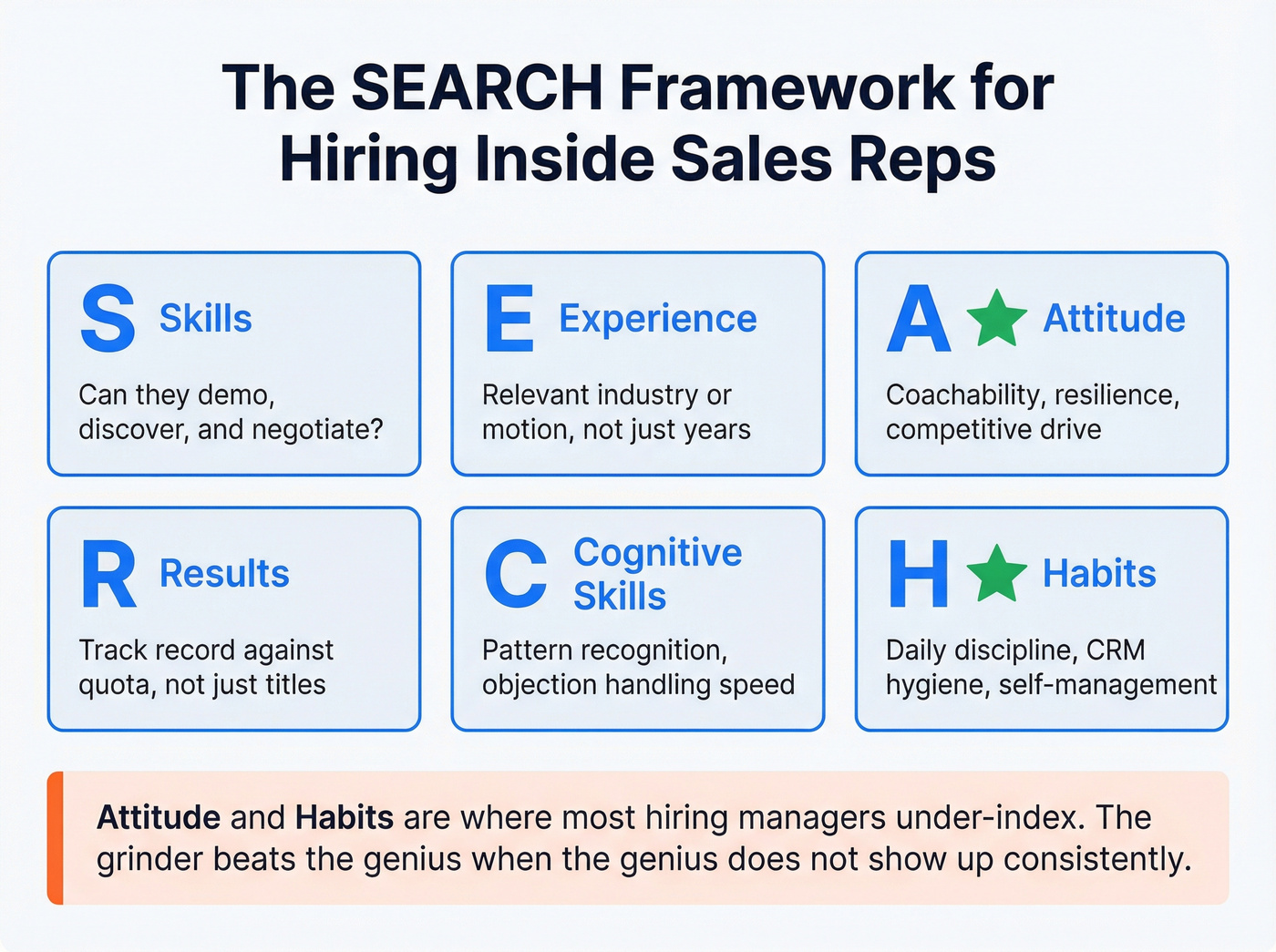
For hiring, we use a version of the SEARCH framework:
- Skills - Can they demo, discover, negotiate?
- Experience - Relevant industry or motion, not just years
- Attitude - Coachability, resilience, competitive drive
- Results - Track record against quota, not just titles
- Cognitive skills - Pattern recognition, objection handling speed
- Habits - Daily discipline, CRM hygiene, self-management
Attitude and Habits are where most hiring managers under-index. A rep with average skills but relentless daily discipline will outperform a talented rep who can't maintain cadence. We've seen it over and over - the grinder beats the genius when the genius doesn't show up consistently.
Span of control matters more than most org charts reflect. Target 6-10 reps per frontline manager. Fewer for enterprise AEs who need deep deal coaching, more for high-volume SDR pods where coaching is primarily activity-based. Once you're past 10 directs, you're not managing - you're firefighting.
Plan for 3-4 months of ramp time. If reps aren't productive by month four, the problem is usually onboarding design, not the hire. (If you're building this for distributed teams, use a structured remote sales onboarding plan.)

You just read that reps need 80-100 touches per day. Those touches are worthless if the data is bad. Prospeo delivers 98% email accuracy and 125M+ verified mobile numbers with a 30% pickup rate - so every dial and every send reaches a real person.
Stop burning rep activity on dead leads. Start with data that connects.
Compensation That Retains Reps
Sales turnover runs ~35% annually - nearly triple the 13% all-industry average. Bad comp plans are the single biggest driver. And 87% of sales leaders set quotas without a structured method. That's a recipe for attrition.
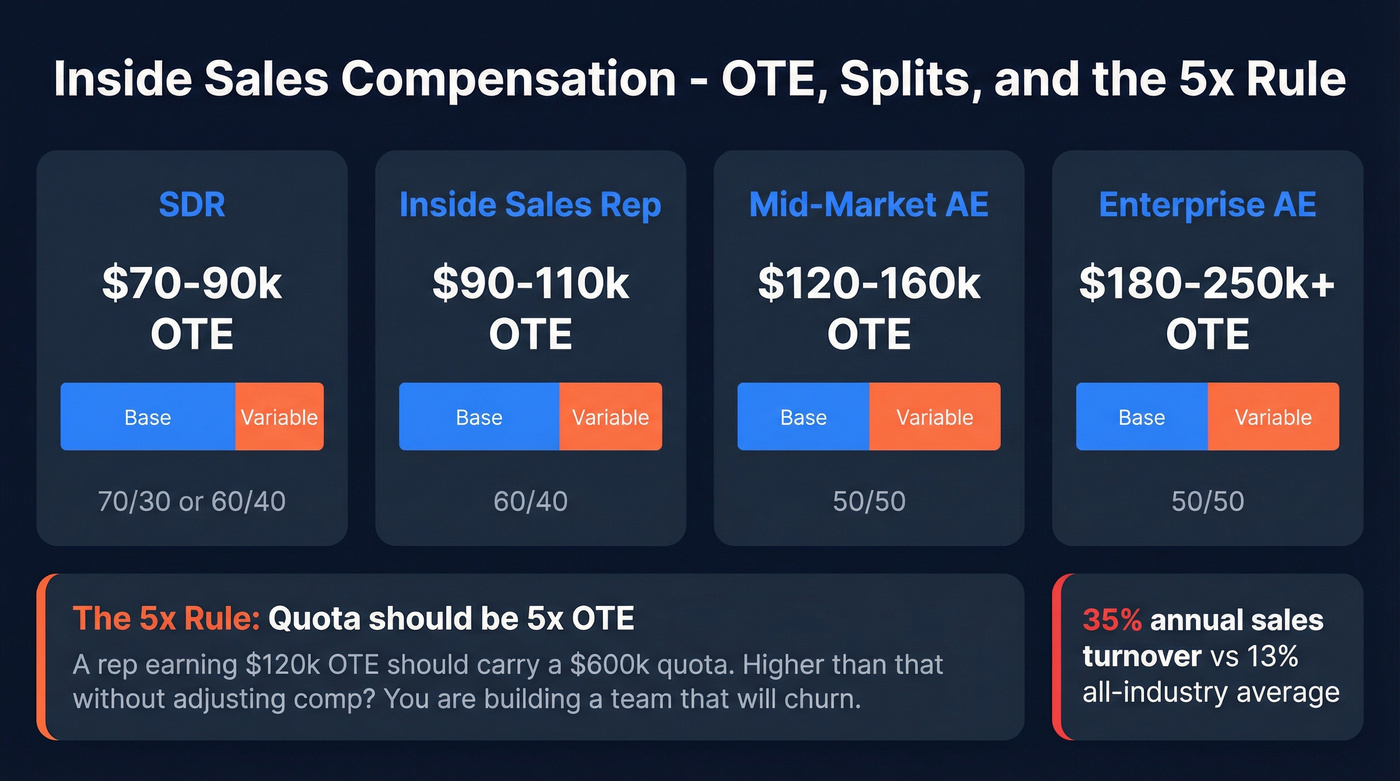
| Role | OTE Range | Typical Split |
|---|---|---|
| SDR | $70-90k | 70/30 or 60/40 |
| Inside Sales Rep | $90-110k | 60/40 |
| Mid-Market AE | $120-160k | 50/50 |
| Enterprise AE | $180-250k+ | 50/50 |
The rule of thumb: quota should be 5x OTE. A rep earning $120k OTE should carry a $600k quota. If you're setting quotas higher than that without adjusting comp, you're building a team that'll churn.
Use 70/30 splits for activity-driven roles like SDRs, 50/50 for closers where variable comp needs to drive behavior, and 60/40 as the middle ground for reps who both prospect and close. Budget 5-10% of variable comp for SPIFFs - short-burst accelerators like $500 for booking five demos in a week. Rotate them monthly so they don't become expected income.
Look, if your average contract value is under $25k and you're paying enterprise AE comp, you don't have a sales problem - you have a math problem. Restructure the role before you restructure the quota.
The Daily, Weekly, and Monthly Cadence
The difference between a manager and a good manager is rhythm. The most common failure mode for new frontline leaders isn't effort - it's inheriting a team with no process and being expected to fix it in 90 days.
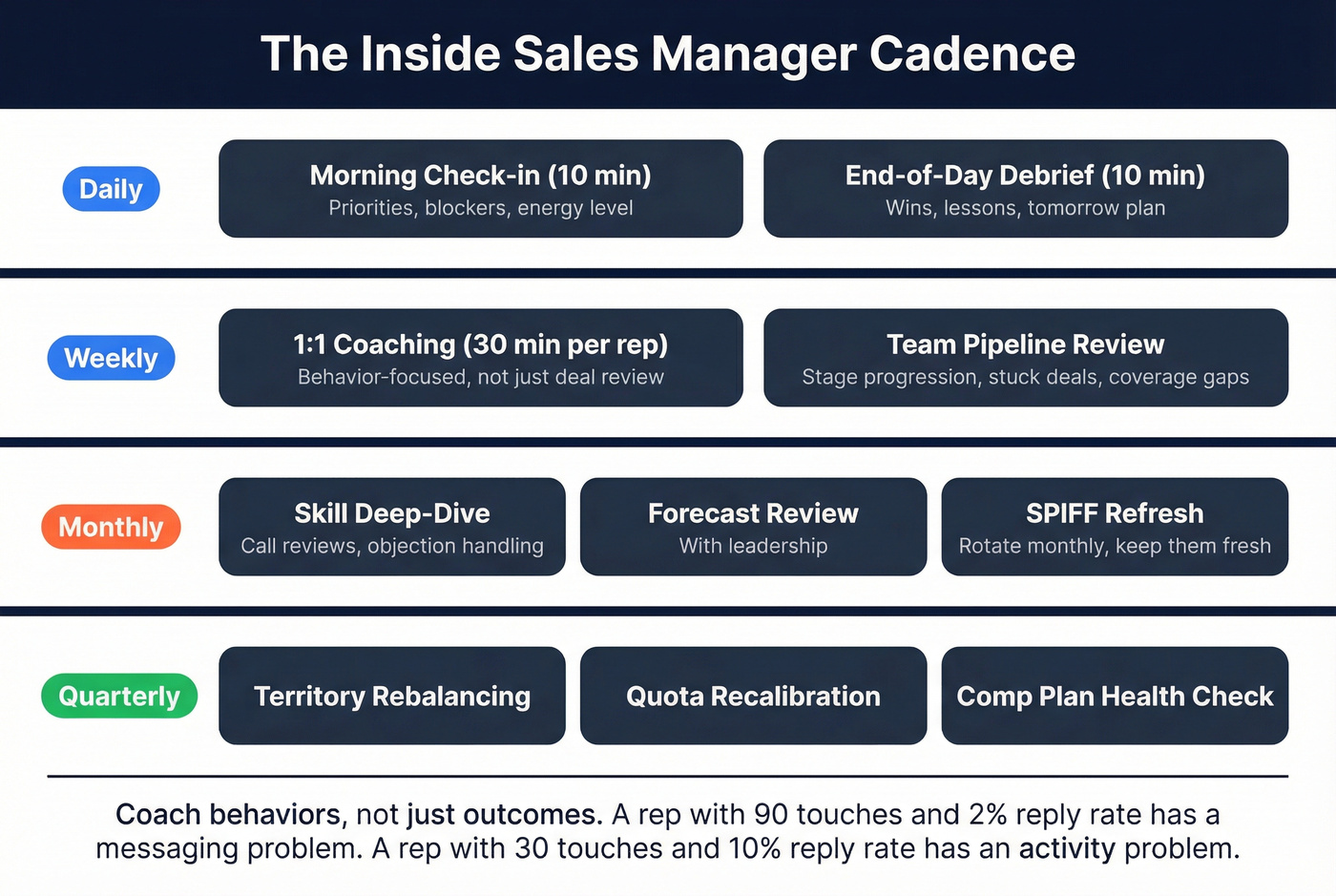
Daily:
- Start-of-day check-in (10 min) - priorities, blockers, energy level
- End-of-day debrief (10 min) - wins, lessons, tomorrow's plan
Weekly:
- 1:1 coaching session per rep (30 min) - behavior-focused, not just deal review
- Pipeline review at the team level - stage progression, stuck deals, coverage gaps
Monthly:
- Skill coaching deep-dive - call reviews, objection handling, discovery technique
- Forecast review with leadership
- SPIFF review and refresh
Quarterly:
- Territory rebalancing
- Quota recalibration based on actual market data
- Comp plan health check
The principle that separates good managers from average ones is coaching behaviors, not just outcomes. A rep making 90 touches a day with a 2% reply rate has a messaging problem. A rep making 30 touches with a 10% reply rate has an activity problem. The response is completely different, and if you can't tell which is which from your dashboard, your dashboard is wrong.
Build a clear consequence ladder for consistently missed behavior targets - not punitive, but structured. Escalate from coaching to PIP to role change. Document everything. This cadence applies whether you're in the office or managing a remote inbound team across time zones; the rhythm stays the same, only the tools change.
Building the Right Tech Stack
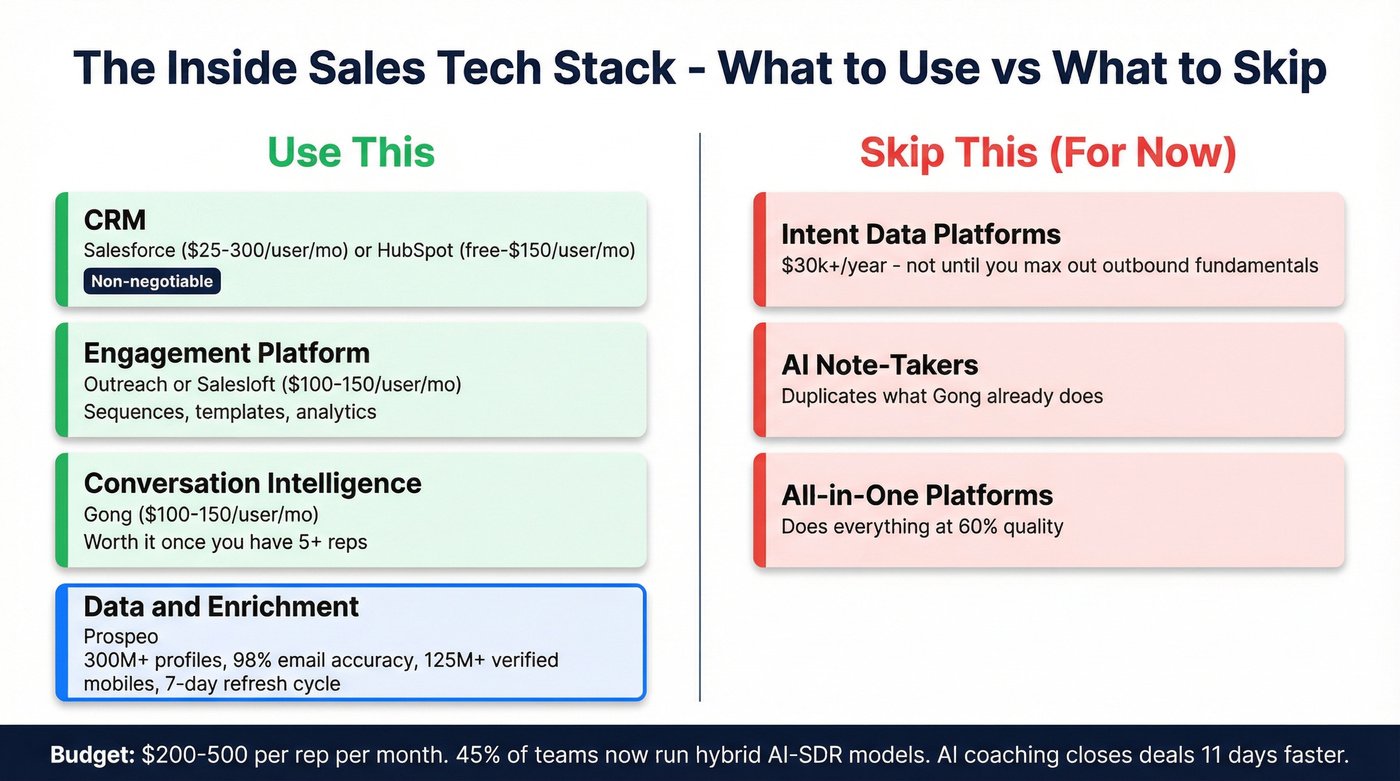
The average inside sales stack runs $200-500 per rep per month. Here's what you actually need versus what becomes shelfware.
Use this:
- CRM - Salesforce ($25-300/user/mo) or HubSpot (free-$150/user/mo). Non-negotiable.
- Engagement platform - Outreach or Salesloft (~$100-150/user/mo). Sequences, templates, analytics.
- Conversation intelligence - Gong (~$100-150/user/mo). Worth it once you have 5+ reps.
- Data and enrichment - Prospeo. 300M+ professional profiles, 143M+ verified emails, 98% email accuracy, 125M+ verified mobile numbers. The 7-day data refresh cycle means reps aren't working stale lists, and native integrations with Salesforce, HubSpot, Outreach, and most sequencing tools mean reps don't toggle between tabs to push contacts into sequences. Skip this (for now):
- Intent data platforms at $30k+/year - until you've maxed out your outbound fundamentals
- AI note-takers that duplicate what Gong already does
- "All-in-one" platforms that do everything at 60% quality
45% of teams are now running hybrid AI-SDR models, and AI tools are saving sales pros 2+ hours per day on research and admin. AI-assisted coaching closes deals 11 days faster with up to a 10-point win-rate lift. The stack is evolving fast, but the foundation - CRM, sequences, clean data - hasn't changed. If you want a blueprint for what to buy (and what to skip), start with a lean B2B sales stack.
Data Quality: The Lever Nobody Pulls First
Here's the problem that doesn't show up in any leadership book: your reps can hit every activity target and still miss quota if the data is garbage. Bad data leads to wasted dials, which tank connect rates, which flatten pipeline, which miss quota, which drive turnover. It's a chain reaction, and it starts before your coaching ever kicks in.
We've seen this pattern repeatedly. GreyScout's team was running a 38% bounce rate on outbound emails. After switching to Prospeo, that dropped to under 4%. Pipeline jumped 140%, and rep ramp time fell from 8-10 weeks to 4. Snyk saw similar results across 50 AEs - bounce rates went from 35-40% down to under 5%, and AE-sourced pipeline climbed 180%.

If your reps are hitting activity targets but pipeline is flat, audit the data first. It's the cheapest, fastest lever you have. The consensus on r/sales echoes this - threads about "my SDRs are dialing but nothing's happening" almost always trace back to bad contact data or outdated lists, not effort. If you're seeing bounces spike, run a quick email validity check and tighten CRM hygiene before you change messaging.
Pipeline velocity depends on SQLs, win rate, deal size, and cycle length. Bad data kills all four - bounced emails stall pipeline, wrong numbers stretch cycles, and unverified leads tank conversion. Prospeo refreshes every 7 days and costs roughly $0.01 per email. That's 90% cheaper than ZoomInfo.
Teams using Prospeo book 26% more meetings than ZoomInfo users.
FAQ
What does an inside sales manager do day-to-day?
An inside sales manager runs pipeline reviews, conducts 1:1 coaching, monitors activity metrics, builds forecasts, and handles hiring. The daily rhythm centers on morning check-ins and end-of-day debriefs, weekly pipeline inspections, and monthly skill deep-dives. The best managers spend 60%+ of their time coaching, not on admin.
How many reps should one manager oversee?
The sweet spot is 6-10 direct reports. Enterprise AE managers should stay closer to 6 since deal coaching is intensive. High-volume SDR managers can handle 8-10 with strong enablement infrastructure. Beyond 10, coaching quality drops fast.
What's the biggest challenge managing an inside sales team?
Consistency. Enforcing daily activity standards, maintaining coaching cadence, and keeping data clean - all simultaneously. Most new managers focus on closing tactics when the real bottleneck is upstream: pipeline quality, lead response time, and rep discipline. Fix the system before you fix individual deals.
How do you fix low quota attainment?
Start by auditing data quality - check bounce rates and connect rates before anything else. If reps can't reach real people, no amount of coaching fixes the number. Then inspect comp plan math: is quota set at 5x OTE or higher? Finally, tighten coaching cadence to weekly 1:1s focused on behaviors, not just outcomes.