Remote Sales Onboarding: The Complete Guide for 2026
It's 9:03 AM on a Monday. Your newest SDR is sitting in their apartment, staring at 47 Notion links, a Slack channel with 200 unread messages, and a calendar that says "Self-guided product training" for the next four hours. Their manager is in back-to-back meetings until 2 PM. By lunch, they've watched two product videos, skimmed a battlecard, and started wondering if they made the right career move.
This isn't a hypothetical. It's the default remote sales onboarding experience at most companies. Average SaaS ramp time hit 5.7 months in 2025, up 32% from 4.3 months in 2020. And 88% of companies openly admit their onboarding is subpar. The problem isn't remote work. It's that most teams never built a real onboarding program in the first place - they just had hallway osmosis, and now that's gone.
Here's the thing: structured virtual onboarding outperforms unstructured in-person onboarding every time. You just have to build it intentionally.
What You Need (Quick Version)
A structured 30-60-90 day plan with daily milestones for the first two weeks. Not "create a schedule" - an actual schedule, hour by hour, with every session, module, and checkpoint mapped out before your new hire's laptop arrives.
Three layers of tools: an LMS for structured learning (Mindtickle, 360Learning), an AI roleplay tool for practice (Hyperbound, Allego), and a verified data platform so new reps aren't burning through bad contacts on day one.
A coaching cadence that replaces the hallway micro-coaching you lose in remote settings - film reviews, daily standups, weekly 1:1s. If you don't engineer these touchpoints, they don't happen.
Why Onboarding Remote Sales Reps Is Harder (and Why It Can Be Better)
36% of remote workers describe their onboarding as "baffling." That's more than one in three new hires starting their job confused and disoriented. The downstream effects are brutal: 86% of new hires decide how long they'll stay within the first six months. Employees who get great onboarding are 69% more likely to stay three or more years. Get it wrong, and you're not just losing productivity - you're losing people.

The cost math is unforgiving. Replacing a failed sales hire runs roughly 3x their base salary when you factor in recruiting, training, lost pipeline, and ramp time for the replacement. Twenty percent of new sales hires leave within the first 90 days due to poor onboarding. For a team hiring 10 reps a year, that's two wasted hires - easily $200-300k in sunk costs.
Only 43.5% of sales professionals hit quota. 17% of reps generate 81% of revenue. The gap between top performers and everyone else is enormous, and onboarding is where that gap starts forming.
But the data on virtual onboarding gets interesting:
| Metric | Remote | Hybrid | In-Person |
|---|---|---|---|
| Overall satisfaction | 71% | 75% | 73% |
| Accelerated performance | 61% | 73% | 69% |
| Provided what I needed | 63% | 72% | 67% |
That's from TalentLMS and BambooHR's 2025 survey. Hybrid edges out both remote and in-person across every category. But look at the gap between remote and in-person - it's only 2-6 percentage points. The real differentiator isn't location. It's structure.
Companies with formal onboarding programs see 54-70% productivity increases, 34% faster ramp, 82% better retention, and 353% ROI on new sales hires. New hires are 77% more likely to hit their first performance milestone with structured onboarding. Businesses with smooth onboarding processes see revenue growth of 2.5x compared to those without.
Remote is harder by default. But a well-designed program outperforms unstructured in-person onboarding every single time. The companies winning in 2026 aren't the ones with the best office culture. They're the ones who actually wrote down what a new rep's first 90 days should look like - and then held themselves accountable to it.
What Actually Goes Wrong - Practitioner Voices
I've seen the same failure patterns across dozens of sales teams. But don't take my word for it - here's what practitioners actually say.
The "Dump and Run"
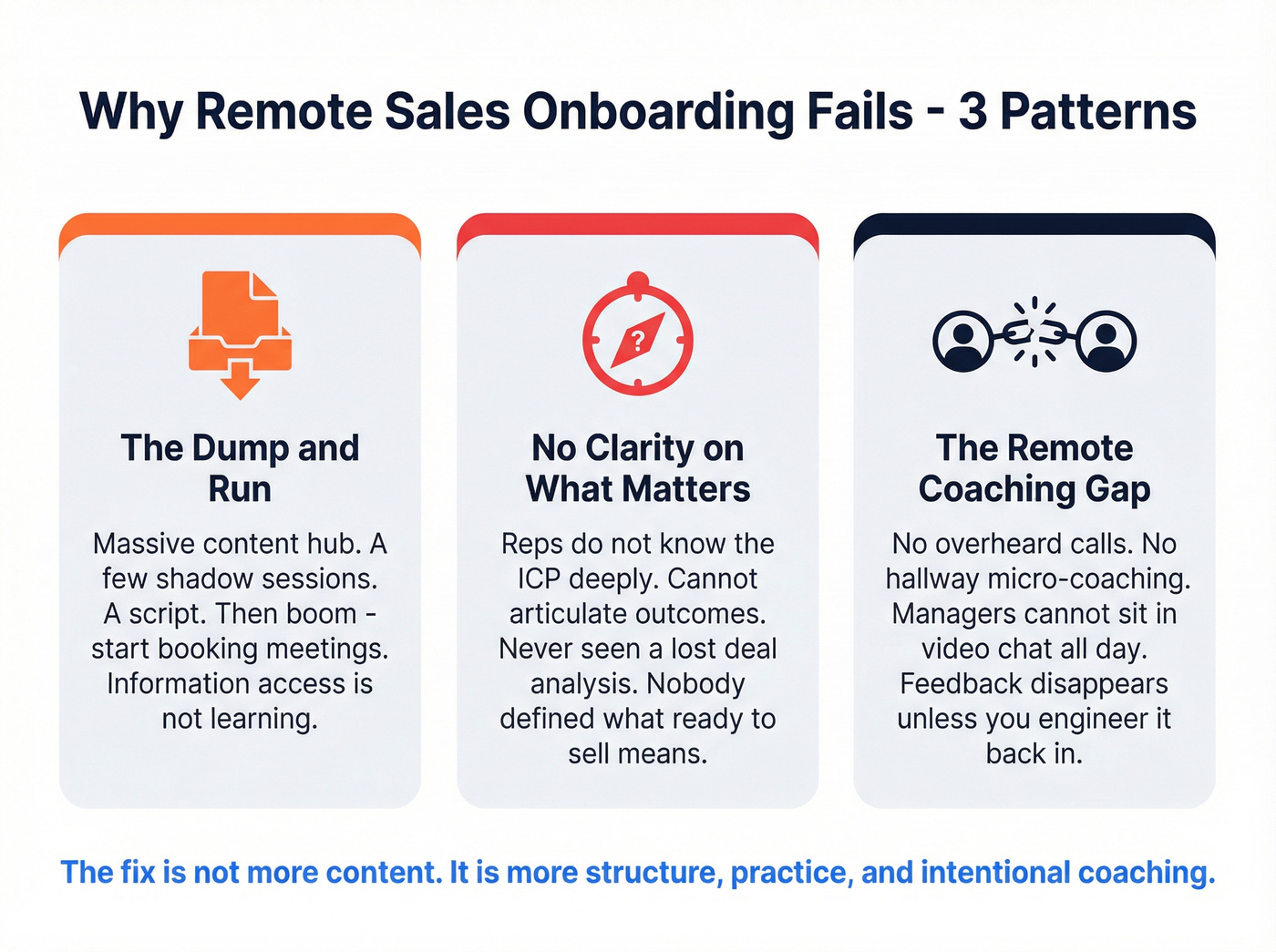
A rep who'd worked at seven companies over a decade put it bluntly on Reddit: "Sales onboarding has been a disaster almost everywhere." The pattern is depressingly consistent: "You get access to a massive content hub. A few shadow sessions with a top rep. Maybe a product deck and a script. And then boom - you're expected to start booking meetings."
This is the most common onboarding model in B2B sales. It's also the worst. It confuses information access with actual learning. Giving someone a Notion workspace with 200 pages isn't onboarding - it's abandonment with extra steps.
No Clarity on What Matters
The most common cause of enthusiasm deflation isn't a lack of resources. It's a lack of clarity. New reps don't know the ICP deeply enough. They can't articulate what outcomes the product delivers. They've never seen a lost-deal analysis. They don't understand competitive positioning beyond a one-page battlecard that hasn't been updated in six months.
33% of employees report poor onboarding experiences. The root cause isn't laziness - it's that nobody sat down and defined what "ready to sell" actually means at their company.
The Remote Coaching Gap
Here's a quote from a sales manager on Reddit that captures the remote-specific challenge perfectly: "It is not like I can sit in a video chat with him all day long, watching every move he makes."
In-office, managers overhear calls. They do quick micro-coaching sessions after someone gets off a tough call. They notice when a rep looks confused or frustrated. Remote, all of that disappears. And most managers haven't replaced it with anything intentional.
This coaching gap is the single biggest reason onboarding new SDRs remotely fails - not the lack of content, but the lack of real-time feedback.

Your new SDRs already take 5.7 months to ramp. Don't make it worse with bad data. Prospeo gives every rep 98% verified emails and 125M+ direct dials - so their first outreach actually lands.
Cut ramp time, not corners. Give new reps data that connects.
The 30-60-90 Day Framework for Remote Sales Onboarding
This is the centerpiece. Everything before this section explains why you need a framework. Everything after explains how to enhance it. But this is the actual plan.
It's built on five pillars: Clarity (what does success look like?), Consistency (same experience for every hire), Practice (knowledge without practice doesn't produce performance), Coaching (structured feedback loops), and Measurement (certifications and KPIs that tell you if it's working).
Day 0: Pre-boarding (Before They Start)
The best companies don't wait for day one. They start onboarding the moment the offer letter is signed.

93% of employees who got an early start described their onboarding experience as "over the moon." Best-in-class companies are 35% more likely to begin onboarding before day one. This isn't about dumping training materials early - it's about removing friction and building excitement.
Pre-boarding checklist:
- Equipment shipped with setup instructions (arrive 3-5 days before start date)
- All accounts provisioned: email, calendar, Slack, CRM, LMS, prospecting tools
- Welcome email with first-week agenda (hour by hour, not "TBD")
- Buddy assigned and introduced via email or Slack
- Intro docs and product overview videos shared (30-60 minutes of content, max)
- First-week calendar pre-loaded with every meeting, training session, and checkpoint
- Manager sends a personal welcome message - not a template
The goal is simple: when your new rep opens their laptop on Monday morning, they know exactly what to do for the next eight hours. No guessing. No "explore the wiki." No waiting for someone to tell them what's next.
Days 1-30: Foundation
This is where most onboarding programs fail. They front-load information and under-invest in practice. The human brain can only process 3-5 meaningful items at once. Dumping a week of product training into someone's head and then expecting them to prospect is a recipe for failure.

Week 1: Orient and immerse
- Day 1: Welcome call with manager and team introductions. Separate session on company mission, values, and "what does this company actually do and why does it matter."
- Day 2: ICP deep-dive - not a slide deck, but a working session. Who do we sell to? What are their pain points? What triggers a buying conversation?
- Day 3: Product training begins - video modules (3-5 minutes each), not slide decks. Track completion.
- Day 4: CRM setup and hygiene standards. First call shadowing session with a top rep, followed by a debrief.
- Day 5: Week 1 recap with manager. Questions answered. Expectations for week 2 set explicitly.
Weeks 2-3: Build the muscle
- First roleplays begin (scored against a rubric, not just "that was good")
- Prospecting plan built and aligned with ICP - not generic outreach, but targeted lists
- Activity targets start: calls, emails, connection requests. Low bar, but consistent.
- Continue call shadowing - minimum 3 sessions per week with debrief notes
Think of your call recording library like a Spotify playlist - curate recordings by type (discovery, objection handling, closing) so reps can binge the ones most relevant to their current phase. A new rep in week two doesn't need to hear enterprise closing calls. They need 10 great discovery calls, organized and accessible.
This is also where you equip reps with prospecting tools and verified data access. Here's a pattern I've watched destroy new rep confidence: they spend a day building their first outreach list, craft personalized emails, hit send - and 30% bounce. That's not a learning experience. That's a gut punch. Give reps access to verified contact data from day one so their first outreach actually lands. Clean data sets the tone for everything that follows.

Week 4: Certify the foundation
- Product/ICP certification: quiz plus live Q&A with a product expert
- 3+ roleplays scored above minimum threshold
- Clean CRM usage demonstrated (no junk data, proper stage management)
- Prospecting plan reviewed and refined with manager
Async-to-sync ratio: Aim for roughly 60% async / 40% sync in weeks 1-2, shifting to 40% async / 60% sync by weeks 3-4. Early on, reps need to absorb information at their own pace. As they move into practice, they need more live interaction.
Manager coaching tip: For the first 30 days, reward habits and learning velocity. Don't over-index on results yet. A rep who's making 40 calls a day with clean CRM notes is on track, even if they haven't booked a meeting. A rep who booked one meeting through luck but can't articulate the ICP is not.
Days 31-60: Practice
The forgetting curve is real. People forget roughly 40-50% of what they learn within 24 hours. If your entire product training happened in week one and you never reinforced it, your reps have already lost nearly half of it - and without reinforcement, it only gets worse.

This phase is about spaced repetition and live application:
- Live discovery calls with coaching debrief. Not just "go make calls" - structured sessions where the rep runs a discovery call, then immediately debriefs with their manager or buddy. What went well? What was missed? What would you do differently?
- Pipeline building and management. Reps should be building their own pipeline, not just working inbound leads. Set minimum activity targets: X calls, Y emails, Z meetings booked per week.
- Qualify and disqualify independently. By day 45, a rep should be able to look at an opportunity and tell you whether it's real or not - without asking their manager.
- Methodology certification. Whatever sales methodology you use (MEDDIC, BANT, Challenger, SPICED), certify reps on it during this phase. Quiz plus live scenario.
The key shift in days 31-60 is from "learning about selling" to "actually selling with guardrails." Managers should be reviewing calls and pipeline weekly, but reps should be making decisions independently.
It takes over 7,000 activities to close the first deal for new sales hires. That number sounds intimidating, but it's actually liberating - it means you should be measuring activity volume and quality, not just closed deals, during this phase.
Days 61-90: Autonomy
This is the transition from "new hire" to "contributing team member."
- Full pipeline ownership. The rep owns their territory, their accounts, and their pipeline. Manager involvement shifts from directing to coaching.
- Quota ramp begins. Most companies ramp quota gradually - 25% in month three, 50% in month four, 75% in month five, 100% by month six. Whatever your ramp schedule, it starts here.
- Independent selling with coaching check-ins. Weekly 1:1s continue, but the rep is driving the agenda. They're bringing deals to discuss, not waiting for assignments.
- Formal performance review. At day 90, sit down and assess: Is this rep on track? What are their strengths? Where do they need continued development? Build a long-term development plan.
- Certification into full quota expectations. This is the formal "graduation" from onboarding. The rep knows the product, the process, the methodology, and the tools.
Don't confuse "finished onboarding" with "fully productive." SDRs typically reach full productivity at 3.2 months. AEs take 5.3 months. Enterprise reps can take 9-12 months. The 30-60-90 framework gives structure to the critical early period, but development continues well beyond day 90 for most roles.
Remote-Specific Tactics That Actually Work
These five tactics address problems that only exist - or get dramatically worse - when your team isn't in the same building.
Over-schedule the first two weeks
Do this: Build a daily calendar with every hour accounted for. Training modules, shadowing sessions, 1:1s, team standups, even lunch breaks and "explore the product" time - all on the calendar.
Not that: "Here's your Notion workspace. Explore it this week and let me know if you have questions."
Stephanie Middaugh, Director of Enablement at WorkRamp, put it perfectly: "Almost over-schedule them and give them a guiding path, so they know where to go instead of just flailing in the middle of the new-hire ocean." Microsoft's research shows concentration dwindles 30-40 minutes into video meetings, so keep individual sessions short and varied. But fill the day.
Film reviews over call shadowing
Do this: Record calls and run "film review" sessions where the whole sales team critiques them together. Daniel Hebert, Director of Sales at Proposify, built this into their remote process after realizing they couldn't do hallway micro-coaching anymore: "We can't overhear calls and do quick micro-coaching sessions after someone gets off the call." Film reviews solve this - and they benefit the whole team, not just the new hire.
Not that: Having new reps silently shadow calls on mute for two weeks straight. Passive observation without structured debrief is almost useless.
Convert slides to short video modules
Take your 60-slide product training deck and turn it into a series of 3-5 minute video modules. Upload them to your LMS. Track completion and quiz scores. Don't schedule a 90-minute Zoom where someone reads slides aloud.
Middaugh did exactly this at a previous company: "The team loved it. We saw an increase of 140% of pipeline generation after we rolled it out." Employees retain up to 95% of a message via video versus 10% from text. The ROI on converting slides to video is enormous.
Build a real buddy program
Follow Demodesk's five-step framework: define the purpose, set parameters with a checklist, identify the right mentors (not just whoever's available), make supportive pairings (complementary skills, not identical), and gauge progress with regular check-ins. "Hey, Sarah is your buddy. Reach out if you need anything" isn't a buddy program. It's a suggestion. Pairing new hires with experienced reps is especially critical when you're onboarding people remotely, because there's no organic way for them to absorb team norms.
Create culture touchpoints
Proposify's "Frappuccino program" pairs two team members for virtual coffee get-to-know-you sessions. Combine that with daily standups, weekly social Zooms, and monthly team events. Hebert's philosophy: "Onboarding is not an event. It's a process."
Culture won't happen organically on Slack.
No program should be 100% automated. Human touchpoints sustain motivation and belonging. Encourage ramped reps to create "field note" videos - short recordings sharing what they learned from a recent deal or a tactic that worked. This creates a peer-driven knowledge loop that scales without manager involvement.
AI-Powered Onboarding - The 2026 Advantage
60% of sales teams now use AI for real-time call feedback. 57% rely on AI-driven coaching simulations. Sellers who actively use AI are 3.7x more likely to meet quota. This isn't a future trend - it's the current state of play.
The biggest unlock for remote sales rep onboarding? AI roleplay.
Remember the manager who said "I can't sit on a video call watching him all day"? AI roleplay tools solve that exact problem. They give new reps unlimited practice with consistent scoring, instant feedback, and zero scheduling constraints. No more waiting for a senior rep to have 30 minutes free. No more awkward roleplays where the manager plays the buyer and everyone knows it's fake.
Niyati Parikh at Visa framed it well: "Leaders are busy - spending one or two hours in role plays isn't scalable. We're using AI to give reps real-time feedback." Hyperbound users report up to 50% reduction in ramp time with AI roleplays. Even if you discount that number by half, it's still a massive improvement.
Hot take: If your deal sizes are under $10k and your sales cycle is under 30 days, AI roleplay tools will give you more ramp-time ROI than any LMS. Most teams over-invest in content delivery and under-invest in practice. Flip that ratio.
A Practical Roleplay Playbook
Research shows reps improve performance by up to 24% through regular roleplay. Aim for 2-3 structured roleplays per week during the first 30 days (8-12 total before live selling). Here are five scenarios every new rep should practice:
- Discovery with a vague buyer - the prospect says "we're just looking at options." Rep must dig for pain.
- Objection handling - "It's too expensive" / "We're happy with our current vendor" / "Not a priority right now."
- Competitor comparison - prospect is evaluating your top competitor. Rep must differentiate without bashing.
- Follow-up and re-engagement - a prospect went dark after the second call. Rep must re-open the conversation.
- Executive presentation - condensed value prop for a VP or C-level who has 10 minutes and zero patience for fluff.
Use the Triad Model for live roleplays: groups of three - Salesperson, Customer, Observer. The observer provides structured feedback using a rubric. Rotate roles each session.
Managers should do the first roleplay themselves. It demonstrates vulnerability, sets the standard, and shows new reps that practice isn't punishment - it's how the best sellers stay sharp.
Measuring Onboarding Success
Most companies don't measure onboarding at all - they just wait six months and see who's hitting quota. That's not a strategy. It's a coin flip.
Here's what to track:
| Metric | What It Tells You | When to Measure |
|---|---|---|
| Time-to-first-deal | How quickly reps become productive | Day 60-90+ |
| Quota attainment (90 days) | Early performance signal | Day 90 |
| Quota attainment (180 days) | Full ramp effectiveness | Day 180 |
| Activity metrics | Effort and consistency | Weekly from day 14 |
| Pipeline coverage ratio | Quality of prospecting | Monthly from day 30 |
| Certification pass rates | Knowledge retention | End of each phase |
| Call quality scores | Skill development | Weekly from day 21 |
| Retention at 6 months | Onboarding satisfaction | Day 180 |
Certification Design
Build certifications at the end of each 30-day phase. A well-designed certification covers product knowledge, ICP understanding, CRM proficiency, methodology application, and live scenario performance.
What passing looks like: 70-80% first-attempt pass rate is the sweet spot. If everyone passes on the first try, your bar is too low. If fewer than 60% pass, your training isn't preparing reps adequately.
Recommended sequence: alternate weekly modules of product, process, and skill practice over 90 days. Don't front-load all product training in week one and all skills training in week four. Interleave them.
When to intervene: If a rep isn't hitting activity targets by day 30 or booking meetings by day 60, don't wait for day 90 to address it. Early intervention - additional coaching, adjusted targets, buddy reassignment - is far cheaper than a failed hire.
In our experience, the reps who skip modules or rush through them are the same ones who struggle in months two and three. Correlate video engagement with sales performance. Track which modules reps complete, how long they spend on them, and how they score on quizzes. These metrics matter even more when you're onboarding reps remotely, because you can't rely on visual cues to gauge engagement.
Sales Onboarding Tools and Software
The sales training software market is projected to grow from $5.57 billion to $12.38 billion by 2034. The challenge is picking the right stack without overbuying.
72% of sales training fails by trying to be one-size-fits-all. Don't buy a monolithic platform and hope it covers everything. Build a stack with three layers: structured learning, practice, and data.
| Tool | Category | Best For | Starting Price |
|---|---|---|---|
| Mindtickle | LMS/Readiness | Readiness + gamification | ~$20/user/mo |
| 360Learning | LMS/Collaborative | Mid-size, collaborative | ~$8/user/mo |
| WorkRamp | LMS/GTM Enablement | All-in-one enablement | ~$15-25/user/mo |
| Trainual | Process Onboarding | Process-driven, flat-rate | $249/mo |
| Hyperbound | AI Roleplay | Unlimited AI practice | ~$200-500/mo |
| Allego | AI Coaching | Video coaching + peer learning | ~$50-100/user/mo |
| SalesHood | Sales Enablement | Budget-friendly enablement | $45/mo |
| Seismic | Sales Enablement | Enterprise content mgmt | ~$30-60/user/mo |
| Gong | Conversation Intel | Call recording + coaching | ~$100-150/user/mo |
| HubSpot | CRM | Free CRM for SMBs | Free; from $15/user |
| Salesforce | CRM | Enterprise CRM | From $25/user/mo |
Skip Seismic and Gong if you're a team of five. They're built for orgs with 50+ reps and the budget to match.
If you're building from scratch on a budget, start with three layers: 360Learning ($8/user/mo) for structured training, Hyperbound for AI roleplay, and Prospeo's free tier for prospecting - 75 verified emails per month at 98% accuracy, no procurement delays, data refreshed every 7 days. That's a functional onboarding tech stack for under $300/month for a small team. Everything else is nice-to-have until you've nailed the fundamentals.
Common Mistakes When Onboarding New Sales Reps Remotely
Ten anti-patterns that kill the process - and how to fix each one.
1. The "dump and run." Giving reps access to a content library and calling it onboarding. Fix: Build a structured daily schedule for the first two weeks.
2. Information overload. The brain processes 3-5 meaningful items at once. A 60-slide deck on day one violates this. Fix: Break training into 3-5 minute video modules spread across weeks, not days.
3. No pre-boarding. Waiting until day one to start anything. Fix: Ship equipment, provision accounts, and share intro materials a week before start date.
4. Unclear goals and expectations. Reps don't know what "good" looks like at 30, 60, or 90 days. Fix: Write down specific milestones for each phase and share them on day one.
5. No feedback loop. Training happens, but nobody checks if it stuck. Fix: Certifications at the end of each 30-day phase, plus weekly coaching check-ins.
6. Treating onboarding as a one-time event. "Onboarding week" ends on Friday, and that's it. Fix: Onboarding is 90 days minimum. Build it as a program, not an event.
7. No buddy system. Or worse, a buddy system that's just a name on a spreadsheet. Fix: Define the purpose, set parameters, match intentionally, and track engagement.
8. Failing to measure effectiveness. No KPIs, no certifications, no way to know if onboarding is working. Fix: Track the KPIs outlined in the measurement section above. Review them quarterly.
9. Ignoring remote-specific needs. Running the same onboarding program you'd run in-office, just on Zoom. Fix: Over-schedule the first two weeks, build culture touchpoints, and replace hallway coaching with film reviews and AI roleplay. Onboarding SDRs remotely demands intentional design - you can't just port your in-person playbook to a video call.
10. Giving reps bad data. New reps' first outreach sets the tone. If 30% of their emails bounce, confidence craters and ramp time extends. Fix: Verify contact data before handing it to new reps. Use a platform with weekly data refresh cycles - the industry average is six weeks, and stale data is the fastest way to kill a new rep's momentum. (If you're building a QA workflow, start with an email verifier and a documented email verification list SOP.)
20% of new sales hires leave within 90 days - often because they're burning hours on bounced emails and dead numbers. Prospeo refreshes every record every 7 days, so your reps start booking meetings, not filing bounce reports.
Stop onboarding reps into a broken data stack.
FAQ
How long should remote sales onboarding take?
Plan for 90 days minimum. SDRs typically ramp in 3.2 months, AEs in 5.3 months, and enterprise reps in 9-12 months. The 30-60-90 framework structures the critical early period, but full productivity extends well beyond day 90. Don't confuse "finished onboarding" with "fully ramped."
What's the biggest difference between remote and in-person sales onboarding?
Coaching visibility. In-office, managers overhear calls and deliver micro-coaching in real time. Remote, that disappears entirely. Replace it with film reviews, AI roleplay tools, and structured daily standups - or your reps will ramp in isolation with no feedback loop.
What tools do I need for remote sales onboarding?
Three layers: an LMS for structured training (Mindtickle or 360Learning), an AI roleplay tool for practice (Hyperbound or Allego), and a verified data platform so new reps start outreach with clean contacts instead of bounced emails. Add Gong for conversation intelligence once reps are making live calls.
How do I measure whether onboarding is working?
Track time-to-first-deal, quota attainment at 90 and 180 days, weekly activity metrics, certification pass rates, and pipeline coverage ratio. If reps aren't hitting activity targets by day 30 or booking meetings by day 60, intervene immediately - don't wait for the 90-day review.
Should remote sales onboarding be mostly async or live?
Blend both. Start with roughly 60% async / 40% live in weeks one and two, then shift to 40% async / 60% live by weeks three and four as reps move from learning into practice. The best virtual onboarding programs use async content for knowledge transfer and reserve live sessions for coaching, roleplay, and relationship building.