Gamification Sales Training: What Works, What Fails, and How to Do It Right
Your Q1 training kickoff cost $50K. By February, nobody remembers the new objection-handling framework. Your SDR manager shows you the leaderboard. The same three reps are on top. The other twelve stopped checking it weeks ago.
That's the forgetting curve doing its thing - and it's why gamification sales training has become a priority for revenue leaders. The global workplace training industry hit $401B in 2024, yet the default delivery model - two-day workshop, PDF playbook, good luck - hasn't changed in decades. Gamification promises to fix that. Sometimes it does. More often, it creates a leaderboard nobody looks at and a Slack channel full of confetti emojis.
What You Need (Quick Version)
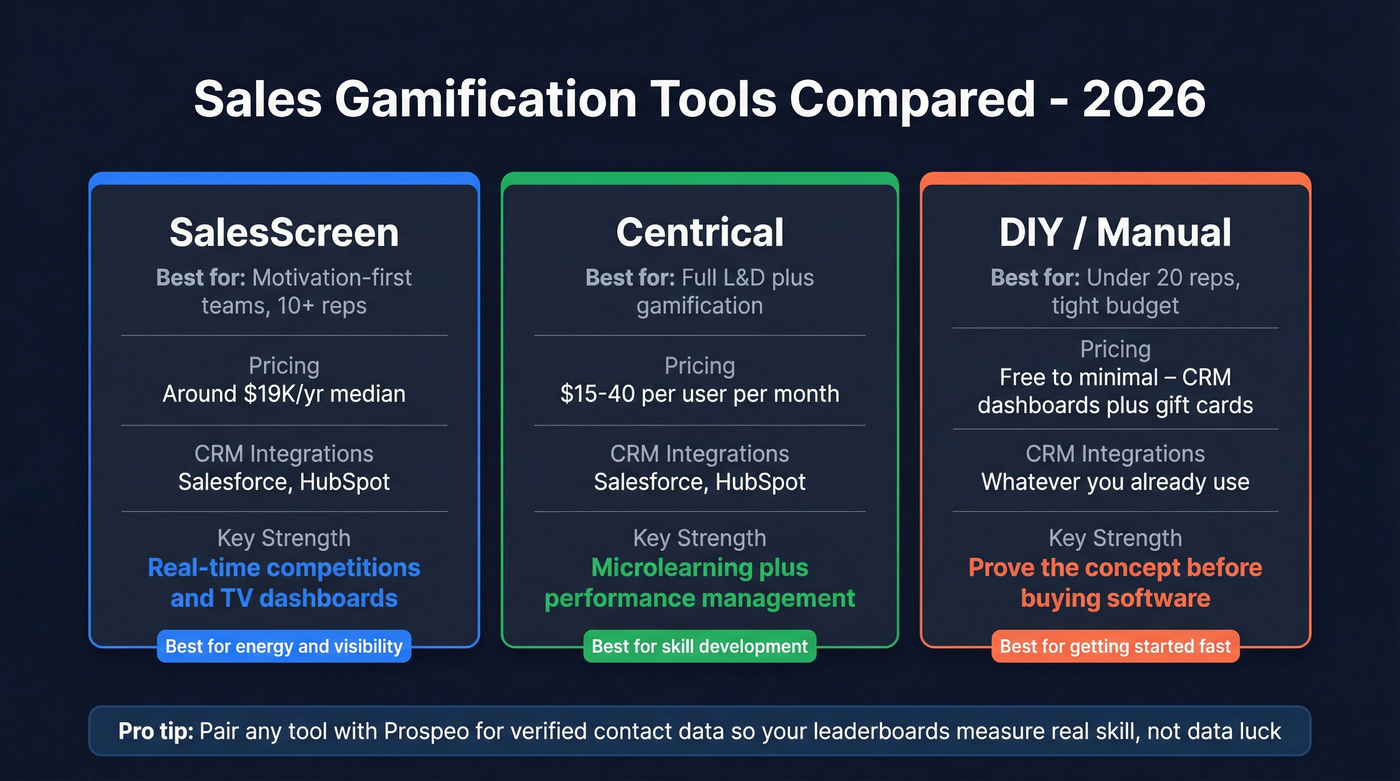
Under 20 reps, tight budget: Start with CRM dashboards and manual weekly challenges. A whiteboard, a manager who gives a damn, and a $50 gift card go further than you'd think. Prove the concept before buying software.
Mid-market (20-100 reps): SalesScreen if you're motivation-first, Centrical if you're learning-first. Expect $10-40/user/month depending on features and seat count.
Before anything else: Audit your data. If a third of your emails bounce, your leaderboard measures data luck, not skill. Run a sample through Prospeo's free tier - 75 email verifications and 100 Chrome extension lookups per month - before you gamify a single metric.
What Is Gamification in Sales Training?
Gamification sales training applies game mechanics - points, badges, leaderboards, challenges, levels - to the learning and development process for sales teams. It's not turning training into a video game. It's borrowing the psychological triggers that make games compelling and layering them onto skill-building activities.
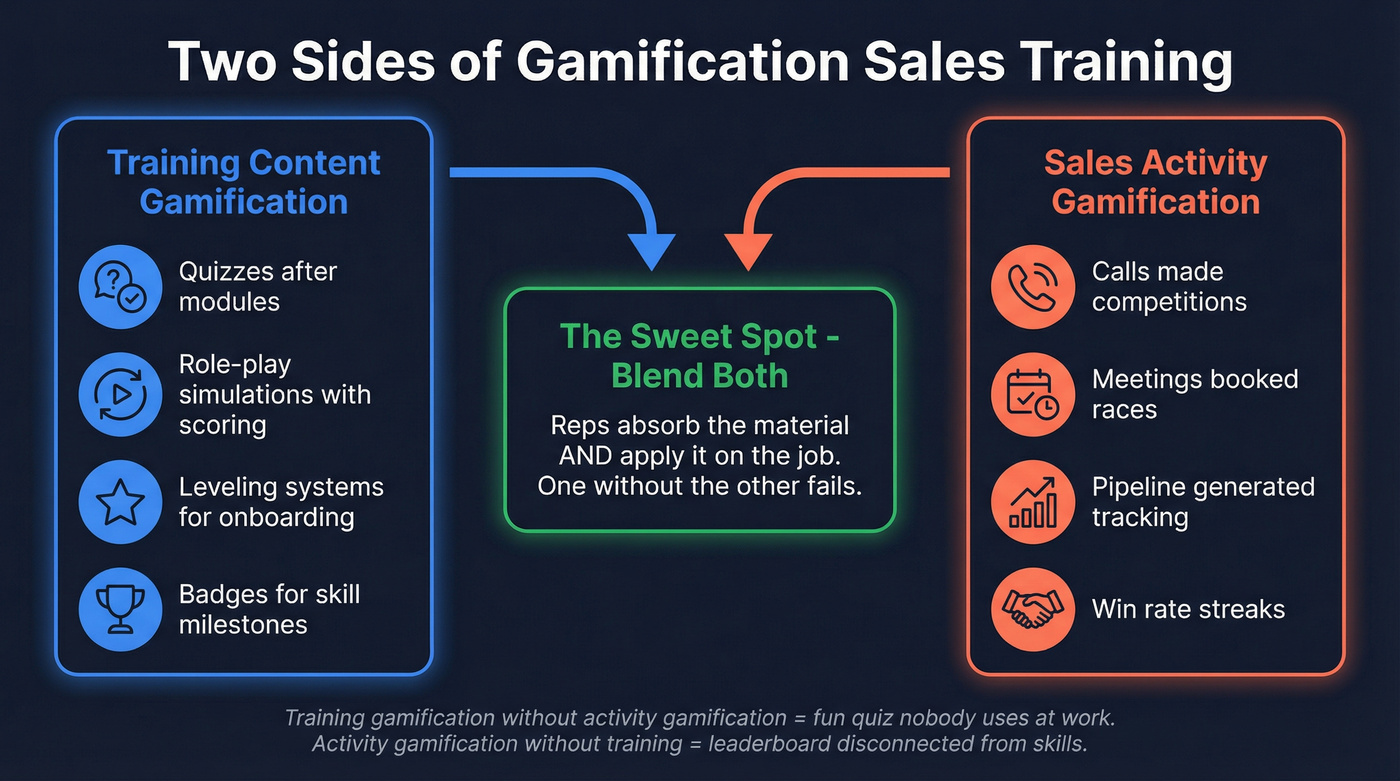
Most articles gloss over an important distinction. Gamification of training content means making the learning itself more engaging: quizzes after modules, role-play simulations with scoring, leveling systems for onboarding. Gamification of sales activity means applying game mechanics to the work itself - competitions around calls made, meetings booked, or pipeline generated.
The best programs blend both. You gamify the training so reps actually absorb the material, then gamify the activities so they apply what they learned. One without the other is either a fun quiz nobody uses at work or a leaderboard disconnected from skill development.
Does It Actually Work?
Yes, when designed well. The evidence is stronger than most people expect.
A 2024 study in the Journal of Innovation & Knowledge tested gamified corporate training across 110 employees and business owners in seven European countries using surveys and eye-tracking experiments. Points, badges, and leaderboards measurably improved knowledge retention and job performance. The collaborative elements mattered as much as the competitive ones - social interaction mediated the relationship between gamification techniques and knowledge sharing.
Corporate case studies back this up. Hewlett-Packard reported a 30-42% revenue increase over two months after deploying sales gamification. KPMG achieved a 25% increase in fee collection and a 22% boost in new business opportunities. Deloitte observed a 30% rise in adoption of gamified training programs among clients. And 90% of employees say gamification makes them more productive at work.
Here's the thing, though: every one of those success stories involved thoughtful design. HP didn't slap a leaderboard on a CRM. KPMG didn't hand out badges for logging in. The programs that work gamify specific behaviors tied to specific business outcomes. The ones that fail gamify vanity metrics and wonder why engagement drops after week three.
7 Ideas That Build Real Skills
Weekly Skill Challenges
Pick one skill per week - objection handling, discovery questions, competitive positioning - and run a scored challenge. Record mock calls, have peers rate them on a rubric, award points. Specificity matters: "Handle the 'we're already using ZoomInfo' objection" beats "practice objection handling" every time.
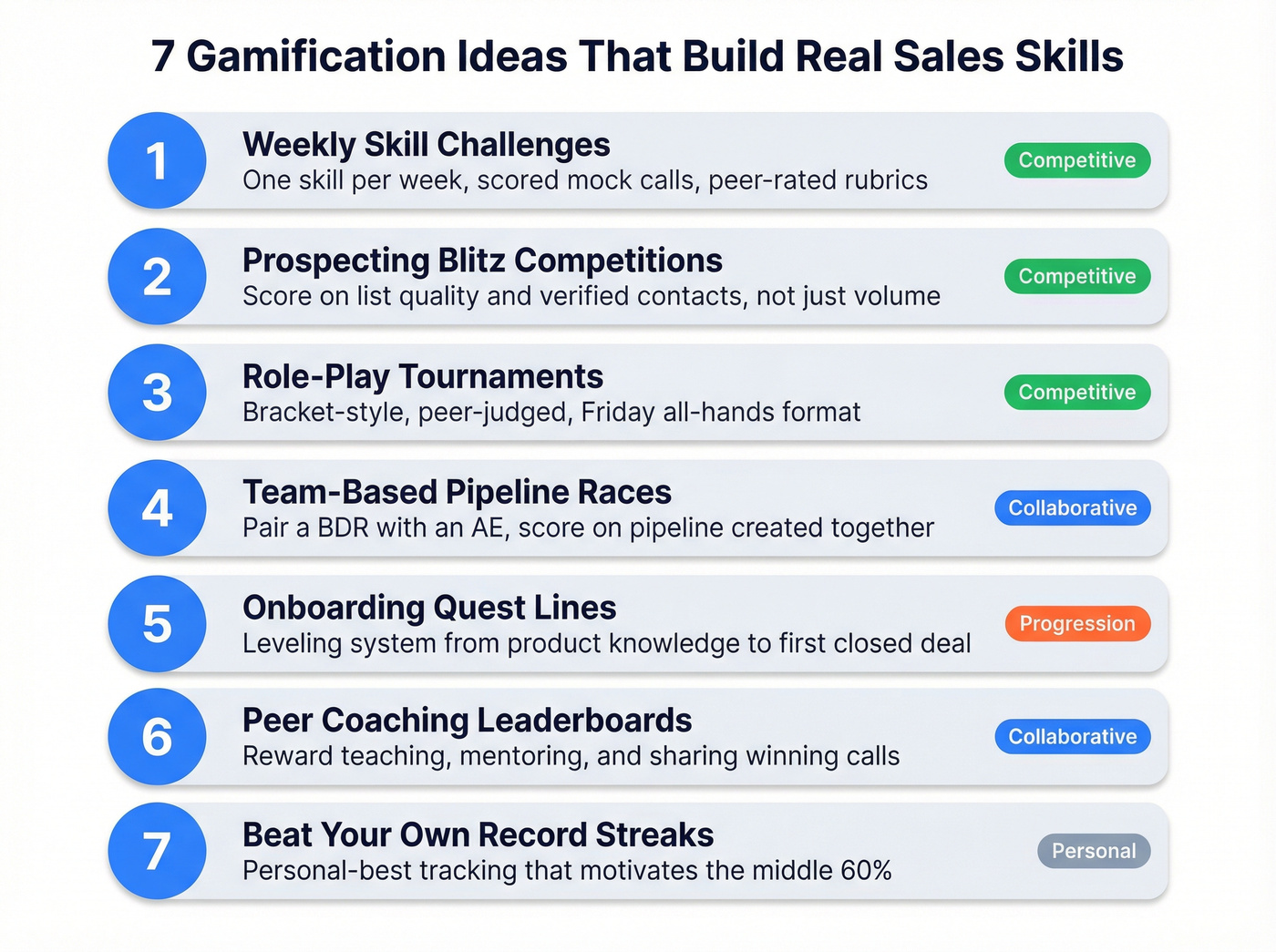
Prospecting Blitz Competitions
Give reps 30 minutes to build a targeted prospect list, then score on list quality - verified contacts, ICP match, title accuracy - not just volume. The rep who finds 15 verified VP-level contacts beats the one who dumps 50 unverified names into the CRM. This teaches research skills while creating usable pipeline.
Role-Play Tournaments
Bracket-style, peer-judged. Pair reps up, give them a scenario, let the team vote on who handled it better. Advance winners through rounds. We've seen teams run these during Friday all-hands - engagement is consistently high because they combine social pressure, skill practice, and entertainment. One team we worked with turned their tournament finals into a monthly event with a live audience on Zoom. Reps who'd normally skip optional training were volunteering to compete.
Team-Based Pipeline Races
Pair a BDR with an AE. Score the pair on pipeline created, not just activities. This forces collaboration and teaches BDRs what actually converts downstream. The Insurance Surgery, a UK broker, used a similar team-based approach with Plecto dashboards and saw a 50% increase in calls - the equivalent of eight extra hours per month.
Onboarding Quest Lines
Structure new hire onboarding as a leveling system. Level 1: product knowledge quiz. Level 2: shadow three calls and submit notes. Level 3: run a solo discovery call reviewed by a manager. Level 4: close your first deal. Each level unlocks the next, with badges along the way. Clear progression beats a firehose of information every time - especially for remote sales onboarding.
Peer Coaching Leaderboards
Reward teaching, not just selling. Award points when a rep records a winning call for the team library, mentors a new hire, or shares a competitive insight in Slack. This builds a sales collaboration culture and prevents the "lone wolf" problem where top performers hoard their playbooks.
"Beat Your Own Record" Streaks
Not everyone thrives on rank-based competition. Personal-best streaks - consecutive days hitting activity targets, improving call-to-meeting ratios week over week - motivate the middle 60% who'll never top a leaderboard but can absolutely improve. In our experience, these quiet mechanics often drive more sustained behavior change than flashy competitions. The consensus on r/sales tends to agree: public leaderboards motivate the top and demoralize the rest, while personal-best tracking keeps everyone moving forward.

Gamifying prospecting blitzes? Your reps shouldn't lose points because their contact data bounces. Prospeo delivers 98% email accuracy with a 7-day refresh cycle - so your leaderboards measure actual skill, not data luck.
Stop rewarding reps for finding contacts that don't exist.
5 Mistakes That Kill Motivation
Only Rewarding Top Performers
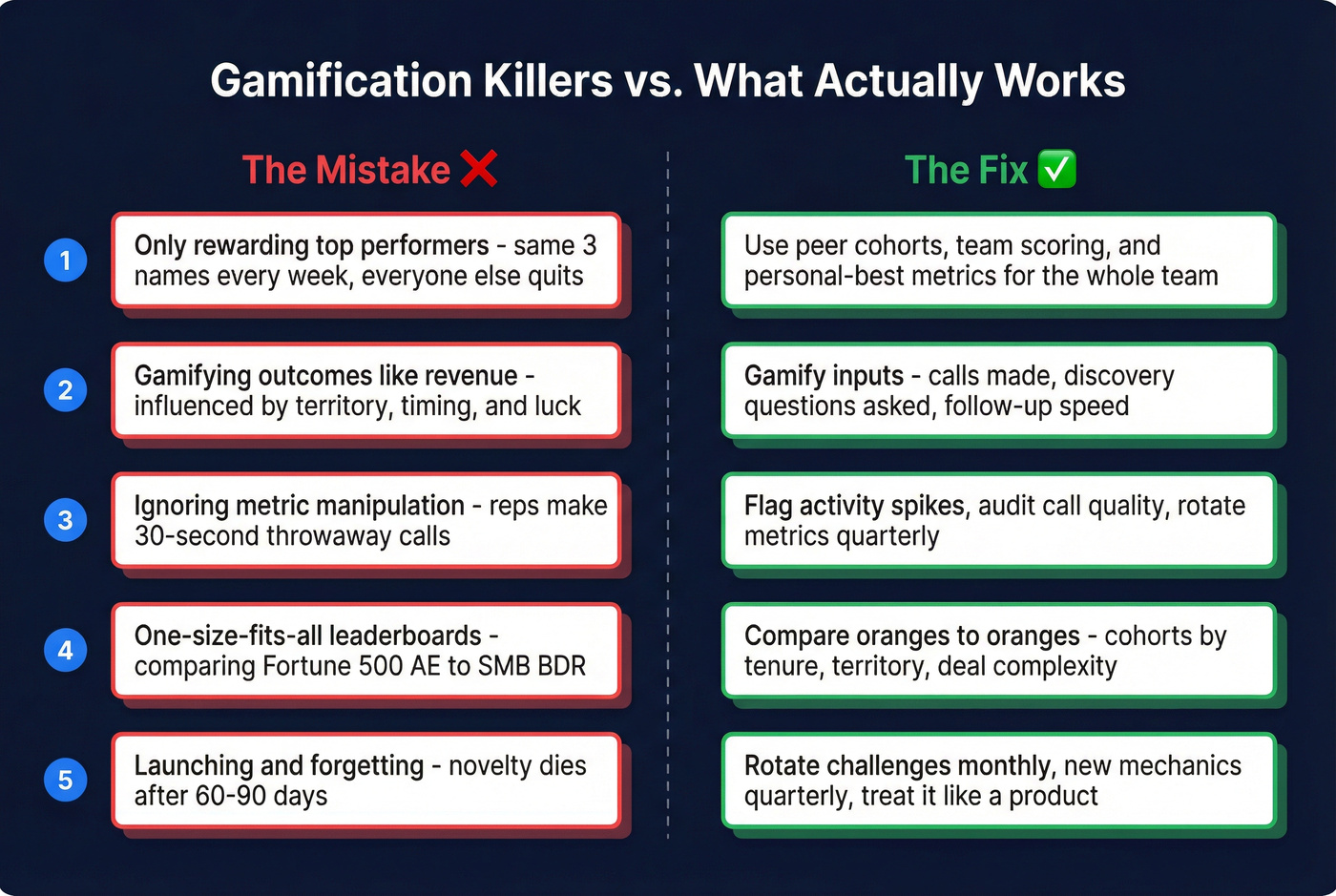
This is the single most common failure. If the same three names sit atop the leaderboard every week, the other twelve stop trying. Design for the middle 60%, not the top 10%. Use peer cohorts, team-based scoring, and personal-best metrics to keep the whole team engaged.
Gamifying Outcomes Instead of Behaviors
Revenue is influenced by territory, deal size, timing, and luck. Gamify the inputs - calls made, discovery questions asked, qualification rigor, follow-up speed - and the outcomes follow. A scoreboard that only tracks closed-won isn't a training program. It's just a scoreboard. (If you want a clean definition of pipeline stages, see SQO meaning.)
Ignoring Metric Manipulation
Rules will be bent. If you reward call volume, reps will make 30-second throwaway calls. If you reward meetings booked, they'll book unqualified meetings. Build anti-gaming controls from day one: flag sudden activity spikes, audit call quality on a sample basis, and rotate the metrics you gamify quarterly so gaming strategies can't calcify. This is also where sales training KPIs help you separate activity from impact.
One-Size-Fits-All Leaderboards
Comparing a rep with a Fortune 500 territory to one working SMB accounts is meaningless. Compare oranges to oranges - peer cohorts by tenure, territory size, or deal complexity. A first-year BDR competing against a five-year enterprise AE isn't gamification. It's cruelty.
Launching and Forgetting
The biggest failure mode isn't bad design - it's decay. Gamification programs lose their novelty after 60-90 days if you don't refresh them. We've watched teams burn serious money on platforms that nobody logged into after month two. Rotate challenges monthly, introduce new mechanics quarterly, retire stale leaderboards. Treat your program like a product, not a project.
How to Roll Out a Gamified Program
Step Zero: Audit Your Data
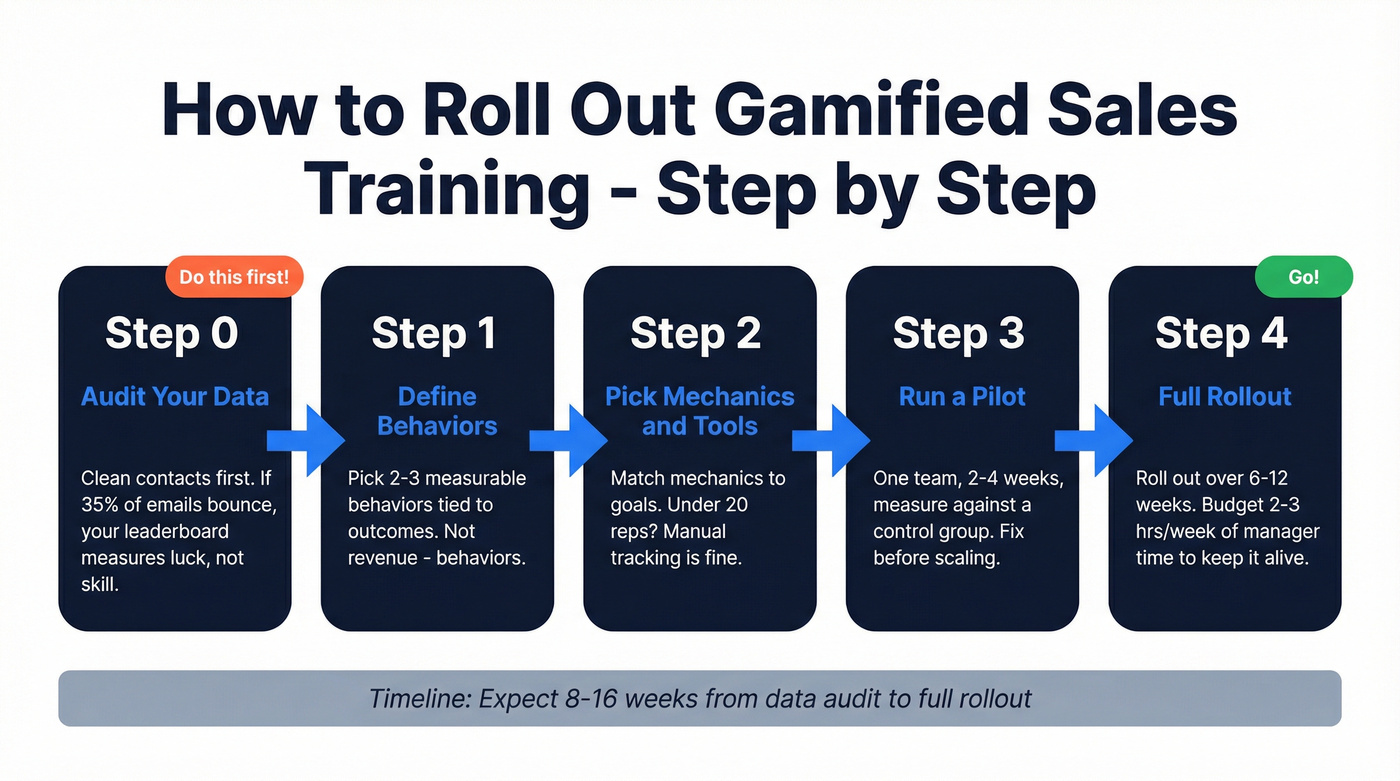
Look, a $20K/year gamification platform is worthless if your reps are calling dead numbers. Before you gamify anything, clean your contact data. If 35% of your emails bounce, your leaderboard measures data luck, not skill. Verify a sample with Prospeo's email finder - 98% accuracy on a 7-day refresh cycle - so when you gamify "meetings booked" or "calls connected," the numbers reflect actual performance. If you’re seeing systemic issues, start with CRM hygiene and a quick read on B2B contact data decay.
Define Behaviors, Not Outcomes
Pick 2-3 behaviors tied to business outcomes. Not revenue. Behaviors. "Discovery calls completed with all five qualification questions asked." "Follow-ups sent within 24 hours of demo." Write these down. If you can't measure it in your CRM, don't gamify it. (For a practical framework, use account qualification.)
Pick Mechanics and Tools
Match mechanics to goals. Leaderboards for competitive teams. Quest lines for onboarding. Personal-best streaks for individual development. For teams under 20, manual tracking is fine - don't let anyone tell you otherwise. For 20+, look at SalesScreen or Centrical.
Run a Pilot
Pick one team. Run the program for two to four weeks. Measure activity lift against a control group. If you don't see a measurable difference, the problem is design, not scale. Fix it before rolling out company-wide.
Full Rollout
After a successful pilot, roll out over 6-12 weeks. Integrate with your CRM for automated scoring. Set a monthly cadence for refreshing challenges and a quarterly cadence for reviewing whether the program still drives the right behaviors. Budget 2-3 hours per week of manager time to keep it alive - this isn't optional.
Best Tools Compared (2026)
| Tool | Best For | Pricing | CRM Integrations | Key Strength |
|---|---|---|---|---|
| SalesScreen | Motivation-first (10+ reps) | ~$19K/yr median | Salesforce, HubSpot | Real-time competitions |
| Centrical | Full L&D + gamification | ~$15-40/user/mo | Salesforce, HubSpot | Microlearning + perf mgmt |
| Plecto | Dashboard-first teams | ~$10-30/user/mo | SF, HubSpot, SQL | Multi-source KPI dashboards |
| Ambition | Mid-market sales perf | ~$15-35/user/mo | Salesforce, HubSpot | Coaching + scorecards |
| Spinify | Small teams, quick setup | ~$15/user/mo | Salesforce, HubSpot | Simple leaderboards |
SalesScreen
SalesScreen is the platform most sales teams encounter first, and for good reason - it's built around motivation, not learning management. Real-time competitions, TV dashboards for the sales floor, and celebration screens when someone closes a deal. Think live leaderboards updating as calls happen and team-vs-team challenges you can spin up in minutes.
Use this if you have 10+ reps and your primary goal is energy and activity lift. The TV dashboard alone changes the vibe of a sales floor.
Skip this if you need a full learning management system. SalesScreen gamifies activity, not training content.
Vendr benchmark data puts the median annual contract at $19,061, with a range of $12,332-$38,532 depending on team size. They offer a 30-day free trial on the Essentials plan. Acrisure drove 45% year-over-year revenue growth using SalesScreen - the kind of case study that gets procurement's attention.
Centrical
Where SalesScreen is motivation-first, Centrical is learning-first. It's a full L&D platform with gamification baked in, combining microlearning modules, performance management, coaching workflows, and gamification mechanics into a single stack. Reps don't just earn badges for completing a module - the system tracks whether the training actually changed their behavior on calls and in pipeline.
Use this if you want reps to complete training and then apply it with gamified reinforcement. It replaces both an LMS and a gamification platform.
Skip this if you want something lightweight. Centrical is a serious implementation. Expect $15-40/user/month depending on license type and support tier. Request pricing here.
Plecto
Plecto is the dashboard-first option. It pulls data from CRMs, dialers, spreadsheets, and SQL databases into unified KPI dashboards that can display on office TVs. Gamification is layered on top - leaderboards, contests, badges - but the core value is visibility. When your team's biggest problem is that nobody knows where they stand, Plecto solves that before you even turn on the game mechanics. Pricing runs ~$10-30/user/month with a 14-day free trial.
Other Options Worth Knowing
Ambition sits in the mid-market sweet spot - coaching scorecards, performance tracking, and gamification in one platform at ~$15-35/user/month. Solid for teams that want coaching workflows alongside competitions. Spinify is the simplest option for small teams that just want leaderboards and celebration screens without a complex rollout - around $15/user/month, up and running in a day.
How to Measure ROI
Companies with in-depth training programs see 218% higher income per employee than those without formalized training. Gamification should accelerate that return, not just add cost.
Activity lift is the first signal - are reps doing more of the behaviors you gamified? Expect 5-15% activity lift in a well-designed program within the first month. Performance lift follows: quota attainment, ramp time for new hires, conversion rates at each pipeline stage. A realistic target is 5-10% improvement within one quarter.
Run an A/B test if you can. Gamify one team, leave another as a control, and compare after 30-60 days. This eliminates the "would it have happened anyway?" question that plagues training ROI conversations. Track knowledge retention scores at 30, 60, and 90 days post-training. Track ramp time for new hires on quest-line onboarding versus traditional onboarding. And track engagement decay - if participation drops 50% after month two, your program needs a refresh, not more budget.
Let's be honest about something: if your deals average under $10K, you probably don't need a $20K gamification platform. A CRM dashboard, a weekly Slack challenge, and a manager who actually coaches will get you 80% of the results at 5% of the cost. Save the platform spend for when you've proven the concept manually and need to scale it across 50+ reps.
Our team has found that groups refreshing challenges monthly keep engagement alive far longer than those who set and forget. If you don't see measurable improvement after a full quarter, sunset the program and try a different design. The willingness to kill what isn't working is what separates good gamification sales training from expensive distractions.
Team pipeline races fall apart when half the leads have dead emails. Prospeo's 143M+ verified emails and 125M+ mobile numbers mean your BDR-AE pairs compete on selling ability - not on who got luckier with their list.
Give every rep on your leaderboard data worth competing over.
FAQ
Does gamification work for remote sales teams?
Yes - digital leaderboards, virtual challenges, and async competitions work regardless of location. Platforms like SalesScreen and Centrical are built for distributed teams. Remote teams often benefit more because gamification replaces the natural visibility of a physical sales floor.
How long does it take to see results?
Most teams see measurable activity lifts within 2-4 weeks of a well-designed pilot. Performance improvements like quota attainment and ramp time reduction typically emerge within one full quarter. Give it 30 days minimum before judging.
What's the cheapest way to start?
A CRM dashboard, a whiteboard, and a manager who runs weekly challenges. Prove the concept with manual competitions, $50 gift cards, and public recognition before committing $15K+ to software.
Can gamification demotivate reps?
Absolutely, if poorly designed. Leaderboards that only spotlight top performers demoralize the middle 60%. The most common complaint in sales communities is gamification that rewards activity volume over quality. Use peer cohorts, team-based challenges, and personal-best streaks to keep everyone engaged.
How do you prevent gaming the system?
Gamify behaviors like call quality and discovery questions rather than outcomes alone. Flag sudden activity spikes, audit a sample of calls weekly, and rotate the metrics you gamify quarterly so gaming strategies can't take root.