Cursing During Sales Calls: The Science, the Strategy, and When It Backfires
It's 4:47 PM. Your SDR has burned through 60 dials, hit voicemail on 40 of them, and finally gets a live prospect who opens with "Man, this quarter has been an absolute shit show." Without thinking, the rep mirrors back: "Yeah, sounds like a nightmare - what's driving the chaos?" The call runs 22 minutes. The meeting books. Nobody files an HR complaint.
That moment isn't an accident, and it's not a strategy you can fake. Cursing during sales calls is one of those topics everyone has an opinion on but few have data for.
69% of Reps Already Swear at Work
Roughly 69% of Americans curse at work. Not in the parking lot after a bad meeting - at work, on the clock, around colleagues and sometimes customers. Sales floors aren't exactly monasteries. The question isn't whether your reps swear. It's whether they're doing it in a way that builds rapport or torches deals.
Most of the advice out there boils down to "mirror the buyer" or "never swear, period." Both are incomplete.
Quick version before we get into it:
- Swearing correlates with an 8% higher close rate when both buyer and seller curse on the call - and reps usually wait for the buyer to go first.
- The safe move: mild profanity like damn or hell after the buyer signals informality. The risky move: anything stronger without an established relationship.
- If your calls are frustrating because half your numbers are dead, the problem isn't your vocabulary - it's your data.
What the Data Actually Says
Gong's conversational intelligence platform found that sales professionals swear on 20% of calls with buyers. One in five conversations. Reps are 4x more likely to swear if the buyer curses first. That's mirroring, not bravado.
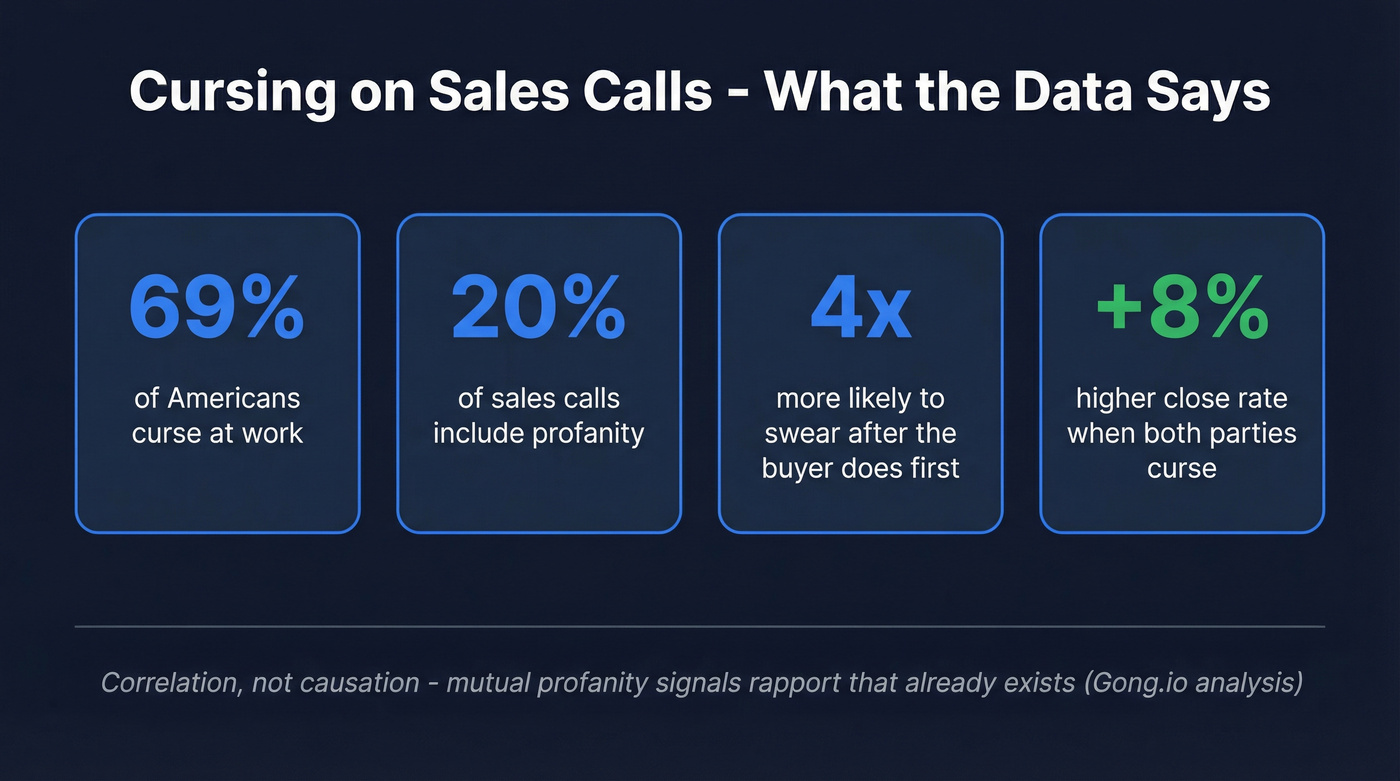
The headline stat: an 8% increase in close rates when both buyer and seller curse, compared to calls where nobody does. Sounds like a green light, but the same analysis doesn't publish sample size, industry breakdown, or statistical significance. We're looking at a correlation from a vendor's blog post, not a controlled experiment.
And Gong explicitly warns about causation here. Mutual profanity is a signal of rapport that already exists, not the cause of it. Reps who read the room well enough to mirror swearing are reading other cues well too. The language isn't the magic. The attunement is.
One more number worth noting: only 5% of reps swear before the buyer does, while 20% swear after. That gap tells you everything about where the risk lives.
The Neuroscience Behind Profanity
Profanity hits the brain differently than regular language. A 2022 review in Lingua synthesized decades of research and found that swear words produce heightened autonomic activity - elevated heart rate, increased skin conductance - along with measurably increased attention and memory retention. Taboo language acts like verbal bolding. It cuts through noise in a way that "gosh, that's frustrating" never will.
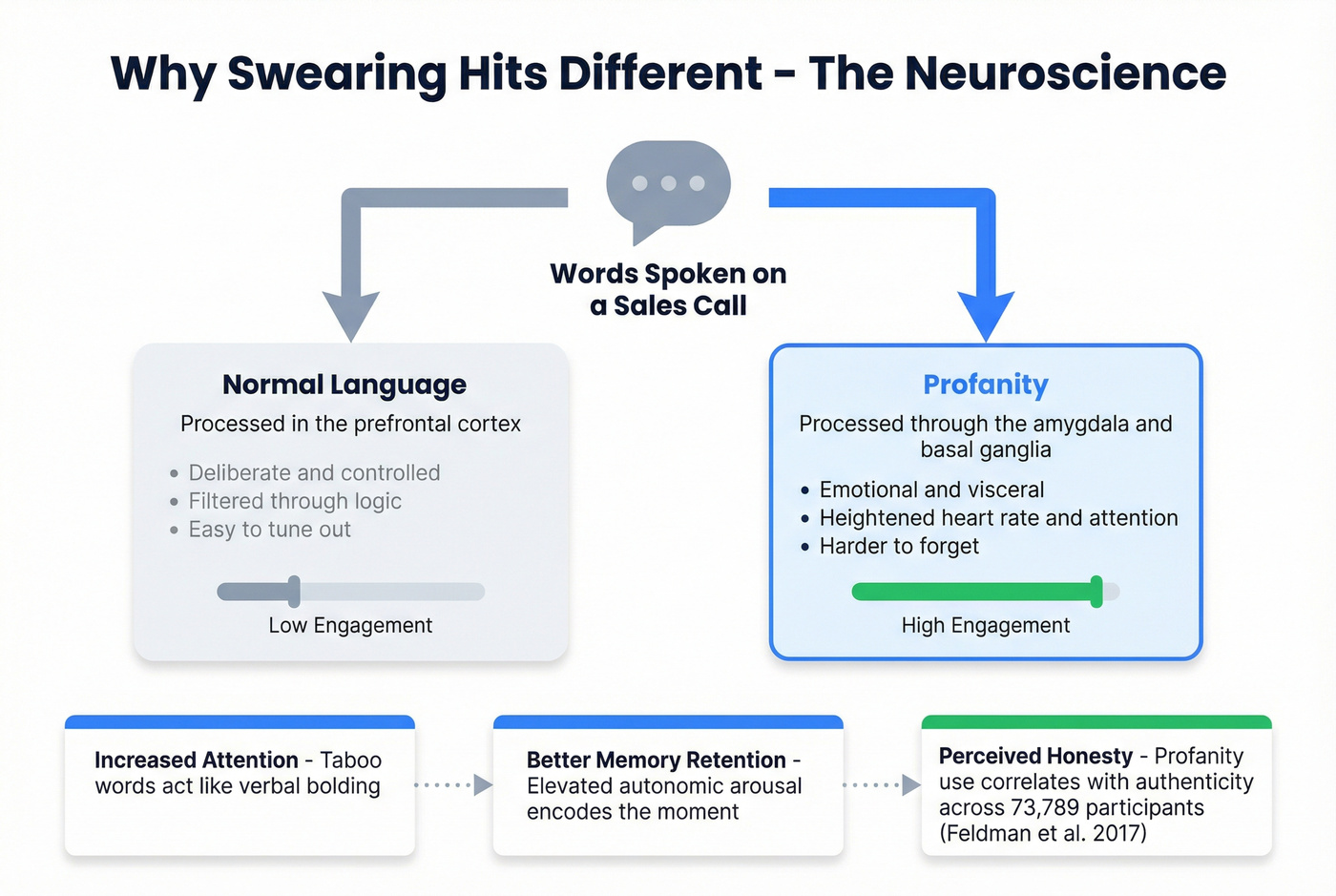
The mechanism traces back to how we learn these words. The prevailing theory is aversive classical conditioning: we learn as children that certain words are forbidden, and that emotional charge never fully fades. Swear words get processed partly through the amygdala and basal ganglia - emotional circuitry - rather than purely through the prefrontal cortex's deliberate language centers. That's why a well-timed expletive feels visceral and authentic rather than rehearsed.
There's a credibility angle too. A multi-method study by Feldman et al. (2017) tested the profanity-honesty link across three designs: a lab study with 276 participants, linguistic analysis of 73,789 Facebook users, and an aggregate analysis across all 50 US states. All three found a consistent positive relationship between profanity use and honesty. For sales, this matters. Buyers constantly filter for authenticity, and when a rep drops a mild expletive in a natural moment, it signals "I'm not running a script right now." That perception of honesty lowers the buyer's guard.
The Mirroring Rule (and Its Limits)
Salesforce's mirroring framework describes the broader principle: match your buyer's verbal and tonal cues to build connection. Chris Voss popularized this in negotiation contexts, and profanity mirroring is one expression of it. The 4x stat - reps are four times more likely to swear after the buyer does - shows that good reps already do this instinctively.
Here's what the best move in sales profanity actually looks like:
Buyer: "Honestly, our onboarding process is a complete disaster right now."
Rep: "Yeah, that sounds like a pain in the ass. What's breaking first - the handoff or the tooling?"
That's it. You're not escalating, not performing. You're acknowledging the buyer's emotional register and staying in it. The conversation moves forward naturally.
But "mirror the buyer" assumes a level playing field. It doesn't account for power dynamics, identity-based perception gaps, or industry norms. You need the context matrix too.

Swearing on calls won't save you if 35% of your emails bounce. Prospeo delivers 98% email accuracy and 125M+ verified mobile numbers so your reps actually reach the humans they're trying to build rapport with.
Stop perfecting your delivery for voicemails and dead inboxes.
The Word-Tier Framework
Not all profanity carries the same weight. We use a three-tier model to help reps calibrate risk:
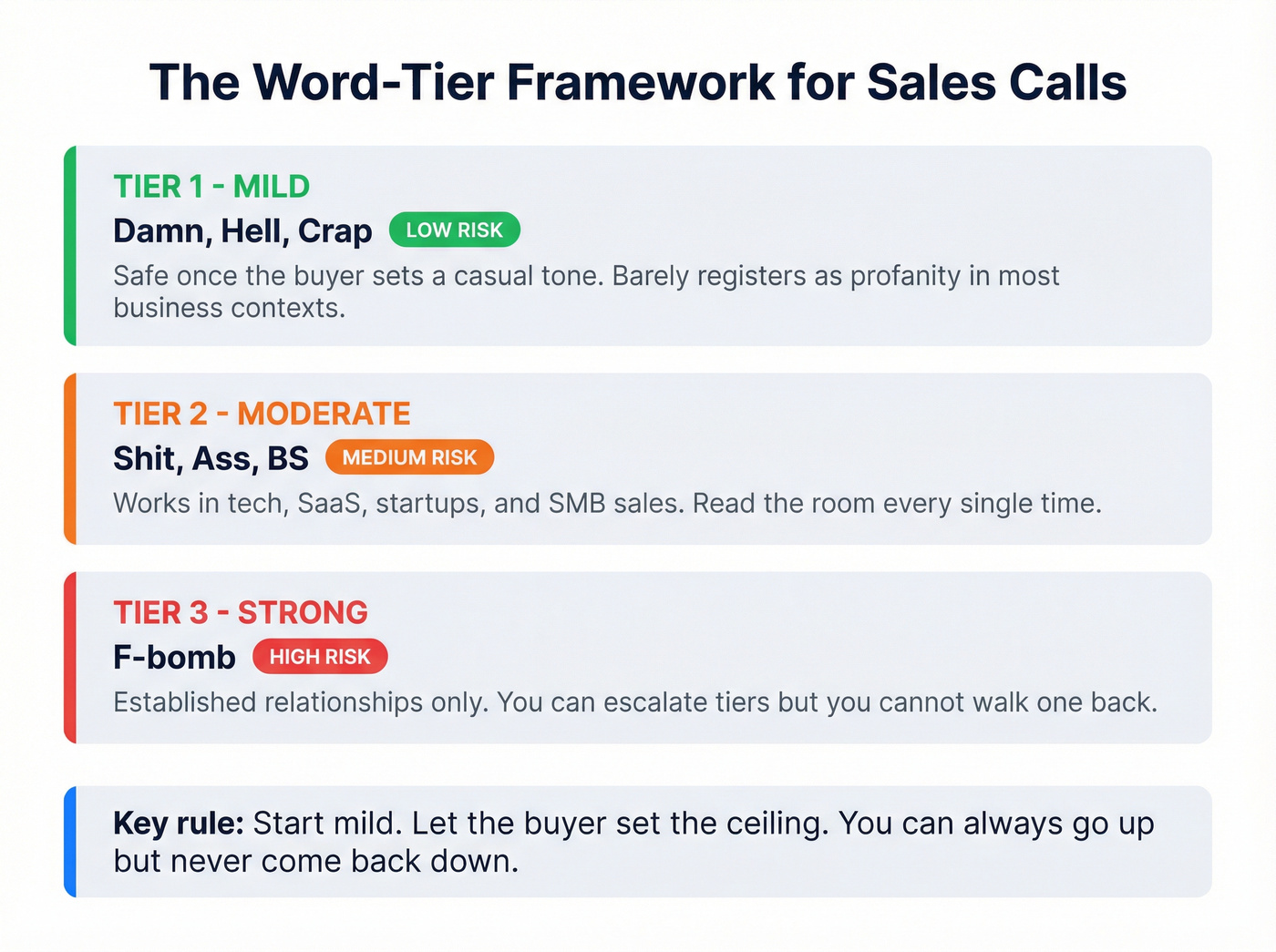
| Tier | Words | Risk Level | When It Works |
|---|---|---|---|
| Mild | Damn, hell, crap | Low | Buyer sets casual tone |
| Moderate | Shit, ass, BS | Medium | Tech/SaaS, SMB, peer-level |
| Strong | F-bomb | High | Established relationships only |
Mild is almost always safe once the buyer has set an informal tone. "Damn, that's a tight timeline" barely registers as profanity in most business contexts.
Moderate works in tech, SaaS, startups, and SMB sales where the culture skews casual - but it's a read-the-room call every time. We've seen it land perfectly in a startup demo and bomb in a mid-market fintech deal on the same afternoon.
Strong is reserved for relationships where you've already built significant trust. Using the f-bomb on a third call with a friendly VP of Engineering? Probably fine. On a first discovery call with a healthcare procurement lead? Career risk.
The key insight: you can always escalate tiers within a relationship, but you can't easily walk one back. Start mild. Let the buyer set the ceiling.
When Swearing Backfires
Here's the thing: if you're selling sub-$15k deals into regulated industries, profanity is all downside and no upside. The rapport gains are marginal; the compliance and perception risks are real. Skip the colorful language entirely and focus on contexts where the culture actually rewards it.
The Bias Problem
This is where the "just mirror the buyer" advice falls apart in real life. Women are often judged more harshly than men for using identical language in workplace settings. Black professionals can face disproportionate negative perception for the same words. The mirroring playbook assumes everyone gets the same response to the same behavior, and that's simply not how workplaces work. If you're managing a diverse sales team, a blanket "mirror the buyer's profanity" policy ignores the uneven consequences your reps face.
The Compliance Problem
In our experience, the reps who get flagged aren't the ones who slip once - they're the ones who don't know their org's policy. We've seen top closers get surfaced in QA reviews not because a deal was lost, but because a recorded call with moderate profanity got flagged during a routine audit. If your org records calls, your language is on tape. Know your company's code of conduct before you test boundaries.
Recovery
If you overshoot, the Ridge Films recovery framework is solid: check your tone, contextualize if needed ("sorry, I get fired up about this stuff"), and apologize directly if the buyer's energy shifts. Most people won't hold a single mild slip against you. Doubling down after a visible flinch is how you lose deals.
The Context Matrix
Industry, sales stage, buyer seniority, and channel all shape the risk:
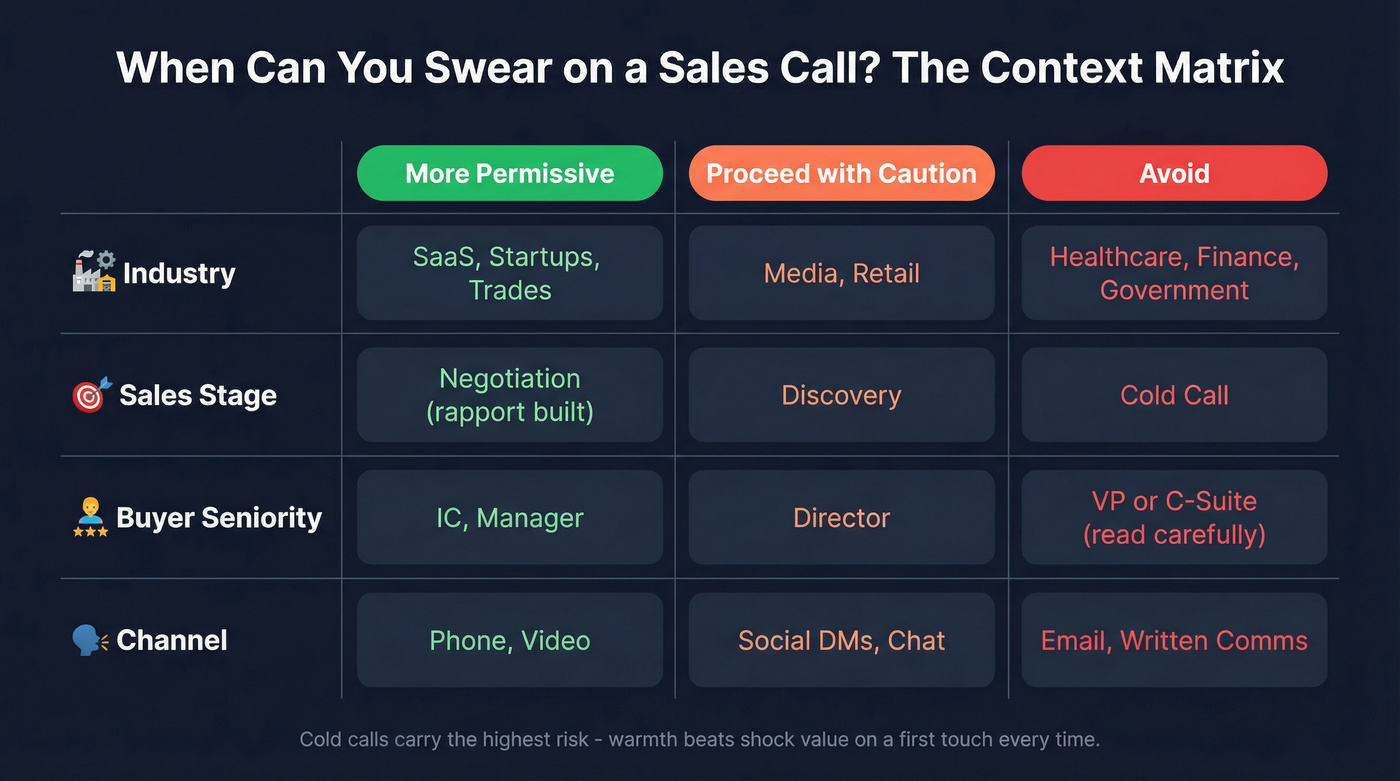
| Factor | More Permissive | Proceed with Caution | Avoid |
|---|---|---|---|
| Industry | SaaS, startups, trades | Media, retail | Healthcare, finance, gov |
| Stage | Negotiation (rapport built) | Discovery | Cold call |
| Seniority | IC, manager | Director | VP/C-suite (read carefully) |
| Channel | Phone, video | Social DMs, chat | Email, written comms |
Construction and trades sales? Swearing is practically a dialect. SaaS and startup sales? Moderate profanity is common and rarely penalized. Healthcare, financial services, and government? The compliance and cultural norms make it a bad bet regardless of how casual the buyer seems.
Cold calls carry the highest risk because you have zero rapport baseline. Gong data also shows that "How have you been?" yields 6.6x higher booking rates than "Did I catch you at a bad time?" - which tells you that warmth beats shock value every time on a first touch. Once you're in negotiation, multiple conversations deep with real trust established, profanity carries the least risk and the most upside.
Let's be honest about one more thing: never put profanity in writing. Emails, Slack messages, proposals - these create permanent records. What sounds natural on a phone call reads as unprofessional in an email thread that gets forwarded to legal.
Fix Your Data Before Your Language
Here's the contrarian take nobody in the "should I swear on calls?" debate talks about: most reps don't swear strategically. They swear reactively - out of frustration from burning through dead numbers, wrong contacts, and voicemail after voicemail. Profanity calibration is a 1% optimization. Reaching the right person at a verified number is a 100% prerequisite.
We've watched teams obsess over call scripts and talk tracks while half their dial list was outdated. One agency we work with went from a 3% connect rate to over 20% just by switching to verified mobile numbers with a 7-day refresh cycle through Prospeo. Their reps stopped rage-dialing through dead lists and started having actual conversations - the kind where rapport tactics, including well-timed profanity, actually matter.

The Gong data is clear: reps who read the room close more. But you can't read the room if you never get in it. Prospeo's 7-day data refresh means your dials connect to real people - not recycled numbers from six weeks ago.
Book 26% more meetings with data that actually picks up.
The Bottom Line
Cursing during sales calls isn't a hack. It's a signal - of rapport, of attunement, of shared emotional register. The reps who use it well aren't the ones with the biggest vocabularies of expletives. They're the ones who listen closely enough to know when a mild "that's a pain in the ass" will land, and disciplined enough to stay silent when it won't.
Master mirroring. Read the room. Fix the fundamentals. The reps who close the most aren't the ones who swear the best - they're the ones who prepare the best.
If you want to tighten the rest of the call (not just the language), start with a B2B cold calling guide and a cold call checklist your team can actually follow.
FAQ
Does swearing on cold calls help book meetings?
Rarely. You have zero rapport on a cold call, so mild profanity only works as a pattern interrupt in very casual SMB contexts. The 8% close-rate lift comes from calls where both sides were already cursing mid-relationship. Default to reading the buyer's tone first, and avoid it entirely in enterprise or regulated verticals.
Can I get fired for profanity on a recorded sales call?
It depends on your company's code of conduct. Most orgs won't terminate over a single "damn," but repeated strong profanity on QA-flagged recordings is a real career risk. If calls are recorded, act like compliance is listening - because eventually, they will be.
What matters more - rapport language or contact data quality?
Data quality, by a wide margin. Profanity accounts for a marginal rapport signal. Reaching the right person at a verified number determines whether the call happens at all. Teams using verified mobiles with a 30% pickup rate get live conversations where rapport tactics can actually work - without that foundation, your word choice is irrelevant.