Sales Training KPIs: Stop Measuring Completion, Start Measuring Impact
You spent $80,000 on a sales training program last quarter. Completion rate: 94%. Satisfaction score: 4.3 out of 5. Quota attainment hasn't moved a single point.
That's not a training problem - it's a measurement problem. The right sales training KPIs would've flagged the disconnect weeks ago. 85-90% of sales training fails to produce lasting improvement because teams never measure the things that'd tell them why. The global sales training market is headed toward $19 billion by 2032, and only 37% of organizations evaluate outcomes beyond completion and satisfaction. That's a staggering amount of money spent on programs nobody can prove actually work.
The Short Version
Pick five KPIs - one per Kirkpatrick level plus ROI: training NPS, pre/post assessment lift, talk-to-listen ratio change, ramp time by cohort, Phillips ROI. Measure those five rigorously and you'll know more than 90% of sales enablement teams.
The Evaluation Framework Most Teams Skip
Donald Kirkpatrick published his four-level evaluation model in 1959, and it's still the most useful lens for measuring training effectiveness:
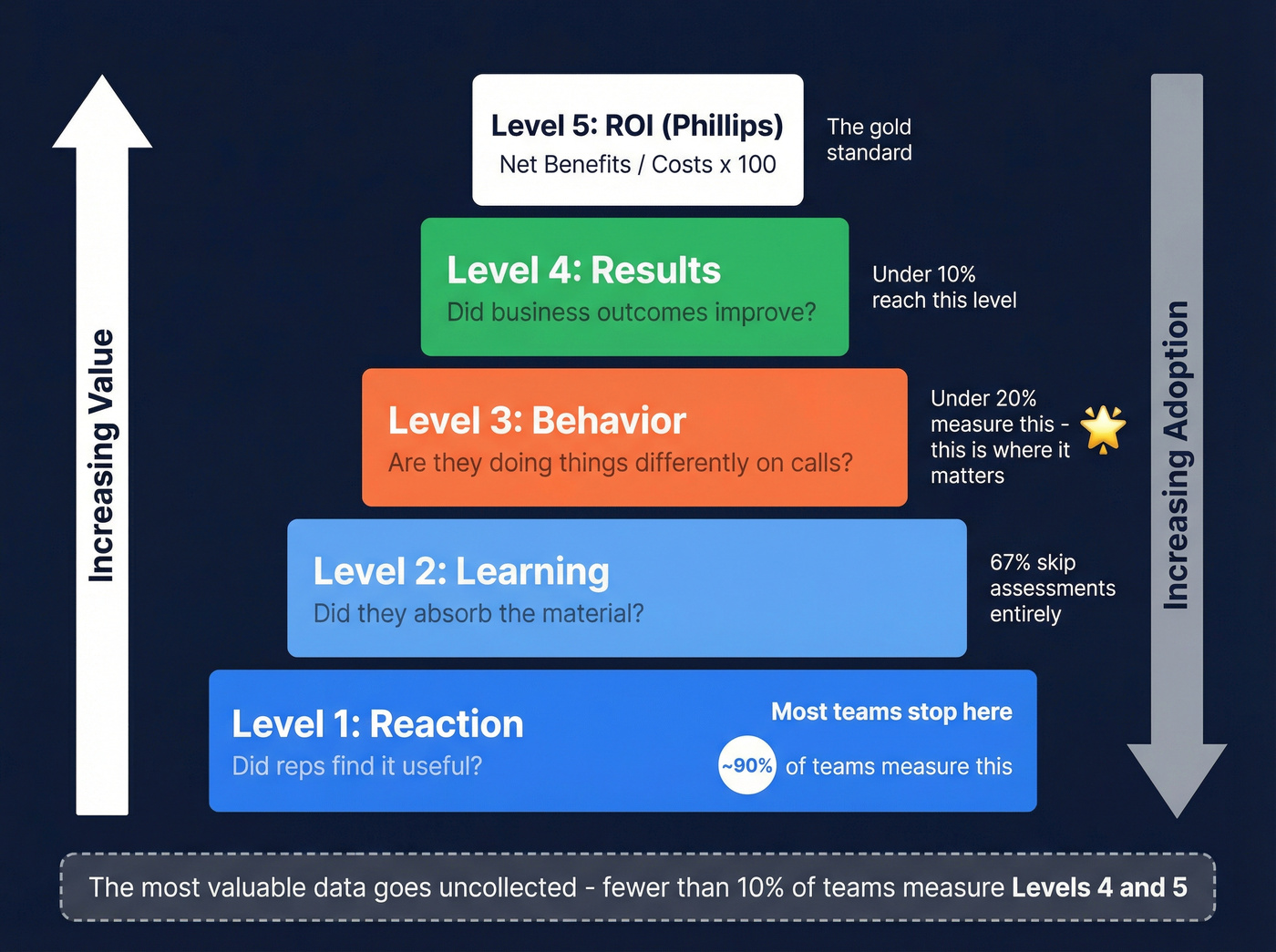
- Reaction - Did reps find the training relevant?
- Learning - Did they absorb the material?
- Behavior - Are they doing things differently on calls?
- Results - Did business outcomes improve?
Most enablement teams stop at Levels 1 and 2. Fewer than 20% consistently measure Level 3, and under 10% reach Level 4. The most valuable data goes uncollected.
Jack Phillips added a fifth level - ROI: (Net Program Benefits / Program Costs) x 100. We'll work through a real example below.
12 Metrics by Evaluation Level
| Level | KPI | Benchmark / Target |
|---|---|---|
| 1 - Reaction | Satisfaction score | ≥ 4.0 / 5.0 |
| 1 - Reaction | Training NPS | ≥ 40 |
| 2 - Learning | Pre/post score lift | ≥ 20% improvement |
| 2 - Learning | Certification pass rate | ≥ 85% |
| 3 - Behavior | Talk-to-listen ratio | More listening than talking |
| 3 - Behavior | Discovery question adoption | Increase questions per call |
| 3 - Behavior | CRM hygiene compliance | Required-field completion rate |
| 3 - Behavior | Pipeline stage conversion | Stage-to-stage conversion lift |
| 4 - Results | Ramp time (by cohort) | SDR: ~2-4 mo, AE: ~4-6 mo |
| 4 - Results | Win rate (trained cohort) | ~19% lift benchmark |
| 4 - Results | Revenue per rep | Trained vs. untrained |
| 5 - ROI | Phillips ROI | Track ROI % |
Level 1 - Reaction
Satisfaction scores and training NPS tell you whether reps found the session useful. They're easy to collect and nearly worthless on their own. But a low training NPS is a red flag that nothing downstream will stick.
Level 2 - Learning
Pre/post assessment scores are the minimum viable measurement. Without a pre-test baseline, you can't prove anyone learned anything. Only 33% of sales leaders use assessments to measure training ROI - which means two-thirds of teams are flying blind. Aim for at least 20% improvement between pre and post.
Level 3 - Behavior (Where It Actually Matters)
Here's the thing: this is where most teams quit, and it's exactly where measurement starts to mean something. Conversation intelligence tools like Gong and Chorus make Level 3 measurable at scale. Track talk-to-listen ratio shifts, discovery question adoption, and CRM hygiene compliance. Pipeline stage conversion is the critical leading indicator - it connects behavior change to revenue before win rates have time to move.
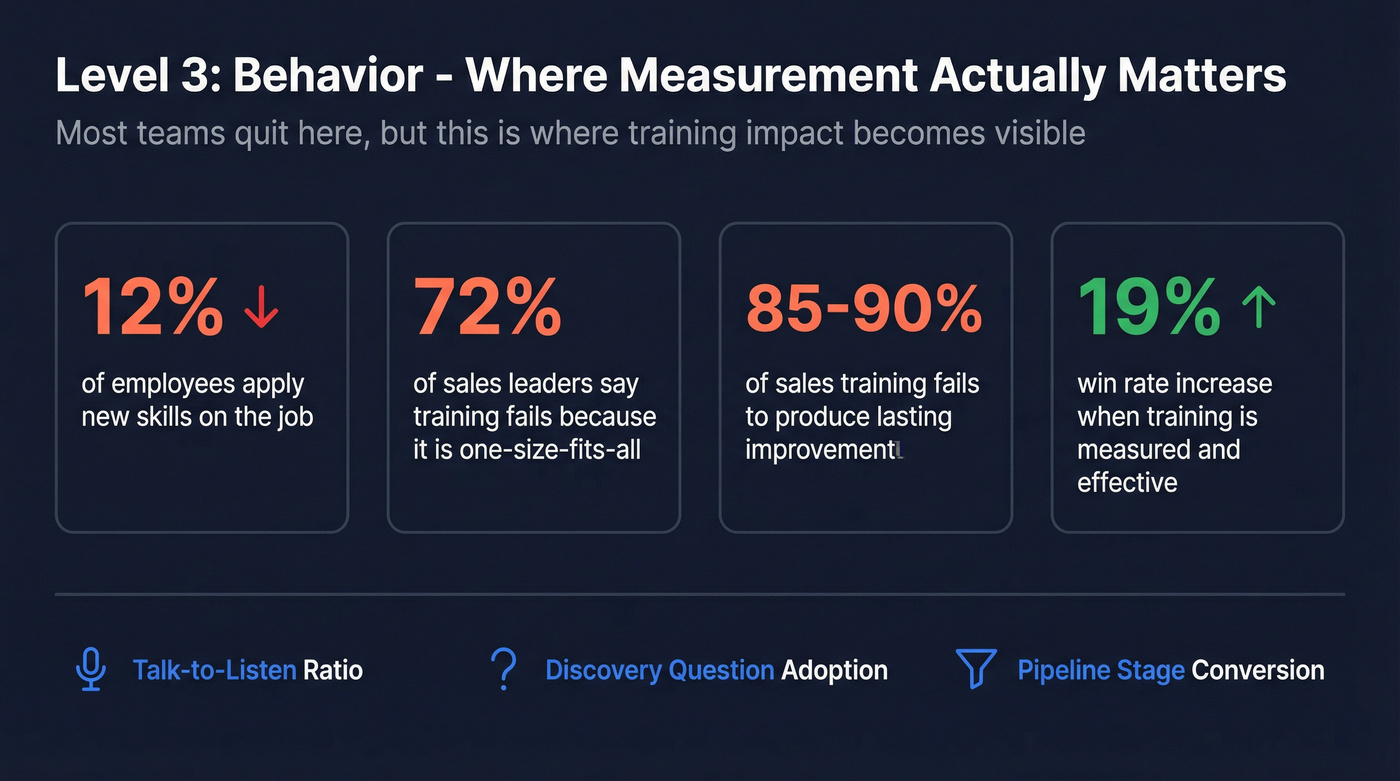
In our experience, the gap between training and application is enormous. Only 12% of employees apply new skills on the job. Twelve percent. Without Level 3 measurement, you'll never know which reps made the leap and which forgot everything by Friday.
Level 4 - Results
Ramp time is the headline metric. TrainingIndustry.com pegs the average at 381 days to full productivity - over a year. AppDynamics cut through this by tracking "time to close first $50K deal" as their ramp KPI, which is far more actionable than a vague productivity threshold.
Revenue per rep and win rate comparisons between trained and untrained cohorts during the same period round out Level 4. Effective programs show a 19% increase in win rates.
Level 5 - ROI
Let's walk through a real example. You invest $80,000 in a negotiation skills program. Over two quarters, the trained cohort generates $363,000 in incremental revenue from improved deal sizes. Net benefit: $283,000. ROI: ($283,000 / $80,000) x 100 = 353%. That's $4.53 back for every dollar spent.
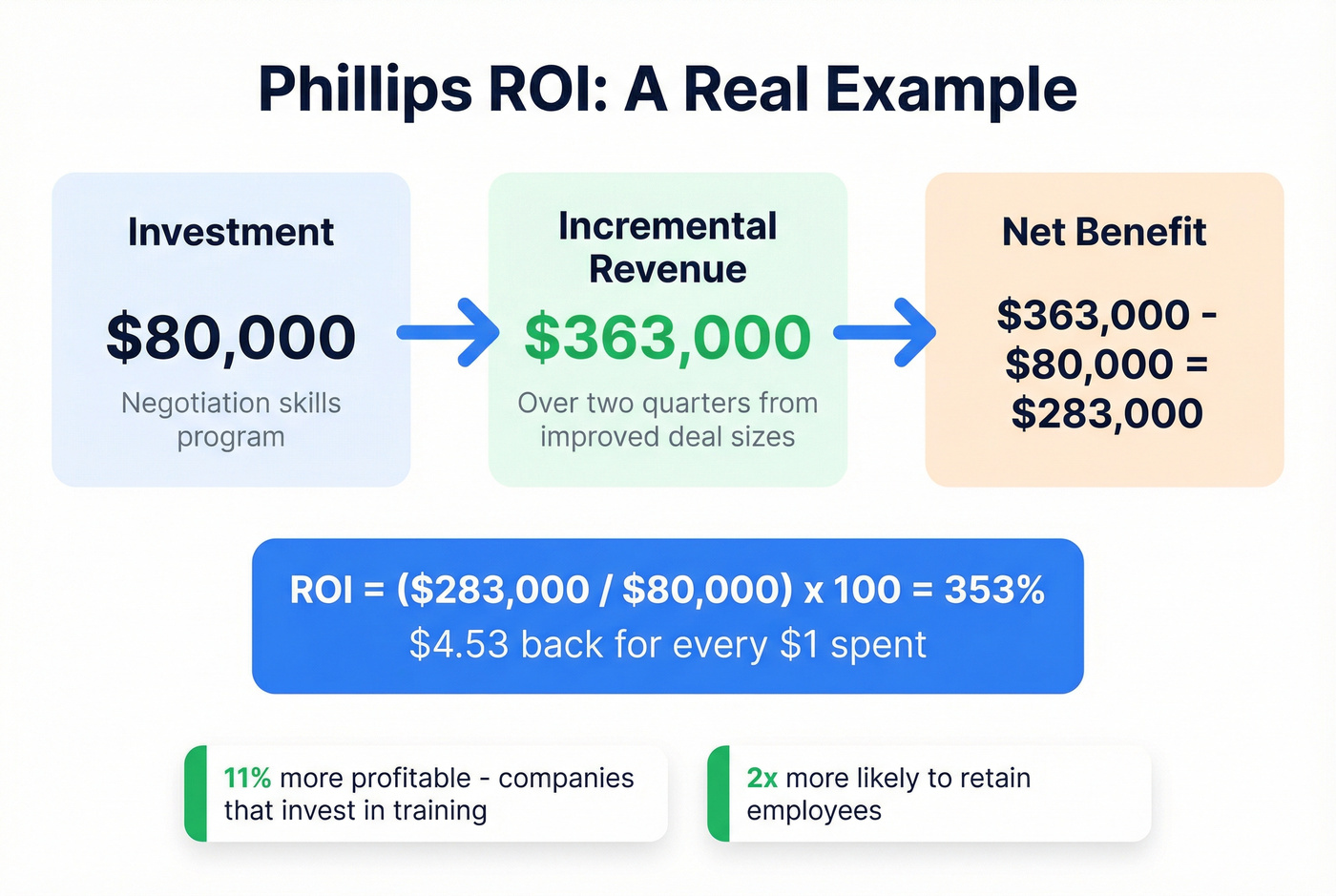
Companies that invest in training are 11% more profitable and twice as likely to retain employees - which makes the ROI case even stronger when you factor in reduced hiring costs.

Your ramp-time KPI is only as reliable as your contact data. When reps bounce 35% of emails, training metrics lie - they look undertrained when the real problem is data rot. Prospeo delivers 98% email accuracy on a 7-day refresh cycle, so your Level 3 and Level 4 KPIs reflect actual skill, not stale data.
Stop blaming training when bad data is the real culprit.
Why Attribution Falls Apart
Even teams that want to measure Levels 3-4 can't, because their data architecture won't support it. Fragmented tools - LMS here, CRM there, call recordings in a third system - prevent linking learner records to business outcomes. We've seen teams where 80% of analyst time goes to data cleanup instead of actual analysis.
The fix is boring but essential: persistent unique learner IDs across every system, plus 30-90 day longitudinal tracking windows.
There's a subtler problem too. If reps are trained on outbound prospecting but working with bad contact data, your ramp-time and activity KPIs reflect data quality, not training quality. A rep who bounces 35% of emails looks undertrained when the real issue is data rot. GreyScout saw this firsthand: after switching to Prospeo for verified contact data, rep ramp time dropped from 8-10 weeks to 4 weeks - not because training changed, but because reps finally had accurate emails to work with and their metrics stopped lying to them.

Three Mistakes That Kill Measurement
Measuring completion, not behavior. 72% of sales leaders say training fails because it's one-size-fits-all - yet they measure with a one-size-fits-all metric. Completion tells you nothing about impact.
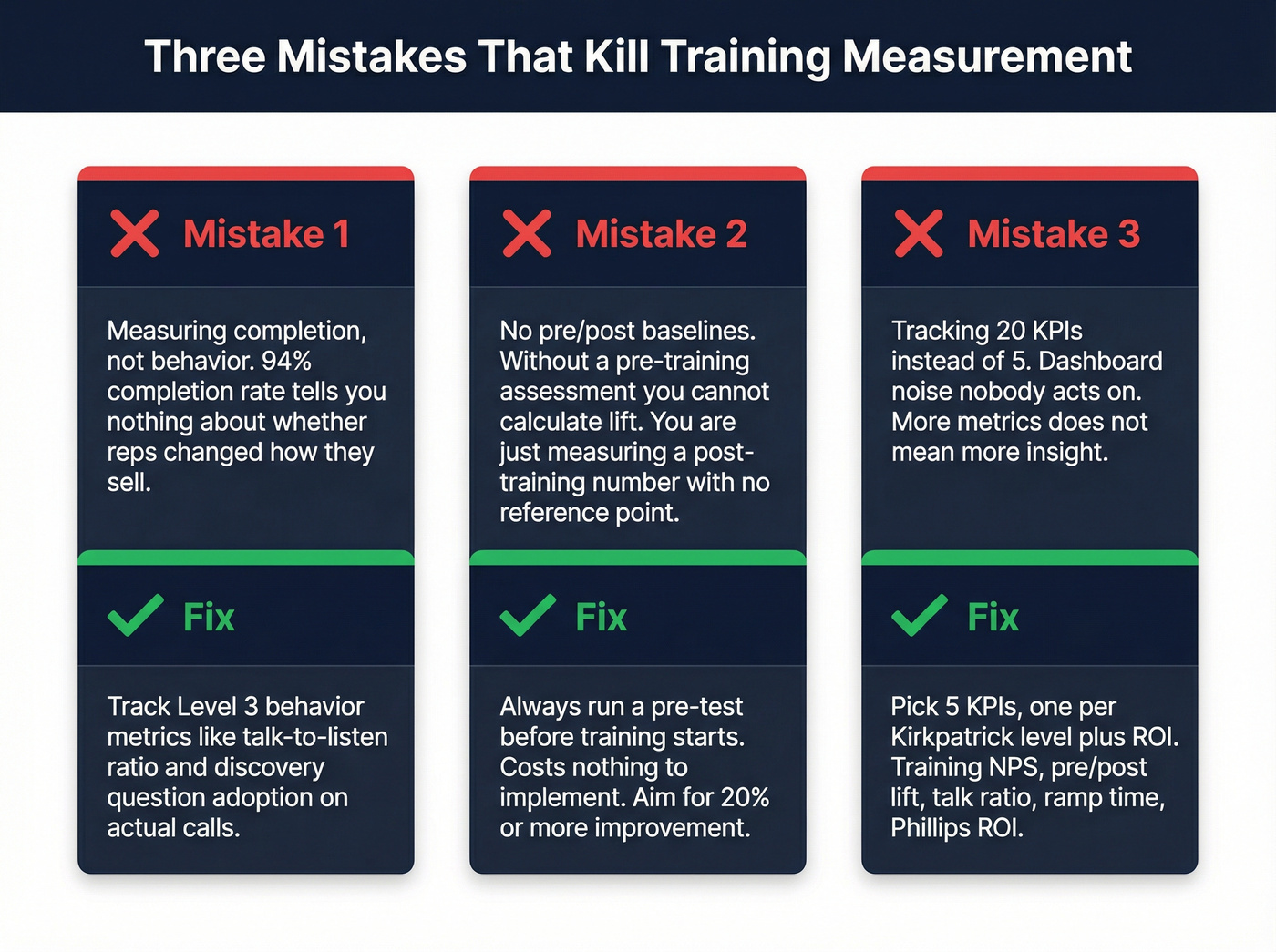
No pre/post baselines. Without a pre-training assessment, you can't calculate lift. You're just measuring a post-training number with no reference point. This one's inexcusable because it costs nothing to fix.
Tracking 20 KPIs instead of 5. Most sales managers should track 6-10 performance metrics total. For training specifically, five is enough. More than that and you're creating dashboard noise nobody acts on.
Let's be honest: if your deals average under $10K, you probably don't need a $2,000/seat conversation intelligence platform to measure training. Pre/post call reviews by a manager, done consistently, will get you 80% of the insight at 5% of the cost. Skip the enterprise tooling until your ACV justifies it.
Tools for Measuring Training Effectiveness
Conversation intelligence - Gong, Chorus, roughly $1,000-$2,500 per user/year. These give you Level 3 behavior data at scale: talk ratios, discovery adoption, objection handling patterns. They're worth it for teams running 50+ recorded calls per week. For smaller teams, they're overkill.
Enablement platforms - Highspot, Mindtickle, around $20-$60 per user/month. They manage content, certifications, and coaching workflows. Users report 34% faster ramp times, though we'd push you to verify that against your own cohort data before committing.
CRM analytics - Salesforce, HubSpot. These provide the pipeline and revenue data for Levels 4 and 5. You already have one. Use it.
For outbound activity KPIs to mean anything, reps need verified contact data. Prospeo's 98% email accuracy and 7-day data refresh cycle means your metrics measure rep skill, not whether half their prospect list was dead on arrival. At roughly $0.01 per lead, it removes data quality as a confounding variable without blowing your enablement budget.
GreyScout cut rep ramp time from 8-10 weeks to 4 weeks - not by changing training, but by switching to Prospeo's verified contact data. When activity metrics finally reflect real performance, you can isolate what training actually moves the needle. 300M+ profiles, $0.01/email, no contracts.
Measure training impact, not data quality problems.
FAQ
What's the difference between sales KPIs and sales training KPIs?
Sales KPIs measure outcomes like revenue and pipeline value. Sales training KPIs measure whether training caused those outcomes - using pre/post cohort comparisons and behavior-change indicators like talk-ratio shifts. The distinction matters because a win-rate jump could come from market conditions, a weaker competitor quarter, or a dozen other factors that have nothing to do with coaching.
How long should you wait to measure training impact?
Measure reaction immediately, learning within a week, behavior at 30-60 days, and business results at 60-90 days. Checking too early captures enthusiasm, not impact. Most teams make the mistake of surveying at week one and declaring success.
How do you isolate training impact from other variables?
Compare trained vs. untrained cohorts during the same period, control for territory and experience level, and use pre-training baselines. Clean contact data eliminates data quality as a confounding variable - if a rep's emails aren't bouncing, you know their activity metrics reflect actual skill, not bad data.
What are the most important sales training KPIs to start with?
Start with five: training NPS for reaction, pre/post assessment lift for learning, talk-to-listen ratio change for behavior, ramp time by cohort for results, and Phillips ROI. These five cover every Kirkpatrick level and give you a complete picture without dashboard overload.