

Why Sales Enablement Is Important - And Why Most Programs Still Fail
Your SDR team hits the phones at 8 AM. Half the numbers are disconnected. The other half go to voicemail because reps are calling the wrong titles with the wrong message. That's two enablement failures in a single sentence, and it happens every day at companies that think they've "done" enablement.
So why is sales enablement important? Because organizations with formal programs achieve a 49% win rate on forecasted deals, compared to 42.5% without one. A 6.5-point gap doesn't sound dramatic until you multiply it across your entire pipeline - suddenly it's the difference between a flat quarter and a record one.
Here's the thing: enablement works when it gets three things right - training, content, and data. It fails when it's treated as a project instead of a system. Two-thirds of enablement investments don't deliver expected results. Below, we'll break down the failure modes, the fix, and the numbers you need for your next leadership deck.
What Sales Enablement Actually Is
Training Industry defines it well: enablement bridges the gap between sales strategy and execution. It's four aligned elements - process, information, learning, and leadership - working as a system. Remove any one, and the other three degrade. A coaching program without updated content is theater. Great content without clean prospect data is a library nobody visits.
With 90% of organizations now running a dedicated enablement program, the question isn't whether to do it. It's how to do it without joining the majority that fails. The market agrees - Mordor Intelligence projects the sales enablement platform market will reach $8.79B by 2029, a sign that companies are betting heavily on getting this right.
5 Data-Backed Reasons Enablement Drives Revenue
If you're still building the internal case for a dedicated program, these five data points make the argument for you.
1. Measurable Revenue Lift
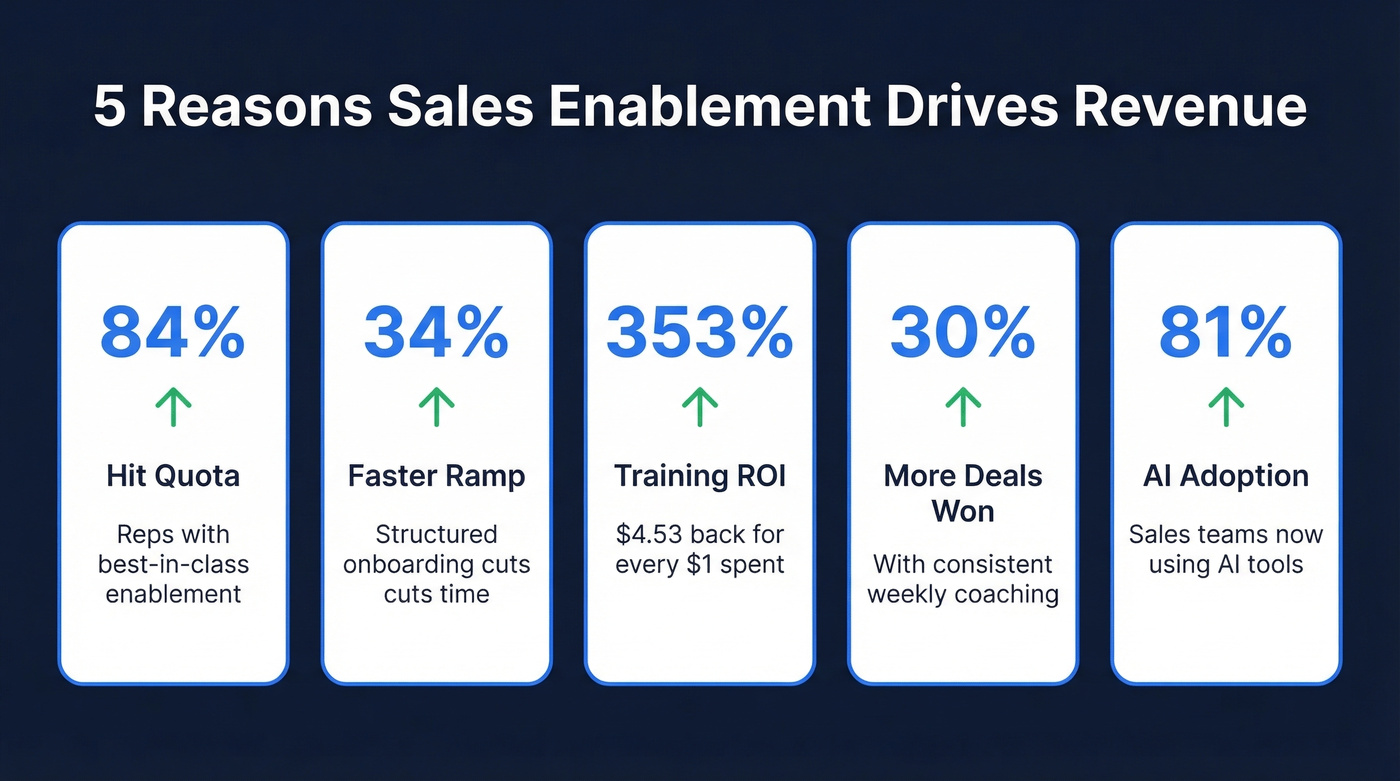
84% of reps hit quota when supported by best-in-class enablement. Industry benchmarks typically show 50-60% quota attainment without it. A well-designed program roughly doubles the odds your reps perform.
2. Faster Onboarding and Ramp
Structured onboarding reduces ramp time by up to 34% and retains 50% more new hires. Sales training returns $4.53 for every $1 spent - a 353% return. When your average rep takes 6-9 months to ramp, shaving two months off that timeline means two extra months of full productivity per hire, per year. That math compounds fast once you're onboarding a new cohort every quarter.
3. Sales and Marketing Alignment
Only 30% of marketing content gets used by sales - which means 70% gets built, approved, and published for nothing. And 50% of prospect engagement comes from just 10% of enablement content. Enablement creates the feedback loop that fixes this: sales tells marketing what resonates, marketing produces less but better content, usage climbs.
4. A Coaching Culture That Scales
Only 26% of reps receive weekly coaching. Yet consistent coaching drives 25% higher quota attainment and 30% more deals won. Enablement turns coaching from a personality trait of individual managers into a repeatable, measurable process that works across every team.
5. Preparing Reps for AI-Era Buyers
75% of B2B buyers now prefer a rep-free experience, yet 43% of those self-service buyers report higher purchase regret. Nearly a quarter of B2B buyers used GenAI for purchase research last year, and AI usage in sales itself grew from 39% to 81% in two years. By 2027, Gartner predicts 40% of B2B leaders will form dedicated GenAI search teams. Enablement is how you prepare reps for a world where the buyer's journey starts with ChatGPT, not a cold call.
Why Most Programs Fail
Over two-thirds of enablement investments don't deliver expected results. That's not a rounding error - it's the majority. They break down in four predictable ways:
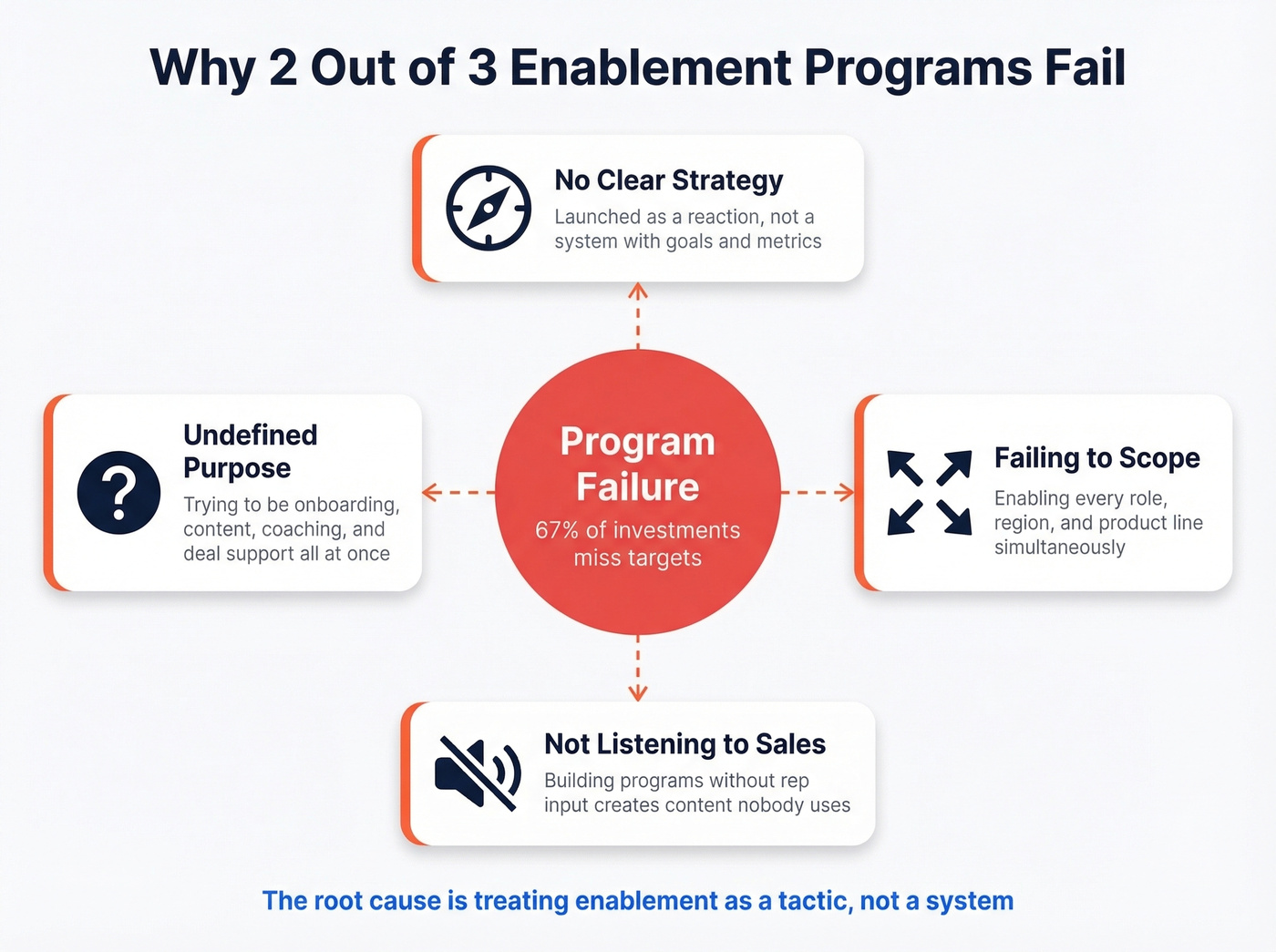
- No clear strategy. Enablement gets launched as a reaction ("our reps need training") instead of a system with defined goals, metrics, and ownership.
- Undefined purpose. Is it onboarding? Content management? Coaching? Deal support? When the answer is "all of it," nothing gets done well.
- Failing to scope. Teams try to enable every role, every region, every product line simultaneously. Enablement that tries to be everything becomes nothing.
- Not listening to sales. There's an r/sales thread asking why so many enablement people have zero sales experience - and it's a common rep frustration. When enablement teams build programs without rep input, they produce content nobody uses and training nobody applies.
In our experience, the teams that fail at enablement aren't under-resourced. They're under-coordinated. Treating enablement as a tactic - a deck here, a training session there - instead of a system is the root cause. If you can't draw a line from your enablement activity to a revenue metric, you don't have a program. You have a cost center waiting to be cut.

Two-thirds of enablement programs fail - and bad data is the silent killer. Prospeo gives your reps 300M+ profiles with 98% email accuracy and a 7-day refresh cycle, so every coaching session and battlecard actually connects to a real buyer.
Stop enabling reps to dial disconnected numbers. Start with clean data.
Do You Actually Need It?
Not every team needs a full-blown enablement function on day one. If you've got five reps, a single product, and a founder who still closes deals, a lightweight playbook and clean data might be enough.
But the moment you add a second product line, a second market, or a second cohort of new hires, the importance of sales enablement compounds fast. The signals are hard to miss: ramp times stretching past two quarters, win rates declining as the team grows, reps improvising their own decks instead of using approved content. If any of those sound familiar, you've already outgrown the "we don't need enablement" stage.
The Overlooked Pillar - Data Quality
Every enablement article talks about training and content. Almost none talk about data. We've watched teams invest six figures in coaching platforms and battlecards, then watched reps fail because their contact data was stale. Even the 30% of marketing content that sales does use falls flat when reps can't reach the right people. You can train a rep on perfect messaging - it doesn't matter if the email bounces or the phone number belongs to someone who left the company eight months ago.

Only 22% of the average enablement budget goes to technology, which means data quality - the foundation everything else depends on - is chronically underfunded.
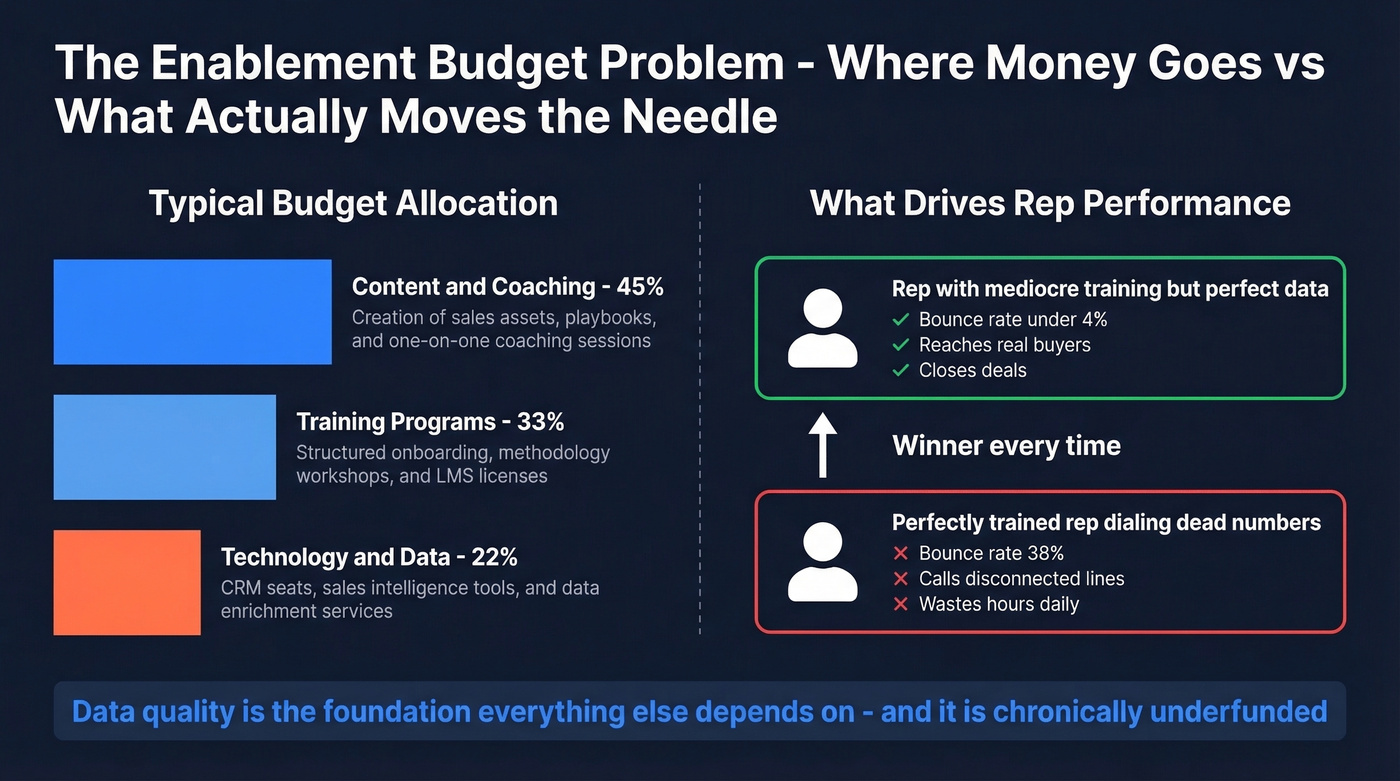
This is where tools like Prospeo fit into the enablement stack: 300M+ professional profiles, 98% email accuracy, 125M+ verified mobiles, and a 7-day data refresh cycle versus the six-week industry average. GreyScout saw this firsthand - after switching, their bounce rate dropped from 38% to under 4%, and rep ramp time fell from 8-10 weeks to just 4. That's an enablement outcome driven entirely by data quality.
Let's be honest: most enablement programs over-invest in content and coaching while completely ignoring the data layer. A rep with mediocre training and perfect data will outperform a perfectly trained rep dialing dead numbers every single time.
Measuring Enablement Impact
Gartner projected that 65% of B2B sales organizations would shift to data-driven decision making by 2026, and that shift is happening now. The industry is also moving toward revenue enablement as the evolved framing, tying enablement metrics directly to pipeline and closed-won outcomes. Your program needs to be ready for that scrutiny.
| KPI | What It Measures | Target Direction |
|---|---|---|
| Win rate | Deal conversion | ↑ |
| Ramp time | New hire productivity | ↓ |
| Content usage rate | Marketing-sales alignment | ↑ |
| Average deal size | Rep effectiveness | ↑ |
| Sales cycle length | Process efficiency | ↓ |
| Quota attainment | Overall performance | ↑ |
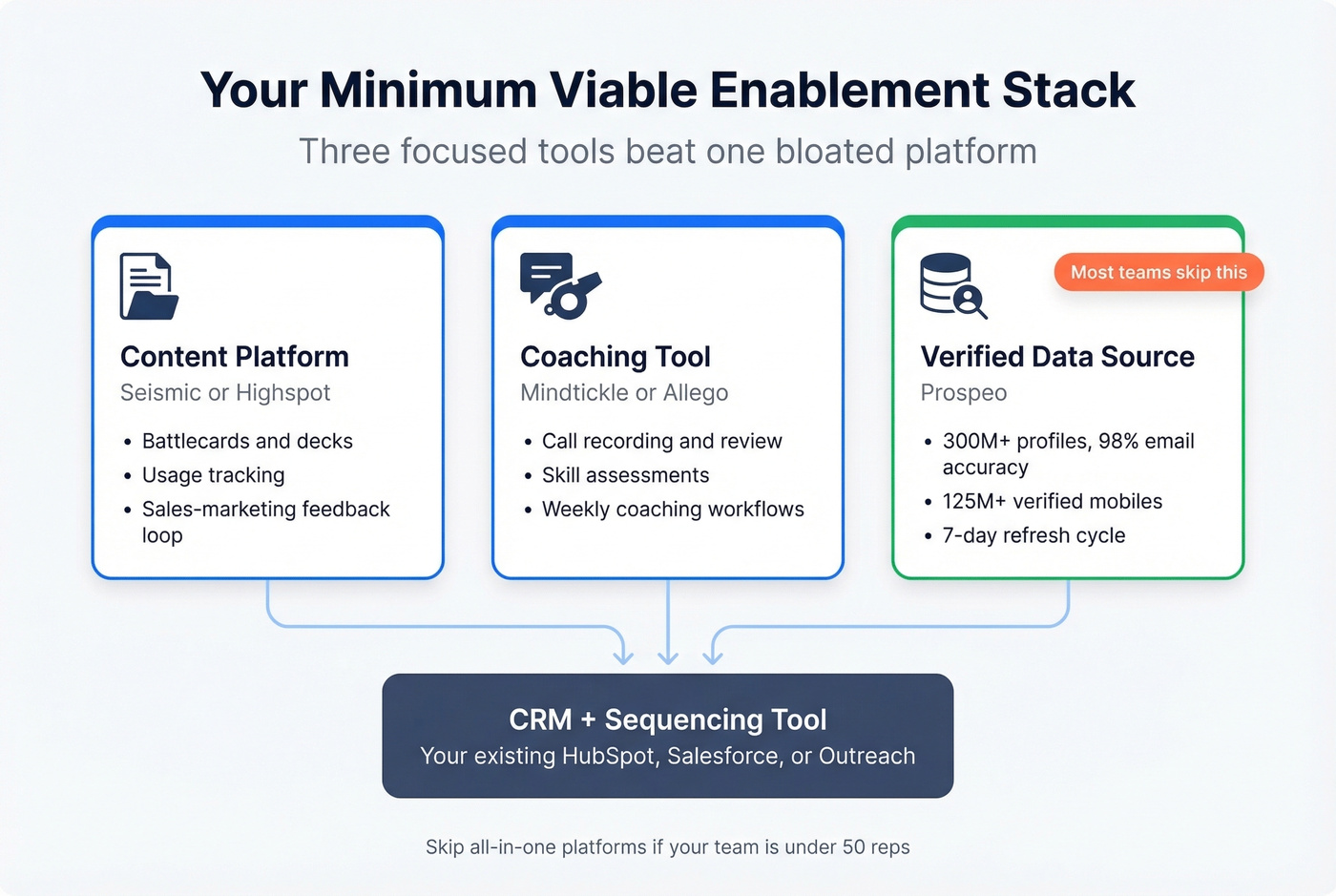
Once you're tracking these metrics, the stack question becomes straightforward. Start with three things: a content platform like Seismic or Highspot, a coaching tool like Mindtickle or Allego, and a verified data source. That's your minimum viable enablement stack - everything else is optimization.
Skip the all-in-one platforms that promise to do everything if your team is under 50 reps. They're expensive, slow to implement, and you'll use 20% of the features. Three focused tools beat one bloated one.
GreyScout cut rep ramp time from 10 weeks to 4 and dropped bounce rates from 38% to under 4% - not with more training, but with better data. Prospeo's 125M+ verified mobiles and 98% accurate emails are the enablement layer most teams are missing.
The fastest enablement win is data your reps can actually trust.
FAQ
What's the difference between sales enablement and sales training?
Training teaches skills - objection handling, discovery frameworks, closing techniques. Enablement is the full system: process, content, tools, and data that ensures reps can actually apply those skills with the right prospects at the right time. Training is one input. Enablement is the operating system.
How long does it take to see ROI from enablement?
Ramp time improvements show within 3-6 months; win rate and revenue impact typically take 6-12 months. Structured onboarding delivers the fastest measurable results, with companies reporting up to 34% faster ramp and 50% better new-hire retention.
What tools do you need for a sales enablement stack?
Start with three categories: content management (Seismic or Highspot), coaching (Mindtickle or Allego), and verified prospect data. Layer in your CRM and sequencing tool and you've covered 90% of what reps need day-to-day.
Can small teams benefit from sales enablement?
Yes - teams with 10+ reps adding new hires quarterly see the biggest immediate lift. For smaller teams under five reps, a lightweight playbook paired with clean, verified contact data often delivers 80% of the value at a fraction of the cost of a full platform rollout.