

Sales Battle Cards: How to Build, Ship, and Actually Get Reps to Use Them
You spend two weeks building a battle card. Product marketing reviews it. Design makes it pretty. You upload it to the shared drive, send a Slack message, and... crickets. Three months later, a rep loses a deal to the exact competitor you covered, using the exact objection you scripted a rebuttal for. They never opened the card.
That's the battle card problem. Not creation - adoption. Here's how to solve both.
What Is a Battle Card?
A sales battle card is a one-page competitive cheat sheet that gives reps what they need to win against a specific competitor - mid-conversation, in real time.
Crayon's research found that 68% of B2B sales deals involve at least one direct competitor. Most of your pipeline is contested. Battle cards exist to tilt those contested deals in your favor, and teams using them well see up to a 30% increase in win rates. The format varies - PDFs, Salesforce embeds, Notion pages - but the constant is brevity. If a rep can't pull a useful answer from it in under 10 seconds during a live call, it's not a battle card. It's a wiki page nobody reads.
The Quick Version
If you don't read anything else:
- The 10-second test. If a rep can't find the answer mid-call in 10 seconds, the card fails. One screen. No scrolling.
- Talk tracks + proof points, not feature dumps. Reps need words they can say out loud and evidence they can reference. Not a comparison matrix.
- Lives where reps already work. Salesforce, Slack, Gong - wherever your team spends their day. Not a shared drive.
- Refreshed every 30-60 days. One outdated pricing number and reps stop trusting the whole card. Permanently.
Why Most Battle Cards Fail
Here's the uncomfortable data. Research from competitive enablement circles shows 78% of CI leaders provide battle cards to their sales teams, but only 65% are satisfied with adoption. That's a 13-point gap between "we built it" and "they actually use it."
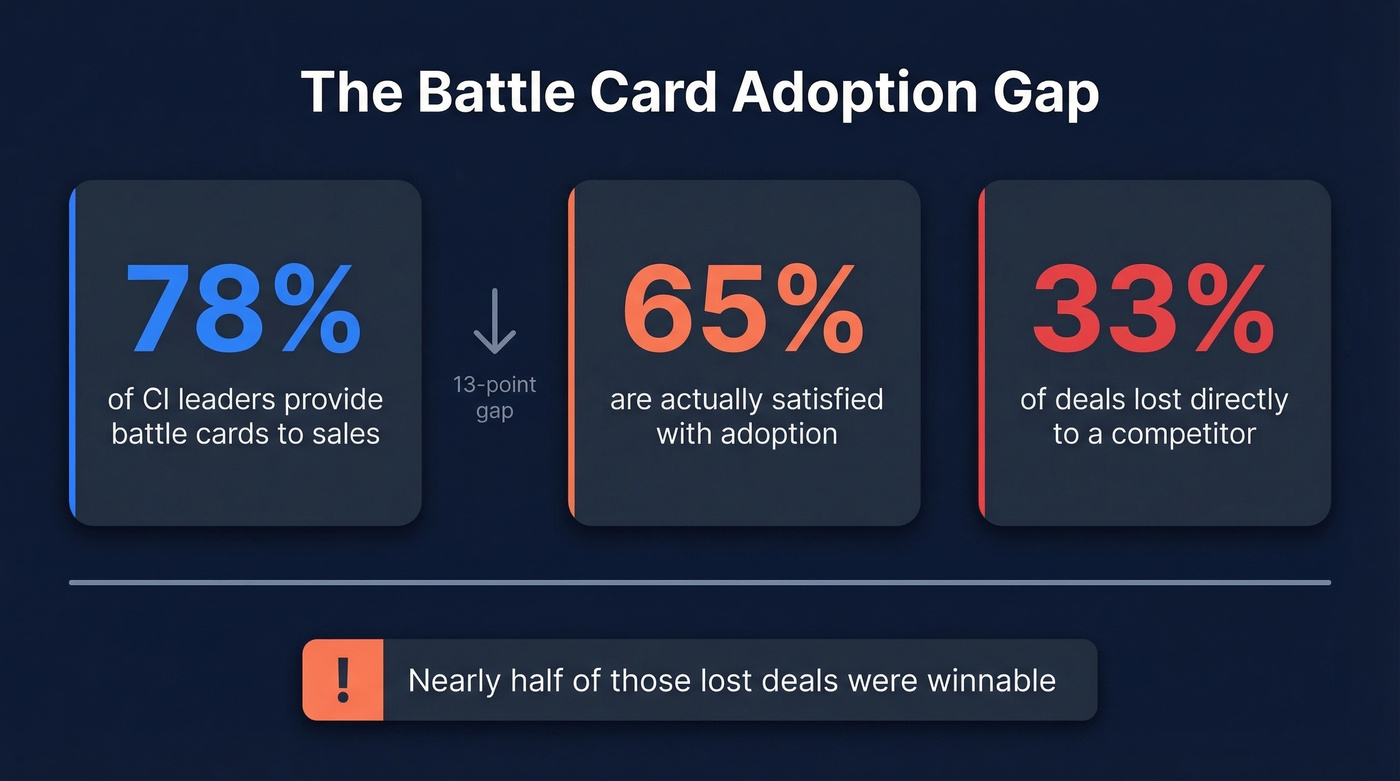
It gets worse: 33% of deals are lost directly to a competitor, and nearly half of those were winnable.
An audit of 150+ battle cards revealed the content itself is usually the culprit. Only 43% included talk tracks. Only 19% included supporting evidence. Cards were 1.5x less likely to include guidance on when or how to use the intel - context by deal stage was almost always missing.
Three things kill adoption every time:
Outdated information. A rep uses your pricing comparison in a call, the prospect corrects them, and that rep never opens the card again. One bad experience destroys trust permanently.
Inaccessibility. Battle cards buried in a Google Drive folder three levels deep don't exist. If reps have to leave their workflow to find them, they won't.
The actionability gap. This is the big one. Most cards read like Wikipedia entries - background information that's interesting but useless when a prospect says "we're also looking at [Competitor X]." Reps don't need a company overview. They need a sentence they can say right now.
What to Include: Know / Say / Show
The framework that works is simple: Know, Say, Show. Some tools call this Fact-Impact-Act - same principle, different labels.
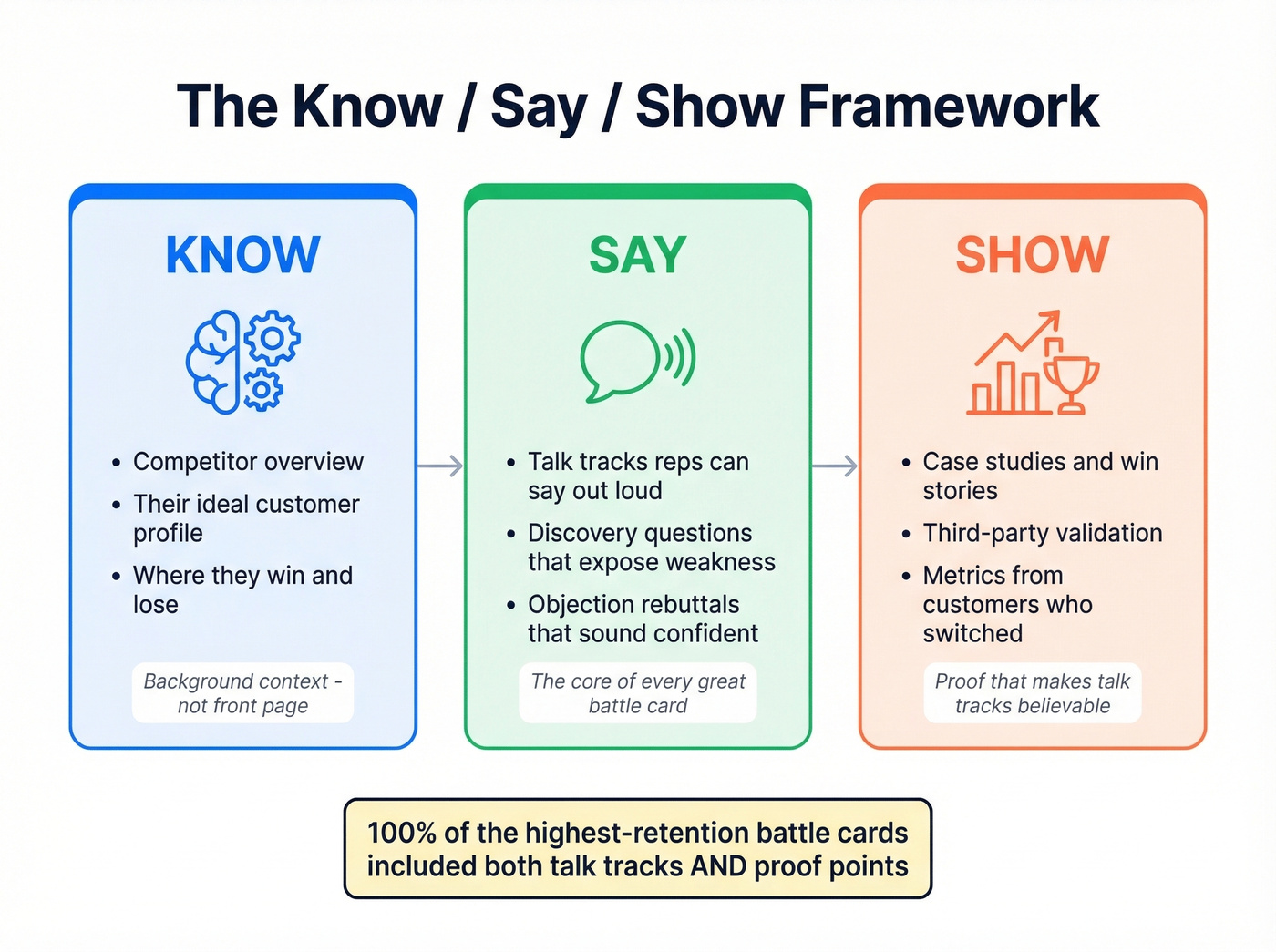
Know is the context a rep needs before the conversation. Competitor overview, their ideal customer profile, where they win, where they're weak. This is background - it doesn't go on the card's front page, but it informs everything else.
Say is the talk track. Actual words a rep can use when a competitor comes up. Discovery questions that expose a competitor's weakness. Objection rebuttals that don't sound defensive.
Show is the proof. Case studies, win stories, third-party validation, specific metrics from customers who switched. Klue's analysis is clear on this: 100% of the highest-retention battle cards included both talk tracks and proof points. The cards that got ignored were missing one or both.
Your sections checklist: competitor overview, key differentiators, objection handling scripts, discovery questions, pricing comparison, proof points, and landmine questions that expose competitor weaknesses.
Let's be honest - if your card uses words like "seamless" or "best-in-class," your reps stopped reading. Write in seller language, not marketing language. Have your top AE review the draft before you ship it.
Battle Card Template You Can Copy
This template follows the one-screen / 10-second rule. Every section fits on a single view. If you're adding a second page, you're adding content reps won't read.
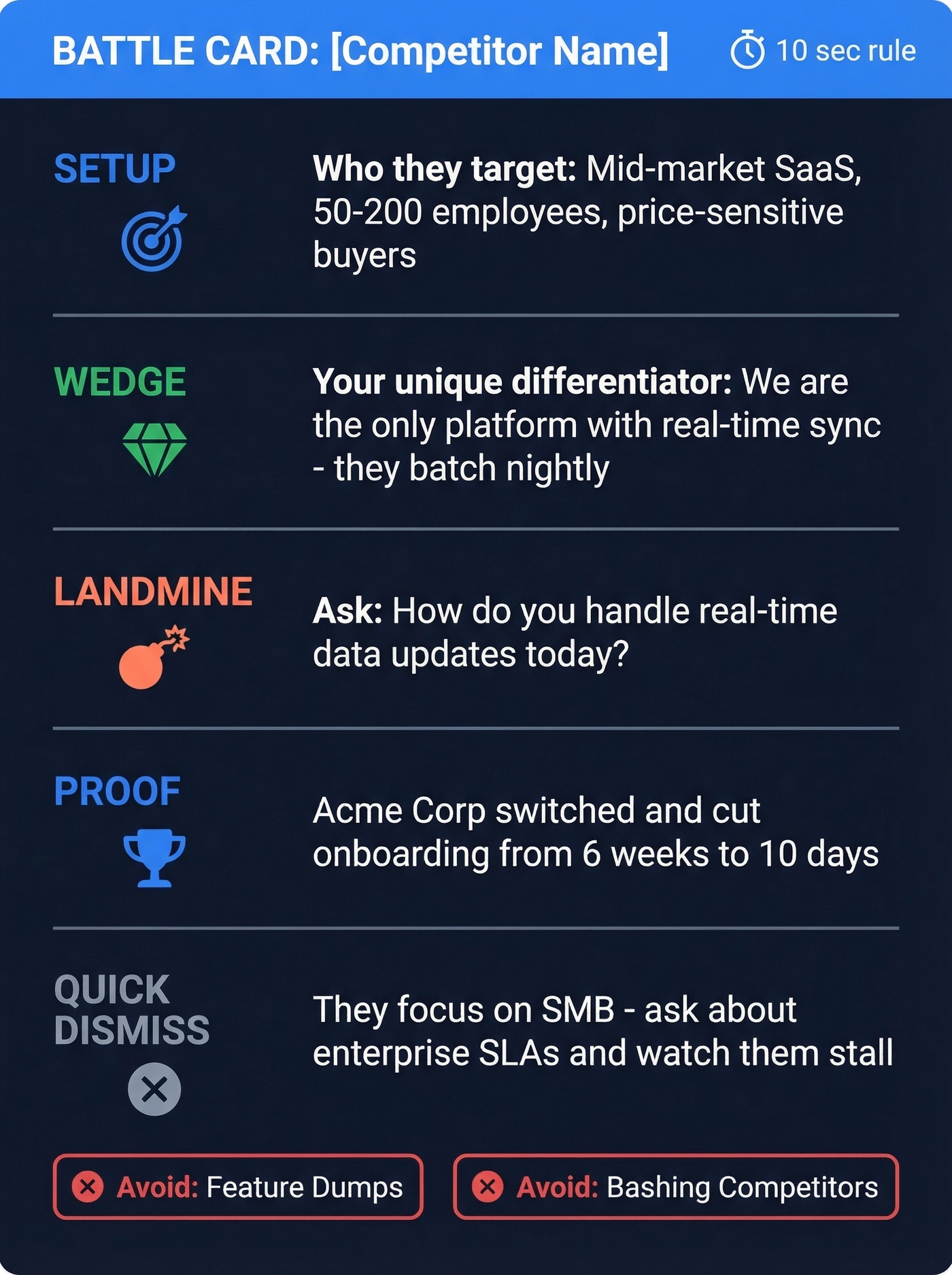
| Section | What Goes Here | Example |
|---|---|---|
| Setup | Who this competitor targets | "Mid-market SaaS, 50-200 employees, price-sensitive buyers" |
| Wedge | Your unique differentiator | "We're the only platform with real-time sync - they batch nightly" |
| Landmine | Trap question for discovery | "Ask: 'How do you handle real-time data updates today?'" |
| Proof | Social proof or switch story | "Acme Corp switched from [Competitor] and cut onboarding from 6 weeks to 10 days" |
| Quick Dismiss | For non-threats, one sentence to move on | "They focus on SMB - ask about enterprise SLAs and watch them stall" |
Two anti-patterns to avoid. The feature dump - a side-by-side comparison of 30 features that reads like a spec sheet. Reps don't use these mid-call. And the bash error - scripts that trash the competitor so aggressively they make your rep sound desperate. Confident positioning beats angry positioning every time.

Battle cards without proof points get ignored. Prospeo gives your reps the competitive edge behind the card - 98% accurate emails, 125M+ verified mobiles, and intent data across 15,000 topics so they know exactly who's in-market before the call even starts.
Arm your reps with data that makes every battle card hit harder.
Real Examples That Work
Real battle cards are almost always kept internal. Dock curated 24 that were publicly accessible, and a few patterns stand out.
Cisco Webex: Scenario-Based
Cisco's Webex vs. Zoom/Microsoft cards don't lead with features. They anchor positioning to everyday scenarios - "when the prospect mentions hybrid meeting rooms" - and include discovery questions about MFA and device management. The scenario framing gives reps a mental trigger for when to pull the card, which is half the adoption battle right there.
Parallels: Table-Driven Scanability
Parallels' card against Citrix is blunt, table-driven, and enforces a "30-second pitch" discipline. The table format works because reps can scan it while a prospect is talking. No paragraphs. No narrative. Just answers.
Netskope: Buyer Questions First
Netskope flips the typical structure by leading with buyer questions rather than seller talking points, plus micro case studies explaining why they won specific deals. This buyer-first framing makes the card feel less like internal propaganda and more like genuine competitive insight - and in our experience, that framing difference alone can double adoption rates.
How to Create a Battle Card
The Traditional Method (2-6 Hours)
For a lean first version covering one competitor, expect 2-6 hours. A thorough version with win/loss interviews and SME input takes 1-3 days.
The process: research the competitor, interview 2-3 reps who've won against them, draft using Know/Say/Show, review with your best AE, distribute inside the tools reps already use, then measure usage and win rates. Win/loss interviews are the highest-value input, but they require reaching people who've changed roles or left companies entirely. Prospeo's 300M+ professional profiles and 98% email accuracy make tracking down those contacts significantly easier - especially when you're chasing a specific VP who left a competitor's customer last quarter.
The AI Shortcut (15 Minutes)
A practitioner on r/CustomerSuccess shared a workflow that produces a solid first draft in under 15 minutes using Google Gemini:
- Use Gemini's "Deep Research" mode to gather competitor intel - positioning, pricing, reviews, recent changes.
- Feed your own product context into Canvas and generate a structured comparison.
- Convert the output to a single-page infographic card.
The output still needs fact-checking and seller-language polish. AI gets the structure right but writes in marketing-speak - exactly what kills adoption. Use the AI draft as scaffolding, then have a top performer rewrite the talk tracks in their own words. We've tested this internally and the rewrite step is non-negotiable; raw AI output reads like a press release, not a cheat sheet.
Scaling From 3 Cards to 30
Don't try to cover every competitor on day one. Start with your top 3 - the ones that show up in deals most often. Get those cards adopted before expanding.
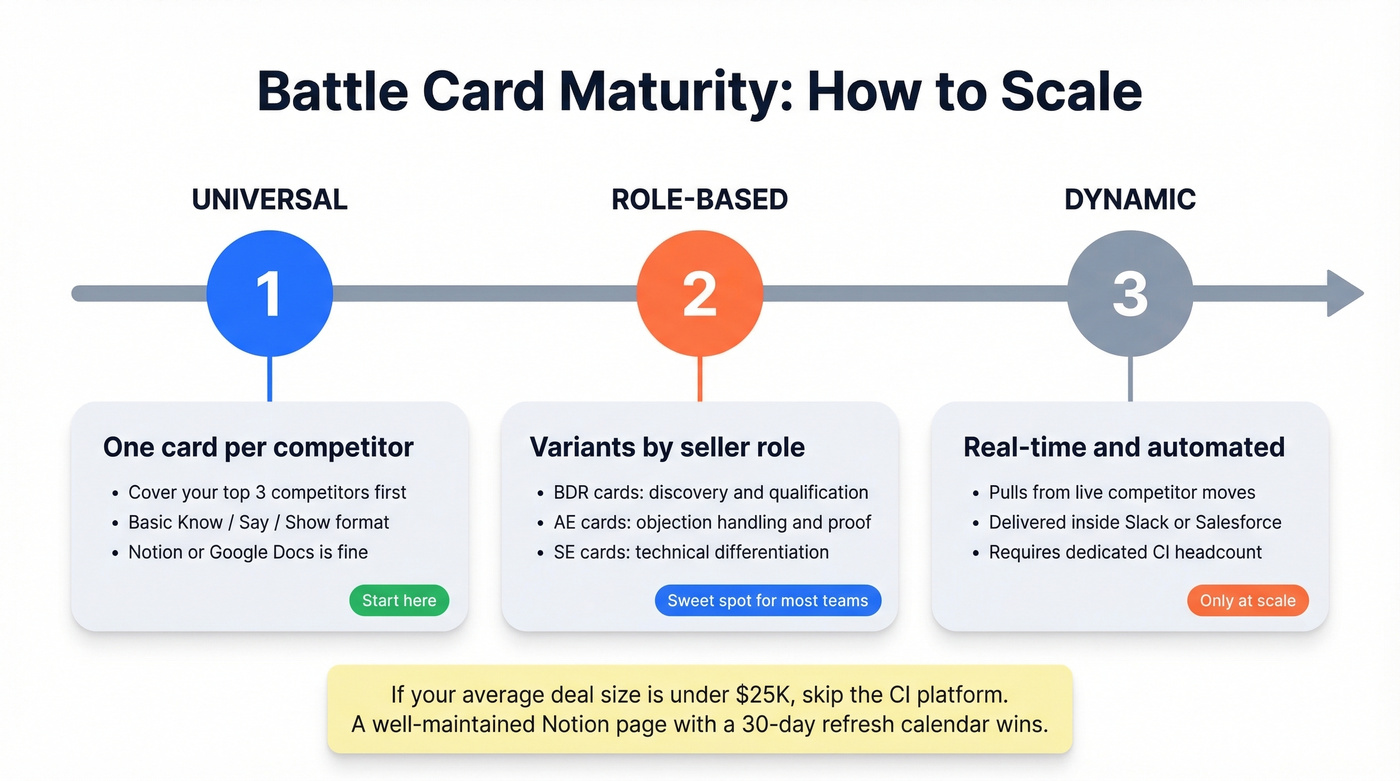
Crayon's maturity framework maps the progression well. Universal cards cover one per competitor with the basics. Role-based cards create variants: BDR cards focus on discovery and qualification, AE cards emphasize objection handling and proof, SE cards highlight technical differentiation. Dynamic cards pull from real-time competitor moves and win/loss data, delivered inside Slack or Salesforce automatically.
Most teams should aim for role-based and stop there. Dynamic cards require dedicated CI headcount and tooling that only makes sense at scale.
Skip the dedicated CI platform entirely if your average deal size is under $25K. A well-maintained Notion page with a 30-day refresh calendar will outperform a platform nobody logs into.
Driving Adoption (The Hard Part)
Building the card is the easy part. Getting reps to use it is a change management problem.
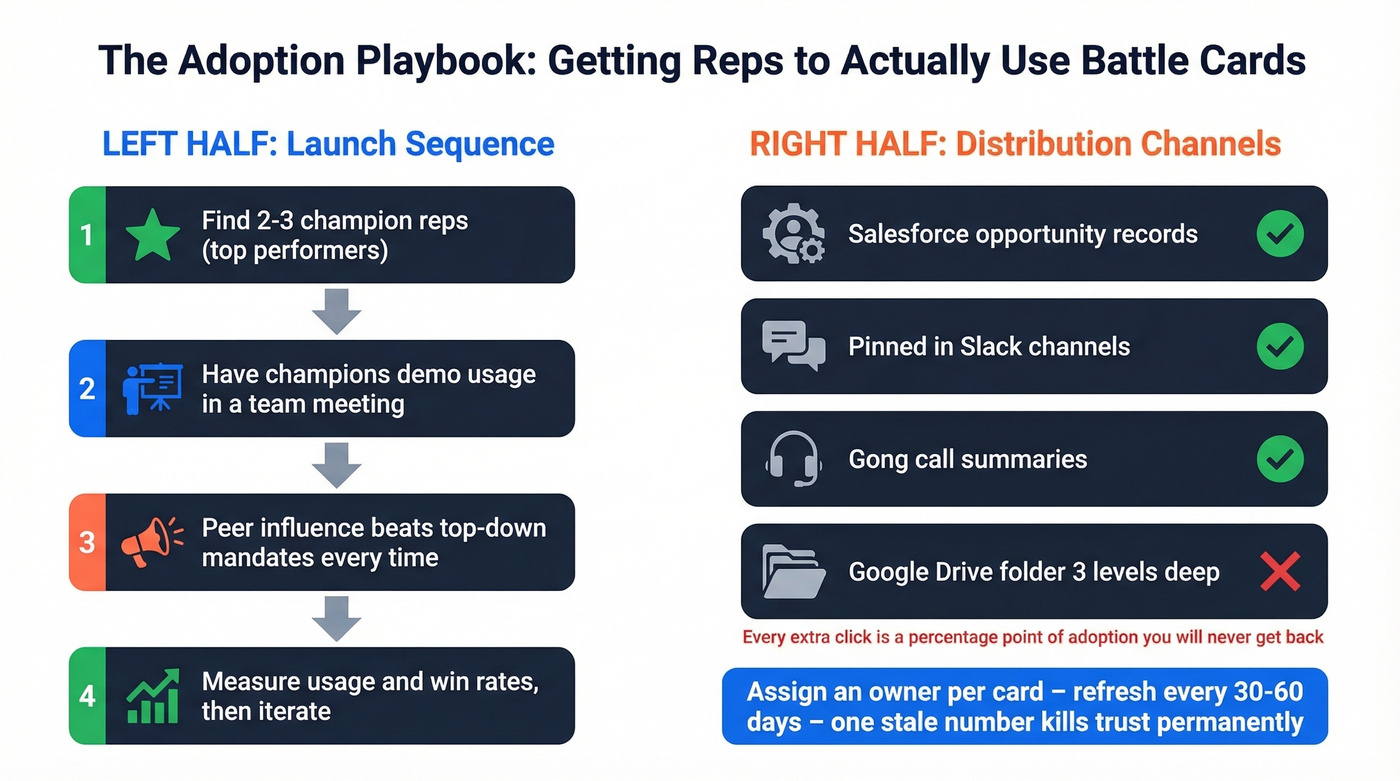
Start with champions. Find your top 2-3 performers, get them using the cards, then have them demo usage in a team meeting. Peer influence beats top-down mandates every time - we've seen this play out across dozens of sales orgs, and the pattern is remarkably consistent. The moment a top rep says "I used this on a call yesterday and it worked," adoption jumps.

Distribution matters as much as content. Embed cards inside Salesforce opportunity records, pin them in Slack channels, surface them in Gong call summaries. Every extra click between the rep and the card is a percentage point of adoption you'll never get back.
Assign an owner for each card and set a 30-60 day refresh cadence. Stale data undermines competitive intel trust just as much as stale positioning - if the contact info and account data underneath your cards is wrong, reps lose confidence in the whole system.
Best Competitive Intelligence Tools
Gartner predicted that by 2026, 40% of technology and service providers would use commercial CI tools. Most hide their pricing, so here's what to actually expect:
| Tool | Best For | Price Range |
|---|---|---|
| Prospeo | Data accuracy layer | Free-$39/mo+ |
| Klue | Enterprise CI + win/loss | ~$16K+/yr |
| Crayon | Real-time monitoring | ~$15K-$47K/yr |
| Kompyte | Teams under $15K budget | From $300/yr |
| Playwise HQ | First 3 cards free | Free-$450/mo |
| Highspot / Seismic | Enablement hosting | $30K-$80K/yr |
Klue is the strongest option for enterprise teams that want battle cards tightly integrated with win/loss analysis. Their 150+ card audit data comes from real product usage. The price tag makes sense for organizations with dedicated CI teams and 50+ reps consuming cards regularly.
Crayon excels at real-time competitive monitoring - tracking competitor website changes, pricing updates, job postings, and press releases. If your staleness problem comes from not knowing when competitors change, Crayon solves that.
Kompyte is the most accessible dedicated CI tool at $300/yr. Solid for mid-market teams that need the basics without enterprise pricing.
Playwise HQ has a genuinely free tier that's enough to build and distribute your first few cards.
Highspot and Seismic aren't CI tools - they're sales enablement platforms that host battle cards alongside other content. If you're already on one, use it. Don't buy a separate tool just for cards.
Your battle card says 'ask about their data accuracy.' Make sure yours holds up. Prospeo delivers 98% email accuracy on a 7-day refresh cycle - so the competitive stats on your cards never go stale and reps never get corrected by a prospect again.
Stop losing trust over outdated data - refresh every 7 days, not 6 weeks.
FAQ
How long does it take to create a battle card?
A lean first version takes 2-6 hours per competitor. The Gemini AI workflow produces a solid draft in about 15 minutes, but budget another hour for fact-checking and rewriting talk tracks in seller language. Win/loss interview versions take 1-3 days.
How often should you update battle cards?
Every 30-60 days at minimum, with a specific owner assigned per card. Trigger immediate updates when a competitor changes pricing, launches a major feature, or when you lose a deal with new competitive intel.
What's the difference between a battle card and a sales playbook?
A sales playbook covers your entire sales process - discovery frameworks, qualification criteria, demo scripts, negotiation tactics. A battle card is a single-page competitive cheat sheet focused on one specific competitor, designed to be pulled up mid-conversation. The playbook is the textbook; the card is the flashcard.
What's the best free tool for building battle cards?
Playwise HQ offers a free tier for your first 3 cards with basic distribution. For the data layer underneath, Prospeo's free plan includes 75 verified emails and 100 Chrome extension credits per month - enough to source win/loss contacts and validate competitor customer lists without spending anything.