

Discovery Questions That Actually Win Deals - Backed by 326K Sales Calls
Your rep just ran a 45-minute discovery call. They asked 22 questions, talked for 70% of the call, and came back saying the deal "looks promising." It's not. An analysis of 326,000 sales calls tells a different story: won deals average 15-16 discovery questions, not 20. Lost deals are the ones drowning in questions.
The reps who close aren't asking more. They're asking fewer, sharper questions and then shutting up long enough to hear the answer.
This isn't a list of 50 generic questions you'll never use. It's a framework-mapped playbook built on conversation intelligence data, organized by deal type and persona, with a script template you can adapt before your next call.
What Are Discovery Questions?
Discovery questions are the open-ended, strategic questions sales reps use during early conversations to uncover a prospect's pain points, priorities, decision-making process, and urgency. Unlike qualification checklists, effective ones create genuine dialogue - one where the prospect reveals not just what they need, but why they need it now.
The golden ratio: Talk 43% of the time. Listen 57%. Top-performing calls cluster near this split.
Pick your framework by deal type:
- BANT - Transactional deals, <60-day cycles, 1-3 decision-makers
- MEDDIC/MEDDPICC - Enterprise deals, $100K+ ARR, 5+ stakeholders
- SPIN - Consultative sales where the prospect doesn't yet see the full problem
- SPICED - SaaS deals where emotional and rational motives both matter
Target 15-16 questions total. Not 8. Not 25. If you only have 15 minutes, skip to the Essential 8 later in this guide.
Discovery Call Benchmarks
Let's ground this in data before we get to the questions.
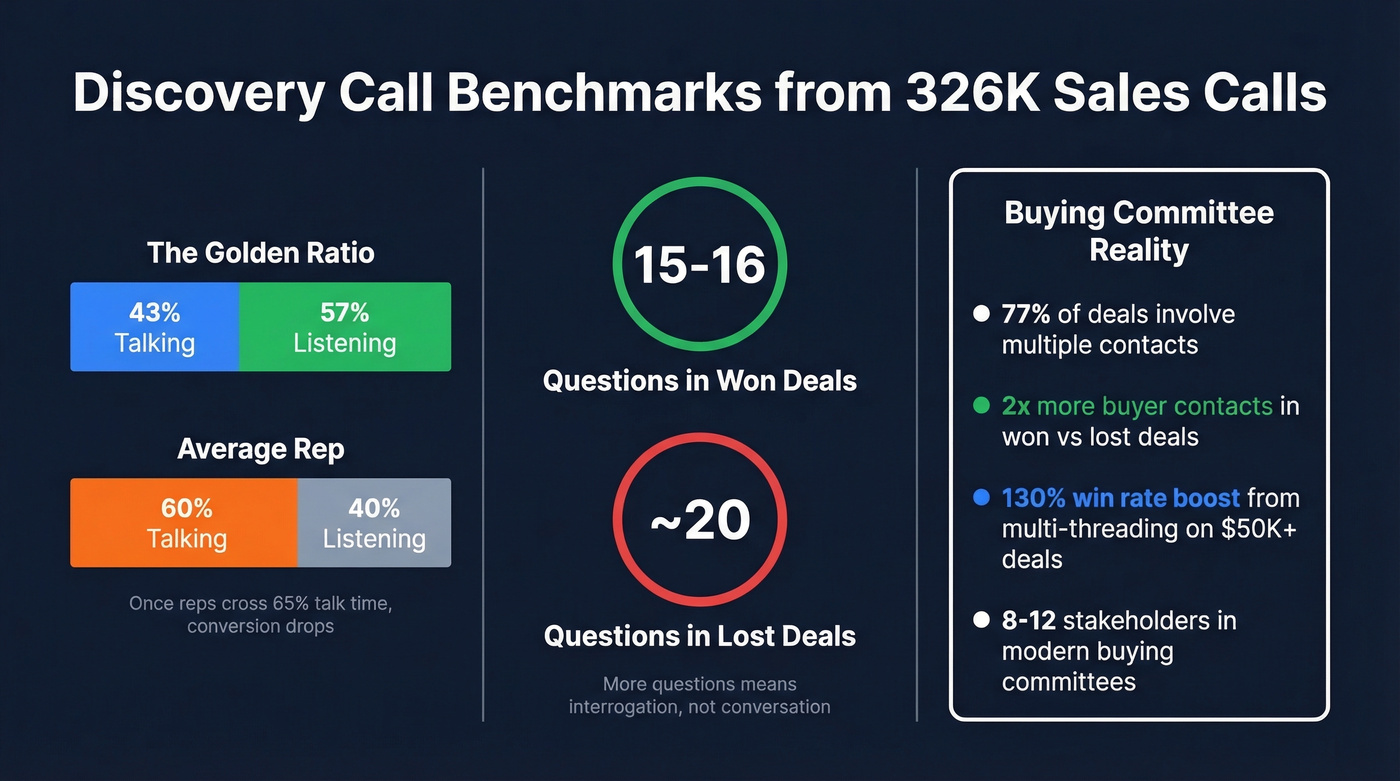
From 326K analyzed sales calls:
- Golden ratio: ~43% talk / ~57% listen
- Average across calls: ~60% talk / ~40% listen
- Closed-won deals average ~15-16 questions; closed-lost deals average ~20
- Once a rep crosses ~65% talk time, conversion rates drop
The question-count finding is counterintuitive. More questions doesn't mean better qualification - it means you're interrogating, not conversing.

Now layer in the buying committee reality. Across 1.8 million analyzed opportunities, 77% of deals involve multiple contacts. Closed-won deals have roughly 2x as many buyer contacts as closed-lost. For deals over $50K, multi-threading boosts win rates by 130%. Bringing in a sales engineer can lift win rates by up to 30%.
The modern buying committee has expanded to 8-12 stakeholders, cycles stretch 6-9 months, and buyers complete nearly 80% of their research before they ever talk to you. Your discovery call isn't where they learn about your product. It's where you learn about their problem - and prove you understand it.
Which Framework Should You Use?
Four frameworks dominate B2B sales qualification. Each works for different deal shapes. Picking the wrong one is like running a BANT checklist on a $500K enterprise deal - you'll miss everything that matters.
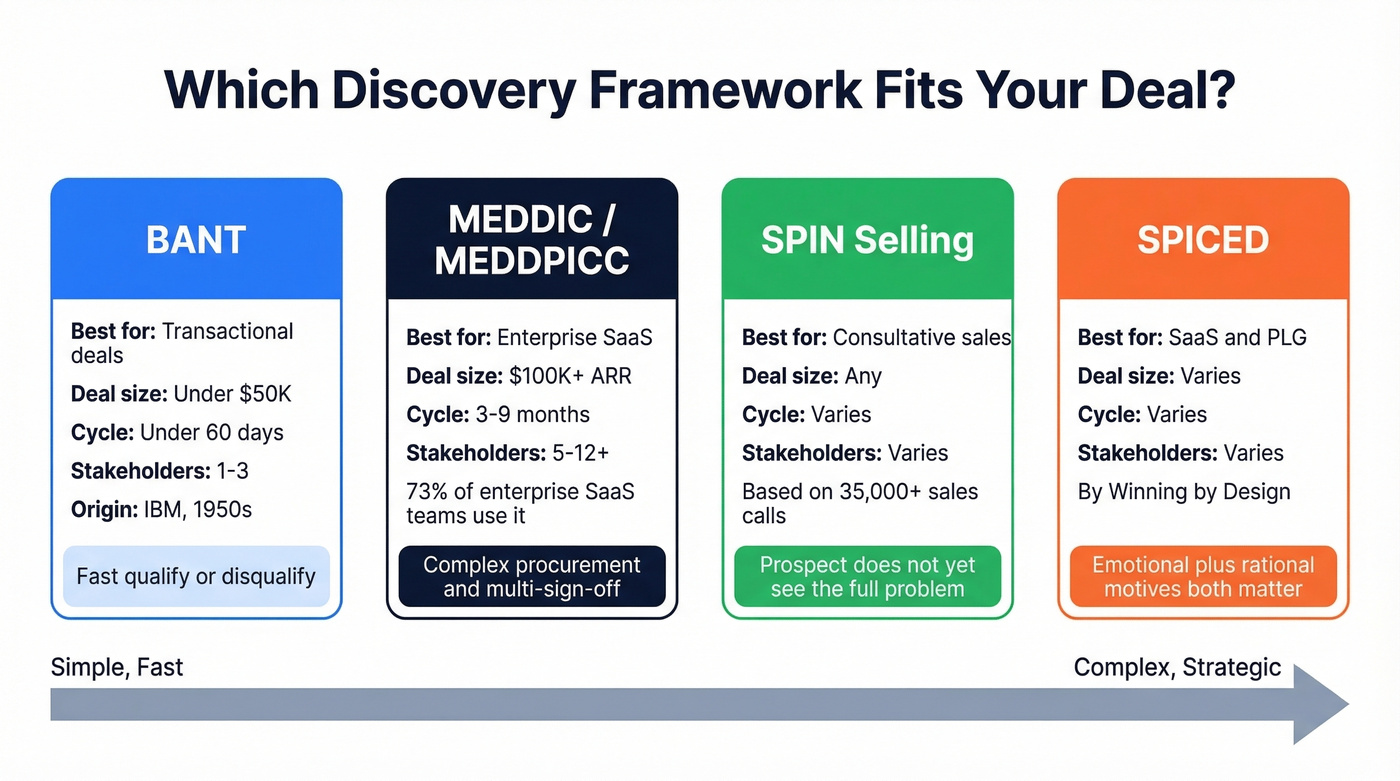
| Framework | Best For | Deal Size | Cycle | Stakeholders |
|---|---|---|---|---|
| BANT | Transactional | <$50K | <60 days | 1-3 |
| MEDDIC | Enterprise SaaS | $100K+ | 3-9 months | 5-12+ |
| SPIN | Consultative | Any | Varies | Varies |
| SPICED | SaaS / PLG | Varies | Varies | Varies |
BANT was created by IBM in the 1950s. It's fast, linear, and works when you need to qualify or disqualify in one call. It misses emotional and political dimensions entirely. For sub-$50K deals with short cycles, that's fine. For anything complex, BANT is a starting point, not a strategy.
MEDDIC and its variants dominate enterprise sales - 73% of SaaS companies selling above $100K ARR use some version. It's built for deals with procurement processes, multiple sign-offs, and long evaluation cycles. The tradeoff: running full MEDDIC on a $15K deal is overkill. If you want a deeper enterprise-ready set, use these MEDDIC prompts and MEDDIC discovery questions as your baseline.
SPIN Selling comes from Neil Rackham's research across 35,000+ sales calls. The genius is the sequencing - you walk the prospect from their current situation through the problem, into the implications of inaction, and only then into the payoff of solving it.
SPICED, developed by Winning by Design, is the newest entrant. Where MEDDIC focuses on rational KPIs, SPICED explicitly covers emotional and rational motives. The "Critical Event" stage forces urgency into the conversation - and deals without urgency die in pipeline.
You'll see other frameworks like Salesforce's POWERFUL mnemonic or Allego's permission-based opener. These are repackaged versions of the same core principles. Master one of these four and you're covered.
Questions Mapped by Framework
BANT Questions
BANT covers four categories in 6-8 questions:
| Question | Category | What It Reveals |
|---|---|---|
| "What's the budget range you've allocated for solving this?" | Budget | Spend ceiling |
| "Who else needs to sign off before this moves forward?" | Authority | Real decision-maker |
| "Walk me through what's not working today." | Need | Core pain |
| "What happens if this doesn't get solved this quarter?" | Timeline + Need | Urgency level |
| "Have you evaluated other solutions? What did you like or dislike?" | Need | Competitive landscape |
| "If we could solve this, what does success look like in 90 days?" | Need + Timeline | Success criteria |
Don't ask these in order - weave them into conversation. And don't ask "are you the decision-maker?" Nobody answers that honestly.
MEDDIC / MEDDPICC Questions
MEDDIC gives you 10-12 questions across six categories. This is the framework for deals where losing means losing six months of pipeline.
Metrics: "What KPIs are you measured on this year?" connects your solution to their scorecard. Follow with "Fast-forward one year - what numbers would make this investment a clear win?" to force them to quantify success.
Economic Buyer: "Who signed off on similar investments in the past?" identifies the real buyer without asking directly. "How does your leadership team prefer to see ROI presented?" tells you how to build the business case. (If you struggle to get to the real signer, use this economic buyer playbook.)
Decision Criteria & Process: "What are the non-negotiables for any solution you'd consider?" surfaces deal-breakers early. "Walk me through the evaluation steps from here to a signed contract" maps the entire process. Don't skip "Is there a procurement or legal review involved?" - that's MEDDPICC's Paper Process stage, and ignoring it has killed more enterprise deals than bad demos.
Identify Pain: "What's the cost of doing nothing for another six months?" quantifies inaction. "Which team feels this problem most acutely?" finds your champion's pain.
Champion: "Who internally is most motivated to see this solved?" and "What would make you look great if this project succeeds?" align your champion's personal win with the deal.
SPIN Selling Questions
Rackham's research showed that the sequence matters as much as the questions themselves. Here's how a SPIN discovery actually flows.
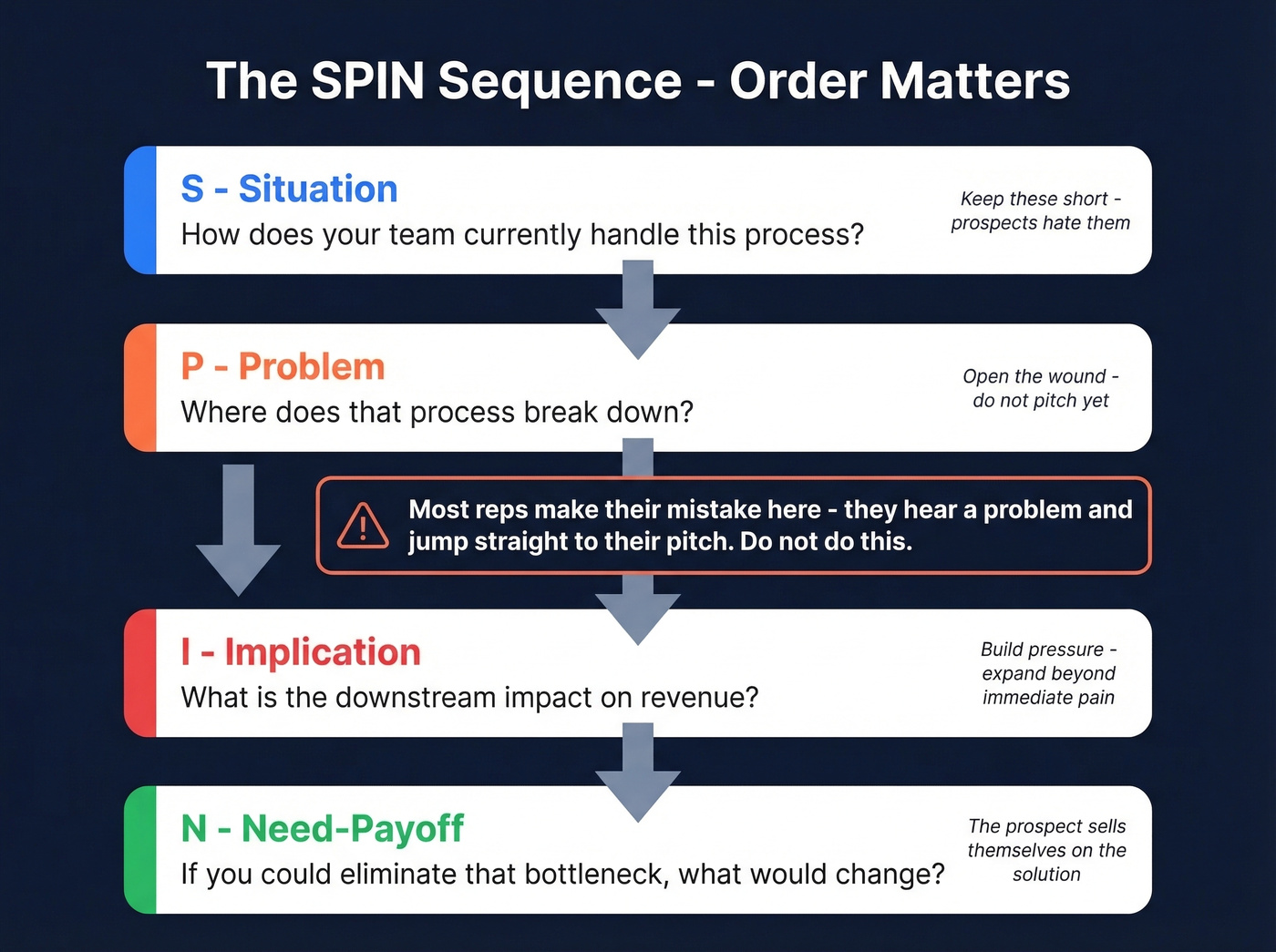
You open with one or two Situation questions - "How does your team currently handle [process]?" and maybe "How many people are involved?" - but you keep these short. Prospects hate Situation questions because they feel like you didn't do your homework.
Then you shift to Problem. "Where does that process break down?" opens the wound. "What frustrates your team most about the current approach?" adds the emotional layer. This is where most reps make their mistake: they hear a problem and immediately jump to their pitch. Don't.
Instead, move to Implication. "When that breaks down, what's the downstream impact on revenue?" expands the problem beyond the immediate pain. "How does that affect your ability to hit [their stated goal]?" connects it to what keeps them up at night. The key is patience - you're building pressure, not solving anything yet.
Only then do you reach Need-Payoff. "If you could eliminate that bottleneck, what would change?" lets the prospect sell themselves on the solution. You haven't pitched once - and they're already imagining life after the problem.
SPICED Questions
SPICED is particularly effective when the prospect knows they have a problem but hasn't felt enough urgency to act.
Situation: "Describe a typical day for your team when it comes to [process]." / "How has your business changed in the last six months?"
Pain: "What frustrates you most about the current setup?" / "Where do you lose the most time or resources?"
Impact: "How much time does this cost your team per week?" / "What does it cost if you don't change anything in the next year?"
Critical Event: "Is there a deadline driving this - a board review, a renewal, a compliance date?"
Decision: "Who else needs to be involved in this evaluation?" / "How have you made similar purchasing decisions in the past?"
The Critical Event stage is what separates SPICED from everything else. If there's no critical event, you don't have urgency. A deal without urgency isn't a deal - it's a wish.
The Essential 8 (If You Only Have 15 Minutes)
These eight questions cover every critical dimension - pain, impact, urgency, authority, budget, and next steps - in roughly half the time of a full framework.
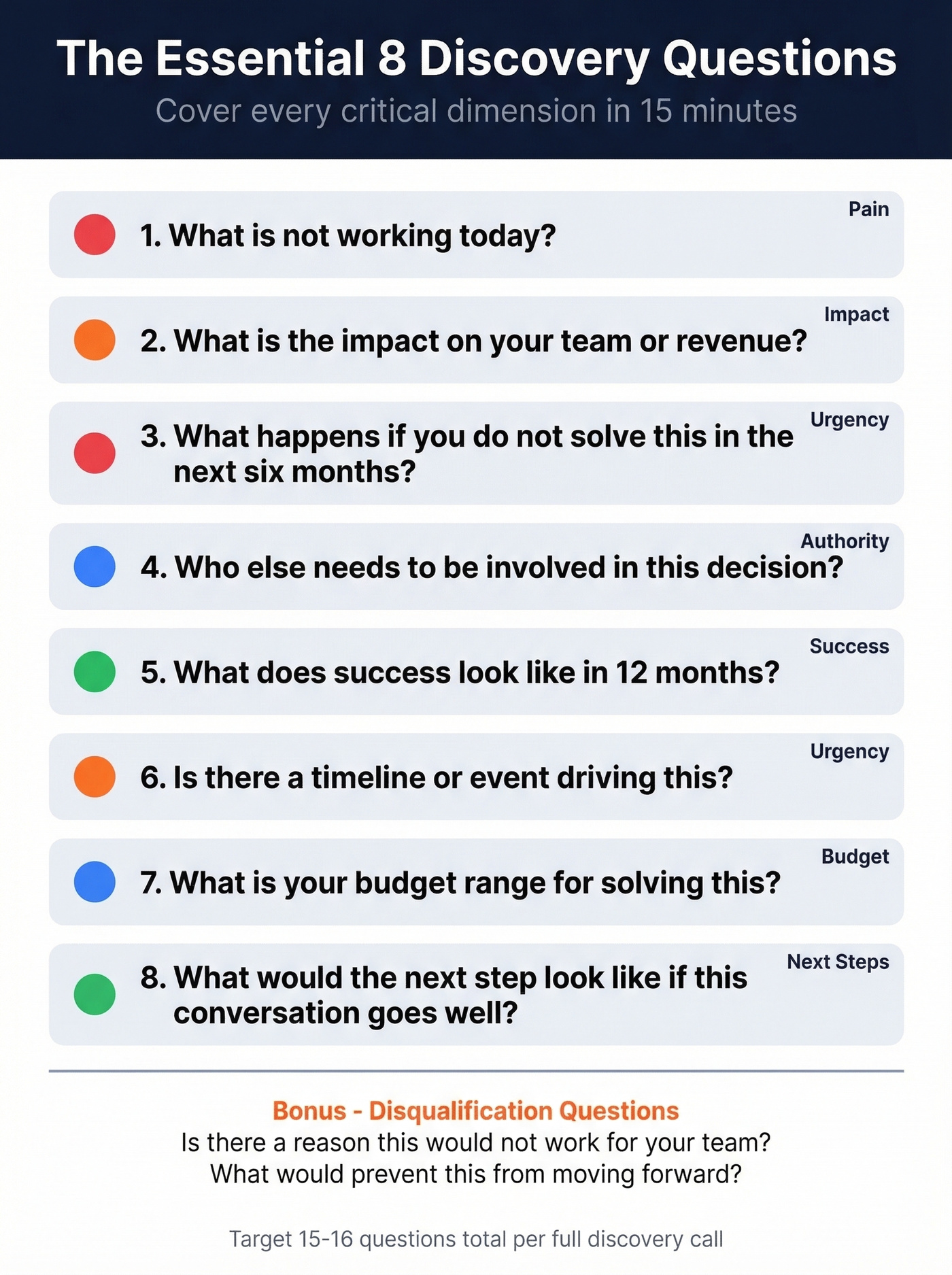
- "What's not working today?"
- "What's the impact on your team or revenue?"
- "What happens if you don't solve this in the next six months?"
- "Who else needs to be involved in this decision?"
- "What does success look like in 12 months?"
- "Is there a timeline or event driving this?"
- "What's your budget range for solving this?"
- "What would the next step look like if this conversation goes well?"
Disqualification questions for when something feels off: "Is there a reason this wouldn't work for your team?" and "What would prevent this from moving forward?" Good discovery isn't just about finding reasons to sell - it's about finding reasons to walk away.

Your discovery calls only work when you're talking to the right stakeholders. Prospeo's 300M+ profiles with 30+ filters - including buyer intent, job changes, and department headcount - let you multi-thread into every account before the first call. 98% email accuracy means zero bounced follow-ups after discovery.
Stop wasting sharp questions on the wrong people.
Adapting Questions by Persona
The same question lands completely differently depending on who you're asking.
Selling to a CFO: CFOs evaluate purchases on efficiency, long-term value, measurable results, and risk. They don't want to hear about features. Lead with "What financial goals are top priority this quarter?" and connect every question back to dollars, risk reduction, or time-to-value.
Selling to a VP of Sales: Pipeline, quota attainment, and rep efficiency - that's their world. "Where in your pipeline do deals most often die?" gets you further than any product-focused question. We've seen this firsthand: the reps on our team who ask about pipeline bottlenecks get 3x more engagement than those who open with product capabilities. If you want a tighter system for diagnosing and fixing leaks, use these sales pipeline challenges and pipeline health benchmarks.
Selling to an End User: Daily workflow and adoption friction. They care about whether this thing will make their Tuesday better or worse. "Walk me through how you handle [task] right now" is the right opener. Don't go strategic - go practical.
Here's the thing: one MSP sales team spent 15 minutes explaining SIEM and EDR to a CFO who just wanted to know "What happens to my business if we get breached?" The competitor who framed the conversation around breach impact and regulatory pressure won the deal. Match your language to the persona, not to your own expertise.
Mistakes That Kill Deals
Talking more than 65% of the call. The data is unambiguous. Once you cross that threshold, win rates drop. Record yourself. You're probably talking more than you think.
Turning discovery into an interrogation. Lost deals average ~20 questions. That's not thoroughness - it's a firing squad. If the prospect feels like they're being deposed, they'll disengage. The consensus on r/sales is that the best discovery calls feel like a conversation with a smart friend, not a compliance audit.
Ignoring that buyers already know your product. 96% of buyers research tools before they ever speak to a rep. If you spend 10 minutes explaining what your product does, you've wasted 10 minutes they didn't need.
Rushing to solutions. You hear a keyword that matches your pitch and you pounce. Resist. The prospect mentioned "reporting" - that doesn't mean they want your reporting feature. Ask two more questions before you prescribe anything.
Most reps think they're good at discovery because they ask a lot of questions. The data says the opposite. The best discovery calls feel like conversations, not interviews. If your prospect is giving one-sentence answers, you've already lost.
Skip the 45-minute call if your average deal size is under $10K. Run the Essential 8 in 15 minutes, qualify or disqualify, and move on. Save the deep discovery for deals that justify the time investment.
Discovery Call Script Template
This template follows the SPICED structure and stays within benchmarks: 15-16 questions, 43/57 talk ratio.
Opener (30 seconds): "Thanks for making time. Here's what I'd love to cover in the next 30 minutes: understand what's driving this conversation, dig into the specific challenges you're facing, and figure out whether there's a fit. If there isn't, I'll tell you. Sound good?"
Situation (2-3 questions, ~5 minutes):
- "Give me the 60-second version - what does your team do and how does [process] work today?"
- "Which tools are you using for [function] right now?"
- "How has that changed in the last six months?"
Pain (2-3 questions, ~7 minutes):
- "Where does that process break down?"
- "What's the most frustrating part for your team?"
- "What have you tried so far to fix it?"
Impact (1-2 questions, ~5 minutes):
- "How much time does that cost your team per week?"
- "What's the revenue impact if this doesn't get solved this year?"
Critical Event (1 question, ~2 minutes):
- "Is there a specific deadline or event driving the timeline?"
Decision & Stakeholders (2 questions, ~5 minutes):
- "Who else needs to weigh in before a decision gets made?"
- "How has your team made similar purchasing decisions in the past?"
Next Steps (1 question, ~2 minutes):
- "Based on what we've discussed, here's what I'd suggest as a next step: [specific action]. Does that work for your timeline?"
Always propose the next step. "I'll send a proposal by Thursday and we'll review it with your VP on Monday at 2pm" is a next step. "We'll follow up" is not. Log everything in your CRM immediately after the call - the details you forget in 24 hours are the details that win the deal. (If you need copy you can paste right after the call, use these sales follow-up templates and this sales meeting follow-up email guide.)
Pre-Call Research Checklist
Discovery fails when you walk in blind. Here's what to research before every call.
Company context:
- Recent funding rounds, acquisitions, or leadership changes
- Tech stack clues from job postings
- Headcount growth or contraction in the last 6 months
Stakeholder mapping:
- Who's on the buying committee? Aim for 3-5 names before the first call.
- What are their roles, reporting lines, and likely priorities?
- Have any of them changed jobs recently? Job changers are 3x more likely to buy.
Contact verification: This is where most teams drop the ball. You've done the research, mapped the committee, prepared your questions - and then the email bounces. In our experience, bad contact data wastes more prep time than anything else. Verify emails and mobile numbers for the entire buying committee before the call, not after. If you're building this into your workflow, start with a data enrichment process and a dedicated AI email checker to reduce bounces.
Prospeo covers 300M+ professional profiles with 98% email accuracy and 125M+ verified mobile numbers, all refreshed every 7 days. Once discovery reveals new stakeholders - and it will - enrich your contact list immediately so you can multi-thread the deal while momentum is fresh.
Multi-threading boosts win rates by 130% on $50K+ deals. But you need verified contact data for 8-12 stakeholders per account. Prospeo gives you direct emails and 125M+ verified mobile numbers so you can reach the economic buyer, champion, and every decision-maker MEDDIC demands - at $0.01 per email.
Map the entire buying committee before your next discovery call.
FAQ
How many discovery questions should I ask?
Target 15-16 questions per call. Analysis of 326K sales calls found that won deals averaged this range, while lost deals averaged around 20. More questions creates an interrogation dynamic, not a better-qualified deal.
What's the ideal talk-to-listen ratio?
Aim for 43% talk, 57% listen. Top performers stay near this split. Once you cross the 65% talk threshold, win rates drop significantly. Record your calls and check - most reps overestimate how much they listen.
Should I use a script or improvise?
Use a framework-based structure, not a rigid script. Prepare 12-16 questions organized by framework stage, then follow the conversation naturally. The structure keeps you on track; the flexibility keeps it human.
How do I handle discovery when there's no clear urgency?
Ask the SPICED Critical Event question directly: "Is there a deadline driving this?" If the answer is no, quantify the cost of inaction - "What does six more months of this problem cost your team?" - or deprioritize the deal. Pipeline full of "no urgency" deals is how quotas get missed.
What tools help with pre-call research?
Your CRM, a conversation intelligence platform for tracking which questions drive the best outcomes, and a data provider for contact verification and stakeholder mapping. The goal is to walk into every call knowing who's on the buying committee, what they care about, and how to reach them.