

The 10 Best Data Enrichment Services in 2026
Your CRM has 50,000 contacts. A third of the emails bounced last quarter, half the phone numbers ring out to voicemail boxes that haven't been set up, and your reps are spending more time cleaning data than selling. That's not a hypothetical - 47% of CRM decision-makers cite data quality as their top operational challenge, and roughly 30% of B2B data decays every year. The market for data enrichment services is racing toward $4.58B by 2030, up from $2.37B in 2023, because every revenue team eventually hits this wall.
Here's what's actually worth paying for.
Our Picks (TL;DR)
- Prospeo - Best for email accuracy and data freshness. 98% email accuracy, 7-day refresh cycle, pricing from ~$0.01/email.
- Apollo.io - Best free tier for getting started. 275M+ contacts, a useful free plan, paid tiers from $49/mo per user.
- Clay - Best for waterfall enrichment orchestration. 150+ data providers in a single workflow. Powerful, but expect a learning curve.
How to Choose the Right Provider
Before you compare feature lists, nail down what matters for your workflow. These six criteria separate a good enrichment investment from an expensive mistake.
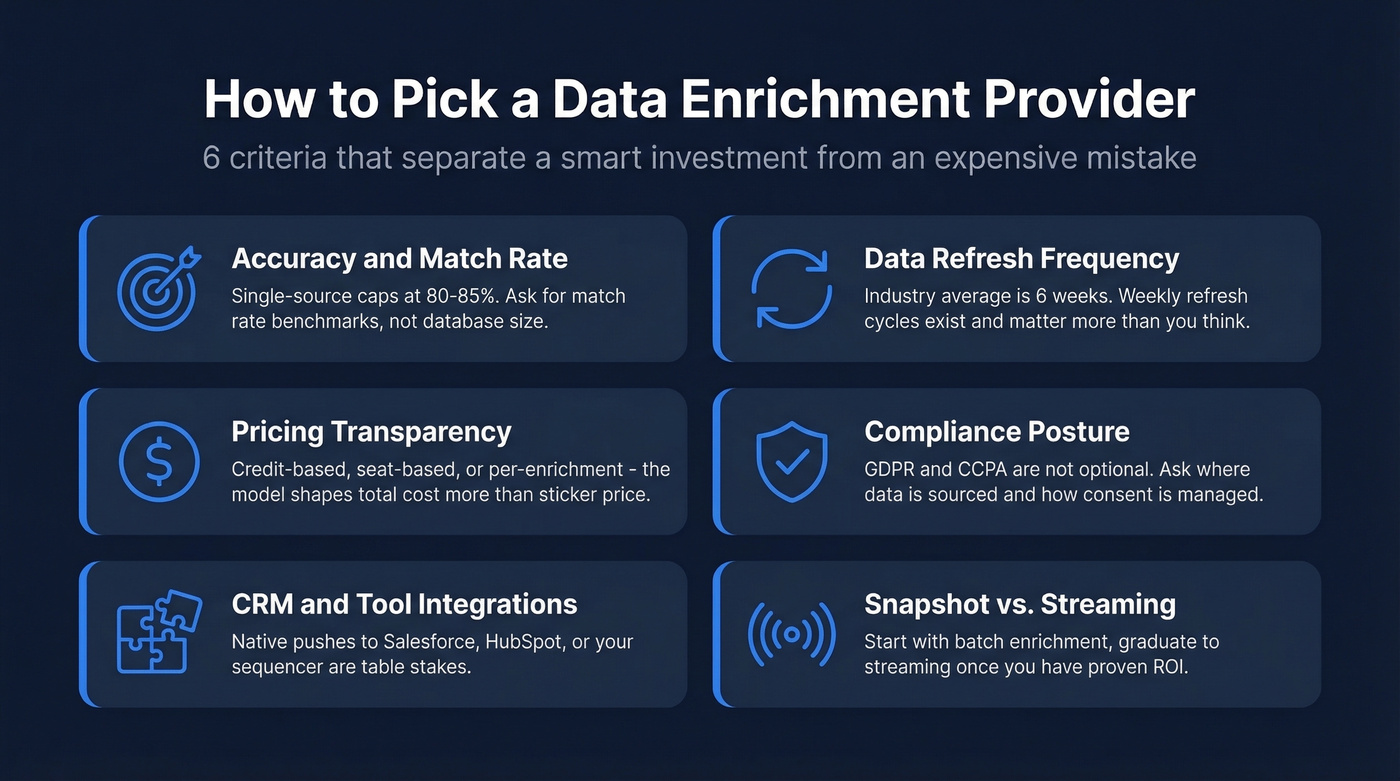
Accuracy and match rate. Single-source providers cap out around 80-85% email accuracy. A 15% bounce rate will torch your sender reputation. Ask for match-rate benchmarks, not database size. (If you’re still evaluating sources, start with our roundup of the B2B database landscape.)
Data refresh frequency. The industry average is about 6 weeks between refreshes. Weekly refresh cycles exist - and they matter more than most buyers realize. Any enrichment company worth considering should be transparent about how often records get updated.
Pricing model transparency. Credit-based, seat-based, bundled, or per-enrichment - the model shapes total cost more than the sticker price. If a vendor won't publish pricing, that's a warning sign. (This is also why pay-as-you-go data can be easier to forecast.)
Compliance posture. GDPR and CCPA aren't optional. Ask where data is sourced, how consent is managed, and whether a DPA is available. If the vendor can't answer clearly, walk away. If you need a deeper checklist, see our guide to B2B compliance.
CRM and tool integrations. Enrichment data sitting in a CSV is enrichment data nobody uses. Native pushes to Salesforce, HubSpot, or your sequencer are table stakes. If you’re rebuilding processes anyway, it’s worth reviewing CRM automation software options too.
Snapshot vs. streaming enrichment. Snapshot enrichment is a one-time batch job. Streaming enrichment updates records continuously as data changes. Most teams start with snapshot and graduate to streaming once they've proven ROI.
The 10 Best Data Enrichment Tools for 2026
Prospeo - Best for Email Accuracy
Use this if: You need the cleanest possible email and mobile data without signing an annual contract or talking to a sales rep.
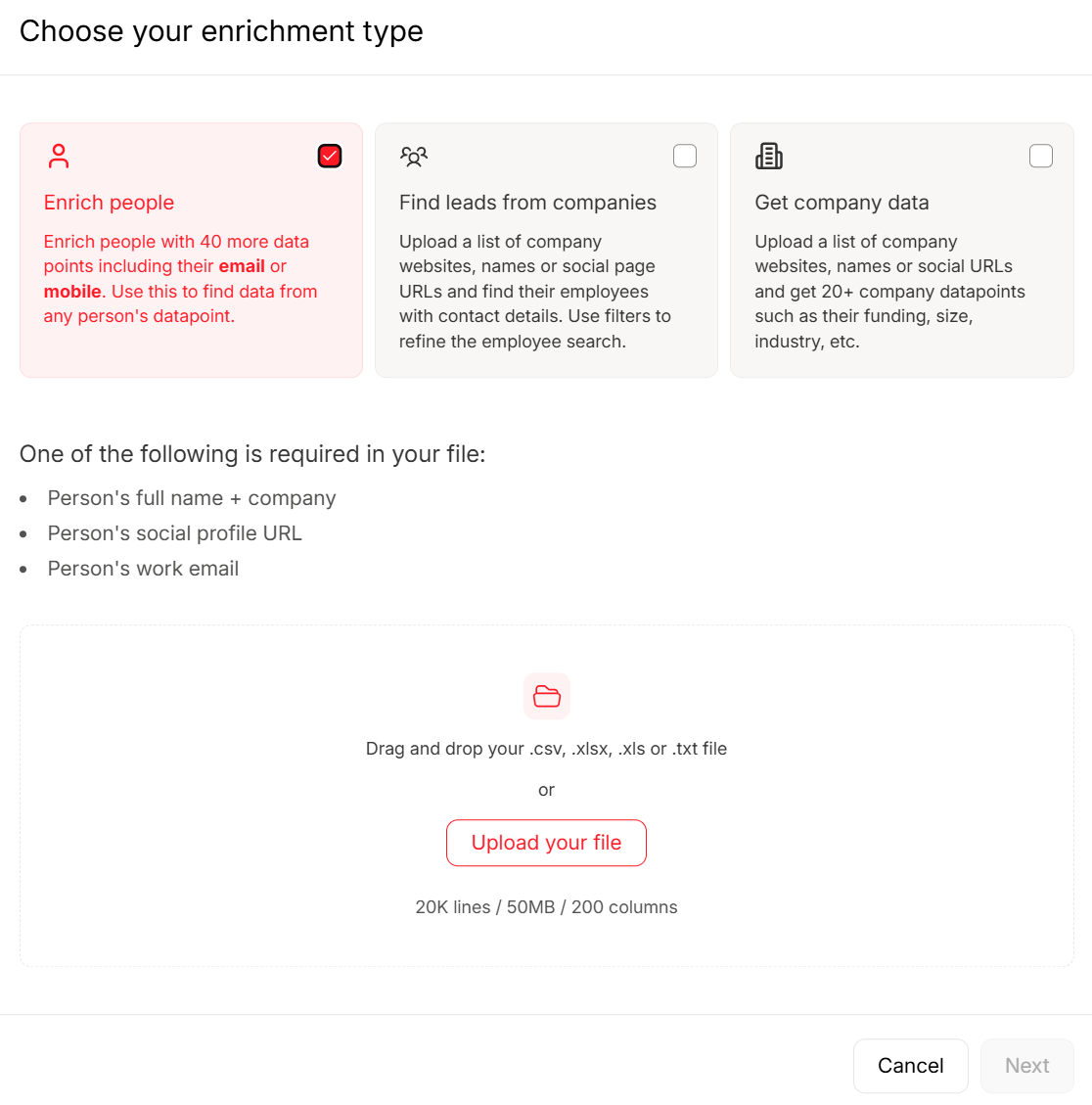
Prospeo's database covers 300M+ professional profiles, 143M+ verified emails, and 125M+ verified mobile numbers with a 30% pickup rate. The Enrich API returns 50+ data points per contact at a 92% match rate. Pricing starts at roughly $0.01 per email with a free tier (75 emails + 100 Chrome extension credits per month), no contracts, and self-serve onboarding. If you’re comparing vendors, our best data enrichment tools breakdown goes deeper.
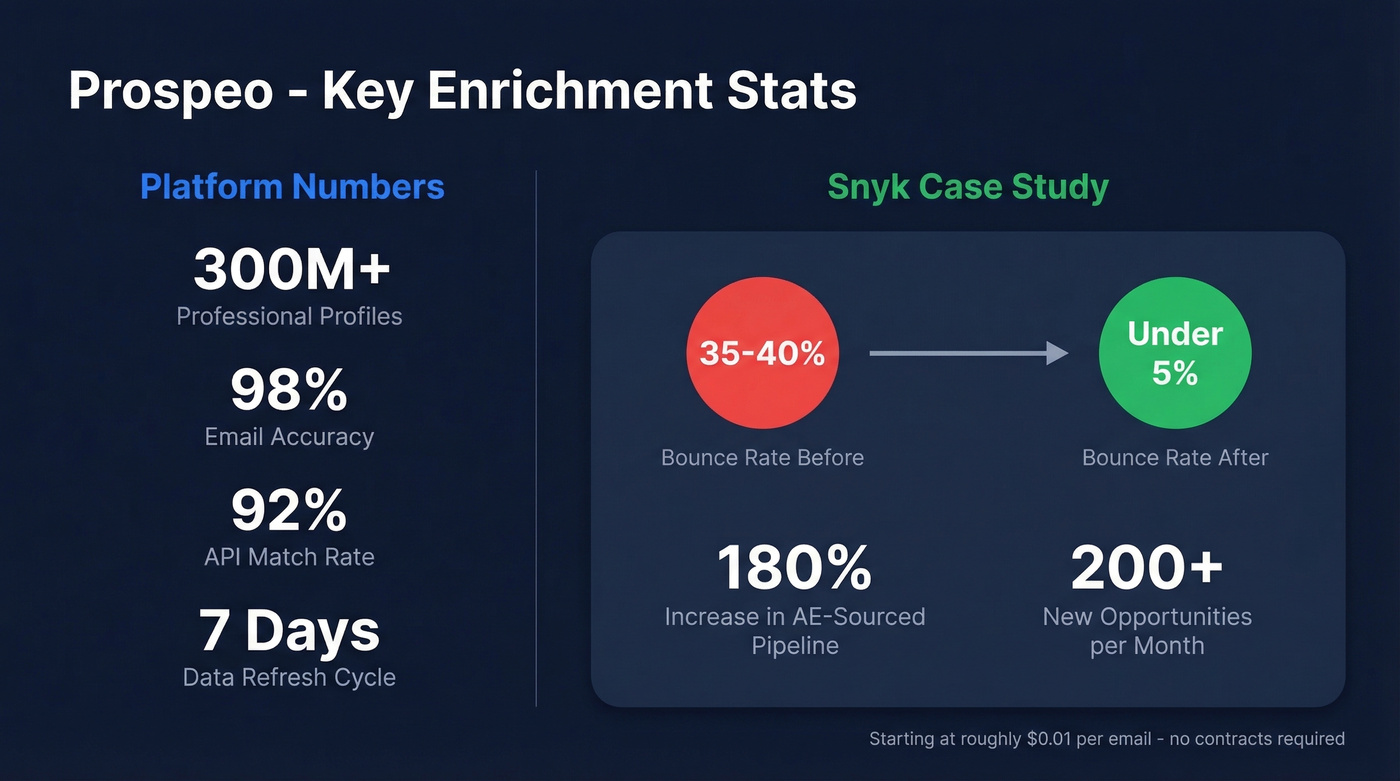
The proof point that sticks with us: Snyk's 50-person AE team went from a 35-40% bounce rate to under 5% after switching. AE-sourced pipeline jumped 180%, generating 200+ new opportunities per month. That's not a marginal improvement - it's a different operating model entirely. (If bounces are your main pain, start with check bounce and work backward.)

Most enrichment services refresh data every 6 weeks. By then, 5% of your records are already stale. Prospeo's 7-day refresh cycle and 92% API match rate mean your CRM stays current - returning 50+ data points per contact at ~$0.01/email.
Stop enriching your CRM with data that's already decaying.
ZoomInfo - Enterprise-Grade (at Enterprise Prices)
Use this if: You're a 200+ person sales org that needs a single platform for data, intent, org charts, and workflow automation - and you've got the budget to match.
Skip this if: You're a Series A company or a lean outbound team. A 10-seat ZoomInfo contract with intent data runs $15k-$45k+/year depending on the tier, and that's before add-ons like Global Data ($9,995) or bulk credits ($0.20-$0.60 each). Additional users cost ~$2,500 at list price. Renewal uplifts of 10-20% are standard, though negotiation discounts of 30-65% are common if you push back.
ZoomInfo's database runs 300M+ contacts with ~85-87% email accuracy. The platform is impressive - intent signals, technographics, org charts, and workflow automation all under one roof. But it's a Rolls-Royce, and most teams are using it for grocery runs. The #1 complaint in every procurement conversation we've tracked: paying for modules you never activate.
Here's the thing: ZoomInfo is still the best all-in-one platform. But most teams don't need all-in-one. If your average deal size is under $15k, you'll get better ROI from a focused data provider plus a sequencer.
Apollo.io - Best Free Tier
Apollo is the fastest path from "I need contacts" to "I'm sending emails." The database covers 275M+ contacts, and a single rep can be prospecting within minutes. Where it falls short is accuracy - email accuracy hovers around ~80%, which means you'll want a verification layer on top. (If you’re building a stack, start with an email verifier you trust.)
Pricing looks straightforward: Free, Basic ($49/user/mo annual), Professional ($79), and Organization ($119, minimum 3 users). The catch is credits - they expire every billing cycle, overage credits cost $0.20 each with a 250-credit minimum, and the free plan caps you at 5 mobile credits and 10 export credits per month. Enough to test the product, not enough to run a campaign.
For most mid-market teams, Apollo is the obvious starting point. Just budget for a separate verification tool.
Clay - Best for Waterfall Enrichment
Clay isn't a database. It's an orchestration layer that sits on top of 150+ data providers and lets you build waterfall enrichment workflows - querying one source, then another, then another until every field is filled. The OpenAI team improved enrichment coverage from 40% to 80% using Clay workflows, which tells you the ceiling is high. If you want a practical walkthrough, see our Clay list building guide.
The learning curve is real, though. We've watched teams burn through credits in the first week just figuring out how tables and automations work. CRM integrations are locked behind the Pro plan at ~$720/month, and per-1k enrichment costs run around $140. If you're comfortable with spreadsheet-style logic and don't mind investing a few days in setup, Clay rewards that effort handsomely. If you want something that works out of the box, look elsewhere.
Cognism - Best for EMEA Compliance
If you're selling into the UK, DACH, or Nordics and GDPR compliance keeps your legal team up at night, Cognism is the pick. Diamond Data (phone-verified mobiles) and a compliance-first architecture are differentiated in ways ZoomInfo hasn't matched in EMEA. Custom pricing typically runs $1,000-$3,000/month for small teams, and it's sales-led - expect a demo before you see numbers.
Lusha
Credit-per-reveal model with a free tier and paid plans from ~$49/mo. Best for small sales teams who need quick direct dials and emails without an enterprise contract. The interface is dead simple, and the Chrome extension works well for one-off lookups. Don't expect deep firmographic data or intent signals.
Clearbit (HubSpot Breeze Intelligence)
Now folded into HubSpot as Breeze Intelligence, Clearbit runs on a credit-based model for HubSpot Pro and Enterprise customers. Expect $100-$500+/mo on top of your HubSpot subscription depending on credit volume. 100M+ contacts, solid firmographic data. Best for teams already deep in HubSpot who don't want another vendor in the stack.
People Data Labs
Developer-first enrichment via API. Credit-based, pay-as-you-go pricing with trial credits available. Best for engineering teams building custom enrichment pipelines, not sales reps who want a Chrome extension. The documentation is excellent, and the data quality on firmographics is strong.
Dun & Bradstreet
Enterprise firmographic enrichment anchored by DUNS numbers - the gold standard for company-level data. Typically $30k+/year with sales-led contracts. Best for large organizations needing standardized firmographic records across global operations. If you're a 50-person startup, this isn't for you.
Experian
The consumer-enterprise crossover play. Enrichment strengths lean B2C - credit data, consumer demographics - with enterprise capabilities layered on. Enterprise contracts typically start at $10k+/year; a free 30-day trial is available. Best for teams enriching consumer or mixed B2B/B2C datasets.
Snyk cut their bounce rate from 35-40% to under 5% and generated 200+ new opportunities per month. Stack Optimize built a $1M agency with sub-3% bounce rates across every client. The difference wasn't effort - it was enrichment accuracy. Prospeo's 5-step verification delivers 98% email accuracy with 125M+ verified mobiles.
Run your next enrichment batch through data you can actually trust.
Pricing Comparison
Let's be honest: if a vendor won't publish pricing, they're banking on information asymmetry during the sales process. Here's what you'll actually pay.
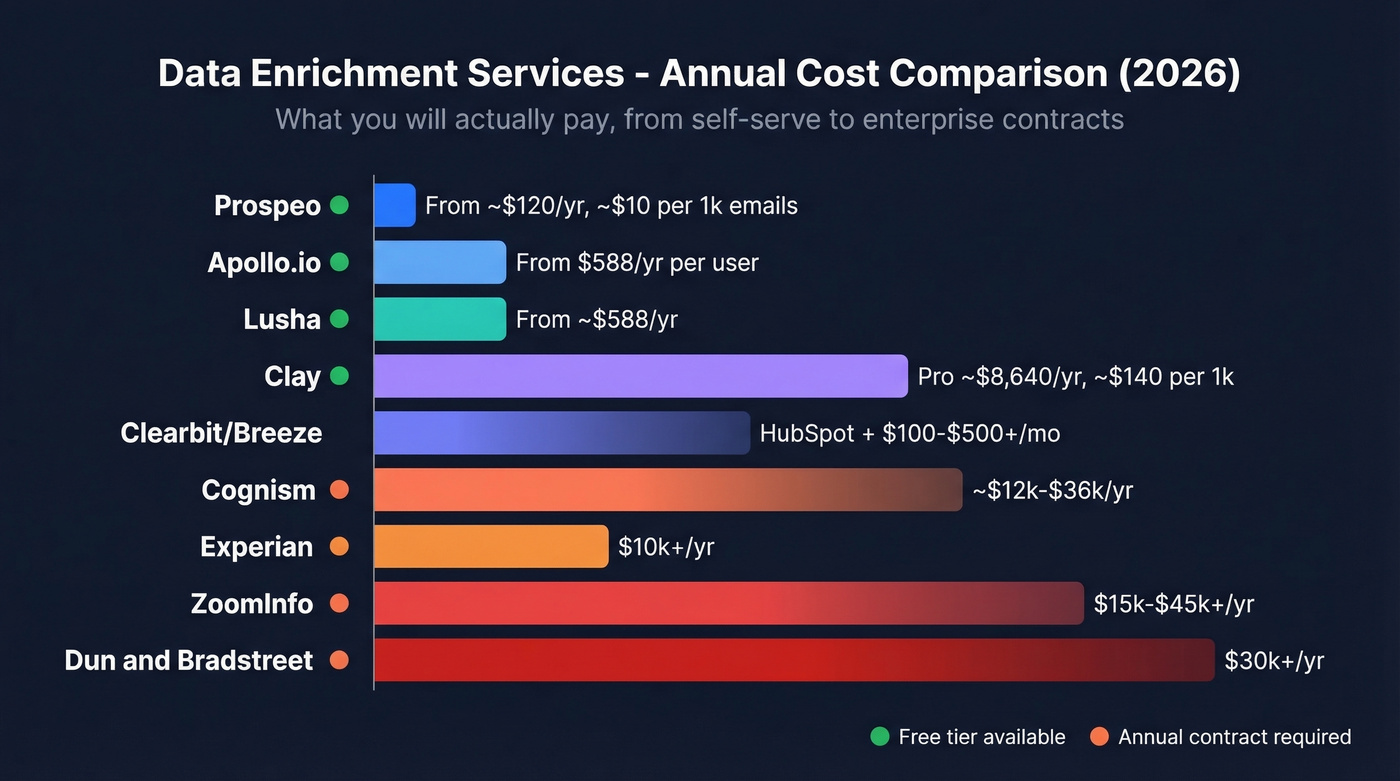
| Tool | Annual Cost | Per 1k Enrichments | Free Tier | Contract |
|---|---|---|---|---|
| ZoomInfo | $15k-$45k+ | N/A (bundled) | No | Annual |
| Apollo.io | From $588/yr/user | ~$100 | Yes (limited) | No |
| Clay | Free; Pro ~$8,640/yr | ~$140 | Yes (100 credits/mo) | No |
| Cognism | ~$12k-$36k/yr | Custom | No | Annual |
| Lusha | From ~$588/yr | Credit-based | Yes | No |
| Clearbit/Breeze | HubSpot + $100-$500+/mo | ~$50-$150 | No (needs HubSpot) | HubSpot contract |
| People Data Labs | Pay-per-credit | Custom | Trial credits | No |
| Dun & Bradstreet | $30k+ | Custom | No | Annual |
| Experian | $10k+ | Custom | 30-day trial | Annual |
The ~$10 per 1,000 emails from Prospeo is the lowest unit cost on this list by a wide margin. ZoomInfo's bundled model makes per-enrichment math nearly impossible - which is, of course, the point.
Why One Provider Isn't Enough
A single enrichment provider typically delivers 50-60% match rates. For every 1,000 records you push through, 400-500 come back incomplete. Waterfall enrichment - sequentially querying multiple providers until every gap is filled - pushes match rates past 80%, and some configurations hit 93%.
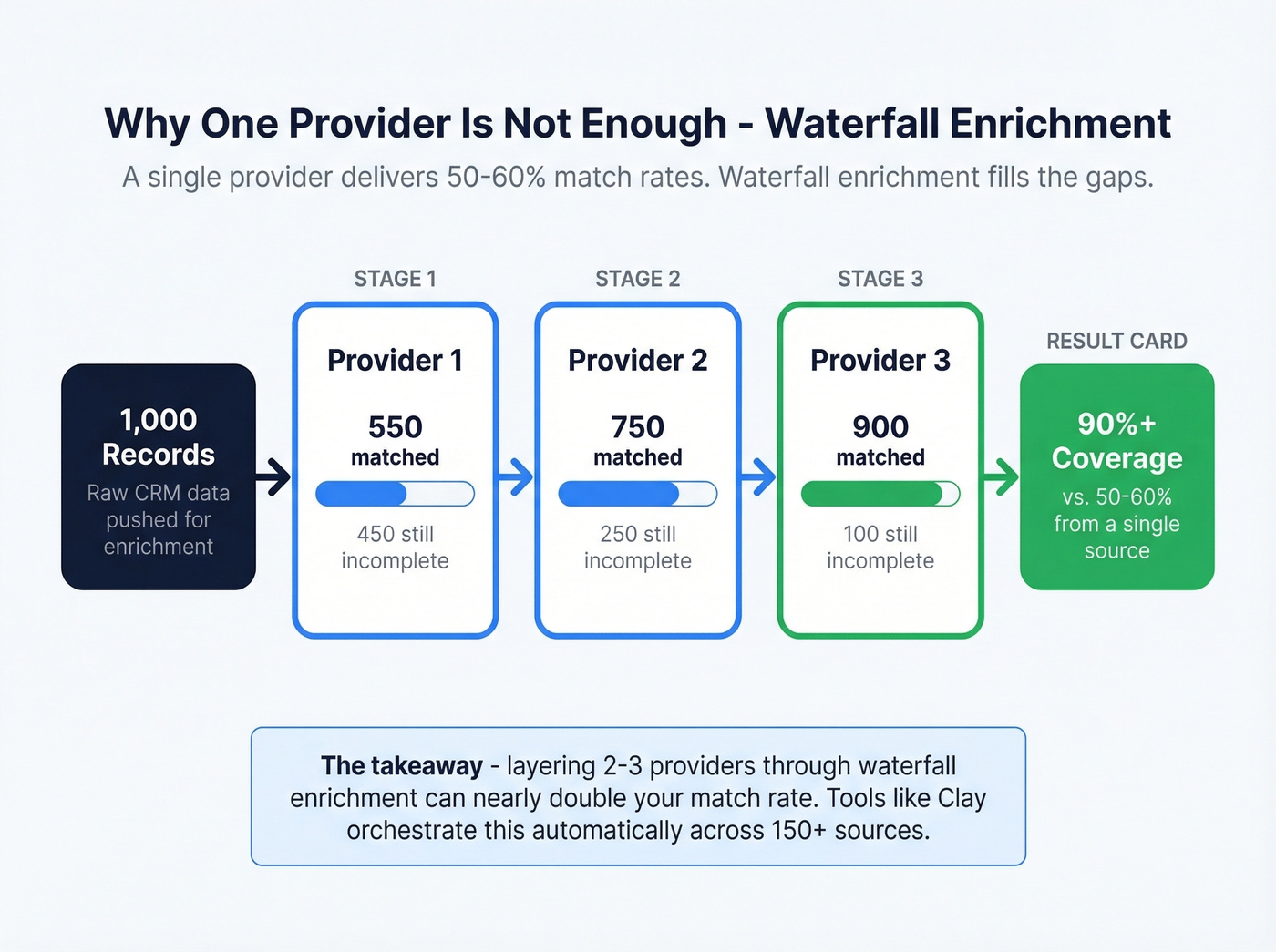
The average B2B sales team now uses 2.7 data providers simultaneously, up from 1.3 in 2022. That's not tool sprawl - it's a rational response to the accuracy ceiling of any single database. One practitioner on HubSpot's community forum reported 85%+ match rates with waterfall enrichment and fewer bounces from triple-verifying emails, which tracks with what we've seen across teams running multi-source stacks.
The practical move: pick a high-accuracy primary source and layer verification on top. Pay-for-success models, where you're only charged when valid data is returned, make this economically viable even at scale. (If you’re building lists from scratch, use a prospecting list template so enrichment fields map cleanly.)
Build vs. Buy
Some teams consider handling enrichment in-house, but the math rarely works out. Between maintaining API connections to multiple providers, building deduplication logic, and keeping up with data decay, the engineering cost alone can exceed what you'd spend on a dedicated vendor. We've seen teams spend 6+ months building internal enrichment pipelines only to rip them out when the maintenance burden crushed their eng roadmap.
For teams evaluating outsourced options, focus on vendors that offer both batch and real-time processing, transparent SLAs on match rates, and native CRM integrations. The best providers handle cleansing and enrichment in a single pass, so you're not paying twice to fix the same record. (If you’re automating handoffs, a RevOps tech stack view helps.)
Compliance Basics
Before you sign any enrichment contract, ask these questions. The answers determine whether you're building on solid ground or inheriting someone else's liability.
Where is the data sourced? Vendors that scrape without consent pass that risk to you. When your vendor's data source violates GDPR, you inherit the liability.
How is consent managed? GDPR requires opt-in. CCPA operates on opt-out. Your vendor needs to handle both correctly depending on where your prospects are located.
Is a DPA available? A Data Processing Agreement isn't optional under GDPR. If a vendor can't produce one, that's a dealbreaker.
What are the real penalties? GDPR fines reach EUR20M or 4% of global turnover. CCPA penalties hit $7,500 per intentional violation. Enforcement is accelerating, and ignorance isn't a defense.
FAQ
What is data enrichment?
Data enrichment appends missing information - emails, phone numbers, firmographics, technographics, intent signals - to your existing records using external databases. It transforms a name and company into a complete, actionable prospect profile that reps can actually work.
How much do data enrichment services cost?
Costs range from free tiers to $45k+/year for enterprise ZoomInfo contracts. Most mid-market tools run $50-$150/month per user. Unit economics vary wildly - from ~$0.01/email with Prospeo to ~$0.14 per enrichment with orchestration platforms like Clay.
What's a good match rate?
Single-source providers typically hit 50-85% depending on your ICP and geography. Waterfall approaches combining multiple sources push past 80%, with some configurations reaching 93%. Look for providers that let you set match-rate thresholds so you only pay for records meeting your quality bar.
How often should enrichment data be refreshed?
At minimum monthly. B2B data decays roughly 30% per year, meaning records go stale faster than most teams realize. Best-in-class providers refresh weekly - Prospeo's 7-day cycle is among the fastest in production, compared to the 6-week industry average.
Is data enrichment GDPR compliant?
It can be, if the provider sources data legally, manages consent correctly, and offers a DPA. Always ask about data origins and consent models before signing anything.