

The 10 Best B2B Databases in 2026 (Ranked by What Actually Matters)
You exported 5,000 contacts last quarter, loaded them into your sequencer, and watched 1,200 bounce. That's not a prospecting problem - it's a data problem. About 30% of B2B contact data goes stale every year, and the best B2B database isn't the biggest one. It's the one that keeps your data fresh.
Here's the thing: the consensus on r/sales is that big static databases are broken. Overused contacts, generic emails, stale records - they hurt deliverability more than they help pipeline. We've seen this firsthand across dozens of outbound campaigns.
These are the 10 B2B contact databases worth evaluating right now, ranked by accuracy, data freshness, and real cost per usable contact. If you're still deciding between list sources vs full platforms, start with our breakdown of B2B contact databases and B2B list providers.
Quick Picks
| Tool | Best For | Price | Email Accuracy | G2 Rating |
|---|---|---|---|---|
| Apollo.io | Free tier, US SMBs | $0-$119/user/mo | ~80% | 4.7/5 (9,250) |
| Cognism | EMEA compliance | ~$22,513/yr (5 users) | ~90% | 4.5/5 (1,200) |
What Separates Great B2B Data Providers
Most buyers compare databases on size. Wrong metric.
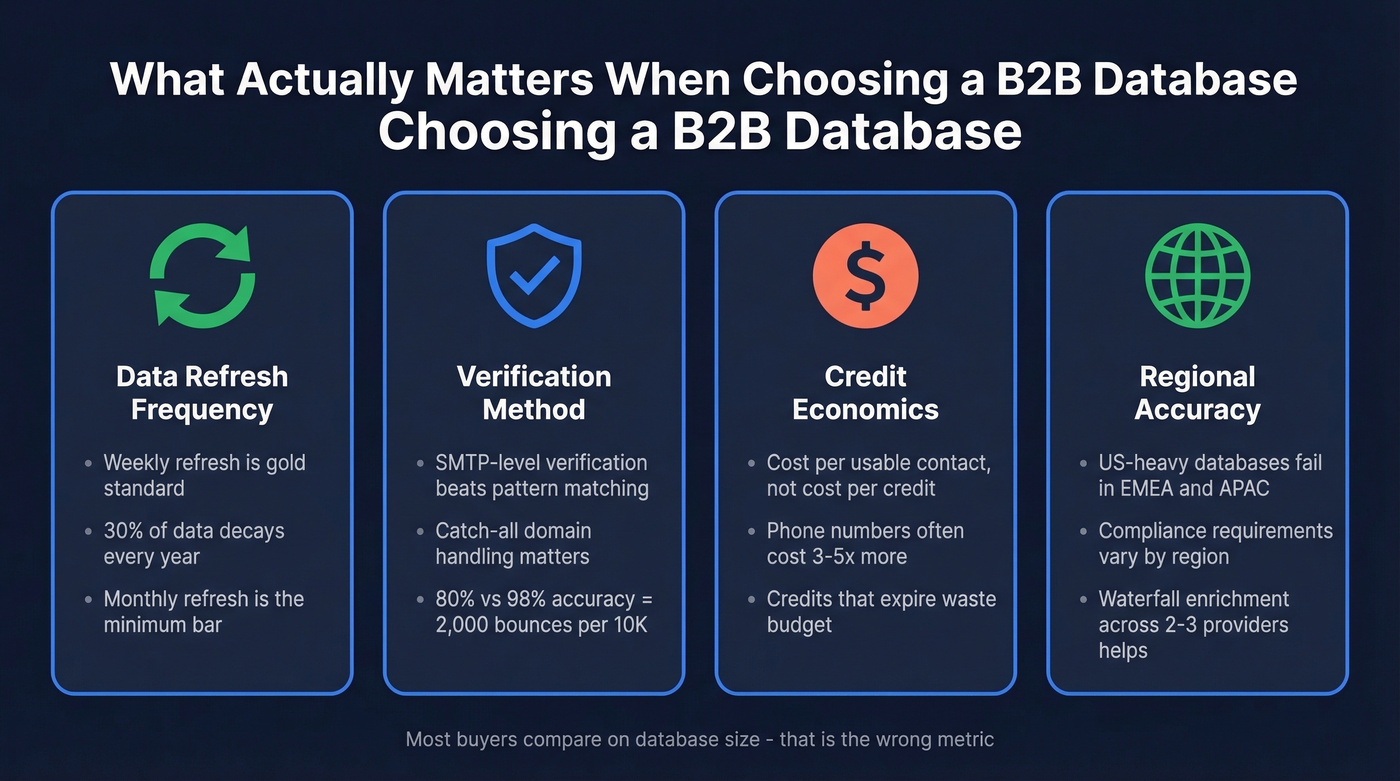
Data refresh frequency matters more than record count. A 300M-record database refreshed weekly beats a 600M-record database refreshed quarterly, every single time. With 30% of data decaying annually, monthly refresh should be your minimum bar - weekly is the gold standard.
Verification methodology is the second filter. Does the provider verify emails at the SMTP level, or just pattern-match? Do they handle catch-all domains and spam traps? The difference between 80% and 98% accuracy on a 10,000-contact export is 2,000 bounced emails - enough to torch your sending domain in a week. (If you're troubleshooting bounces, see our guide on check bounce and email reputation check.)
Phone data accuracy ranges from 63% to 91% across providers in independent testing, with coverage as low as 26%. If phone is a core channel, pair your data choice with stronger phone sales skills.
Beyond that, evaluate credit economics - cost per usable contact, not cost per credit - and regional accuracy, since US-heavy databases underperform significantly in EMEA and APAC. A waterfall enrichment approach across two or three providers maximizes both coverage and accuracy. 60% of B2B teams now use AI across their sales processes, so the database that plugs cleanly into your existing workflow wins over the one with the longest feature list. (More on this in our roundup of data enrichment tools.)

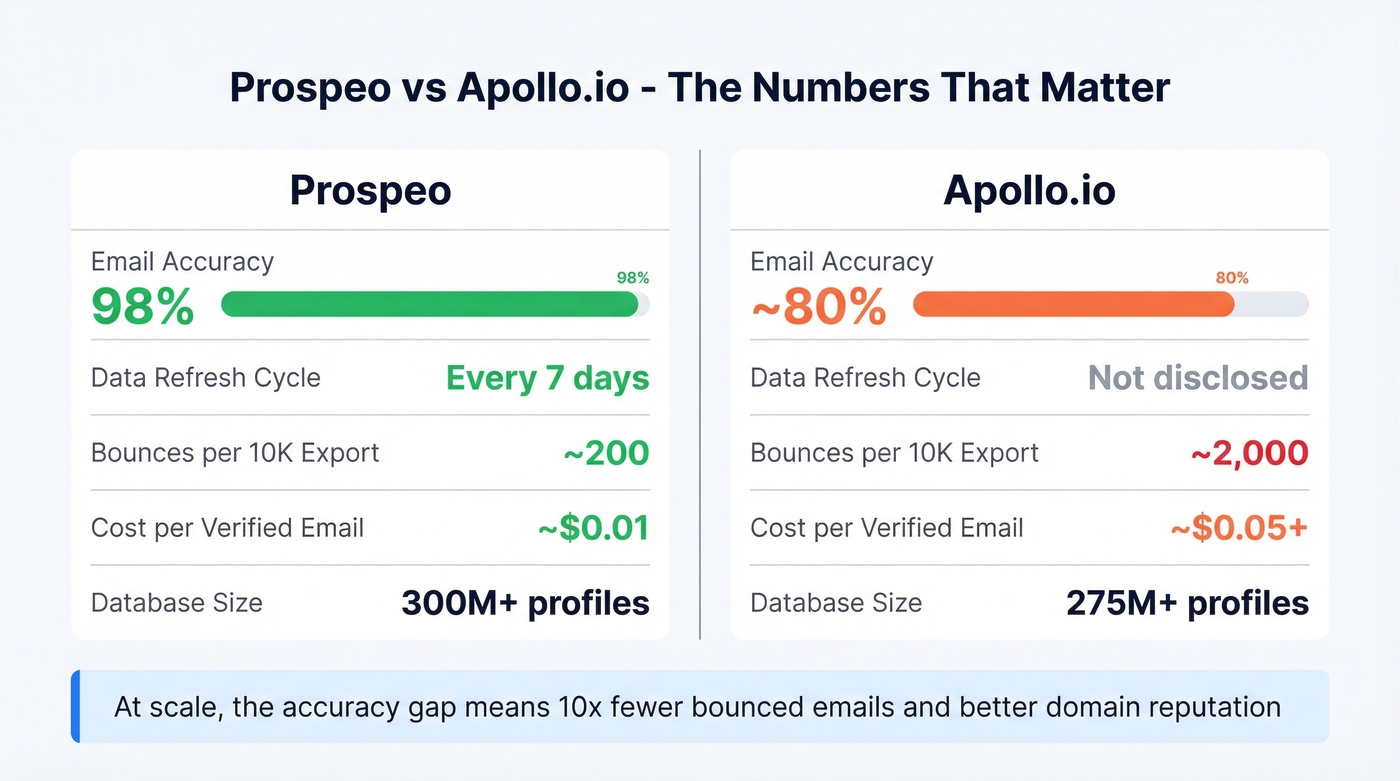
You just read that 30% of B2B data decays annually and 80% email accuracy means 2,000 bounces per 10K export. Prospeo's 7-day refresh cycle and 98% email accuracy exist to solve exactly that. At $0.01 per email with no contracts, your cost per usable contact drops to a fraction of what ZoomInfo or Apollo charges.
Stop paying for data that bounces. Start with 75 free verified emails.
Top B2B Database Providers in 2026
Prospeo - Best for Email Accuracy & Freshness
Use this if you care more about data quality than feature count.
Prospeo's database covers 300M+ professional profiles and 143M+ verified emails, backed by a 5-step verification process and proprietary email-finding infrastructure with no third-party email providers in the chain. The result: 98% email accuracy plus 125M+ verified mobile numbers with a 30% pickup rate.
The 7-day data refresh cycle is the headline differentiator. The industry average sits around 6 weeks. That gap matters at scale - Meritt tripled their pipeline from $100K to $300K/week after switching, and their bounce rate dropped from 35% to under 4%. (If you're building a repeatable outbound engine, use these B2B prospecting strategies.)

The platform includes 30+ search filters with intent data powered by Bombora across 15,000 topics, a Chrome extension with 40,000+ users, and native integrations with Salesforce, HubSpot, Smartlead, Instantly, Lemlist, Salesloft, Outreach, Clay, Zapier, n8n, Make, plus API access. If you're standardizing your stack, map it against a lean RevOps tech stack.
Pricing starts free with 75 emails and 100 Chrome extension credits per month, scaling to roughly $0.01 per email with no contracts. Most teams pair it with a sequencer like Instantly or Lemlist for execution, keeping each tool best-in-class at what it does. For more options, see our guide to outbound email automation.
Apollo.io - Best Free Tier for US SMBs
Apollo is the obvious starting point for most SMB teams running US-focused outbound. The free tier alone is more generous than some paid plans elsewhere, and paid tiers run from $49/user/mo (Basic) through $79/user/mo (Professional) to $119/user/mo (Organization). Built-in sequencing means fewer tools in your stack, and a G2 rating of 4.7/5 across 9,250 reviews makes it the most-reviewed option on the market.
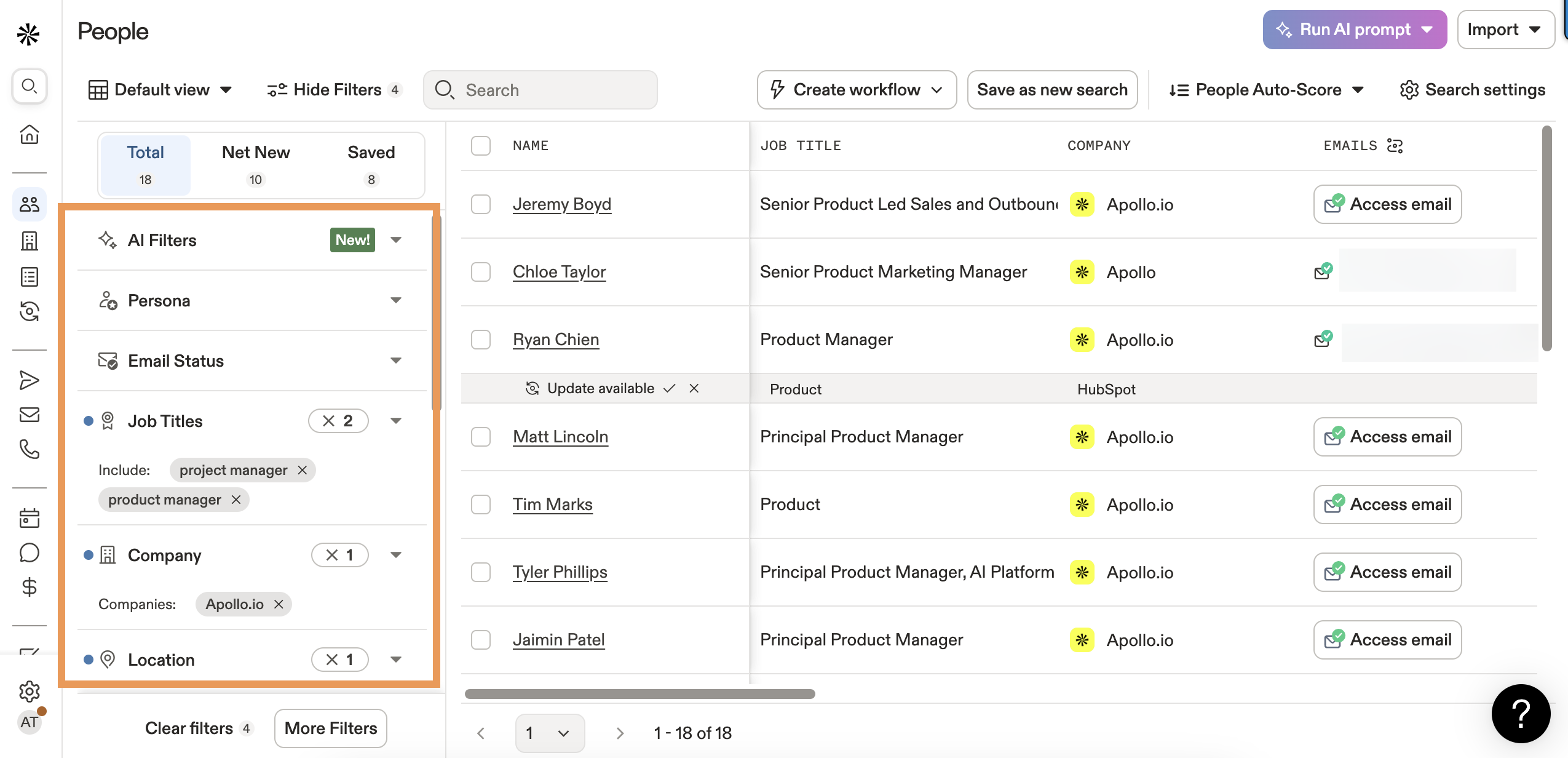
The catch: email accuracy benchmarks around 80% in independent testing, which means 1 in 5 emails could bounce. Credits don't roll over, phone numbers cost 5 credits each, and accuracy drops noticeably outside the US. We've seen teams hit accuracy walls once they scale past a few hundred contacts per month - at that point, the bounce rate starts costing you in domain reputation. The Organization plan also requires a minimum of 3 seats. If you're comparing accuracy tradeoffs, see our BounceBan vs Apollo.io breakdown.
ZoomInfo - Enterprise Default, Enterprise Price
ZoomInfo is still the default for enterprise sales orgs, and for good reason - the platform does everything: intent, chat, workflow automation, org charts. G2 rating of 4.5/5 across 8,875 reviews.
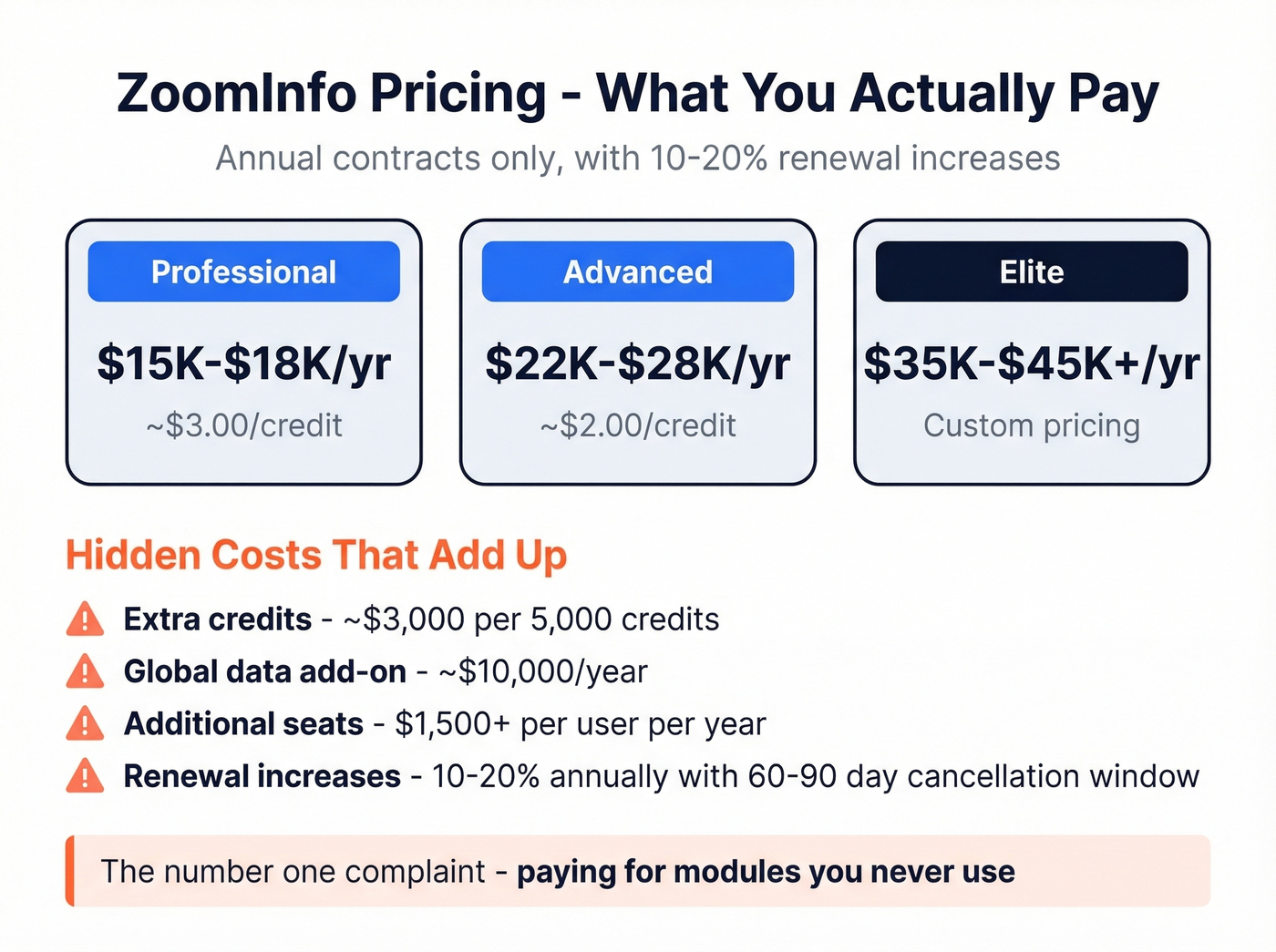
But the costs add up fast. Professional tier runs $15K-$18K/year at roughly $3.00/credit. Advanced hits $22K-$28K at ~$2.00/credit. Elite goes $35K-$45K+. Add-ons stack: extra credits around $3K per 5,000, global data around $10K, additional seats at $1,500+/user/year. Annual contracts only, and renewal increases of 10-20% are standard with a 60-90 day cancellation window that catches teams off guard.
The #1 complaint you'll hear is paying for modules you don't use. Email accuracy benchmarks at 85%, meaning you're still bouncing 15% of exports. We've watched teams spend $30K/year on ZoomInfo when their reps only use the search bar and export function. That's an expensive search bar.
Our take: ZoomInfo is still the best all-in-one GTM platform. But most teams don't need all-in-one - they need accurate data piped into the tools they already use.
Cognism - Best for EMEA Compliance
Where Cognism wins over ZoomInfo: EMEA compliance and mobile verification. Where ZoomInfo still wins: US database depth and workflow breadth. That's the entire decision framework. If compliance is a deciding factor, start with B2B compliance and a GDPR compliant database checklist.
Cognism's Diamond Data focuses on phone-verified mobile numbers. Pricing runs on a platform fee plus per-user model - Grow starts at ~$22,513/year for 5 users, Elevate hits ~$37,498/year. The "unlimited" access is governed by fair-use policies, roughly ~2,000 records per user per month. Onboarding adds $2K-$5K. Email accuracy benchmarks around 90%.
Skip this if you're US-only and budget-conscious.
Lusha - Quick Lookups, Tight Credits
| Metric | Detail |
|---|---|
| Free tier | 70 credits/mo |
| Pro | $22.45/user/mo |
| Premium | $52.45/user/mo |
| Phone cost | 5 credits each |
| G2 | 4.3/5 (1,566 reviews) |
At 5 credits per phone number, Premium's 250 credits get you roughly 50 direct dials per month. Lusha works best for individual reps doing one-off lookups, not bulk prospecting. If you're pulling more than a few dozen contacts a week, you'll burn through credits before the month is half over.
UpLead - Budget Pick
UpLead is a straightforward pick for teams that want predictable monthly pricing without jumping to enterprise contracts. Essentials runs $99/mo for 170 credits, Plus $199/mo for 400 credits. G2 rating of 4.6/5.
The database is smaller than Apollo or ZoomInfo, but for small teams spending carefully, the economics work well when you're targeting a narrow ICP.
Skip this if you need deep EMEA coverage or intent data.
Lead411 - Unlimited-Access Model
Lead411 offers something rare: genuinely unlimited contact exports on higher tiers. Spark starts at $75/user/mo on annual billing, Pro runs ~$3K/year, and Enterprise ~$6K+/year with unlimited access. If your team is tired of credit math and just wants to pull lists without watching a counter, it's worth the 7-day free trial.
Seamless.AI - Real-Time Search, Inconsistent Quality
Seamless.AI searches for contact data in real time rather than pulling from a static database. Results vary significantly by search, and credits get consumed even when data comes back bad - a frustrating quirk that burns through budgets. Free tier gives 50 lifetime credits. Basic runs ~$147/mo. Enterprise pricing ranges from $20K-$100K+/year.
RocketReach - Simple Lookup Tool
RocketReach is a simple lookup tool for teams doing occasional one-off searches rather than systematic prospecting. Free version gives 5 searches per month, paid plans start at $39/month. It won't replace a proper database, but it fills gaps.
Hunter.io - Email-Only Specialist
Hunter focuses exclusively on email - no phone data, no intent signals. Free tier includes 25 searches and 50 verifications per month. Starter runs $49/mo, Growth $149/mo. The domain search feature is particularly useful for mapping email patterns at target companies. Pair it with a phone data provider if you need direct dials. If you're evaluating similar tools, see our list of Hunter alternatives.
Real Cost-Per-Lead Math
Database pricing is meaningless without context. Here's what 1,000 verified emails per month actually costs at paid tier rates:
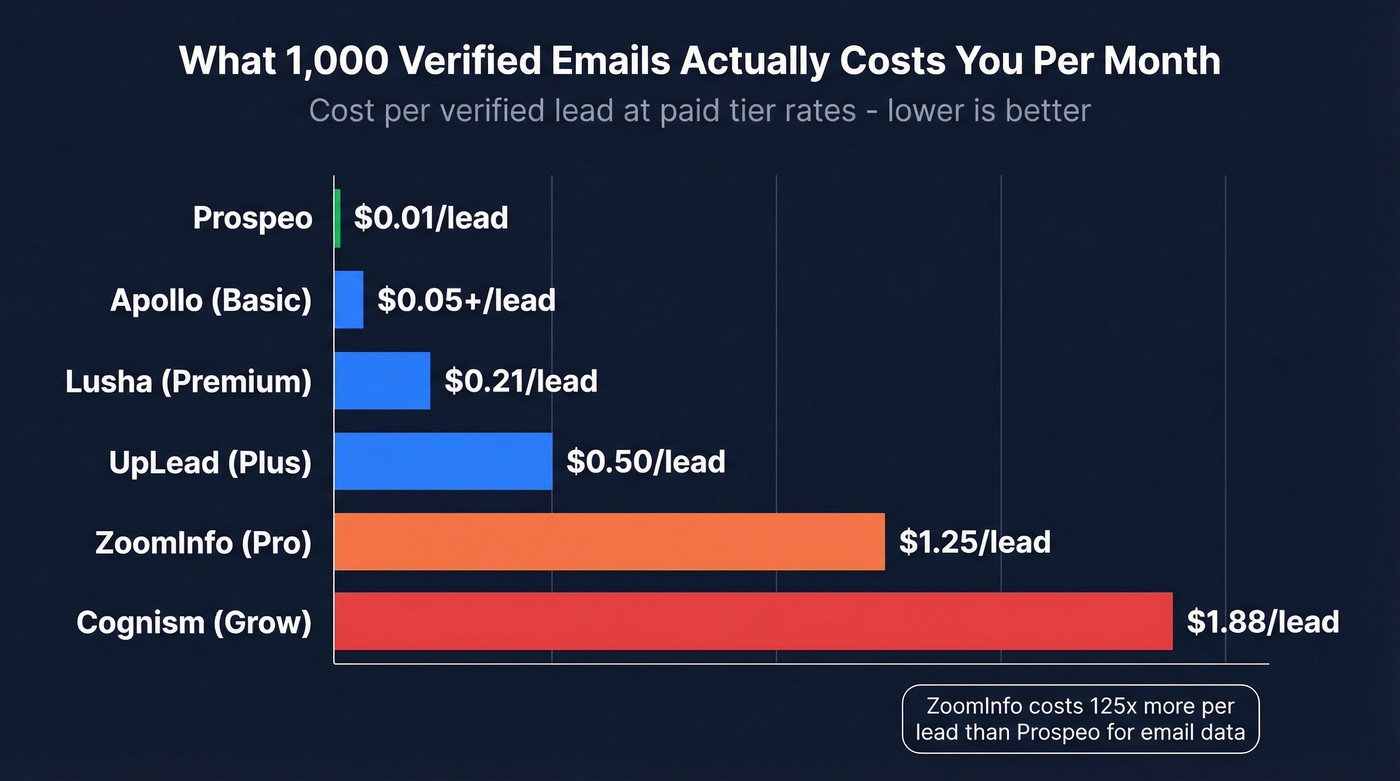
| Provider | Monthly Cost | Cost Per Lead |
|---|---|---|
| Apollo (Basic) | $49+ | ~$0.05+ |
| Lusha (Premium) | $52.45 | ~$0.21 |
| ZoomInfo (Pro) | ~$1,250 | ~$1.25 |
| Cognism (Grow) | ~$1,875 | ~$1.88 |
The spread is staggering. ZoomInfo costs 125x more per lead than Prospeo for email data. Even if ZoomInfo's broader feature set justifies a premium, the gap on pure data economics is hard to rationalize for teams that primarily need verified contact information.
Let's break this down by use case. If you're running US-only outbound under $5K/year, Apollo's free tier gets you started. For EMEA compliance, Cognism is the play. But if cost-per-usable-contact is the metric - and for most outbound teams, it should be - the numbers above speak for themselves. (To pressure-test your outbound economics, track it alongside account executive KPIs.)
Meritt tripled pipeline from $100K to $300K/week and cut bounce rates from 35% to under 4%. Snyk's 50 AEs grew AE-sourced pipeline 180%. The difference wasn't effort - it was switching to 300M+ profiles verified every 7 days with 98% accuracy across 143M+ emails and 125M+ mobile numbers.
The best B2B database is the one that doesn't wreck your domain reputation.
FAQ
What's the most accurate B2B database in 2026?
Prospeo leads at 98% email accuracy with a 7-day refresh cycle, followed by Cognism at ~90% and ZoomInfo at ~85%. Apollo benchmarks around 80%. On a 10,000-contact export, that accuracy gap means the difference between 200 and 2,000 bounced emails - enough to wreck your sending domain.
How much does a B2B contact database cost?
Free tiers exist from Apollo and Prospeo. Enterprise platforms like ZoomInfo run $15K-$45K+/year, while most mid-market teams spend $3K-$25K/year. The real metric is cost per usable contact - an 80%-accurate database at $0.05/lead often costs more per valid email than a 98%-accurate one at $0.01.
How often should B2B data be refreshed?
Monthly at minimum. The industry average sits around every 6 weeks, but with 30% of contact data going stale annually, anything longer than monthly means you're sequencing outdated records. Top-tier providers refresh weekly and verify at the SMTP level before delivering results.
Should I use one database or multiple?
No single provider covers every region, role level, or data type equally well. Start with one primary source for bulk prospecting, then run gaps through a second provider for verification and fill. This waterfall approach across two or three tools is how top-performing outbound teams maximize coverage without sacrificing accuracy.