

The 10 Best Data Enrichment Tools in 2026
A RevOps lead we know pulled their SDR team's bounce report last quarter: 18% of "verified" emails bounced on the first sequence. They were paying $25,000 a year for that data. Finding the right enrichment tool shouldn't require a lesson that expensive in what "verified" actually means.
The enrichment market is projected to grow from $7.55B to $16.72B by 2034, and 68% of providers claim 95%+ accuracy - but far fewer deliver it in production. The gap between marketing promises and real-world accuracy is where money gets wasted.
Here's the thing: not all enrichment tools do the same job. Some are databases, some are orchestration layers that chain multiple sources together, and some are verification tools that confirm data quality. Picking the right one comes down to unit economics, verification rigor, and workflow fit - not who claims the biggest database.
Top Picks at a Glance
| Tool | Best For | Starting Price | Verdict |
|---|---|---|---|
| Prospeo | Email accuracy + self-serve | Free (paid ~$39/mo) | 98% email accuracy, 7-day refresh, one of the lowest unit costs |
| Clay | Waterfall workflows | $185/mo | 150+ data providers, powerful but pricing needs a spreadsheet |
| Apollo.io | All-in-one SMB | Free (paid $49/mo) | Prospecting + enrichment in one seat, accuracy trade-off |
What Enrichment Actually Costs
Most "pricing pages" in this space are designed to get you on a sales call, not to give you a number.
Work emails decay at 25-30% per year. Job titles churn at 30-35% annually. If your enrichment tool isn't keeping pace with that decay, you're building sequences on stale data - and that's why evaluating these platforms requires looking at refresh cycles, not just database size.
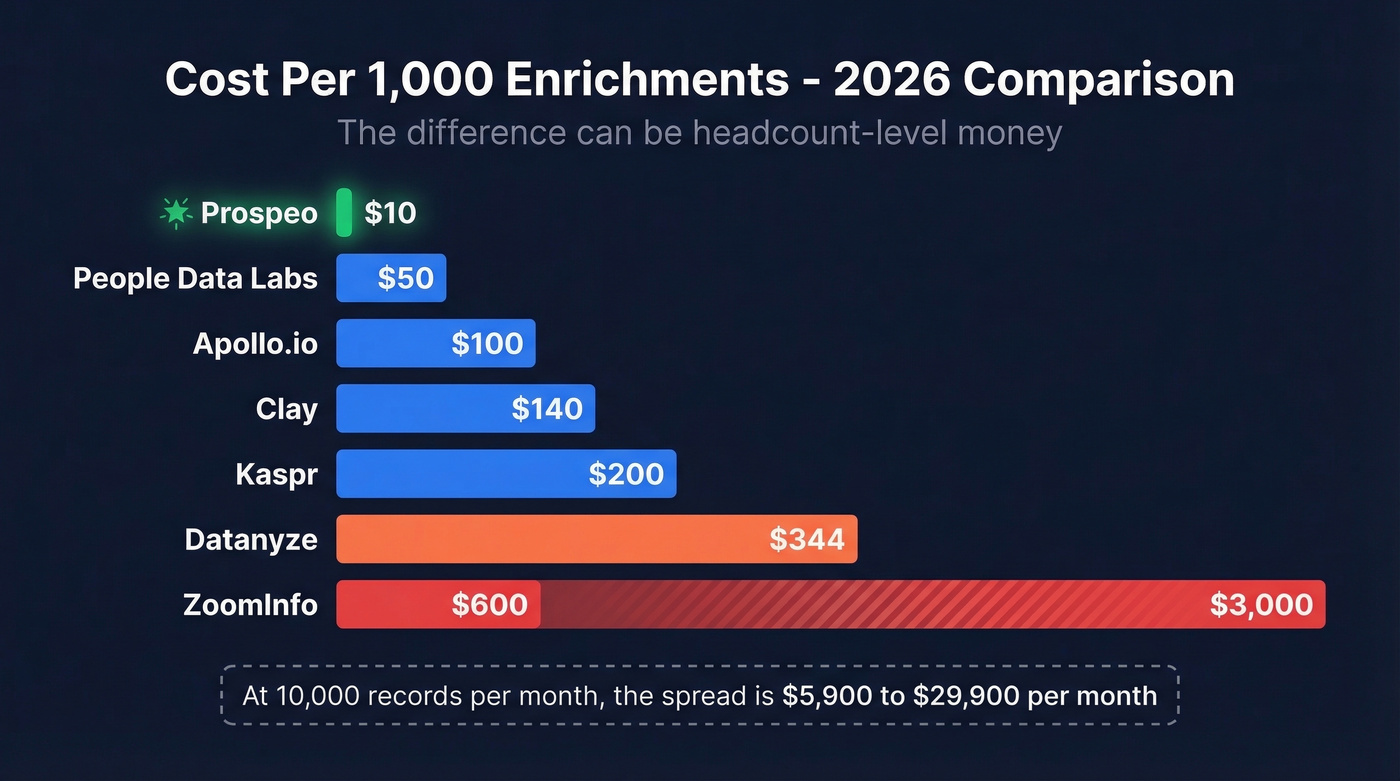
Cost Per 1,000 Enrichments
| Tool | Cost/1K Enrichments |
|---|---|
| Prospeo | ~$10 |
| People Data Labs | ~$50 |
| Apollo.io | ~$100 |
| Clay | ~$140 |
| Kaspr | ~$200 |
| Datanyze | ~$344 |
| ZoomInfo | ~$600-$3,000 |
That's a massive spread. For a team enriching 10,000 records a month, the difference between a ~$10/1K tool and a ~$600-$3,000/1K tool is roughly $5,900-$29,900/month - headcount-level money.
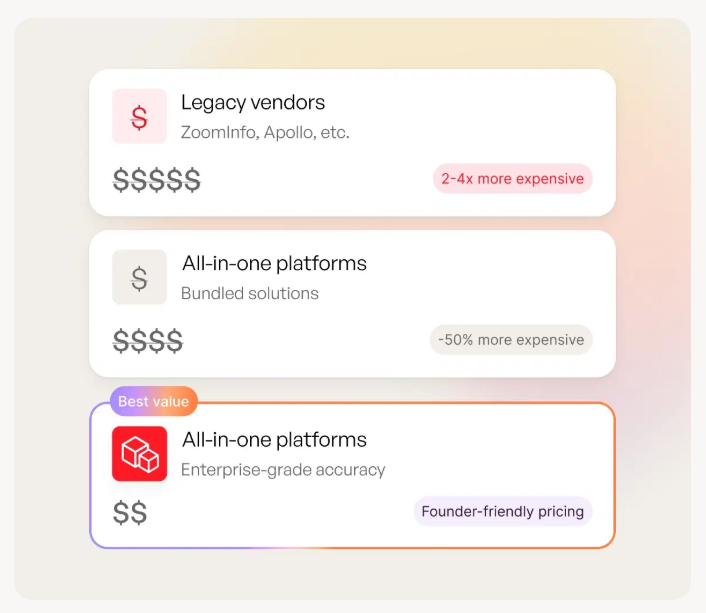
Single-Source vs. Waterfall
| Metric | Single-Source | Waterfall |
|---|---|---|
| Accuracy | 70-85% | 90-98% |
| Coverage | 50-70% | 85-95% |
| Cost/record | $0.10-$0.50 | $0.15-$0.40 |
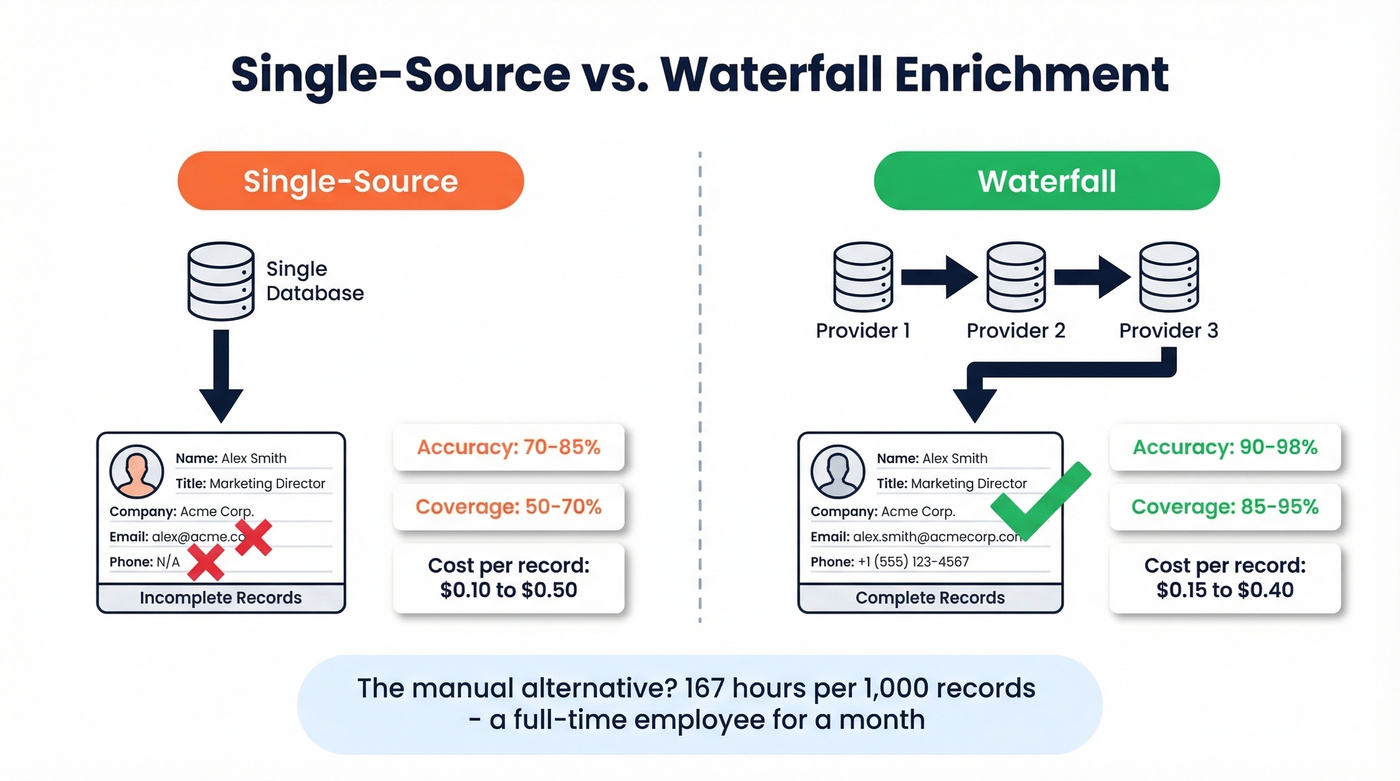
The alternative to any tool? Manual research. At 10 minutes per contact, 1,000 records takes 167 hours - a full-time employee doing nothing but data entry for a month.
Full Comparison Table
| Tool | Best For | Starting Price | Cost/1K | Key Strength |
|---|---|---|---|---|
| Prospeo | Email accuracy | Free | ~$10 | 98% verified emails |
| Clay | Waterfall workflows | $185/mo | ~$140 | 150+ providers |
| ZoomInfo | Enterprise orgs | $15K+/yr | ~$600-$3K | Deep US database + intent |
| Apollo.io | SMB all-in-one | Free | ~$100 | Prospecting + sequences |
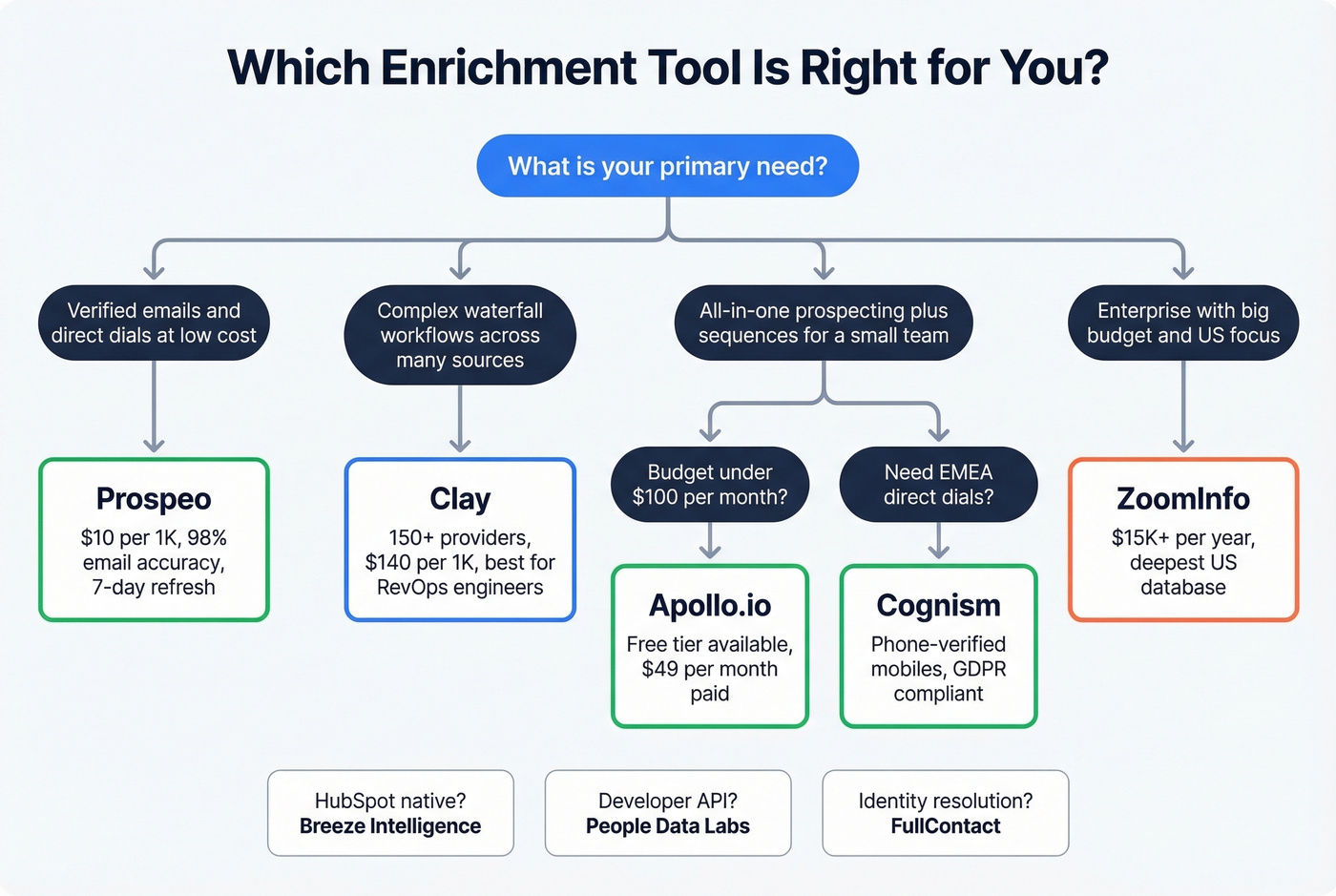
| Cognism | EMEA direct dials | ~$22K/yr | Custom | Phone-verified mobiles |
| Breeze Intel | HubSpot teams | $45/mo | ~$450 | Native CRM enrichment |
| Lusha | Quick phone lookups | Free | ~$160 | Chrome extension speed |
| RocketReach | One-off lookups | ~$39/mo | ~$200 | Broad coverage |
| People Data Labs | Dev teams | ~$0.05/rec | ~$50 | API-first flexibility |
| FullContact | Identity resolution | Custom | Not public | Cross-device matching |
10 B2B Data Enrichment Tools Reviewed
1. Prospeo
Prospeo covers 300M+ professional profiles with 143M+ verified emails and 125M+ verified mobile numbers. The standout number: 98% email accuracy through a 5-step proprietary verification process that handles catch-all domains, removes spam traps, and filters honeypots. Where most enrichment tools refresh data every 4-6 weeks, Prospeo runs on a 7-day cycle.
Search filters go 30+ deep - buyer intent powered by Bombora across 15,000 topics , technographics, job changes, funding events, and headcount growth. The API delivers a 92% match rate, and CRM and CSV enrichment return 50+ data points per record. Native integrations cover Salesforce, HubSpot, Smartlead, Instantly, Lemlist, Clay, Zapier, and Make.
Use this if: You need verified emails and direct dials without enterprise contracts. The free tier gives you 75 emails a month to test - making it one of the strongest free options on the market. Paid plans start around $39/mo with no annual commitment.
Real-world proof: Snyk's team of 50 AEs went from 35-40% bounce rates to under 5% after switching. AE-sourced pipeline jumped 180%, generating 200+ new opportunities per month.


You just saw the cost spread: $10 vs. $600-$3,000 per 1,000 enrichments. Prospeo delivers 98% email accuracy with a 92% API match rate and 50+ data points per record - on a 7-day refresh cycle. That's enterprise-grade enrichment at $0.01/email, no contract required.
Stop paying headcount-level money for data that decays in weeks.
2. Clay
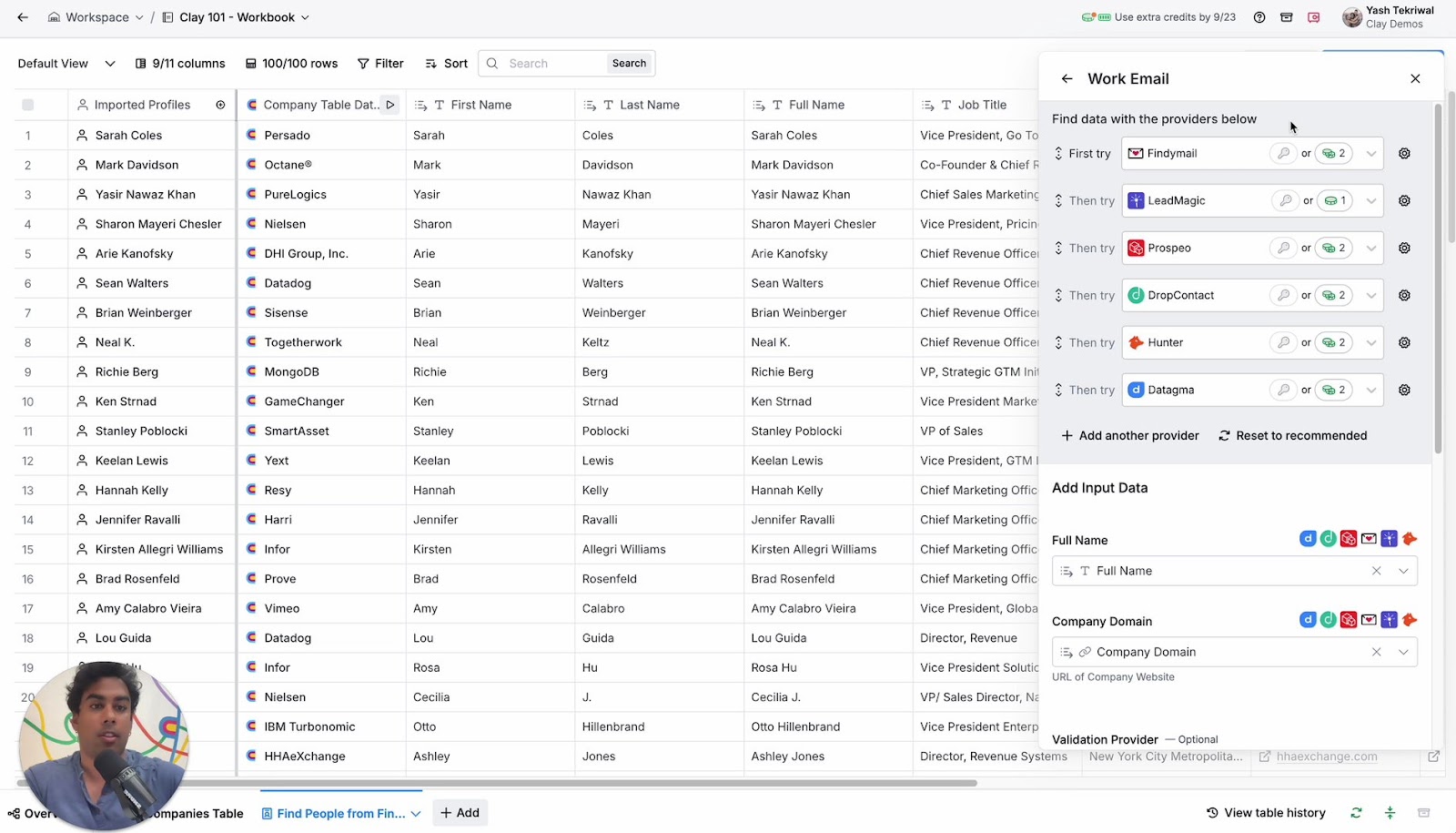
Clay isn't a database - it's an orchestration layer that runs waterfall enrichment across 150+ data providers. You build workflows that query multiple sources sequentially, filling gaps until each record is as complete as possible.
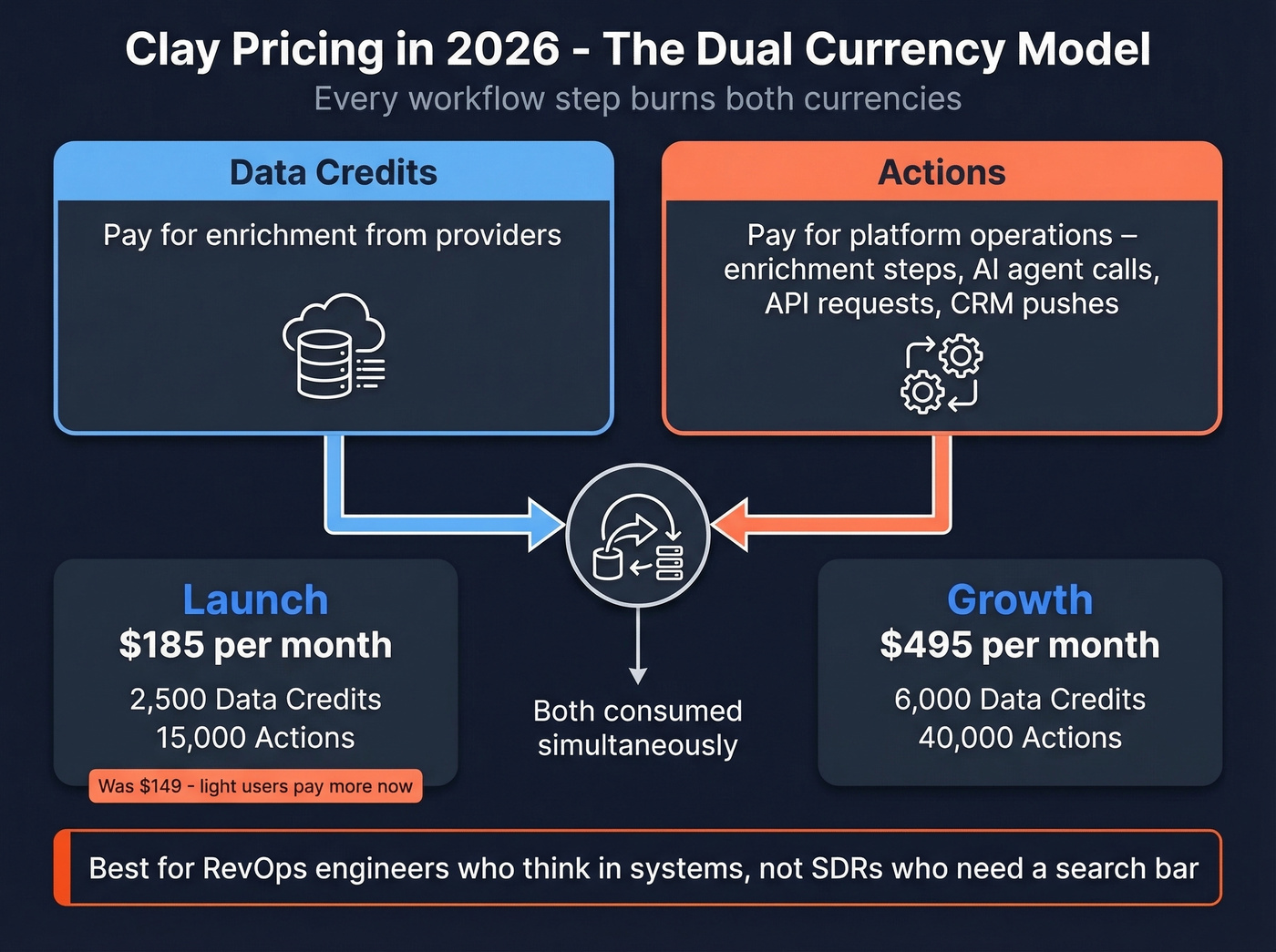
The biggest gotcha? The 2026 pricing overhaul introduced a dual-currency model. Launch runs $185/mo for 2,500 Data Credits plus 15,000 Actions. Growth is $495/mo for 6,000 Data Credits plus 40,000 Actions. Data Credits pay for enrichment from providers. Actions pay for platform operations - enrichment steps, AI agent calls, API requests, CRM pushes. Every workflow step consumes both currencies, and light users actually pay more than before ($149 to $185 on the entry plan).
On r/sales, Clay shows up as a favorite - but the users praising it are almost always RevOps engineers, not SDRs. If you think in systems rather than search bars, it's genuinely powerful. If you just need verified emails, it's overkill.
3. ZoomInfo
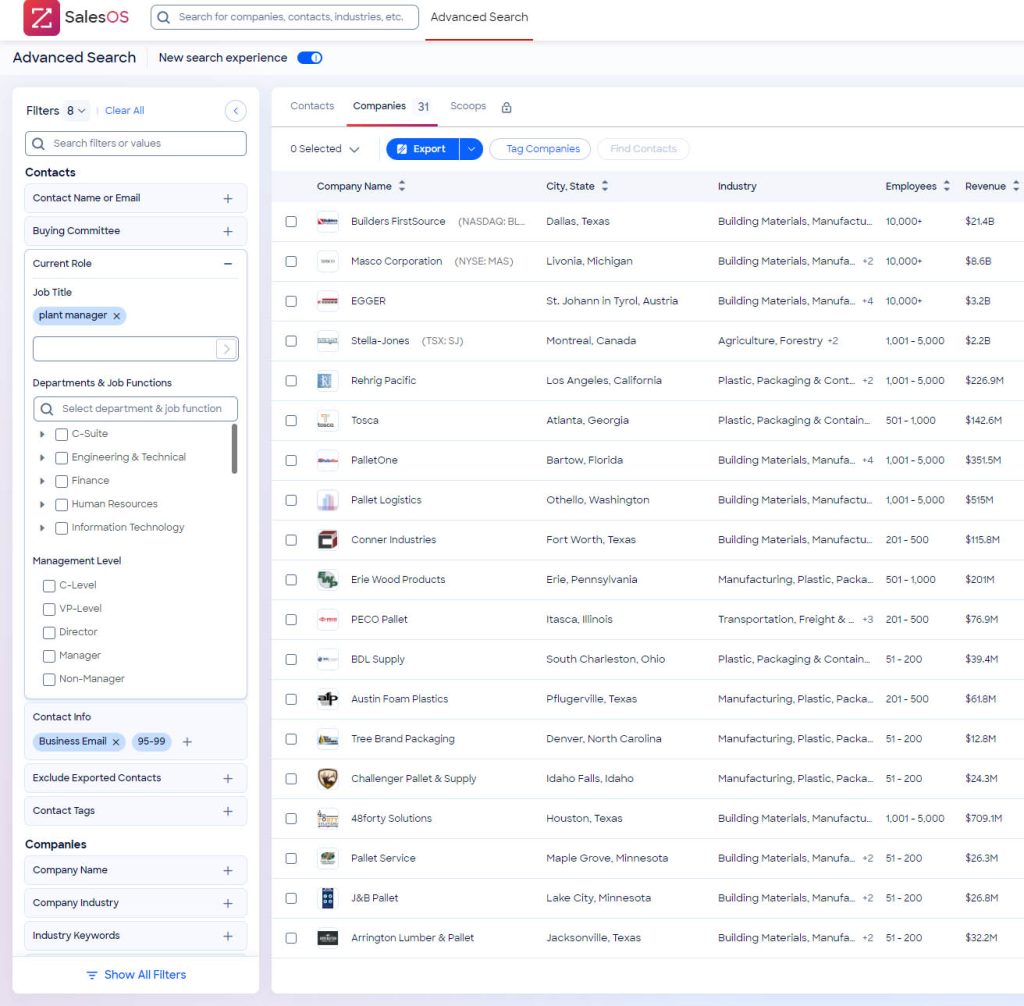
ZoomInfo is the enterprise default and the tool most teams realize they're overpaying for. The US database is the deepest in the market, the intent data is mature, and the platform covers everything from prospecting to enrichment to engagement.
What it actually costs: published tiers start at $15,000+/year for Professional, $24,000+ for Advanced, and $40,000+ for Elite. The real cost lives in add-ons - roughly $3,000 per 5,000 extra credits, $9,995 for Global Data, and $1,500-$2,500 per additional seat per year. Typical negotiated discounts run 30-65%, meaning list price is a fiction.
The #1 complaint on Reddit is paying for modules you don't use. The 60-90 day auto-renewal windows are aggressive. If you're a Series A company or a team under 20 reps, this isn't your tool.
4. Apollo.io
Apollo is the obvious starting point for SMB teams who want prospecting, enrichment, and sequences in one platform. The free tier is genuinely useful. Paid plans run $49/mo (Basic), $79/mo (Professional), $119/mo (Organization, minimum 3 seats).
The credit gotcha: they don't roll over. Unused credits expire monthly. We've seen teams blow through a month's allocation in two weeks when running aggressive enrichment campaigns because waterfall-style enrichment can burn multiple credits per record.
Use this if: You're a team under 50 reps who wants one tool instead of five. Skip this if: Email accuracy is mission-critical. Dedicated enrichment tools deliver noticeably higher verification rates, and for teams where deliverability directly impacts revenue - agencies, high-volume outbound - that gap matters (see Apollo.io benchmarks).
5. Cognism
Cognism's strength is EMEA. Selling into the UK, Germany, or France? Their phone-verified mobile numbers are one of the strongest options in the market. GDPR compliance is baked in, not bolted on.
Cognism wins over ZoomInfo on European data quality and compliant direct dials. ZoomInfo still wins on US database depth and platform breadth. A 5-user Grow setup benchmarks around $22,513/year; Elevate for 5 users hits $37,498. The "unlimited" access is governed by fair use - roughly 2,000 records per user per month.
6. Breeze Intelligence
Clearbit got acquired by HubSpot and rebranded as Breeze Intelligence. If you're already on HubSpot, enrichment happens directly inside your CRM without CSV exports or API plumbing. That's the entire value proposition (more in our CRM data enrichment guide).
Pricing starts at $45/mo (annual) for 100 credits. One credit per record, no rollover, but re-enriching the same record in the same billing period is free. The limitation: you're locked to the HubSpot ecosystem. On Salesforce or considering a CRM switch? Look elsewhere.
7. Lusha
Lusha is the fastest path from "I need this person's phone number" to having it. The Chrome extension is snappy, the free plan exists, and paid starts at $49.90/mo for 3 users. For individual reps doing targeted outreach, it works. Don't expect deep enrichment - Lusha is a lookup tool, not a data platform.
8. RocketReach
Broad coverage across industries, simple credit model starting around $39/mo. Best for one-off lookups and small-scale prospecting rather than systematic enrichment workflows. Nothing flashy, but it gets the job done when you need a quick answer on a specific contact (see our RocketReach breakdown).
9. People Data Labs
Developer-first API at ~$0.05/record with free API keys for testing. If your engineering team is building a custom enrichment pipeline and wants raw data access without a UI, People Data Labs is the cleanest option. Not built for sales teams - built for data engineers (compare options in our lead enrichment API guide).
10. FullContact
Identity resolution is FullContact's angle - cross-device matching, offline-to-online identity graphs, customer recognition at scale. Comparable enterprise identity tools run $15K-$50K/year. Best for companies with large consumer databases needing identity unification, not typical B2B prospecting (see identity resolution tools).
Snyk cut bounce rates from 35-40% to under 5% and generated 200+ new opportunities per month. The difference? A 5-step verification process that catches what other tools miss - catch-all domains, spam traps, and honeypots. 75 free enrichments to see it yourself.
Test 98% accuracy against your current provider. No credit card needed.
Waterfall Enrichment Explained
Waterfall enrichment queries multiple data providers sequentially for each record until every field is filled. Instead of relying on one database and accepting its gaps, you chain providers: if Provider A doesn't have the email, Provider B gets queried, then Provider C.
The coverage lift is significant. Single-source providers hover around 40-60% email match rates. A well-configured waterfall pushes that to 85-95%.
But waterfall isn't free of risk. Combining providers with different GDPR/CCPA practices creates legal gray areas. One provider can overwrite verified data with worse data if you don't set rules. Miss rates vary by segment, making monthly spend hard to forecast. And managing multiple integrations, data formats, and refresh rates adds real operational overhead.
Let's be honest: most teams don't need a waterfall. One high-accuracy primary source plus a verification layer gets you to 95%+ deliverability at a fraction of the cost and complexity. Save the 150-provider waterfall for when you've exhausted what a single strong source can do.
Mistakes That Waste Budget
Overwriting manually verified data. Your AE confirmed a direct line through a conversation. Then your enrichment tool overwrites it with a switchboard number. Set do-not-overwrite rules for any field flagged as manually verified.
Ignoring the 5% bounce threshold. If your email bounce rate exceeds 5%, your definition of "verified" is broken. Switch providers or add a verification layer (use a bounce rate calculator to quantify the impact).
Not auditing credit consumption monthly is equally damaging - teams routinely waste 20-30% of purchased credits because nobody's tracking burn rate. And skipping email verification as a separate step from enrichment is a common mistake: your enrichment tool finds the email, a verification tool confirms it won't bounce. Running both isn't redundant - it's insurance.
In our experience, one team went from 58% to 71% verified email coverage by adding stop rules and a second provider. Their bounce rate dropped by half. They only got there by measuring what each tool actually contributed.
How to Choose the Right Tool
For SDRs and AEs, prioritize email accuracy, a Chrome extension for quick lookups, and native integration with your sequencer. You don't need a 150-provider waterfall - you need verified emails that don't bounce (see data enrichment tools for sales).
For RevOps, prioritize API access, waterfall capability, and credit economics. Clay for orchestration, ZoomInfo if the budget exists and the team is large enough to justify it.
Founders and SMB teams should prioritize free tiers, self-serve onboarding, and no contracts. Prospeo, Apollo.io, and Lusha all offer free plans that let you validate your ICP before committing real budget.
One team on r/b2bmarketing described running ZoomInfo + Clearbit + BuiltWith + Trigify + 6sense - five subscriptions requiring manual coordination. That's operational overhead masquerading as data coverage. Most teams need one good primary source plus one verification layer. Not ten tools.
Compliance note: If you sell into the EU, GDPR compliance isn't optional. Verify your provider's data sourcing practices, DPA availability, and opt-out enforcement before signing (see our guide to compliant B2B data). Cognism leads here; most US-first tools treat compliance as an afterthought.
FAQ
What is data enrichment?
Data enrichment enhances existing contact or company records with additional data points - verified emails, phone numbers, job titles, firmographics, technographics, and intent signals - from third-party providers. It turns a name and company into a complete, actionable prospect record.
How much do enrichment tools cost?
Per-record costs range from ~$0.01 to $3.00+. Most mid-market teams spend $2,000-$15,000/year depending on volume. Start with free tiers to benchmark accuracy before scaling spend.
What's a good email accuracy rate?
Aim for 95%+ verified email accuracy with bounce rates under 5%. Single-source providers typically deliver 70-85%, while waterfall approaches reach 90-98%.
What is waterfall enrichment?
Waterfall enrichment sequentially queries multiple providers for each record until all gaps are filled. It improves coverage from 50-70% (single-source) to 85-95%, but adds compliance complexity and cost unpredictability. Clay automates this across 150+ providers; most teams get comparable results from one accurate source plus a verification layer.
How often should you re-enrich CRM data?
Quarterly at minimum. Work emails decay at 25-30% per year and job titles at 30-35%. Tools with faster refresh cycles reduce the manual re-enrichment burden and keep records current between bulk runs.