

The 10 Best Data Enrichment Tools for Sales Teams in 2026
B2B contact data decays roughly 2.1% per month. That's 22-25% annually. People change jobs, companies get acquired, phone numbers rotate. The data enrichment market is projected to hit $4.58B by 2030, but most of that spend gets wasted on stale records and bloated platforms nobody fully uses.
You don't need more data. You need fresher, more accurate data at a price that doesn't require CFO approval every quarter.
Our Picks (TL;DR)
| Scenario | Pick | Why |
|---|---|---|
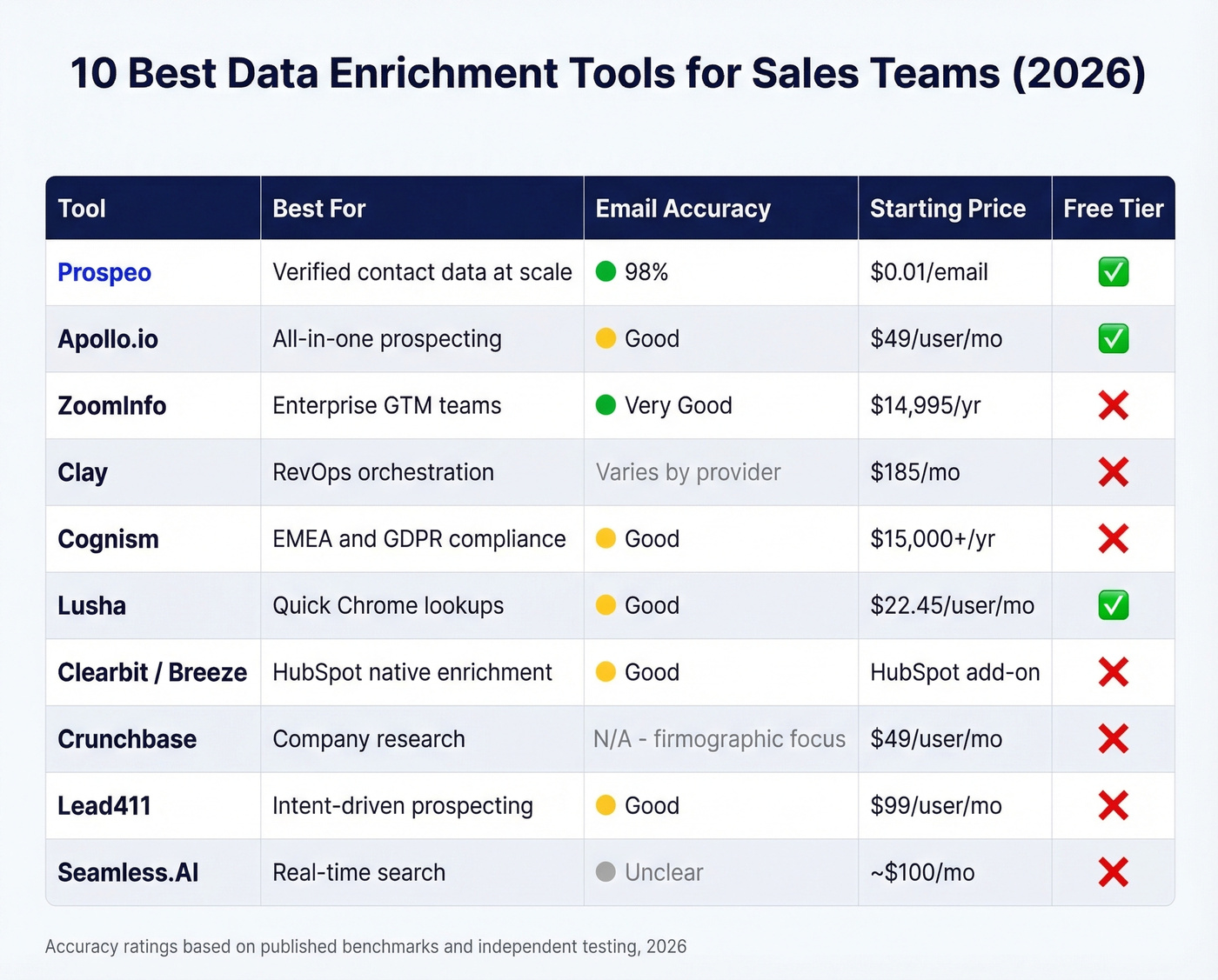
| Best email accuracy + value | Prospeo | 98% email accuracy, 7-day refresh, ~$0.01/email. Free tier, no contracts. |
| Best all-in-one for mid-market | Apollo.io | Sequencing + enrichment in one platform. Free tier, paid from $49/user/mo. |
| Best for RevOps automation | Clay | Orchestrate 150+ data providers. Launch plan $185/mo. |
Need enterprise scale with budget to match? ZoomInfo. EU-focused with GDPR baked in? Cognism. Read on for the full breakdown - including what each tool actually costs per contact.
What Data Enrichment Actually Is
Data enrichment takes your existing lead records - a name, a company, maybe a title - and fills in everything missing. The output falls into four categories: contact data (verified emails, direct dials), firmographics (revenue, headcount, industry), technographics (what software they run), and intent data (signals they're actively researching solutions like yours).
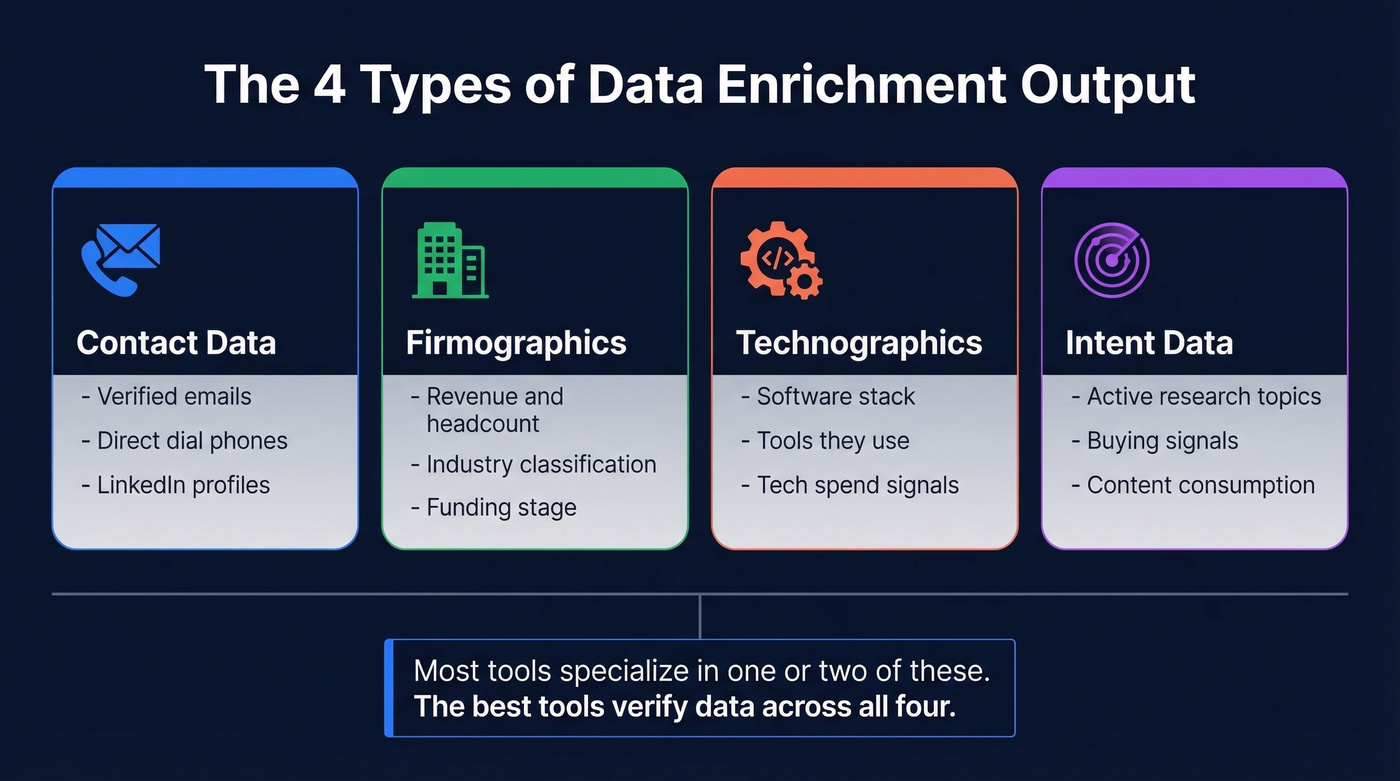
The distinction that matters most is contact enrichment versus company enrichment. Crunchbase excels at telling you a company raised a Series C but can't give you the VP of Engineering's direct dial. Others nail contact data but leave firmographics thin. The best tools do both and verify the data before handing it to you.
Top 10 B2B Data Enrichment Tools
1. Prospeo
Snyk had a problem: 50 AEs prospecting 4-6 hours per week, and their email bounce rate sat at 35-40%. After switching to Prospeo, bounces dropped below 5% and AE-sourced pipeline jumped 180%. That's what happens when your data refreshes every 7 days instead of the industry-standard six weeks.

The database covers 300M+ professional profiles, 143M+ verified emails, and 125M+ verified mobile numbers. The verification pipeline runs five steps - syntax check, domain validation, catch-all handling, spam-trap removal, and honeypot filtering - which is how Prospeo hits 98% email accuracy. Enrichment returns 50+ data points per contact, with a 92% API match rate. Across leads, 83% come back with contact data, and intent data covers 15,000 topics via Bombora.
Integrations span Salesforce, HubSpot, Clay, Zapier, Make, Smartlead, Instantly, and Lemlist. Pricing starts free (75 emails/month), with paid plans at ~$0.01 per email. No annual contracts, no sales calls required.
Use this if: You need verified contact data at scale without enterprise pricing. If you're also comparing providers, see our B2B database rankings.
2. Apollo.io
Apollo bundles a 275M+ contact database with built-in sequencing, a dialer, and workflow automation - making it one of the most popular prospecting and enrichment options for growing teams. The free tier gives you 50 credits/month. Paid plans start at $49/user/month, with Professional at $79/user/month unlocking unlimited email credits under fair-use terms.
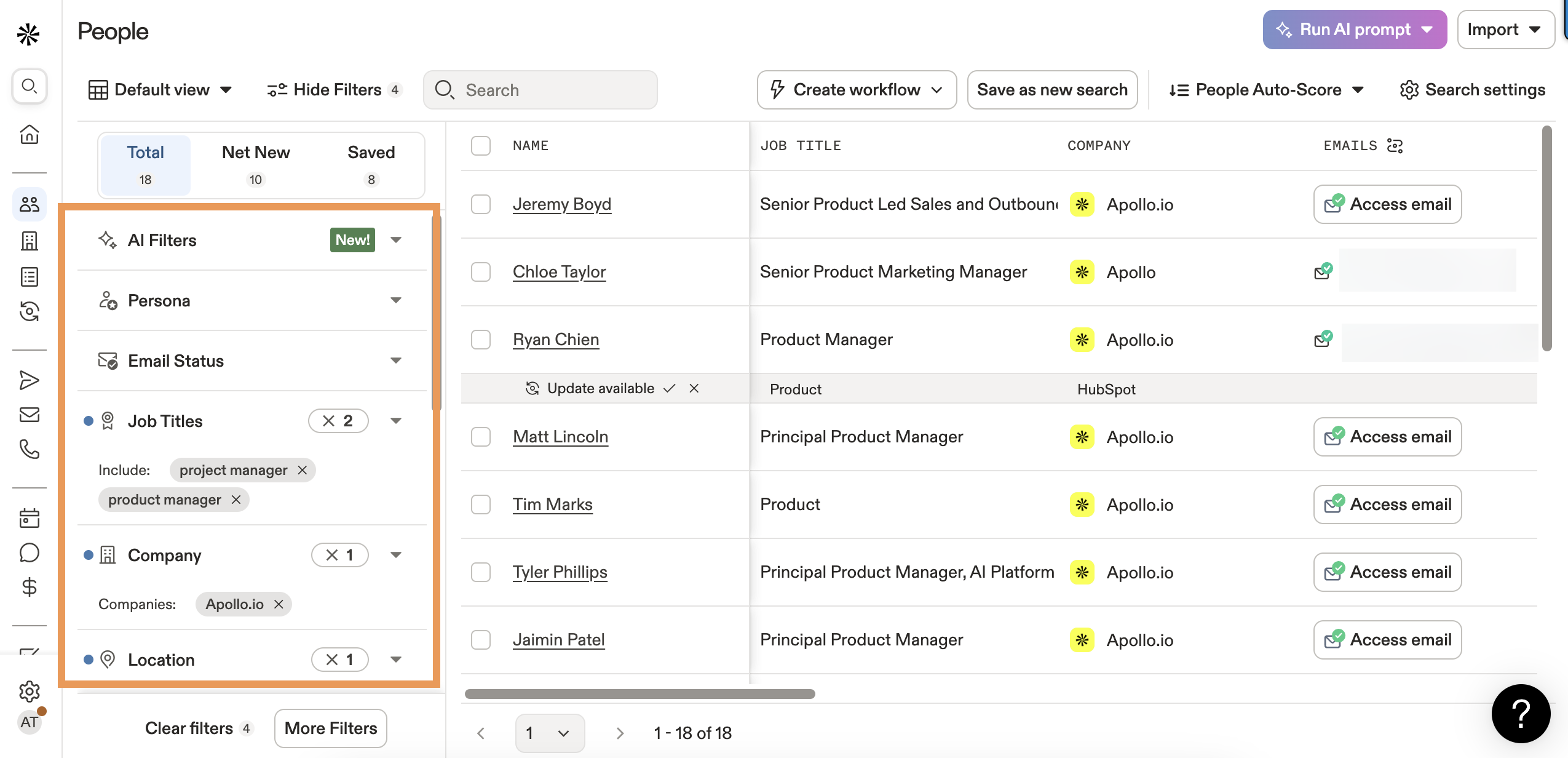
A new SDR can search, build a list, enrich it, and launch a sequence without leaving the app. That speed is Apollo's real advantage. The tradeoff: email accuracy runs noticeably below the 98% benchmark we've seen from dedicated verification tools, especially in EMEA. International coverage is thinner than you'd expect from a database that size.
Best for: Teams that want enrichment and sequencing in one tool, primarily targeting North America. Look elsewhere if email deliverability is your top KPI (see our guide to email verification).
3. ZoomInfo
The 800-pound gorilla - and the platform many sales teams overpay for.
Here's the pricing reality. List prices run Professional+ at $14,995/year, Advanced+ at $29,995/year, and Elite+ at $35,995/year. Nobody pays list. Vendr data shows companies with ~200 employees paying $24,800-$44,200, while 1,000+ employee orgs hit $83,200-$161,900. Negotiate early - examples show teams that renew before contract expiration can eliminate the 10% annual uplift.
The credit math is where it gets painful. Professional includes 5,000 credits - that's about $3/credit baked into your subscription. Need more? Overage blocks run ~$3,000 per 5,000 ($0.60/credit), but you're already ~$15K deep before you buy a single extra. Add-ons pile up: extra users at $2,500 each, Global Data at $9,995, NeverBounce verification at ~$3,000. Contract lock-in is a common complaint on Reddit and G2 alike.
Bottom line: If you're an enterprise team with a $30K+ budget and complex GTM needs, ZoomInfo delivers. Everyone else is overpaying for features they'll never touch. If you're evaluating alternatives, compare approaches in our database providers guide.
4. Clay
Clay isn't a database. It's an orchestration layer that sits on top of 150+ data providers and lets you build enrichment workflows visually. Think of it as Zapier for sales data, with built-in waterfall logic that queries multiple sources until it finds what you need.
The 2026 pricing overhaul simplified things: Launch at $185/month (2,500 Data Credits + 15,000 Actions) and Growth at $495/month with CRM integrations and HTTP APIs. The no-result-no-charge policy is genuinely useful.
There's a recurring Reddit thread where someone asks whether Clay is "worth the cost" and repeats a claim that Clay finds "only 2% more emails" than simpler tools. In our experience, Clay's value isn't the marginal email discovery - it's the data workflows sales intelligence teams can build to eliminate manual enrichment entirely. If you're building workflows, our Clay list building breakdown is a good next read.
Brilliant for ops teams that want to chain providers, deduplicate, and score leads programmatically. Overkill for a five-person team that just needs clean contact data.
5. Cognism
Cognism's play is GDPR-first compliance and manually verified premium phone data. If you're selling into the UK, Germany, or France, Cognism's European coverage is widely considered stronger than most US-first databases. The tradeoff: US coverage is typically weaker than ZoomInfo or Apollo.
Expect a platform fee of $15,000-$25,000 plus $1,500-$2,500 per user per year. Deployments commonly land in the mid-five figures annually. That's a serious commitment, but for teams where EMEA compliance isn't optional, Cognism earns its price (more on requirements in our GDPR compliant database guide).
6. Lusha
Lusha's Chrome extension makes it dead simple to grab contact data while browsing - one click and you've got an email and phone number. The free tier offers 70 credits/month, which sounds generous until you understand the credit math: 1 credit per email, 10 credits per phone number. So that free tier gets you 70 emails or 7 phone numbers. Not both.
Paid plans run Pro at $22.45/user/month (annual, capped at 3 users) and Premium at $52.45/user/month (annual, capped at 5 users). CRM integrations with Salesforce and HubSpot are locked behind the Scale plan - custom-priced and annual only. For quick lookups and small teams, Lusha works. At scale, the credit costs and seat caps force you into enterprise pricing sooner than you'd like.
7. Clearbit / HubSpot Breeze Intelligence
Clearbit is now sold inside HubSpot as Breeze Intelligence. HubSpot uses a credit-based model, and pricing isn't published as a simple standalone table. If you're already deep in HubSpot's ecosystem, it's a natural fit for in-CRM enrichment. As a standalone enrichment tool, it doesn't compete with dedicated platforms. If you're trying to reduce manual work, look at CRM automation options too.
8. Crunchbase
Crunchbase Pro runs $49/user/month and excels at company-level firmographic data - funding rounds, leadership changes, industry classifications. Contact-level enrichment is weak, with separate packages starting at $29/month for 100 contacts. Use it for account research, not prospecting (pair it with a stronger ideal customer profile process).
9. Lead411
Lead411 starts at $99/user/month with Bombora intent data on higher tiers. It's a solid choice for intent-driven prospecting if you want buying signals baked into your enrichment workflow. The database is smaller than Apollo or ZoomInfo, so coverage gaps show up in niche verticals.
10. Seamless.AI
Seamless.AI starts around $100/month, with Pro and Enterprise tiers custom-priced. The fact that they still won't publish transparent pricing in 2026 tells you something. You can't test enrichment quality without paying first - a red flag when competitors offer free tiers. We'd skip this one unless you've exhausted the options above.

You just read that B2B data decays 2.1% per month. Prospeo's 7-day refresh cycle means your enriched records stay current while competitors work off 6-week-old data. 92% API match rate, 50+ data points per contact, 98% email accuracy - at ~$0.01 per email.
Stop enriching leads with data that's already stale.
Real Cost Per Contact
Most enrichment guides list features. Here's what actually matters: what you pay per usable contact. We've run the math across dozens of team configurations, and the spread is staggering.
| Tool | Cost/Email | Cost/Phone | ~Annual Cost (10-Seat Team) |
|---|---|---|---|
| Prospeo | ~$0.01 | ~$0.10 | $1,200-$3,600 |
| Apollo.io | Included | Limited | $5,880-$9,480 |
| Lusha | Credit-based | Credit-based | $2,694-$6,294 |
| Clay | Varies by provider | Varies by provider | $2,220-$5,940 |
| ZoomInfo | ~$0.60/credit (overage) | Included | $30,000-$75,000 |
| Cognism | Custom | Custom | $25,000-$50,000 |
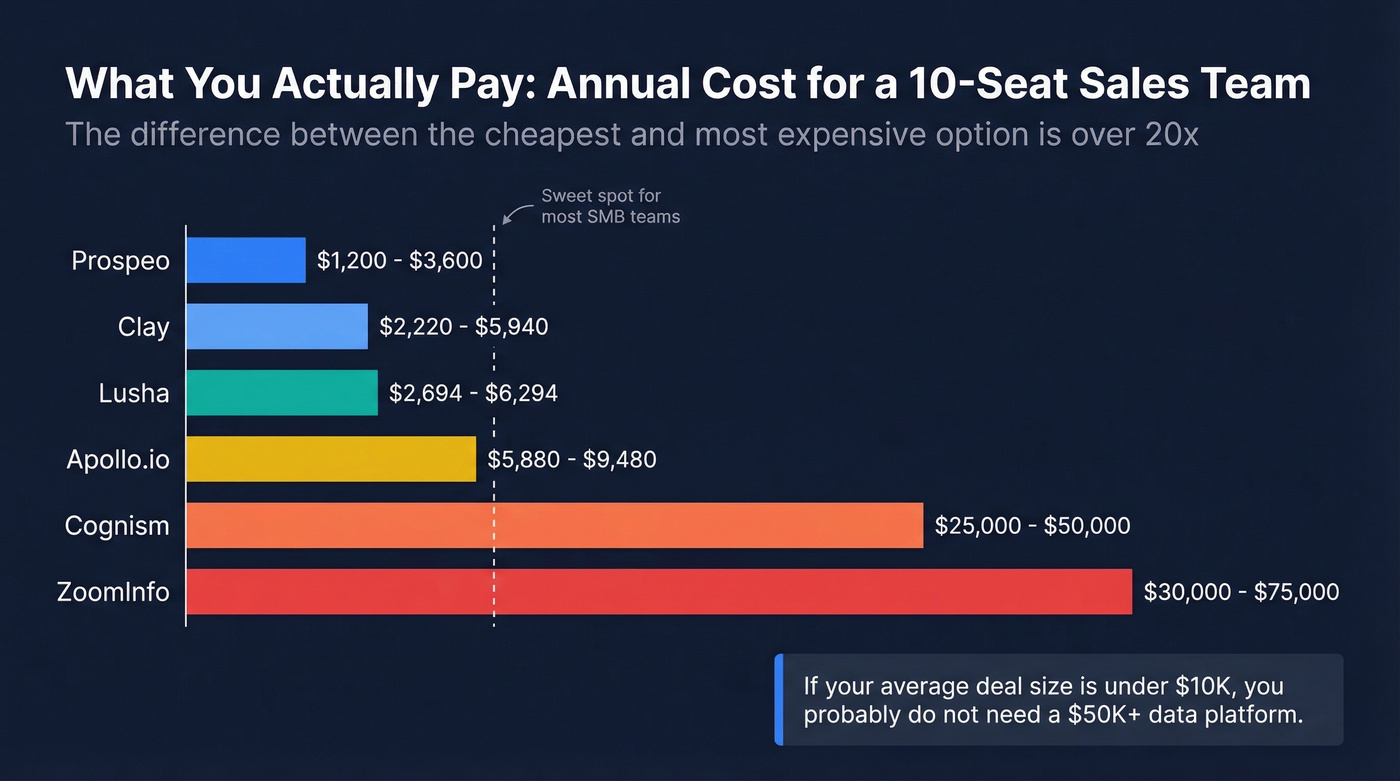
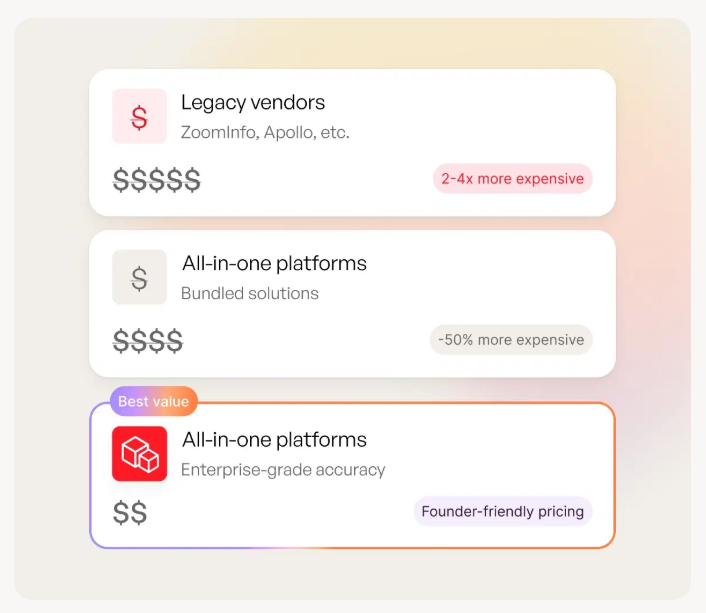
Look at that spread. For a 10-person team doing serious outbound, you're choosing between $3,600/year and $75,000/year. The data quality gap doesn't justify a 20x price difference.
Here's the thing: if your average deal size sits below $10K, you almost certainly don't need ZoomInfo-level data. A tool at $0.01/email with 98% accuracy will outperform a $3/credit platform that your reps barely log into. Spend the savings on better sequencing or more SDR headcount (or steal a few pipeline generation ideas).
How to Choose the Right Tool
Two mental models matter here: aggregation-first and platform-first.
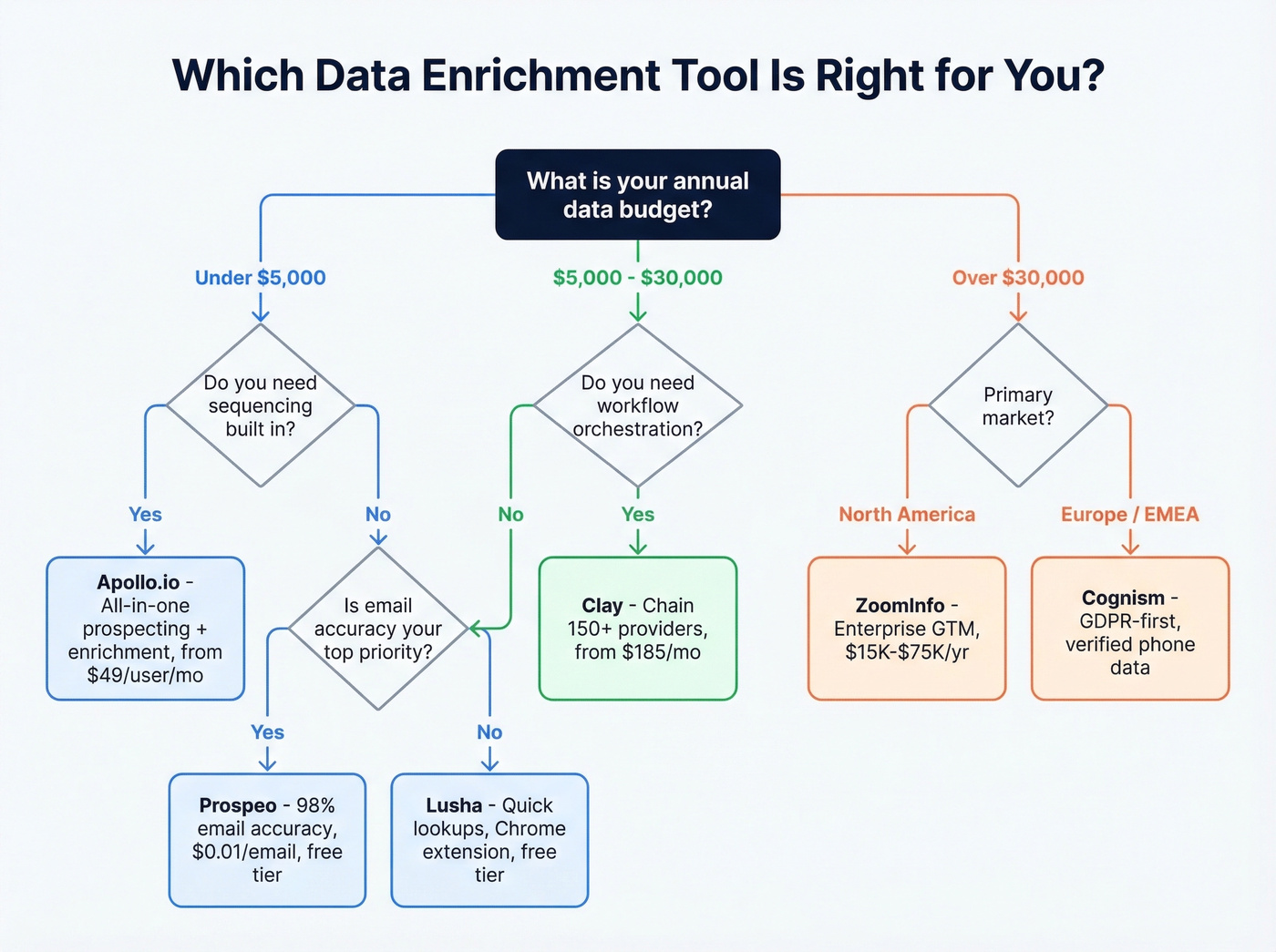
Aggregation-first tools pull data from multiple sources, verify it independently, and hand you clean records. You control the workflow. Platform-first tools embed enrichment inside your CRM with built-in governance. You trade flexibility for convenience.
Three questions to answer before you pick:
- What's your annual budget for data? Under $5,000 means Apollo or a dedicated contact data tool. Over $30K opens the door to ZoomInfo and Cognism.
- Do you need enrichment inside your CRM or as a standalone workflow? Platform-first if you live in HubSpot. Aggregation-first if you run outbound through dedicated sequencers (see our outbound email automation picks).
- How important is global coverage? Cognism for EMEA, Apollo or ZoomInfo for North America.
One more operational distinction worth calling out: real-time enrichment (enriching form fills and website visitors as they arrive) versus batch enrichment (cleaning your CRM or CSV lists periodically). Most B2B enrichment platforms support both modes, but the quality of real-time enrichment varies significantly by provider.
Set an enrichment cadence too. Active prospects should be re-enriched every 30-90 days. Dormant records in your CRM can stretch to 90-180 days. Anything older than six months without a refresh will drive bounces.
Waterfall Enrichment: Why Single-Source Is Dead
When a single data provider can't find a contact's email or phone, waterfall enrichment queries a second provider, then a third, until the data is found or all sources are exhausted. The performance lift is real: 80%+ contact discovery rates versus 40-50% from a single source.
The catch is compliance. Each provider in your waterfall has different data provenance, consent mechanisms, and retention policies. Cognism's team has flagged that combining providers who scrape different databases can create GDPR exposure you didn't plan for. Use providers with transparent sourcing and zero-trust data partner policies, and pair them with an orchestration layer like Clay that handles deduplication automatically.
If you're running single-source enrichment in 2026, you're leaving ~30-40 points of discovery rate on the table. Build a waterfall. Just do it with providers you trust.
Snyk cut bounce rates from 35-40% to under 5% and grew AE-sourced pipeline 180% - all by switching to a data enrichment tool that actually verifies what it returns. Prospeo's 5-step verification pipeline, 143M+ verified emails, and 83% enrichment match rate deliver the contact data your sales team needs.
Enrich your first 75 leads free - no contract, no sales call.
FAQ
What is data enrichment in sales?
Data enrichment adds missing information - verified emails, phone numbers, firmographics, technographics, intent signals - to your existing lead records. It transforms a name and company into a contactable, qualified prospect with 50+ data points, enabling personalized outreach at scale instead of manual research.
How much do sales enrichment tools cost?
Self-serve tools start at ~$0.01/email with free tiers. Mid-market platforms like Apollo run $49-$79/user/month. Enterprise solutions like ZoomInfo typically cost $30,000-$75,000/year after negotiation, with add-ons pushing costs higher.
What's the difference between enrichment and lead generation?
Lead generation finds new prospects you didn't know about. Data enrichment fills in missing data on prospects you already have. Many tools do both - combining a searchable database with CRM and CSV enrichment - but the core functions are distinct.
How accurate are data enrichment tools?
Accuracy ranges from 70% to 98% depending on the provider, region, and data type. Top-tier tools run multi-step verification including catch-all handling, spam-trap removal, and honeypot filtering. Prospeo's 5-step pipeline delivers 98% email accuracy; most competitors land between 79% and 87%.
What is waterfall enrichment?
Waterfall enrichment queries multiple data providers sequentially until contact information is found. It lifts discovery rates from 40-50% (single source) to 80%+, but adds compliance complexity when combining providers with different data provenance and consent policies.