

10 Pipeline Generation Ideas That Produce Revenue, Not Vanity Metrics
84% of reps missed quota last year. Not because they lacked leads - because the leads they had didn't convert.
The "pipeline inflation" pattern is showing up hard in 2026: MQL volume up 20-30%, close rates down 15%, and enterprise sales cycles 25% longer. More names, more activity, same revenue. Or worse.
The fix isn't more pipeline generation ideas. It's better ones. 79% of marketing leads never convert because they lack a "why now" trigger. Buying committees average 7 people across roughly 10 interaction channels, and 92% already have a vendor in mind before they start evaluating. So the real question isn't "how do I fill the funnel?" - it's "how do I generate pipeline that actually closes?"
Start Here
If you only implement one idea from this list, make it the multi-touch outbound sequence (Idea #1). If you've got budget for ABM, add signal-based outreach (Idea #2). And before running any play, verify your prospect list. Bad data kills every idea on this page before it starts.
What Healthy Pipeline Actually Looks Like
Here are the stage conversion benchmarks that separate healthy pipelines from inflated ones:
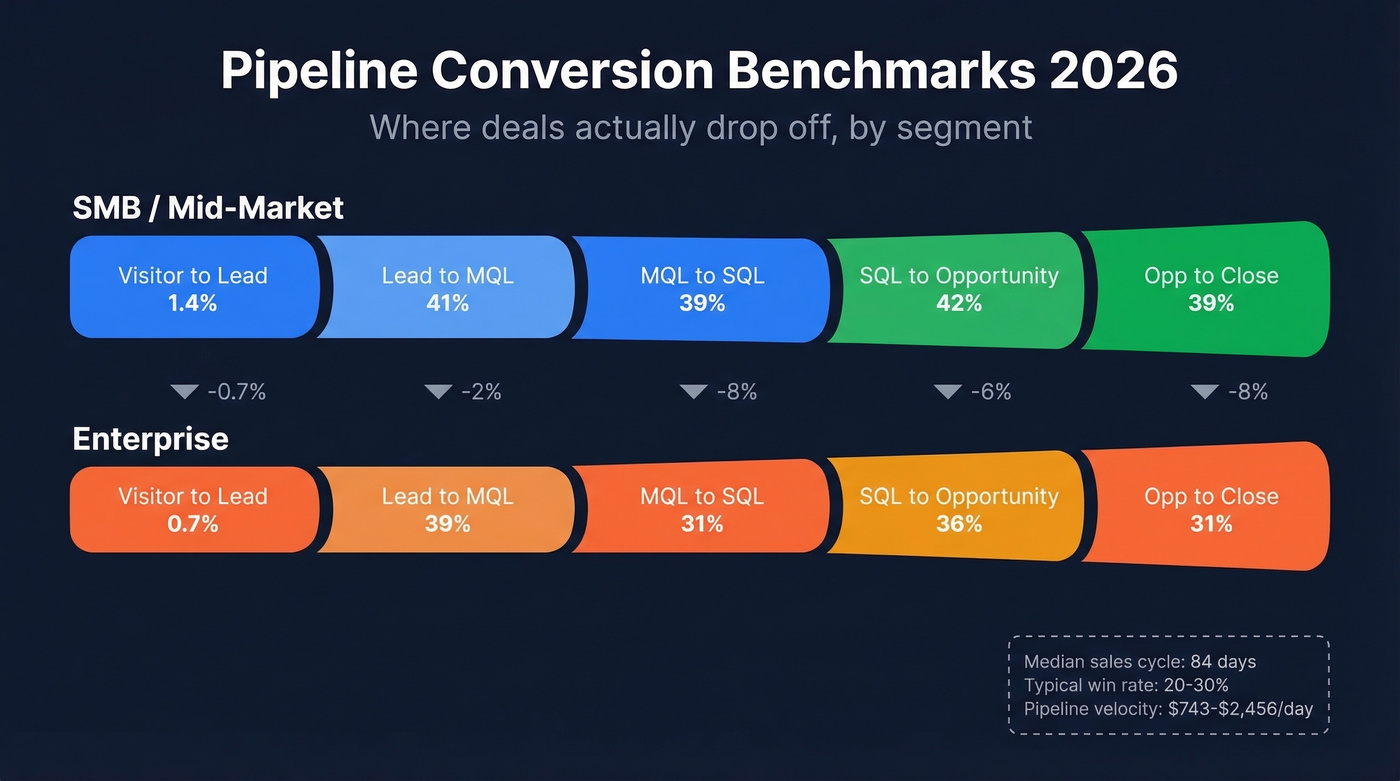
| Stage | SMB/Mid-Market | Enterprise |
|---|---|---|
| Visitor to Lead | 1.4% | 0.7% |
| Lead to MQL | 41% | 39% |
| MQL to SQL | 39% | 31% |
| SQL to Opportunity | 42% | 36% |
| Opp to Close | 39% | 31% |
The median B2B sales cycle runs 84 days, with a typical win rate of 20-30% and pipeline velocity between $743-$2,456/day. Channel matters too - SEO leads convert MQL-to-SQL at 51%, while PPC sits at 26% and events at 24%.
Optimizing for MQL volume instead of pipeline velocity is how you end up with a bloated funnel and a missed quarter. Knowing these numbers - and actually tracking against them - is one of the most important pipeline building habits you can adopt.

Every pipeline generation idea on this list dies if your contact data bounces. Prospeo delivers 98% email accuracy on 300M+ profiles with a 7-day refresh cycle - so your multi-touch sequences actually reach real buyers. Snyk's 50 AEs saw pipeline jump 180% after switching.
Stop feeding dead emails into your pipeline. Fix the data first.
10 B2B Pipeline Strategies That Close
Idea 1: Multi-Touch Outbound (Not 3 Emails)
A bootstrapped SaaS team on Reddit reported 8x-ing their pipeline in two weeks using a 9-15 touchpoint sequence: email chains, then social engagement, then social messages, then calls last. Their cold call opener? "I'll be honest, this is a cold call, but it's a well-researched cold call. Can I have 30 seconds?"
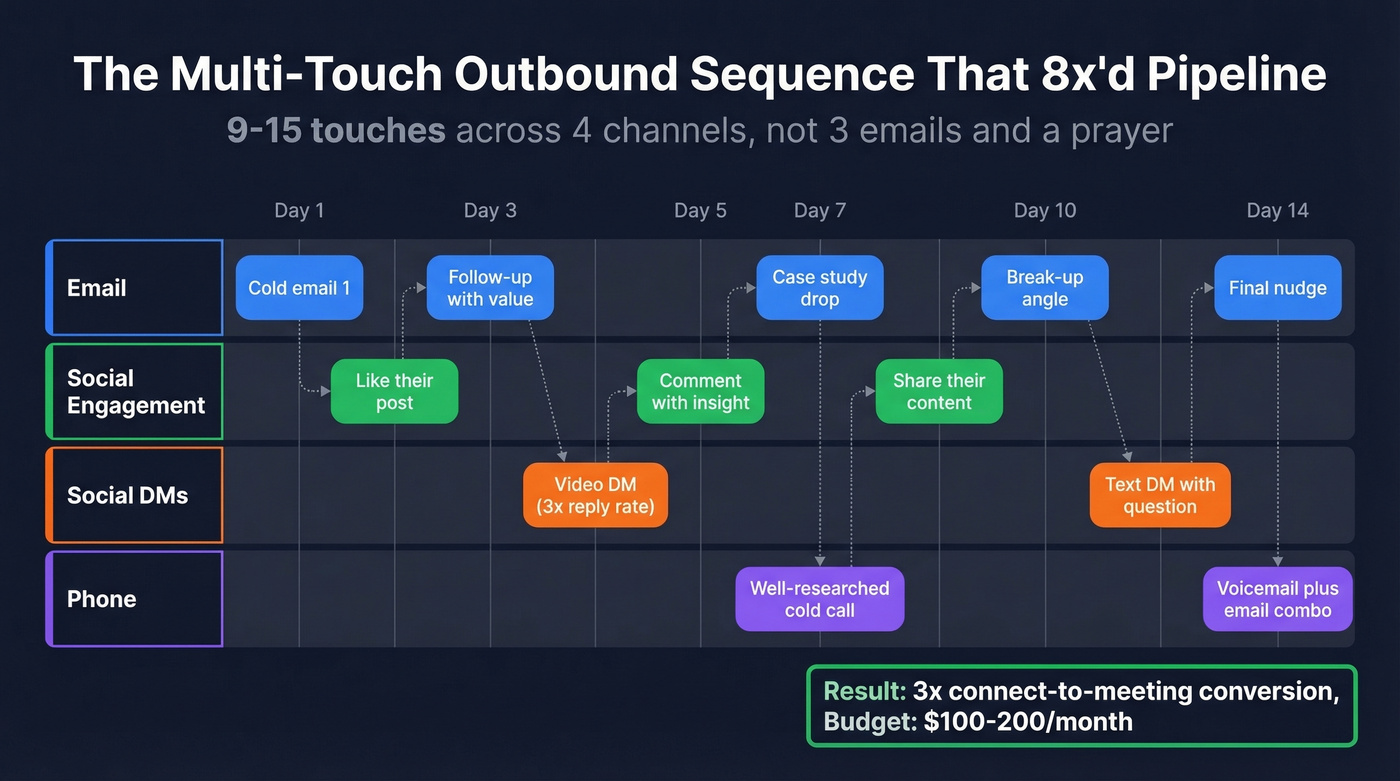
Connect-to-meeting conversion tripled. Budget was $100-200/month. With buying committees averaging 7 people, multi-threading across channels isn't optional - it's how you reach the full decision unit. We've tested variations of this approach internally, and the key insight holds: sequencing matters more than any single channel. (If you need a starting point, use these sales prospecting techniques to structure daily outreach.)
Idea 2: Target Buying Signals, Not Static Lists
Static lists are dead weight. Signal-based selling means prioritizing outreach based on real-time triggers: pricing page visits get immediate follow-up, job changes get new-role outreach, funding rounds get a scale angle. Start with 2-3 high-impact signals and build templated plays for each.
Prospeo makes this practical - its intent data tracks 15,000 topics via Bombora, and you can layer that with 30+ filters like job changes, headcount growth, funding, and technographics across 300M+ professional profiles. Snyk's 50 AEs saw AE-sourced pipeline jump 180% after switching to verified, signal-enriched data. To operationalize this, borrow a simple framework for identifying buying signals.
Idea 3: Send Video Instead of Text
That same bootstrapped SaaS team found that sending video DMs instead of text produced roughly 3x higher response rates. Async video works for meeting requests too. Personalize the thumbnail with the prospect's name or company logo - it stops the scroll. Loom has a free tier that makes this a zero-budget play. (If you want a tighter playbook, see Loom video cold email.)
Idea 4: Launch Podcast ABM
Invite decision-makers at target accounts as podcast guests. Build a Dream 100 list, frame outreach as value-first, and repurpose episodes into clips to multi-thread within the account. It's relationship-building disguised as content marketing, and it works because the prospect gets something real out of it.
Skip this if your deal size is under $25k or your sales cycle is under 30 days. The ROI math doesn't work for transactional sales.
Idea 5: Dynamic Microsites for Target Accounts
Hyper-personalized landing pages tailored to individual accounts and buying stage. Coordinate timing with outbound sequences so the prospect hits a page that speaks directly to their pain. UserLed has good examples of how teams execute this without a dev team. The effort is real - you're building custom pages - but for enterprise deals, one closed account pays for months of production.
Idea 6: Win the Day One Shortlist
Here's the thing: 92% of buyers start research with at least one vendor in mind. The pre-contact favorite wins roughly 80% of deals. Pipeline generation isn't just outbound - it's demand creation before the evaluation starts. Content, community, and brand awareness aren't "nice to haves." They're pipeline plays. (If you need a system, start with B2B brand positioning.)
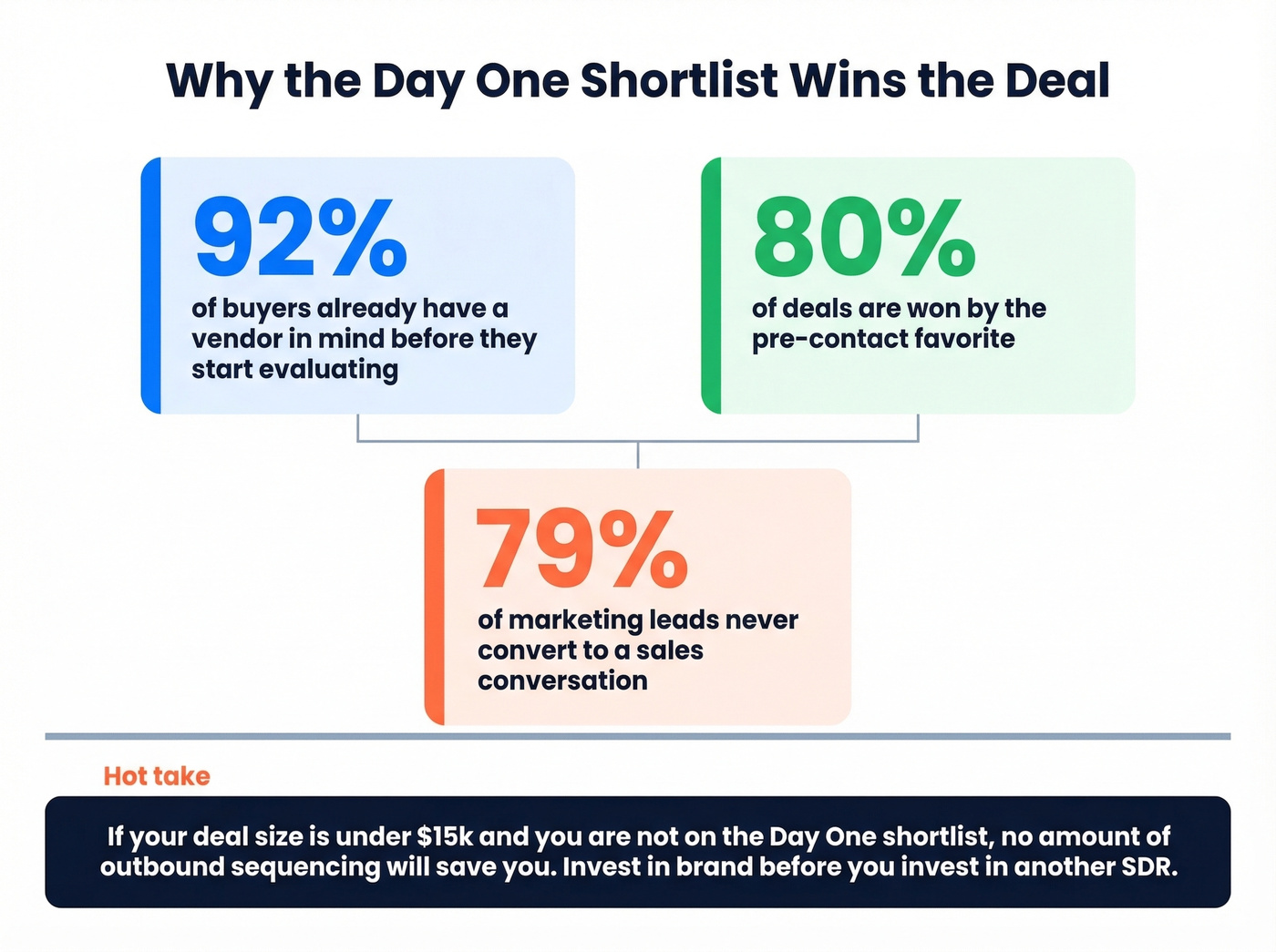
Hot take: If your deal size is under $15k and you're not on the Day One shortlist, no amount of outbound sequencing will save you. Invest in brand before you invest in another SDR.
Idea 7: Referral and Co-Marketing Engine
Partner with complementary vendors. Co-host webinars, swap email lists, create joint content. Referral leads convert at higher rates and shorter cycles than cold outbound because trust transfers. We've seen teams under 50 people generate 20-30% of their pipeline from partnerships alone - yet most ignore this channel entirely because it doesn't fit neatly into a dashboard.
Idea 8: Interactive Demos as Pipeline Entry
PLG-style self-serve demos that qualify prospects before a sales conversation. They capture intent data and work as landing pages for outbound sequences. Used well, they turn "curious" traffic into qualified meetings without adding SDR headcount. For teams selling technical products, this is often the highest-converting top-of-funnel asset you can build. (Use this product demo checklist to tighten the flow.)
Idea 9: Optimize Cold Email for Reply Rate
4-6 email sequences drive up to 50% higher reply rates versus single-touch sends. Email ROI sits at $36-40 per $1 spent - still the highest of any channel. Cold email benchmarks: 15-25% open, 1-5% reply, 0.2-2% conversion.
But your sequences are only as good as your contact data. When list quality is bad, bounce rates hit 35-40% and your domain reputation craters. Prospeo's 98% email accuracy and 7-day refresh cycle exist specifically to solve this - bad data is the silent killer of outbound, and it's the easiest problem to fix. If you're diagnosing deliverability, start with email bounce rate and then work through an email deliverability guide.
Idea 10: Time-Block Pipeline Gen Daily
Not "when I have time" - scheduled. Example: 10:00-11:30 and 2:00-3:00. The team that 8x'd their pipeline didn't discover a magic tactic. They committed to a daily habit. Consistency beats tactic-hopping every time.
Pick Two, Not Ten
You don't need ten strategies. You need 2-3 executed daily.
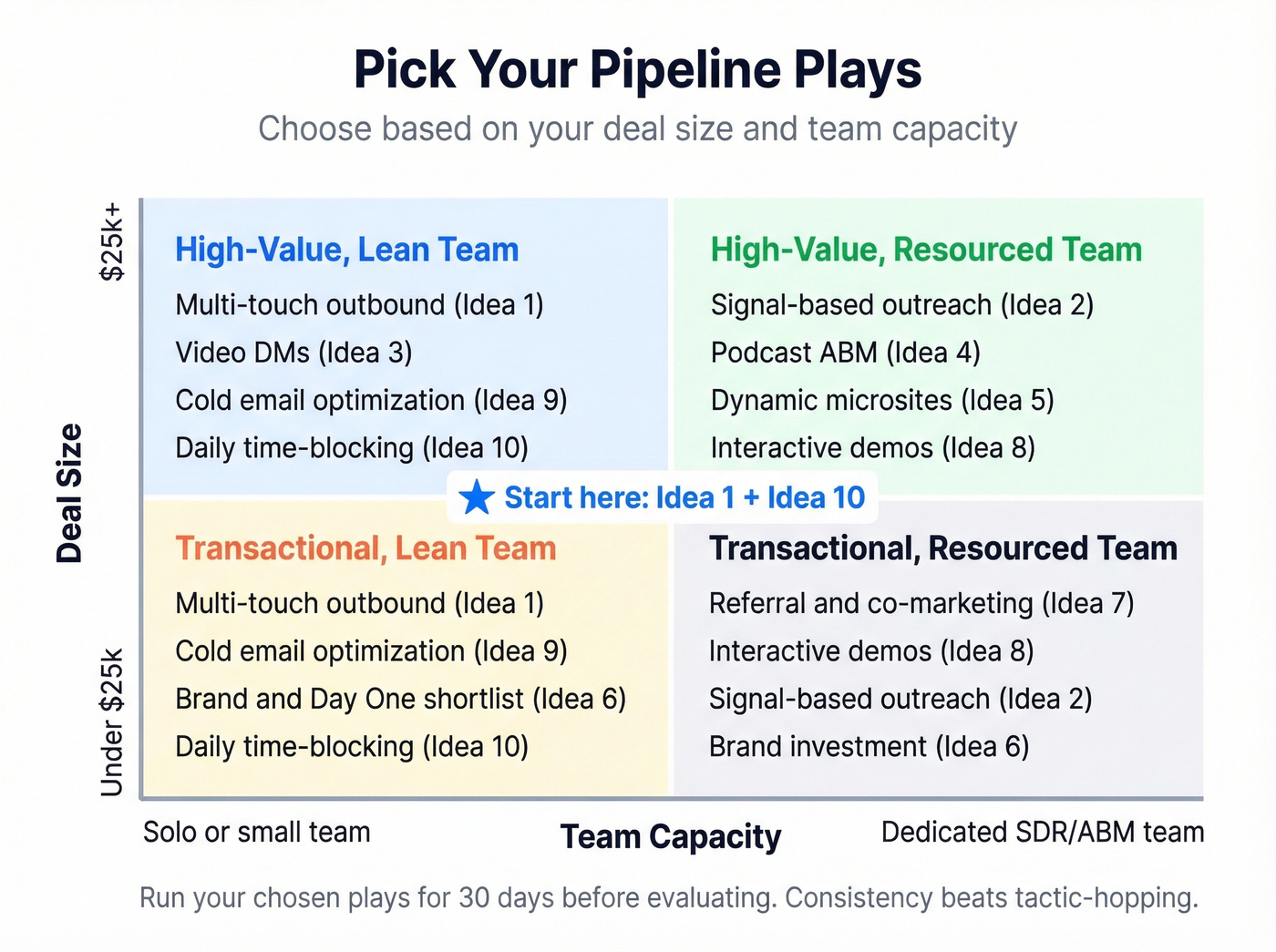
Let's be honest - we've seen teams try to run every play simultaneously and end up doing none of them well. Pick the multi-touch sequence (Idea #1) as your foundation. Add one signal-based or content-led play on top. Time-block it. Run it for 30 days before you evaluate.
Remember the pipeline inflation problem from the intro? This is how you solve it - not by adding more volume, but by going deeper on fewer plays with better data and better targeting. The teams that win at pipeline generation aren't the ones with the most creative playbook. They're the ones who actually execute.
Mistakes That Kill Pipeline Results
Five anti-patterns that quietly destroy pipeline coverage, no matter how good your strategy is.
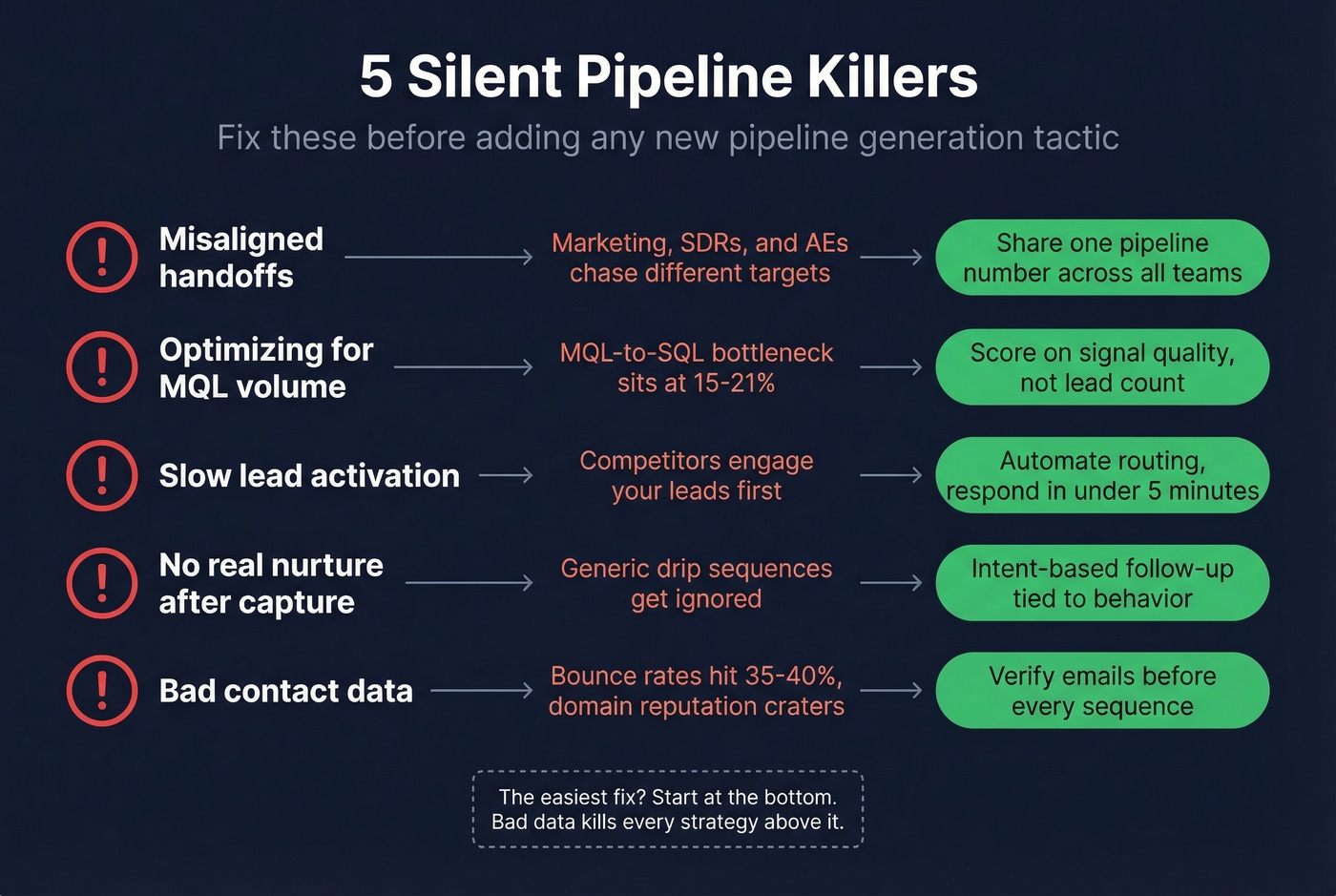
Misaligned handoffs. Marketing optimizes for MQLs, SDRs for activity, AEs for quota - nobody shares a pipeline target. Enterprise AEs on Reddit frequently describe having zero inbound and sharing one BDR across multiple reps. Fix alignment first, or nothing else matters.
Optimizing for MQL volume over signal quality. The MQL-to-SQL bottleneck sits at 15-21% for a reason. More leads doesn't equal more pipeline.
Slow lead activation. Manual routing means competitors engage first. Speed-to-lead is a competitive advantage, not an ops detail.
No nurture after capture. Generic drip sequences don't count. Intent-based follow-up does. If someone downloaded your whitepaper and you're sending them a "just checking in" email three weeks later, you've already lost. (Use these sales follow-up templates to keep it specific.)
Bad contact data tanking everything. When bounce rates hit 35-40%, your domain reputation craters and none of these strategies work. This is the easiest problem to fix and the one most teams ignore the longest.
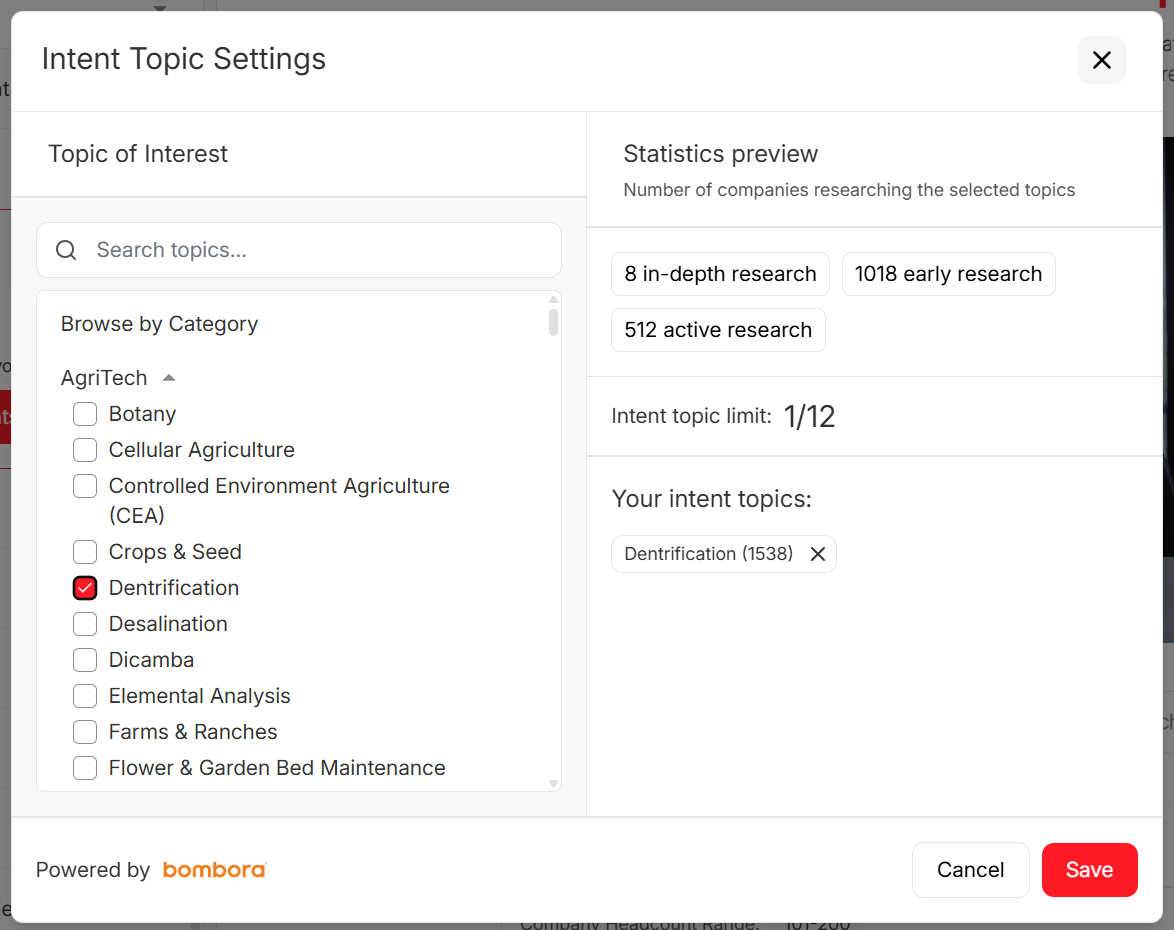
Signal-based selling needs signal-rich data. Prospeo layers Bombora intent data across 15,000 topics with 30+ filters - job changes, funding, headcount growth, technographics - so you target accounts with a 'why now,' not a static list. All at $0.01 per email.
Generate pipeline that closes, not pipeline that inflates your CRM.
FAQ
What's the difference between pipeline generation and lead generation?
Lead generation fills the top of the funnel with names. Pipeline generation creates qualified opportunities that move through stages toward revenue. The distinction matters - 79% of marketing leads never convert to a sales conversation. Effective pipeline building focuses on quality signals and multi-threaded engagement rather than raw lead volume.
How long do pipeline generation results take?
Outbound sequences can produce meetings within 1-2 weeks - the 8x pipeline case study saw results in 14 days. Content and brand-driven demand creation takes 3-6 months. The average B2B buying cycle runs 10.1 months, so the best time to start was last quarter.
What tools do I need for B2B pipeline generation?
At minimum: a CRM (HubSpot or Salesforce), a sequencing tool (Instantly, Lemlist, or Smartlead at $30-100/month), and a verified contact data source. Prospeo offers a free tier with 75 emails/month and paid plans at roughly $0.01/email. The 98% email accuracy prevents the domain reputation damage that kills outbound before it starts.
What's a realistic pipeline conversion benchmark?
For mid-market B2B, expect 39% MQL-to-SQL, 42% SQL-to-Opportunity, and a 20-30% win rate. Pipeline velocity should land between $743-$2,456/day. If your MQL-to-SQL rate is below 20%, your lead quality - not your volume - needs work.