

10 Sales Prospecting Techniques That Actually Work in 2026
It's Monday morning. Your pipeline report is open, and the number at the top hasn't moved in two weeks. You're not alone - 84% of reps missed quota last year, and 67% don't expect to hit it this year either. The problem isn't effort. It's that most sales prospecting techniques were built for a buying environment that no longer exists.
What You Need (Quick Version)
The quota crisis is real, but the fix isn't more techniques - it's better execution of fewer ones. The three highest-ROI moves right now: prospect based on buyer signals instead of static lists, run a structured multi-channel cadence with verified data, and use AI to personalize at scale.
Reps spend just 37.67% of their time actually selling. The other 62% disappears into admin, CRM hygiene, and chasing bad contact data, while 69% of B2B salespeople say they don't have enough leads to make quota. Below you'll find exact benchmarks, a day-by-day cadence template, and the tools to execute.
Why Old Prospecting Methods Fail
The buyer you're reaching out to in 2026 isn't the same buyer from 2020. Gartner projected that 80% of B2B sales interactions would be digital by 2025, and that's largely played out. Buyers now use an average of 10 interaction channels, up from 5 in 2016.
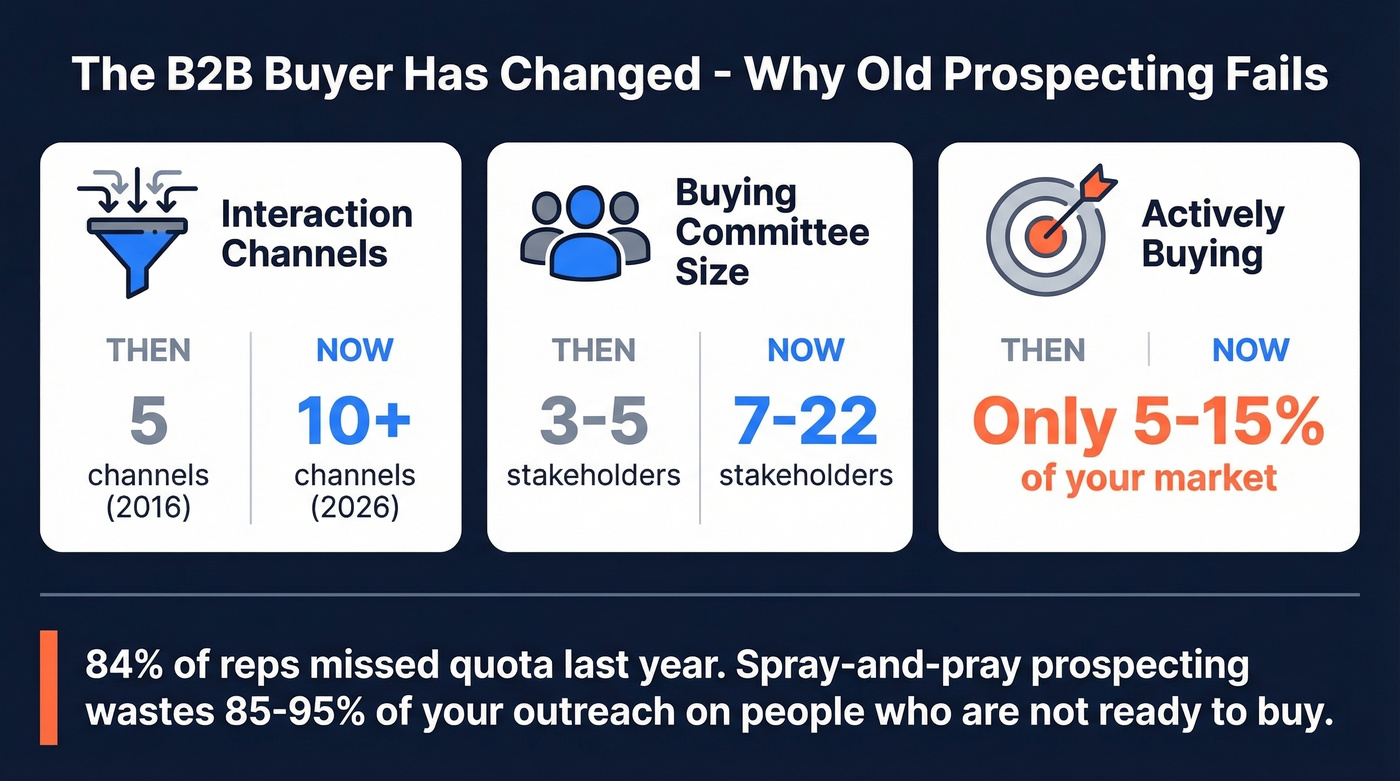
Buying committees have expanded too. Mid-market decisions often involve around 7 stakeholders, and in enterprise deals, buying groups can balloon to 22 or more. Here's the stat that should reshape your entire approach: only 5-15% of your total addressable market is actively buying at any given time. Spray-and-pray prospecting means you're interrupting the 85-95% who aren't ready. Signal-based selling - reaching the right people at the right moment - is the 2026 meta, and traditional methods like batch-and-blast email or cold-calling purchased lists simply can't keep up.
RAIN Group's WAVE framework captures this shift well: the best prospectors set 2.7x more meetings because they run structured attraction campaigns, not random acts of outreach. Winner's Mindset, Attraction Campaign, Value, Execution - it's a useful mental model for everything that follows.
10 Techniques Backed by Data
1. Define Your ICP First
58% of sales meetings aren't valuable to buyers. That's a targeting problem, not a volume problem. Before you write a single email, nail these four criteria:
- Industry + company size that matches your best customers' profile
- Department and seniority of the actual decision-maker, not just the person who'll take a meeting
- Technographic fit - do they use tools your product integrates with or replaces? (More on firmographic and technographic data.)
- Growth signals - headcount growth, recent funding, or hiring in relevant departments
A tool like Prospeo with 30+ search filters covering technographics, headcount growth, funding stage, and department size turns this from a spreadsheet exercise into a 5-minute workflow.
2. Prospect on Buyer Signals, Not Lists
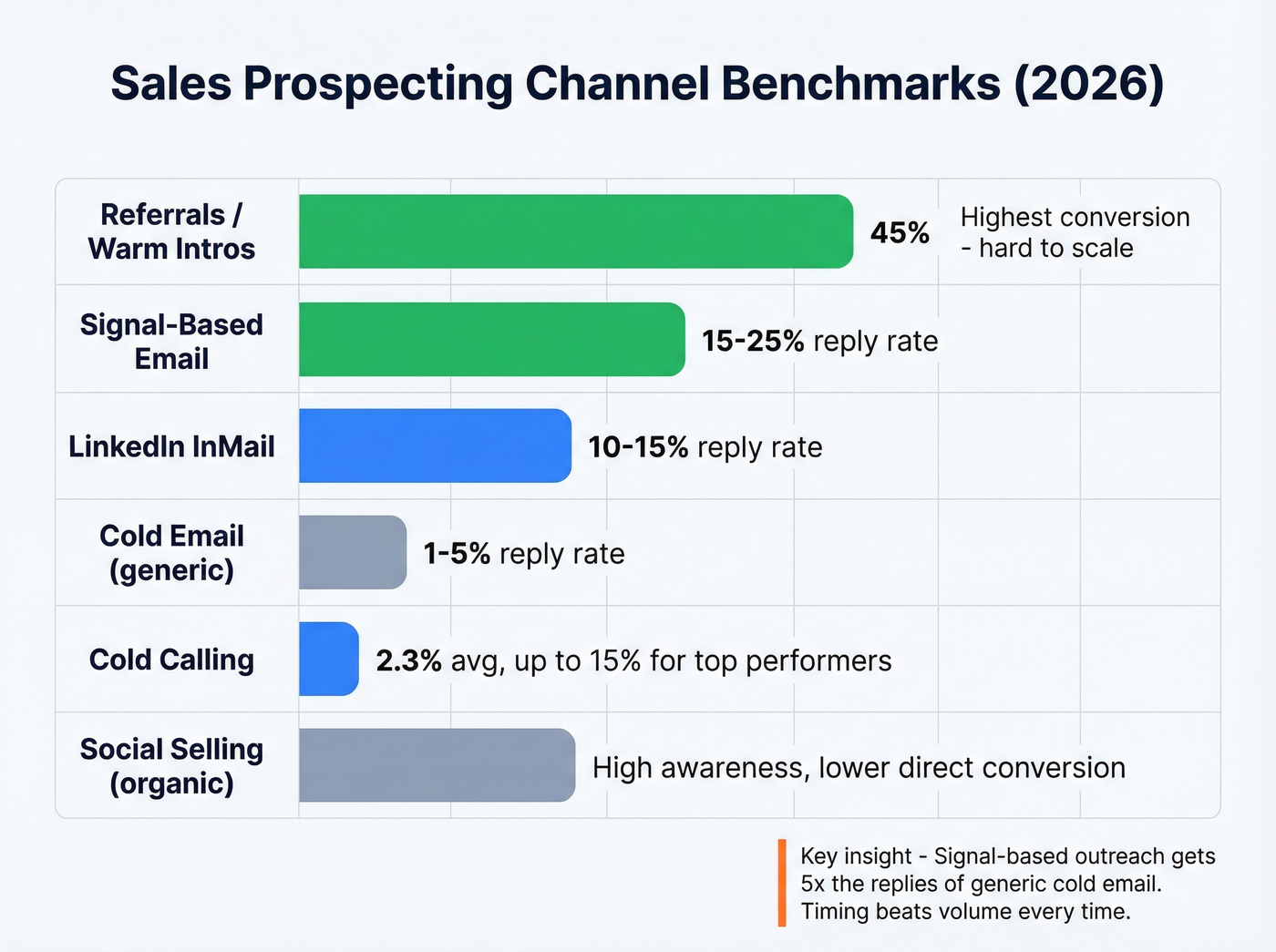
This is the single biggest shift in prospecting over the past two years. Static lists - "all VPs of Marketing at companies with 200-500 employees" - cast too wide a net. Signal-based outreach achieves 15-25% reply rates compared to 1-5% for generic cold email. The difference is timing.
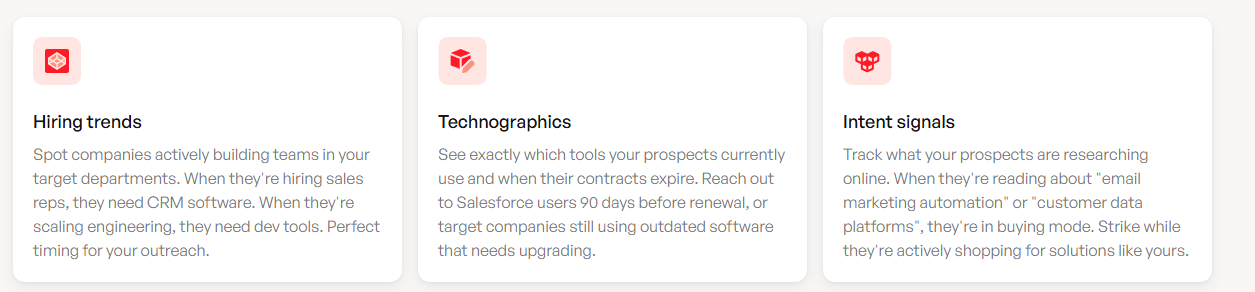
Six signal types that matter most:
- Website activity - pricing page visits, repeated blog engagement
- Job changes - new VP just landed and is building their stack
- Funding rounds - fresh capital means new budget
- Tech stack changes - they just installed or dropped a competitor
- Keyword search spikes - surging interest in your category
- Hiring sprees - posting roles that signal a problem you solve
The concept of "signal density" is worth internalizing. A single signal - say, a job change - is interesting. But when you see a new VP of Sales at a company that just raised a Series B and is hiring 5 SDRs? That's signal density. That account goes to the top of the list.
3. Build a Multi-Channel Cadence
Single-channel outreach is dead. Multi-channel sequences drive 250% higher conversion than sticking to one channel. The sweet spot is 8-12 touchpoints spread across 17-21 days. (If you want a deeper build, use this B2B cold email sequence framework as the backbone.)
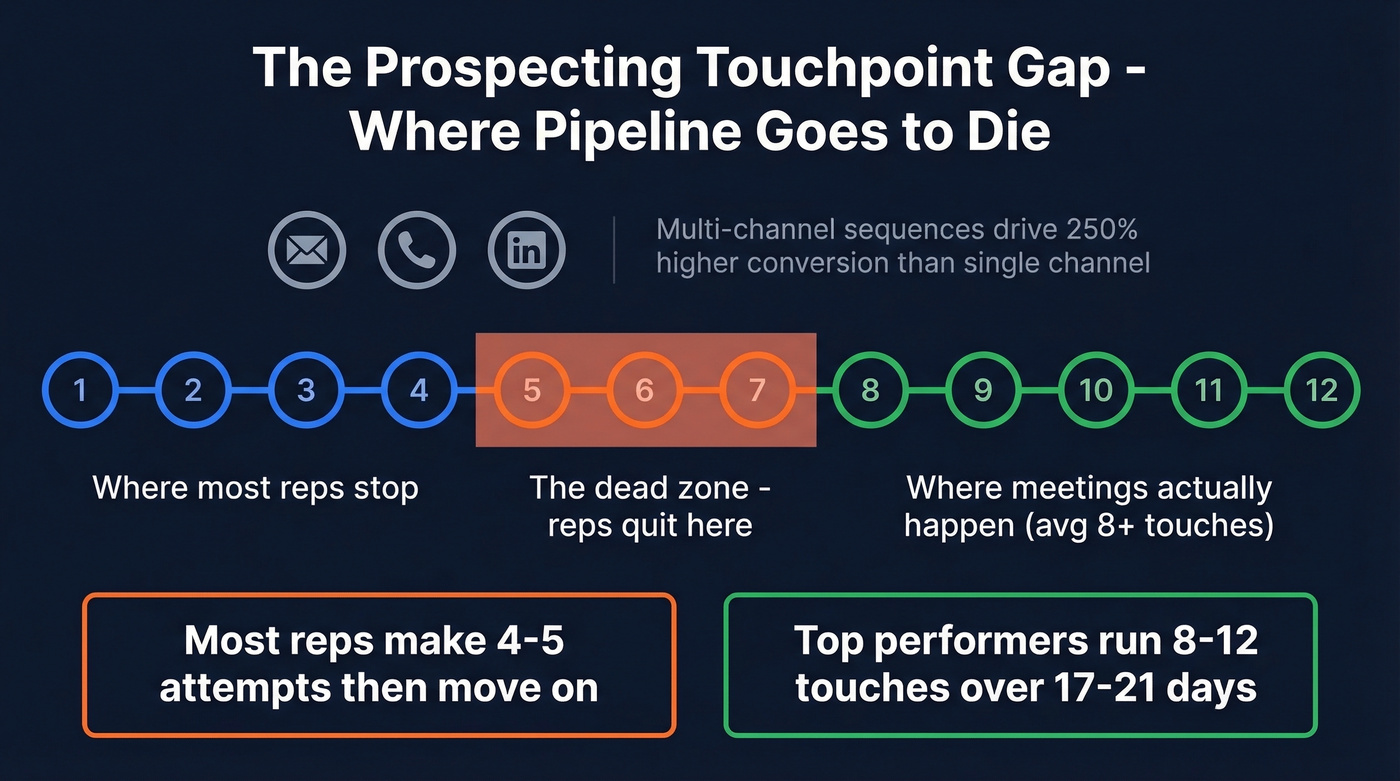
Most reps quit at touch 4 or 5. RAIN Group's research shows meetings require around 8 touches on average. The gap between "where reps stop" and "where meetings happen" is where pipeline goes to die. McKinsey research shows systematic sales engagement processes drive 10-20% pipeline improvements through consistent execution alone. We've included a full day-by-day template below.
4. Personalize at Scale with AI
56% of sales professionals now use AI daily, up 133% since 2023. Sellers who effectively partner with AI are 3.7x more likely to meet quota. With a fully loaded SDR costing ~$139K/year, AI that saves even 30 minutes per day per rep pays for itself in weeks.
The practical application isn't "let AI write all your emails." Signal-based personalization hits 18% response rates vs. 3.4% for generic outreach. The workflow: identify a signal (job change, funding round, intent spike), feed the context to your AI tool, review the output, send. What used to take 15 minutes per prospect now takes 90 seconds. If you're building this into your process, see AI cold email outreach for a practical playbook.
5. Master the Cold Call
Cold calling converts at 2.3% on average. That sounds terrible until you realize 49% of buyers prefer to be contacted by phone, and 57% of C-suite and VP-level buyers prefer it over any other channel.
Use this if: You're selling to director+ roles, your deal size justifies the time investment, and you have verified direct dials. Top performers convert up to ~15% of conversations into meetings.
Skip this if: You're running high-volume outbound to mid-level contacts where email scales better, or your mobile data is garbage. Calling switchboards is a waste of everyone's time.
It takes an average of 8 attempts to reach a prospect. Verified mobile numbers with a 30% pickup rate make those attempts count - without them, you're dialing into voicemail purgatory. If you need a repeatable process, build a cold calling system before you scale attempts.
6. Write Cold Emails That Get Replies
The average cold email response rate sits at 5.1%, with most campaigns landing between 1% and 5%. Anything above 5% is exceptional. If you're sending 100+ emails a day, even a 1% improvement in reply rate means one extra conversation daily - roughly 20 more meetings per month.
Keep emails between 75-100 words. Lead with a signal or insight specific to the prospect's situation, not a feature dump. And here's the uncomfortable truth: roughly 20% of cold emails get flagged as spam before anyone sees them. Deliverability isn't a nice-to-have; it's the prerequisite. If your bounce rate is above 5%, fix your data before you touch your copy. Use these sales follow-up templates to keep the cadence tight without bloating word count.
7. Use Social Selling Strategically
InMail response rates run 10-15%, roughly double what cold email delivers. One analysis found a 46% lift in InMail acceptance when the seller indicates at least one shared commonality - mutual connections, same school, shared group.
Social selling isn't about posting thought leadership and hoping buyers come to you. It's about using social signals - profile views, post engagement, job changes - to warm up prospects before the first direct touch. Engage with their content first. Then reach out. Social platforms generate the majority of B2B social leads, but the conversion to booked meetings is lower than phone or email. Use social to build familiarity, not to close.
8. Win Meetings Through Referrals
The oldest technique on the list and still the most underused. Warm intros bypass the cold-to-trust gap entirely.
The friction is operational: reps don't ask because there's no system for it. Build referral requests into your post-close process and your champion nurture sequences. Make it easy for happy customers to connect you - a templated email they can forward in 10 seconds beats a vague "let me know if anyone comes to mind." (This pairs well with a structured sales activities plan so it actually happens weekly.)
9. Verify Your Data Before Outreach
None of the techniques above matter if your contact data is wrong. CRM data decays up to 30% annually. Nearly a third of the list you're prospecting into right now has stale emails, wrong titles, or dead phone numbers. If you're evaluating vendors, start with these data enrichment services.
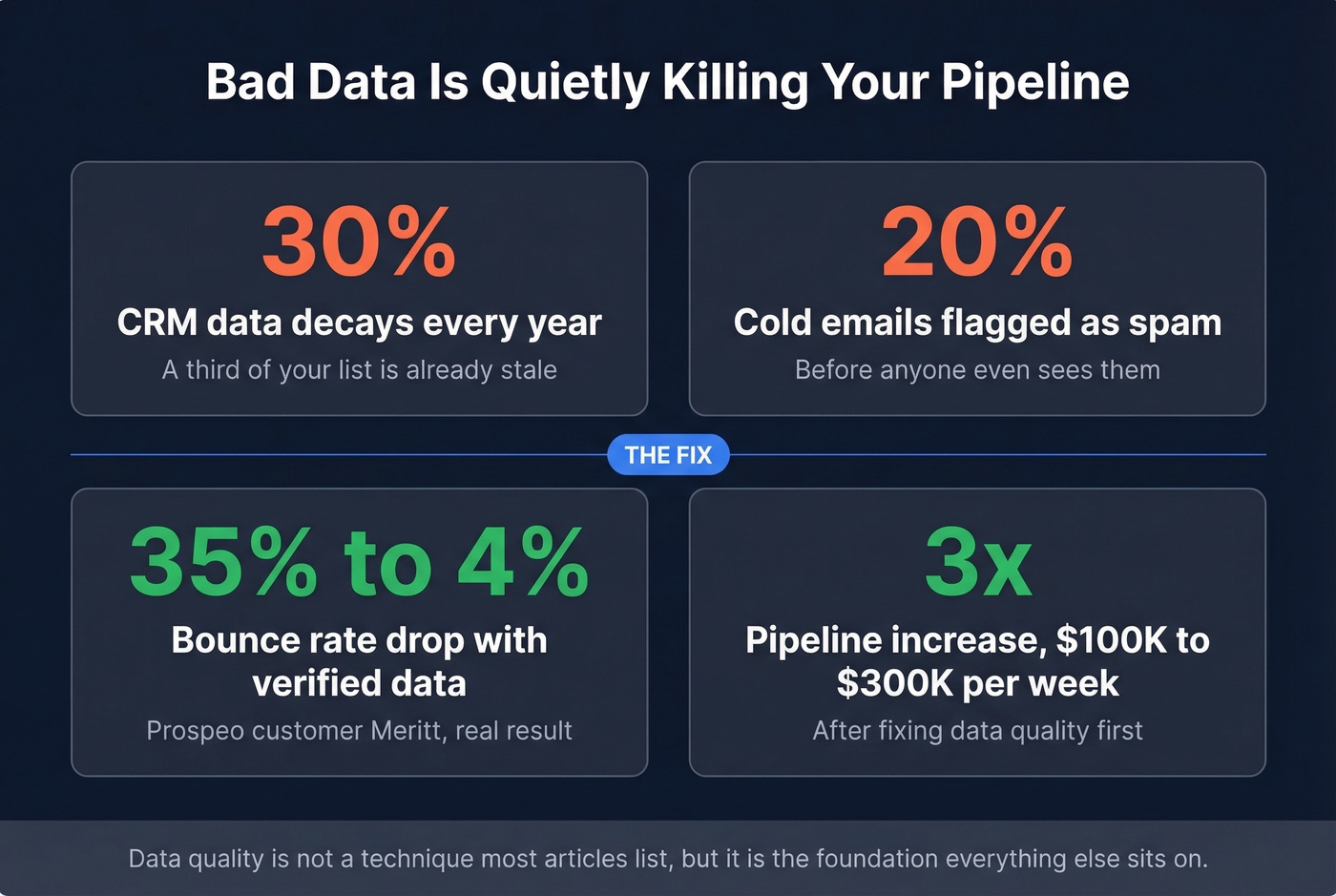
We've seen this pattern repeatedly - finance signs off on $35K/year for a data tool, but the bounce rate is still 15% and domain reputation is tanking. Bad data doesn't just waste time; it actively damages your sender reputation, which tanks deliverability for every email you send afterward. The consensus on r/sales is pretty clear: reps blame their messaging when the real problem is data quality.
Prospeo runs a 5-step verification process with catch-all handling, spam-trap removal, and honeypot filtering - hitting 98% email accuracy on a 7-day refresh cycle versus the 6-week industry average. One customer, Meritt, dropped their bounce rate from 35% to under 4% and tripled their pipeline from $100K to $300K per week. Data quality isn't a technique most articles list, but it's the foundation everything else sits on.
10. Block Time and Measure Everything
Dedicate at least 10 hours per week to prospecting. Manual prospecting consumes roughly 40% of a rep's week, and most of that time isn't actual outreach. It's searching, list building, and data cleanup.
Track these KPIs weekly: activities per day (emails, calls, social touches), connect rate, reply rate, meetings booked per 100 prospects contacted, and meeting-to-opportunity conversion rate. If your connect rate is below 5%, the problem is usually data quality, not technique. For a tighter operating rhythm, use a 30-60-90 day plan to lock in habits.
Let's be honest: if your average deal size is under $15K, you probably don't need a $30K/year data platform. A solid $99/month tool with 98% accuracy will outperform an enterprise suite with lower accuracy every time. A simple stack - a research tool for account and stakeholder mapping, a dedicated data tool for contact info, and a separate sequencer. Simple beats bloated.

You just read that signal-based outreach hits 15-25% reply rates. Prospeo's database lets you stack those signals - intent data across 15,000 topics, job changes, funding rounds, technographics, and headcount growth - with 30+ filters. 98% email accuracy means your cadence actually lands.
Build a signal-rich prospect list in 5 minutes, not 5 hours.
The 21-Day Cadence Blueprint
This is the template we've seen work across dozens of outbound teams. Adapt timing to your sales cycle - enterprise deals may need 30+ days - but the channel mix and spacing hold up.
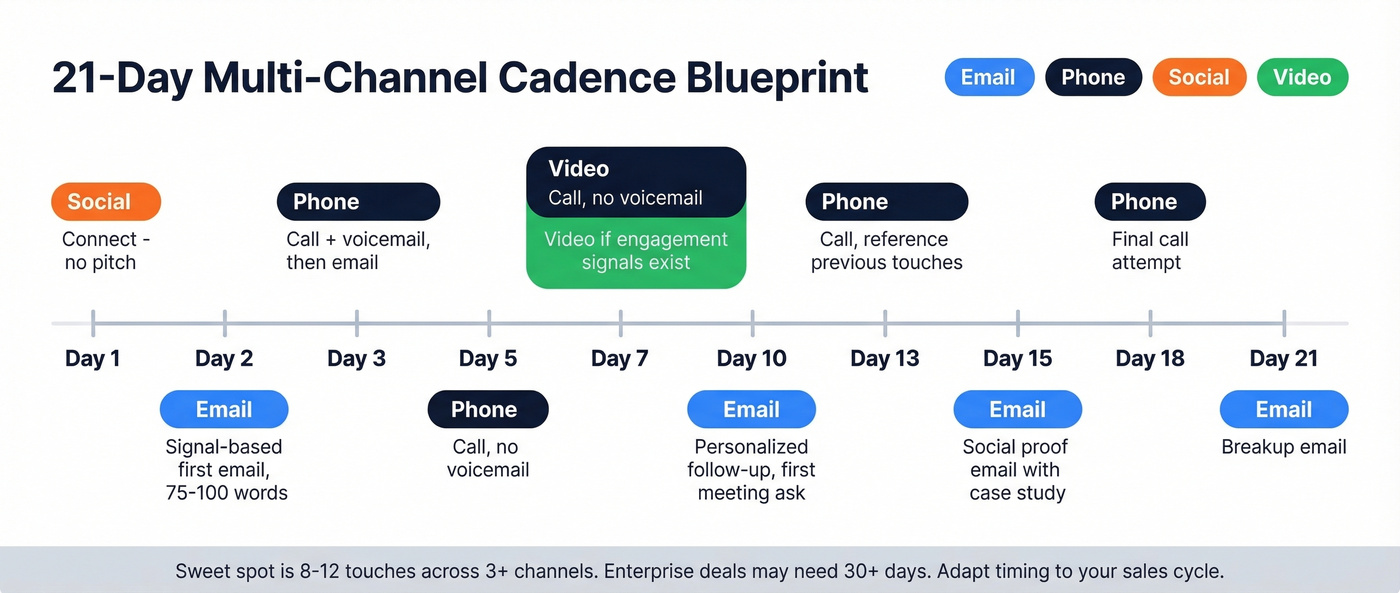
| Day | Channel | Action | Notes |
|---|---|---|---|
| 1 | Social | Connection request | No pitch - just connect |
| 2 | First email (75-100 words) | Lead with a signal or insight | |
| 3 | Phone | Call + voicemail | Follow up with email within minutes |
| 5 | Phone | Call attempt | No voicemail |
| 7 | Phone | Call attempt | No voicemail |
| 7-10 | Video/Email | Video outreach | Only if engagement signals exist |
| 10 | Personalized follow-up | First direct meeting ask | |
| 13 | Phone | Call attempt | Reference previous touches |
| 15 | Social proof email | Case study or relevant stat | |
| 18 | Phone | Final call + voicemail | Say you'll pause outreach |
| 21 | Breakup email | Leave the door open |
Start with 1-2 days between early touches, then expand to 3+ days later in the sequence. Phone calls make up only 20-30% of touches but drive disproportionate response. Most reps over-index on email because it's comfortable - the cadence above forces channel diversity.
Channel Comparison
| Cold Calling | Social | ||
|---|---|---|---|
| Avg. reply/success | 5.1% reply (69% inbox rate) | 2.3% success | 10-15% InMail |
| Conversion to deal | <0.4% | Higher per touch | Low without follow-up |
| Scalability | High | Low (time-intensive) | Medium |
| Best for | Volume outreach, nurture | C-suite, high-ACV deals | Warming, relationship |
| Key risk | Spam filters (20% flagged) | Bad mobile data | Low conversion to meeting |
No single channel wins. Multi-channel outreach converts 250% better than any single channel alone. Understanding the different types of prospecting - inbound vs. outbound, warm vs. cold, signal-driven vs. list-based - helps you allocate reps and budget to the right mix. If you're pressure-testing your numbers, compare against these sales pipeline benchmarks.
Tools That Make It Work
Data and Enrichment
Prospeo covers 300M+ professional profiles with 143M+ verified emails and 125M+ verified mobiles. The 98% email accuracy rate beats ZoomInfo (87%) and Apollo (79%), and at ~$0.01 per verified email, it's about 90% cheaper than ZoomInfo. Intent data tracks 15,000 topics via Bombora. Native integrations with Salesforce, HubSpot, Outreach, Salesloft, Instantly, Smartlead, Lemlist, Clay, Zapier, Make, and n8n mean your data flows directly into whatever sequencing tool you're running. Free tier includes 75 emails per month + 100 Chrome extension credits - no contract, no sales call.

Apollo is the all-in-one option for SMB teams that want data and outreach in a single platform. Free tier available, paid plans from ~$49-99/mo per user. Email accuracy runs lower at 79%, but the built-in sequencer saves you from buying a separate tool.
ZoomInfo is the enterprise standard - deep US data, broad feature set, but typically $15-40K/year with annual contracts. Strong if you need the full GTM platform; overkill if you just need accurate contact data.
Cognism wins on European data coverage and GDPR compliance. Typically $1,000-3,000/mo for small teams. Worth evaluating if EMEA is your primary market.
Sequencing and Outreach
Outreach is the enterprise sequencing standard with multi-channel cadence automation, analytics, and AI-powered suggestions for timing and messaging. Typically $100-150/user/month.
Salesloft competes directly with Outreach and is strong for mid-market teams. Similar pricing range, slightly different UX philosophy. The choice often comes down to which one your reps already know.
HubSpot Sales Hub is the natural choice if you're already on HubSpot CRM. Built-in sequences, meeting scheduling, and email tracking with a unified contact record. Free CRM tier available; Sales Hub starts at ~$20/user/month for Starter.
Conversation Intelligence
Gong records and analyzes sales calls, helping you refine cold call openers and objection handling based on what actually works. Roughly $100-150/user/month.
Your multi-channel cadence is only as good as your contact data. A 20% spam rate and 35% bounce rate aren't copy problems - they're data problems. Prospeo delivers 98% verified emails and 125M+ direct dials with a 30% pickup rate, refreshed every 7 days. At $0.01 per email, fixing your data costs less than one wasted hour of prospecting.
Kill your bounce rate before it kills your domain reputation.
FAQ
How many touches does it take to book a meeting?
Expect 8-18 touches depending on channel mix and prospect seniority. Most reps give up at touch 4-5, which is exactly why structured cadences matter - they force you past the point where competitors stop. The 21-day blueprint above spaces 11 touches across three channels for optimal coverage.
Is cold calling dead in 2026?
No. 57% of C-suite and VP-level buyers actually prefer phone contact over email or social. The key is pairing calls with other channels in a multi-channel cadence and dialing verified mobile numbers instead of switchboards. At 2.3% average conversion, volume matters, so accurate dials are non-negotiable.
What's the best prospecting channel?
Multi-channel outreach converts 250% better than single-channel. Email scales best (5.1% reply rate), calling converts highest-value prospects, and social builds pre-outreach trust. Use all three in a structured sequence rather than betting on one.
What's a good free tool for prospecting data?
Prospeo's free tier gives you 75 verified emails and 100 Chrome extension credits per month with 98% accuracy - enough to run a real outbound campaign. Apollo also offers a free plan with a built-in sequencer, though email accuracy sits lower at 79%. For teams under 5 reps, free tiers can cover early pipeline needs without a contract.