

The 30-60-90 Day Plan for Sales Reps: Benchmarks, Templates, and What Actually Works
A bad sales hire costs $97,000-$115,000 when you add up recruiting, onboarding, lost pipeline, and the revenue gap while you backfill the seat. And 62% of organizations rate their onboarding programs as ineffective. A 30-60-90 day plan for sales reps is supposed to fix this - but most plans are vague checklists that don't survive first contact with a real sales cycle.
Here's what actually works, built on real benchmarks and the mistakes we've watched teams repeat.
Quick Version
- Days 1-30 (Learn): Product knowledge, ICP study, CRM setup, call shadowing. ~25% productivity. Zero quota pressure.
- Days 31-60 (Execute): Supervised outreach, first solo meetings, pipeline building. ~50% productivity. Ramp quota at 50%.
- Days 61-90 (Own): Independent selling, pipeline at ~3x monthly quota by Day 90, first deals. ~75% productivity. Full quota doesn't start until month 7.
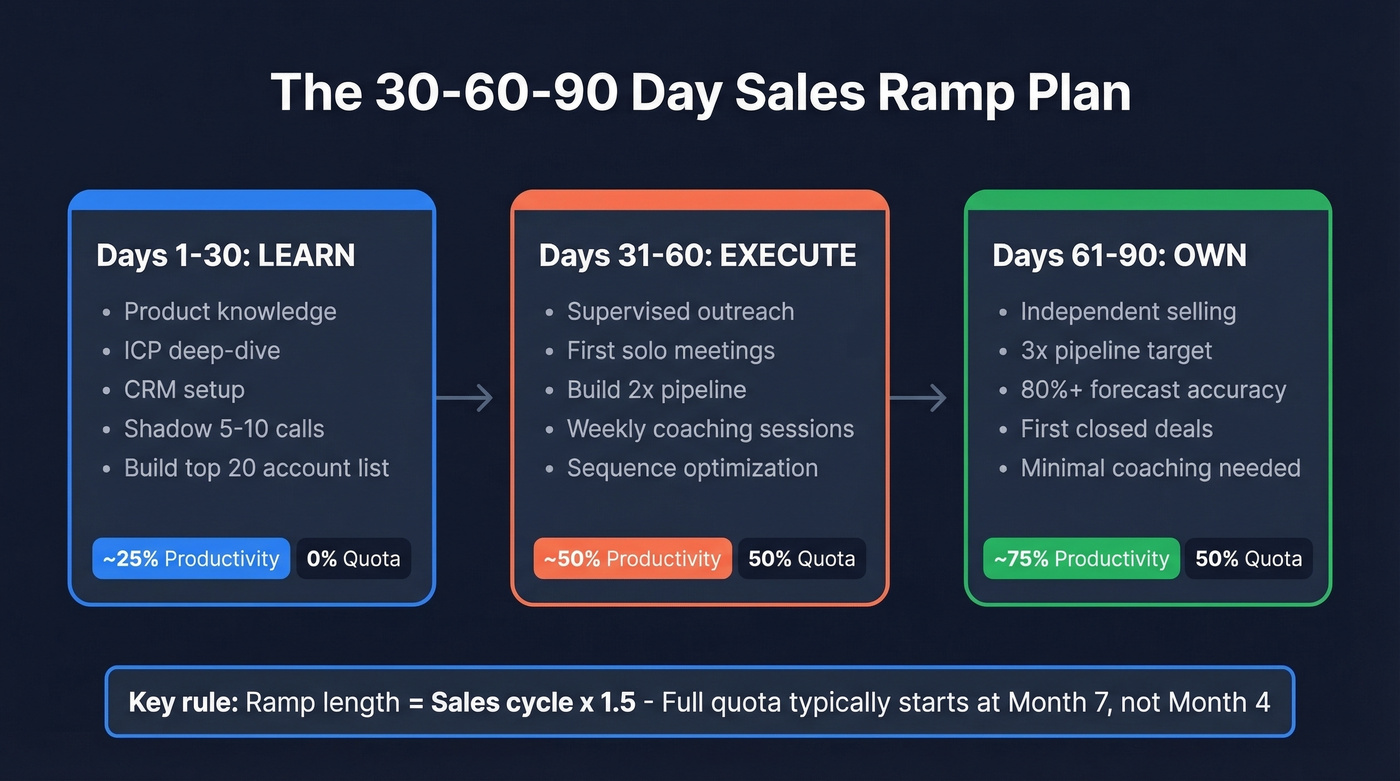
The one heuristic that changes everything: ramp length = sales cycle x 1.5. If your average deal takes 6 months to close, a 3-month ramp is setting reps up to fail.
Match Your Plan to Sales Cycle Length
Most templates assume every sales role ramps identically. They don't. The Bridge Group's research across 365 B2B companies puts average SDR ramp at 3.2 months - a number that's held steady since 2010. High-growth companies get there in 2.8 months. For enterprise AEs, ramp often stretches to 6-9 months.
If you’re selling longer-cycle deals, it also helps to align onboarding KPIs to your broader B2B sales motion (not just activity volume).
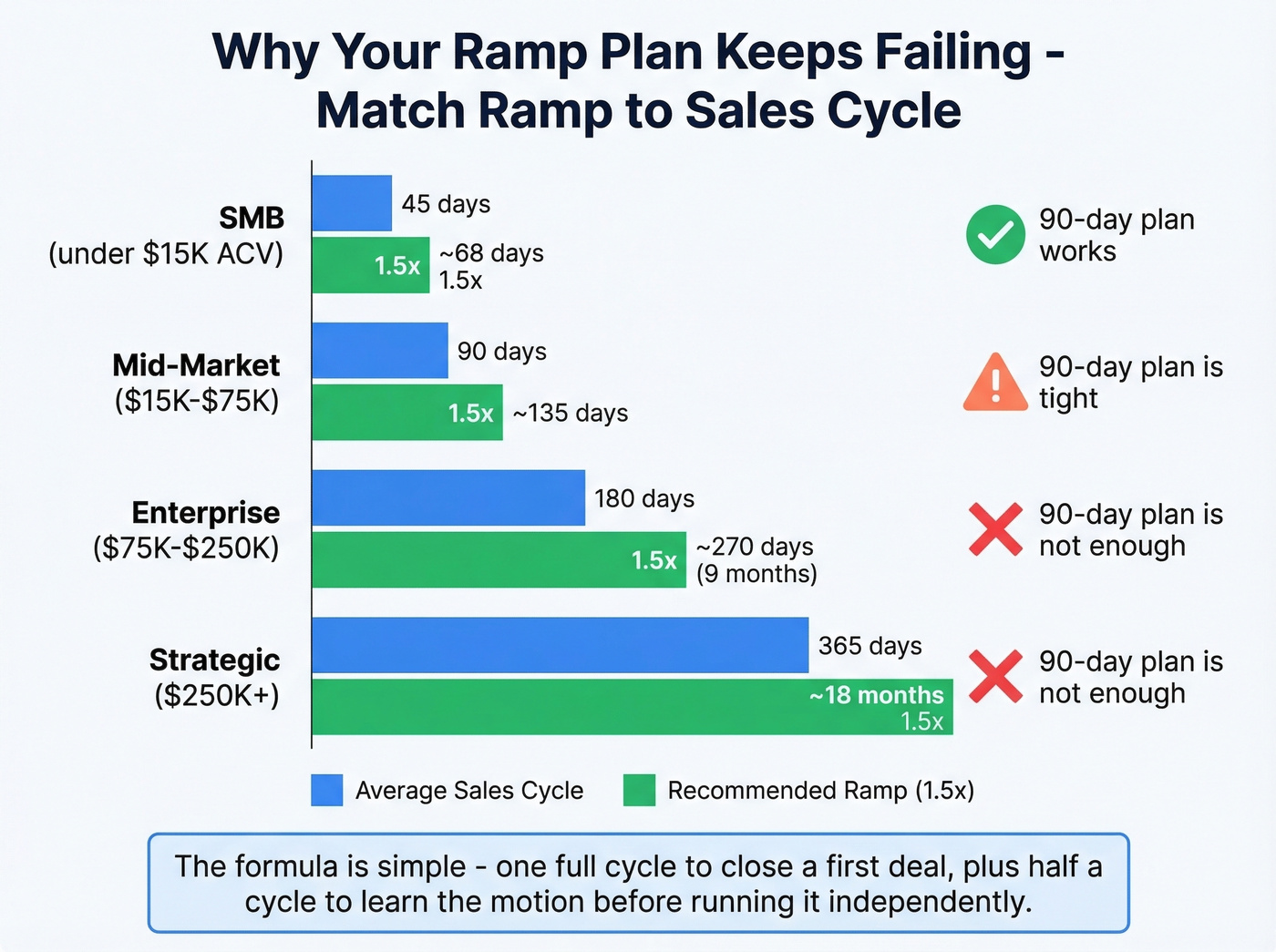
The math behind the 1.5x multiplier is straightforward: your rep needs one full sales cycle to close their first deal, plus roughly half a cycle to learn the product, market, and motion before they can run that cycle independently. Selling enterprise software with a 6-month close? Your rep won't have a single closed-won deal by Day 90. That's not failure - that's arithmetic. Build your plan around activities and pipeline creation, not revenue, when cycles are long.
Here's the thing most companies get wrong: they set ramp quotas based on what finance wants, not what the sales cycle allows. If your average contract value is under $15K and your cycle is under 45 days, a 90-day ramp to full quota is reasonable. For everyone else, you're probably rushing it - and the attrition numbers prove it.
Three Phases of Sales Onboarding
Days 1-30: Learn
Your rep's first month should be split between product immersion and market understanding. Start with CRM setup and hygiene standards - non-negotiable before any outreach. Then move into an ICP deep-dive covering who buys, why they buy, and what triggers the purchase. A product knowledge assessment targeting 90%+ should happen in the first month, alongside shadowing 5-10 calls or visits with top performers.
By Day 30, your rep presents a territory plan with their top 20 target accounts researched. Skip cold outbound for complex sales and skip the five-day slide deck marathon - 84% of training content decays within 90 days](https://salesandmarketing.com/5-sales-onboarding-errors-avoid/) without reinforcement. Sequence training to match upcoming milestones instead.
The biggest time sink in Month 1? Manual list building. GreyScout cut rep ramp time from 8-10 weeks to 4 weeks by using Prospeo's B2B database to get verified prospect data into new reps' hands fast. A new hire can build a researched target account list in hours instead of weeks - and that's the difference between a rep who's prospecting by Week 3 and one who's still Googling company names.
If you want a repeatable workflow for this, build it into your onboarding as a documented lead generation workflow (inputs, filters, QA, and handoff).
Days 31-60: Execute
This is where the manager's role matters most. We recommend supervised outreach starting in Week 5 - the rep makes calls, sends sequences, and books meetings while a manager reviews activity and coaches in real time.
Your rep should be building pipeline aggressively, with around 2x monthly quota as a solid target. They're running first solo discovery meetings and getting consistent feedback loops. Ramp quota sits at 50% of full target for months 1-3. Reps on a structured ramp generate roughly 23% more first-year revenue than those given full quotas immediately.
The reps who stall here are usually the ones who got too much classroom training and not enough live reps. Every call is reinforcement. Every objection handled is a lesson that sticks.
To keep execution consistent, give reps a simple library of sales activities and a few proven sales prospecting techniques to run daily.
Days 61-90: Own
Time-to-competency isn't the same as time-to-quota. Competency is a leading indicator: can the rep run a full cycle, handle objections, forecast accurately? Quota attainment is a lagging indicator that depends on deal length. A rep can be fully competent at Day 90 but not hit full quota for another three months. Measure both, but don't confuse them.
By Day 61, your rep sells independently. The metrics that matter by the end of Month 3: pipeline at ~3x monthly quota, 80%+ forecast accuracy, and ideally first closed deals. Ramp quota is still 50% - 100% doesn't typically start until month 7. Enterprise reps in Reddit threads regularly point out that expecting closed revenue within 90 days on a 6-18 month cycle is absurd. They're right.
| Phase | Focus | Key Metrics | Quota | Success Looks Like |
|---|---|---|---|---|
| Days 1-30 | Learn | 90%+ product score, 5-10 shadowed calls/visits, 20 target accounts | 0% | Territory plan presented |
| Days 31-60 | Execute | ~2x pipeline, solo meetings | 50% | Pipeline building independently |
| Days 61-90 | Own | ~3x pipeline, 80%+ forecast accuracy, first deals | 50% | Full-cycle selling, minimal coaching |

The biggest bottleneck in your 30-60-90 plan isn't training - it's list building. GreyScout cut ramp time from 8-10 weeks to 4 by giving new reps instant access to Prospeo's 300M+ verified profiles. At $0.01 per email with 98% accuracy, your new hires prospect by Week 3 instead of Googling company names.
Stop losing Month 1 to manual prospecting. Arm new reps with real data.
Role-Specific Ramp Plans
A one-size-fits-all plan guarantees misaligned expectations. SDRs, AEs, and field reps have fundamentally different ramp paths.
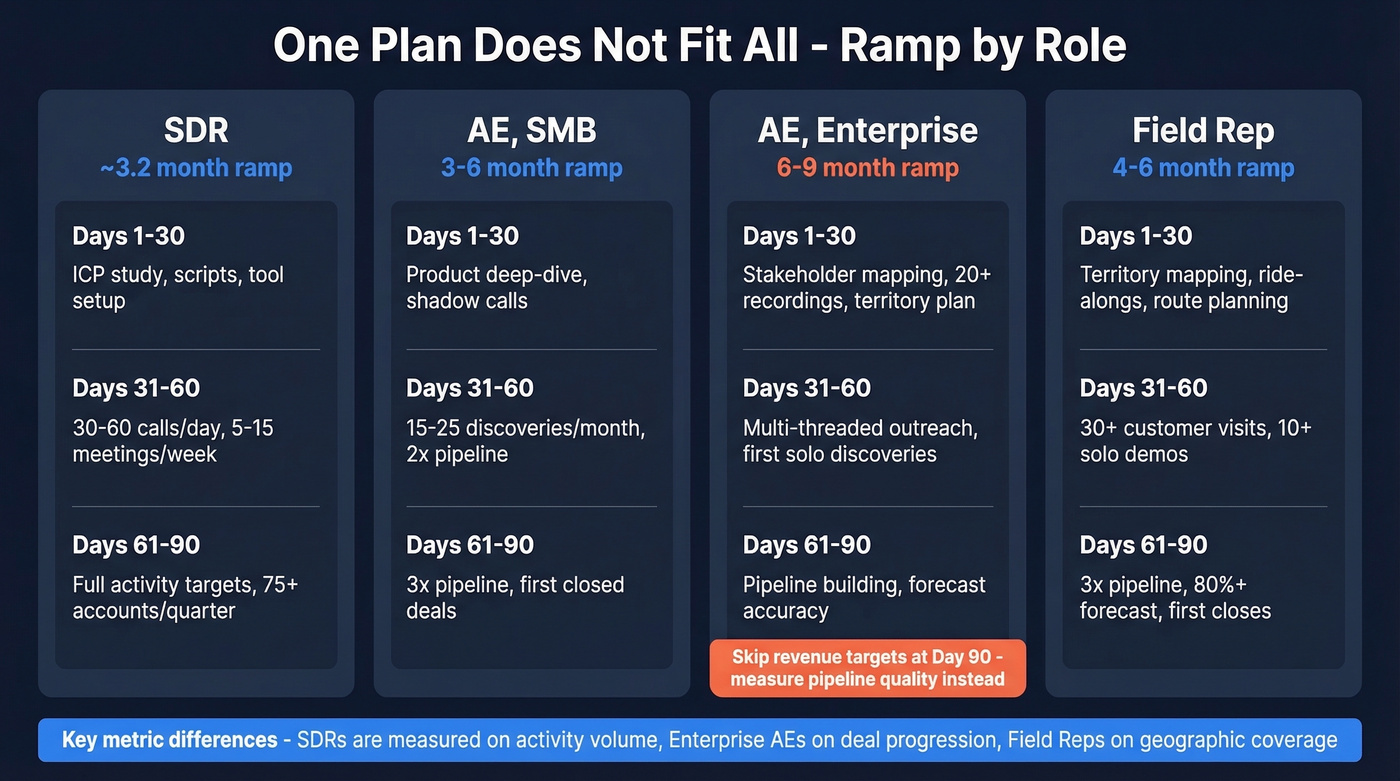
SDR (~3.2 month ramp) Days 1-30: ICP study, call scripts, CRM and tool setup. Days 31-60: 30-60 calls/day, 5-15 meetings booked weekly. Days 61-90: Full activity targets, 75+ accounts managed per quarter. 58% of SDRs manage 75+ accounts - if your plan doesn't account for that volume, it's not realistic.
AE, SMB (3-6 month ramp) Days 1-30: Product deep-dive, shadow discovery calls. Days 31-60: 15-25 discoveries/month, 2x pipeline. Days 61-90: 3x pipeline, first closed deals.
AE, Enterprise (6-9 month ramp) Days 1-30: Stakeholder mapping, 20+ call recordings, territory plan. Days 31-60: Multi-threaded outreach, first solo discoveries. Days 61-90: Pipeline building, forecast accuracy. Revenue targets at Day 90 are meaningless here - skip them entirely and measure pipeline quality and deal progression instead.
Field Rep (4-6 month ramp) Days 1-30: Territory mapping, ride-alongs, route planning. Days 31-60: 30+ customer visits, 10+ solo demos. Days 61-90: 3x pipeline, 80%+ forecast, first closes. Strong field plans emphasize geographic coverage and face-to-face relationship building over pure call volume.
For SDRs transitioning to AE roles, the ramp starts before Day 1. Build a CRM report of your qualified leads, listen to 20+ AE recordings, and map internal stakeholders. The best transitions treat the last 30 days of the SDR role as pre-boarding.
Using This Plan in Interviews
A 30-60-90 day plan is the single best differentiator in a final-round interview. One candidate on Reddit credited their unsolicited plan with landing a role that had roughly 500 applicants. It works because one-third of new hires leave within 90 days, and hiring managers are nervous about that.
Real talk: some candidates on r/sales call it "ridiculous" to submit a detailed plan before even meeting the team. I get the frustration. But in our experience, the candidates who do the work consistently beat those who don't. Whether you're interviewing for an SDR seat or an enterprise AE position, a well-structured plan tells the hiring manager you understand the ramp and won't need hand-holding.
Hiring managers score your plan on assumptions and dependencies, stakeholder awareness, ICP understanding, leading activity indicators, and a tangible 90-day deliverable. Use metric ranges - "I'll book 8-12 meetings per week by Day 60" is credible. "I'll book 15" sounds like guessing.
If you’re including outreach examples, pull from a few battle-tested sales follow-up templates rather than writing everything from scratch.
Five Mistakes That Kill Ramp Plans
1. Revenue targets beyond your cycle. If deals take 6 months, expecting closed revenue by Day 90 is fantasy. Measure pipeline and activity instead.
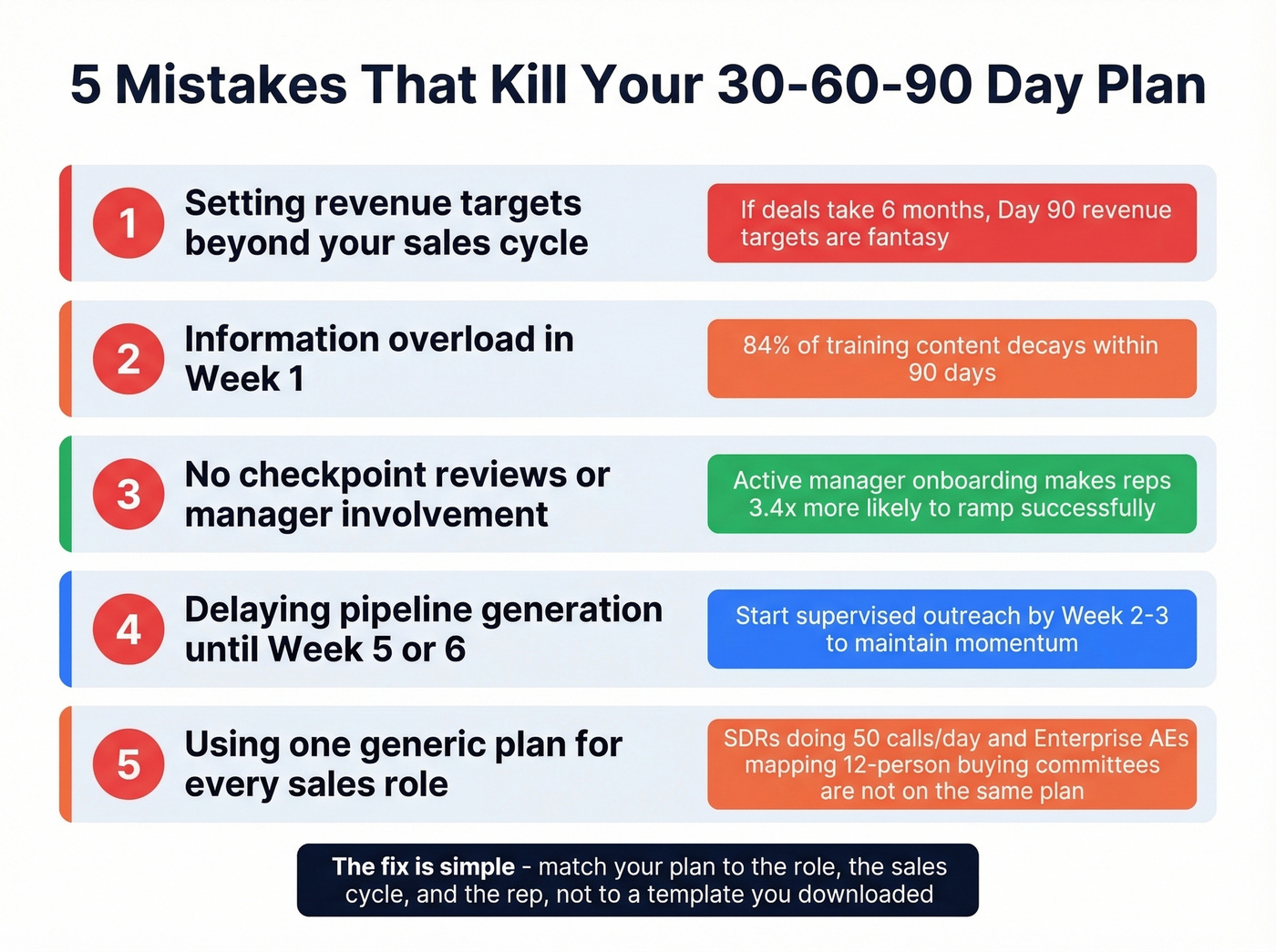
2. Information overload in Week 1. The boot camp approach leads to 84% learning decay within 90 days. Teach prospecting skills right before the rep starts prospecting - the best onboarding programs sequence knowledge delivery to match what the rep actually needs that week.
3. No checkpoint reviews. When managers take an active role in onboarding, team members are 3.4x more likely to report successful ramp. Weekly 1:1s with plan review aren't optional.
4. Delaying pipeline generation. We've seen teams hold reps back from any outreach for 4-6 weeks. By the time they start, they've lost momentum and confidence. Supervised outreach should begin in Week 2 or 3.
5. Generic plans with no role specificity. An SDR doing 50 calls a day and an enterprise AE mapping a 12-person buying committee aren't on the same plan. If your template doesn't change by role, it's a formality, not a plan.
If you want to operationalize the “pipeline by Day 60” target, align it to a simple pipeline health dashboard and review it weekly.
Your Day 31-60 pipeline targets depend on one thing: whether reps can actually reach the right buyers. Prospeo's 125M+ verified mobile numbers hit a 30% pickup rate, and 30+ search filters let ramping reps build territory plans with buyer intent, technographics, and headcount growth signals baked in.
Hit 2x pipeline by Month 2 because the contact data actually connects.
FAQ
How long should a 30-60-90 plan be?
One to two pages maximum. Hiring managers scan - they don't read essays. Use bullet points with specific KPIs per phase rather than narrative paragraphs. If it doesn't fit on two pages, you're overcomplicating it.
Should I submit one even if the interviewer doesn't ask?
Yes. It signals preparation, reduces perceived hiring risk, and gives the manager something concrete beyond your interview answers. Proactive effort consistently wins - one Reddit user reported beating ~500 applicants by submitting an unsolicited plan.
What tools should a new rep have on Day 1?
A CRM like Salesforce or HubSpot, a sales engagement platform like Outreach or Salesloft, and a B2B data tool for building verified prospect lists immediately. 43% of employees wait over a week for basic tools - don't let data access stall your entire ramp.
What's the difference between onboarding and a 30-60-90 day plan?
A 30-60-90 day plan is the structured, milestone-driven core of any onboarding program - focused specifically on getting the rep to productivity with clear KPIs at each checkpoint. Broader onboarding includes HR paperwork, benefits, and culture orientation, but the 30-60-90 framework is where revenue impact lives.