

How to Build a Lead Generation Workflow That Doesn't Leak Leads
You send 2,000 cold emails on Monday. By Wednesday, 700 have bounced, your domain reputation is tanking, and the 14 replies sitting in your inbox are buried under delivery failure notifications. That's not a lead generation problem - it's a lead generation workflow problem.
79% of marketing leads never convert into sales. The root cause is almost always a broken handoff between stages - not bad copy, not the wrong tool, not some missing "hack." The fix is a sequence that doesn't leak.
The Quick Version
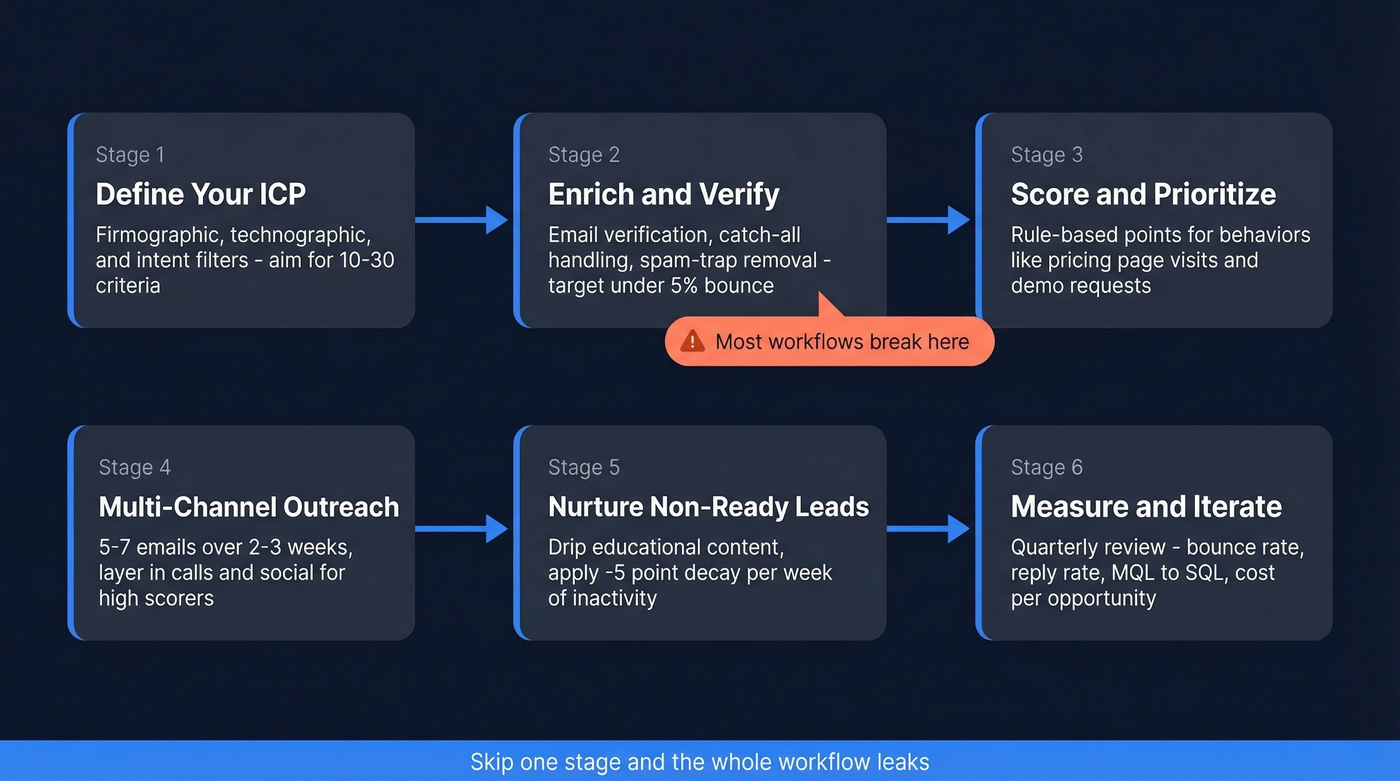
- Six stages, in order: ICP definition, enrichment/verification, scoring, outreach, nurture, measurement. Skip one and the whole thing leaks.
- Data quality is the stage everyone skips. It's also the stage that determines whether everything downstream works or wastes money.
- Map it manually first. Prove the stages work before you automate anything. Customer journey mapping helps you spot the exact handoff points where prospects drop out.
6 Stages of a Lead Generation Workflow
Stage 1 - Define Your ICP
Go beyond "VP of Marketing at mid-market SaaS." Layer firmographic, technographic, and intent signals: company size, tech stack, recent funding, department headcount growth, hiring patterns. Aim for 10-30 filter criteria. A broad ICP produces volume. A precise ICP produces pipeline. There's a meaningful difference between those two things, and most teams learn it the expensive way - after burning through three months of outreach aimed at contacts who were never going to buy.
Stage 2 - Enrich and Verify
Here's the thing: this is where most workflows fall apart. You build a great list, push it into your sequencer, and 35% of emails bounce. That's not hypothetical - Meritt was running a 35% bounce rate before switching their verification layer, then dropped it under 4%.
We use Prospeo for this step. With 98% email accuracy and a 7-day data refresh cycle - compared to the 6-week industry average - you're not sending to stale addresses. Upload a CSV, get verified results back, push to your sequencer. The 5-step verification process includes catch-all handling, spam-trap removal, and honeypot filtering, which is why teams like Stack Optimize maintain 94%+ deliverability with bounce rates under 3%.

Compliance checkpoint: GDPR requires a privacy notice within one month or at first contact if you obtained data indirectly. Document your data sources now, not after someone files a complaint.
Stage 3 - Score and Prioritize
Not every lead deserves an AE's time. Start rule-based - explicit point values for behaviors like pricing page visits and demo requests. Add AI-assisted scoring after you've got six months of conversion data to train on. Agentic scoring tools are maturing fast in 2026, but they still need clean historical data. Garbage in, garbage out applies to AI too.
A well-configured CRM sync ensures scores update in real time so reps always act on the freshest data.
Stage 4 - Multi-Channel Outreach
Send 5-7 emails over 2-3 weeks, spaced 2-4 days apart. Layer in calls and social touches for high-scoring leads.
CAN-SPAM requires a physical mailing address and a working unsubscribe link in every message. Violations run $51,744 per non-compliant email. Build compliance into your templates from day one, not after your first cease-and-desist.
Stage 5 - Nurture Non-Ready Leads
Leads scoring under 30 don't get deleted - they get routed to a nurture drip. Educational content, case studies, industry benchmarks. This is where your email nurture sequence does the heavy lifting, keeping cold prospects warm until timing and intent align.
Apply a decay rule: -5 points per week of inactivity. When engagement spikes, the score climbs and they re-enter the active pipeline automatically. We've watched leads sit dormant for three months, then suddenly download two case studies in a week and request a demo the following Monday. Without decay and re-entry rules, that signal gets lost.
Stage 6 - Measure and Iterate
A marketing automation case-study roundup cites a 72% reduction in lead-to-conversion time after implementing structured automation for a B2B funnel. Set a quarterly review cadence: bounce rate, reply rate, MQL-to-SQL conversion, cost per opportunity. If you're not measuring, you're guessing.
Lead Scoring Template
| Signal | Points |
|---|---|
| Pricing page view | +10 |
| Demo/contact form fill | +15 |
| Case study view | +8 |
| Return visit within 48 hrs | +12 |
| 10+ email clicks | +10 |
| Email bounce | -25 |
| Personal email domain | -20 |
| Competitor domain | -50 |
| Inactivity decay | -5/week |
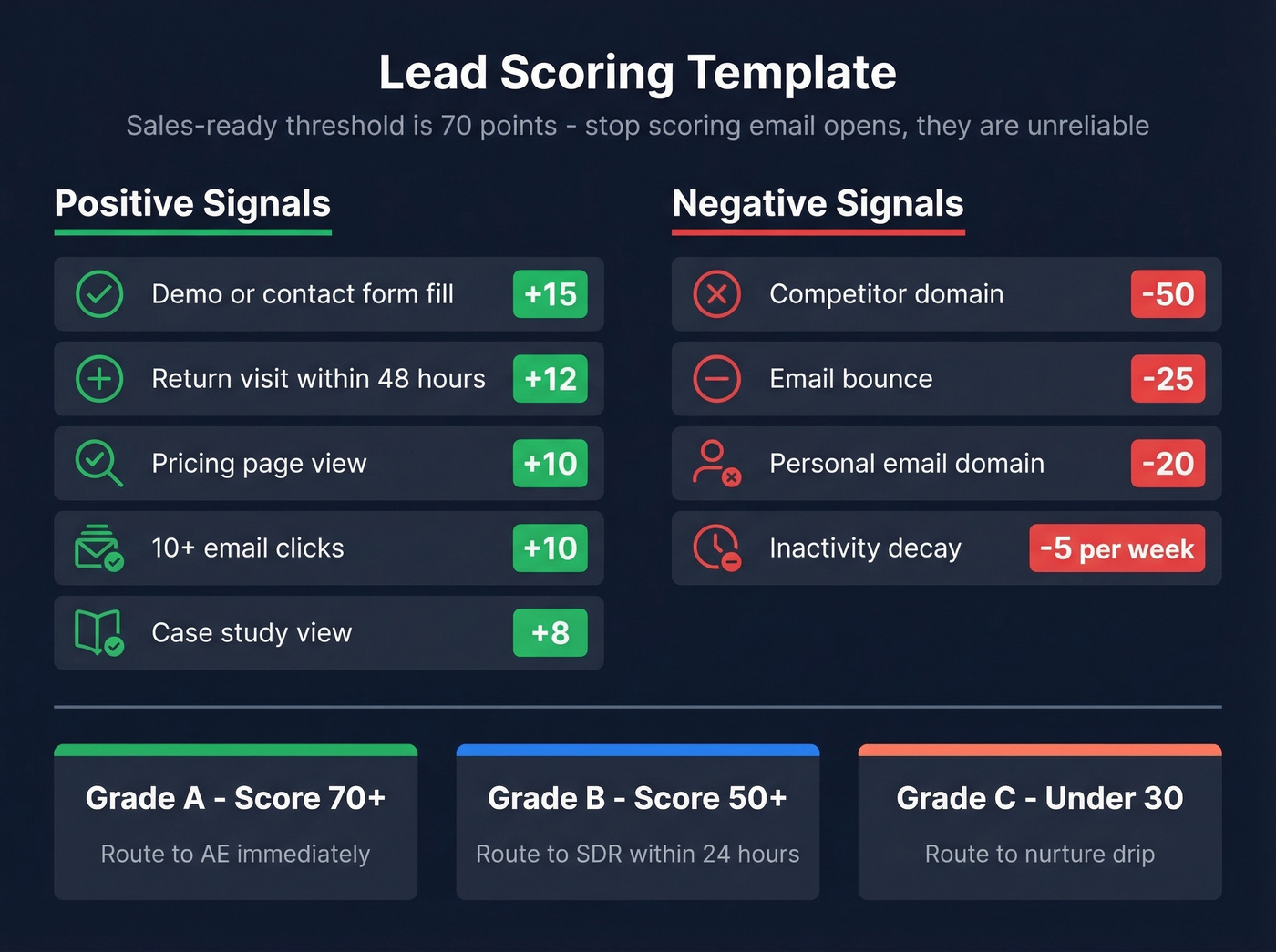
Sales-ready threshold: 70+. Stop scoring email opens - privacy changes have made open tracking unreliable.
| Grade + Score | Route To |
|---|---|
| A + 70+ | AE immediately |
| B + 50+ | SDR within 24 hrs |
| C or below + under 30 | Nurture drip |

Stage 2 is where workflows break - and where Prospeo fixes them. With 98% email accuracy, a 7-day data refresh cycle, and 5-step verification that catches spam traps and honeypots, your outreach hits real inboxes. Meritt dropped their bounce rate from 35% to under 4%. Stack Optimize runs 94%+ deliverability across every client.
Stop leaking leads at the verification stage. Start with 75 free verified emails.
Tool Stack and Pricing
The martech space has blown past 15,000 solutions. You need three to five.
| Workflow Stage | Tool | Starting Price |
|---|---|---|
| Data & Verification | Apollo.io | Free; from $49/user/mo |
| Enrichment & Workflows | Clay | Free; from $149/mo |
| CRM | HubSpot | Free; Sales Hub from $15/user/mo |
| CRM | Salesforce | Sales Cloud from $25/user/mo |
| Outreach | Lemlist | From ~$50-$60/user/mo |
| Outreach | Instantly | From ~$30-$40/mo |
| Automation | n8n | Free (self-hosted); cloud from ~$20+/mo |
Best-of-breed stacks usually win for teams under ~20 reps because you get flexibility and can swap any layer without rebuilding everything. The all-in-one vs. best-of-breed question comes up constantly on r/sales and the consensus is pretty clear: solo founders scaling fast can start with an all-in-one like Apollo, but you should verify your data quality independently regardless. The tool that sends your emails shouldn't also be the only one validating them.
Hot take: If your average deal size is under $10k, you probably don't need a $30k/year data platform. A verification layer, a CRM, and a sequencer will outperform an overbuilt stack that nobody fully uses. We've seen teams burn through three domains before realizing their list quality - not their copy - was the problem.
You don't need a $30K/year data platform to run a workflow that converts. Prospeo gives you 300M+ profiles, 30+ ICP filters, and verified emails at $0.01 each - no contracts, no sales calls. Plug it into HubSpot, Salesforce, Clay, or your sequencer and close the gaps between every stage.
Build the workflow. We'll make sure the data doesn't break it.
Benchmarks - What Good Looks Like
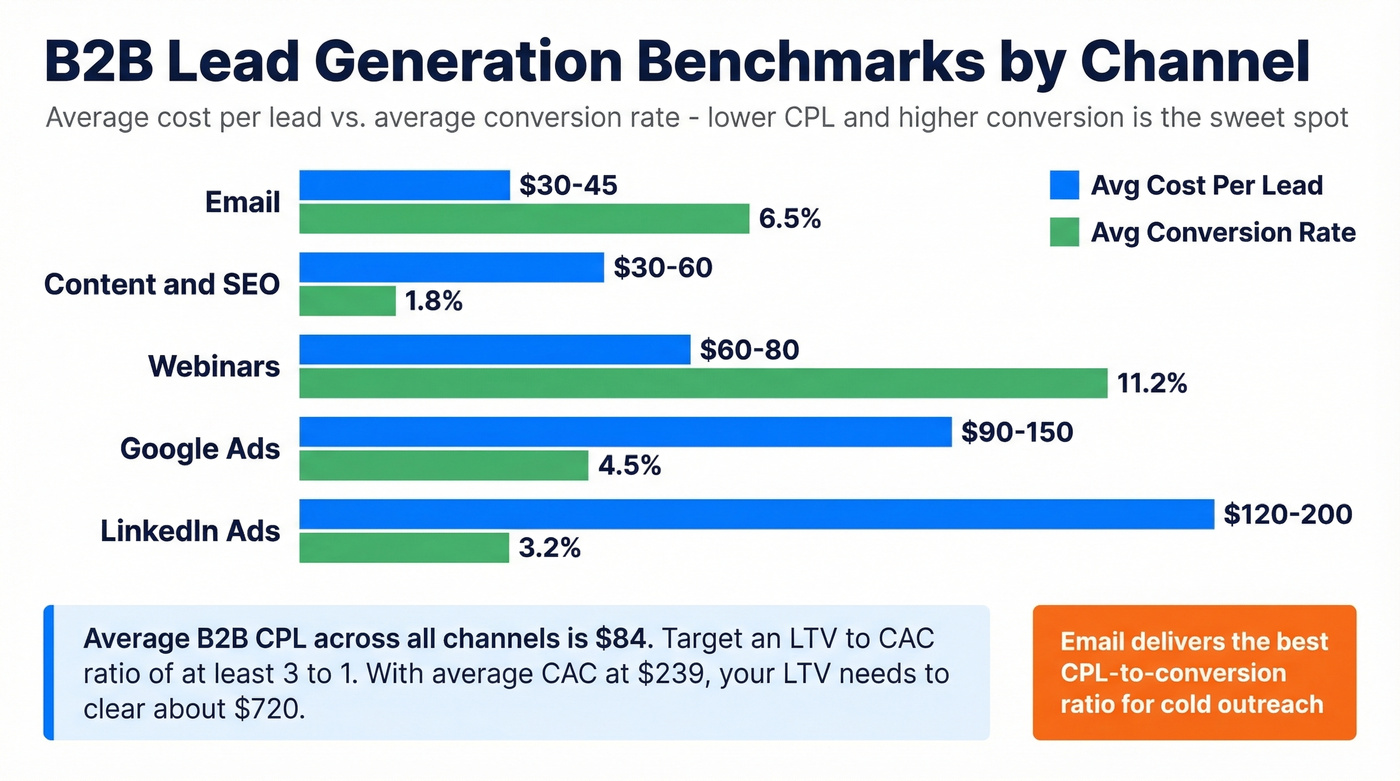
The average B2B cost per lead is $84 across all channels. Channel-level numbers tell a more useful story:
| Channel | Avg CPL | Avg Conversion |
|---|---|---|
| $30-45 | 6.5% | |
| Content/SEO | $30-60 | 1.8% |
| Webinars | $60-80 | 11.2% |
| Google Ads | $90-150 | 4.5% |
| LinkedIn Ads | $120-200 | 3.2% |
Target an LTV:CAC ratio of at least 3:1. Average B2B SaaS customer acquisition cost runs $239, so your lifetime value per customer needs to clear ~$720 to justify the spend.
Mistakes That Kill Workflows
Buying lists instead of building them. Purchased lists are stale, non-compliant, and destroy deliverability. GDPR fines have exceeded EUR 6.2 billion since 2018. Don't gamble your domain on someone else's data hygiene.
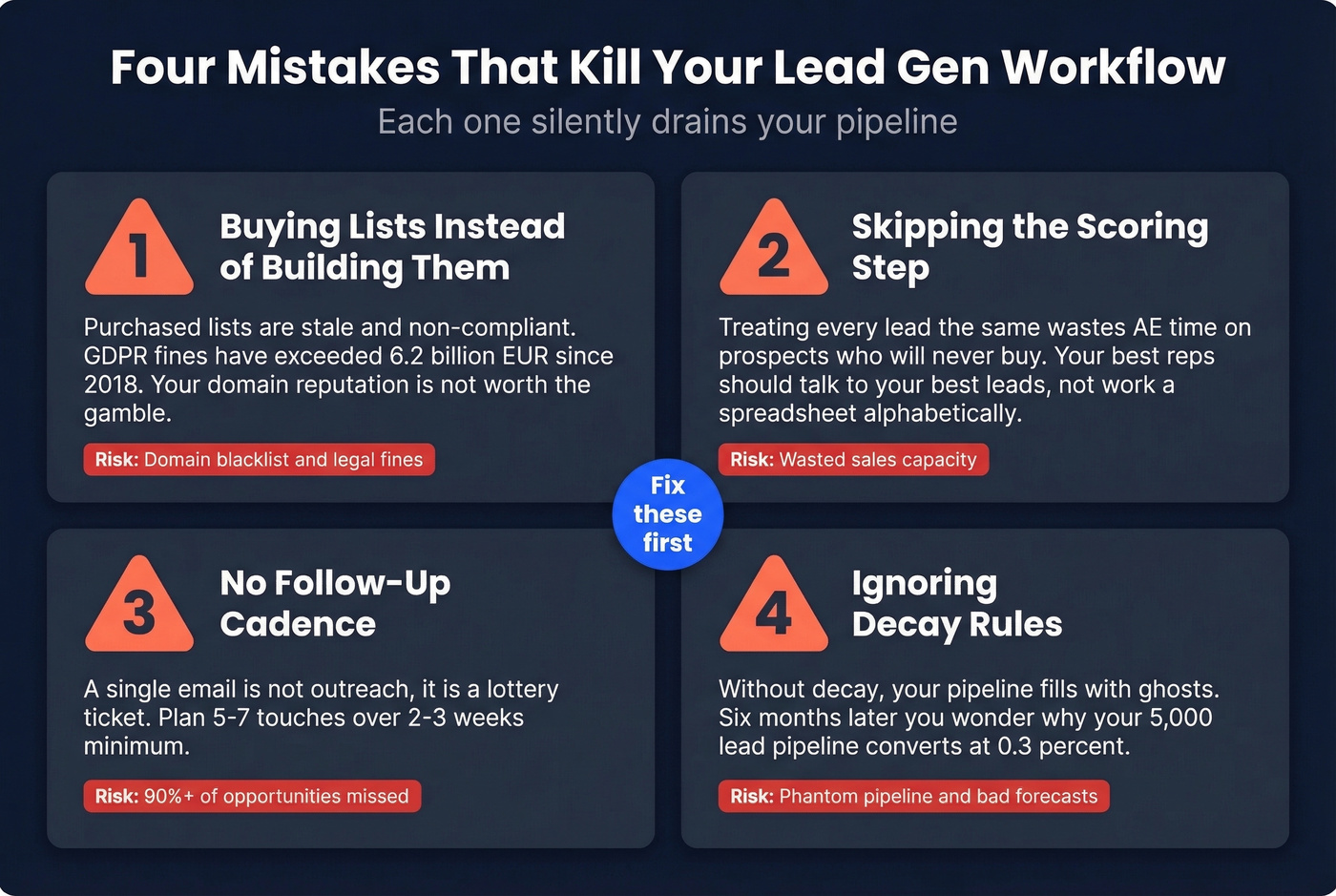
Skipping the scoring step. Treating every lead the same wastes AE time on prospects who aren't ready. Your best reps should be talking to your best leads, not working a spreadsheet alphabetically.
No follow-up cadence. A single email isn't outreach - it's a lottery ticket. Use proven sales follow-up templates to keep the cadence consistent.
Ignoring decay. Without decay rules, your pipeline fills with ghosts. Six months from now you'll wonder why your "5,000-lead pipeline" converts at 0.3%.
FAQ
How long before a new workflow produces results?
Most teams see measurable pipeline impact within 4-6 weeks. Don't judge the process before you've completed at least two full sequence cycles - early data is noisy and unrepresentative.
What's the most important stage to get right first?
Data verification. If your emails bounce above 5%, nothing downstream works - scoring is meaningless, outreach tanks your domain, and nurture sequences reach nobody. Fix this stage first and every other stage performs better.
How does marketing automation fit in?
Automation handles scoring updates, nurture triggers, and CRM syncs so reps focus on selling instead of data entry. Without it, handoffs between marketing and sales are where most leads quietly die. Expect a 40-70% improvement in lead-to-conversion time once you've automated the core routing logic.