GDPR Lead Generation: What B2B Teams Need to Know in 2026
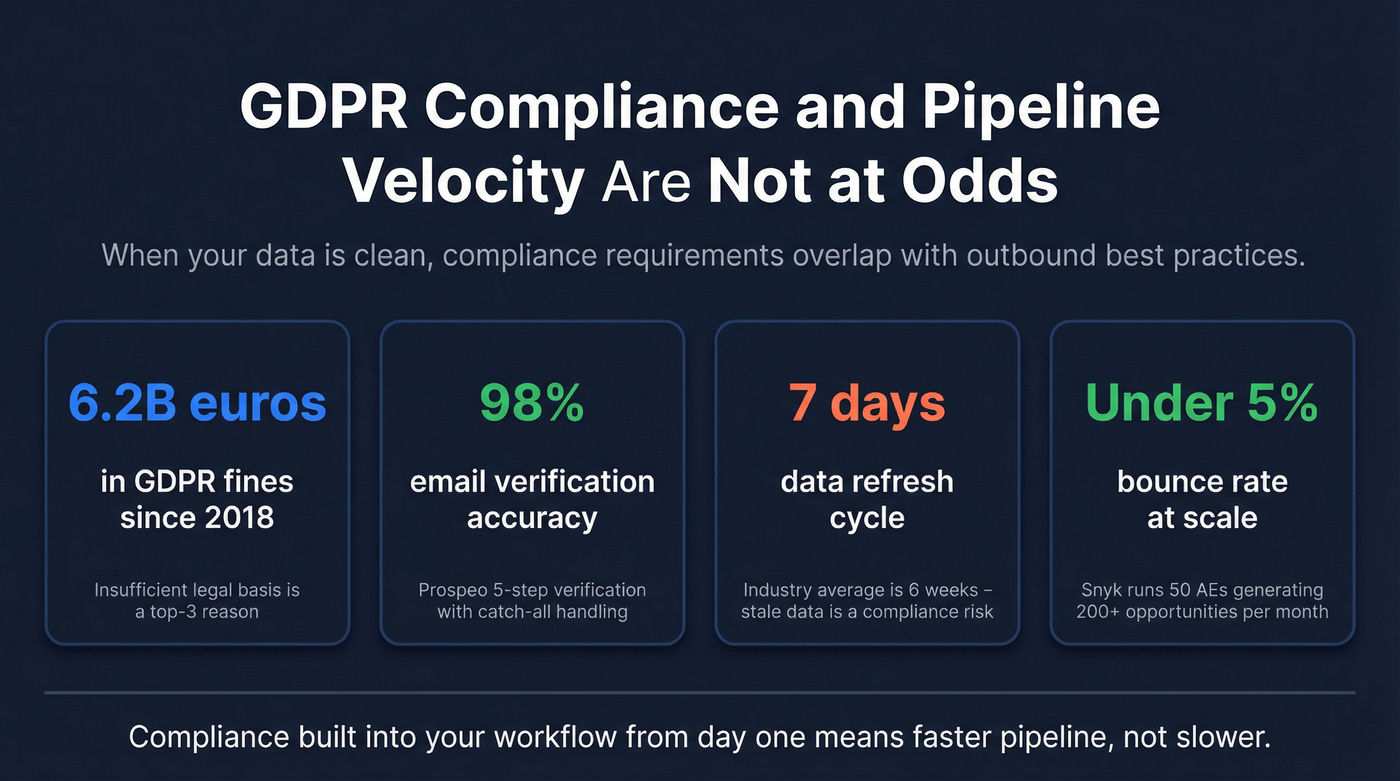
EU regulators have issued over €6.2 billion in GDPR fines since 2018, including LinkedIn's €310M penalty for behavioral targeting. "Insufficient legal basis" ranks among the top three reasons regulators hand out penalties - 73 fines and counting. If you're running outbound in Europe, GDPR lead generation compliance isn't theoretical. It's a budget line item.
What You Need (Quick Version)
- You don't need explicit consent for most B2B outbound. Legitimate interest is the correct lawful basis, but you must pass a three-part test and document it.
- Purchased lists and scraped data don't give you a lawful basis. They'll also tank your deliverability. Build your own prospect lists with verified, fresh data instead.
- Rules vary by EU country. Some countries treat unsolicited B2B email as requiring opt-in under national ePrivacy implementations. Germany is typically among the strictest, while France tends to be more permissive for B2B-to-B2B outreach. Plan accordingly.
Lawful Bases for B2B Outreach
Legitimate Interest (the Three-Part Test)
The biggest misconception in B2B marketing is that you need explicit consent before sending a cold email. You don't - not in most EU countries. Legitimate interest is the lawful basis used for contacting business decision-makers about products relevant to their professional role.
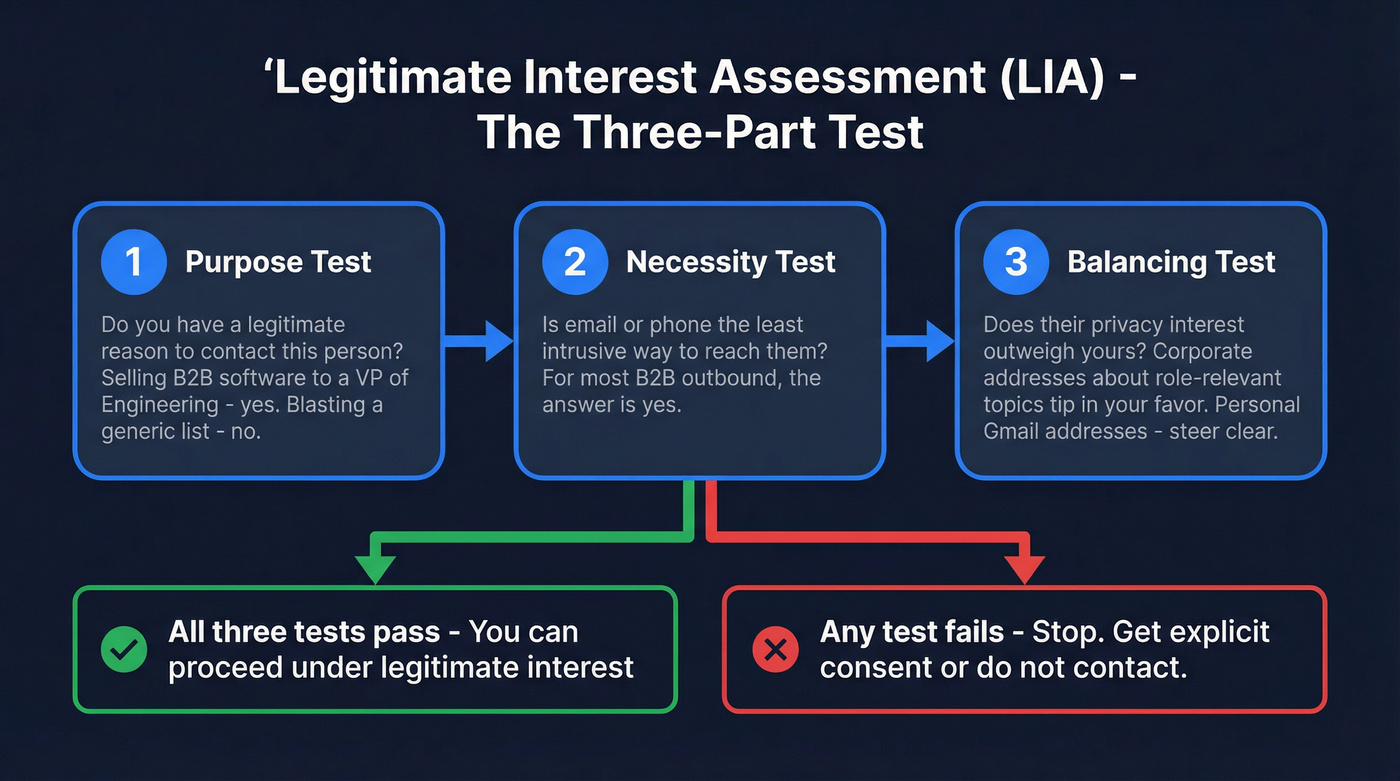
But it's not a free pass. You need a Legitimate Interest Assessment (LIA):
- Purpose test - Do you have a legitimate reason to contact this person? Selling B2B software to a VP of Engineering qualifies. Blasting a generic list doesn't.
- Necessity test - Is email or phone the least intrusive way to reach them? For most B2B outbound, yes.
- Balancing test - Does the person's privacy interest outweigh yours? Corporate addresses about role-relevant topics typically tip in your favor. Personal Gmail addresses are a different story entirely, and we'd recommend steering clear unless you have explicit consent.
When You Need Consent
You'll need consent when targeting consumers, using personal email addresses, or operating in countries where national ePrivacy rules are stricter for unsolicited outreach.
Double opt-in - where the subscriber confirms via a verification link - isn't legally required by GDPR itself, but roughly 40% of senders use it because it's strong proof of consent and improves deliverability. For inbound lists, just do it.
GDPR vs. ePrivacy: Why the Rules Actually Vary
Here's the thing: GDPR is a regulation that applies uniformly across the EU. The ePrivacy Directive is implemented through national legislation, and the rules diverge significantly from one country to the next.
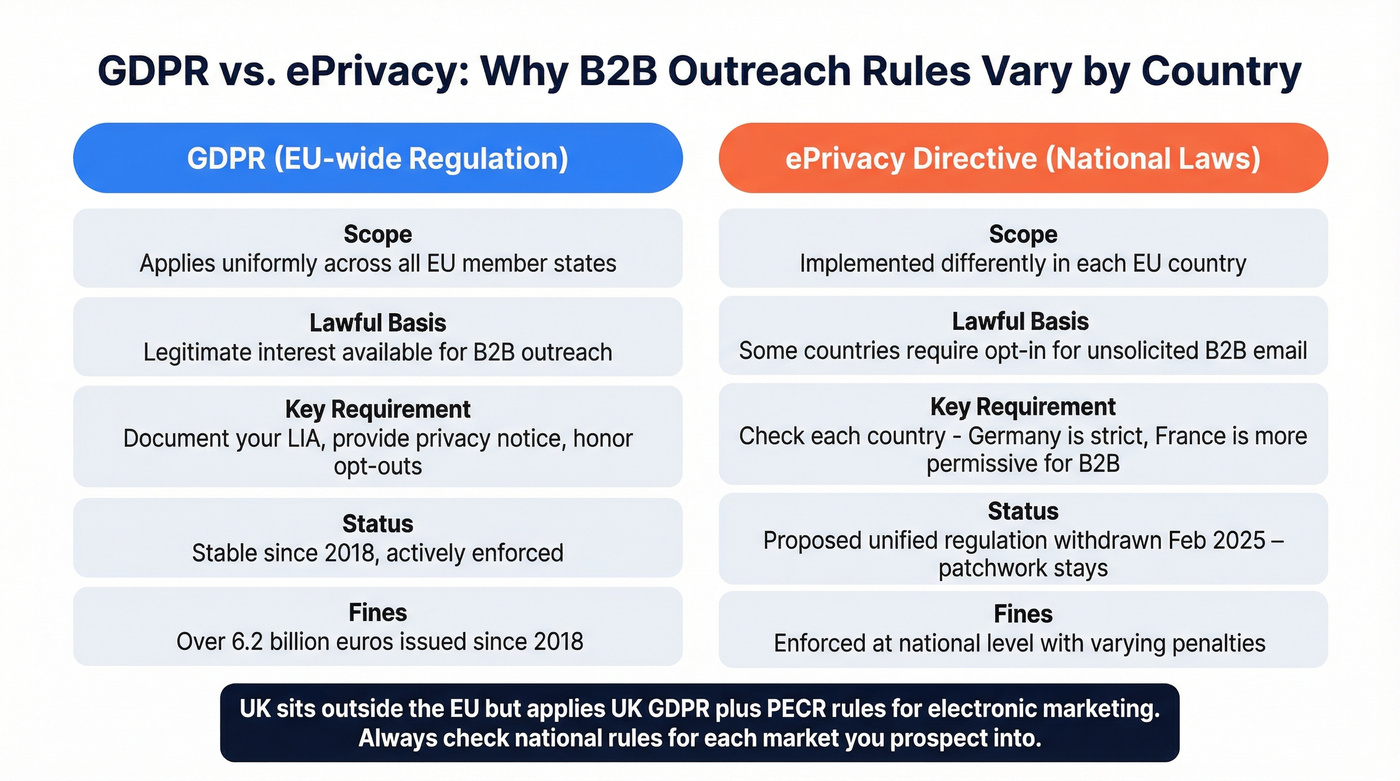
The proposed ePrivacy Regulation, which would've unified these rules, was officially withdrawn on February 5, 2025 after years of failed negotiations. That patchwork isn't going anywhere.
The UK sits outside the EU but applies GDPR-equivalent rules through UK GDPR, with additional electronic marketing requirements under PECR. If you're prospecting across multiple European markets, you need to check the national rules for each one. There's no shortcut here.

GDPR's accuracy principle demands fresh, verified data - and stale records are both a compliance risk and a deliverability killer. Prospeo refreshes 300M+ profiles every 7 days (industry average: 6 weeks), verifies emails at 98% accuracy, and enforces opt-outs globally with DPAs available on request.
Replace your compliance liability with data you can actually defend.
What Breaks in Practice
We've seen teams get burned by assumptions that feel reasonable but aren't. These are the scenarios that trip up even experienced marketers.
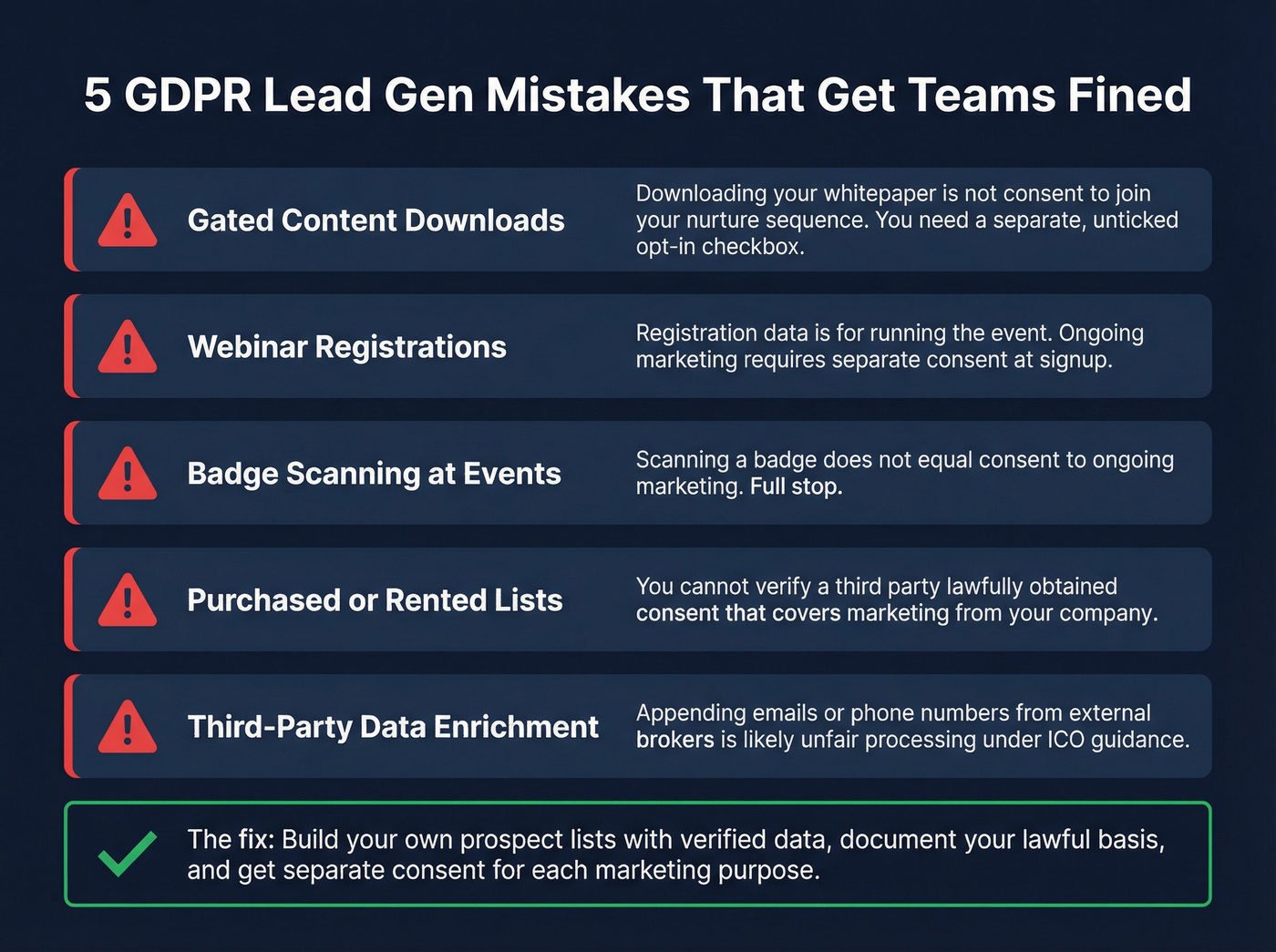
Gated content downloads don't give you marketing rights. Someone downloads your whitepaper - that's permission to receive the asset, not permission to join your nurture sequence. You need a separate, unticked opt-in checkbox. Getting lead capture compliance right at this stage prevents problems downstream.
Webinar registrations work the same way. Registration data is for running the event. Ongoing marketing requires separate consent at signup, and pre-ticked boxes don't count under GDPR.
Badge scanning at trade shows is particularly problematic. Scanning someone's badge doesn't equal consent to ongoing marketing. Full stop.
Purchased or rented lists are the biggest trap. The broker might claim the data was lawfully obtained, but you need to demonstrate that consent actually covers marketing from your company. In practice, verifying a third party's data provenance is nearly impossible - and the consensus on r/sales is that purchased lists are a waste of money even before you factor in compliance risk.
Enrichment through third-party brokers - appending extra emails or phone numbers from external sources - is likely to be unfair processing under ICO guidance. If you wouldn't want to tell the person how you got their data, rethink the activity.
A Compliant Outbound Workflow
Let's break down what a compliant outbound process actually looks like for teams doing GDPR lead generation properly.
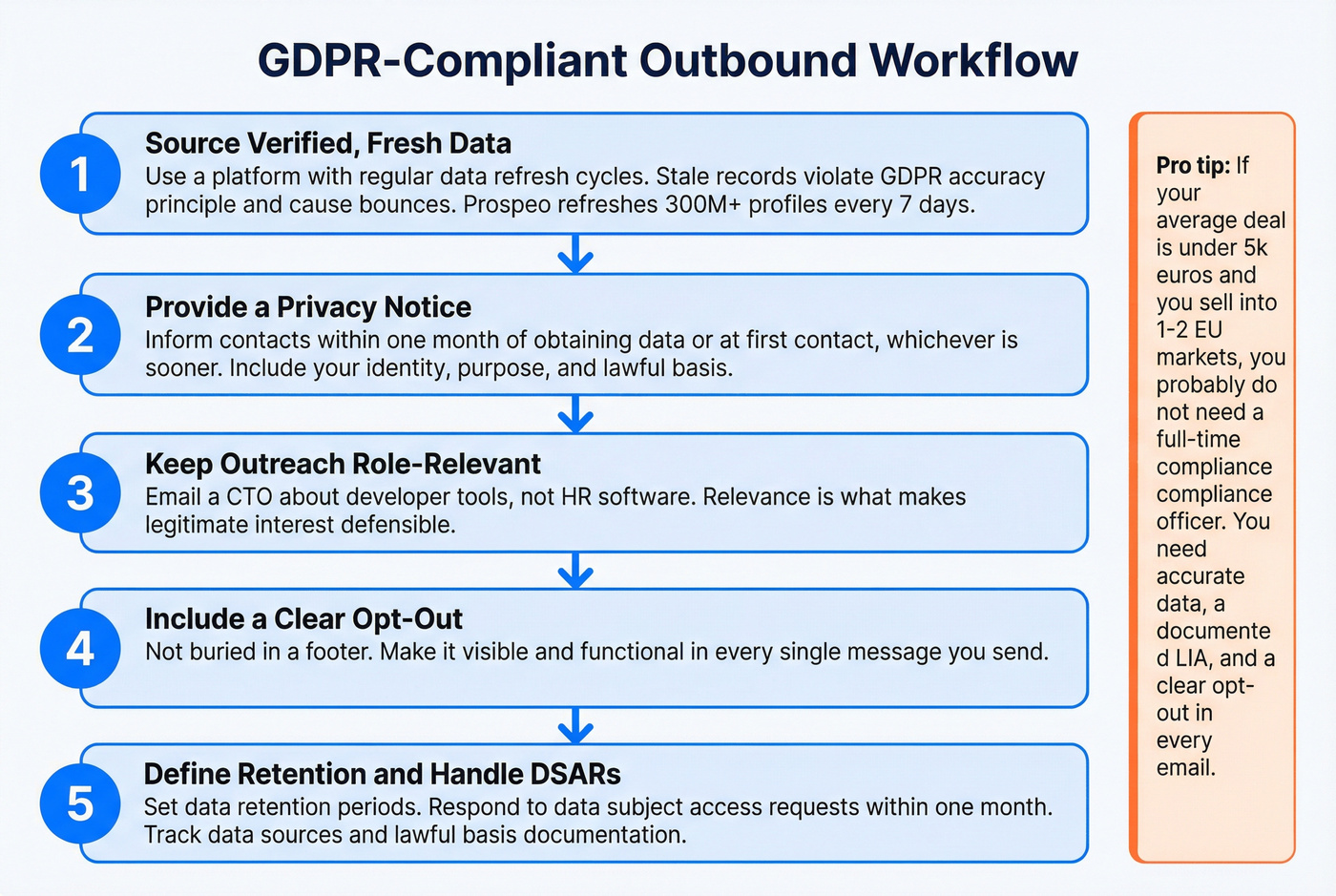
- Source verified, fresh data. GDPR's accuracy principle requires personal data to be accurate and kept up to date. Stale records are a compliance risk, and bounces are often an operational sign your data quality is slipping. Prospeo's 7-day data refresh cycle and 98% email accuracy directly reduce this risk, with opt-out enforced globally and DPAs available on request.
- Provide a privacy notice. If you obtained data indirectly, provide privacy information within one month or at first contact - whichever comes sooner. Note: ICO guidance is currently under review following the Data (Use and Access) Act, so watch for updates.
- Keep outreach role-relevant. Email a CTO about developer tools, not HR software. Relevance is what makes legitimate interest defensible.
- Include a clear opt-out in every message. Not buried in a footer. Visible and functional.
- Define a retention period and respond to DSARs within one month. Don't keep prospect data indefinitely. Track your data sources and lawful basis documentation so you can answer access requests quickly.
I'll be blunt: if your average deal size is under €5k and you're only selling into one or two EU markets, you probably don't need a full-time compliance officer. What you need is accurate data, a documented LIA, and a clear opt-out in every email. Most fines hit companies that were reckless with data at scale, not small teams doing targeted outbound with clean lists.
One more thing worth watching: AI-generated outreach adds new privacy risk when it's fueled by scraped or unexpected data sources. If you're using AI to personalize cold emails, document how the underlying data was sourced and processed, and keep personalization proportional to what the recipient would reasonably expect.
Purchased lists can't prove lawful basis, and scraped data tanks your deliverability. Prospeo's proprietary 5-step verification, catch-all handling, and spam-trap removal give you clean prospect lists that pass both the LIA balancing test and inbox filters - at $0.01 per email.
Build GDPR-defensible prospect lists in minutes, not hours.
Quick Compliance Checklist
- Document your lawful basis for each campaign
- Run a Legitimate Interest Assessment (purpose, necessity, balancing)
- Provide a privacy notice before or at first contact
- Include an opt-out mechanism in every message
- Never use pre-ticked consent boxes
- Define data retention periods and automate deletion
- Respond to DSARs within one month
- Verify email data before sending - bounces often indicate inaccurate processing
- Schedule regular list cleaning to remove outdated or invalid contacts
- Don't buy lists - they don't create a lawful basis for you
Skip this checklist if you're only doing inbound with double opt-in and no outbound. For everyone else, print it out and tape it next to your monitor. Seriously.
FAQ
Is cold email legal under GDPR?
Yes, for B2B outreach, under legitimate interest - provided messaging is role-relevant, you include a clear opt-out, and you've documented your LIA. Country-specific ePrivacy rules can be stricter in some markets, so check national requirements before launching campaigns.
Do I need double opt-in?
GDPR doesn't require it, but about 40% of senders use it because it's strong proof of consent and boosts deliverability. For inbound lists, just do it - the marginal drop in signups is worth the compliance and data quality gains.
How do I build a compliant email list?
Use a verified B2B data platform with filters for job title, industry, company size, and intent signals - then document your lawful basis for each contact. Avoid purchased databases entirely. We've found that teams who build lists from scratch with verified data spend less time on compliance firefighting and more time actually selling.
How does GDPR affect pipeline velocity?
Teams that build compliance into their workflow from the start rarely see it slow down pipeline. The key requirements - documented lawful bases, accurate data, and clear opt-outs at every touchpoint - overlap almost entirely with outbound best practices that drive higher reply rates anyway. One of our customers, Snyk, runs 50 AEs on outbound with bounce rates under 5% and generates 200+ new opportunities per month. Compliance and velocity aren't at odds when your data is clean.