

What Is SDR in Marketing? Role, KPIs, and SDR vs MDR (2026)
Your marketing team ran a webinar last month. 200 registrants, solid engagement, great content. Then 12 of those leads got a follow-up from sales. The other 188 went cold. That gap - between marketing generating demand and sales actually working it - is exactly why people keep asking: what is an SDR in marketing?
The titles in B2B sales are a mess. We searched eight industry sources for "SDR vs BDR" and got eight different answers. Let's cut through it.
The Short Answer
An SDR is a Sales Development Representative who generates pipeline through outbound prospecting. But when people search "what is SDR in marketing," they're usually trying to understand the inbound follow-up role - often called an MDR (Marketing Development Representative) - that converts marketing-generated leads into sales conversations. The difference matters because dedicated inbound coverage typically lifts conversion rates and speed-to-lead.
What Does an SDR Actually Do?
A Sales Development Representative is the front line of outbound pipeline generation. SDRs don't close deals. They open doors.
Their core responsibilities break down like this:
- Outbound prospecting - cold calls, cold emails, multi-touch sequences targeting accounts that haven't raised their hand (see cold emails and cold calling)
- Lead qualification - determining whether a prospect fits the ICP and has enough intent to warrant an AE's time (use a consistent lead qualification model)
- Meeting booking - the primary KPI; everything else ladders up to getting qualified meetings on an AE's calendar
- Handoff to AEs - passing context, notes, and qualification data so the AE doesn't start from scratch
Don't let "entry-level" undersell the skill required. A good SDR handles rejection at scale, manages dozens of active sequences, and develops enough product knowledge to hold a credible conversation with a VP of Engineering or a CFO. Most SDRs report into a Head of Sales Development or VP Sales.
A typical day looks like this: 2-3 hours of cold calls in the morning when connect rates peak, email sequences and follow-ups midday, then account research and list building in the afternoon. The best reps protect their calling blocks ruthlessly - and the ones who don't wonder why they're missing quota by month three.
SDR in Marketing: Where the Role Actually Sits
Here's where the naming confusion matters. A Marketing Development Representative does something fundamentally different from an SDR, even though the titles sound interchangeable.
MDRs bridge the gap between marketing-qualified leads and sales-qualified leads. Instead of cold-prospecting into new accounts, they follow up on leads that marketing already generated - webinar attendees, content downloaders, demo requests, event contacts. They educate and qualify rather than cold-prospect.
The reporting structure reflects this hybrid nature. MDRs often sit between sales and marketing - reporting to sales for process and training, while feeding qualification insights back to the marketing team. That dual accountability is the point: MDRs force the conversation between two teams that historically ignore each other.
The performance impact is real. After one B2B company introduced dedicated MDRs, inbound conversions jumped from 3% to 10%, and MDRs drove 50% of marketing's pipeline and revenue. We've seen similar results across teams we work with. Creating a dedicated inbound qualification role is one of the highest-leverage hires a scaling company can make.
When to hire an MDR: Marketing generates hundreds of MQLs per month and sales is cherry-picking the obvious ones while the rest decay. That's your signal.
SDR vs MDR vs BDR vs AE
At most companies below ~$50M ARR, SDR and BDR are functionally the same role with different business cards. The distinctions that actually matter are between outbound prospecting, inbound qualification, and closing.
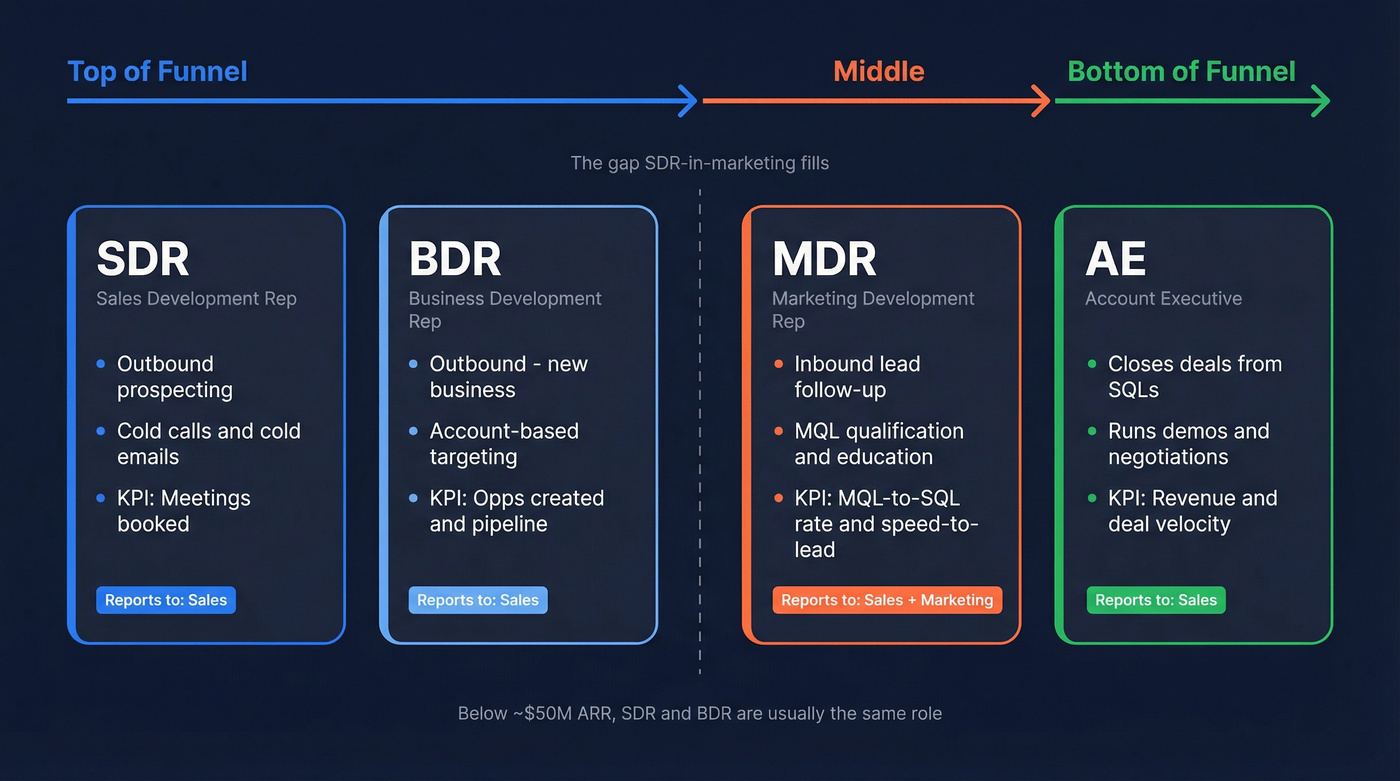
| Role | Funnel Stage | Lead Source | Primary KPIs | Reports To |
|---|---|---|---|---|
| SDR | Top | Outbound | Meetings booked, dials | Sales |
| BDR | Top | Outbound (new biz) | Opps created, pipeline | Sales |
| MDR | Middle | Inbound / MQLs | MQL-to-SQL rate, speed | Sales + Marketing |
| AE | Bottom | SQLs from SDR/MDR | Revenue, deal velocity | Sales |
If your org doesn't have an MDR, whoever's following up on inbound leads is doing the job - they just don't have the title or the dedicated focus. This is why the "SDR in marketing" conversation keeps coming up: teams feel the gap even if they can't name it.

SDRs miss quota when they prospect with bad data. Prospeo gives your reps 300M+ verified profiles with 98% email accuracy and 125M+ direct dials - so they spend time booking meetings, not hunting contacts. At $0.01 per email, even lean teams get enterprise-grade data.
Cut your SDRs' list-building time from hours to minutes.
The MQL-to-SQL Handoff
This is where deals die quietly.
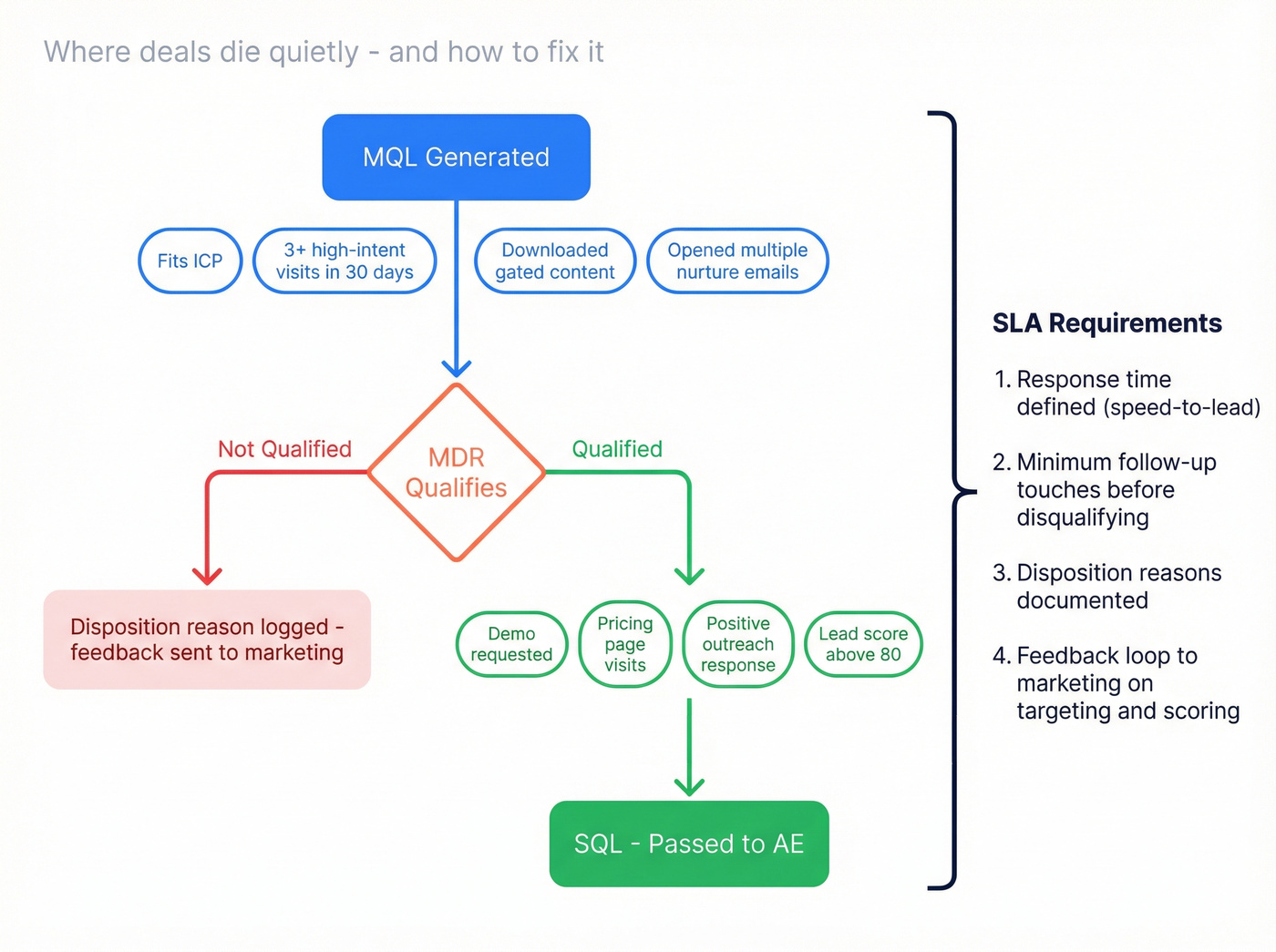
Marketing generates an MQL. Sales says it's not qualified. Marketing says sales didn't follow up fast enough. The cycle repeats until someone builds an SLA - or until the CEO loses patience and forces the issue.
A lead qualifies as an MQL when it fits your ICP, has 3+ high-intent web visits in 30 days, downloaded gated content, or opened multiple nurture emails. An MQL becomes an SQL when stronger buying signals appear: demo requests, repeated pricing page visits, positive responses to outreach, or a lead score above 80 points (see lead scoring).
The SLA between marketing and sales should define:
- Response time - speed-to-lead is the single biggest predictor of conversion
- Minimum follow-up touches before disqualifying
- Disposition reasons so marketing knows why leads were rejected
- A feedback loop covering what marketing should change in targeting, offers, and scoring
Without this, you're throwing leads over a wall and hoping someone catches them.
SDR Benchmarks and KPIs for 2026
Numbers every sales development leader should benchmark against:
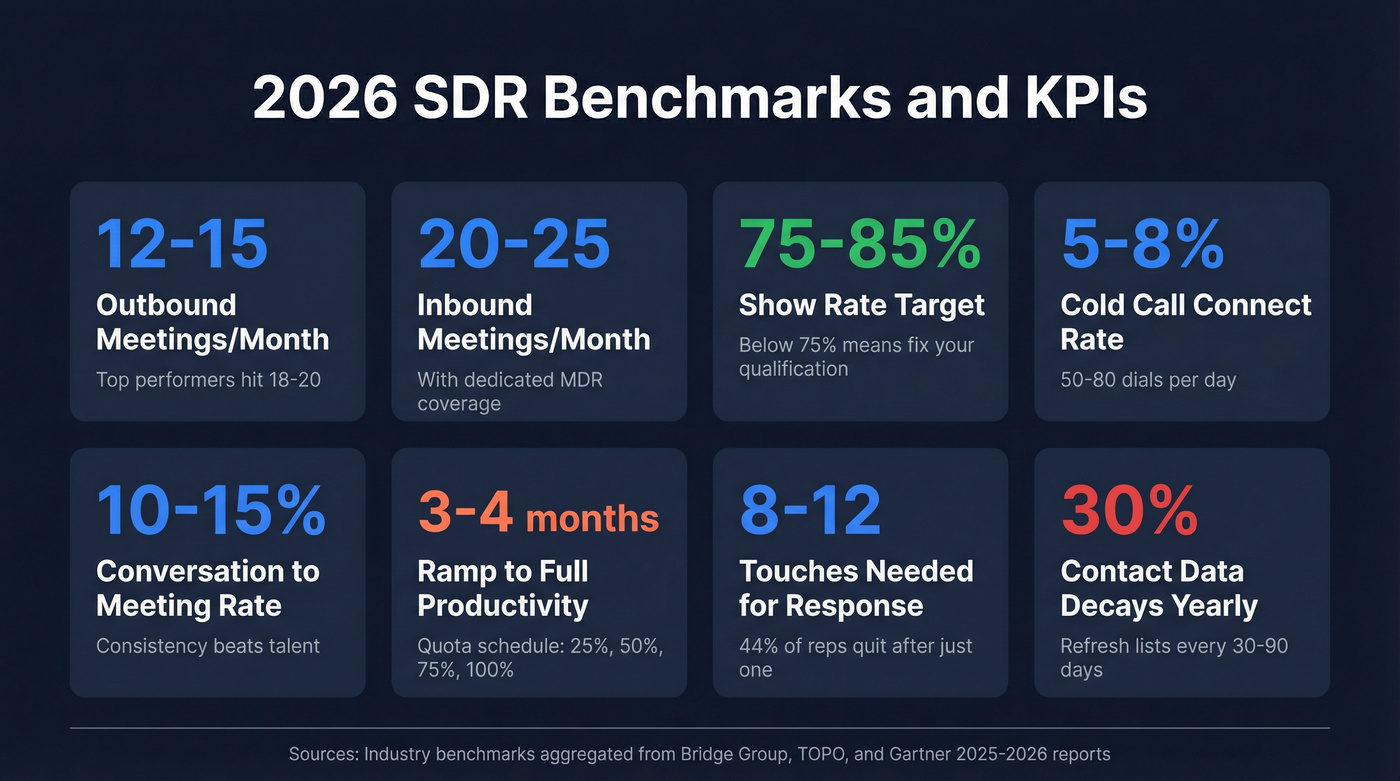
- Outbound meetings booked: 12-15/month is standard; top performers hit 18-20
- Inbound meetings booked: 20-25/month
- Show rates: 75-85% - below 75% means your qualification or scheduling workflow needs fixing
- Cold-call connect rate: 5-8%
- Conversation-to-meeting conversion: 10-15%
- Daily dials: 50-80
- Ramp time: 3-4 months to full productivity, with a typical quota schedule of 25%, 50%, 75%, then 100%
Here's the stat that explains most missed pipeline: 44% of reps give up after just one follow-up, while meaningful responses typically require 8-12 touches (build a repeatable follow-up cadence). Consistency beats talent in this role every single time.
SDR Salary and Compensation in 2026
SDR comp has climbed steadily. Based on 10,000+ Glassdoor salary submissions, the US median total pay sits at $102K/year, with a range of $83K-$128K. Base pay runs $53K-$71K, with commission and bonuses adding $30K-$57K.
At the top end, companies like Stripe pay $129K-$196K and Google pays $130K-$193K - more than many companies pay their AEs. Those are outliers, but they signal how seriously high-growth companies take the role. The r/sales subreddit has plenty of threads debating whether SDR comp has peaked or still has room to climb; the consensus leans toward "still climbing, especially for reps who can work multi-channel."
The SDR Tech Stack
CRM
Everything starts here. Salesforce starts at $165/month/seat and is the enterprise default. HubSpot's free CRM tier works for smaller teams. The CRM isn't where reps spend most of their time, but it's where all the data needs to end up clean (see CRM hygiene).
Sales Engagement
Outreach and Salesloft dominate this space, automating multi-touch sequences so reps focus on conversations instead of manually tracking who needs a third email. Plans typically start around $50/user/month at the low end and scale up from there (related: sales cadence).
Data Enrichment and Verification
Look - roughly 30% of workers change jobs annually. That means nearly a third of your contact list decays every year. If you're not refreshing data every 30-90 days, you're burning activity on dead records and torching your sender reputation in the process (more on B2B contact data decay).

Prospeo handles this with 300M+ professional profiles, 143M+ verified emails, and 125M+ verified mobile numbers on a 7-day refresh cycle - the industry average is six weeks. It delivers 98% email accuracy, supports 30+ search filters to build targeted lists matching your ICP, and includes real-time verification so you reduce bounces before you hit send (see email verification). Pricing is self-serve and credit-based at roughly $0.01 per email, with a free tier of 75 verified emails per month. No contracts, no sales calls required. For comparison, a mid-market ZoomInfo contract runs $15K-$40K/year, and Apollo offers a free tier with paid plans from approximately $49/mo per user.
Intent Data and Signals
The hardest part of outbound isn't the pitch - it's picking the right accounts. Intent data tracks topics your buyers are actively researching, letting you layer buying signals with job role and company growth data to prioritize accounts that are actually in-market (see intent signals). If your average contract value is in the low five figures, you probably don't need ZoomInfo-level data spend. A self-serve tool with accurate emails and intent signals gets you 80% of the way there at a fraction of the cost.
That MQL-to-SQL handoff breaks when contact data is stale. Prospeo refreshes every 7 days - not the 6-week industry average - so your MDRs reach inbound leads with verified emails and direct dials before they go cold. One team tripled pipeline from $100K to $300K/week after switching.
Stop losing warm leads to outdated contact data.
SDR Career Paths (Including Marketing)
The SDR role isn't a destination. It's a launchpad. Most SDRs transition into AE roles within 12-18 months, with high performers making the jump in 10-12.
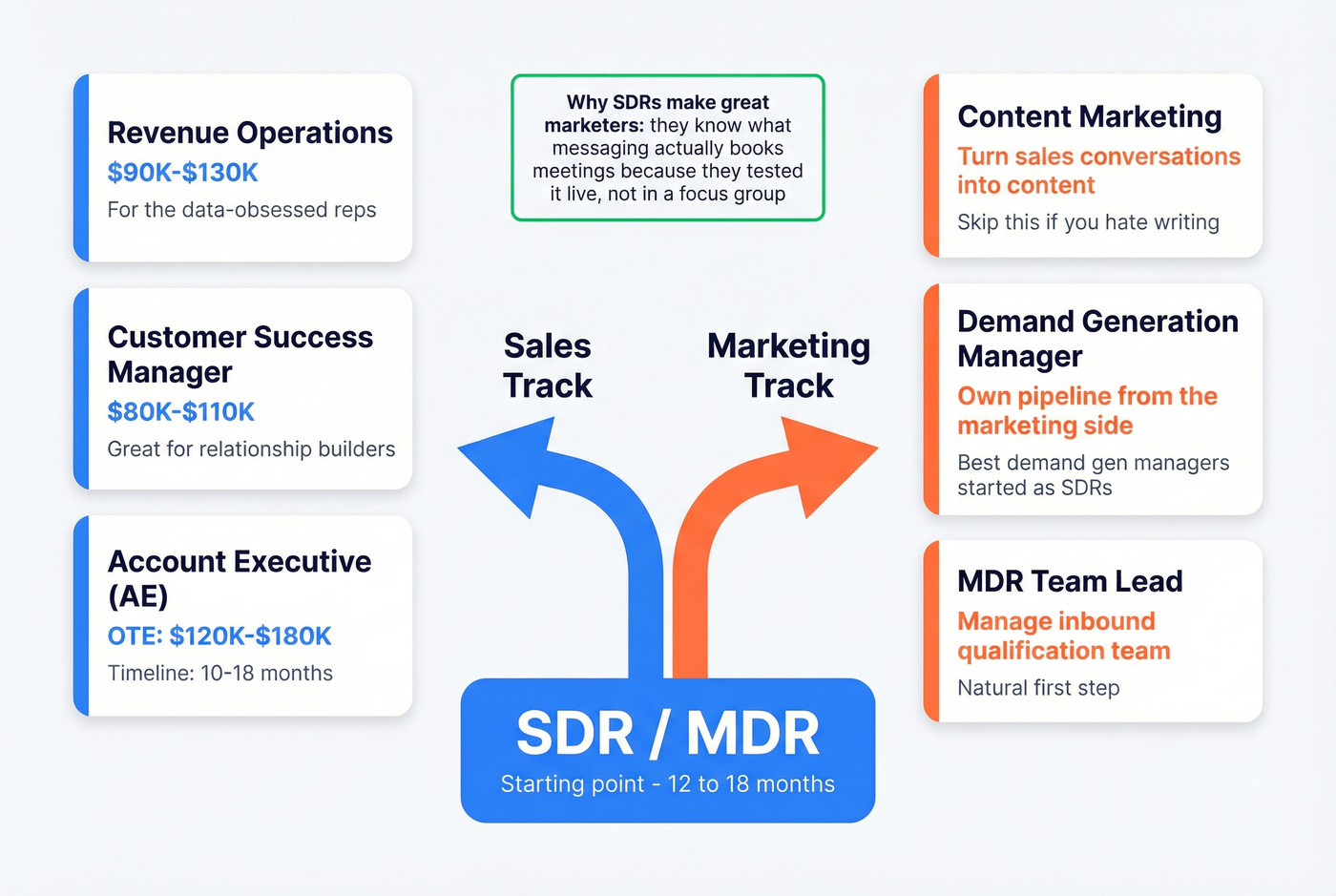
The sales track is obvious: mid-market AE OTE runs $120K-$180K, Customer Success lands at $80K-$110K, and RevOps roles pay $90K-$130K.
But here's what most career guides miss - the marketing track. Reps who've spent 15+ months qualifying inbound leads are uniquely positioned to move into MDR leadership, demand generation, or content marketing. They understand what makes a lead convert because they've been on the phone with hundreds of them. In our experience, the best demand gen managers we've worked with started as SDRs or MDRs. They know which messaging actually books meetings because they've tested it live, not in a focus group (see demand generation).
Skip the marketing track if you hate writing and data analysis. But if you're an SDR who geeks out over conversion rates and messaging tests, it's a path worth exploring seriously.
FAQ
Is an SDR a sales or marketing role?
An SDR is traditionally a sales role focused on outbound prospecting and booking meetings. Inbound follow-up is often handled by an MDR that sits between sales and marketing. If your team has 200+ MQLs/month and slow follow-up, put inbound ownership on one dedicated role and measure speed-to-lead.
What's the difference between an SDR and a BDR?
At many companies, they're the same job with different titles. When teams do separate them, SDRs handle inbound qualification and BDRs focus on outbound new business. If you only pick one title, define it by lead source and keep KPIs consistent.
What tools do SDRs need to hit quota?
Most teams need three things: a CRM, a sequencing tool like Outreach or Salesloft, and verified contact data to protect deliverability. Aim for under 5% bounce rates and refresh lists every 30-90 days.
What's a good free tool for verified leads?
A good free option gives you verified emails - not guesses - and doesn't lock basics behind annual contracts. Prospeo includes 75 verified emails/month plus Chrome extension credits, and tools like Apollo also offer free tiers. Just watch accuracy and list decay as you scale.
So what does "SDR in marketing" really mean in practice? It's usually a signal that your org needs clearer ownership of lead follow-up: outbound gets an SDR, inbound gets an MDR, and both roles need clean data, tight SLAs, and a real handoff process. That's the formula that actually turns demand into pipeline in 2026.