How to Build a Demand Generation Strategy That Actually Drives Pipeline
Your VP of Sales wants to know why pipeline is down when MQLs hit an all-time high last quarter. You already know the answer: most of those leads never had buying intent. They downloaded an ebook, got scored, and clogged the funnel. That's not a demand generation strategy - it's a lead generation hamster wheel.
Ask any demand gen practitioner in a B2B Slack group what's broken, and you'll hear the same thing: "Marketing celebrates MQL targets while sales ignores 80% of the leads." The fix isn't more leads. It's building an engine that creates real demand.
What Is Demand Generation?
Demand gen in 2026 is an engine, not a campaign calendar. Three things matter: build awareness where buyers actually research - the dark funnel, AI-powered search, communities, and creator content. Measure what your CRM can't see - branded search lifts, self-reported attribution, save/share signals. And make sure the handoff to sales doesn't break because you're passing over verified contact data, not stale records that bounce.
The biggest arbitrage opportunity most teams miss? Partner and channel programs have the highest win rate of any booking source but receive only 14% of marketing dollars. We'll get to that.
The 69% Problem
Buyers are roughly 69% through the purchasing process before they ever talk to a seller, per 6sense's Buyer Experience Study. In APAC it's over 72%. They initiate first contact 80%+ of the time, and most already have a preferred vendor when they do.
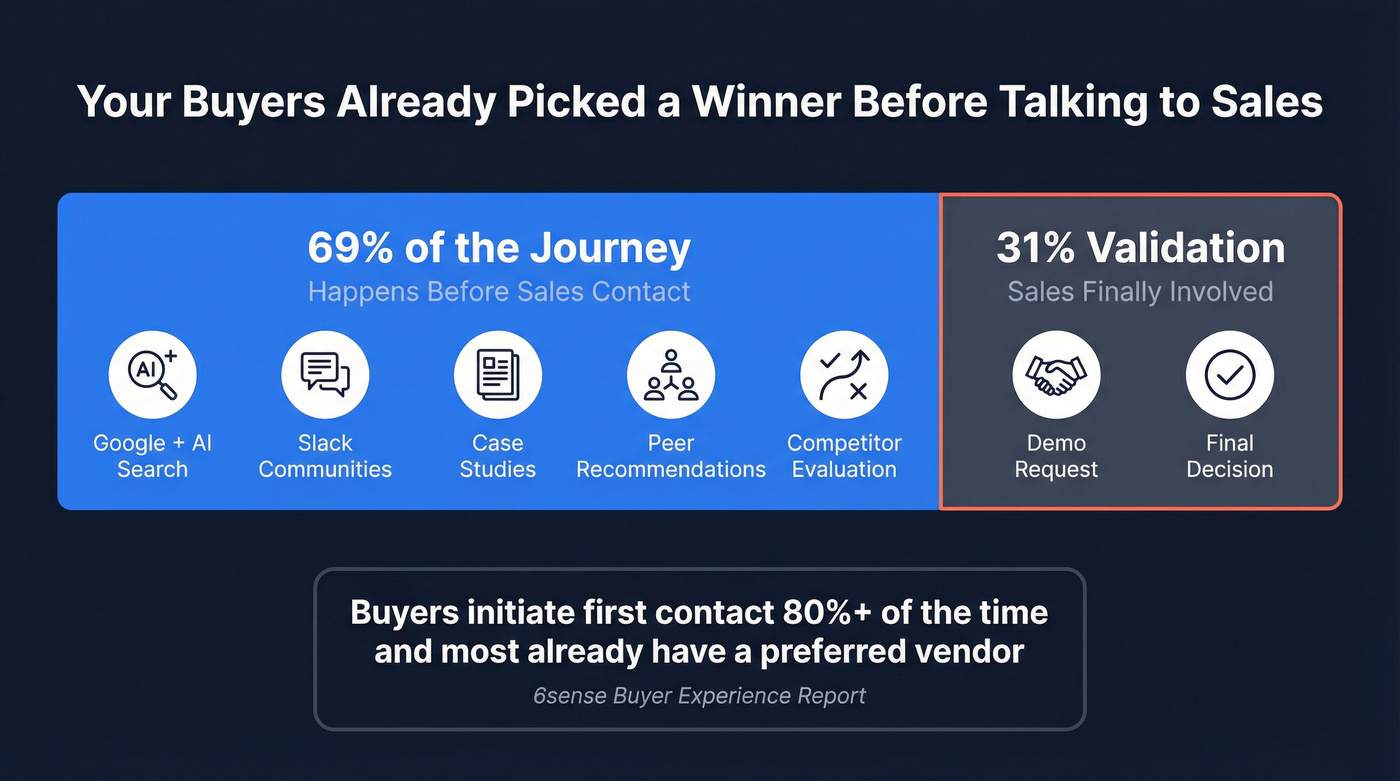
By the time a prospect fills out your demo form, they've evaluated you against competitors, read your case studies, asked a peer in a Slack community, and checked Reddit. The "selection" phase - roughly 70% of the journey - happened without your sales team. The remaining 30% is validation.
Your demand gen approach has to win during that invisible 70%. If you're only investing in the capture moment, you're competing for the scraps. This is why modern demand generation looks nothing like the gated-content playbooks of five years ago.
Demand Gen vs. Lead Gen vs. ABM
These three get conflated constantly.
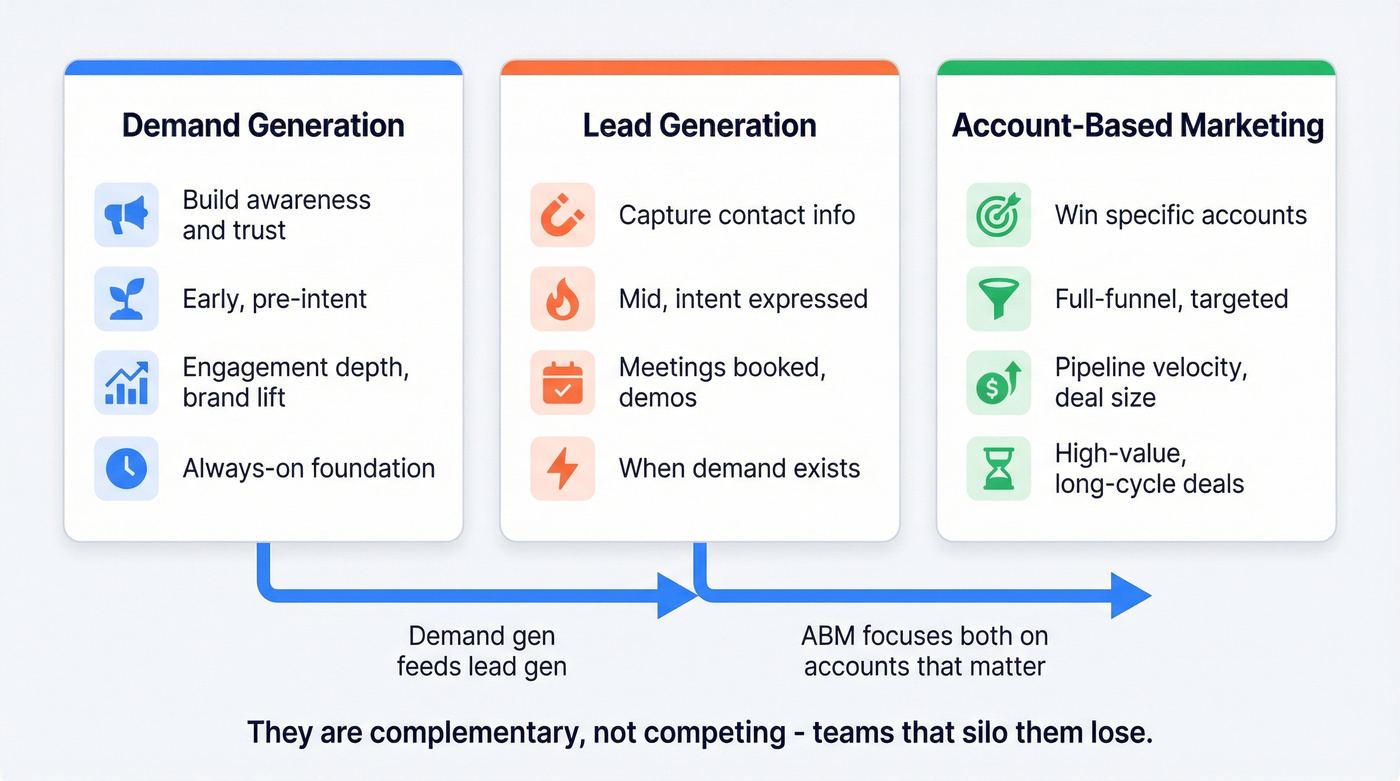
| Demand Gen | Lead Gen | ABM | |
|---|---|---|---|
| Goal | Build awareness + trust | Capture contact info | Win specific accounts |
| Stage | Early (pre-intent) | Mid (intent expressed) | Full-funnel (targeted) |
| Key metrics | Engagement depth, brand lift | Meetings booked, demos | Pipeline velocity, deal size |
| When to use | Always-on foundation | When demand exists | High-value, long-cycle deals |
The sequencing matters more than the definitions. Run demand gen to build awareness within target accounts, track engagement signals, then introduce personalized lead gen offers when intent spikes. Demand gen feeds lead gen. ABM focuses both on the accounts that matter most. They're complementary, not competing - and teams that treat them as separate silos end up with a VP of Marketing running brand campaigns that sales never sees, and an SDR team burning 200 dials a day for three meetings.
What Changed in 2026
The channel mix has shifted hard. In HubSpot's 2026 State of Marketing survey of 1,500 marketing leaders, 94% diversified their channel mix last year. Only 6% still rely on one or two channels. That's not a trend - it's a consensus.
What's driving it: 49% of marketers report declining traditional search traffic as AI answers absorb clicks. But 58% say AI referral traffic converts at a higher rate. The visitors who do click through from generative search results are further along - they're validating, not browsing.
Meanwhile, 76% of senior B2B marketers say strong competitive brand awareness positively impacts pipeline, and 42% say increasing it among decision-makers is their top priority. Video is the default format - 78% of B2B marketers use it, and 55% partner with creators or industry voices to produce it. Brands combining video with creator partnerships are 2.2x more likely to be trusted.
Build an Engine, Not Campaigns
Most demand gen "strategies" are really just campaign calendars. A webinar in March, a report in June, a LinkedIn push in Q4. Each one starts from zero. Nothing compounds.
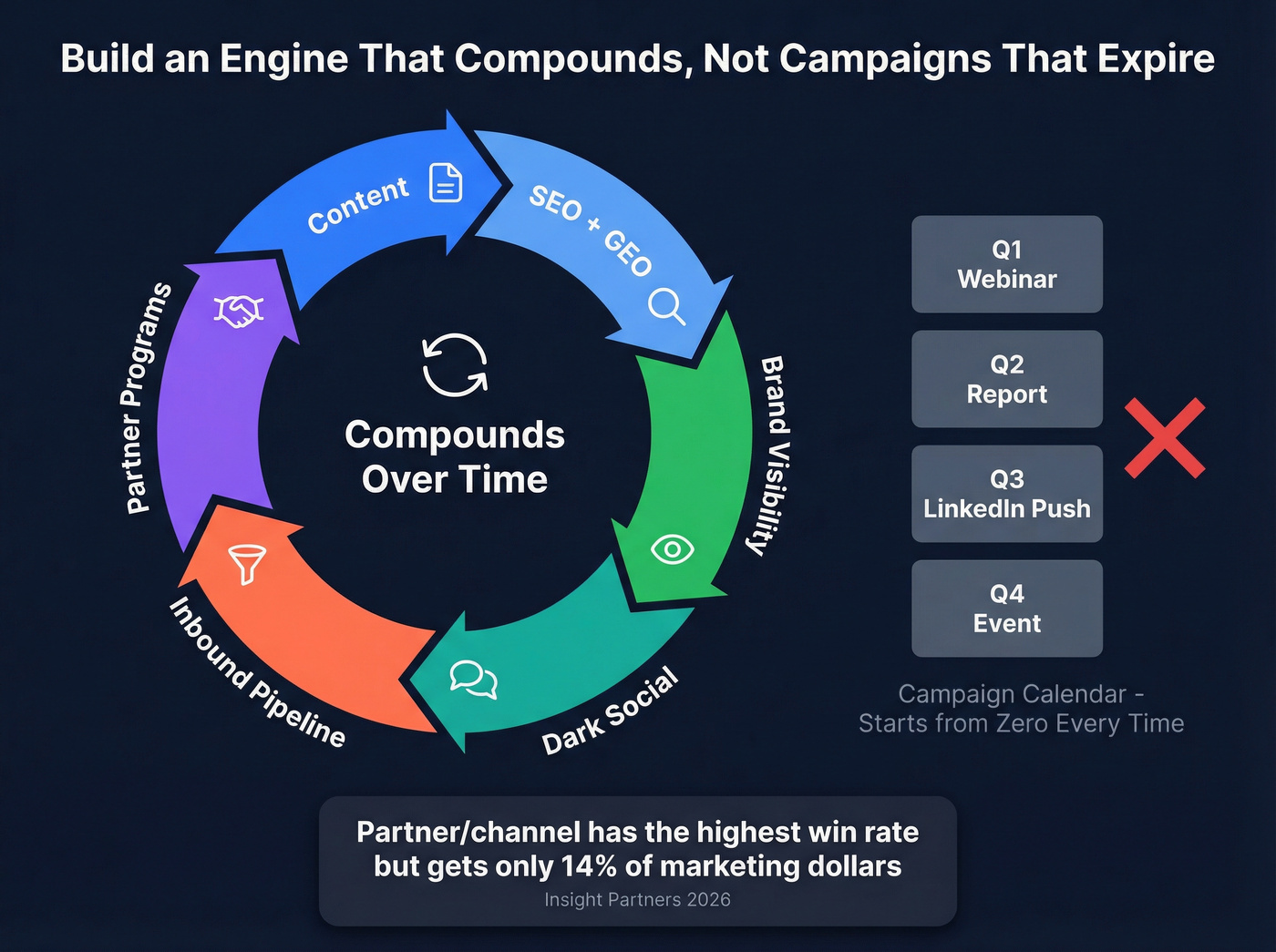
An engine works differently. Content feeds SEO. SEO feeds GEO (generative engine optimization). GEO feeds brand visibility. Brand visibility feeds dark social conversations. Dark social feeds inbound. When you stop running a campaign, it disappears. When you stop feeding an engine, it coasts on momentum for months.
We've watched teams pour huge budgets into LinkedIn ads while ignoring partner programs that close at 2x the rate. Per Insight Partners' 2026 pipeline survey, partner/channel has the highest win rate among common booking sources - yet it receives only 14% of marketing dollars. That's a gap worth closing.

Your demand gen engine creates awareness, but pipeline stalls when sales can't reach buyers. Prospeo layers Bombora intent data across 15,000 topics onto 300M+ profiles - so when accounts surge, you pull verified emails (98% accuracy) and direct dials instantly. No stale records. No bounces killing your domain.
Stop generating demand you can't capture. Start reaching buyers while intent is hot.
Strategies That Drive Pipeline
Here's the thing: 80% of respondents in the Insight Partners survey said AI usage positively impacted pipeline generation. Yet only 32% use AI for predictive analytics like lead scoring. Most teams are using AI to write blog posts when they should be using it to find buyers.
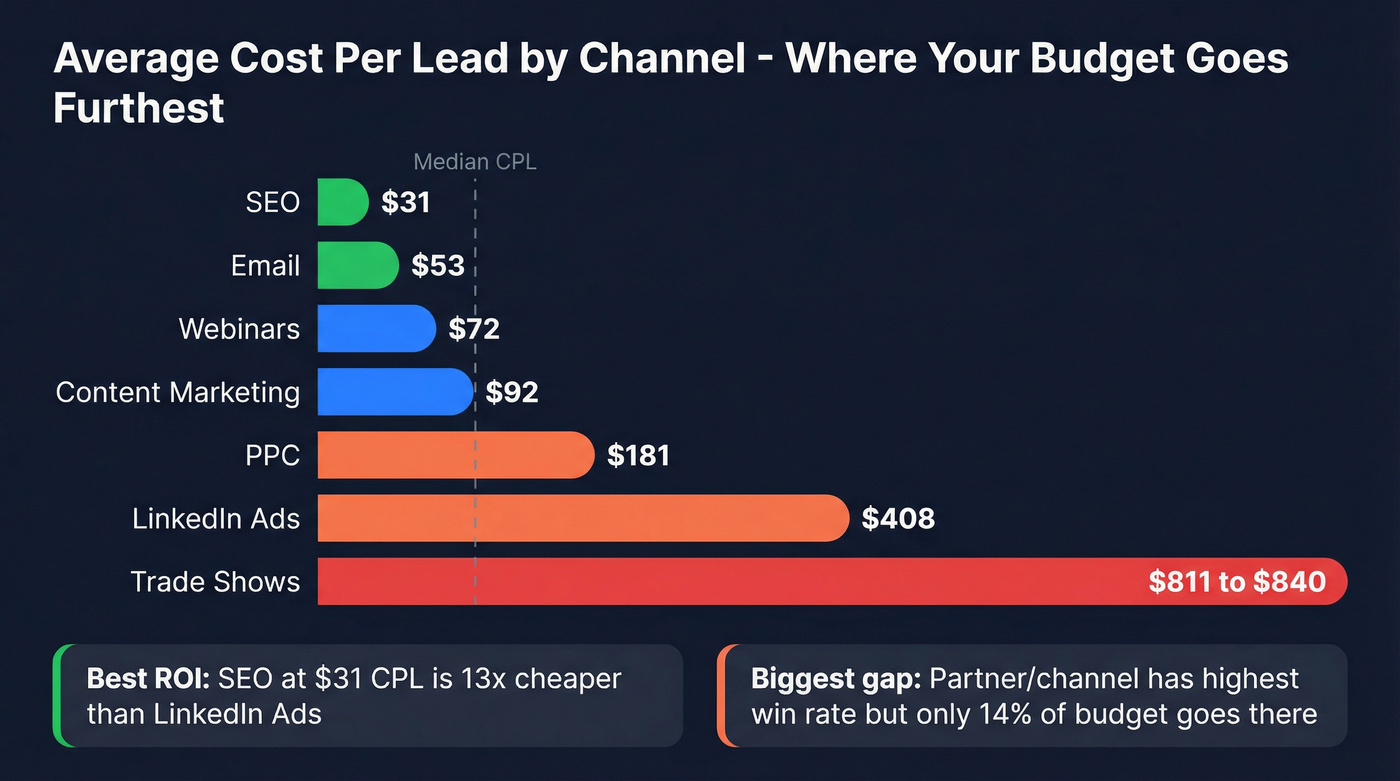
Benchmark CPLs for context:
| Channel | Avg. CPL |
|---|---|
| SEO | $31 |
| $53 | |
| Webinars | $72 |
| Content marketing | $92 |
| PPC | $181 |
| LinkedIn ads | $408 |
| Trade shows | $811-$840 |
Content + Creator Partnerships
Stop producing content in a vacuum. 55% of B2B marketers now partner with creators and industry voices - the trust lift is real at 2.2x with video + creator combos. Find three to five practitioners your buyers already follow. Co-create with them. Their distribution is your demand gen, and it costs a fraction of what you'd spend building that audience from scratch.
SEO + GEO
GEO isn't optional anymore - it's table stakes. 80% of companies are implementing GEO programs, but only 25% feel confident in their approach. GEO already accounts for 4% of marketing-sourced pipeline across Insight Partners' B2B SaaS portfolio, and that number is climbing fast. Optimize for citations, not just rankings.
Intent Data-Driven Targeting
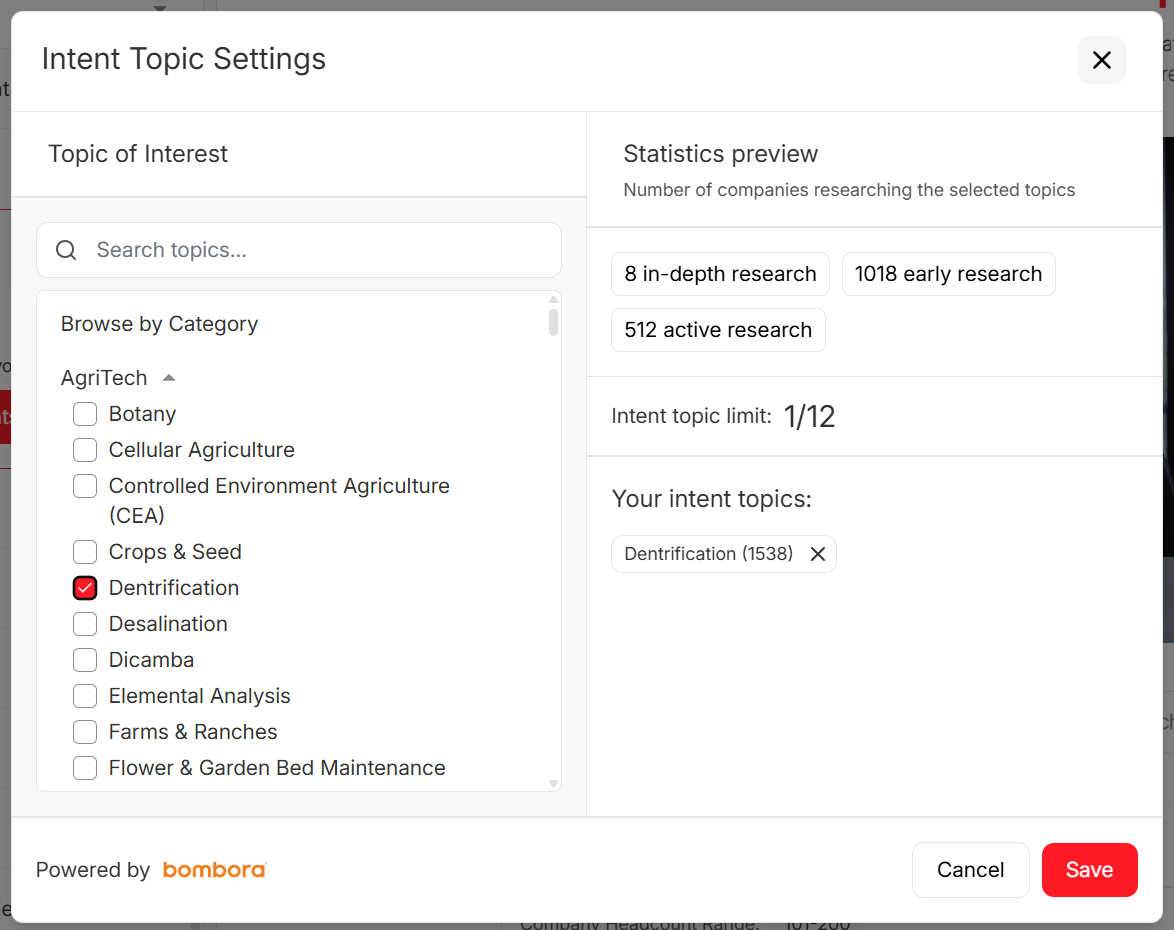
What if you knew which accounts were actively researching your category before they hit your website? That's intent data - and it's one of the clearest separators between high-performing demand gen teams and everyone else.
The play is straightforward: track topic surges across your ICP, then pull verified emails and direct dials for the buying committee while interest is hot. Prospeo layers Bombora-powered intent tracking across 15,000 topics onto 300M+ professional profiles, so when an account surges on a topic you care about, you can reach the right people with 98% email accuracy - no manual research, no stale data bouncing back.
Account-Based Marketing
ABM isn't a separate strategy - it's demand gen with a target list. Focus resources on your highest-value accounts, personalize across channels, and measure engagement depth per account rather than lead volume. Skip this if you don't have at least 50 named accounts and the content resources to personalize for them. Otherwise you're just doing bad demand gen with extra steps.
Email Nurture Sequences
Segment by intent signals and engagement behavior, then trigger sequences based on what a prospect actually did - visited pricing, attended a webinar, downloaded a comparison guide. Don't blast your entire database with the same monthly newsletter and call it "nurture." We've seen teams cut their nurture list in half and double their SQL conversion rate just by removing contacts with zero engagement signals.
Events: Virtual + In-Person
Outbound pipeline has declined three points since 2021, but calls remain the most impactful outreach method for 50% of companies. The play is hybrid: virtual events at $72 CPL for awareness at scale, in-person for high-value relationship building. Measure by meetings booked, not badge scans.
Partner & Channel Programs
This is the biggest gap in most demand gen playbooks. Highest win rate, 14% of budget. If you have an integration ecosystem, technology partners, or a reseller network, invest here. Co-marketing with partners who already have your buyer's trust is demand generation on easy mode - and the consensus on r/sales is that partner-sourced deals close faster and churn less.
Paid Media
Paid media works best as an accelerant, not a foundation. Use it to amplify content that's already performing organically and retarget engaged accounts. CTV is emerging as a brand play for mid-market and enterprise - lower CPMs than LinkedIn with broader reach. For teams spending less than $10K/month on paid, skip CTV and focus that budget on retargeting warm accounts through LinkedIn and display.
Community + Dark Social
Picture this: someone in a private Slack channel asks "anyone used a tool for X?" and three people mention your name. That's demand gen at its most powerful - and its least measurable. Show up in the communities your buyers inhabit. Share genuinely useful insights without a pitch. You can't track it directly, but you can earn it.
The Dark Funnel
The dark funnel is the buyer journey your CRM never sees - the Slack message where a VP asks peers for vendor recommendations, the DM where someone forwards your podcast clip, the internal email thread where a champion sells your solution using language from your content.
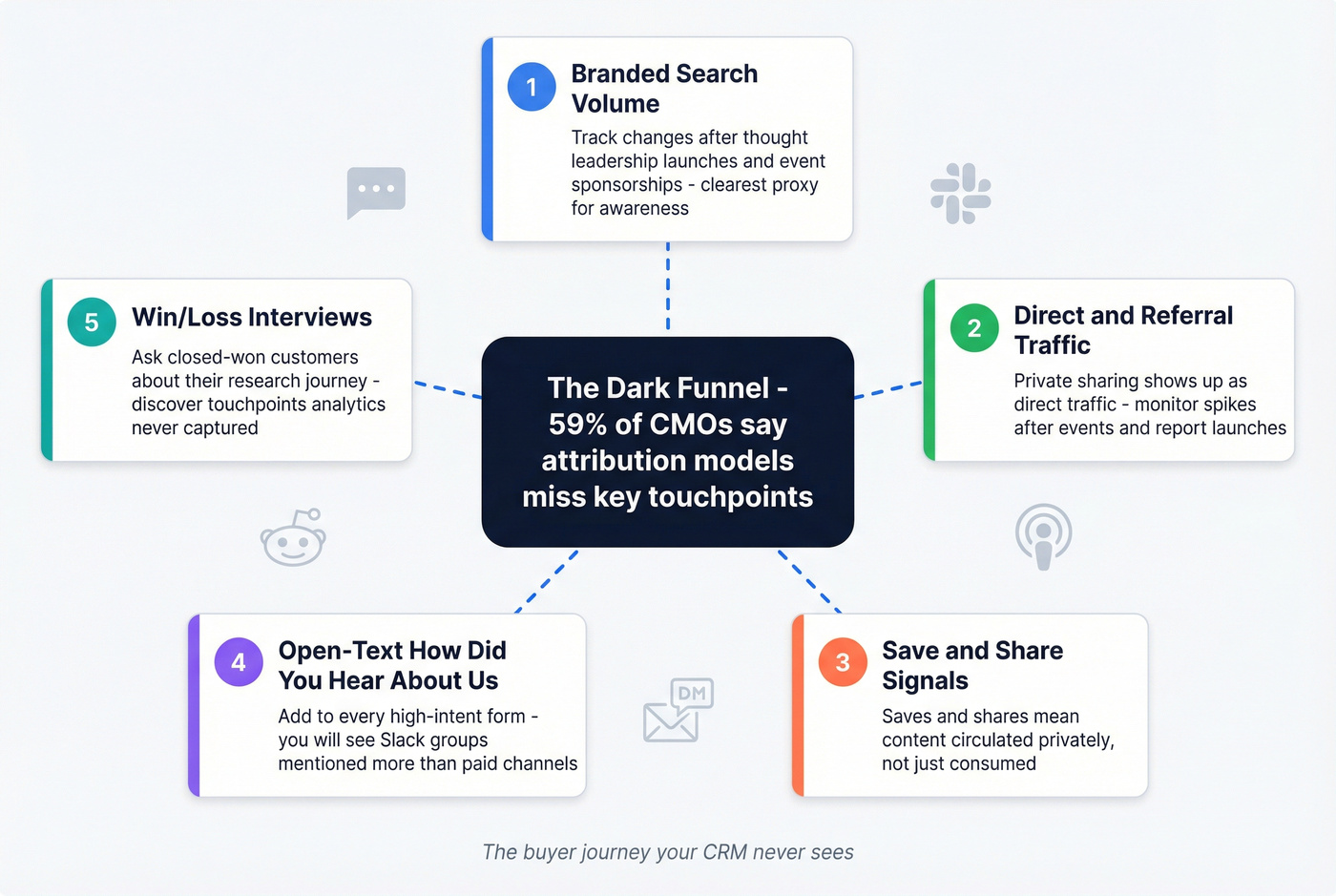
59% of CMOs say their attribution models don't accurately track key touchpoints. Five ways to read the signals:
- Branded search volume - track changes after thought leadership launches and event sponsorships. The clearest proxy for awareness.
- Direct/referral traffic patterns - private sharing shows up as direct traffic. Monitor spikes after events and report launches.
- Save/share signals - saves and shares indicate content circulated privately, not just consumed.
- Open-text "How did you hear about us?" - add this to every high-intent form. We've seen "a friend mentioned you in a Slack group" appear more often than any paid channel.
- Win/loss interviews - ask closed-won customers about their research journey. You'll discover touchpoints analytics never captured.
5 Mistakes That Kill Results
1. Optimizing for MQLs over revenue. In our experience, the teams that struggle most with pipeline are the ones still measuring MQL volume. Tie marketing metrics to revenue outcomes and tighten your MQL definition to require both intent signals and ICP fit.
2. Static ICP definitions. If your ICP is just "VP of Marketing at 200-1,000 employee SaaS companies," you're working with a sketch. Layer behavioral signals - content engagement, site behavior, third-party intent data - onto firmographics. Audit closed-won patterns quarterly.
3. Launching without buyer research. Talk to 10-15 recent buyers. Capture the exact words they use, what triggered their search, and what differentiated you. That language becomes your demand gen copy.
4. Ignoring data quality. If your bounce rate is above 5%, your data provider is the bottleneck - not your messaging, not your targeting. Bad data doesn't just waste time; it burns your domain reputation and makes every subsequent campaign harder. (If you want a tighter process, start with CRM hygiene.)
5. Single-channel dependency. 94% of marketing leaders diversified last year. If you're running 70%+ of demand gen through one channel, you're one algorithm change away from a pipeline crisis.
Budget & Benchmarks
The median B2B SaaS company spends about 8% of ARR on marketing. Past $5M ARR, demand gen typically claims 34-38% of that budget.
Conversion benchmarks worth targeting:
| Metric | Benchmark | Top performers |
|---|---|---|
| Visitor to Lead | 2-5% | 5-10% |
| MQL to SQL | 50-60% | 60%+ |
| Marketing-sourced pipeline | 30-50% | 50%+ |
If your demand generation strategy produces less than 30% of total pipeline, you're either under-investing or measuring wrong.
Your Demand Gen Tech Stack
You don't need 15 tools. You need the right four or five, wired together.
Data & Enrichment: Prospeo - 300M+ profiles, 30+ search filters including buyer intent and technographics, 98% email accuracy, ~$0.01/email. Free tier available, no contracts.
CRM: HubSpot (free tier to ~$150+/mo) for SMBs; Salesforce ($25-300/user/mo) for mid-market and enterprise.
Marketing Automation: HubSpot Marketing Hub (~$800+/mo) or Marketo (~$1,000-6,000+/mo) for complex multi-touch nurture at scale.
ABM & Intent: Demandbase or 6sense for account-level orchestration (~$30-100k+/yr). Don't buy one until you've outgrown what intent data layered into your data platform can do.
Buyers are 69% through the journey before they talk to sales. When they finally surface, your team has minutes - not days - to connect. Prospeo's 7-day data refresh means every email and phone number is current, not six weeks stale like competitor databases. At $0.01 per email, scaling outreach to surging accounts costs less than a single LinkedIn ad click.
Win the 30% that matters with contact data that actually connects.
FAQ
What's the difference between demand generation and lead generation?
Demand gen creates awareness and trust before a buyer is ready to talk to sales. Lead gen captures contact information from that awareness. Without demand gen, lead gen becomes cold outreach to strangers - and conversion rates reflect it.
How do you create a demand generation strategy?
Start with buyer research - interview 10-15 recent customers to understand their journey. Define your ICP using firmographic and behavioral data, map the channels where your buyers research, build always-on content and distribution, and layer in intent data to time your outreach. Tie every activity back to pipeline, not vanity metrics.
How long does it take to see results?
Expect branded search lifts and engagement increases within 3-6 months. Measurable pipeline impact typically takes 6-12 months. The engine compounds - month 12 looks dramatically different from month 3, which is why executive buy-in from day one is non-negotiable.
What's the most important demand gen metric?
Marketing-sourced pipeline as a percentage of total pipeline - aim for 30-50%. MQLs, impressions, and engagement scores are leading indicators, but pipeline contribution is the number your CFO cares about.
What tools do you need for B2B demand generation?
At minimum: a CRM, a data platform with verified contacts and intent signals, and a content distribution engine. Everything else - ABM platforms, marketing automation, paid media - is optimization on top of that foundation.