

B2B Lead Generation for Marketing Teams: The 2026 Operational Playbook
It's Monday morning. The pipeline report lands in your inbox: 2,000 MQLs last month, 47 sales conversations, 2 closed deals. That's a 2.35% conversion rate from lead to conversation - and your CEO is asking why marketing headcount grew while pipeline stayed flat.
Here's the thing most teams won't admit: B2B lead generation for marketing teams has become a pipeline problem, not a volume problem. Your program is optimized for vanity metrics instead of revenue. We've watched this pattern play up close dozens of times, and the fix isn't more leads - it's better systems.
91% of marketers say lead generation is their most important goal. But most teams still measure the wrong things, run campaigns on dirty data, and hand sales leads that never had a chance of converting. This isn't another list of 14 tactics. It's the operational system behind them: benchmarks, scoring models, attribution frameworks, and the tech stack that actually drives pipeline.
Fix These Three Things First
Before you touch a single campaign:
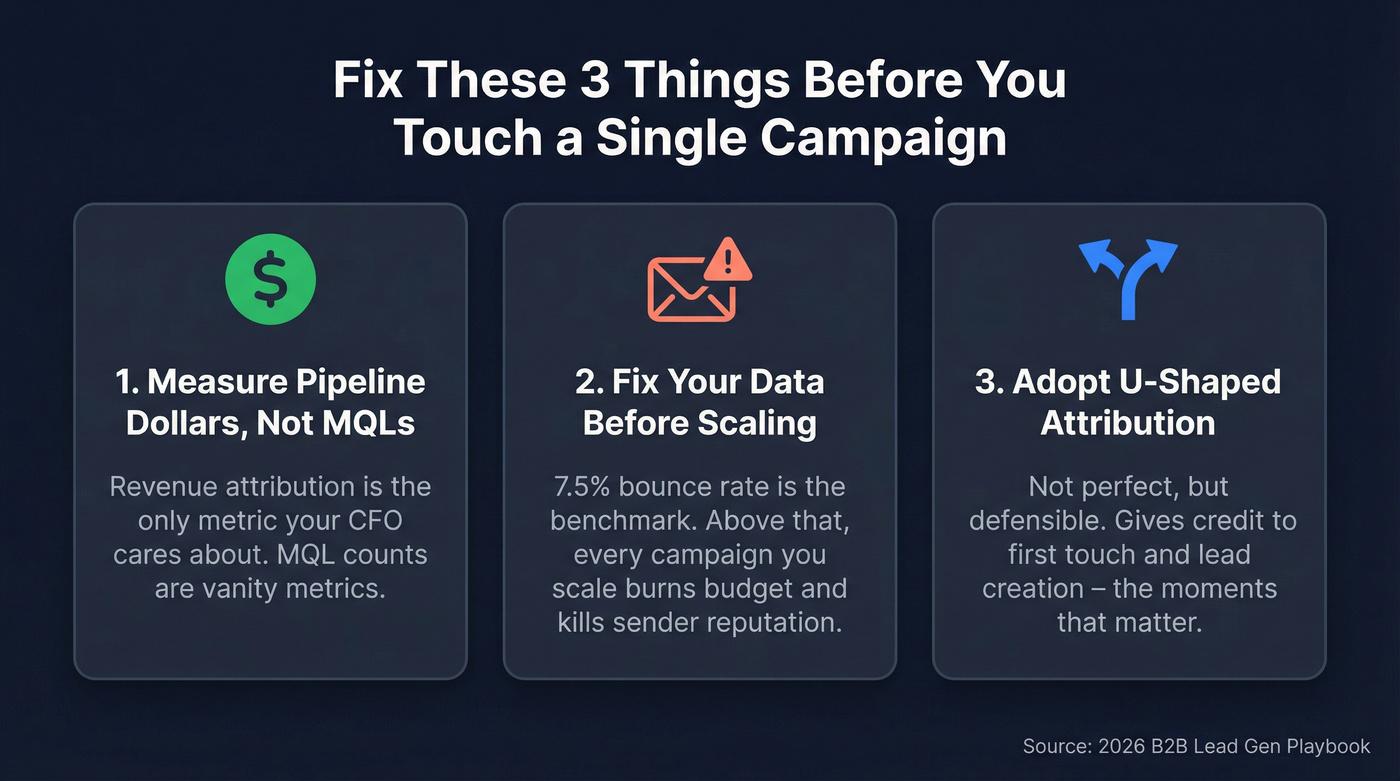
- Measure pipeline contribution, not lead volume. If your dashboard shows MQLs but not pipeline dollars influenced, you're flying blind. Revenue attribution is the only metric your CFO cares about.
- Fix your data before scaling outreach. A 7.5% bounce rate is the average cold email benchmark. If you're above that, every campaign you scale burns more budget and damages your sender reputation faster. (If you need a framework, start with data quality and B2B contact data decay.)
- Adopt an attribution model your CFO can understand. Start with U-shaped attribution. It's not perfect, but it's defensible and gives credit where it matters.
What's Changed in 2026
The biggest shift isn't a new channel or tool. It's trust.
A LinkedIn/Ipsos study of 1,500 senior B2B marketers found that 94% agree trust is the key driver of B2B success. Brands combining video and influencer partnerships are 2.2x more likely to be trusted and 1.8x more likely to be well known. 55% of B2B marketing teams now partner with creators, SMEs, and industry voices as a core strategy - and the consensus on r/sales is that "thought leader" content from real practitioners outperforms branded content by a wide margin.
Trust matters more because the easy answers are already handled by AI. 49% of marketers report declining traditional search traffic as AI answers absorb clicks, but 58% say AI referral traffic converts at higher intent. The visitors you do get are more serious - they've already gotten the surface-level answer from ChatGPT and are looking for depth.
The buying process itself has gotten more complex. Deals now involve 6 to 10 committee members before a purchase decision. Your lead gen can't just capture one contact per account - you need to multi-thread into the buying group. Single-threaded deals die in committee. (If you want the mechanics, see What Is Multithreading in Sales? and buying group personas.)
Channel diversification isn't optional anymore. Only 6% of B2B marketers rely on one or two channels. 45% allocate 10-20% of budget specifically to testing new channels each quarter.
Strategy Before Tactics
Before you pick channels or tools, get your ICP right. Not "companies with 50-500 employees in North America" - that's a TAM, not an ICP. A real ICP defines the firmographic, technographic, and behavioral signals that predict a deal will close in under 90 days at your target ACV. (If you need a template, use account qualification and firmographic and technographic data.)
Start with your best 20 closed-won deals from the last 12 months. What do they have in common? Industry vertical, tech stack, growth stage, trigger events. That pattern is your ICP. Everything else - channel selection, content strategy, budget allocation - flows from it.
On budget, 53% of B2B marketing teams spend at least half their total budget on lead generation. We've seen teams blow 80% of that on paid channels with $400+ CPLs when a rebalance toward organic and outbound would've cut costs in half.
Stop gating everything. Ungate your blog posts, guides, and webinars. Gate only the highest-value assets - ROI calculators, benchmark reports, custom assessments. The ungated content builds trust and drives organic traffic. The gated content captures people already engaged enough to trade their email for something genuinely valuable. Gating a 500-word blog post in 2026 just trains your audience to give you fake emails, and it usually tanks lead quality.
The Channel Playbook
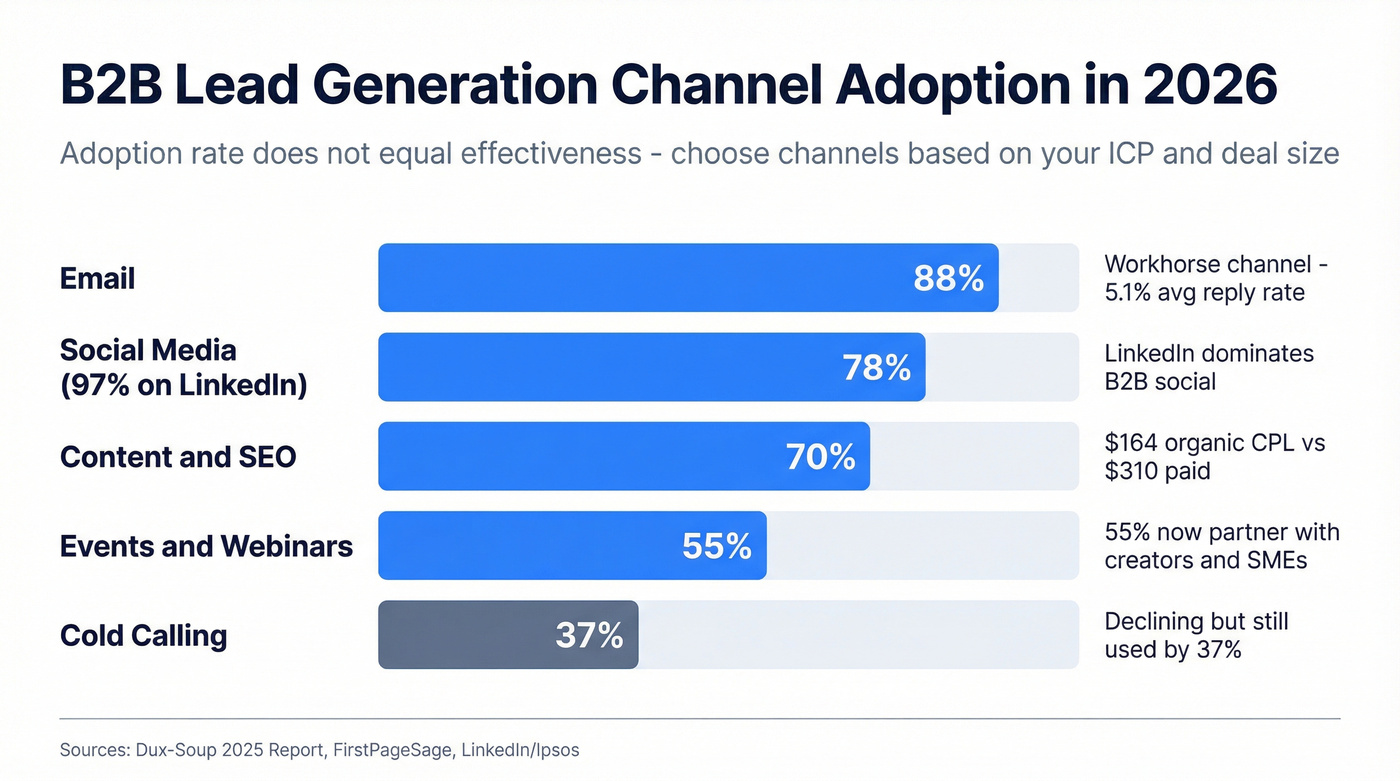
88% of B2B teams use email for lead generation, 78% use social media (with 97% of social users on LinkedIn), and 37% still use cold calling. But adoption doesn't equal effectiveness.
Content and SEO
Organic content is the cheapest lead gen channel at scale. B2B SaaS companies pay $164 per organic lead versus $310 per paid lead - nearly half the cost. The catch is time: organic takes 6-12 months to compound, while paid delivers immediately.
The new angle is AIO - AI optimization. Structure your content to answer specific questions directly, and you'll capture both traditional search and AI referral traffic. Don't neglect distribution either. Creating content without a syndication, retargeting, and promotion plan is like writing a book and leaving it in a drawer. Competitor displacement content - where you directly compare your solution against alternatives - converts at 2-3x the rate of generic educational posts.
Outbound Email
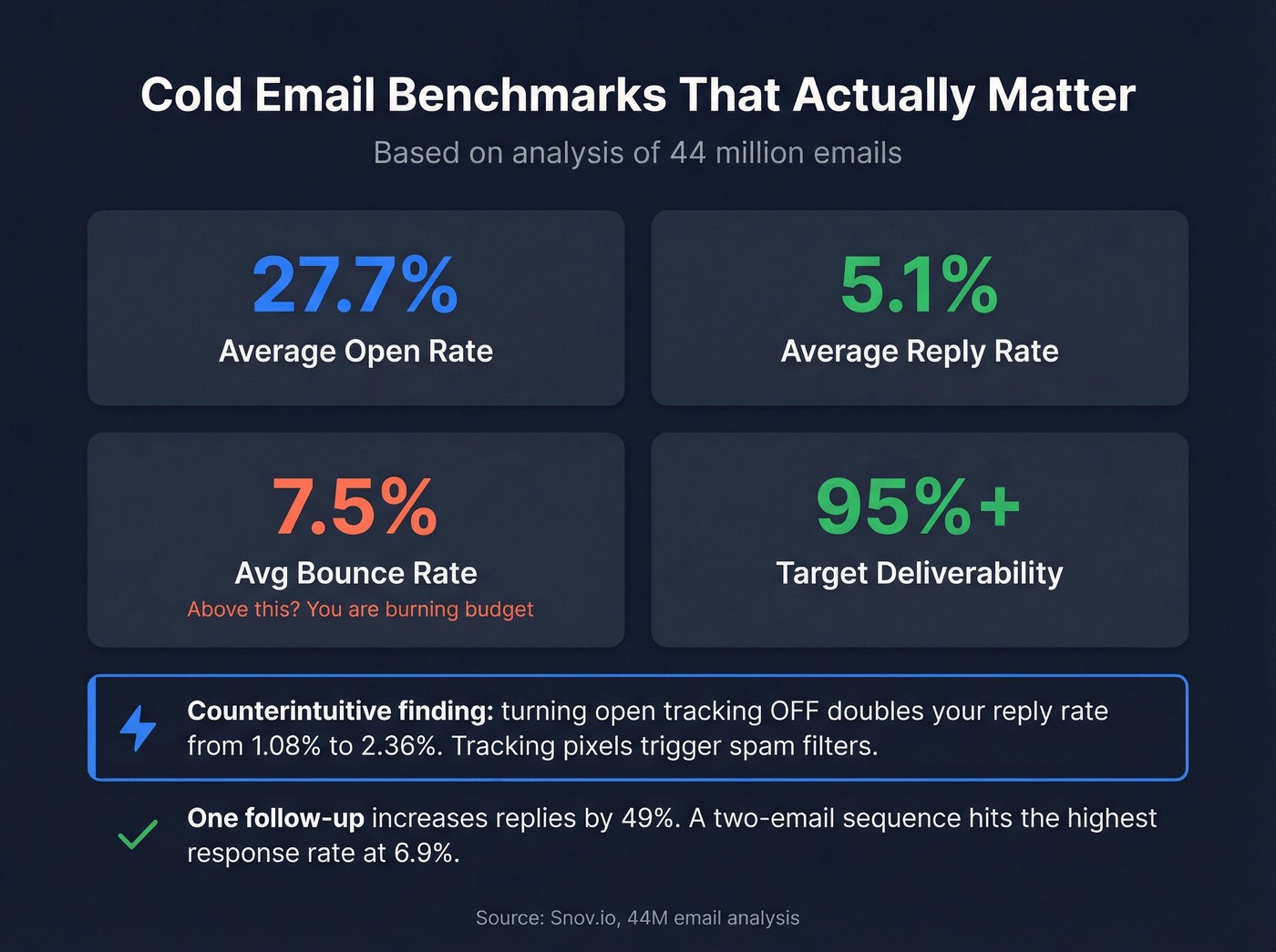
Cold email remains the workhorse, but the benchmarks have shifted. Based on an analysis of 44 million emails:
| Metric | Benchmark |
|---|---|
| Open rate | 27.7% |
| Reply rate | 5.1% |
| Bounce rate | 7.5% |
| Good deliverability | 95%+ |
A single follow-up increases replies by 49%. A two-email sequence hits the highest response rate at 6.9%. The counterintuitive finding: turning open tracking off doubles your reply rate, from 1.08% to 2.36%. Open tracking pixels trigger spam filters, and recipients who know they're being tracked are less likely to engage. (For deeper deliverability mechanics, use the email deliverability checklist and does open tracking hurt cold email.)
Paid Media
Paid channels are your short-term growth lever. CPLs vary wildly by industry, but the pattern is consistent: paid gets you leads now, organic gets you leads cheaper over time. The best teams run both - paid for immediate pipeline, organic for compounding returns.
Events, Webinars, and Partnerships
Picture this: you run a webinar with 800 registrants, but 60 of those email addresses bounce. That's 60 pipeline contacts you'll never reach for follow-up - at a $15 CPL, that's $900 in wasted acquisition cost before you even count the downstream impact. The 55% of teams partnering with creators and SMEs are onto something. Co-hosted webinars and joint content with industry voices consistently outperform solo efforts on both registration rates and post-event engagement.
ABM and Intent Data
Lead gen doesn't start with a form fill - it starts with behavior. Account-level intent signals tell you which companies are actively researching your category before they ever visit your site. When buying committees run 6-10 members deep, you can't wait for one person to raise their hand.
Intent data lets you identify accounts showing topic surges, then multi-thread into the buying group with personalized outreach to each stakeholder. You're not generating leads - you're identifying in-market accounts and orchestrating engagement across the committee. If your average deal size is north of $10K, intent data isn't optional. It's the difference between spraying emails at a cold list and focusing resources on the 3-5% of your TAM that's actively buying right now. (To operationalize this, see intent signals and ABM account prioritization.)

You just read that a 7.5% bounce rate is the cold email benchmark - and anything above it burns budget and sender reputation. Prospeo's 5-step email verification delivers 98% accuracy, refreshed every 7 days. Teams using Prospeo cut bounce rates from 35%+ to under 4% while scaling volume.
Fix your data before you scale another campaign.
CPL Benchmarks by Industry
Your CPL means nothing without context. Here's what FirstPageSage's 2026 data shows across key industries:
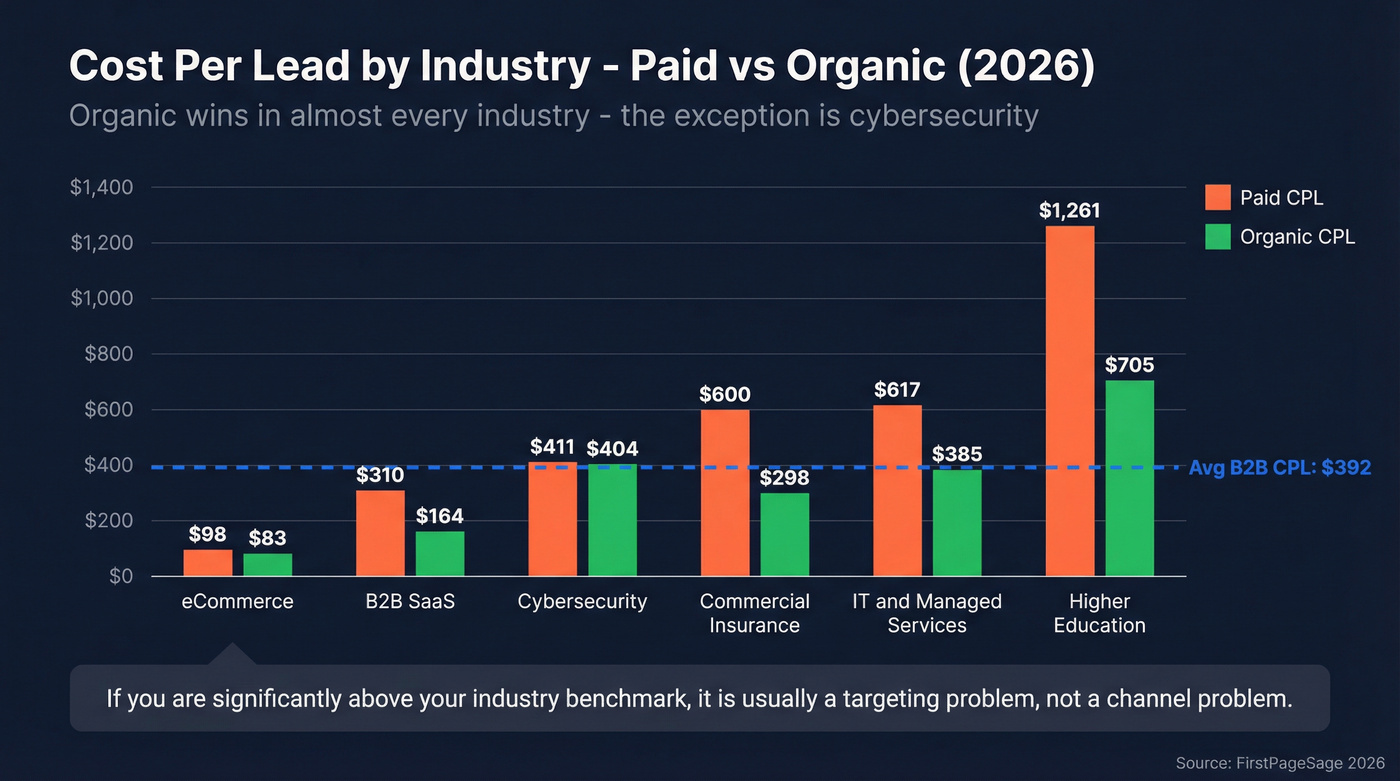
| Industry | Paid CPL | Organic CPL | Blended CPL |
|---|---|---|---|
| B2B SaaS | $310 | $164 | $237 |
| Cybersecurity | $411 | $404 | $406 |
| IT & Managed Services | $617 | $385 | $503 |
| Higher Education | $1,261 | $705 | $982 |
| eCommerce | $98 | $83 | $91 |
| Commercial Insurance | $600 | $298 | $449 |
The average CPL across all B2B channels runs about $392. If you're significantly above your industry benchmark, it's usually a targeting problem - not a channel problem. Tighten your ICP before you cut channels.
The organic advantage is clear in every industry except cybersecurity, where organic and paid CPLs are nearly identical. For most marketing teams, investing in organic is the highest-ROI long-term play.
Building Your Tech Stack
Your stack should map to four stages: Target, Attract, Capture, Qualify. Most teams overbuy in the Attract phase and underspend on the foundation - data quality.
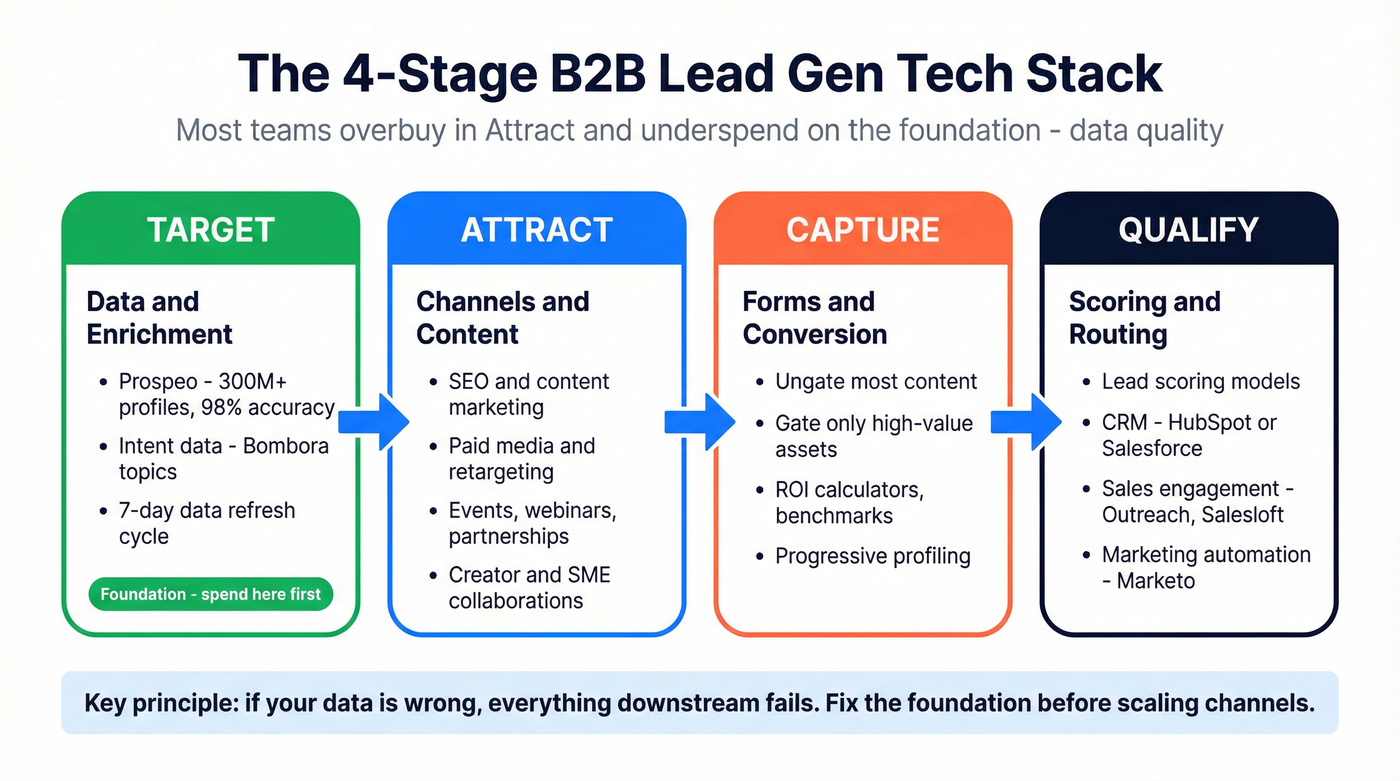
Data and Enrichment
If your data is wrong, everything downstream fails. Your sequences hit dead inboxes. Your ABM campaigns target the wrong accounts. Your sales team wastes hours chasing contacts who left the company six months ago.
Prospeo covers 300M+ professional profiles with 98% email accuracy, verified through a proprietary 5-step process - not third-party providers. The 7-day data refresh cycle means you're not working with stale records when the industry average is six weeks. Intent data powered by Bombora tracks 15,000 topics, so you can layer buying signals directly into your prospecting without paying for a separate intent platform. GDPR compliant with opt-out enforcement and DPAs available, which is critical for teams operating in the EU or selling to EU companies.

Pricing makes this accessible for teams of any size: the free tier gives you 75 verified emails per month, and paid plans run about $0.01 per email with no contracts. Compare that to ZoomInfo at $15K-$40K+/year, Apollo's paid plans from ~$49-99/user/month, or Cognism at ~$1K-$3K/month.
Outreach, CRM, and Automation
HubSpot is a common choice for SMB and mid-market teams, while Marketo fits enterprise. Pick one and commit. Straddling two marketing automation platforms fragments your data and wastes budget. (If you're evaluating, start with HubSpot vs Salesforce.)
Salesforce Sales Cloud starts at $25/user/month. For sales engagement, Outreach and Salesloft often land in the $100-$150/user/month range. The key evaluation criteria isn't features - it's adoption. The tool your team actually uses beats the tool with the best feature matrix every time.
AI Tools Worth the Budget
21% of a sales rep's time goes to lead research. AI tools cut this significantly:
| Tool | Starting Price | Best For |
|---|---|---|
| ChatGPT | $20/mo | Research, copy drafts |
| Jasper | $39/user/mo | Marketing content |
| Surfer SEO | $89/mo | Content optimization |
| Gemini | $19/mo | Research, analysis |
| Salesforce Einstein | $75/mo | CRM intelligence |
Skip buying all of these. ChatGPT plus one specialized tool - Surfer for SEO teams, Jasper for content-heavy teams - covers 80% of use cases.
Lead Scoring That Sales Trusts
Let's be honest: if marketing and sales can't agree on what an MQL means, no amount of lead gen will fix your pipeline. Lead scoring is the contract between the two teams, and it should be treated like a cross-functional revenue agreement - not a marketing-only exercise. (If you need a build guide, use lead scoring systems.)
Build your scoring model across three signal types:
Demographic fit - does this person match your ICP?
- Job title matches target persona: +15 points
- Company size in ICP range: +10 points
- Industry match: +10 points
Behavioral signals - are they engaged?
- Pricing page visit: +20 points
- Webinar attended: +15 points
- Content download from gated asset: +10 points
- Email opened: +5 points
Intent signals - are they in-market?
- Bombora topic surge on relevant category: +25 points
Set your MQL threshold at 50 points and your SQL threshold at 80. An MQL gets nurtured by marketing with targeted content. An SQL gets a handoff to sales with a 24-hour follow-up SLA - no exceptions.
The scoring model isn't static. Review it quarterly with sales. If they're rejecting 40%+ of MQLs, your thresholds are too low or your demographic scoring is off. If they're converting MQLs at 30%+, you're probably too conservative and leaving pipeline on the table.
Proving ROI With Attribution
The formula: (Revenue attributed to marketing - marketing cost) / marketing cost. The commonly cited benchmark is a 5:1 revenue-to-marketing spend ratio. Below 3:1, your program is underperforming. Above 7:1, you're probably underinvesting.
The hard part is attribution. Six models, each telling a different story:
- First-touch: 100% credit to the first interaction. Shows what fills the top of funnel.
- Last-touch: 100% credit to the final touch before conversion. Shows what closes.
- Linear: Equal credit across all touchpoints. Simple but naive.
- Time-decay: More credit to recent touches. Better for long sales cycles.
- U-shaped: 40% first touch, 40% lead creation, 20% distributed. The right starting point for most teams.
- W-shaped: Adds a third 30% weight at opportunity creation. Best for complex enterprise sales.
Start with U-shaped. It gives credit to both the channel that created awareness and the touchpoint that captured the lead, it's defensible in a board meeting, and you can graduate to W-shaped as your measurement matures.
Add self-reported attribution - a simple "how did you hear about us?" field on your demo request form. This captures dark social influence: the podcast mention, the Slack community recommendation, the conference conversation that no tracking pixel will ever see. If you can't tell your CFO the ROI of your lead gen spend within 15 minutes, your measurement framework is broken.
Mistakes That Kill Pipeline
Your ICP is too broad. "All companies with 50-500 employees in North America" isn't an ICP - it's a census. Narrow to the signals that predict closed-won deals.
You're measuring MQL volume instead of pipeline contribution. Measuring marketing on MQL volume while sales is measured on revenue is organizational malpractice. Align both teams on pipeline dollars.
No nurture sequence. If your SDRs don't follow up within 24 hours and marketing doesn't have an automated nurture for leads that aren't ready, you're throwing away acquisition spend. (Use a real lead nurturing strategy instead of ad-hoc follow-ups.)
Bad data is destroying your sender reputation. One of our customers, Snyk, had 50 AEs prospecting 4-6 hours per week on unverified lists. Bounce rates sat at 35-40%. After switching to verified data, bounces dropped under 5% and AE-sourced pipeline jumped 180% - over 200 new opportunities per month. That's not a marginal improvement; that's the difference between a pipeline that works and one that doesn't.
Sales and marketing disagree on lead definitions. If there's no shared document defining MQL and SQL criteria with specific scoring thresholds, your handoff process is a coin flip. Write it down. Review it quarterly.
Multi-threading into buying committees means you need verified emails and direct dials for 6-10 decision-makers per account - not just one contact. Prospeo gives you 300M+ profiles with 30+ filters including buyer intent, technographics, and department headcount, so your marketing team builds lists that match your real ICP, not a loose TAM.
Stop handing sales single-threaded leads that die in committee.
FAQ
What's the difference between lead generation and demand generation?
Lead gen captures known contacts through forms, downloads, and outreach. Demand gen creates awareness and interest before someone is ready to buy - think brand content, podcasts, community engagement. Most marketing teams need both: demand gen fills the top of funnel, lead gen converts it into pipeline.
How much should a marketing team budget for lead gen?
53% of B2B marketing teams spend at least half their total budget on lead generation. Within that allocation, reserve 10-20% for testing new channels each quarter. Teams that don't experiment get stuck on channels with rising CPLs and diminishing returns.
What's a good cost per lead in B2B?
B2B SaaS averages $237 blended ($164 organic, $310 paid). Cybersecurity averages $406. eCommerce runs just $91. Benchmark against your specific industry using FirstPageSage data, and use organic channels to bring your blended CPL down over time.
How do you improve lead quality without reducing volume?
Start with verified contact data - 98% accuracy eliminates bounces and ensures outreach reaches real inboxes. Then layer intent signals to prioritize in-market accounts. Tools like Prospeo combine both in one platform, with 15,000 intent topics and a 7-day data refresh cycle, so your lists stay current and targeted.
What attribution model works best for marketing teams?
U-shaped attribution is the best starting point: 40% credit to first touch, 40% to lead creation, 20% distributed across middle interactions. Pair it with self-reported attribution ("how did you hear about us?") to capture dark social and community influence that no tracking pixel can see.