

Stop Setting 15 Goals for Sales Reps. They Need 3.
Average quota attainment hit 43.14% in Q4 2024, and 91% of sales organizations missed their number that year. The problem isn't lazy reps - it's leaders who hand down a spreadsheet of 15 goals for sales reps and call it a plan. Fewer goals grounded in real math will outperform a wish list quarter after quarter.
Set these three before anything else:
- One revenue target backed by pipeline math, not a VP's gut feeling
- One activity goal calibrated to your team's actual conversion rates
- One data quality goal so reps aren't burning dials on dead numbers and bounced emails
Everything else is noise until those three are dialed in.
Activity Goals vs. Outcome Goals
Here's the distinction most managers blur: activity goals are inputs you control, outcome goals are results you measure. An SDR can control how many dials they make. They can't control how many prospects pick up.
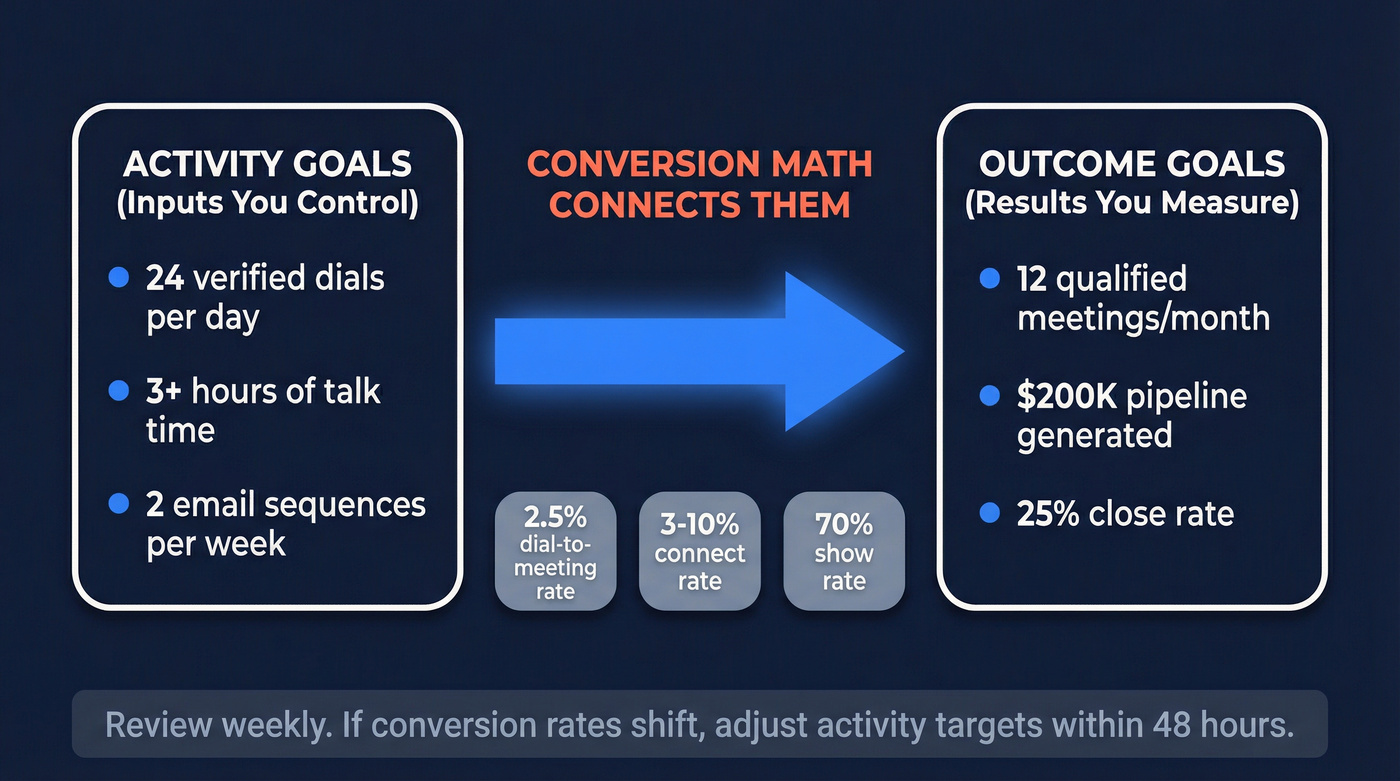
Reps spend 60% of their time on non-selling tasks, and 57% say the sales cycle is getting longer. Your activity goals need to protect selling time, not just demand more of it. Telling a rep to make 60 dials a day when they're drowning in CRM hygiene and internal meetings isn't a goal - it's a fantasy.
The right approach: set one activity goal that directly feeds one outcome goal, and make sure the math connects them. "Book 12 qualified meetings this month" is an outcome. "Make 24 dials per day into verified contacts" is the activity that gets you there - if your dial-to-meeting rate is around 2.5%. Without that conversion math, activity targets become busywork quotas that demoralize your best people. Financial incentives drive short-term compliance; intrinsic motivation - autonomy, mastery, purpose - drives sustained performance. Design goals that tap both.
Review these numbers weekly. If conversion rates shift, adjust the activity target within 48 hours, not at the end of the quarter when it's too late. Short-term sales goals like weekly dial targets or monthly meeting counts should flex as your data changes. Rigidity is the enemy of accuracy.
Role-Specific Sales Goals
Not every seat in your revenue org should chase the same metrics. Unrealistic quotas kill motivation fast. Individual sales goals need to reflect the reality of each role's conversion math and selling environment.
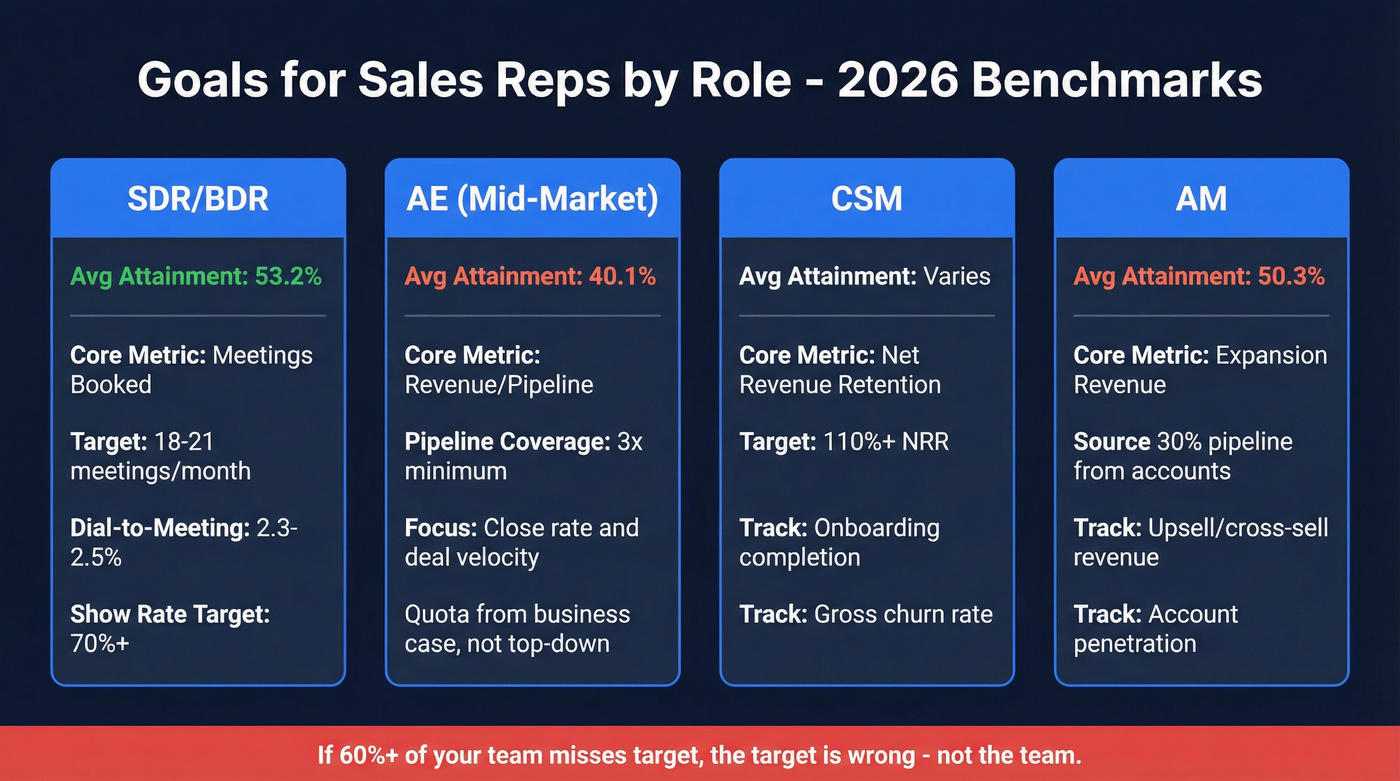
SDR/BDR Goals
SDRs average 53.2% quota attainment - the highest of any sales role, and still barely above half.
The core metric is meetings booked, with a practical benchmark around 18-21 meetings per month and a 2.3-2.5% dial-to-meeting rate. That means 40-45 dials to generate one meeting. Track connect rate (3-10% is typical) and show rate (target 60-70%, top teams hit 80%+). It takes roughly 8 call attempts to reach a single prospect. If your SDRs give up after three, that's your problem. (If you want the math behind daily targets, see how many cold calls a day.)
AE Goals
Mid-market AEs average 40.1% attainment. Enterprise AEs? 38.2%. If more than 60% of your AEs are missing target, the target is wrong - full stop.
Revenue targets should cascade from a business-case model, not a top-down number divided by headcount. Calculate the cost to staff the pod, multiply by your desired profit margin, and you've got a defensible target. Focus on pipeline coverage ratio (3x minimum), close rate, and deal velocity. The consensus on r/sales is that most quota misses trace back to pipeline coverage, not effort - and we've found the same thing in our own work with outbound teams.
CSM Goals
If your CSM goals don't include a retention number, you're treating them like support reps instead of revenue drivers. Net revenue retention is the north star - layer in onboarding completion rate and gross churn. NPS is fine as a signal, but it doesn't pay the bills.
AM Goals
Account managers with 50.3% average attainment are your best proof that expansion targets need the same rigor as new-business quotas. Track upsell/cross-sell revenue, account penetration across buying centers, and expansion rate as a percentage of existing ARR. Expansion is cheaper than acquisition - measure it like you mean it.
10 Individual Sales Goals With Real Numbers
- Book 12 qualified meetings/month (SDR). At 2.5% dial-to-meeting, that's roughly 480 dials/month - 24 per day across 20 working days.
- Maintain 3.5x pipeline coverage (AE). If your quota is $200K, you need $700K in qualified pipeline at all times.
- Hit 25% close rate on qualified opportunities. If it drops below 20%, your qualification criteria are broken.
- Reduce average sales cycle by 10%. If your mid-market cycle is 45 days, target 40. (If you need a baseline, use SaaS sales cycle benchmarks.)
- Achieve 70%+ meeting show rate (SDR). Confirmation sequences and same-day reminders get you there.
- Generate 110% net revenue retention (CSM). Anything under 100% means you're shrinking.
- Log 3+ hours of talk time daily (SDR). Better proxy than dial count - it measures real conversations.
- Source 30% of pipeline from existing accounts (AM). Track it quarterly.
- Complete one professional development activity per quarter. A book, a course, a certification. Reps who stop learning stop improving - and long-term goals for a sales representative should always include skill development alongside revenue targets.
- Keep email bounce rate under 5%. The goal nobody sets and everyone should. If your sequences bounce in double digits, you're wasting activity and hurting deliverability. Verifying contacts before you send - using a tool like Prospeo's email finder with its 98% accuracy and 7-day refresh cycle - keeps bounce rates under control. (For more options, compare email ID validators.)

You just calculated that SDRs need 480 dials/month to hit 12 meetings. Now ask: how many of those dials reach a real person? With Prospeo's 125M+ verified mobiles (30% pickup rate) and 98% email accuracy, every rep activity goal maps to actual conversations - not voicemails and bounces.
Stop burning dials on dead data. Make every activity count.
Why SMART Goals Aren't Enough
SMART goals have been the default since George T. Doran coined the acronym in 1981. Forty-five years later, sales teams still use it - and still miss quota at historic rates. The framework isn't wrong, but it's incomplete.
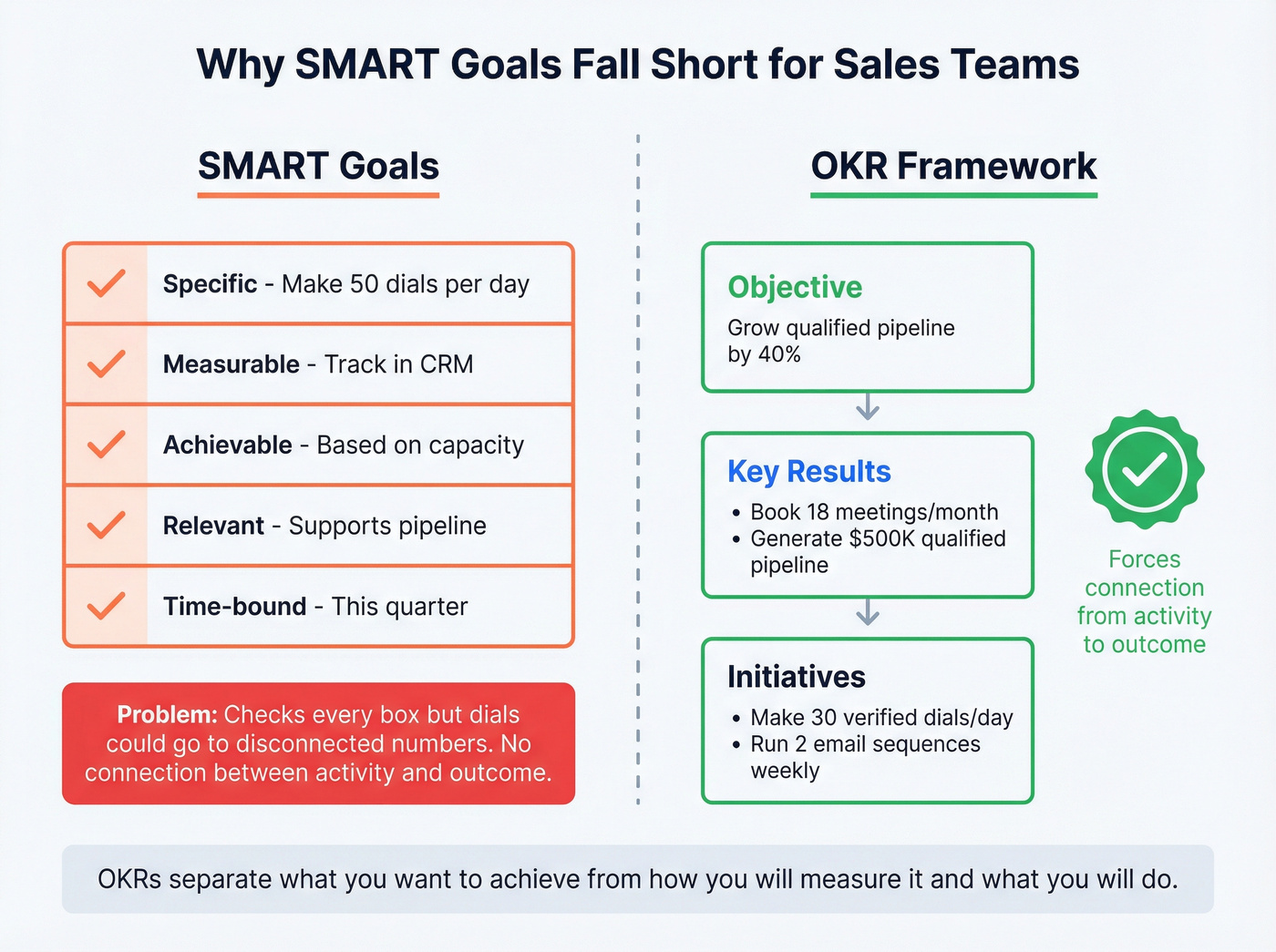
SMART conflates outputs with outcomes. "Make 50 dials per day" checks every SMART box. It's also meaningless if those dials go to disconnected numbers. OKRs fix this by separating the objective (grow pipeline 40%) from the key results (book 18 meetings, generate $500K in qualified pipeline) and the initiatives (make 30 verified dials/day, run two email sequences). That layered structure forces you to connect activity to outcome - which is exactly what SMART alone doesn't do.
Let's be honest: most teams slap "SMART" on goals they've already decided and call it a methodology. If you're going to use a framework, OKRs give you more structure where it counts.
Goal-Setting Mistakes That Kill Quota
Setting stretch goals without new resources. Stretch goals backfire when teams lack the capacity to pursue them. A 30% increase on the same headcount isn't ambitious - it's demoralizing.
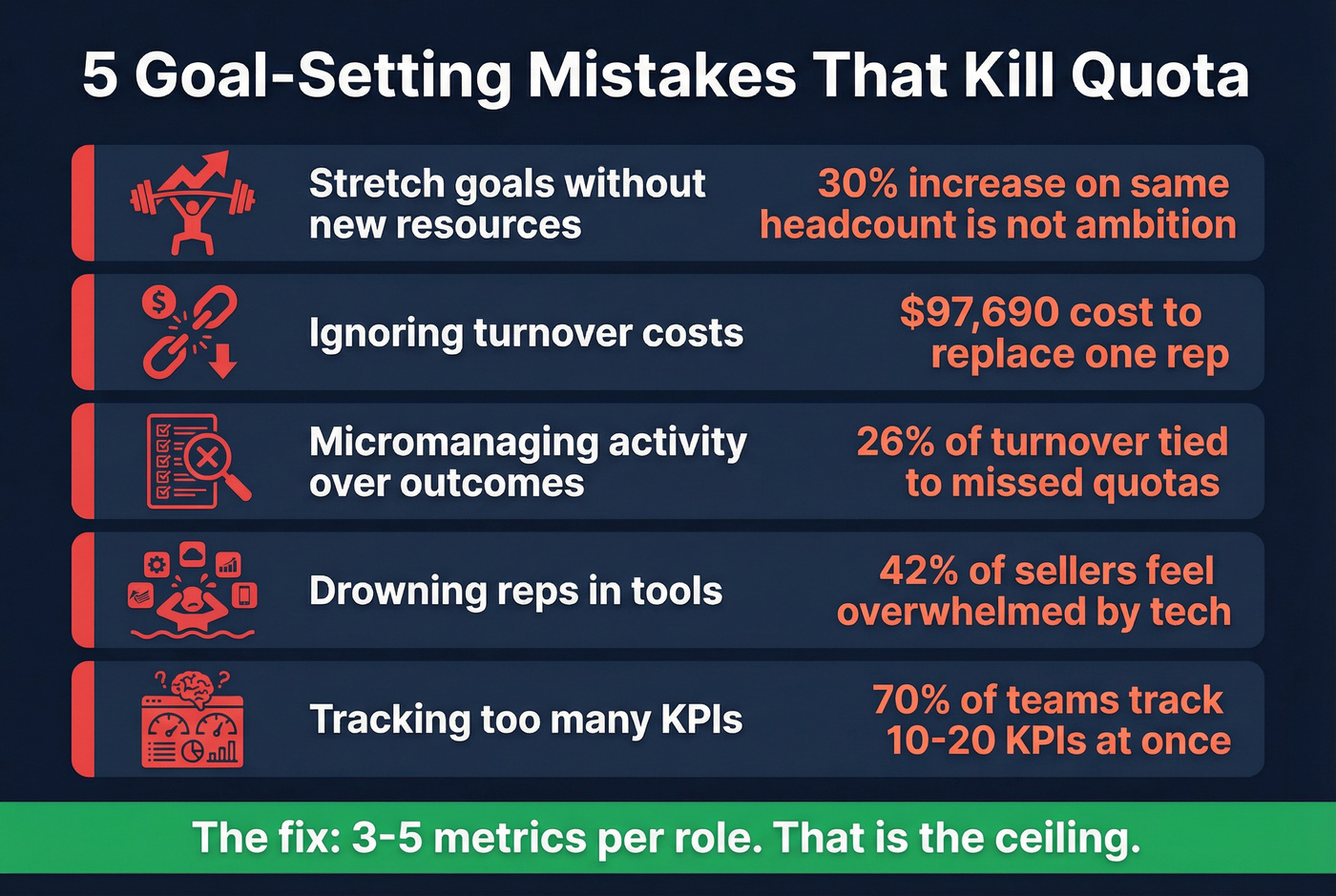
Ignoring the cost of turnover. 26% of sales rep turnover traces back to missed quotas. Replacing one rep costs roughly $97,690. Bad goals are expensive.
Micromanaging activity instead of coaching outcomes. Autonomy drives performance, surveillance kills it. In our experience, the teams tracking 15+ KPIs are the same ones that can't tell you which three actually matter. (If you need a system, use BDR performance management.)
Drowning reps in tools. 42% of sellers feel overwhelmed by their tech stack, and overwhelmed sellers are 45% less likely to hit quota. Skip the shiny new platform if your team hasn't mastered the two they already have. (Build a lean stack with a sales tools checklist.)
Tracking too many KPIs. 70% of teams track 10-20 KPIs simultaneously. That's 10-20 things nobody's actually focused on. Three to five metrics per role. That's the ceiling.
Look - if your average deal size is under $10K, you probably don't need 10 goals, an OKR framework, and a weekly pipeline review. You need one clean list, one activity target, and a rep who picks up the phone. Overengineering goal frameworks is how mid-market teams cosplay as enterprise orgs and miss quota doing it.
The Data Problem Nobody Talks About
Every activity goal assumes your reps are reaching real people. If your contact data bounces at 35%, your SDR isn't making 40 meaningful dials a day - they're making 26. The math breaks immediately. And 73% of B2B buyers actively avoid irrelevant outreach, which means outreach built on bad data is irrelevant by default.
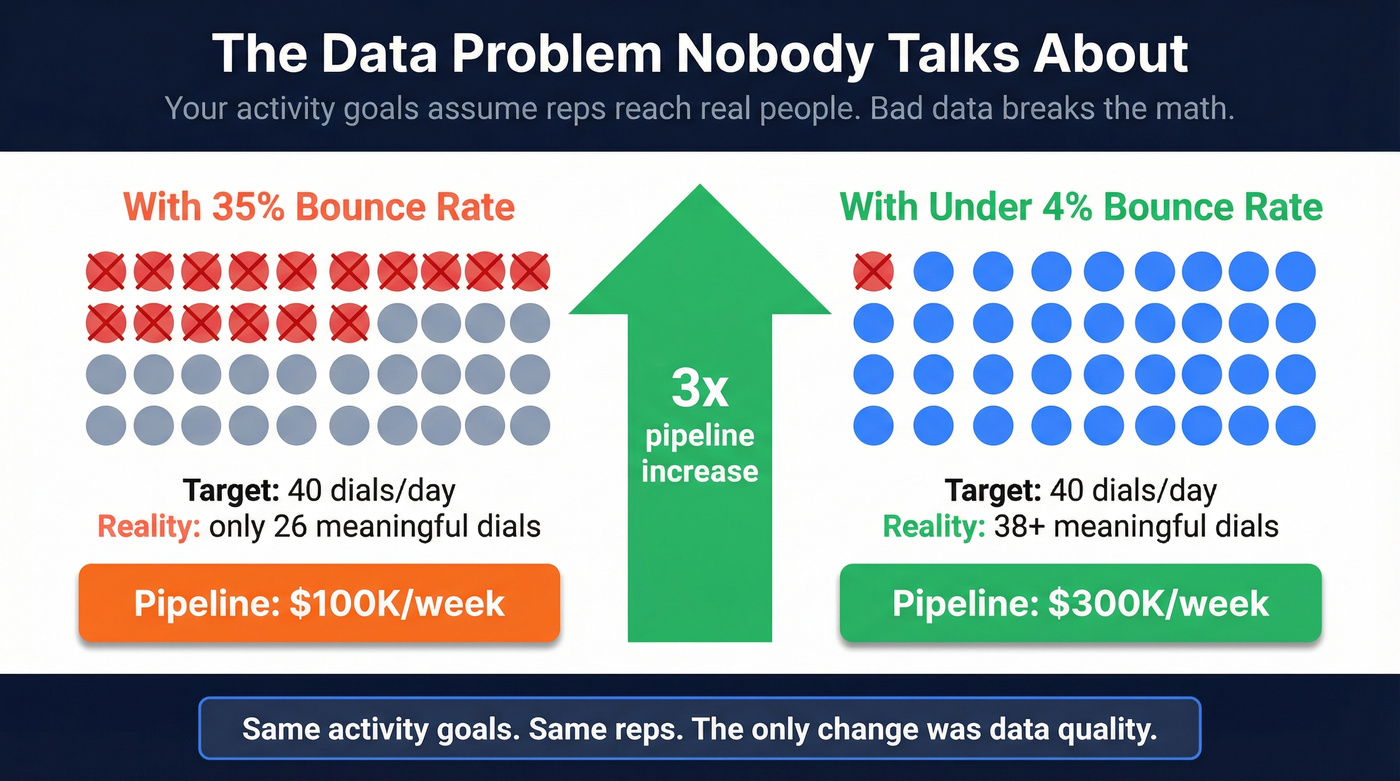
We've seen this pattern repeatedly. One team we work with was running a 35% bounce rate with pipeline stuck at $100K/week. After cleaning their data with Prospeo's verified email database, bounce dropped under 4% and pipeline tripled to $300K/week. Activity goals didn't change. Data quality did. (If you want to quantify decay, start with B2B contact data decay.)
That's the frustrating part: managers will spend weeks debating whether the dial target should be 30 or 40, then hand reps a list where a third of the numbers are dead. Fix the list first. The goals will follow. (A practical workflow: CRM verify.)

Goal #10 on your list - keeping bounce rates under 5% - is the foundation every other sales goal depends on. Prospeo refreshes all contact data every 7 days (not the 6-week industry average), so your reps' email sequences land in inboxes, not spam folders. At $0.01 per email, clean data costs less than one bounced opportunity.
Hit every sales goal starting with the one nobody sets: data quality.
FAQ
How many goals should a sales rep have?
Three to five, maximum. One revenue or outcome goal, one activity goal calibrated to your conversion math, and one development or data quality goal. Teams tracking 10+ KPIs dilute focus - pick the metrics that actually move pipeline and cut the rest.
What's a realistic quota attainment rate in 2026?
Average attainment was 43.14% in Q4 2024. SDRs average 53%, mid-market AEs 40%, enterprise AEs 38%. If 60-70% of your team can't hit target, the target is wrong - not the team. Benchmark against role-specific data before setting next quarter's number.
How do you set activity goals that aren't busywork?
Work backward from outcomes. If your dial-to-meeting rate is 2.5%, you need roughly 40 dials per meeting booked. Then verify your contact data so those 40 dials reach real people, not disconnected numbers. Activity without data quality is just motion.
What's the difference between short-term and long-term sales goals?
Short-term sales goals cover daily, weekly, or monthly targets - dials made, meetings booked, emails sent. They keep reps focused on the inputs they control right now. Long-term goals span quarters or years: hitting President's Club, growing into an AE role, or building a book of business worth $2M+ in ARR. Both matter, but short-term targets should always ladder up to the long-term ones. Otherwise you're just running on a treadmill.