How Many Cold Calls Should You Make Per Day?
It's 9:15am. You've been dialing for 45 minutes and hit voicemail 18 times in a row. Your manager wants 100 dials by lunch, but you're starting to wonder if the number even matters when nobody picks up.
The answer to how many cold calls a day you should actually make depends almost entirely on your setup - and most quota targets ignore that reality.
The Quick Answer
| Setup | Realistic Daily Dials |
|---|---|
| Manual dialing, complex B2B | 40-60 |
| Power dialer, mid-market | 80-120 |
| Parallel dialer, high-velocity | 150-250 |
The real metric isn't dials - it's quality conversations. The benchmark is 4.4 quality conversations per day, and that number has been falling since 2014.
2026 Cold Call Benchmarks
The most useful dataset comes from Cognism's State of Cold Calling report, built on 204,000+ cold calls and 27,000+ conversations. Average cold call duration sits at 93 seconds. The average success rate lands at 2.3%. For every 100 dials, two or three turn into something useful.
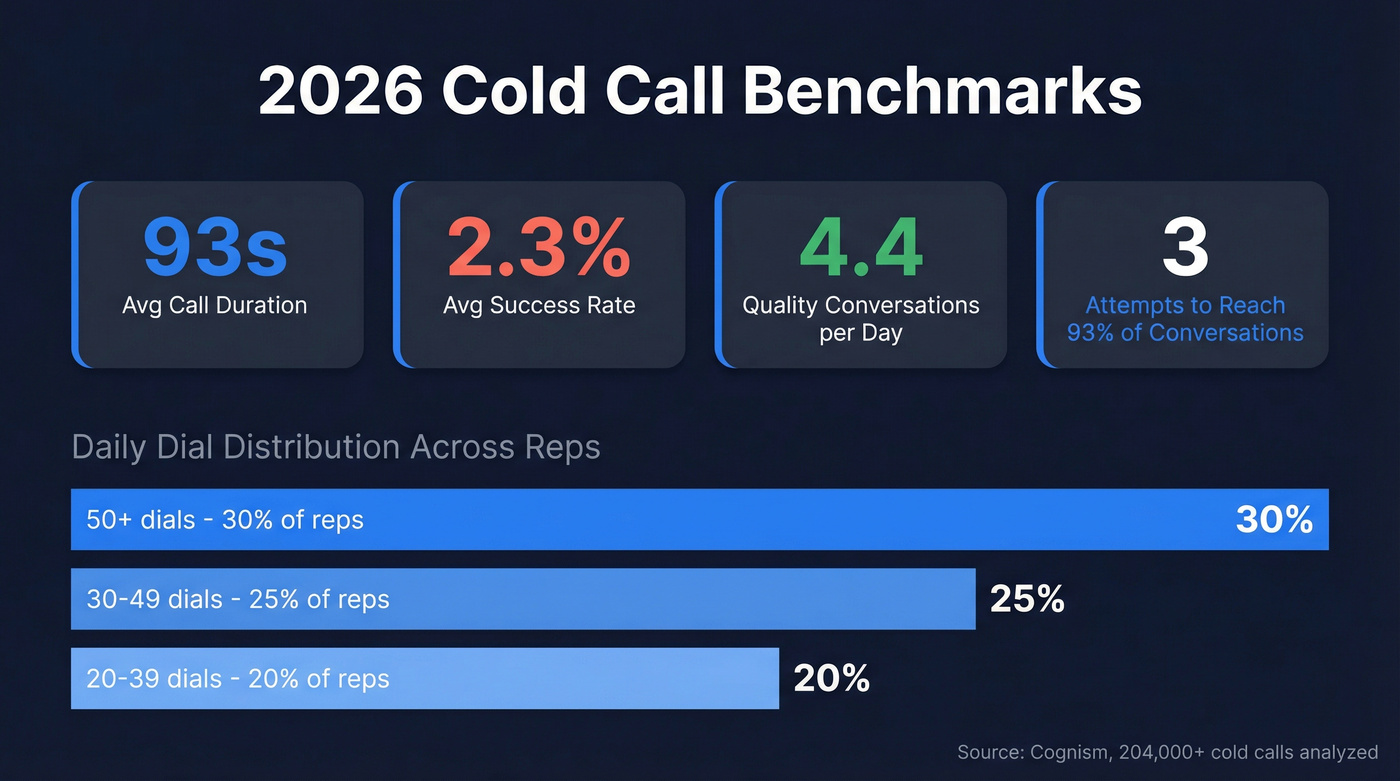
The distribution of average cold calls per day across reps tells the story:
- 30% of reps make 50+ dials per day
- 25% make 30-49
- 20% make 20-39
If you're hitting 50 dials manually, you're already in the top third.
The conversation quality picture is even more revealing. According to Bridge Group data, reps average 4.4 quality conversations per day - down 45% since 2014. Phone-based reps still outperform email-centric ones, logging 6.8 quality conversations versus 3.3. The phone isn't dead, but it's harder to get someone on the other end than it used to be.
These benchmarks skew toward B2B SaaS. Insurance and real estate reps often dial higher volumes (80-150+) with shorter, more transactional calls.
Three attempts is the magic number. By the third call, 93% of conversations have already happened. By the fifth, you're at 98%. Anything beyond that is wasted effort on that particular prospect.
The Math Behind Daily Dial Targets
Instead of guessing, calculate your realistic daily volume:
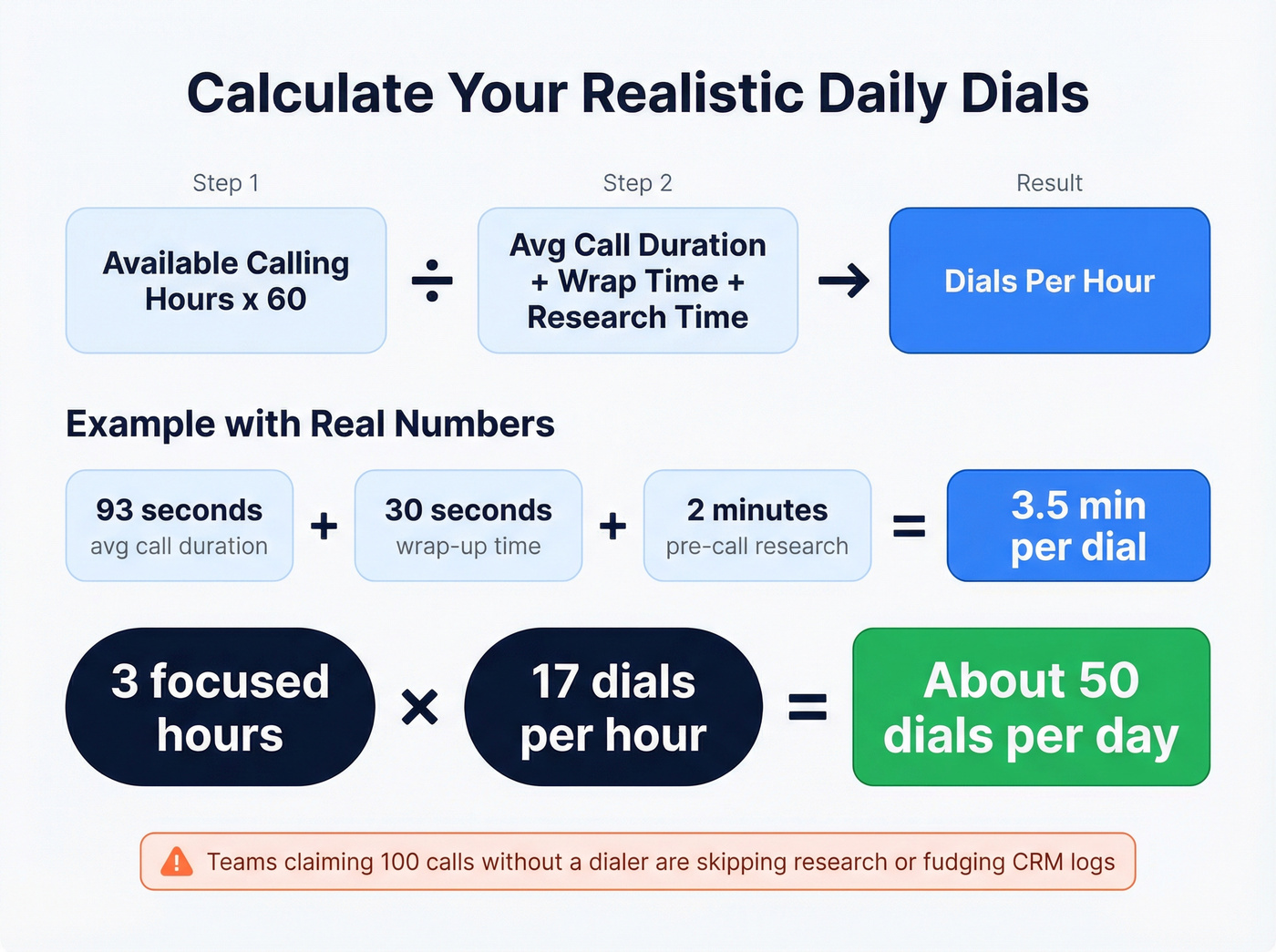
(Available calling hours x 60) / (avg call duration + wrap time + research time) = dials per hour
Average call duration is 93 seconds. Add 30 seconds for wrap-up and 2 minutes for pre-call research. That's about 3.5 minutes per dial, giving you roughly 17 dials per hour.
Protect three focused hours for calling - realistic given meetings, admin, and email - and you're looking at about 50 dials per day. That lines up almost perfectly with the benchmark data. Teams that claim 100 calls a day without a dialer are either skipping research entirely or fudging their CRM logs.
There's a fine line between pre-call research and call avoidance, though. If you're spending more than 5 minutes per prospect before dialing, you're stalling - not preparing. (If you want a tighter system, use a pre-call research tiering framework.)
How Dialers Change Your Volume
The gap between 50 and 250 dials per day comes down to your dialer. But more dials doesn't automatically mean more meetings.
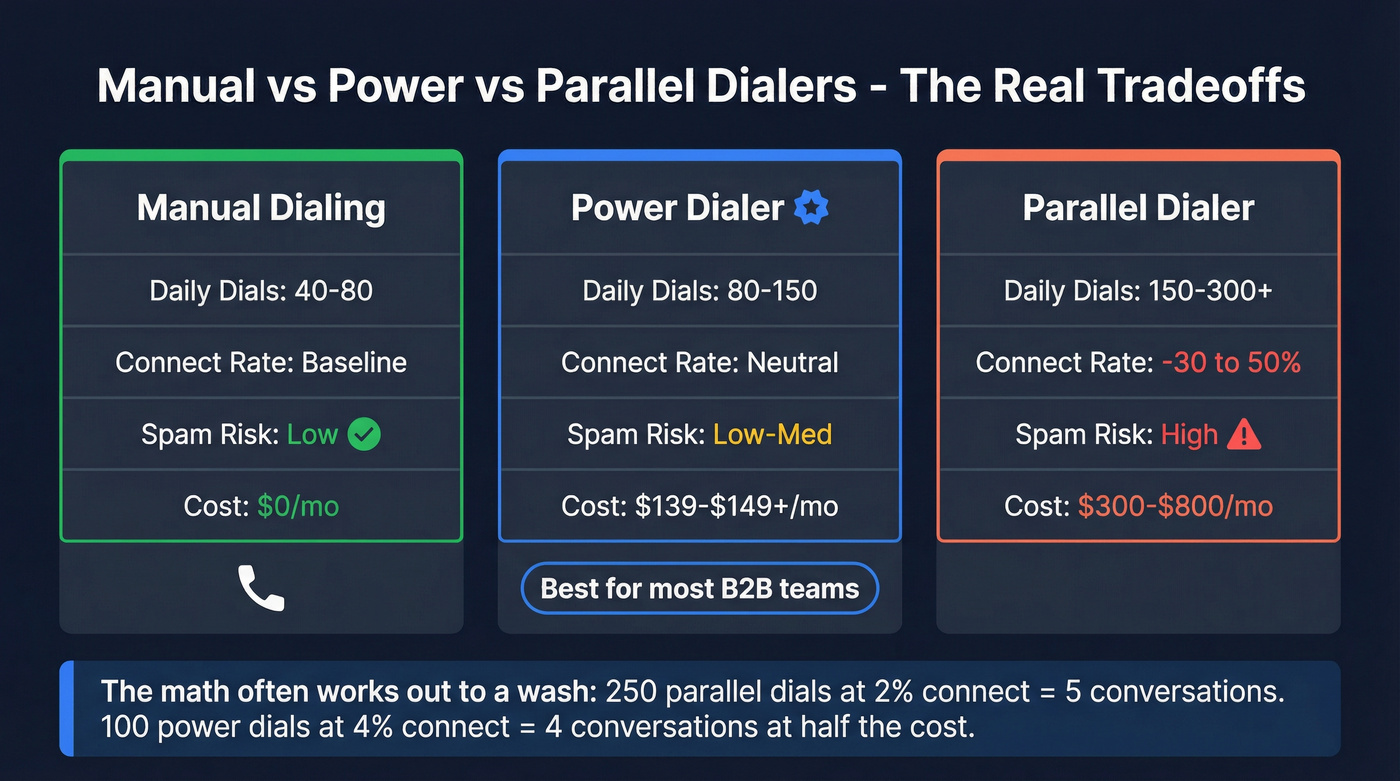
| Dialer Type | Daily Dials | Connect Rate Impact | Spam Risk | Cost/User/Mo |
|---|---|---|---|---|
| Manual | 40-80 | Baseline | Low | $0 |
| Power (Salesfinity, etc.) | 80-150 | Neutral | Low-Med | $139-$149+ |
| Parallel (Nooks, Orum) | 150-300+ | -30-50% | High | $300-$800 |
Parallel dialers like Nooks ($300-$500/mo) and Orum ($500-$800/mo) push volume up 3-5x. The tradeoffs are real, though. Conversion rates can drop 30-40% because of the awkward pause when a prospect picks up and the system routes the call. Worse, numbers get flagged as "Spam Likely" within 2-3 weeks of heavy use. Make 8 dials from the same number in an hour, and that number's burned.
The math often works out to a wash. A parallel dialer at 250 dials with a 2% connect rate gives you 5 conversations. A power dialer at 100 dials with a 4% connect rate gives you 4 - at half the cost and without the spam risk. For most mid-market B2B teams, a power dialer is the better bet.
Here's the thing: if your average contract value is under $15K, you don't need a parallel dialer. You need cleaner data and better timing. The teams burning $500+/mo on parallel dialers with garbage lists are subsidizing their dialer vendor's growth, not their own pipeline. (If you're evaluating tools, start with a dynamic dialer breakdown.)

You calculated 50 dials per day. Now imagine every number actually rings. Prospeo gives you 125M+ verified mobile numbers with a 30% pickup rate - so your 50 dials produce more conversations than a competitor's 200 dials on an unverified list.
Hit your 4.4 daily conversations in half the dials.
A Daily Schedule That Works
The best SDRs don't just "make calls all day." They structure around two or three focused call blocks with prep time built in. We've seen this approach consistently produce 60-80 well-researched dials - enough to hit conversation targets without burning out by 2pm.
| Time | Activity | Output |
|---|---|---|
| 8:30-9:00 | List prep + verification | 50-75 verified numbers |
| 9:00-11:00 | Call block 1 (East Coast) | 30-40 dials |
| 11:00-11:30 | Research + personalization | 10-15 new prospects prepped |
| 11:30-12:00 | Email/social touches | 15-20 messages |
| 1:00-1:30 | Review morning outcomes + prep | Callbacks queued |
| 1:30-3:30 | Call block 2 (Pacific/callbacks) | 30-40 dials |
| 3:30-4:30 | Admin, CRM logging, next-day prep | Pipeline updated |
This framework combines morning East Coast and international calls with midday Pacific and Mountain dials, saving end-of-day for callbacks. A few tactical rules that separate top performers from the middle of the pack:
Protect your call blocks. No internal meetings during 9-11am or 1:30-3:30pm. Period. (This is also a core outbound calling strategy principle.)
Prep specific lists with talk tracks before each block. Webinar follow-ups, event attendees, content downloads - each list gets its own angle. (If you need a repeatable system, build a prospecting workflow.)
Verify your numbers before you start dialing. Run your list through a mobile verification tool to reduce disconnected and wrong numbers. Thirty minutes of prep saves hours of dead dials. (More on what a direct dial is and why it matters.)
Log outcomes immediately. Batching your CRM updates at 4pm means you forget half the context. (If logging is messy, fix it with cold calling CRM integration.)
Quality vs. Quantity: The Metrics That Actually Matter
Let's be honest - most cold calling advice falls apart right here. Managers set arbitrary dial quotas of 100, 150, 200 without accounting for what those dials actually produce. The consensus on r/sales is pretty clear: reps are frustrated with managers who worship dial counts while ignoring conversation quality. They're right to be.
The benchmark is 4.4 quality conversations per day. That's the metric that correlates with pipeline, not raw dials. (If you want the deeper argument, see cold calling quality vs quantity.)
Rejection fatigue is real. Hitting voicemail 40 times in a row doesn't just waste time - it degrades your energy and your pitch quality on call 41. Personalization strategies drive 10-15% revenue increases even in outbound-heavy motions, and 84% of buyers say being treated like a person, not a number, is critical to winning their business. (A practical framework: personalization in outbound sales.)
The hybrid approach works best: semi-personalize at volume to identify engagement signals, then hyper-personalize your follow-up for anyone who shows interest. If your average deal is $30K and you book 2 meetings per week from cold calls, that's $60K+ in pipeline weekly from roughly 250 dials. Focus on the pipeline math, not the dial count.
If your manager wants 200 calls per day without a parallel dialer, the problem isn't your effort - it's the setup.
Your Data Is the Upstream Problem
None of the math above matters if 25% of your numbers are disconnected. Eighty dials with bad data is really 60 real attempts - and you've burned 20 dials' worth of time and energy on nothing.
Data quality is the single highest-leverage fix for call efficiency. It's not glamorous, but in our experience it's where we've seen the biggest jump in conversations-per-day metrics. One of our customers, GreyScout, cut their bounce rate from 38% to under 4% just by switching data sources - and their pipeline went up 140% as a result. Before obsessing over daily dial targets, fix the data feeding your dialer. (If you want the underlying mechanics, start with B2B contact data decay.)
Prospeo's mobile database covers 125M+ verified numbers with a 30% pickup rate - 2-3x higher than what most platforms deliver. The 7-day data refresh cycle means the list you pull on Monday is still accurate on Friday, unlike the typical 6-week refresh cycle at most providers where numbers go stale mid-campaign. At roughly $0.01 per lead, verifying 500 numbers costs less than one wasted hour of dialing disconnected lines. (If you're auditing accuracy, use these prospect data accuracy benchmarks.)
Bad data doesn't just waste dials - it burns your caller ID and kills your energy by call 20. Prospeo refreshes every record on a 7-day cycle and removes spam traps before you ever dial. At $0.01 per lead, cleaning your list costs less than one wasted minute on a disconnected number.
Stop subsidizing your dialer vendor with garbage data.
When to Call
Timing matters more than most reps realize:
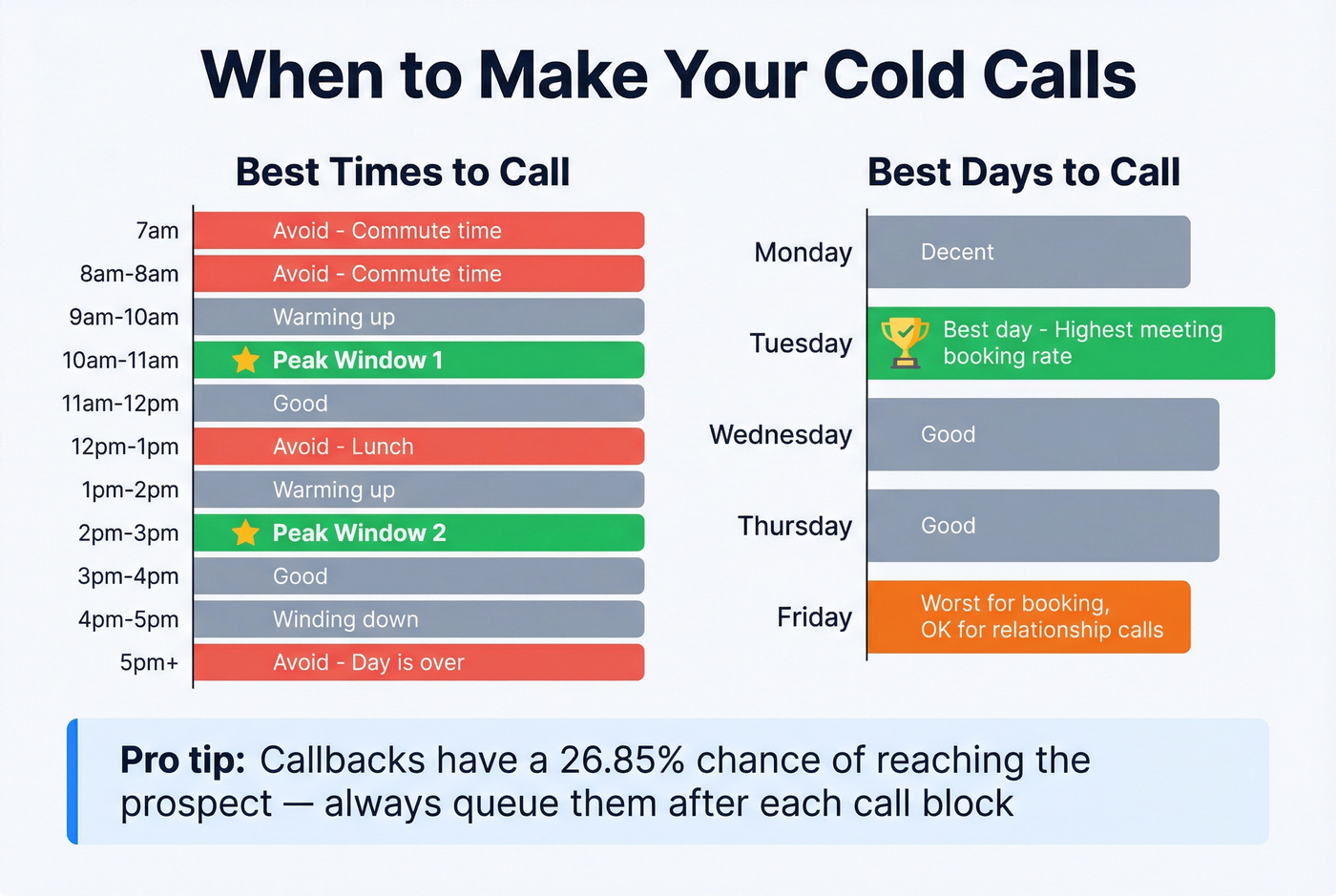
- Best windows: 10-11am and 2-3pm in the prospect's time zone
- Avoid: 7-9am (commute), noon (lunch), 5pm+ (wrapping up)
- Best day: Tuesday has the highest meeting-booking rate
- Worst day: Friday is terrible for booking but decent for relationship-building calls
- Callbacks: 26.85% chance of reaching a prospect on a callback - always queue them
Structure your call blocks around these windows. If you're covering multiple time zones, the three-block framework naturally aligns East Coast mornings with Pacific afternoons. Skip the vanity metric of total daily dials and focus on hitting the right people at the right time.
FAQ
How many cold calls should I make a day?
For manual dialing in complex B2B, 50 focused dials with pre-call research is a strong day - only 30% of reps consistently hit that mark. With a power dialer, 80-120 is realistic. Focus on conversations booked and meetings set; 50 well-targeted calls beat 150 spray-and-pray dials every time.
How many dials does it take to book one meeting?
At a 2.3% success rate, expect 40-50 dials per meeting booked. With verified mobile data and good timing, top reps cut that to 25-35. The variable that moves this number most isn't script quality - it's whether the numbers you're dialing actually connect to the right person.
How many calls should a full-cycle AE make?
An SDR with a power dialer should target 80-120 dials, while a full-cycle AE juggling demos and proposals might only manage 20-30. The right number always comes back to available calling hours and deal complexity. Set your dial targets based on the math, not an arbitrary quota.
Should I use a parallel dialer to increase volume?
Only if you've got number rotation infrastructure and a high-velocity sales motion. For most teams, a power dialer at 80-120 dials with clean data outperforms 250 parallel dials with burned numbers. The spam-flagging risk alone makes parallel dialers a poor fit for teams selling into enterprise accounts where caller ID reputation matters.