Outsourcing Cold Calling: Pricing, Benchmarks, and the Playbook Nobody Gives You
A RevOps lead we know signed a 12-month outsourcing contract last year. Six months in, the agency had booked 47 meetings - and 19 of them were no-shows dialing disconnected numbers. The agency blamed "the list." They weren't wrong.
The real question with outsourcing cold calling isn't whether you should do it. 49% of organizations use cold calling as a primary or secondary channel, and the global B2B sales outsourcing market topped $105B. The question is how you avoid lighting money on fire while doing it.
59% of companies outsource at least some lead generation. Most of them learn the hard way that the vendor you pick matters less than the data you feed them.
Quick Version
If you're short on time:
- Monthly cost: $2,000-$5,000/mo on retainer, or $75-$500 per booked meeting
- Realistic conversion: roughly 1 meeting per 40-45 dials at average performance
- Show rate matters more than bookings. A 60% show rate turns a $300 meeting into a $500 one.
- The single biggest lever isn't the agency - it's data quality. Verify your lists before handing them off.
- Start with a 90-day pilot. Never sign a 12-month contract without one.
Three Models for Outsourced Calls
Before comparing agencies, know what you're actually buying. Outsourced cold calling falls into three buckets.
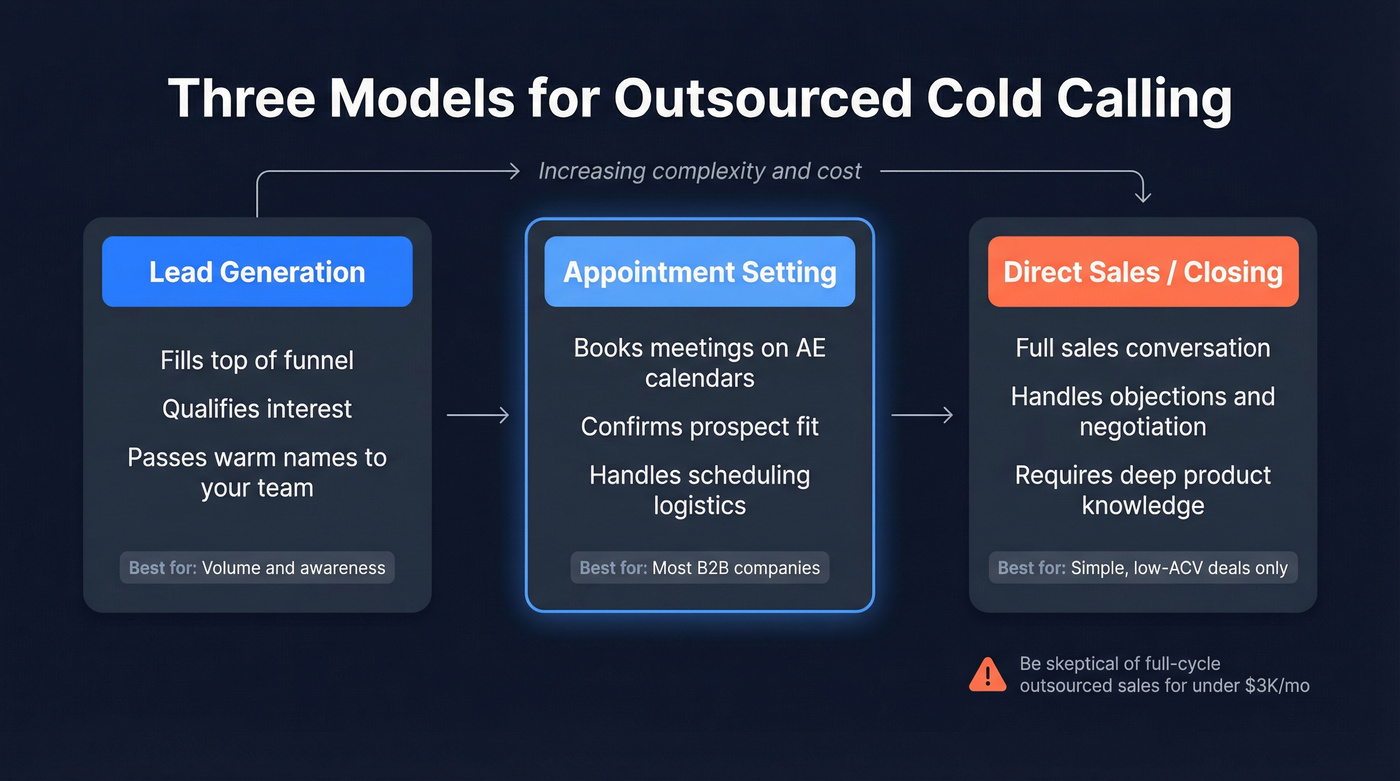
Lead generation fills the top of your funnel - callers qualify interest and pass warm names to your team. Appointment setting goes a step further, booking meetings directly on your AEs' calendars. Direct sales/closing hands off the entire sales conversation to an external team. Most B2B companies outsource appointment setting. If someone pitches you "full-cycle outsourced sales" for $3,000/month, be skeptical. Closing complex deals requires product depth that external teams rarely have.
In-House vs. Outsourced Sales Calls
Let's do the math that most "should you outsource?" articles skip.
| Factor | In-House (2 SDRs + Manager) | Outsourced |
|---|---|---|
| Annual cost | $300K-$350K | $120K-$150K |
| Ramp time | ~3.2 months per SDR | 2-4 weeks typical |
| Annual turnover | ~40% | Agency's problem |
| Tools/data stack | $15K-$30K/yr extra | Usually included |
| When it wins | Enterprise, brand-sensitive | Scale, seasonal, new markets |
A fully loaded SDR runs $110K-$150K/year when you factor in salary, benefits, tools, management overhead, and the recruiting cost every time one churns. With ~40% annual SDR turnover, you're essentially re-hiring and re-ramping one of your two reps every year. In high-performing orgs, outbound SDRs contribute 30-45% of total pipeline, so every month of ramp time is real revenue lost.
Delegating cold calls to an external team cuts that cost by 40-60%. But the savings only materialize if the outsourced team actually books meetings that show up and convert. A cheap agency that fills your calendar with unqualified prospects is more expensive than an in-house SDR who books half as many meetings that actually close.
Here's the thing: in-house wins when your sale requires deep product knowledge, nuanced objection handling, or brand-sensitive conversations with enterprise buyers. Outsourcing wins when you need to scale fast, test a new market, or run seasonal campaigns without the hiring overhead.
If your average deal is under $15K, you probably don't need an in-house SDR team at all. Outsource the dialing, own the data, and spend the savings on closing.
What Outsourced Cold Calling Costs in 2026
Pricing Models Compared
| Model | Typical Range | Best For |
|---|---|---|
| Subscription | $2,000-$4,500/mo | Predictable budgeting |
| Retainer | $2,000-$5,000/mo | Dedicated team access |
| Per appointment | $75-$500/meeting | Pay-for-performance |
| Per qualified lead | $50-$250/lead | Top-of-funnel volume |
| Hourly | $8-$16/hr (offshore-US) | Simple qualification |
| Per call | $0.50-$3.00/call | High-volume, low-complexity |
One warning on pay-per-appointment: it incentivizes volume over quality. When the agency gets paid per booking, their incentive is to cram as many meetings onto your calendar as possible - whether or not those prospects match your ICP. At scale, performance-only pricing can run 30-50% higher per meeting than retainer models. We've seen teams celebrate a "record month" of 30 booked meetings only to discover half were with companies that'd never buy.
Vendor Starting Prices
| Vendor | Starting Price | Notes |
|---|---|---|
| CIENCE | $2,000/mo + $5K setup | See tier breakdown below |
| Belkins | $2,000/mo | Strong optimization curve over time |
| Martal Group | $4,500/mo | Mid-market focus |
| SalesFocus | $3,950/mo | Full-service model |
| Flatworld Solutions | ~$8/hr | Offshore, basic qualification |
CIENCE publishes a tiered rate card that shows the offshore-vs-onshore gap clearly:
| CIENCE Tier | Offshore | US / Western Europe |
|---|---|---|
| Level 1 | $1,500/mo | $3,500/mo |
| Level 2 | $2,500/mo | $4,500/mo |
| Level 3 | $3,500/mo | $5,500/mo |
That gap reflects a real quality difference for complex B2B conversations, but for simple appointment confirmation or initial qualification, offshore Level 1 can work fine.
The Show-Rate Math Nobody Does
Most teams evaluate agencies on cost per booked meeting. Wrong number. Cost per held meeting is what matters, and the gap between the two is bigger than you'd think.
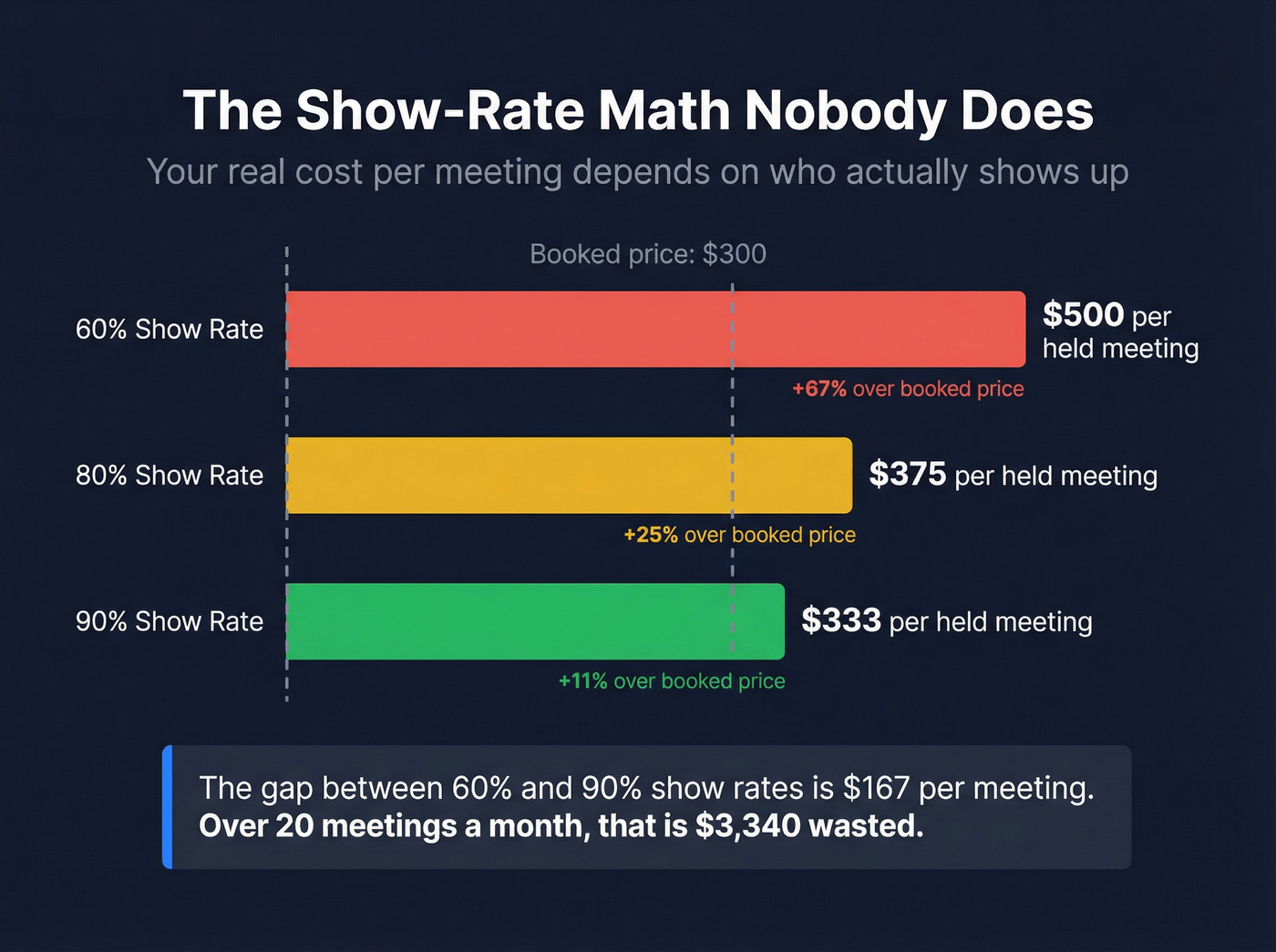
Say you're paying $300 per booked meeting:
- 60% show rate = $500 per held meeting (67% increase)
- 80% show rate = $375 per held meeting
- 90% show rate = $333 per held meeting
That 60% vs. 90% spread is the difference between a program that works and one that bleeds cash. Belkins reports that cost-per-meeting runs $3,000-$5,000 in year one for mid-market and enterprise B2B, drops ~50% by year two, and can reach ~$1,000 by year three with sustained optimization. The agencies that hit those year-three numbers are the ones obsessing over show rates, not just dial volume.

19 no-shows from disconnected numbers isn't an agency problem - it's a data problem. Prospeo's 125M+ verified mobile numbers with a 30% pickup rate and 7-day refresh cycle mean your outsourced team dials real people, not dead lines. At $0.01 per email and 10 credits per mobile, fixing your data costs less than one wasted meeting.
Stop paying $300 per meeting that never happens. Verify the list first.
2026 Cold Calling Benchmarks
Before you evaluate any agency, you need to know what "good" looks like.
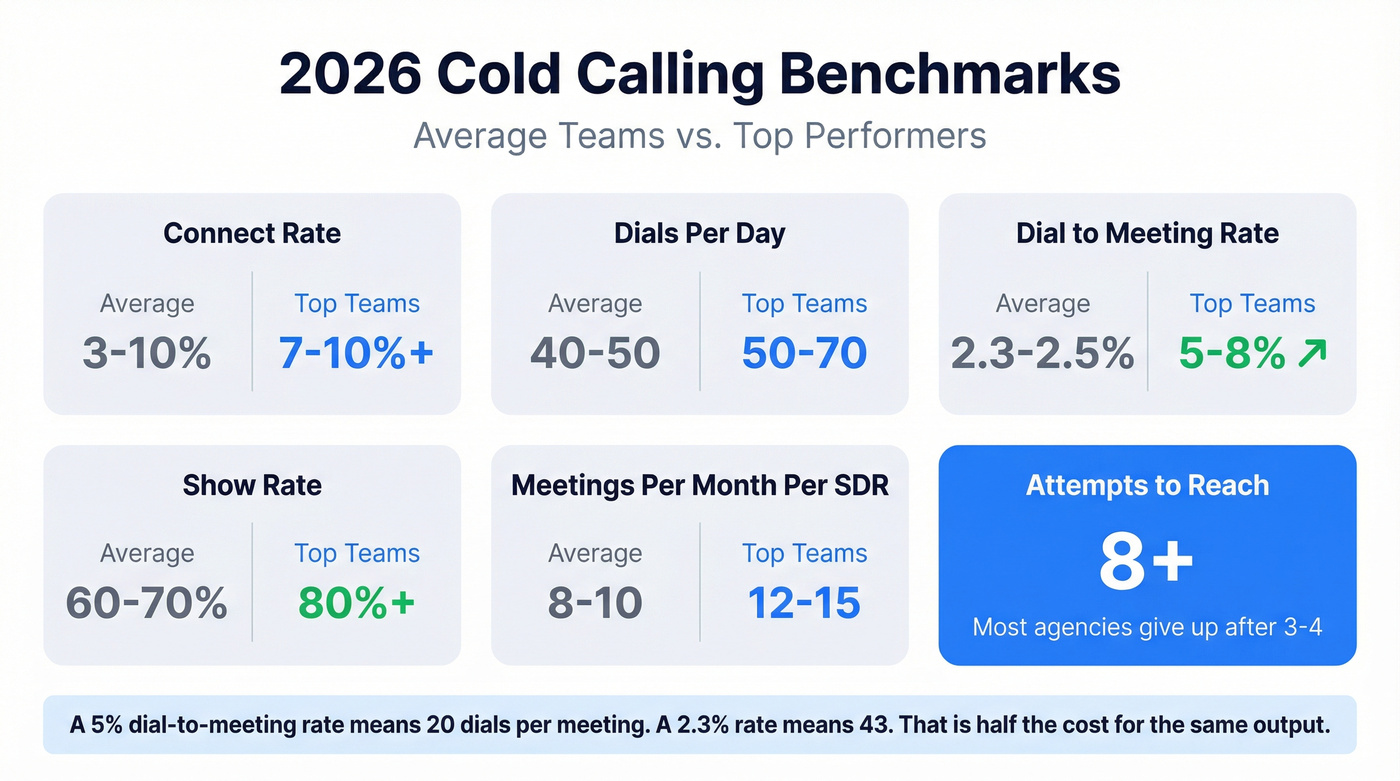
| KPI | Average | Top Teams |
|---|---|---|
| Connect rate | 3-10% | 7-10%+ |
| Dials per day | 40-50 | 50-70 |
| Dial-to-meeting | 2.3-2.5% | 5-8% |
| Show rate | 60-70% | 80%+ |
| Meetings/month per SDR | 8-10 | 12-15 |
| Attempts to reach | 8+ | - |
Two numbers jump out. First, it takes 8+ attempts to reach a prospect - most agencies give up after 3-4. Second, calling at 8-9am or 4-5pm lifts connect rates by 40-70% vs. random timing. Any agency that can't tell you their call-time strategy is winging it.
The gap between average and top teams is massive. A 2.3% dial-to-meeting rate means 43 dials per meeting. A 5% rate means 20 dials. That isn't a marginal improvement - it's half the cost for the same output.
Among daily cold callers, 52% use a script but adapt it on the fly. Only 28% follow a strict script. If your agency insists on rigid scripts with no room for improvisation, they're in the minority and probably underperforming.
The Data Quality Problem
Look, this is where most outsourcing guides fail you. They compare agencies, pricing models, and contract terms - then completely ignore the variable that determines whether any of it works.
When callers use verified direct dials, answered rates hit ~13.3%. When they're dialing switchboards and outdated numbers, connect rates crater to 3-4%. That's a 3-4x difference in productivity from the same agency, same scripts, same callers. Even the best domestic caller can't convert a disconnected number.
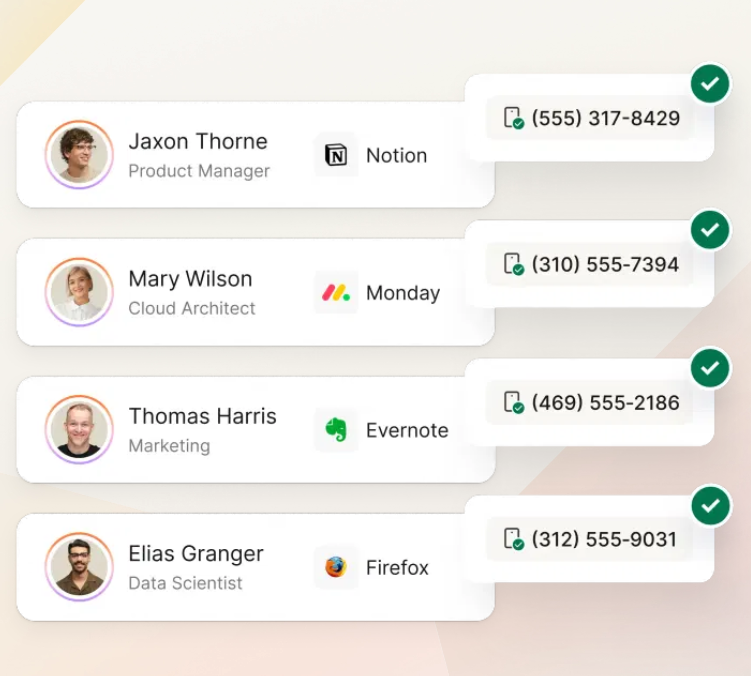
The #1 outsourcing complaint isn't usually cost - it's meeting quality. And meeting quality starts with whether the phone number actually rings.
Before you hand a list to your outsourced team, verify it. Prospeo covers 300M+ professional profiles with 98% email accuracy and 125M+ verified mobile numbers that deliver a 30% pickup rate. At ~$0.01 per verified email, you're spending $50 to verify a 5,000-contact list - compare that to the $2,000-$5,000/month you're paying the agency to dial those contacts. GreyScout ran this exact play: their bounce rate dropped from 38% to under 4%, and pipeline jumped 140%. Clean data is the highest-ROI pre-outsourcing investment you can make.
How to Evaluate an Agency
Questions to Ask
Before you sign anything, get clear answers on these:
- What's your average connect rate on campaigns similar to ours?
- What's your show rate, and how do you improve it?
- Can we access call recordings and listen to live calls?
- Do you work inside our CRM, or do we get a spreadsheet?
- Walk me through your ICP onboarding process - how long does it take?
- What does the pilot period look like? 60 days? 90?
- How do you handle TCPA compliance, DNC list scrubbing, and call recording consent?
That last question isn't optional. TCPA violations carry penalties of $500-$1,500 per unsolicited call, and class actions can scale into millions. Any agency that hand-waves compliance is a liability, not a partner.
Red Flags
Walk away if you hear any of these.
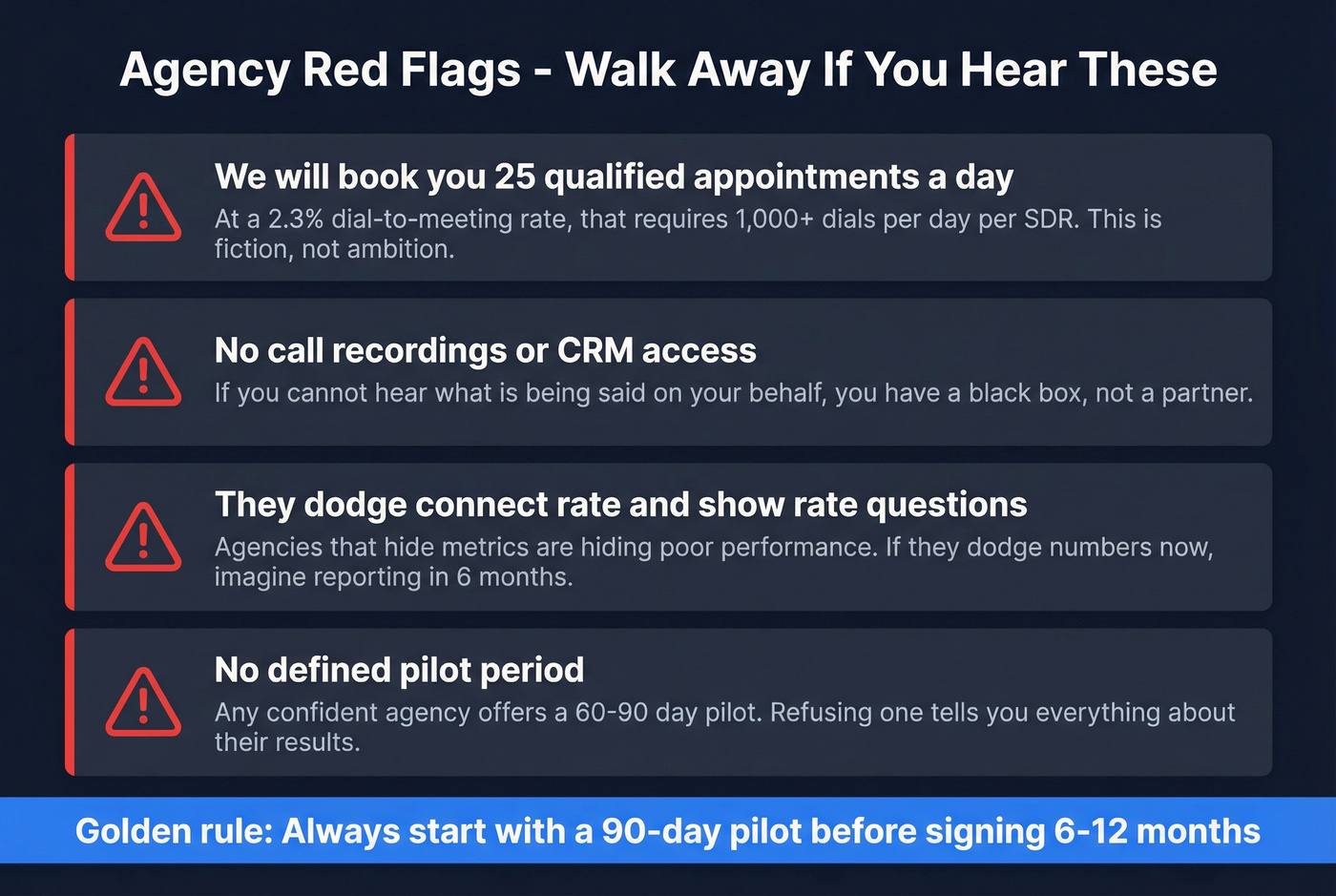
"We'll book you 25 qualified appointments a day." That's not ambitious - it's fiction. At a 2.3% dial-to-meeting rate, you'd need over 1,000 dials per day to hit that number. For one SDR. With "qualified" attached.
No call recordings or CRM access. If you can't hear what's being said on your behalf, you don't have a partner. You have a black box.
They won't share connect rate or show rate data. Agencies that hide metrics are hiding poor performance. The consensus on r/sales is pretty clear: if they dodge the numbers question in the sales process, imagine what reporting looks like six months in.
No defined pilot period. Any agency confident in their work will offer a 60-90 day pilot before locking you into 6-12 months.
5 Mistakes That Burn Your Budget
1. Cheapest offshore for complex deals. Domestic callers outperform offshore by up to 2x on conversion for nuanced B2B conversations. Saving $2,000/month on SDR costs while halving your meeting quality is a net loss.
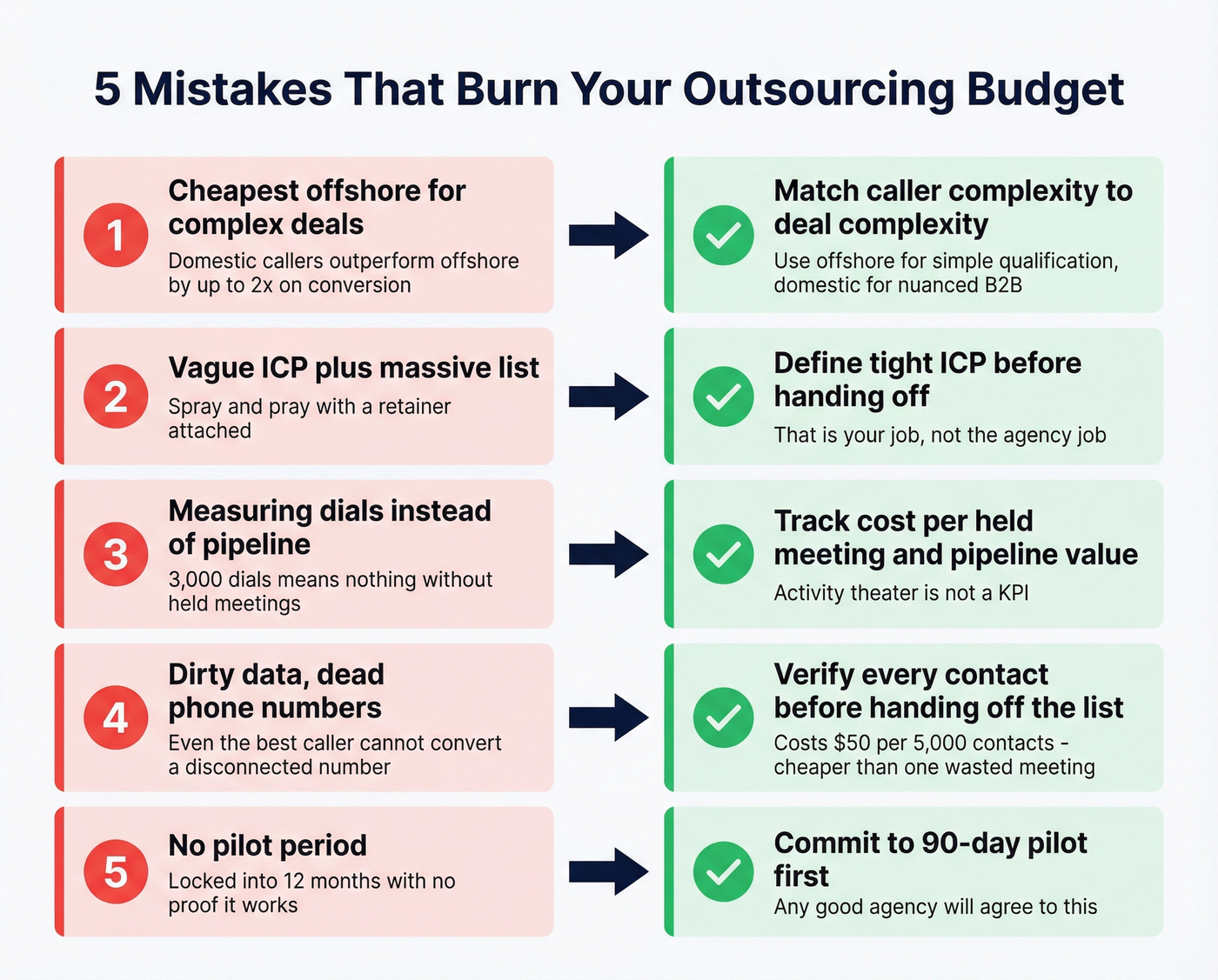
2. Vague ICP + massive list. Handing an agency 50,000 contacts with "mid-market SaaS companies" as the targeting brief is spray-and-pray with a retainer attached. Tight ICP definition is your job, not theirs.
3. Measuring dials instead of pipeline quality. An agency that reports "we made 3,000 dials this week" without connecting that to held meetings and pipeline value is optimizing for activity theater.
5. No pilot period. Commit to a 90-day pilot before signing a 6-12 month contract. Any agency that won't agree to this is telling you something about their confidence.
KPIs for Your Outsourcing SLA
Don't let your agency define what success looks like. Put these in the SLA before you sign.
| KPI | Formula | Target Range |
|---|---|---|
| Connect rate | Connections / Dials | 7-10%+ |
| Dial-to-meeting | Meetings booked / Dials | 3-5%+ |
| Show rate | Meetings held / Booked | 80%+ |
| Cost per held meeting | Total spend / Held meetings | Track monthly |
| Pipeline per dollar | Pipeline value / Total spend | 5x+ |
| Meeting quality score | % meetings matching ICP | 70%+ |
| Gatekeeper bypass rate | % calls reaching decision-maker | 20-30%+ |
The one most teams miss is pipeline per dollar. An agency can book 15 meetings a month, but if those meetings generate $50K in pipeline against $5K in spend, that's a 10x return. If they generate $15K in pipeline, it's 3x - and probably not worth continuing. Track this monthly and share it with the agency. The good ones will optimize toward it.
Gatekeeper bypass rate is the metric that separates agencies running a real operation from those padding reports with voicemail attempts. If fewer than 20% of calls reach an actual decision-maker, your agency has a targeting problem, a data problem, or both.
If you want a deeper baseline for what "good" looks like across scripts, connect rates, and show rates, use our B2B cold calling guide as the reference point.
The difference between a 2.3% and 5% dial-to-meeting rate isn't the script or the agency - it's whether the person picks up. Prospeo's 125M+ verified mobiles hit a 30% pickup rate, refreshed every 7 days. Feed your outsourced team direct dials that actually connect and watch your cost per held meeting drop by half.
Double your agency's connect rate with data that's never more than a week old.
FAQ
How much does outsourced cold calling cost per month?
Expect $2,000-$5,000/month on retainer models. Per-appointment pricing runs $75-$500 per booked meeting, though the true cost per held meeting is 20-67% higher depending on show rates. Offshore options start around $8/hour.
Is it worth outsourcing cold calls for small businesses?
Yes, if your average deal justifies the spend. At $2,000-$4,000/month, you typically need at least one $10K+ closed deal within six months to break even. Start with a 90-day pilot and measure pipeline per dollar - not just meetings booked. Skip this route entirely if your ACV is under $5K and your sales cycle is under two weeks; at that price point, you're better off with automated sequences and self-serve demos.
How long before outsourced calling produces results?
Expect 2-4 weeks for onboarding, ICP alignment, and script refinement. Meaningful pipeline appears in month two or three. Cost-per-meeting often drops ~50% by year two as the agency learns your market and refines targeting.
Should I use offshore or onshore callers?
Offshore works for simple qualification, appointment confirmation, and high-volume initial outreach. For complex B2B conversations requiring product knowledge or industry fluency, domestic callers outperform offshore by up to 2x on conversion. Match the caller tier to the conversation complexity.