SDR Rejection Handling: Scripts, Frameworks, and the System That Actually Works
A RevOps lead we know ran call recordings from a 12-person SDR team last quarter. The reps who hit quota weren't the ones with the thickest skin - they were the ones who'd memorized five responses and knew which one to pull for each objection type. SDR rejection handling isn't a mindset problem. It's a systems problem.
Master 5 objections and you handle 74% of all rejections, based on analysis of 300M+ cold calls. Dismissive, situational, and existing-solution objections each need different scripts. And here's the part most training programs skip entirely: fix your data before you fix your talk tracks. Wrong numbers and departed contacts create fake rejection that no script can solve.
Why Most Rejection Advice Fails
Most rejection content tells you to "embrace the no" or "develop a growth mindset." That's like telling a basketball player to "want it more" without teaching them a crossover.
The top 5 objections account for 74% of all rejections across 300M+ analyzed cold calls. A rep who memorizes five responses - not fifty - covers nearly three-quarters of what they'll hear on any given day. HubSpot's 2025 survey of 379 sales professionals shows 24% of organizations still use cold calling as a primary channel. The phone isn't going anywhere.
What makes it harder than ever: the average B2B buying group has grown from 6 to 12 stakeholders, and only 13% of buyers believe a salesperson understands their requirements. Your cold call lands in a more complex decision environment than it used to, and the person picking up has less patience and more options than they did three years ago. The question isn't whether your team will hear "no." It's whether they have a repeatable system for it.
The 3 Types of Cold Call Rejection
Not all rejections are the same. Treating them identically is the fastest way to burn through a call list.
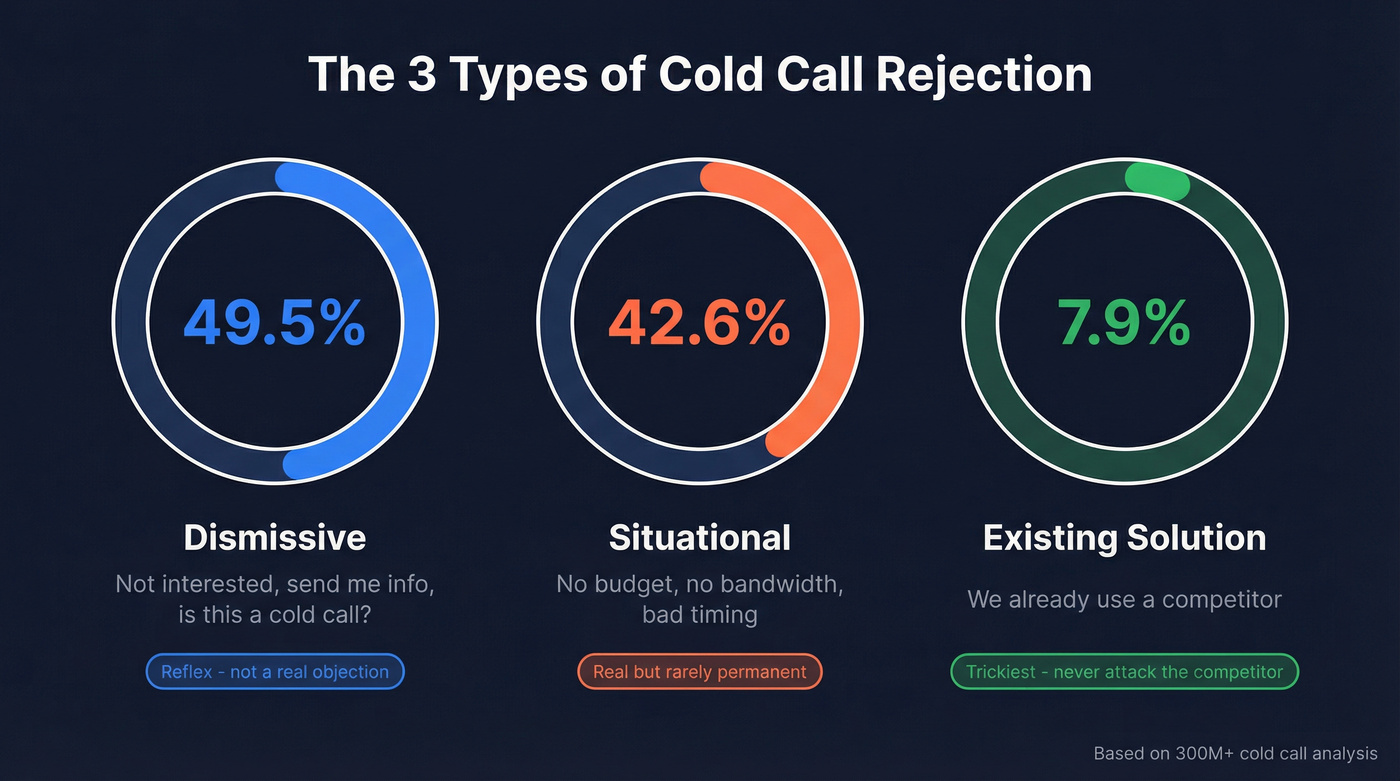
Dismissive (49.5%)
Nearly half of all objections are dismissive - "not interested," "send me info," "is this a cold call?" These aren't real objections. They're reflexes. The prospect hasn't processed your value prop; they've processed that you're a stranger interrupting their day.
A typical exchange: "Hi, is this Sarah?" "Yes - is this a sales call?" "It is, and I'll be quick..." Your job here isn't to overcome an objection. It's to earn 15 more seconds.
Situational (42.6%)
"No budget," "no bandwidth," "bad timing." These are real, but rarely permanent. The mistake most reps make is accepting them at face value. The right move is diagnosing whether the situation is temporary or structural, then setting a concrete follow-up.
Existing Solution (7.9%)
Only 8% of objections fall here, but they're the trickiest. The cardinal rule: don't attack the competitor. Instead, use a trap question - "what would you change about your current setup if you could?" - to surface a gap they've already been thinking about. Sell the test drive, not the product.
Scripts for the Top 5 Objections
Here are copy-paste responses for the five objections you'll hear most, with branching logic for each.
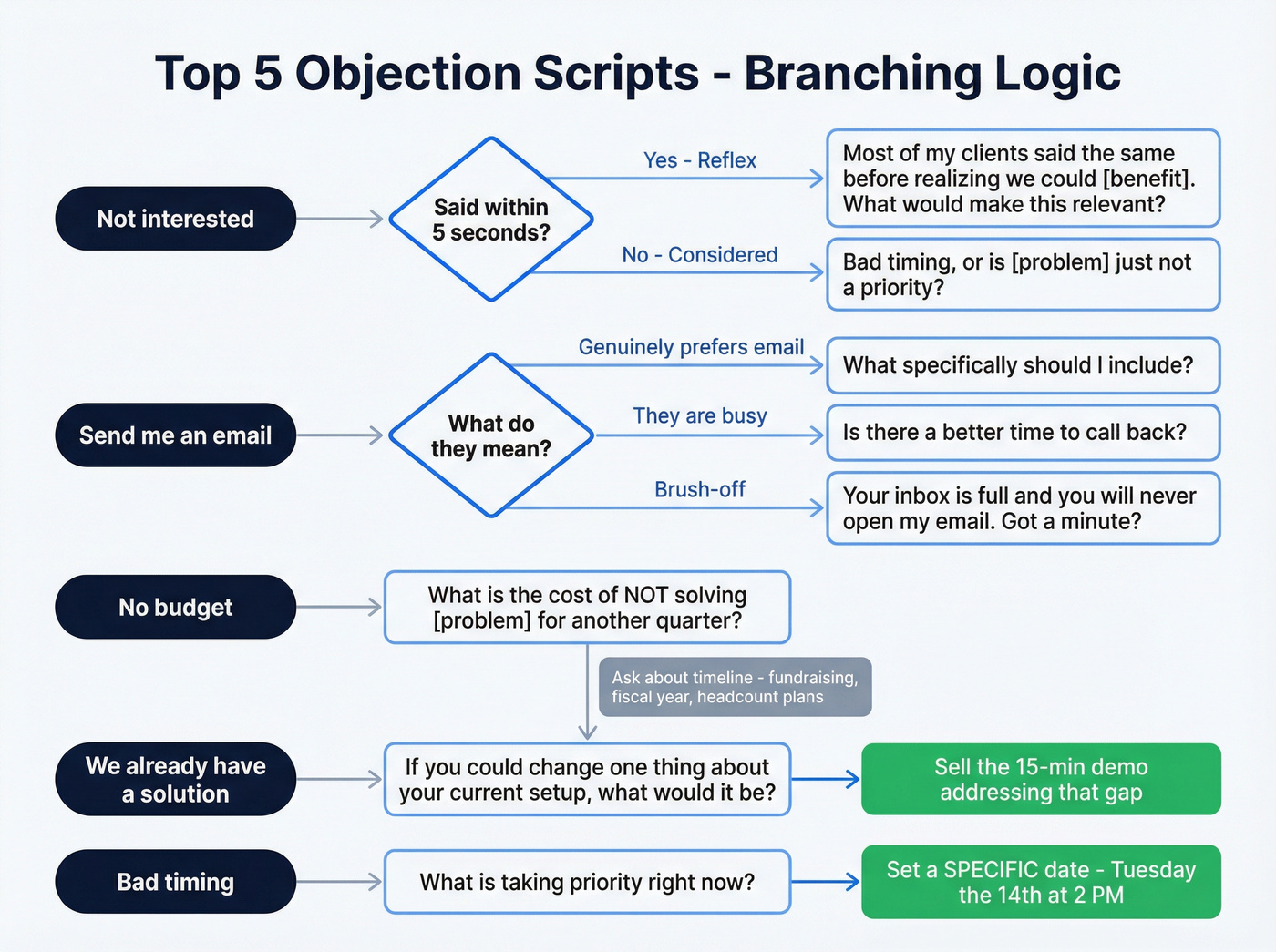
"Not interested." First, diagnose: reflexive or considered? If the prospect says it within five seconds, it's a reflex. Try: "Totally get it. Most of my clients said the same before realizing we could [specific benefit]. Curious - what would make this more relevant?" If they push back again, fork it: "No worries - is it bad timing, or is [problem] just not a priority right now?" That fork gives you information either way.
"Send me an email." This one has three possible meanings, and the wrong response to each will kill the conversation. If they genuinely prefer email: "Of course! What specifically should I include?" If they're busy: "Absolutely - is there a better time to call back?" If it's a brush-off: "Let's be honest - your inbox is probably full, and you're never going to open my email. Do you have a minute for me to explain why I called?" Reserve that third option for prospects who clearly fit your ICP after softer approaches have failed.
"No budget." Don't argue price. Reframe around cost of inaction: "What's the cost of not solving [specific problem] for another quarter?" If they're genuinely budget-constrained, ask about timeline - fundraising rounds, fiscal year resets, headcount plans all signal when budget frees up.
"We already have a solution." Agree, then incentivize. "That's great - [Competitor] is a solid choice. If you could change one thing about your current setup, what would it be?" Whatever they say becomes your opening. Don't sell the product - sell a 15-minute demo addressing that specific gap.
"Bad timing." Ask what's competing for their attention: "Totally understand - what's taking priority right now?" Their answer tells you whether to follow up in two weeks or two quarters. The critical move: set a specific date. "I'll call you back sometime" is a graveyard. "I'll call you Tuesday the 14th at 2 PM" is a pipeline entry. 80% of sales require five or more follow-ups, but most reps quit after one.

You just memorized scripts for the top 5 objections. But scripts can't save a call to a wrong number or departed contact. Prospeo's 300M+ profiles refresh every 7 days - not every 6 weeks - so your SDRs reach the right person, with the right title, at the right company. Teams using Prospeo book 35% more meetings than Apollo users.
Eliminate fake rejections before your reps ever pick up the phone.
Prevent Rejection Before It Happens
The best objection is the one that never comes up. Three levers matter here.
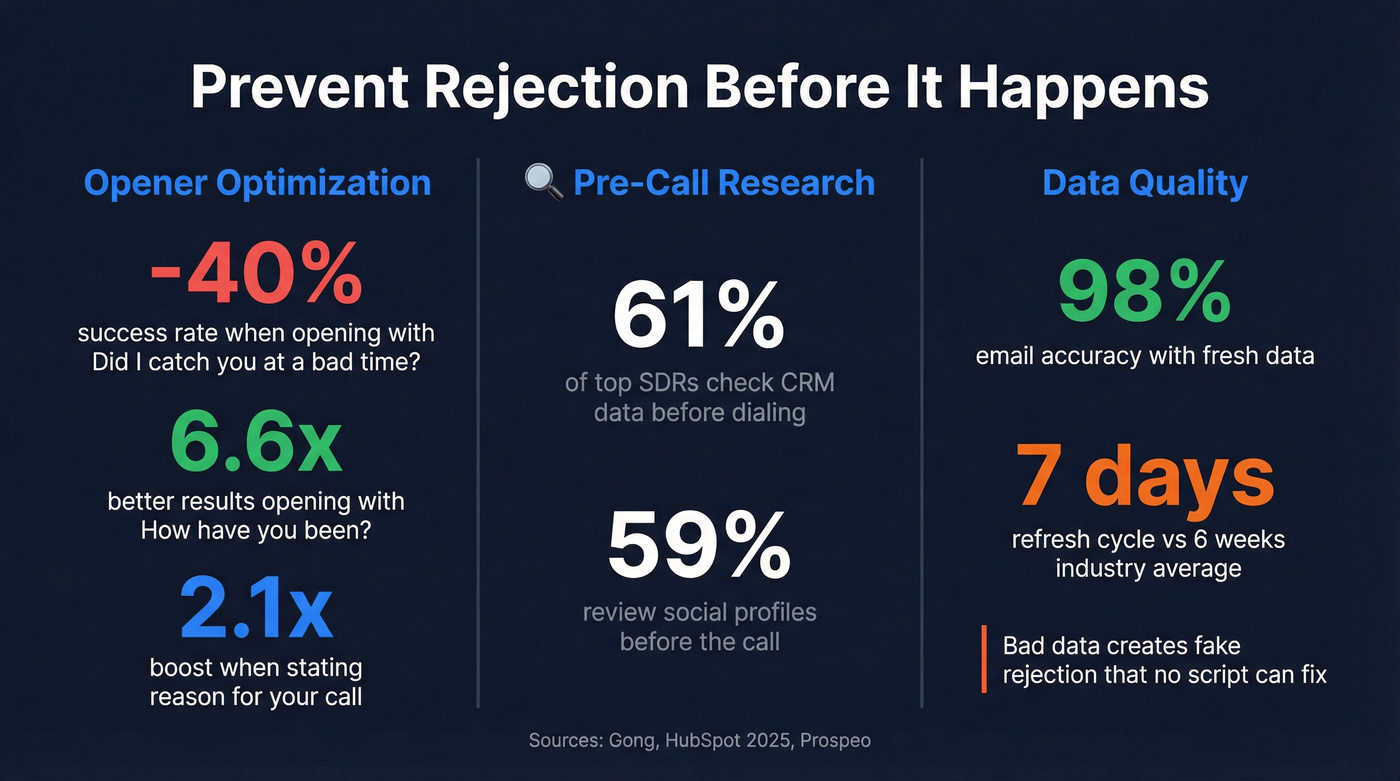
Opener optimization. Opening with "Did I catch you at a bad time?" makes you 40% less likely to book a meeting. Opening with "How've you been?" performs 6.6x better. Stating the reason for your call boosts success by 2.1x. Your first sentence does more work than your entire pitch deck. And per Gong's cold-call benchmarks, Wednesday and Thursday are the highest-converting cold call days - stack your heaviest dial blocks there.
Pre-call research. HubSpot found 61% of daily cold callers use CRM data and past interactions before dialing, and 59% check social profiles. The reps who skip research are the ones getting "not interested" in three seconds - because they deserve it. Use a lightweight pre-call research routine so your opener lands.
Data quality. Here's the thing: a huge chunk of "rejection" isn't rejection at all. It's wrong numbers, departed contacts, and outdated titles. If your list is bouncing and your connects are collapsing, you're burning dials on ghosts. We've seen teams double their connect rates just by cleaning their data before a single script change. Prospeo's 7-day refresh cycle and 98% email accuracy eliminate the rejections that have nothing to do with your pitch and everything to do with bad information - starting with data quality and B2B contact data decay.
Your SDRs need 5+ follow-ups to close - but they can't follow up with bad numbers. Prospeo delivers 125M+ verified mobiles with a 30% pickup rate and 98% email accuracy at $0.01/email. One agency cut bounce rates from 35% to under 3% and built to $1M ARR on Prospeo data alone.
Give your SDRs data worth dialing - not ghosts worth dreading.
Micro-Skills That Separate Top Performers
Beyond scripts, there are behavioral patterns that consistently separate quota-crushers from everyone else. In our experience coaching SDR teams, the pause technique is the single fastest behavior change you can make.
| Skill | Benchmark | Action Item |
|---|---|---|
| Pause after objection | Top reps pause 5x longer | Count to 3 before responding |
| Talk ratio | 55% rep / 45% prospect | Monitor with call recording |
| Monologue length | 53s (wins) vs 25s (losses) | Extend value statements |
| "We" language | 65% more in successful calls | Replace "I" with "we" and "you" |
| Opener | "How've you been?" = 6.6x | Open warm, state reason for call |
| Avoid | "Bad time?" = -40% success | Never open with "bad time?" |
When a prospect says "not interested," your instinct is to jump in immediately. Top reps sit in the silence for a beat. It signals confidence, gives the prospect space, and - counterintuitively - makes them more likely to keep talking. Practice it in role-plays until it's muscle memory. If you want a deeper breakdown of what to say and when, pair this with a B2B cold calling guide and a cold call tonality refresher.
Let's be blunt about something: if your team's connect rate is below 5%, stop investing in talk track training and start investing in data quality. The best script in the world can't save a call to someone who left the company eight months ago. The consensus on r/sales backs this up - threads about "low connect rates" almost always trace back to garbage data, not bad reps. If you're cleaning lists, start with CRM hygiene and a repeatable CRM verify workflow.
The Mental Health Reality
89% of sales professionals report battling stress or burnout. 67% are teetering on the edge. When you're hearing "no" 95-98 times out of 100 dials, that's not a productivity problem - it's a psychological endurance test.
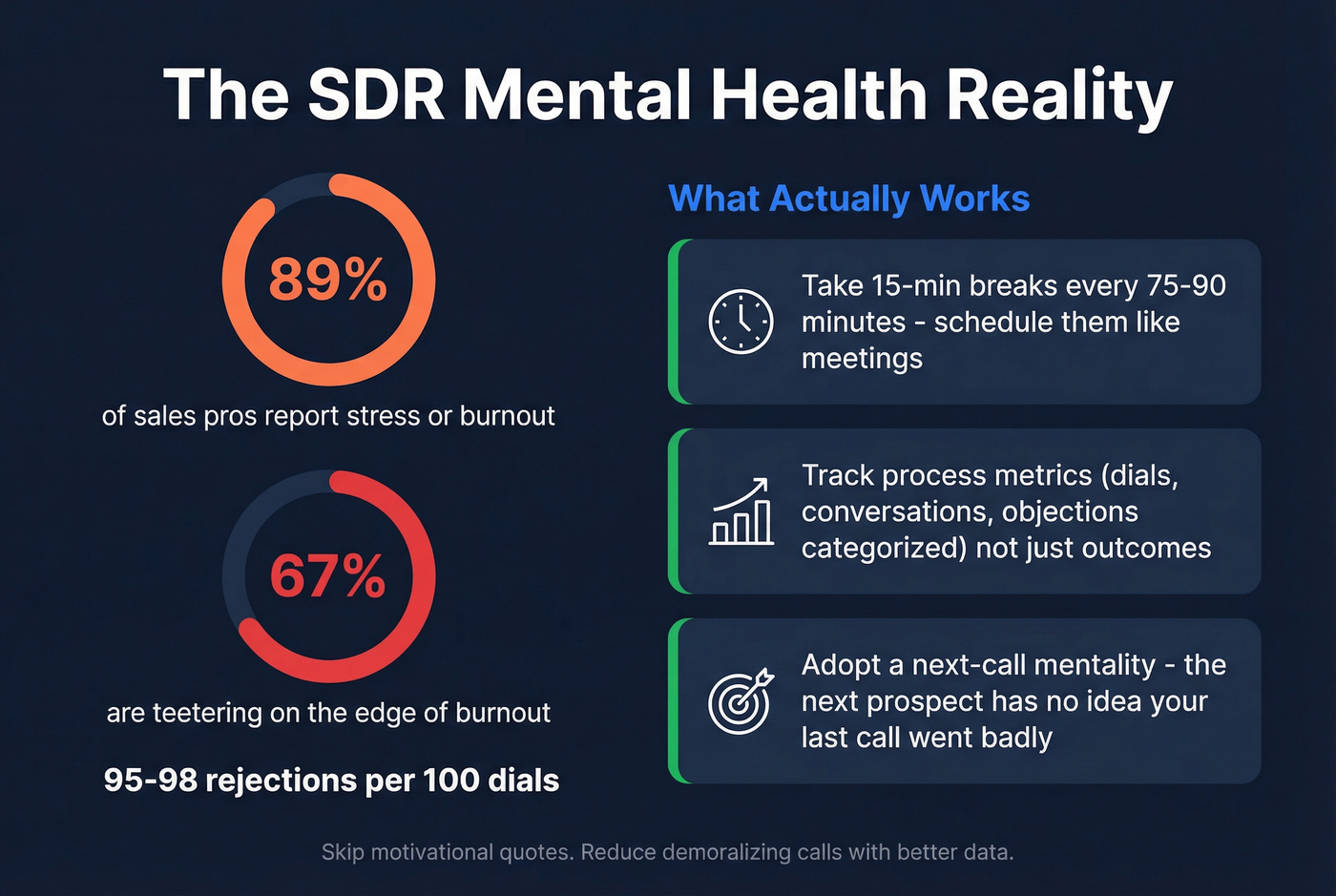
Adopt a next-call mentality: the person on the other end of your next dial has no idea your last call went badly. Take 15-minute breaks every 75-90 minutes and schedule them like meetings, because if they're optional, they won't happen. Track process metrics - dials made, conversations had, objections categorized - instead of outcome metrics. You can't control whether someone books a meeting. You can control whether you executed the right script on the right objection type.
Skip the "motivational quotes on the wall" approach to SDR wellness. It doesn't work. What works is reducing the volume of demoralizing calls by ensuring your reps are actually reaching real, current prospects who match your ICP - using tighter account qualification and better prospect data accuracy.
Build Your Team's Rejection Playbook
If you're managing SDRs, here's the system that turns rejection handling from tribal knowledge into a trainable skill.
- Collect 50 real objections from your team's call recordings - actual phrases prospects used last month, not hypothetical ones from a training manual.
- Categorize each one using the three-type taxonomy: dismissive, situational, existing solution.
- Build response scripts per type. Not one script per objection - one per type. Your reps need frameworks, not memorized lines they'll forget under pressure. (If you want a broader taxonomy, see types of objections.)
- Run weekly role-plays. Pair reps up, assign objection types, rotate. The rep who practiced "existing solution" responses 20 times this month won't freeze when they hear it live.
- Review call recordings together. Pull two calls per week - one handled well, one not. Focus on team patterns, not individual blame. This is where the real coaching happens, and it compounds faster than any other training investment you can make - especially with a structured cold call coaching cadence.
After 90 days, your team has heard every objection type dozens of times in practice before encountering it on a live call. That's the difference between a team that dreads the phone and one that picks it up ready.
FAQ
How many rejections is normal for an SDR?
Most SDRs face a 95-98% rejection rate on cold calls. The top 5 objections cover 74% of all rejections, so mastering a handful of responses handles the vast majority of what you'll hear daily.
Should I follow up after a rejection?
Yes. 80% of sales require five or more follow-ups. Set a specific callback date and log the objection type so your follow-up addresses the real concern rather than restarting from scratch.
What's the fastest way to improve rejection handling?
Fix your data first. Calling verified, current contacts with accurate direct dials eliminates "wrong number" and "they left the company" rejections entirely. From there, categorize your team's actual objections and build scripts per type - not per individual objection.
How should managers coach SDRs through rejection?
Collect 50 real objections from call recordings, categorize them using the three-type taxonomy, build response scripts per type, and run weekly role-plays. Review recordings as a team and focus on patterns, not blame.