

Account Qualification: How to Stop Chasing Bad Deals and Build Pipeline That Closes
Your pipeline says $6M. Your forecast says $1.2M. The gap between those two numbers is made of unqualified accounts - companies that were never going to buy, sitting in your CRM like furniture nobody uses. Account qualification is how you close that gap, and most teams are doing it wrong because they're qualifying leads when they should be qualifying companies.
Here's the thing: most qualification guides tell you to build a scorecard and call it a day. They skip the part that actually matters - the data underneath the scorecard is probably wrong.
What You Need (Quick Version)
Evaluating whether a company - not an individual lead - deserves your team's time, sequences, and custom decks requires three things:
- An ICP scorecard that scores accounts on firmographic and technographic fit before a rep ever picks up the phone.
- A qualification framework - MEDDPICC for enterprise , BANT as a velocity pre-filter - applied consistently across every deal.
- Data that's actually current. Your scoring model is only as good as the data feeding it. A 7-day refresh cycle beats a 6-week refresh cycle every single time.
Get those three right and you'll stop building fluff pipeline.
What Is Account Qualification?
Account qualification determines whether a company - the entire organization, not just one contact who downloaded a whitepaper - is worth pursuing. It evaluates fit (do they match your ICP?), intent (are they actively researching solutions?), and ability to buy (do they have budget, authority, and a real timeline?).
This is different from lead qualification, which focuses on an individual's readiness. The shift from MQL (marketing qualified lead) to MQA (marketing qualified account) isn't just semantics - it changes what you're actually measuring. When you qualify at the account level, you're asking "should we invest resources in this company?" rather than "is this person ready for a demo?" One question prevents wasted pipeline. The other just fills it.
Why It Matters
The median qualified-lead-to-booked rate across B2B SaaS sits at 62%, based on 1M+ form submissions. Top-performing teams hit 78%+. The gap between median and top decile almost always comes down to qualification rigor - the best teams are pickier about which accounts enter the pipeline in the first place.
In B2B, where buying groups include 6-10 stakeholders in mid-market deals and 13+ in enterprise, qualifying a single contact is like judging a movie by one frame. You need the full picture: the company's tech stack, growth trajectory, buying committee structure, and competitive landscape.
And 70% of B2B records decay within 12 months. Titles change, people leave, companies get acquired. If you're scoring accounts against stale data, you're making decisions based on fiction. That's how you end up with a $6M pipeline and a $1.2M forecast.
The cost of fluff pipeline isn't just missed revenue. It's the opportunity cost of reps spending cycles on accounts that were never going to close.
Scoring Model: Fit x Intent x Engagement
The most effective model scores across three buckets. Fit tells you if the account could buy. Intent tells you if they're thinking about buying. Engagement tells you if they already know you exist.
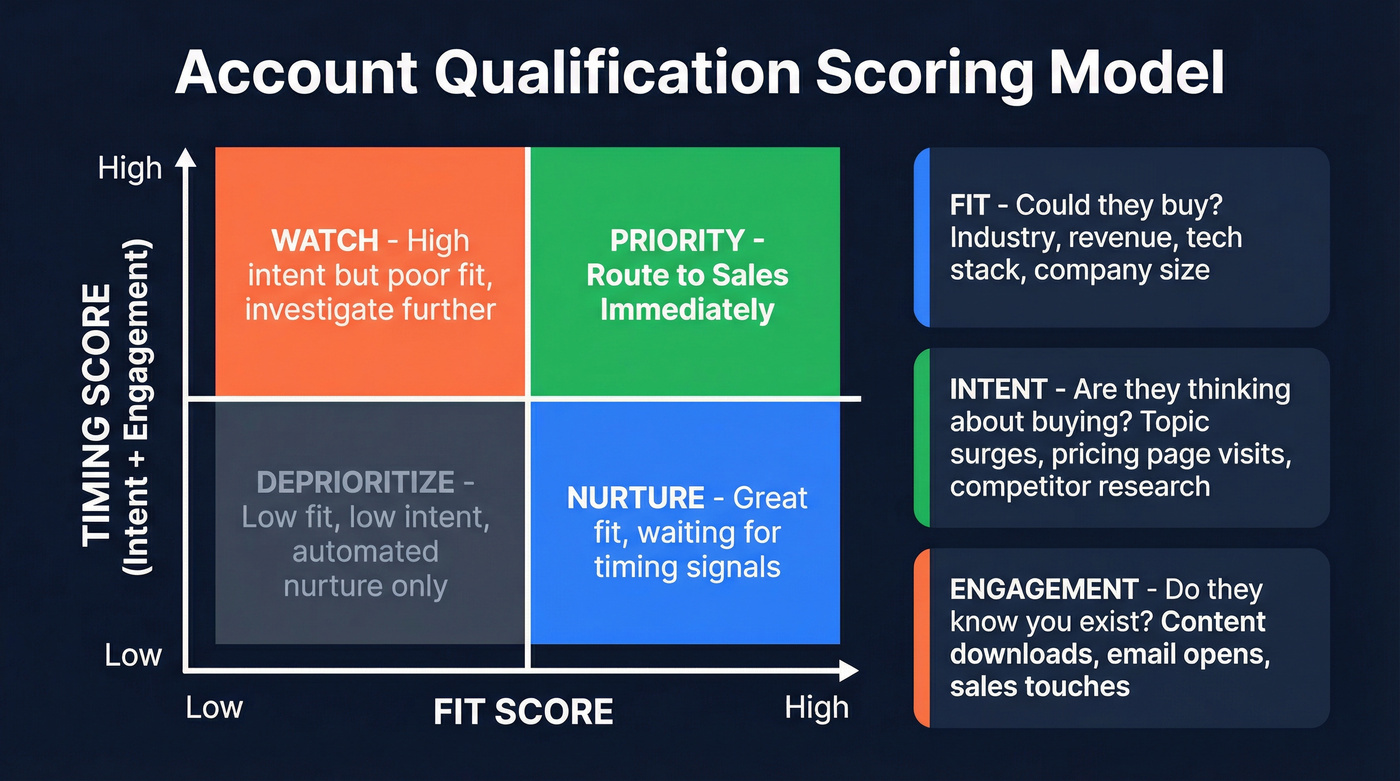
Think of it as two axes: a static fit score and a dynamic timing score. An account that scores high on fit but low on intent goes into nurture. High on both? Immediate attention.
| Criteria | Bucket | Weight | Example Score |
|---|---|---|---|
| Industry match | Fit | 20% | 5 (SaaS) / 2 (govt) |
| Revenue range | Fit | 15% | 5 ($10M-$100M) |
| Tech stack compatibility | Fit | 15% | 4 (uses Salesforce) |
| Intent topic surges | Intent | 20% | 3 (moderate activity) |
| Pricing page visits | Intent | 10% | 5 (3 visits this week) |
| Prior sales touches | Engagement | 10% | 2 (cold outreach only) |
| Content downloads | Engagement | 10% | 4 (2 whitepapers) |
The weighted total becomes your MQA score. Accounts above your threshold get routed to sales. Below it, they stay in marketing nurture until signals change.
Don't treat this as a one-time exercise. Accounts move between tiers as intent signals fire and go quiet. Re-evaluate your scoring model quarterly at minimum.
Four Frameworks That Work
Standardize on one or two frameworks. Don't run a buffet of acronyms - that just means nobody's using any of them consistently.
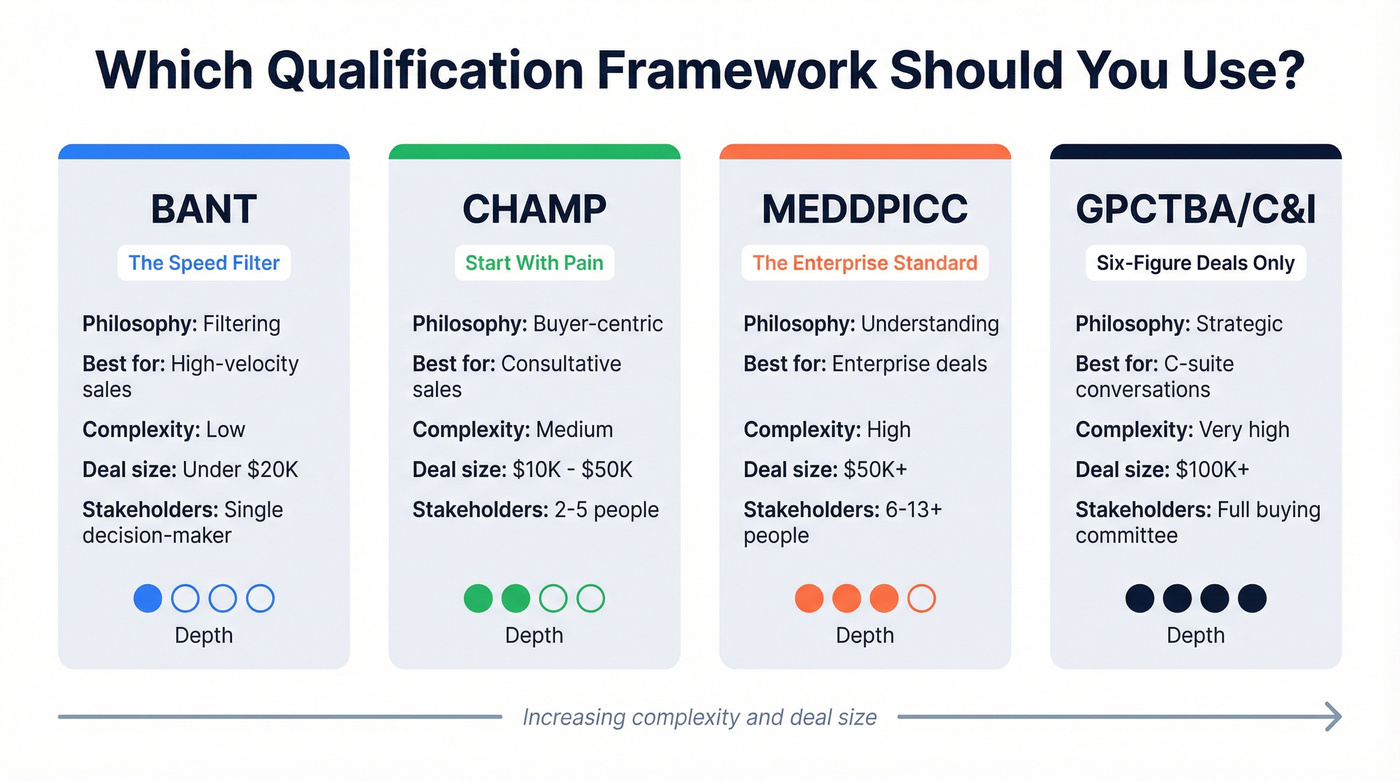
| Framework | Philosophy | Best For | Complexity | Deal Size |
|---|---|---|---|---|
| BANT | Filtering | High-velocity | Low | Under $20K |
| CHAMP | Buyer-centric | Consultative | Medium | $10K-$50K |
| MEDDPICC | Understanding | Enterprise | High | $50K+ |
| GPCTBA/C&I | Strategic | C-suite deals | Very high | $100K+ |
BANT - The Speed Filter
Created by IBM in the 1950s, BANT (Budget, Authority, Need, Timeline) is the oldest framework still in use. Four binary questions that tell you whether to keep talking or move on. Use it as a top-of-funnel pre-filter for high-velocity sales with a single decision-maker and deal sizes under $20K.
BANT's weakness is depth. It treats qualification as filtering: yes/no, in/out. For complex deals with multiple stakeholders and long cycles, you'll pass accounts that look qualified on paper but stall at procurement.
CHAMP - Start With Pain
CHAMP flips the order: Challenges first, then Authority, Money, Prioritization. It's more buyer-centric because it starts with the prospect's pain rather than your checklist. Good for consultative discovery motions in the $10K-$50K range.
MEDDPICC - The Enterprise Standard
MEDDPICC is the enterprise standard. Full stop. MEDDIC originated at PTC in the 1990s; MEDDPICC extends it with Paper Process and Competition. The emphasis on Champion - someone inside the account who's actively selling on your behalf - is what separates it from everything else.
The philosophy behind MEDDIC is qualification as understanding, not filtering. You're not asking "can they buy?" - you're mapping the entire decision process. If BANT is a metal detector, MEDDPICC is a geological survey. For deals over $50K with 3+ month cycles, nothing else comes close.
GPCTBA/C&I - Six-Figure Deals Only
Goals, Plans, Challenges, Timeline, Budget, Authority, Consequences & Implications. This is the heaviest framework - designed for strategic executive conversations where the buying committee needs to see the cost of inaction, not just the cost of your product. If your average contract value sits below six figures, skip this one entirely.

Your Fit × Intent × Engagement model collapses when 70% of your B2B records are decayed. Prospeo's 7-day refresh cycle, 30+ search filters (including buyer intent, technographics, and headcount growth), and 98% email accuracy give your scoring model the foundation it actually needs.
Stop qualifying accounts against stale data. Start qualifying against reality.
How to Tier Qualified Accounts
Once you've scored accounts, tier them. Not every account above your threshold deserves the same level of effort.
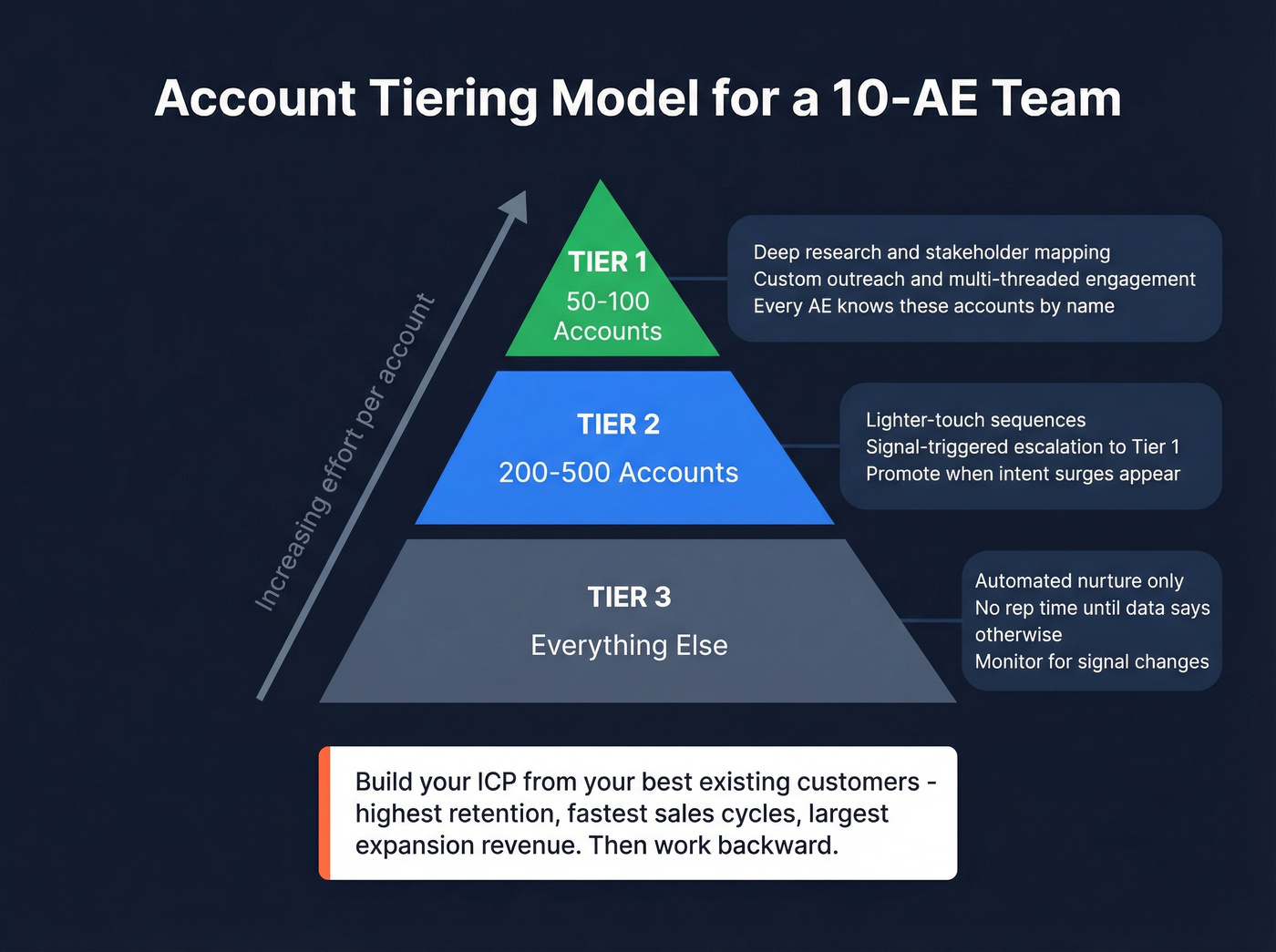
For a 10-AE team, a practical tiering model looks like this:
- Tier 1 (50-100 accounts): Deep research, stakeholder mapping, custom outreach, multi-threaded engagement. Every AE should know their Tier 1 list by name.
- Tier 2 (200-500 accounts): Lighter-touch sequences with signal-triggered escalation. When a Tier 2 account starts showing intent surges, it gets promoted.
- Tier 3 (everything else): Automated nurture until signals fire. No rep time until the data says otherwise.
Build your ICP from your best existing customers - the ones with the highest retention, fastest sales cycles, and largest expansion revenue. Then work backward to identify the firmographic and technographic patterns they share.
We've seen this play out firsthand: an SDR books a meeting with a 12-person company running a completely incompatible tech stack. The AE spends 45 minutes on a discovery call before realizing it's a dead end. That's a tiering failure. If the account had been scored properly, it never would've hit the AE's calendar.
71% of organizations run an ABM strategy, but only 36% say sales and marketing are tightly aligned around it. The gap is usually in tiering - marketing generates a "target account list" that sales ignores because it doesn't match what they're actually seeing in the field.
Disqualification - The Underrated Skill
Let's be honest: disqualification is the most undervalued skill in B2B sales. Saying no to a bad-fit account early saves exponentially more revenue than saying yes to a marginal one late. Create a Non-ICP list - a documented set of characteristics that automatically disqualify an account from your pipeline.
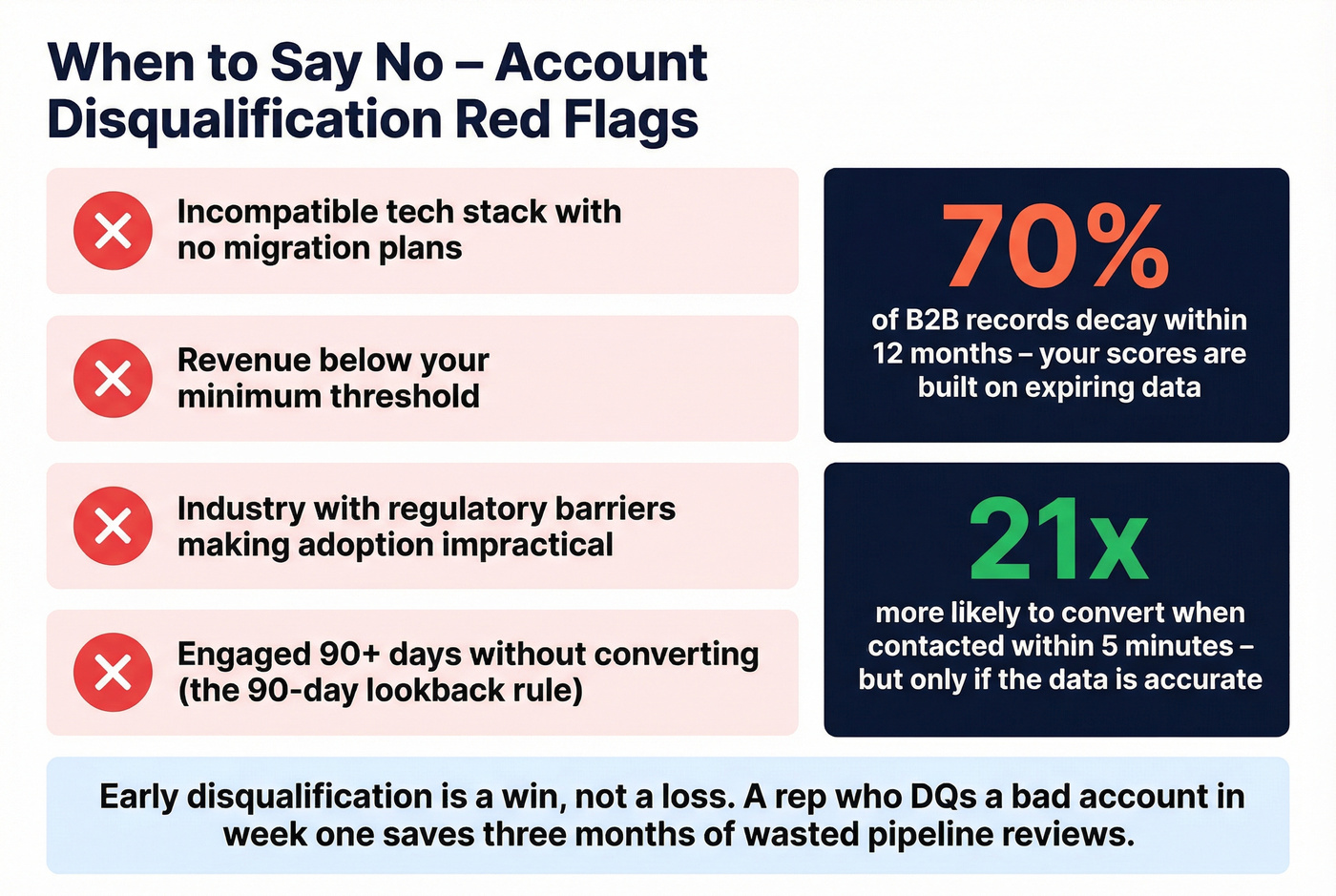
Red flags that should trigger disqualification:
- Incompatible tech stack with no migration plans
- Revenue below your minimum threshold
- Industry with regulatory barriers that make adoption impractical
- Accounts engaged for 90+ days without converting - the 90-day lookback rule is a useful heuristic
Build a culture that praises early disqualification. When a rep DQs an account in week one instead of dragging it through three months of pipeline reviews, that's a win. Celebrate it.
Why Your Data Is Already Wrong
70% of your B2B records are decaying right now. People change jobs, get promoted, leave companies. Titles shift. Companies rebrand, merge, or get acquired. A contact list built six months ago is already half-wrong.
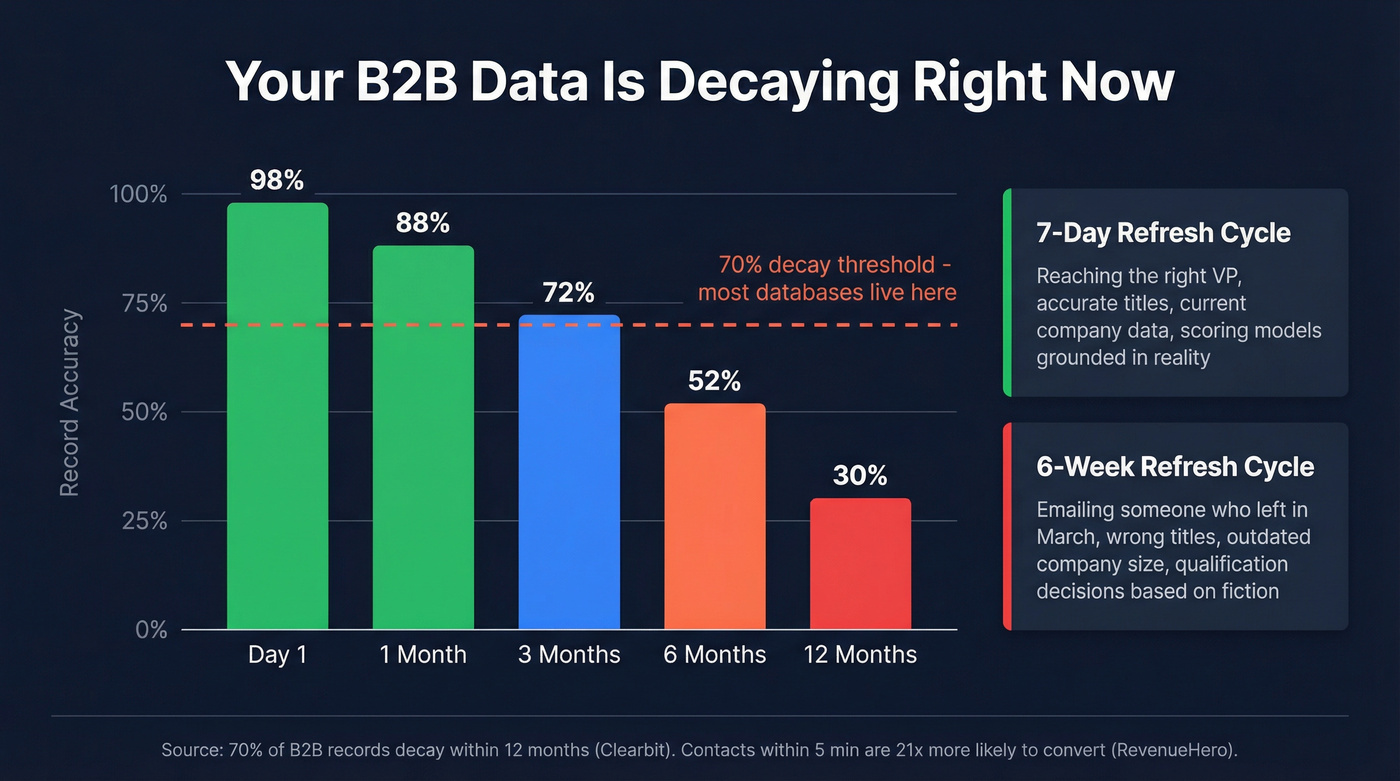
This matters because garbage data produces garbage scores. If your ICP scorecard says "VP of Engineering at companies with 200+ employees using AWS," but your database still shows a contact who left that company eight months ago, your scoring model is making decisions based on fiction.

The 5-minute rule makes this even more urgent: leads contacted within 5 minutes are 21x more likely to convert than those contacted after 30 minutes. Speed only works if the data you're acting on is accurate.
Most qualification guides stop at the scorecard. They don't address the data underneath it. The difference between a 7-day data refresh and a 6-week refresh isn't incremental - it's the difference between reaching the right VP and emailing someone who left the company in March. Tools like Prospeo, with a 7-day refresh cycle and 98% email accuracy across 300M+ profiles, keep scoring models grounded in current reality rather than last quarter's snapshot.
Making Qualification Stick in Your CRM
A qualification model that lives in a spreadsheet is a qualification model that nobody uses.
Fields and Gates
Create these CRM fields: qualification score (numeric), account tier (1/2/3), ICP fit (yes/no/partial), last-qualified date, primary framework used, and disqualification reason. Then define stage entry/exit criteria - "Interested" to "Discovery" requires a confirmed ICP fit and identified pain, while "Discovery" to "Demo" requires a champion identified and budget range confirmed. Without these gates, reps advance deals based on vibes.
Automation That Cleans Itself
Set re-qualification reminders at 90-day intervals. Flag accounts where the primary contact has changed roles. Auto-demote Tier 2 accounts that show no engagement for 60 days. Automation that collapses qualification and scheduling into one step can lift conversion 15-25 percentage points. And tie binary disqualifiers to your product constraints early - if your product only integrates with Salesforce, confirm CRM before you invest real selling time.
Five Mistakes That Kill Pipeline
1. No ICP definition. Without a documented ICP, every rep qualifies differently. One AE's "great fit" is another's "waste of time." The result is inconsistent pipeline quality and lower win rates across the board.
2. No structured framework. If qualification is subjective - "I think they're interested" - your forecast is fiction. Standardize on MEDDPICC or BANT and enforce it in pipeline reviews.
3. Quantity over quality. Every sales leader says "quality over quantity" in the all-hands, then asks why pipeline coverage is only 3x. Pick one. We've seen teams cut their pipeline by 40% and increase closed-won revenue because reps finally had time to work the deals that mattered instead of chasing every inbound that looked vaguely promising.
4. Stale data. You're making qualification decisions on data that's months old. That "VP of Sales" is now a "CRO" at a different company. That "500-person company" just laid off 200 people. Refresh your data or accept that your scores are decorative. (If you want a full ops playbook, start with CRM hygiene.)
5. Single-threading. With 13 stakeholders in the average enterprise deal, pinning your hopes on one contact is a recipe for ghosting. Multi-thread every Tier 1 account - map the buying committee, build relationships with at least 3-4 contacts, and make sure your champion isn't your only thread. (Here’s the deeper breakdown on multithreading.)
Account qualification isn't a sales methodology problem. It's a data problem. You can run MEDDPICC flawlessly and still lose deals if your account data is six months stale. The teams that win aren't the ones with the fanciest framework - they're the ones whose data is fresh enough to act on.
MEDDPICC demands you map the full buying committee - but you can't map what you can't find. Prospeo gives you 300M+ verified profiles, 125M+ direct dials, and intent data across 15,000 topics so every account in your pipeline has real contacts and real buying signals behind it.
Qualify accounts with complete data for $0.01 per email - not $1.
FAQ
What's the difference between account and lead qualification?
Account qualification evaluates the company - firmographic fit, intent signals, and buying committee readiness. Lead qualification evaluates an individual contact's readiness. In B2B with 13+ stakeholders per deal, account-level evaluation catches bad-fit companies before you waste cycles on individual leads inside them.
Which qualification framework should I use?
MEDDPICC for enterprise deals over $50K with 3+ month sales cycles. BANT as a pre-filter for high-velocity sales under $20K. Standardize on one or two - the framework matters less than whether your team actually uses it in every pipeline review.
How often should I re-qualify accounts?
Quarterly at minimum. B2B data decays 70% annually, so a list built six months ago is already half-wrong. Set CRM automation to flag accounts not re-scored in 90 days and pair it with a data platform that refreshes on a weekly cycle rather than the 6-week industry average.
How many qualified accounts should each rep manage?
For enterprise motions, each AE should actively work 15-25 accounts - enough to maintain pipeline coverage without spreading attention too thin. High-velocity teams can handle more, but the principle holds: fewer, better-qualified accounts outperform a bloated list every time.