

How to Build Automated Nurture Campaigns That Actually Convert
The average B2B SaaS website converts 1.1% of visitors. That's 11 leads per 1,000 visitors. If you're not nurturing those 11 with automated nurture campaigns, you're burning the budget that brought them in. Email nurture automation isn't a nice-to-have - it's where pipeline actually gets built.
The short version: automated flows convert 13x better than one-off campaigns. Plan for roughly 10 touchpoints at 1-2 emails per week, match CTA commitment to funnel stage, and verify your contact list before you hit send. Bounces kill deliverability faster than bad copy ever will.
What Are Nurture Campaigns?
Automated nurture campaigns are behavior-triggered or time-based email sequences that move leads through your funnel without manual intervention. They aren't a static drip where everyone gets the same five emails regardless of what they do.
The difference matters. Nurture flows respond to what the lead actually does - downloads a whitepaper, visits pricing, goes quiet for 30 days. 73% of B2B leads aren't ready to buy when they first enter your funnel. Email automation for lead nurturing is how you stay relevant until they are.
Why Automated Email Flows Outperform
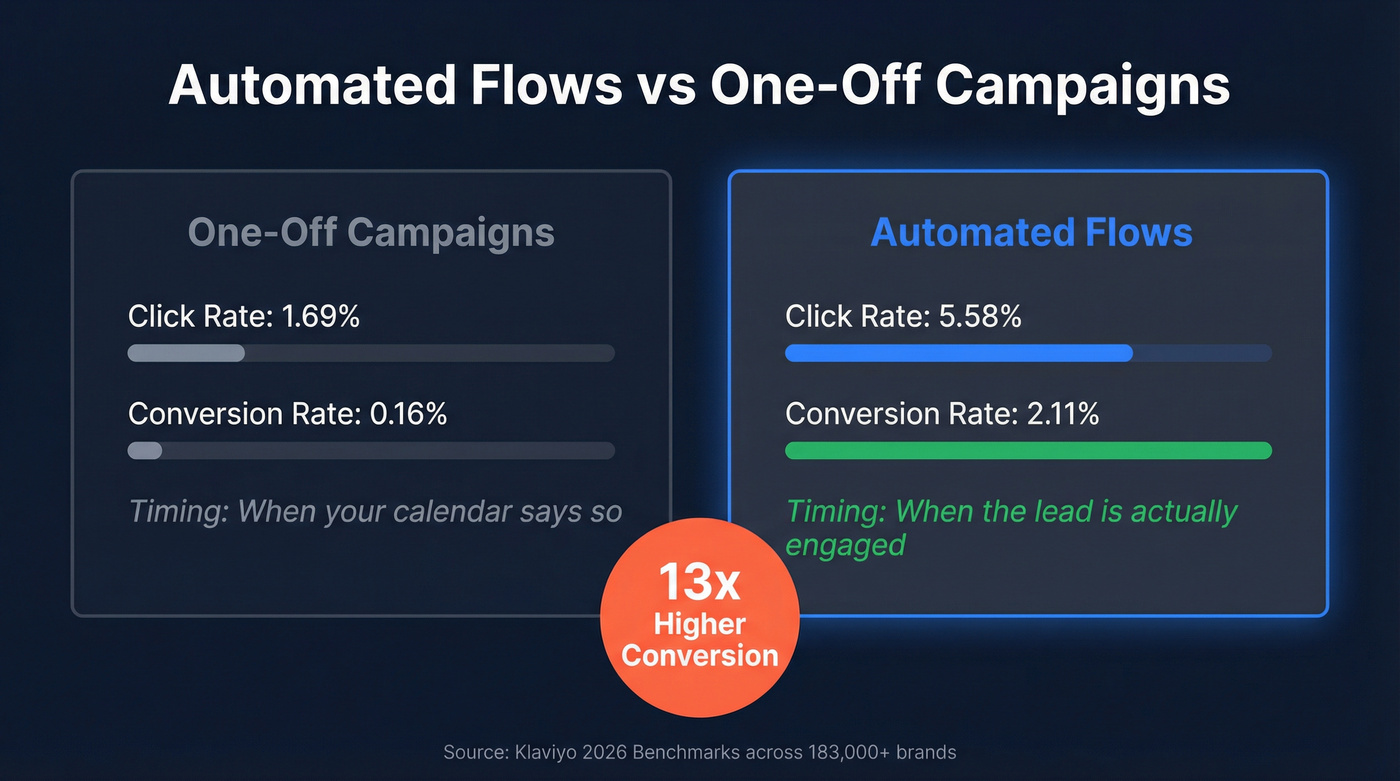
Klaviyo's 2026 benchmarks across 183,000+ brands tell the story clearly: flow click rates hit 5.58% versus 1.69% for one-off campaigns, and flow conversion rates land at 2.11% versus 0.16%. That's a 13x conversion advantage, because flows reach people at the moment they're engaged rather than when your marketing calendar says it's time to send.
Quick note on open rates - Apple's Mail Privacy Protection inflates them, so focus on click and conversion rates instead. (If you want to go deeper on what to track, see open-to-click ratios.)
Speed compounds the advantage. Contacting a lead within one hour makes you 7x more likely to qualify them. Wait 24 hours and that likelihood drops by 98%. AI-powered lead scoring cuts qualification time by roughly 30%, meaning your automation can route hot leads to sales before they cool off. It takes about 10 marketing touchpoints to move a lead from first contact to sales-ready, and nurtured leads move through the pipeline 23% faster.

Four Types Every B2B Team Needs
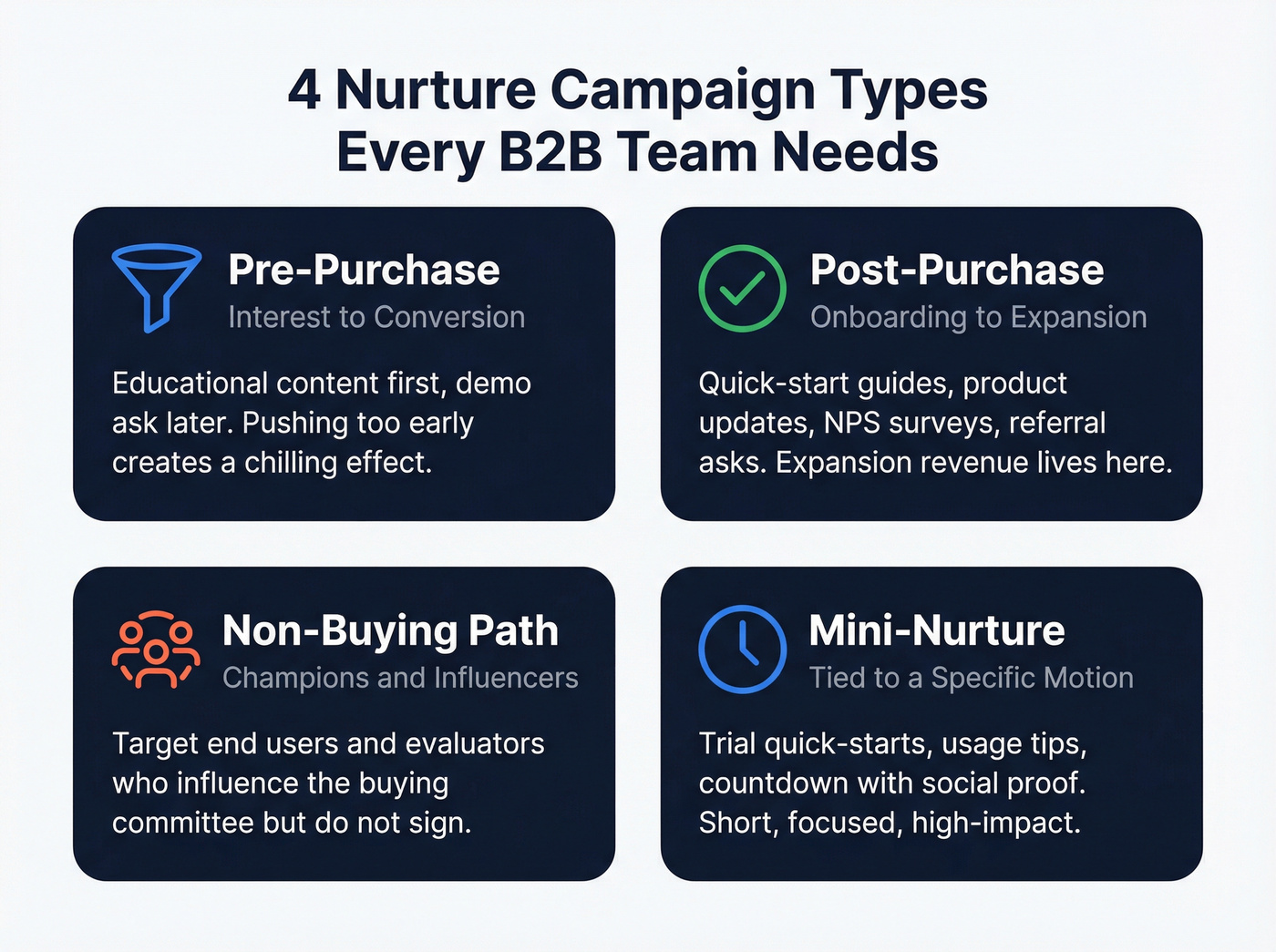
Oracle's nurture framework breaks this into four campaign types. We've found every B2B team should run at least one of each.
Pre-Purchase Sequences
This is your traditional lead nurture: Interest, Consideration, Conversion. Start with educational content and low-commitment CTAs. Save the demo request for later in the sequence. Pushing a high-commitment CTA too early creates what Oracle calls a "chilling effect" - leads disengage entirely. This is where automated lead nurturing emails do their heaviest lifting, educating prospects before asking for anything. (For more examples, see lead nurturing emails.)
Post-Purchase Nurture
Post-purchase nurture covers onboarding emails, quick-start guides, and community invites, then transitions to product updates, NPS surveys, and referral asks. This is where expansion revenue lives. (If you're building upgrade motions, use these upsell email examples.)
Non-Buying Path Nurture
Target end users, technical evaluators, and champions who influence but don't sign. Keep them happy and prevent dissatisfaction from spreading to the buying committee.
Mini-Nurture Sequences
These tie to a specific motion. A 30-day trial gets a quick-start email on day 1, usage-based tips mid-trial, and a countdown with social proof as expiration approaches.
Timing and Cadence Rules
For active sequences, send 1-2 emails per week with 2-4 days between messages. Colder leads get one email every two weeks. If a lead goes quiet, wait 30-60 days before triggering a re-engagement sequence. (Need copy ideas? Use these re-engagement email subject lines.)
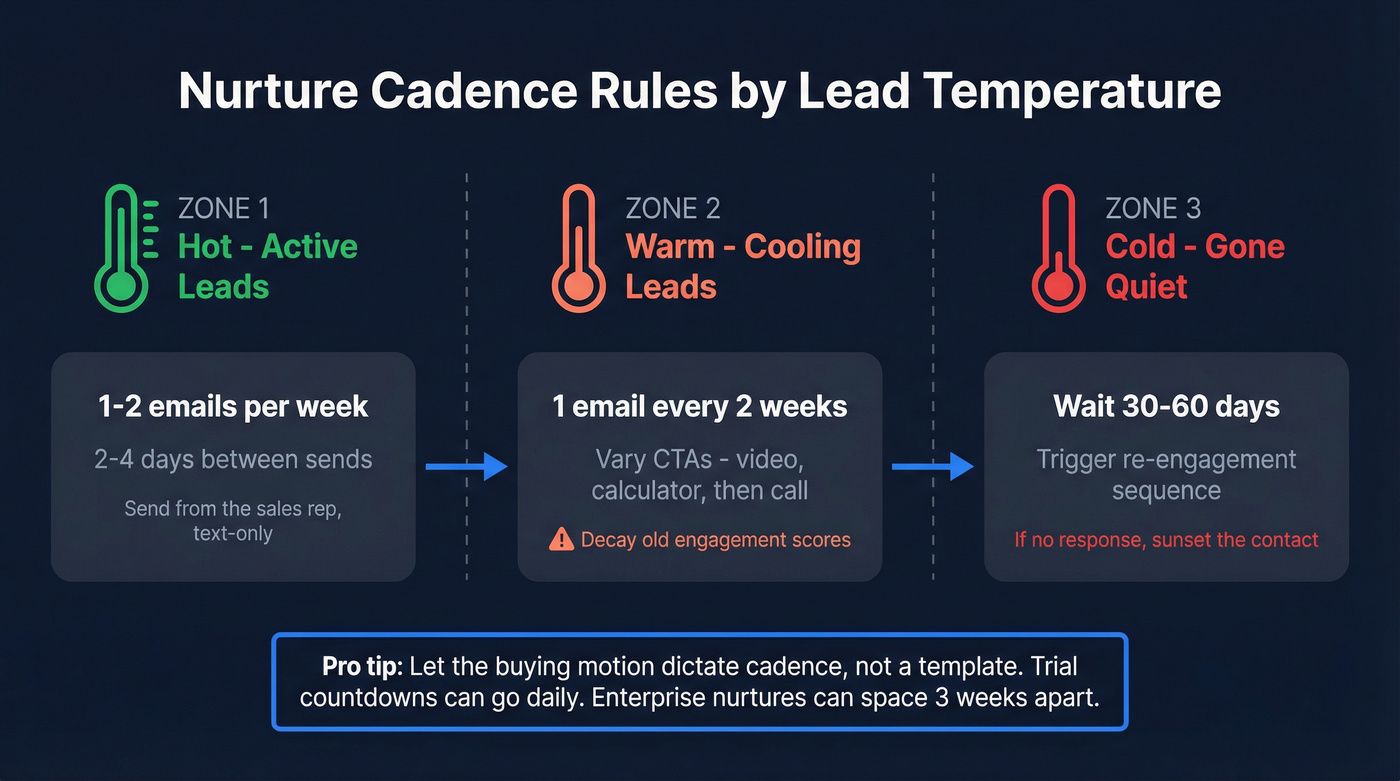
These aren't rigid rules, though. A trial countdown might send daily in the last three days. A long-cycle enterprise nurture might space emails three weeks apart. Let the buying motion dictate the cadence, not a template. Later-stage emails work best sent from the actual sales rep, text-only - personalization should deepen as leads progress through the funnel, not stay flat from first touch to close.
Here's the thing: lead-score time decay matters more than most teams realize. If someone downloaded a whitepaper eight months ago and hasn't engaged since, that activity shouldn't still inflate their qualification score. Decay old engagement signals or your sales team wastes hours chasing cold leads with artificially warm scores. We've seen this mistake tank pipeline efficiency at companies that otherwise had solid nurture flows in place. (This is also why B2B contact data decay and CRM hygiene matter more than most teams budget for.)

You just read that bounces kill deliverability faster than bad copy. Prospeo's 5-step email verification delivers 98% accuracy - so your nurture sequences actually land in inboxes, not spam folders. At $0.01 per verified email, cleaning your list costs less than one bounced send.
Stop feeding bad data into your automation. Verify before you send.
Eight Scenarios Worth Building First
HubSpot documents 16 nurture scenarios. Start with these eight:
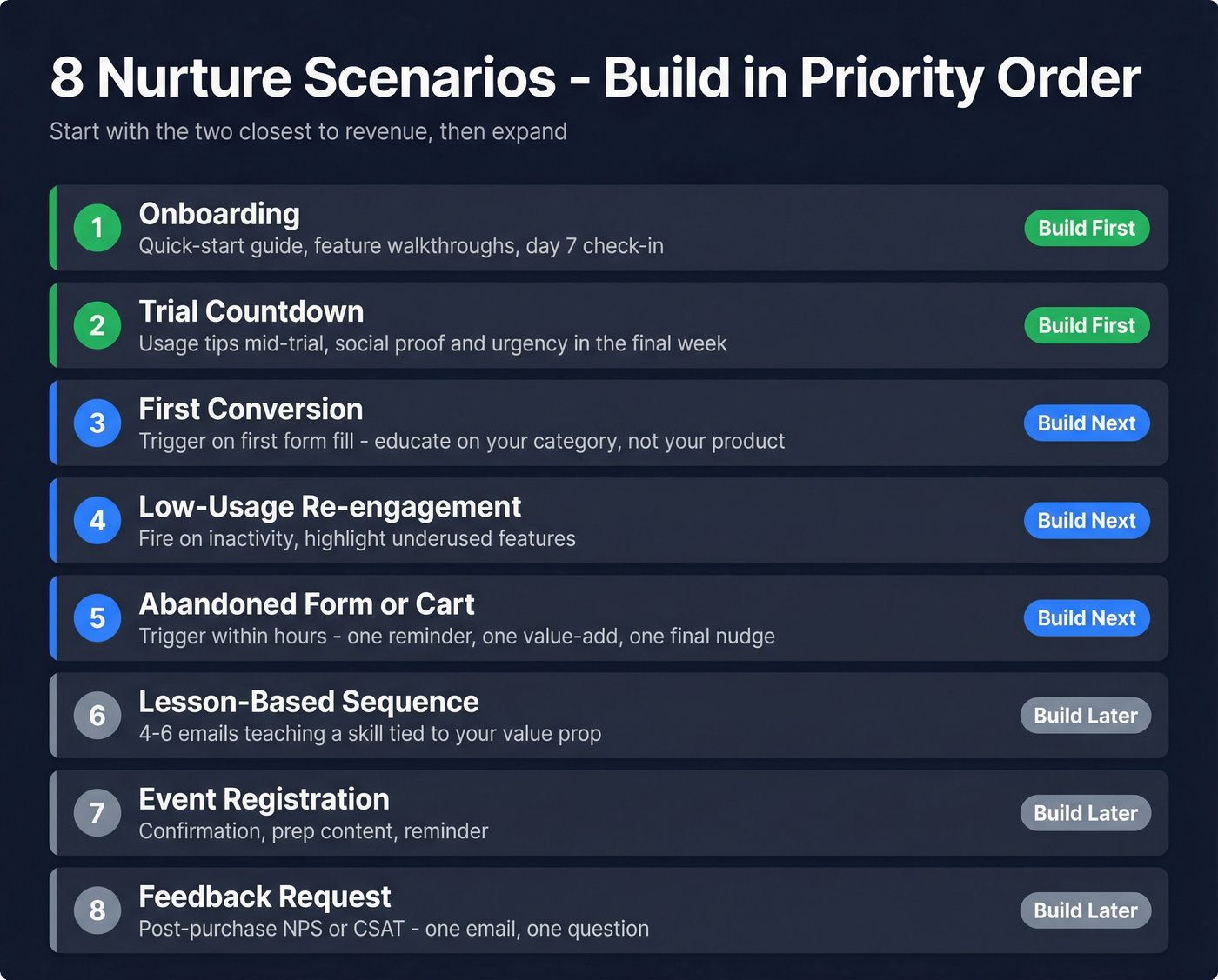
- First conversion - Trigger on first form submission. Educate on your category, not your product.
- Lesson-based sequence - 4-6 emails teaching a skill tied to your product's value prop.
- Event registration to attendance - Confirmation, prep content, reminder.
- Onboarding - Quick-start guide, feature walkthroughs, day-7 check-in.
- Low-usage re-engagement - Triggered emails that fire on inactivity and highlight underused features.
- Trial countdown - Usage tips mid-trial, social proof and urgency in the final week.
- Abandoned form/cart - Trigger within a few hours. One reminder, one value-add, one final nudge.
- Feedback request - Post-purchase NPS/CSAT. One email, one question.
Don't try to build all eight at once. Pick the two closest to revenue - usually onboarding and trial countdown - and get those running before you expand.
Mistakes That Kill Most Sequences
91% of marketers say automation is critical. Most still get these wrong:
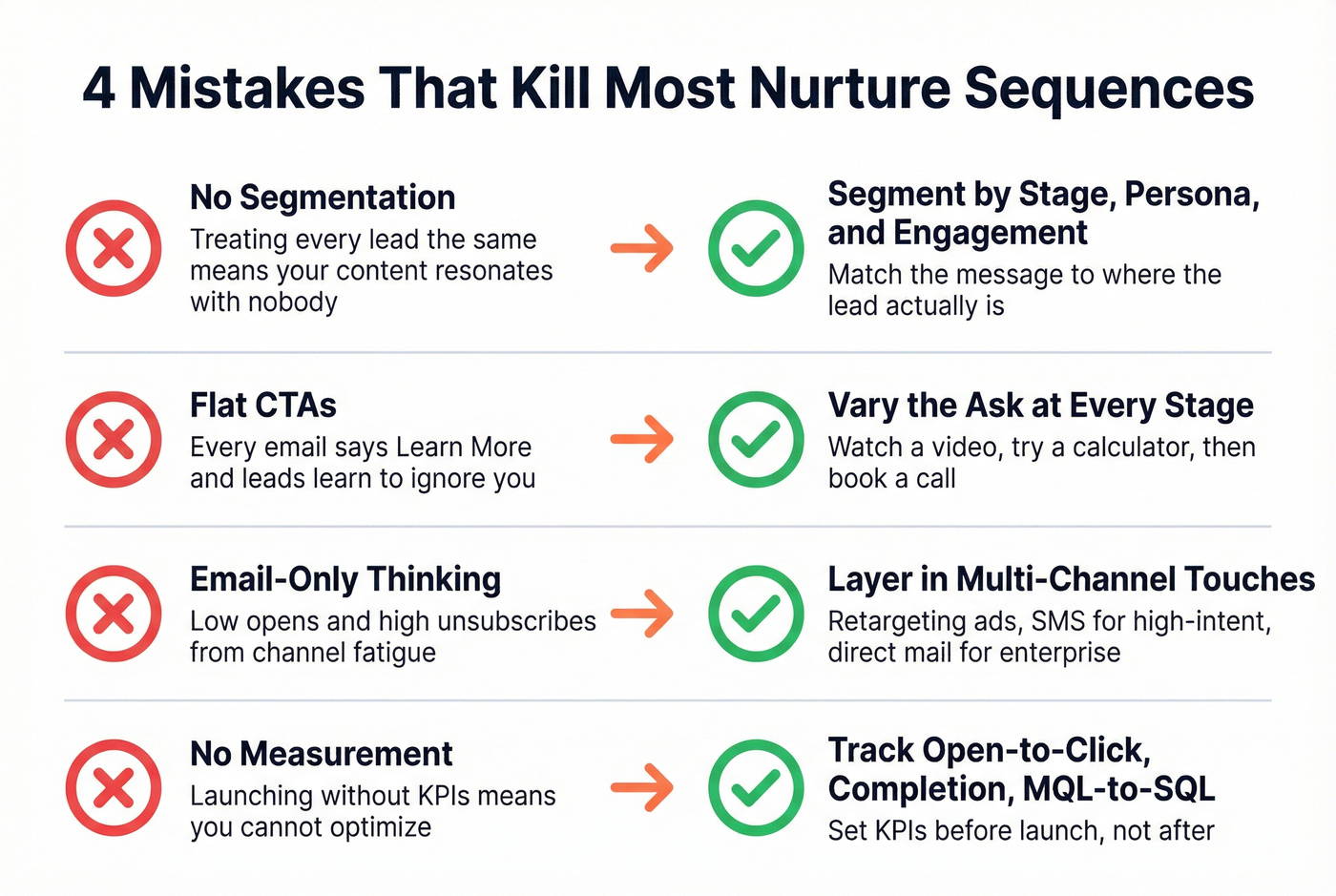
No segmentation. Treating every lead the same means your content resonates with nobody. Segment by funnel stage, persona, and engagement level at minimum. Even the best automation can't compensate for sending the wrong message to the wrong audience. (If you need a framework, start with behavioral segmentation.)
Flat CTAs. If every email says "learn more," you're training leads to ignore you. Vary the ask - watch a video, try a calculator, then book a call.
Email-only thinking. Low opens and high unsubscribes often mean you're over-relying on one channel. Layer in retargeting ads, SMS for high-intent moments, and direct mail for enterprise targets. The consensus on r/sales is that multi-channel sequences consistently outperform email-only flows, especially for deals above $25K ACV. (If you're building this out, use a B2B omnichannel marketing plan.)
No measurement. Track open-to-click ratios, sequence completion rates, and MQL-to-SQL conversion by flow. Set KPIs before you launch, not after.
Tools and Pricing
Let's be honest: you don't need a $2K/month platform. ActiveCampaign gives you 80% of HubSpot's automation at a fraction of the cost. If your average deal size is under $15K, start there and upgrade when you outgrow it. Skip Marketo entirely unless you're running enterprise-scale operations with a dedicated ops team to manage it. (If you're comparing stacks, start with sales funnel tools.)
| Tool | Best For | Starting Price | Top Tier |
|---|---|---|---|
| HubSpot | All-in-one CRM + automation | Free; paid from ~$20/mo | Enterprise ~$3,000+/mo |
| ActiveCampaign | SMBs wanting power | ~$15/mo | Varies by contacts |
| Marketo (Adobe) | Enterprise B2B | ~$1,000+/mo | ~$3,500+/mo and up |
| monday CRM | Teams on monday.com | $9/seat/mo (min 3) | Pro $19/seat/mo |
| Brevo | Budget-friendly starter | Free (300 emails/day) | ~$18+/mo by volume |
| Prospeo | Data quality + verification | Free (75 emails/mo) | ~$0.01/email |
Multi-channel nurture outperforms email-only - but you need real phone numbers. Prospeo gives you 125M+ verified mobiles with a 30% pickup rate, plus 143M+ verified emails. Layer direct dials into your high-intent sequences and watch reply rates climb.
Add verified mobiles to your nurture flows and close the multi-channel gap.
Automated Nurture Campaigns FAQ
How many emails should a nurture sequence have?
Plan for 5-10 emails at 1-2 per week during active nurture, then taper for colder leads. Shorter trials or event flows can run tighter - daily in the final stretch - while long-cycle enterprise sequences often space messages 2-3 weeks apart.
What's a good conversion rate for automated flows?
Automated flows average a 2.11% placed-order rate versus 0.16% for one-off campaigns. For B2B specifically, aim for a 10-30% improvement in MQL-to-SQL conversion compared to non-nurtured leads.
Why do nurture campaigns bounce so many emails?
How is automated nurture different from a basic drip?
A basic drip sends the same sequence to everyone on a fixed schedule. Automated nurture responds to lead behavior - page visits, email clicks, form fills - and adjusts the next message accordingly. That behavioral layer is what drives the 13x conversion gap between flows and one-off sends.