Deal Insights: What They Are & Why They Matter in 2026
Your deal scoring dashboard says the pipeline is healthy. Your rep just called a disconnected number for the third time this week. The problem isn't the insights - it's the data underneath them.
What Are Deal Insights?
Deal insights are the specific signals, scores, and recommended actions a platform surfaces about individual opportunities in your pipeline. They're the "so what" layer on top of your CRM data - instead of raw fields and timestamps, you get a health score, a risk flag, or a suggested next step.
They're distinct from deal intelligence, which is the broader strategic discipline of analyzing and managing data across deal stages to improve forecasting. Intelligence is the approach; insights are the outputs. Outreach's implementation is a solid concrete example - their model analyzes 15 activity signals across emails, calls, and meetings to produce a 0-100 Deal Health Score for each opportunity.
Why They Matter for Revenue Teams
Outreach's 2026 data analysis found that opportunities closed within 50 days have a 47% win rate. Push past that threshold and win rates drop to 20% or lower. That's not a gentle decline. It's a cliff.
Pipeline-level scoring keeps you on the right side of it. It flags stalled deals before your weekly review catches them, surfaces missing stakeholders, and spotlights opportunities where the champion went quiet two weeks ago. Teams using Outreach's Kaia feature close deals 11 days faster and see up to a 10 percentage-point win rate increase on deals over $50K. When 34% of revenue teams report sales cycles of 1-2 quarters, catching a slipping deal late isn't an inconvenience - it's a lost quarter.
How Deal Scoring Models Work
Deal insight engines ingest three categories of data: activity signals like emails sent, calls logged, and meetings booked; CRM metadata such as stage, close date, and deal size; and increasingly, conversation intelligence from call transcripts and sentiment analysis.
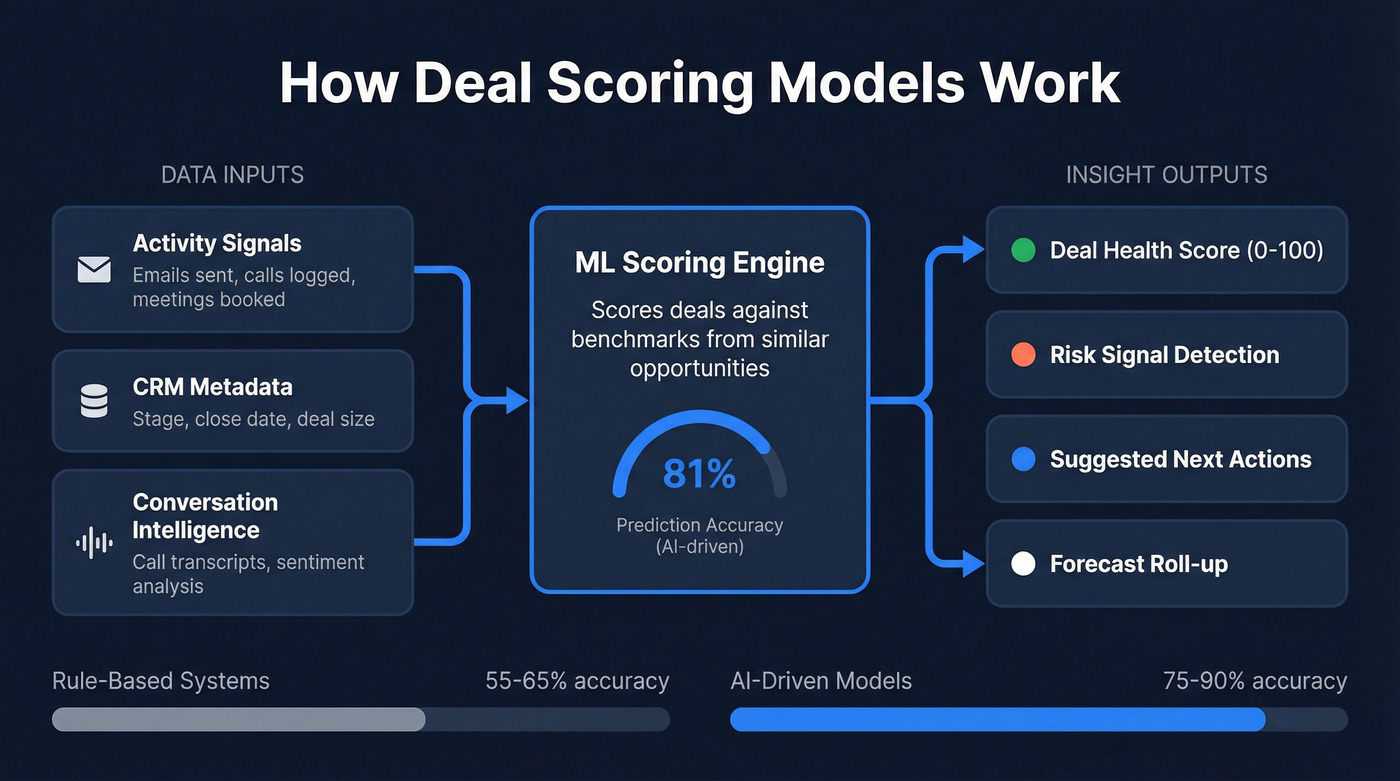
The best platforms score deals against benchmarks from similar opportunities. Outreach's ML model predicts whether a deal will close with 81% accuracy, trained on engagement patterns. That's strong - predictive scoring models typically land in the 75-90% accuracy range, while rule-based systems sit at 55-65%.
The category is shifting toward autonomous agents, and the two leading approaches look different. Outreach's Deal Agent auto-updates CRM fields based on conversation data. Highspot's Deal Agents go further, recommending specific actions like building a digital sales room with relevant content. Mutual Action Plans - another AI-driven feature - increase win rates by 26%.
Here's the thing: most teams buying revenue intelligence tools are solving the wrong problem first. Fix your stage definitions and CRM hygiene before you spend six figures on AI scoring. Clean data in a lightweight CRM will beat expensive scoring layered on top of messy inputs every single time.
Core capabilities to evaluate:
- Deal health scoring - 0-100 or equivalent
- Risk signal detection - stalled deals, missing contacts
- Suggested next actions - not just alerts, but recommendations
- Forecast roll-up - deal-level scores aggregated to pipeline view
- Conversation analysis - call and email sentiment and engagement

Deal scoring models break when contact data decays. Prospeo refreshes 300M+ profiles every 7 days - not every 6 weeks - so your CRM fields stay current and your AI models score real engagement, not phantom activity. 98% email accuracy, verified mobiles, $0.01/lead.
Stop feeding stale data into your deal health scores.
Tools That Surface Deal Insights
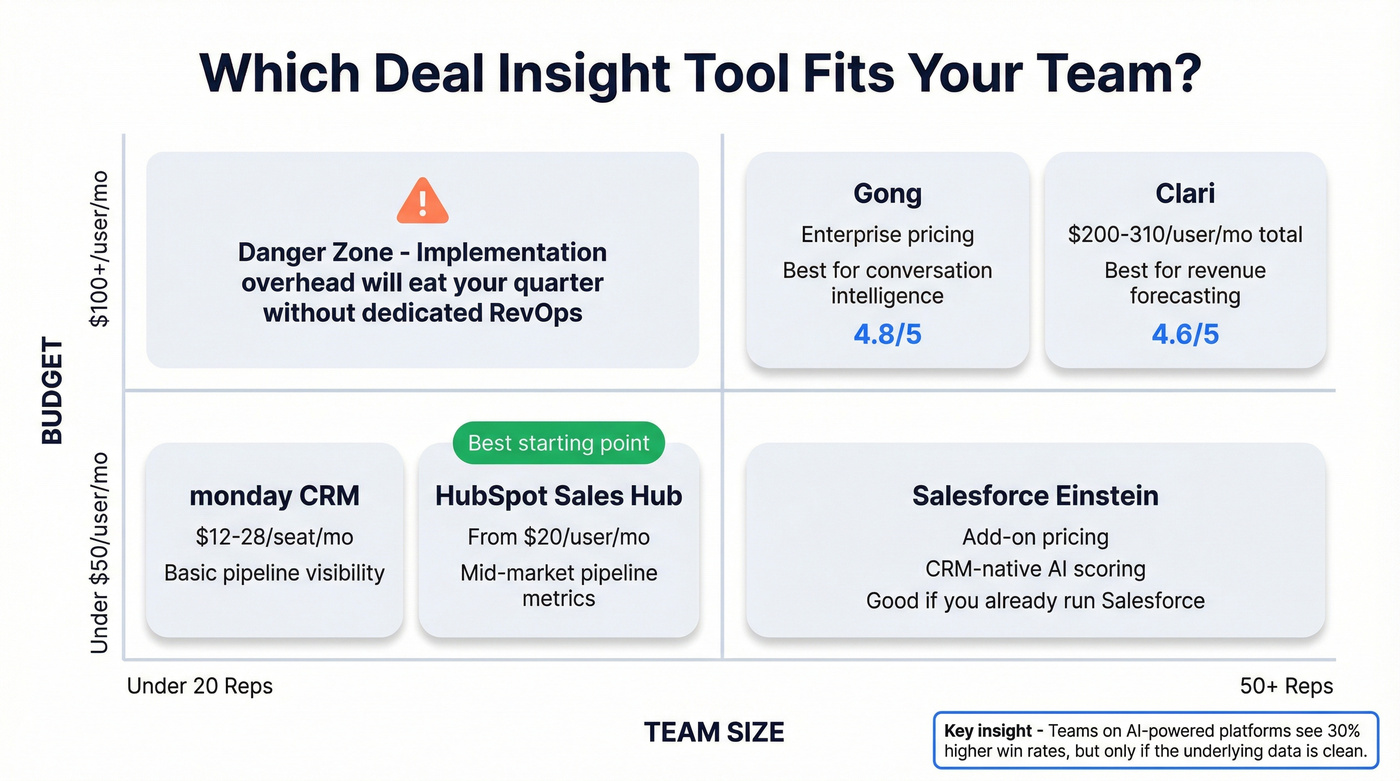
No single tool owns this category. Your choice depends on whether you need standalone revenue intelligence or scoring embedded in a platform you already use.
| Tool | Best For | G2 Rating | Starting Price |
|---|---|---|---|
| Gong | Enterprise conversation intel | 4.8/5 | Custom enterprise pricing |
| Clari | Revenue forecasting | 4.6/5 | ~$100-120/user/mo (core) |
| Outreach | Engagement + deal health | - | Custom enterprise pricing |
| Salesforce Einstein | CRM-native AI scoring | 4.4/5 | Add-on to existing plans |
| HubSpot Sales Hub | Mid-market pipeline | - | From $20/user/mo |
| monday CRM | Budget teams | - | $12-28/seat/mo |
| Jiminny | Call intel + coaching | - | Per-user pricing |
Gong and Clari are the heavyweights - Gong for conversation-driven intelligence, Clari for forecast accuracy. Gong is widely praised for call recording, search, and coaching, but it's also known for a steep learning curve and premium pricing, so budget significant onboarding time. Clari's total cost reaches $200-310/user/month once you add modules and $15K-75K in professional services fees. For teams that don't need enterprise forecasting, HubSpot's deal view metrics or monday CRM at $12/seat/month deliver basic pipeline visibility without the five-figure commitment.
Skip Gong or Clari if you're a team under 20 reps without a dedicated RevOps person. The implementation overhead alone will eat your quarter.
Teams on AI-powered sales platforms see 30% higher win rates and 25% faster cycles - but that ROI only materializes if the underlying data is clean.
Common Deal Insight Mistakes
In our experience, most failures here aren't tool failures - they're process and data failures. We've seen teams spend months evaluating scoring platforms when the real problem was that "Discovery" meant something different to every rep on the floor. Based on Mural's pipeline review research, these five kill accuracy most often:
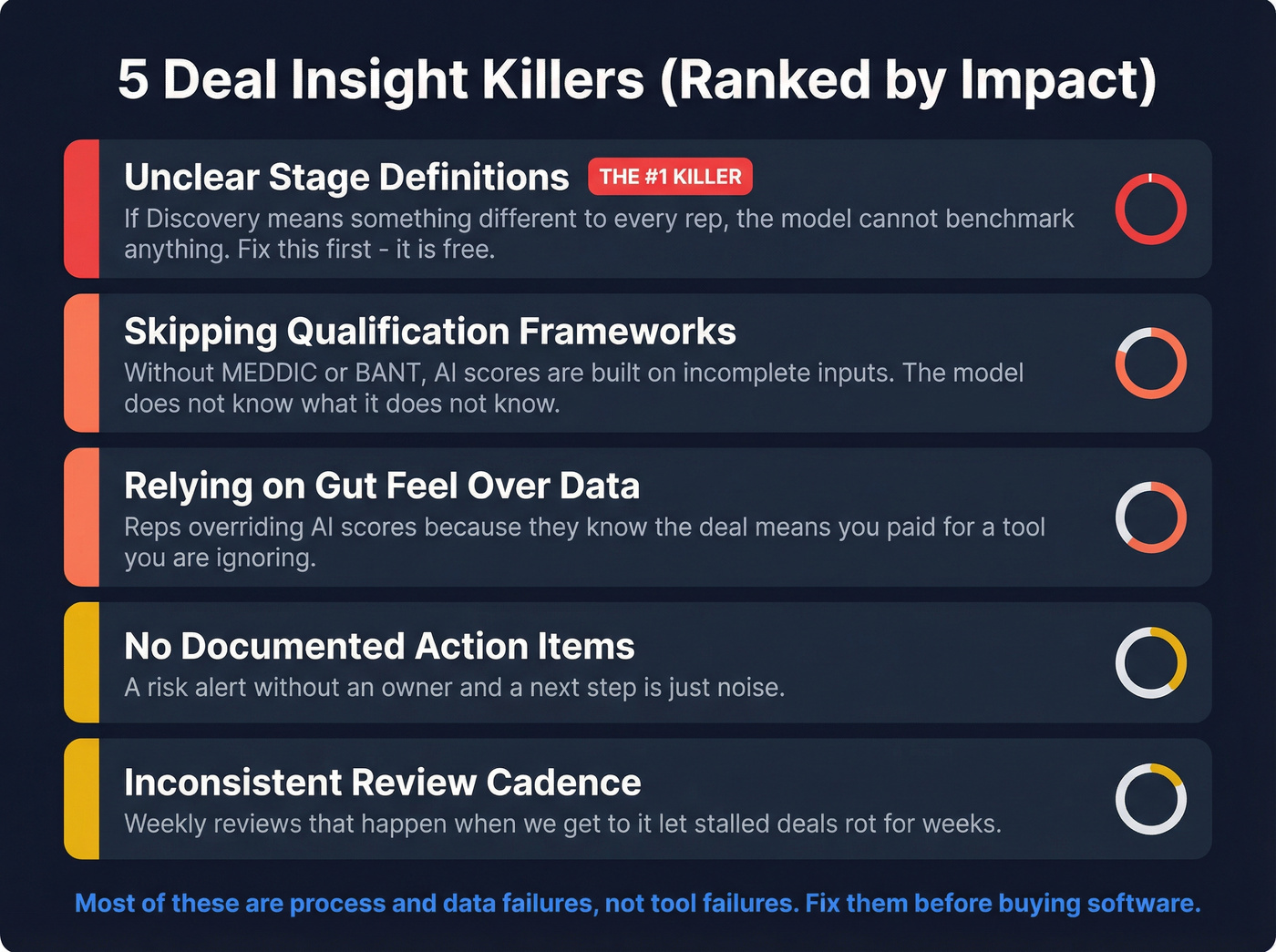
Relying on gut feel over data. Reps overriding AI scores because "they know the deal" means you've paid for a tool you're ignoring. If you aren't going to trust the model, don't buy it.
Unclear stage definitions. This is the single biggest accuracy killer. If your stages aren't standardized across the team, the model can't benchmark anything. Fix this first - it's free.
No documented action items. Every flagged deal needs an owner and a next step. A risk alert without accountability is just noise.
Inconsistent review cadence. Weekly reviews that happen "when we get to it" let stalled deals rot for weeks before anyone notices. Set the meeting, protect the time, run the dashboard.
Skipping qualification frameworks. Without MEDDIC or BANT, AI scores are built on incomplete inputs. The model doesn't know what it doesn't know.
The Data Quality Problem
Let's be honest about something the revenue intelligence vendors won't tell you: deal insights are a $50K bandage on a $500 problem if your contact data is garbage.
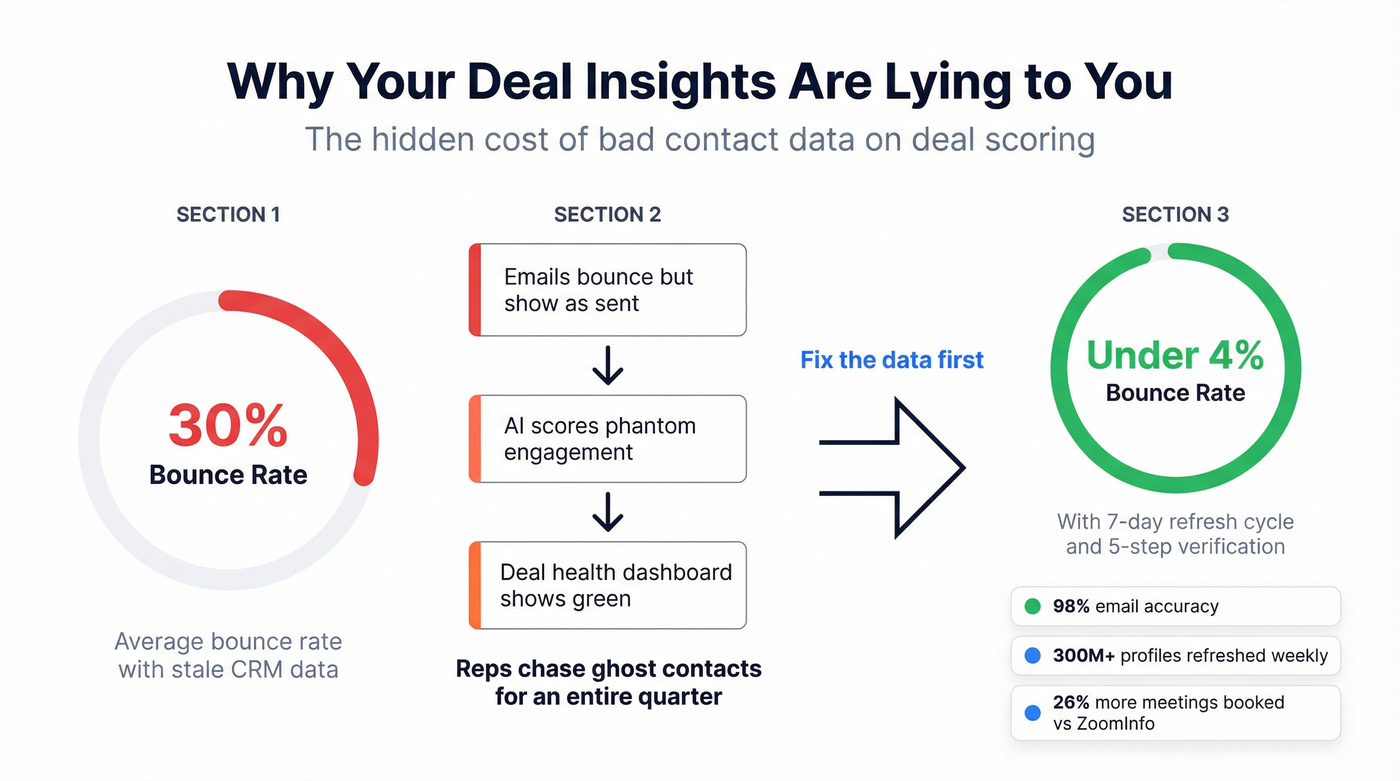
A team invests in Gong or Clari, the dashboard lights up green, and reps still can't reach the economic buyer because the phone number in Salesforce has been disconnected for six months. The AI doesn't know the difference. It sees "email sent" and scores engagement. It doesn't know that email bounced, or that the contact left the company in Q1.
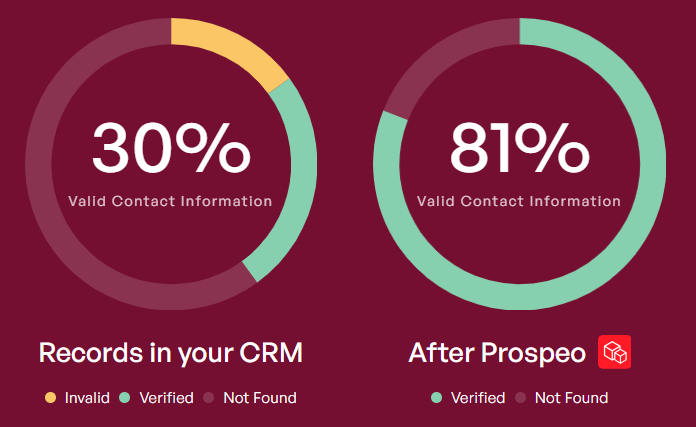
A 30% bounce rate doesn't just tank your sequences - it corrupts every downstream insight your scoring model produces. Your deal health scores are only as reliable as the contact records behind them, and we've watched teams chase phantom engagement for entire quarters before realizing the underlying data was stale.
This is where cleaning up your CRM before investing in scoring pays off immediately. Prospeo verifies emails at 98% accuracy on a 7-day refresh cycle, covering 300M+ professional profiles. When the data feeding your pipeline reflects actual delivered emails, working phone numbers, and current job titles, the AI scores mean something. Pair that enrichment layer with any tool in the table above, and you're scoring against reality instead of ghost contacts who changed jobs three months ago.
If you want to quantify the problem, start with B2B contact data decay benchmarks, then implement a repeatable CRM Verify workflow.
A 30% bounce rate doesn't just kill sequences - it corrupts every deal insight downstream. Prospeo's 5-step verification and catch-all handling keep bounce rates under 4%, so your scoring models actually reflect reality. Teams using Prospeo book 26% more meetings than ZoomInfo users.
Fix the data underneath your deal insights for $0.01 per email.
FAQ
What's the difference between deal insights and deal intelligence?
Deal intelligence is the broader discipline of analyzing data across every deal stage to improve forecasting. Deal insights are the specific outputs - scores, risk flags, and recommended actions - surfaced within that framework. Intelligence is the approach; insights are the deliverables.
Do I need AI for deal insights?
No. HubSpot and monday CRM offer rule-based deal metrics starting at $12-20/user/month. Rule-based systems typically hit 55-65% accuracy on predictive scoring, while AI-driven models land in the 75-90% range - but basic pipeline visibility and stage tracking don't require it. Start simple, upgrade when you've outgrown the basics.
What data do deal insights need to be accurate?
Clean contact records, logged activities, and consistent stage definitions. If your emails bounce at over 5% or phone numbers are stale, refresh your CRM data before investing in scoring. Without accurate underlying data, even the best AI model scores fiction.
How do deal insights improve forecasting?
Deal-level health scores roll up into pipeline-wide forecasts. When each opportunity has a data-backed probability rather than a rep's gut estimate, forecast accuracy improves dramatically. Outreach's model achieves 81% prediction accuracy - compare that to the typical 55-65% from rule-based scoring. The gap is real, but only if the inputs are clean.