How to Get Past an Executive Assistant: Scripts, Tactics, and the Shortcut Most Reps Miss
It's 2:30 PM on a Tuesday. You've made 47 dials. Zero transfers. Every call hits the same wall - a polite but immovable executive assistant who's heard your pitch template before you even finish your first sentence.
You're not bad at sales. You're just fighting the wrong battle.
If you've been wondering how to get past an executive assistant without burning bridges, you're not alone. 80-90% of outreach gets blocked before it ever reaches a decision-maker. And the advice that does exist? Most of it's written for EAs, not the salespeople trying to reach their bosses.
The Quick Version
- Fix your opener. Simple and confident beats clever. "Hey, can I talk to [name]?" works 8 out of 10 times.
- Fix your timing. Call before 8 AM or after 6 PM when the EA isn't at their desk.
The Numbers Working Against You
Before you refine a single script, understand the math.
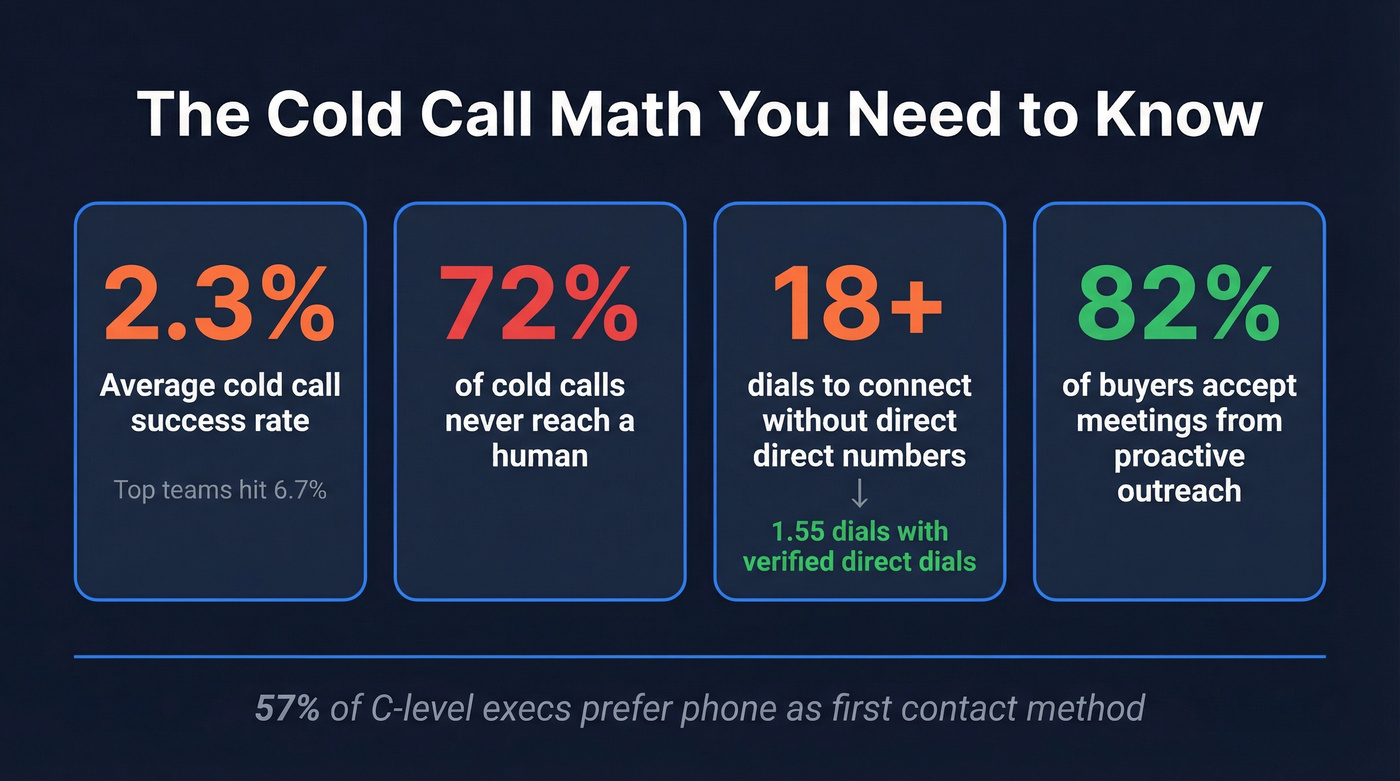
The average cold call success rate - meaning a call that results in a booked meeting - is 2.3%. Top-performing teams hit 6.7%. That's not a typo. The best teams in the world convert fewer than 7 out of 100 cold calls into meetings. (If you want the bigger picture, use this B2B cold calling guide as your baseline.)
72% of cold calls don't reach a human at all. Of the ones that do, you've got 8-30 seconds to make an impression before the gatekeeper decides whether to continue or hang up. Gong.io found that explaining why you're calling produces a 2.1x higher success rate. Every script in this article is built on that principle.
But here's the number that should change your entire strategy: without direct dials, it takes 18+ dials to connect with a single prospect. With verified direct dials, that drops to 1.55. That's not an incremental improvement - it's a completely different game. (More on sourcing numbers in this B2B phone number guide.)
So why bother with any of this? Because the demand side tells a different story. 82% of buyers say they'll accept meetings from proactive outreach, and 57% of C-level executives actually prefer phone as their first contact method. The demand is there. You just need to get through.

Without direct dials, it takes 18+ attempts to reach a single prospect. With Prospeo's 125M+ verified mobile numbers (30% pickup rate), you connect in 1.55 dials - no gatekeeper, no script gymnastics, no wasted afternoons.
Stop rehearsing gatekeeper scripts. Start dialing decision-makers directly.
Why Executive Assistants Block You (From Their Side of the Desk)
Here's the thing most sales training gets wrong: EAs aren't obstacles. They're professionals doing a job, and that job is protecting their executive's time from exactly the kind of interruption you represent.
One cold caller posted on r/AdminAssistant asking EAs for advice on how to stand out from spammers. The framing tells you everything: EAs are "very used to spammers trying to bother or trick their boss" and they lump all callers together. You're not being evaluated as an individual. You're being evaluated as a category - and that category has a terrible reputation. (This is also why pre-call research matters more than most reps think.)
The Two Mistakes That Get You Blocked Instantly
Sales trainer Michael Pedone at SalesBuzz nails the framework. Reps make one of two mistakes:

Saying too little. The evasive approach - dodging questions about why you're calling, being vague, trying to sound mysterious. This raises every red flag the EA has. They ask more questions. You squirm more. Call over.
Saying too much. The over-explain approach - launching into your full pitch to the EA, giving them enough information to make a decision on behalf of their boss. That's a decision that isn't theirs to make, but you just handed them the power to make it anyway. (If you catch yourself doing this, it’s often plain feature dumping.)
The sweet spot is neither.
The Chief-of-Staff Factor
At companies with $50M+ in revenue, you're increasingly not dealing with a traditional receptionist. You're dealing with a senior executive assistant or chief of staff who understands the executive's objectives, current initiatives, and political landscape. These people are sharp. They've been briefed on priorities. They can smell a cold call from the first syllable.
At smaller companies, the gatekeeper might be an office manager or the founder's "right hand" who wears multiple hats. Different person, same instinct: protect the boss's calendar.
Three Behaviors EAs Hate
EAs talk to each other. And they remember.
- Lying about returning a call. EAs check. Always.
- Claiming a personal relationship. If it were true, you'd have their direct number.
- Being rude to the EA. The EA controls access. Disrespect them and you're done - not just for this call, but permanently.
The Mindset Shift That Changes Everything
Stop thinking of the EA as a wall to get around. Start thinking of them as a curator of the executive's time, an insider with context about what matters right now, and a potential champion who can internally endorse you.
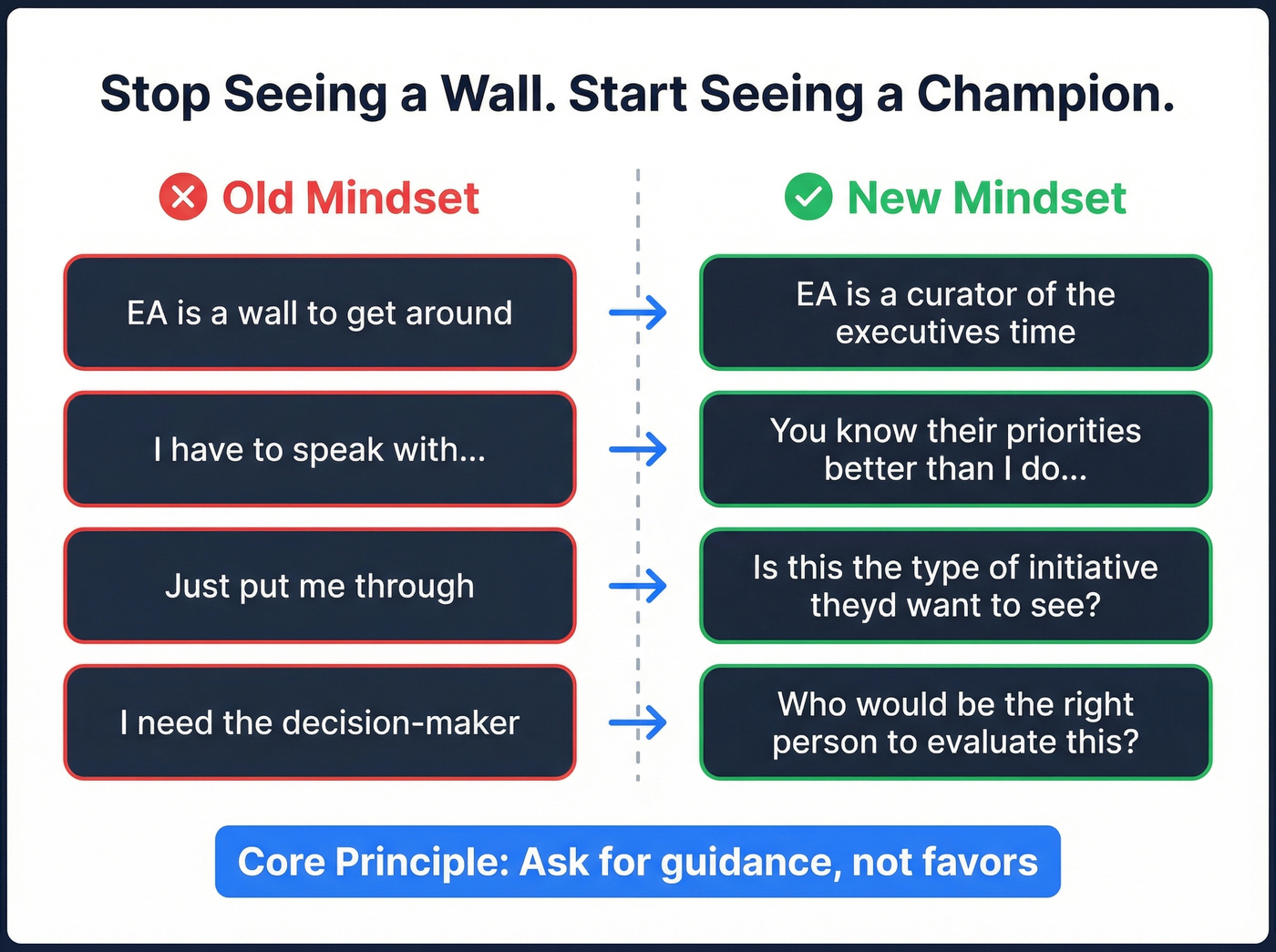
This isn't just feel-good advice. It changes your language. (If you’re mapping who influences the deal, this ties directly to how B2B decision making actually works.)
| Instead of This | Say This |
|---|---|
| "I have to speak with..." | "You know [VP]'s priorities better than I do..." |
| "Just put me through" | "Is this the type of initiative they'd want to see?" |
| "I need to talk to the decision-maker" | "Who would be the right person to evaluate this?" |
| Demanding access | "Would [name] want me to loop in someone on their team?" |
The core principle: ask for guidance, not favors. When you say "You know [VP of Sales]'s priorities better than I do - in your experience, is this the type of initiative they'd want to see?" you're acknowledging the EA's expertise and giving them a role in the process. That's fundamentally different from trying to sneak past them.
Proven Tactics for Navigating Gatekeepers
Be Simple and Confident
The most upvoted advice on r/sales for getting past gatekeepers? Just say "Hey, can I talk to [name]?"
One practitioner reported this works 8 out of 10 times. Don't mention your company name immediately - it signals you're a salesperson. Confidence and brevity trigger a different response than a polished pitch. The EA's brain categorizes you as "someone who knows this person" rather than "someone trying to sell something."
The reps who struggle most with gatekeepers are the ones who overthink the opener. (If you want more variations, pull from these sales pitch opening lines.)
Lead with Problems, Not Products
This is the SalesBuzz framework, and it's brilliant in its simplicity. Instead of mentioning your product, mention the top 3 problems you solve.
"Hi, I'm [name]. I have an idea on how to help [executive] avoid [specific problem]. Would they be the right person to discuss that with?"
It's hard for an EA to say their boss isn't interested in solving a problem. They can easily say their boss doesn't need your software. See the difference? You're not asking the EA to evaluate your product. You're asking them to confirm that their boss cares about a business outcome - which of course they do.
The key is specificity. "Improve efficiency" is too vague. "Reduce their SDR team's ramp time from 8 weeks to 4" gives the EA something concrete to relay.
Ask for Guidance, Not Access
"I know you're the one making sure [Executive]'s time is protected. You know their priorities better than I do. In your experience, is this the type of initiative they'd want to evaluate?"
You're doing three things at once: acknowledging the EA's role, demonstrating that you understand organizational dynamics, and asking a question they can answer without feeling manipulated. Most EAs will either transfer you or tell you the right person to reach. Both are wins. (If you need more language options, see how to ask for the right contact person.)
Use Trigger Events as Your Opening
Not every opening needs a script. Sometimes a bullet list of trigger events is more useful than a blockquote you'll forget mid-call:
- Funding rounds - "I noticed [company] just closed their Series C. We've helped three other companies at that stage solve [specific scaling problem]."
- Leadership hires - New VPs have 90-day mandates and open calendars. They're actively looking for solutions.
- Office expansions or layoffs - Both signal operational change and budget reallocation.
- Regulatory changes - Compliance deadlines create urgency that EAs recognize as legitimate.
- Earnings misses - Public companies under pressure are more receptive to cost-saving or revenue-generating pitches.
Speak the executive's KPIs, not your features. "Revenue growth" beats "our platform." (If you want a tighter system for this, build around buying signals.)
Make Role-Based Requests
Here's a subtle but powerful shift:
| Name-Based Request | Role-Based Request |
|---|---|
| "Can I speak with John Smith?" | "Who owns outbound systems for your SDR team?" |
| Triggers defensiveness | Triggers helpfulness |
| Sounds like you're targeting someone | Sounds like you're finding the right person |
| EA becomes gatekeeper | EA becomes guide |
Role-based requests work especially well when you genuinely don't know who the right contact is. The EA becomes your ally rather than your adversary.
Call During Off-Peak Hours
The EA's shift is typically 9-5. The executive's isn't.

| Time Slot | Why It Works |
|---|---|
| Before 8 AM | Executive often picks up their own phone |
| 11 AM-12 PM, Wed-Thu | Highest mid-day connect rates |
| 4-5 PM, Wed-Thu | EA winding down, executive still working |
| After 6 PM | No gatekeeper on duty |
| Monday AM / Friday PM | Dead zones - avoid these |
Saturday mid-morning works for some high-value targets. A startup CEO might answer. A Fortune 500 CFO won't. Know your audience. (If you’re considering weekends, read cold calling on weekends first.)
If you're making all your calls between 10 AM and 3 PM on weekdays, you're calling during peak gatekeeper hours. That's not a minor detail - it's the reason your connect rate is in the gutter.
Build the EA Into Your Champion
This isn't a one-call play. It's a multi-touchpoint approach over days or weeks.
Research the EA on professional networks before calling. Learn their name. On the first call, be brief and respectful. On the second, reference your previous conversation. By the third, you've built enough familiarity that the EA starts advocating for you internally.
Minimize perceived risk ("I only need 10 minutes"), share what's at stake ("companies in their space are losing $X to this problem"), and always make the EA look good for connecting you.
Deploy Multi-Channel Sequences
Real talk: if you're only cold calling, you're leaving half your meetings on the table. Prospects contacted through 3+ channels respond at 2x the rate of single-channel outreach. The phone is your strongest weapon, but it needs air support. (This is a core theme in sales sequence best practices.)

Here's a sequence that works:
- Day 1: Personalized email - specific subject line, 4-6 sentences max, low-commitment CTA.
- Day 3: Connection request on professional networks. Keep it under 300 characters, lead with a specific content compliment or mutual connection. Generic requests get ignored by 95% of senior executives.
- Day 5: Call the assistant with context: "I sent [executive] some data on [topic] earlier this week..."
- Day 7: Direct executive call, ideally off-peak hours.
Mid-week mornings - Tuesday through Thursday, 8-10 AM - generate 40% more responses than other time slots. A typical CEO gets 120-150 emails per day, so your subject line needs to be specific, not clever. "Q4 treasury optimization data" beats "Quick question" every time. (For more patterns, see cold email subject lines that get opened.)
Use the Referral Play
Mentioning a mutual connection increases your chances of booking a meeting by 70%.
That's the single highest-leverage tactic on this list - and most reps underuse it. Referral leads convert 30% better than other channels with 16% higher lifetime value.
"Our mutual colleague, [name], suggested I reach out. We've seen great results with [solution] and they thought [executive] might find it relevant."
If you don't have a direct referral, look for shared connections, shared investors, shared board members, or even shared conference attendance. Anything that moves you from "stranger" to "someone adjacent to my network."
Send a Pre-Call Email or SMS
A brief SMS or email before calling reduces suspicion. When the EA or executive sees your name on caller ID and thinks "oh, that person who emailed me," you've already cleared the first trust hurdle.
Keep it short: "Sending a quick note before I call tomorrow - wanted to share some data on [specific topic] that's relevant to [company]'s [initiative]."
Word-for-Word Scripts for Every Gatekeeper Objection
These scripts come from SalesScripter, and they're the best objection responses I've seen for gatekeeper conversations. Each one follows the same principle: don't give the EA what they need to shut you down.
"What Is This in Regards To?"
Wrong response: "I'm calling to introduce our product..." or being evasive and dodging the question.
Right response: "The purpose for my call is that we help [role] to [specific outcome]. I wanted to see if that's something [executive] would want to explore."
Leading with anything that signals "salesperson" gives the EA exactly what they need to end the call. Leading with an outcome keeps the door open.
"We're Not Interested"
Wrong response: "Okay, sorry to bother you."
Right response: "I understand. If I could ask you real quick - how confident are you that [relevant area, e.g., your outbound pipeline] is where it needs to be heading into next quarter?"
You're redirecting to a qualifying question that reframes the conversation. The EA either engages with the question (which means you're still talking) or transfers you to someone who can answer it.
"We Already Use Someone for That"
Wrong response: "We're better than them."
Right response: "That's great to hear. How long have you been using them? How is everything going? What are some things that could be better?"
You're positioned as curious, not competitive. These questions surface pain points that the EA might not even realize are relevant - and they often lead to "you should probably talk to [executive] about that."
"Just Send Me Your Information"
Wrong response: "Sure, what's your email?" (Call ends. Information goes to trash.)
Right response: "I can certainly do that. So that I know exactly what to send you, do you mind if I ask - what's your current approach to [relevant area]?"
You appear cooperative while keeping the conversation alive. The qualifying question gives you intel regardless of whether you ever get the meeting.
The Complete Call Flow (Gatekeeper to Prospect)
Here's the full walkthrough, step by step:
Step 1 - Gatekeeper picks up. "Hi, I'm trying to reach the director of HR. Can you point me in the right direction?"
Step 2 - Gatekeeper asks what it's about. "We help HR departments improve their ability to meet federal compliance requirements. I wanted to see if that's something [name] would want to explore."
Step 3 - Transfer happens. Prospect picks up. Don't say "How are you?" - it's a dead giveaway. Instead: "Have I caught you in the middle of anything?"
Step 4 - Deliver your purpose statement. "The reason I'm calling is that we help [role] to [specific outcome]. I wanted to see if that's something worth a quick conversation."
Step 5 - Ask a qualifying question. "How are you currently handling [relevant area]?" or "What's your biggest challenge with [topic] heading into next quarter?"
One critical detail: asking "Is this a bad time?" actually decreases your meeting chances by 40%. "Have I caught you in the middle of anything?" accomplishes the same politeness without the negative framing.
Skip the Gatekeeper Entirely: The Direct Dial Strategy
Every tactic above works. But the highest-leverage move isn't getting better at navigating gatekeepers - it's never having to talk to one in the first place.
With verified direct dials, it takes 1.55 attempts to connect with a prospect. Without them, 18+. Sales reps who connect with decision-makers directly are 147% more likely to close deals. And mobile numbers outperform company direct dials because they reach prospects who are working remotely - which, in 2026, is most of them.
Here's what most teams don't account for: B2B data decays 22.5% annually. That means roughly a quarter of your contact database is wrong right now. Sales reps lose 27.3% of their time to bad contact data. You're not just fighting gatekeepers - you're fighting data rot. (If you want the benchmarks and fixes, start with B2B contact data decay.)
Prospeo's database covers 300M+ professional profiles with 125M+ verified mobile numbers, and those numbers hit a 30% pickup rate - roughly 2.5x what you'll get from ZoomInfo or Apollo mobiles. Email accuracy sits at 98%, so your pre-call emails actually land. The data refreshes every 7 days, not every 6 weeks like most providers. That means you're calling with current titles, current companies, and current numbers.
We've seen teams completely transform their pipeline with this approach. One agency using Prospeo's verified mobiles tripled their pipeline from $100K to $300K/week and cut bounce rates from 35% to under 4%.
The workflow is straightforward: search by role, company size, industry, or any of 30+ filters. Export verified contacts. Push them straight to your sequencer - native integrations with Salesforce, HubSpot, Smartlead, Instantly, Lemlist, and more. You can start free with 75 emails and 100 extension credits per month, no credit card required.
For context on cost: Prospeo runs about $0.01 per email. A mid-market ZoomInfo contract runs $15-40K/year. If your primary goal is reaching decision-makers with accurate contact data, the math isn't close.
What Gets You Permanently Blacklisted
The behaviors from the EA section deserve a deeper look - because the consequences go beyond one failed call.
Lying about returning a call. "I'm returning [executive]'s call" is the oldest trick in the book, and every EA has heard it a thousand times. They check. When you're caught - and you will be - you've confirmed that you're exactly the kind of caller they're trained to block. Your number gets flagged. Your company name gets added to a block list. Other EAs in the same industry hear about it.
Claiming a personal relationship. "Oh, [executive] and I spoke at the conference last month." If that were true, you'd have their cell. EAs know this. The lie doesn't just fail - it poisons every future interaction with that company.
Being rude to the EA. Sighing, talking over them, using a condescending tone, or saying "just put me through." The EA controls access to the person you need. Disrespect them and you're done permanently.
Here's what ties all three together: bad data makes you sound like a spammer even when you're not. Calling with the wrong name, wrong title, or asking for someone who left the company six months ago instantly marks you as someone who doesn't belong on the line. Weekly data refreshes mean you're calling with current titles and current companies - not last quarter's org chart. (If you're trying to operationalize this, use a BDR contact data QA workflow.)
The best gatekeeper strategy? Never hit one. Prospeo's 300M+ profiles with 98% email accuracy and verified direct dials let you reach C-level execs on their personal lines - for $0.01 per lead.
Bypass every executive assistant with data that connects you straight to the buyer.
FAQ
What percentage of cold calls get blocked by executive assistants?
80-90% of outreach gets blocked by executive assistants before reaching the decision-maker, and only 28% of cold calls reach a live human. Top performers overcome this with multi-channel sequences, verified direct dials, and scripts that lead with business problems rather than product pitches.
What's the best time to cold call past an executive assistant?
Call before 8 AM or after 6 PM - the EA typically works 9-5, but the executive doesn't. During business hours, Wednesday and Thursday between 11 AM-12 PM and 4-5 PM see the highest connect rates. Avoid Monday mornings and Friday afternoons entirely.
Does cold calling executives still work in 2026?
Yes. 69% of buyers accepted at least one cold call last year, and 57% of C-level executives prefer phone as their first contact method. The average success rate is 2.3%, but top teams hit 6.7% by combining verified data, structured scripts, and multi-channel sequences.
How do I find an executive's direct phone number without going through a gatekeeper?
Use a B2B data platform with verified mobile numbers. With direct dials, it takes 1.55 attempts to connect versus 18+ through a switchboard, making it the fastest way to bypass gatekeepers entirely.
Should I be honest with the gatekeeper about why I'm calling?
Yes, but strategically. Don't say "I'm selling software" - say "We help [role] solve [specific problem]." Leading with problems you solve is harder for a gatekeeper to dismiss than leading with your product name. The worst approach is being evasive, which raises every red flag the EA has.