Feature Dumping: Definition, Examples, and a Repeatable Fix
You're 8 minutes into a "quick demo" and you've already shown five tabs, three settings menus, and a dashboard the buyer didn't ask for. They're still polite, but their camera's off now, and you can feel yourself speeding up.
That's feature dumping. It's not a "bad rep" problem. It's a broken call structure problem, and it's almost always a symptom of unclear outcomes, weak check-ins, and an unplanned proof flow.
Here's the in-the-moment fix you can use mid-sentence:
PCP: Pause -> Check-in -> Prove. Pause for 3 seconds, ask one steering question, then prove one outcome (not ten capabilities).
What you need (quick version)
- Use PCP on every call: Pause -> Check-in -> Prove (one outcome, one proof flow).
- Aim for Gong's call analysis benchmark: 43% talk / 57% listen on discovery. If you're talking more than you're listening, you're filling space with features.
- Watch the "consistency swing": low performers swing talk time by about 10% (around 54% talk in won vs 64% in lost). If your talk time whipsaws deal-to-deal, you're improvising.
- Use the 2-minute check-in rule: if you talk >2 minutes without a check-in question, you've left the conversation.
- Start with one primary outcome, not ten capabilities: open with a single result the buyer cares about, then show only what proves it.
- Replace "more info" with "better questions": every time you feel the urge to explain, ask: "Compared to what?" or "What are you imagining right now?"
- Hard stance: if your first demo is over 20 minutes, you're likely dumping. Cut it.
- Run a simple loop: Tell (pain) -> Show (proof) -> Tell (impact). Repeat 2-3 times max.
- Coach with numbers, not vibes: track talk/listen, longest monologue, and # of buyer questions asked.
- Upstream fix: relevance starts before the call. Better targeting and fresher contact data reduces "generic meetings" that trigger rambling demos.

Feature dumping (and what it's not)
Gong's definition is the cleanest: feature dumping is when you describe your product's generic features and benefits at length, hoping something sticks. That "hoping something sticks" part is the tell. You're not leading, you're fishing.
It often sounds like confidence ("Let me show you what we can do"), but it's usually anxiety dressed up as enthusiasm. The rep doesn't know what matters yet, so they show everything, which is exactly what happens when discovery doesn't produce a clear problem statement and a short list of evaluation criteria.
What it's not:
- Being detailed. Great sellers go deep after they've mapped the buyer's problem to a specific workflow and metric.
- A structured walkthrough for a high-intent buyer. You can be feature-forward and still disciplined if you're proving a short list of requirements.
Two related traps to watch:
- Benefit dumping: listing outcomes without a believable "how." Example: "You'll save time, increase productivity, reduce churn..." (then you never connect it to a mechanism).
- Solution dumping: prescribing an architecture or process before diagnosing. Example: "You need to centralize everything in our platform and rebuild your routing," before you've confirmed their current workflow, constraints, or success criteria.
A tight pitch ladders Feature -> Advantage -> Benefit, but only for the 2-3 things that matter.
Where it shows up: outbound, discovery, demo, technical deep dive
- Outbound: you rattle off "what we do" instead of a pointed hypothesis.
- Discovery: you answer your own questions with mini-pitches.
- Demo: you run the tab-by-tab tour instead of proving one workflow.
- Technical deep dive: you drown the room in configuration options before confirming requirements.
The "are you feature dumping?" diagnostic (observable signals)
If you're not sure whether you're dumping, don't overthink it. Look for observable signals. It's behavioral, which means it's coachable.
Two dead giveaways: talking for >2 minutes without a check-in and the dreaded tab-by-tab harbor tour (clicking every menu like you're showing someone around a new apartment). These two behaviors usually show up together: long monologues followed by frantic clicking.
I've watched reps "feel" consultative while they narrate the UI for 12 minutes straight.
The buyer isn't learning. They're enduring.
10 signals
Mark a point for each one you did in the last week:

- You spoke >2 minutes without asking a check-in question.
- You answered a buyer question... then kept talking after you'd answered it.
- You switched features rapidly ("Also we have... and also... and also...") without tying back to a goal.
- You showed a dashboard before confirming what they measure today.
- You heard "That's interesting" and treated it like an invitation to explain more.
- The buyer went quiet (camera off, short replies), and you filled the silence with more features.
- You used generic phrases: "end-to-end," "single pane of glass," "powerful."
- You demoed admin settings to a user persona (or vice versa).
- You ran out of time before next steps because you "wanted to show one more thing."
- You left the call without a crisp problem statement in the buyer's words.
Hard stance: if you can't write the buyer's problem statement in one sentence, don't demo. Do discovery until you can.
Quick self-audit: "Mark 1 point each; 3+ = you're dumping"
Score it fast: 0-2 points = you're mostly fine. 3+ points = you're feature dumping.
Don't make it a moral thing. Make it a system thing: fix the call structure, fix the prompts, fix the demo plan.

Feature dumping starts before the call - with bad targeting. When you book meetings with loosely-matched leads, you compensate by showing everything. Prospeo's 30+ filters (intent data, technographics, headcount growth) mean you walk into every call knowing exactly what matters to that buyer.
Better data kills generic demos. Start with 100 free credits.
Why feature dumping happens (it's a process failure, not a personality flaw)
Stage mismatch ("just show me the product" is often earned)
- Cause: you run full discovery when the buyer wants fast proof.
- What it triggers: impatience -> you rush -> you start showing "everything."
- Do this instead: ask, "What are you hoping to achieve with a solution like this?" then demo only the workflow that supports that outcome.

Qualification-too-early (MEDDICC as discovery) triggers dumping
- Cause: you treat qualification frameworks like a first-call script.
- What it triggers: buyer resistance -> you over-explain to justify the meeting.
- Do this instead: do needs analysis first. SPIN basics still work: situation -> problem -> impact -> desired outcome, then qualify.
Corporate Visions found that when sellers jump straight to qualification, they misalign with buyers 54.5% of the time, and in lost deals, misalignment hits 77%. They also found problem-statement alignment lifts win rates by 68%.
That's the job on call one.
Single-thread pressure (you pitch harder to the one person you have)
- Cause: you've only got one contact, so you're trying to turn them into a champion on the spot.
- What it triggers: longer monologues, more "just in case" features.
- Do this instead: multi-thread early (economic + technical + user) so you're not selling through one overwhelmed person.
"Throw spaghetti at the wall" behavior
- Cause: you don't have a feedback loop (no check-ins, no steering questions).
- What it triggers: a spiral where lukewarm reactions lead to more features, faster.
- Do this instead: run PCP: pause, ask a check-in, then prove one thing.
Look, you don't need a viral stat to fix this. You need a call plan and a couple of guardrails that force you to stay in the buyer's world.
Metrics that stop feature dumping (what "good" looks like)
If you want it to stop, you need numbers your team can coach to. Otherwise you'll keep giving vague feedback like "be more consultative," and nothing changes.
Gong's conversation-science approach is why talk/listen and monologue length are worth treating like real performance inputs: calls are recorded, transcribed, and mapped to outcomes via B2B sales pipeline management records, so you can coach behavior instead of arguing about style.
Baseline targets:
- Discovery: 43% talk / 57% listen
- Demo: more talk-heavy, but still controlled
CloudTalk's practitioner guidance adds a useful reminder: different call types naturally skew differently. Use Gong as the anchor; use CloudTalk as a sanity check.
Benchmark table: talk/listen targets + dumping thresholds
| Call type | Target talk/listen | Dumping risk threshold | What to do if you're over |
|---|---|---|---|
| Discovery | 43 / 57 | >50% talk | Ask 2 "why now?" questions, then recap the problem in their words |
| Demo | 60 / 40 | >70% talk | Cut to 2 proof flows; park everything else for follow-up |
| Renewal/negotiation | 50 / 50 | >60% talk | Pause, summarize options, ask them to choose what to evaluate first |

The "2-minute monologue rule" as an in-call alarm
If you've talked for two minutes without a check-in, you're not in a conversation anymore.
Your check-in doesn't need to be clever. It needs to force a reaction: "Is this the part you care about, or should I skip to the other workflow?"
Coaching moves by metric (what managers should actually do)
- Talk% too high: stop the rep mid-review and ask them to rewrite the last 60 seconds as two questions + one recap. Then re-run the segment.
- Monologue >2:00: require a visible check-in every slide or every workflow step ("Is this relevant?" / "Should I keep going?").
- No mapped proof moments: no demo until the rep submits a 1-page feature map (3 pains -> 3 proof moments -> 3 features).
- Buyer asked zero questions: add a comparison prompt ("Compared to what?") and an imagination prompt ("What are you imagining right now?") to the default script.
Simple scorecard for call reviews (3 criteria max)
Keep it usable. Three criteria:

- Longest rep monologue (goal: <2:00 on discovery)
- Talk/listen ratio (goal: hit the table targets)
- Mapped proof moments (goal: 2-3 moments tied to stated pains)
I've run call review programs where we tried to score 12 things. Everyone stopped using it by week two.
Three metrics actually stick.
Scripts for the three most common dumping triggers
These are the moments where otherwise-good reps start rambling. You don't need better willpower. You need default lines you can fall back on.
Two "prospect voice" lines you'll recognize:
- "Just show me what you've got, I'll ask questions later."
- "Can you send a deck? We're just looking around."
Use PCP anyway: pause, check-in, prove.
When they open with "Just show me the product" (15-second talk track + 1 question)
15-second talk track: "Totally. I can show it. I just don't want to guess which parts matter and waste your time."
One steering question: "What are you hoping to achieve with a solution like this?"
If they answer broadly ("speed up outbound"), follow with: "Walk me through the current workflow." Then demo only the workflow that changes that outcome.
When the room goes silent (how to pause + the exact recovery line)
Silence is where the ramble starts. Reps interpret silence as failure and start "adding value" with more screens.
Do this instead:
- Pause for 3 seconds. Count it.
- Name what's happening: "I'm noticing it got quiet."
- Ask: "What are you imagining right now?"
Now you'll learn whether they're confused, skeptical, or thinking about implementation. Any of those beats guessing.
When they say "That's interesting/different" (stop explaining; ask "Compared to what?")
"That's interesting" isn't a compliment. It's a placeholder.
Use this line: "Compared to what?" Then stop talking.
You'll learn whether they're comparing you to a competitor, their current process, or a wrong mental model. Now you can respond with one targeted proof point instead of five extra features.
If you're giving too many options (the "two options max" rule + exact line)
This problem often hides inside "helpful" comparisons.
Rule: present two options, force elimination, then introduce a third if needed.
Line: "We can go one of two ways: Option A is ___, Option B is ___. Which one should we rule out first?"
Optional micro-script: "Let me pause, what's most relevant so far?"
This is the simplest anti-dump interrupt, and it works mid-demo:
"Let me pause, what's most relevant so far? And what should I skip?"
I've seen this one line shorten demos dramatically without losing deal momentum. Buyers like being given permission to steer.
A meeting-by-meeting playbook (discovery vs demo vs exec vs technical)
This isn't evenly distributed. It spikes when you run the wrong meeting motion for the audience.
Discovery: earn questions with a 3-5 minute prompter (template with blanks)
A strong consultative opener is a 3-5 minute prompter about a business problem (not your product), then the transition: "Enough about us, help me understand your biggest challenges."
Template (fill in the blanks): "Teams like yours usually hit a wall when ___ happens. The symptom is ___. The cost is ___. We've seen a few ways to fix it, but it depends on how you ___ today. Enough about us, help me understand your biggest challenges."
Demo: confirm outcomes first; then show only mapped flows
Before you share your screen, confirm the outcome in one sentence: "You said the goal's to reduce handoffs from 6 steps to 2." Then demo only the flows that prove that.
If you can't map a feature to an outcome, it doesn't belong in the demo. Save it for follow-up.
Hard stance: never demo admin settings to end users. Schedule a separate admin call.
Exec call: do less discovery; bring insight + tradeoffs to SVP+
Senior execs have discovery fatigue. A good exec call is: what you learned, what it means, and the tradeoff they need to choose.
Executives don't want a tour. They want a recommendation.
Technical deep dive: bring an SE (win rate up to 30%) and keep check-ins
In enterprise deals, bringing a sales engineer can lift win rates up to 30%. The reason's simple: the rep stops improvising technical answers and stops filling space with random screens, while the SE runs a tighter requirements-to-proof motion that keeps the room focused on feasibility and risk.
Even in technical calls, keep the 2-minute check-in rule. Depth's fine. Monologues aren't.
How to stop feature dumping in demos (Upside Down Demo + Tell-Show-Tell)
If your demo feels like "I'll show you everything and you pick what you like," you're setting yourself up to dump.
The Upside Down Demo fixes that: show the "killer proof moment" in the first 5 minutes. Not because it's flashy, but because it anchors relevance early and gives you permission to ignore everything that doesn't support the buyer's stated outcome.
Then run Tell-Show-Tell for each proof moment:
- Tell: remind them of the pain in their words
- Show: the smallest slice of product that proves it
- Tell: the business impact (time saved, risk reduced, revenue gained)
Rule of thumb: keep the whole thing under 20 minutes when you can.
Pre-demo anti-dump check (30 seconds, no tools)
Read your agenda (or slide titles) out loud. If it sounds like a feature list ("Integrations, Dashboard, Settings, Permissions..."), you're about to dump.
Rewrite titles as outcomes: "Reduce handoffs," "Prevent misses," "Speed approvals."
Demo agenda template (copy/paste)
- 0:00-2:00 Confirm goal + success criteria
- 2:00-5:00 Upside Down Demo: show the #1 proof moment
- 5:00-15:00 Two more Tell-Show-Tell loops (max)
- 15:00-18:00 Implementation/requirements check (interactive)
- 18:00-20:00 Next steps + who else should join
"Feature map" method: map 3 pains -> 3 proof moments -> 3 features (pre-call asset)
Build a one-page feature map before the call:
- Pain 1 -> Proof moment -> Feature
- Pain 2 -> Proof moment -> Feature
- Pain 3 -> Proof moment -> Feature
That's it. Three.
If you need a fourth, you didn't do enough needs analysis, or the buyer isn't qualified.
When feature-first is actually correct (the controlled exception)
Hot take: "Never talk about features" is as wrong as "Just show them everything."
If buyers are high-intent and already in-market, a feature-forward walkthrough can close fast. The difference is control:
- Minimal discovery (<5 questions) to confirm you're not guessing
- Structured walkthrough (two proof flows, not ten tabs)
- Clear next steps (evaluation plan, stakeholders, timeline)
The moment you lose the thread back to their outcome, you're not being helpful. You're dumping.
Prevent feature dumping before the call (targeting + relevance setup)
Most of this starts upstream: you took a meeting with someone who was never a fit, never had the problem, or wasn't even the right persona. So you get on the call with nothing concrete, and you start pitching. That's also why feature dumping in sales is often a pipeline-quality problem disguised as a messaging problem.
Multi-threading fixes a lot of this. Across 1.8M opportunities, closed-won deals have 2x as many buyer contacts as lost. For deals over $50K, multi-threading drives +130% win rate.
When you've got the right stakeholders and a real trigger, you don't need to "hope something sticks." You already know what should stick.
This is where Prospeo fits naturally: it's "The B2B data platform built for accuracy", and it helps teams walk into discovery with a real hypothesis instead of a generic opener. With 300M+ professional profiles, 143M+ verified emails at 98% accuracy, 125M+ verified mobile numbers, and a 7-day data refresh cycle (vs a 6-week industry average), you can build tighter lists using 30+ filters and layer intent data across 15,000 topics (powered by Bombora) so the first call starts with "why you, why now" instead of "here's everything we do."
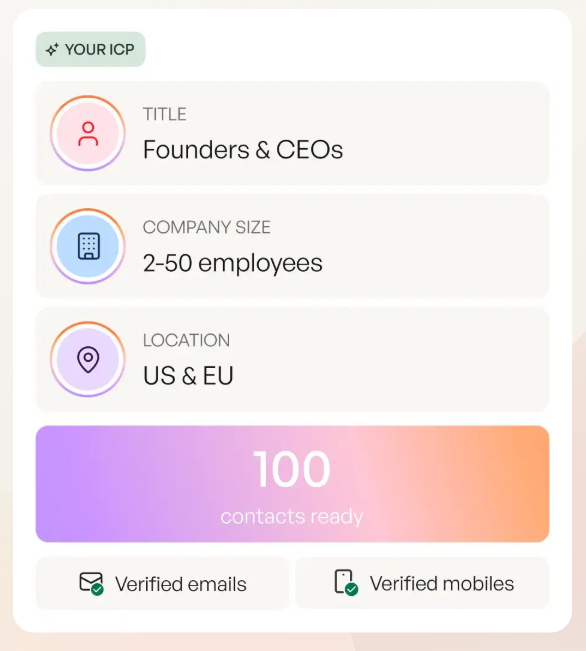
Multi-threading plan: 3 roles to add before demo (economic, technical, user)
Before you run a real demo, add three roles:
- Economic buyer: owns budget and priority
- Technical buyer: owns feasibility/security/integration
- User buyer: lives in the workflow daily
If you've only got the user, you'll over-demo. If you've only got the exec, you'll over-promise. Multi-threading keeps you specific.
"Relevance pack" checklist: 1 hypothesis, 2 risks, 3 questions, 1 proof point
Build this in 10 minutes before the call:
- 1 hypothesis: "I think your biggest bottleneck is ___ because ___."
- 2 risks: "If you don't fix it, you'll likely see ___ and ___."
- 3 questions: one workflow, one metric, one decision process question
- 1 proof point: a short customer story or metric that matches their world
Walk in with that, and feature dumping gets harder to do because you've already chosen the lane, the proof moments, and the questions that keep you honest.
Next steps (do this tomorrow)
- Pick one metric: track longest monologue on discovery (goal: <2:00).
- Rewrite your demo agenda as outcomes: if any line's a feature name, rewrite it.
- Build a 3x3 feature map for your next demo (3 pains -> 3 proof moments -> 3 features).
Then run PCP on the call: pause, check-in, prove. If you end the meeting with a one-sentence problem statement in the buyer's words, you're winning, even before the proposal.
FAQ
What's the difference between feature dumping and benefit dumping?
Feature dumping lists generic capabilities and hopes something resonates, while benefit dumping lists outcomes without a believable mechanism. Fix both by mapping 2-3 pains to 2-3 proof moments and running Tell-Show-Tell so every claim has a visible "how."
How many features should you show in a sales demo?
2-3 features max in a first demo, each tied to a stated pain and success metric. If you need more than three, pause the demo and do 5-10 minutes of discovery to lock evaluation criteria before you keep showing screens.
How do you handle technical buyers without dumping?
Start with requirements and constraints, then go deep only where it maps to their architecture and risk concerns. In enterprise deals, bring an SE (win rates can lift up to 30%) and keep a check-in question at least every 2 minutes.
What tools help prevent feature dumping by improving targeting and personalization (e.g., Prospeo)?
Tools that improve list quality reduce generic meetings that trigger rambling demos. Prospeo's a strong option because it pairs 98% verified email accuracy, a 7-day refresh, and intent data across 15,000 topics so reps show up with a specific hypothesis instead of a generic pitch.
Multi-threading early is the fix for single-thread dumping. Prospeo gives you verified emails (98% accuracy) and direct dials (125M+ mobiles) for economic, technical, and user personas - so you stop over-pitching one overwhelmed contact.
Reach every stakeholder, not just the one who replied.