How to Build Credibility in Sales (A Practical 2026 Playbook)
Buyers don't distrust you because your deck isn't pretty. They distrust you because sellers are sloppy, late, and weirdly evasive when the questions get real.
If you're searching for how to build credibility in sales, here's the truth: credibility isn't something you perform. It's something you prove, in small moments, over and over.
And in 2026, buyers verify everything in minutes.
What you need (quick version)
Credibility's a system, not a vibe. Treat it like "be confident" and you'll keep losing to the vendor that simply feels safer to bet a career on.
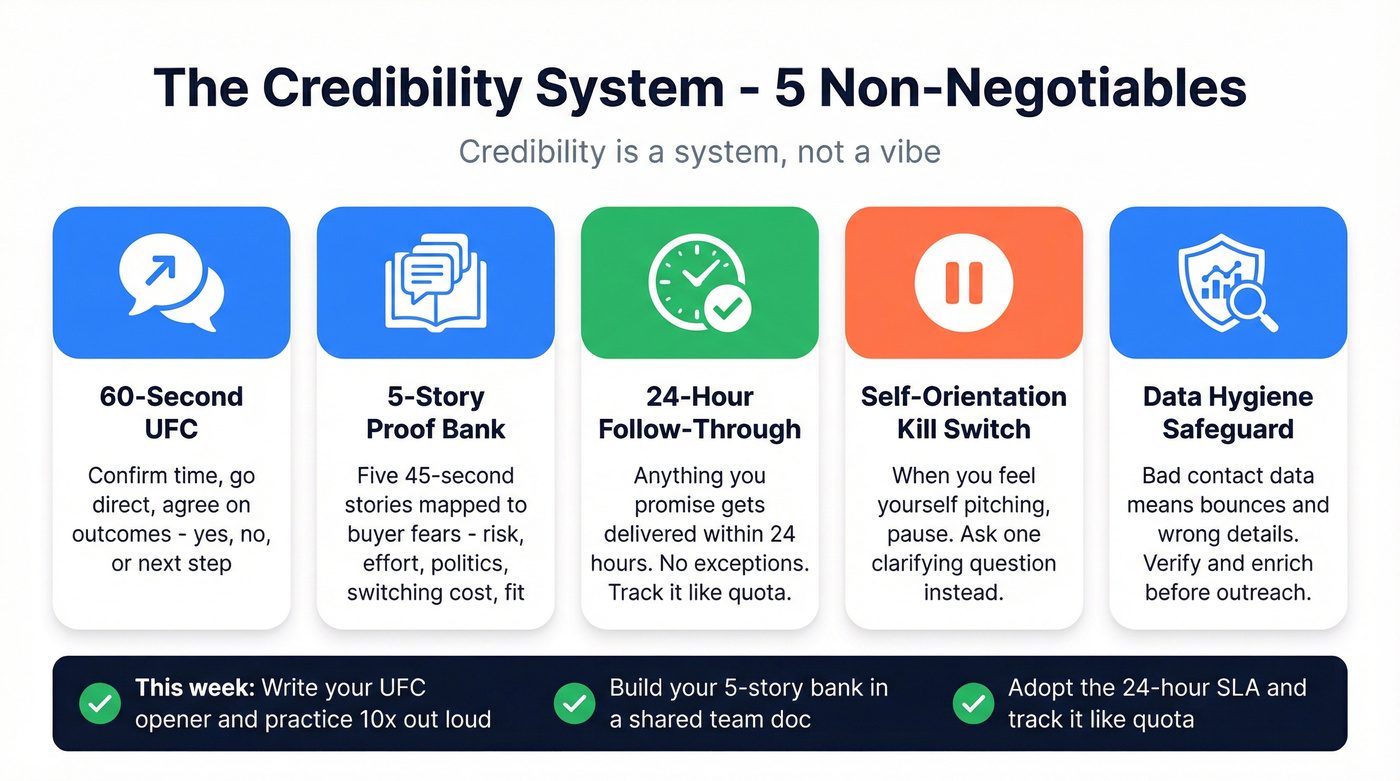
Here's the minimum system that works:
- A 60-second Up-Front Contract (UFC): confirm time + purpose, ask permission to go direct, and agree on outcomes (yes / no / scheduled next step).
- A 5-story proof bank: five 45-second stories mapped to buyer fears (risk, effort, internal politics, switching cost, "will this work here?").
- A 24-hour follow-through SLA: anything you promise (pricing, security docs, recap, customer example) gets delivered within 24 hours - no exceptions.
- A self-orientation kill switch: when you feel yourself pitching, pause and ask one clarifying question instead.
- A data hygiene safeguard: bad contact data creates bounces and wrong details - instant trust loss. Use a verification/enrichment step before outreach.
Three actions to do this week:
- Write your UFC opener and practice it 10 times out loud.
- Build your 5-story bank in a shared doc your whole team can reuse.
- Adopt the 24-hour SLA and track it like a quota.
Why credibility matters more in 2026 (buyers verify more than ever)
Trust used to be built in the room. Now it's built across tabs: reviews, competitors, pricing hints, customer logos, and your leadership team's public footprint. GenAI just makes that verification faster.
Edelman's latest Trust Barometer special report (2026 edition) used 30-minute online interviews across 15,000 respondents in 15 countries. Among the 55% who use generative AI platforms, 91% use them for shopping-related activities like researching brands, comparing options, and summarizing reviews.
So your buyer's default mode is: "Assume marketing is inflated. Verify."
I've watched teams with a better product lose because the seller felt chaotic: late follow-through, fuzzy next steps, and "let me check" answers to basic questions. Buyers don't just buy the product. They buy the operating confidence behind it.
And yes, price matters. But trust closes.
What credibility actually is (and why self-orientation kills it)
The cleanest model for sales trust is the Trust Equation from The Trusted Advisor:

Trustworthiness = (Credibility + Reliability + Intimacy) / Self-orientation
In plain sales language:
- Credibility = your words. Can you be believed? Business acumen, clear logic, and the ability to explain tradeoffs without spinning.
- Reliability = your actions. Do you meet expectations? Follow-through, consistency, and doing what you said you'd do - on time.
- Intimacy = safety. Do they feel safe being honest with you? Not "rapport." Safety to share constraints, politics, and fears.
- Self-orientation = how much this feels about you. Quota energy. Needing to be right. Needing to be liked. Needing to "win."
Self-orientation is the denominator. It's the most powerful variable.
You can be competent and still feel untrustworthy if you come off like you're trying to win the conversation instead of trying to find the truth, which is exactly why so many reps struggle to build trust with buyers even when their product's strong.
Hot take: likeability's overrated in B2B sales.
If you're selling anything with implementation, security, or internal politics, buyers don't need a new friend. They need a safe operator.
What buyers reward (the trust levers with numbers)
Forrester breaks buyer trust into seven levers: accountability, competency, consistency, dependability, empathy, integrity, transparency.

Buyers don't rank them equally.
In North America, the top levers are competence (30%), dependability (19%), and consistency (17%). In Europe, it's even more competence-heavy: competence (46%), dependability (25%), consistency (23%).
As buying groups get larger and deals get more complex, competence matters more because the buyer's managing more stakeholders, more risk, and more ways to fail, and they're quietly asking themselves, "If this goes sideways, will this seller help me fix it or disappear?"
Even better: for risk-tolerant buyers, empathy ranks lowest (it can even have negative utility). Translation: stop over-indexing on "being liked." Over-index on competence + dependability and you'll win the serious deals.
When trust is there, the outcomes are real money: nearly two-thirds of business purchase influencers who trust a company will pay a premium, and 83% will recommend it externally.
Here's how to turn those levers into coachable behaviors:
| Trust lever | What it looks like in sales | Leading indicator to track |
|---|---|---|
| Accountability | You own next steps and decision path | % of calls ending with a scheduled next step |
| Competency | Clear POV + tradeoffs + crisp discovery | 1st-call -> 2nd-call conversion rate |
| Consistency | Same story across email/call/deck | QA checklist: "same 1-sentence POV" pass rate |
| Dependability | You deliver fast and accurately | 24h SLA hit rate |
| Empathy | You name the risk and reflect impact | # of "Did I get that right?" confirmations |
| Integrity | You disqualify and say "not a fit" | # of disqualifications per rep per month |
| Transparency | Pricing/process clarity, no surprises | # of "surprises" flagged early (security, legal, timeline) |
How to coach the top three levers (competence, dependability, consistency)
1) Competence (make it visible)
- Lead with a value hypothesis, then ask permission to test it.
- Explain tradeoffs ("Option A is faster; Option B is safer long-term").
- Use numbers when they matter (time-to-value, implementation effort, opportunity cost).
- Coach it with a weekly POV drill: reps explain the problem, the stakes, and the tradeoff in 30 seconds - no slides.
2) Dependability (make it measurable)
- Deliver within 24 hours, every time.
- Send a recap that matches what the buyer actually said (not your pitch).
- Schedule next steps live; if you can't, treat the deal as unqualified until it's scheduled.
- Coach it with an SLA scoreboard and review misses like you review pipeline.
3) Consistency (make it repeatable)
- Use the same 1-sentence POV across email -> call -> meeting -> follow-up.
- Keep your "why change / why now / why us" language stable; change only the proof.
- Coach it by scoring 10 calls on one objection ("we're happy with X") and checking whether the rep answered it the same way each time.

Nothing kills credibility faster than bounced emails and wrong contact details. Prospeo's 5-step verification delivers 98% email accuracy and data refreshed every 7 days - so your first impression is a clean inbox hit, not a trust-destroying bounce.
Fix your data before you fix your pitch. Start free.
How to build credibility in sales in the first 60 seconds (call + meeting scripts)
If you want instant credibility, stop "warming up" and start contracting.

The Sandler Up-Front Contract (UFC) works because it lowers buyer anxiety. It also lowers your self-orientation because you're not trying to "win the call." You're running a clean process.
Script box: the UFC opener (default)
"I want to make sure we're aligned for today. How much time did you set aside? And what would make this conversation useful on your side? On my side, I'll ask a few direct questions - budget, timeline, and what happens if this doesn't get solved. Then I'll share what we typically see and a couple options. At the end, we'll decide one of three things: yes, no, or we schedule a clear next meeting. Sound fair?"
Add the line most sellers avoid:
"We might not be a fit. If that's the case, I'll tell you."
That single sentence signals integrity, reduces pressure, and upgrades your executive presence.
Variant 1: inbound demo request (they "just want to see it")
Inbound buyers often try to skip discovery. Don't fight them - trade.
"Happy to show it. To make the demo actually relevant, can I ask three quick questions first - then we'll jump into the product? If we can't connect it to a real use case, we'll call it and save you the time."
If they insist on "no questions":
"Got it. I'll do a high-level walkthrough. At the end, if it's interesting, we'll schedule a second call to map it to your workflow and stakeholders. Fair?"
Variant 2: outbound cold intro (you caught them live)
Your goal isn't to pitch. Your goal's to earn a next step without sounding needy.
"Did I catch you with 30 seconds? If yes, I'll tell you why I called in one sentence, then you can tell me if it's relevant."
Then do:
- one sentence value hypothesis
- one diagnostic question
- one next step ask (calendar, not "send info")
If they push back (common objections + credible responses)
Pushback: "Just send me something."
"I can, but it'll be generic. Two quick questions so I send the right thing: are you trying to solve X or Y? And who else is involved if this moves forward?"
Pushback: "What's your price?"
"I'll answer directly. It usually ranges from $X to $Y depending on scope. The only reason I'm asking questions first is so I don't mislead you. Want the 60-second version of what drives it?"
Pushback: "We're already using a competitor."
"Perfect - that means you have a baseline. If you're open to it, I'll ask what you like, what you hate, and what would have to be true to switch. If nothing would, we'll stop there."
Use this if / skip this if
Use this if:
- you sell anything complex (multiple stakeholders, security, implementation)
- buyers ghost after "great call"
- calls drift into demos with no decision
Skip this if:
- it's a true transactional order-take (they already decided)
- it's a 10-minute "one question" intro (run a micro-UFC: time + purpose + next step)
Look, if your team's not contracting meetings, you're not "relationship selling." You're freelancing.
Competence without bragging (your value hypothesis + proof bank)
Competence isn't "I've been doing this 12 years." Competence is: "I understand your world, I can quantify the risk, and I've seen this movie before."
The fastest way to show that is a value hypothesis plus a proof bank.
Value hypothesis template (fill-in)
Growth Institute's value hypothesis has four elements. Use this template:
- Objective: "You're trying to ___ (business outcome) in the next ___."
- Indicators (symptoms): "We're seeing signals like ___, ___, ___."
- Amount at risk: "If nothing changes, the cost/risk looks like ___ (time, revenue, margin, churn, compliance, headcount)."
- Show the risk: "The risk isn't just the number - it's ___ (missed window, competitive exposure, internal credibility, operational drag)."
Example (tight, not cringey):
- Objective: "You're trying to reduce ramp time for new AEs this quarter."
- Indicators: "Ramp's inconsistent by manager, and win rates dip after handoffs."
- Amount at risk: "That's 2-3 months of quota per rep, plus pipeline coverage risk."
- Show the risk: "If Q2 slips, you'll be hiring into a system that can't absorb headcount."
Endgame research steps (how to "show your work")
If you want to sound credible to execs, do the homework most sellers skip:
- Summarize earnings / 10-K / investor updates (use AI to compress, not invent).
- Extract 2-3 concrete pain points tied to strategic priorities.
- Map your value props to those pains (one-to-one, not "we do everything").
- Tailor by persona:
- execs want strategy + execution confidence
- ops wants fewer fires + clean handoffs
- frontline wants autonomy + clarity
- Pick 1-2 messaging angles you can defend with logic and examples.
In our experience, a 20-minute research ritual beats two hours of deck-building every time, because you walk into the call with a point of view you can defend, not a pile of slides you hope will do the work for you.
5-story proof bank system (make it reusable)
You need five stories you can tell in under 45 seconds each:
- Problem (what was happening)
- Stakes (why it mattered)
- Change (what they did differently)
- Result (measurable outcome)
- Lesson (what to copy / what to avoid)
Store it: shared doc or enablement wiki tagged by industry, persona, objection, and implementation complexity. Deploy it: right after the buyer shares a pain, not after your demo.
Stories land when they feel like a mirror, not a pitch.
Follow-through SLAs: the reliability system buyers can feel
A useful distinction: follow-up is communication. Follow-through is action.
Buyers don't trust you because you "checked in." They trust you because you did what you said you'd do - fast, accurately, and without drama.
Reliability checklist (steal this)
- 24-hour delivery expectation: anything promised gets delivered within 24 hours.
- Same-day recap after any real meeting: if they gave you signal, you give them structure.
- Calendar the next step live: no "I'll send times." Send the invite while you're together.
- One owner per deliverable: "we'll send" becomes "I'll send."
- No surprise asks: if legal/security is coming, say it early.
Hard rule: never send "just checking in." Send a deliverable (doc, recap, answer) or a decision question (what changed, what's blocked, what's the next step).
The SLA scoreboard (make reliability visible)
Track reliability like you track pipeline. Simple scoreboard:
- 24h SLA hit rate (target: 90%+)
- Recap sent same day (target: 80%+)
- Next step scheduled live (target: 70%+)
- "No owner" promises (target: 0)
Escalation rule: if a rep misses the 24-hour SLA twice in a week, they stop prospecting for one hour and clear follow-through debt first. Reliability debt compounds. Don't let it.
Mini-template: recap email (3 bullets + next step)
Subject: Recap + next step
- What I heard: [3 bullets, their words]
- What we agreed: [1-2 bullets, decisions]
- Open questions: [1-2 bullets, what's missing]
Next step: [meeting/action] on [date/time]. If that slips, what should we move first?
Boring. Effective.
Intimacy without being weird (create safety, not small talk)
Intimacy in the Trust Equation isn't "being friendly." It's: do they feel safe being honest with you?
In sales, vulnerability looks like admitting budget constraints, naming internal politics, saying "we tried this and it failed," or sharing what leadership will push back on. Your job is to create enough safety that they tell you the truth early, because the truth always shows up later anyway - usually as "procurement," "security," or "we decided to pause."
Do / don't
Do:
- ask permission before going direct
- normalize hard topics ("Most teams have constraints here")
- reflect impact, not just facts
- slow down when they sound uncertain
Don't:
- force personal topics
- use humor as a shortcut
- interrogate like it's a deposition
- "gotcha" them with your expertise
Permission questions (steal these)
- "Can I ask something direct about how decisions get made there?"
- "Mind if I push on timeline for a second? I want to make sure we're not guessing."
- "Is it okay if we talk about budget ranges, even if it's rough?"
- "Can I sanity-check an assumption I'm making?"
Active listening loop (simple, repeatable)
- Reflect: "So if I understand correctly..."
- Confirm: "Did I get that right?"
- Impact: "What does that break if it stays the same?"
Practice + measurement (how to train credibility like a skill)
Most teams try to "coach confidence." That's fluffy. Coach behaviors you can measure.
- 70/30 listening drill (discovery): reps aim for 70% listening / 30% talking in discovery. If they're talking more than the buyer, they're pitching early. Review one call per rep per week and score it.
- Experience asymmetry reality check: buyers often know more about options than you expect. Credibility comes from process + truth, not trivia. If you don't know, say: "I don't know yet. Here's how we'll verify it."
- One-Up / One-Down fix: if the buyer's One-Up on domain, be One-Up on process. Run a clean agenda, define decision criteria, build a mutual action plan, and prevent surprises.
This is how you build executive presence without pretending to be an expert in their business.
What destroys credibility fast (anti-pattern checklist)
Most credibility loss isn't dramatic. It's death by a thousand paper cuts.
Common anti-patterns that scream self-orientation:
- Mechanical icebreakers ("How's your week?" on autopilot)
- Rushing and pitching prematurely (trying to win, not diagnose)
- Pushing personal topics too far (safety drops)
- Failing to match communication style (you feel "off")
- Misjudging humor (risk of disrespect)
- Being inauthentic (buyers smell scripts)
- Overusing jargon (sounds like hiding)
RevOps sees the operational ones constantly:
- late follow-through ("I'll send it" -> nothing for 3 days)
- sloppy details (wrong role, wrong company, wrong region)
- bad data (bounced emails, dead numbers, outdated titles)
Here's the thing: bad data is a credibility tax. It makes you look careless before you've even spoken.
A quick scenario I've seen too many times: an AE reaches out to a VP with the wrong title and an email that bounces, then follows up from a second domain "just in case," and by the time they finally reach the right person, the buyer's already decided the team can't be trusted with a security review, let alone an implementation.
Fix the basics and you stop bleeding trust.

One credibility narrative across channels (email -> call -> meeting -> follow-up)
Credibility isn't one moment. It's a consistent story across touches.
Start with 5-7 touches, then adjust based on reply rate, deal cycle length, and channel performance. The point isn't volume. It's consistency without spam.
Touch 0 (before you send anything): verify + enrich
- Competence signal: you're contacting the right person with the right context.
- Reliability signal: your email doesn't bounce, and your details are correct.
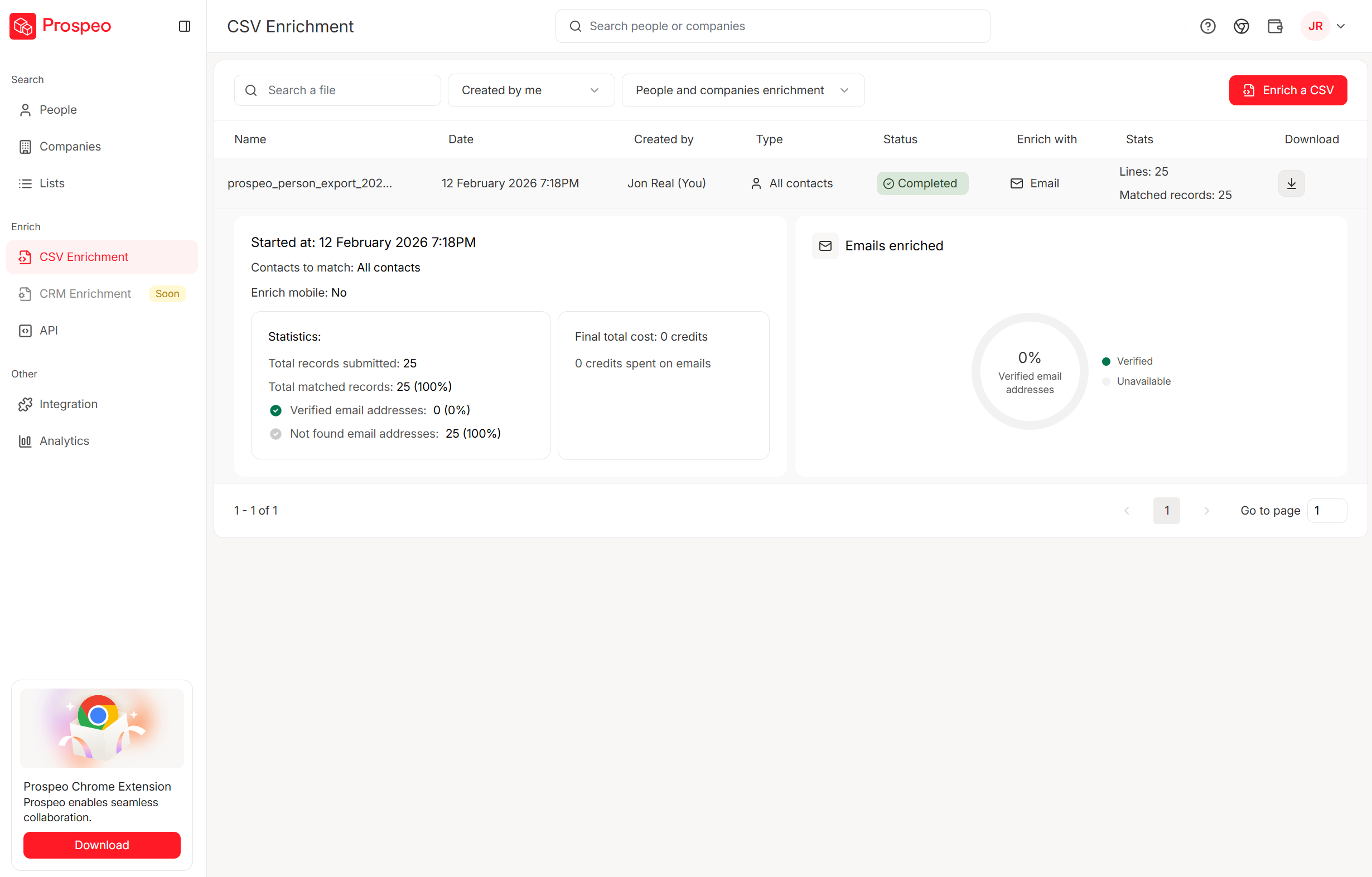
Workflow that actually works:
- upload a CSV
- run verification
- enrich missing fields
- filter to "Invalid" and remove them
- export clean records to your sequencer/CRM
This is where tools like Prospeo fit naturally: it's the B2B data platform built for accuracy, so you can verify and enrich in bulk, then push clean records into your outbound motion without turning "first touch" into an apology tour.
Touch 1 (email): the value hypothesis note
- Competence signal: a specific hypothesis tied to their business.
- Reliability signal: clear ask + clear next step.
Template:
- 1 sentence: what you noticed (fact-based)
- 1 sentence: hypothesis (risk/opportunity)
- 1 sentence: question (permission-based)
- 1 sentence: next step (two time options)
Touch 2 (call): micro-UFC + one question
- Competence signal: you run process.
- Reliability signal: you respect time.
If they answer: "Do you have 2 minutes? If not, when's better?" Then ask one diagnostic question. Don't pitch.
Touch 3 (email): proof story (45 seconds)
- Competence signal: you've seen this pattern.
- Reliability signal: you're helpful even without a meeting.
Send one proof story from your bank. No deck. No attachments unless asked.
If they ghost after touch 3 (the credibility-preserving branch)
Most sellers panic and spam. Don't.
Do this instead (two-step):
- Deliverable email: "Here's the 3-bullet recap of what I'm seeing + the one question that decides if this matters."
- Decision email (48-72 hours later):
- "Should I close the loop?"
- Give three options: "Not a priority / Wrong person / Worth a quick call."
If you can't get a clear next step after a clean decision email, treat it as disqualified. Chasing ghosts doesn't build pipeline; it trains buyers to ignore you.
Touch 4 (social/adjacent): internal trigger + relevance
- Competence signal: you understand timing (hiring, expansion, product launch).
- Reliability signal: you're tracking reality, not blasting sequences.
Keep it short: "Saw X. Usually that creates Y. Worth a quick compare?"
Touch 5 (meeting): full UFC + mutual action plan
- Competence signal: clear agenda, clear decision path.
- Reliability signal: recap + scheduled next step before you end.
End every meeting with:
"What's the decision you need to make next, and what has to be true to make it?"
Then build a lightweight mutual action plan:
- stakeholders
- decision criteria
- timeline
- risks (security, implementation, change management)
- next step on the calendar
Touch 6 (follow-up): recap within 24 hours
- Competence signal: you captured the real problem.
- Reliability signal: you deliver fast, consistently.
This is where deals either tighten up, or drift into "circle back next quarter."
Tools that protect credibility (data quality + systems)
You don't need a 12-tool stack to be credible. You need a few systems that prevent unforced errors.
Mini-stack (what to use when):
- CRM: your source of truth for notes, stakeholders, and next steps. Use it right after calls so you don't "forget" context.
- Sequencing: consistent touches without relying on memory. Use it to enforce timing and messaging consistency, not to spray volume. (If you're rebuilding your stack, start with a lean B2B sales stack.)
- Call recording/coaching: find where you sound self-oriented (interrupting, pitching early, dodging "not a fit"). Use scorecards tied to the Trust Equation.
- Data quality: verify and enrich before outreach so you don't burn trust (and domain reputation) with bounces and wrong titles. If you need a repeatable SOP, use an email verification list workflow and keep an eye on B2B contact data decay.
If you're serious about data hygiene, Prospeo belongs in the top tier: 98% email accuracy, a 7-day refresh cycle, 300M+ professional profiles, 143M+ verified emails, and 125M+ verified mobile numbers, plus self-serve workflows that keep your outbound clean without annual contracts or "talk to sales" gates.
You just built a 24-hour follow-through SLA. Now make sure you're following through to real people. Prospeo gives you 300M+ verified profiles with 30+ filters so every outreach lands with the right decision-maker - not a dead end.
Dependability starts with data you can actually depend on.
FAQ
How do you build credibility in sales when you're new or young?
Run a clean process: use a 60-second up-front contract, ask 5-7 strong discovery questions, and hit a 24-hour follow-through SLA for every promise. Borrow credibility from outcomes by using a 5-story proof bank instead of talking about years of experience.
What should you say at the start of a sales call to sound credible?
Open with an up-front contract that confirms time, defines the purpose, asks permission to go direct, and ends with clear outcomes (yes/no/next meeting). Add one integrity line - "We might not be a fit, and I'll tell you" - to reduce pressure and increase trust.
How do you rebuild credibility after a mistake (wrong detail, late follow-through)?
Own it in one sentence, fix it immediately, and add a prevention step: "You're right - I missed that. Here's the corrected info, and here's the checklist/SLA I'm using so it doesn't happen again." Then deliver the next two promised items within 24 hours.
What's a good free tool to avoid bounced emails and protect credibility?
Use a verifier with a real free tier and frequent refresh. Prospeo's free plan includes 75 email credits plus 100 extension credits per month, and the platform runs on 98% email accuracy with a 7-day refresh cycle.
Summary (the practical answer)
If you want the simplest answer to how to build credibility in sales: contract the conversation in the first minute, show competence with a tight hypothesis + proof stories, and make reliability non-negotiable with a 24-hour follow-through SLA.
Then protect the basics so you don't lose trust to sloppy, avoidable errors.