MEDDIC vs MEDDPICC: The Practitioner's Guide (With Scorecard)
It's December 15th. Your champion just told you legal needs six more weeks to review the MSA, and there's a security questionnaire nobody mentioned until now. That deal you forecasted for Q4? It's a Q2 deal now - if it closes at all.
This is the exact scenario at the heart of MEDDIC vs MEDDPICC. The "PP" - Paper Process - exists because enough enterprise deals died in procurement purgatory that someone decided to make it an explicit qualification step. The second "C" - Competition - exists because reps kept getting blindsided by alternatives they never mapped.
30-Second Verdict
| Scenario | Use This |
|---|---|
| ACV under $25K, cycle under 60 days, no procurement team | MEDDIC |
| ACV over $50K, cycle over 90 days, legal/procurement involved | MEDDPICC |
| In between ($25K-$50K) | Start MEDDIC. Add Paper Process after you lose a deal to procurement delays. |
Stop debating the acronym. The real question is whether your reps are qualifying in live conversations or performing CRM theater after the fact.
Where the Framework Came From
MEDDIC was born at PTC (Parametric Technology Corporation) in 1996. Dick Dunkel - often called the "biological father" of the framework - developed it alongside Jack Napoli under SVP of Sales John McMahon. The results were staggering: PTC grew from $300M to $1B in four years and hit revenue targets for 40+ consecutive quarters.
John Kaplan's analogy captures it well: "MEDDIC is the X-ray - it shows what's broken. You still need a selling methodology to fix it." That distinction matters. MEDDIC is a qualification framework, not a methodology. Pair it with Challenger, SPIN, or Command of the Message for the treatment.
MEDDIC Breakdown
Here's what each letter actually means - and one discovery question that gets you real information, not rehearsed answers.
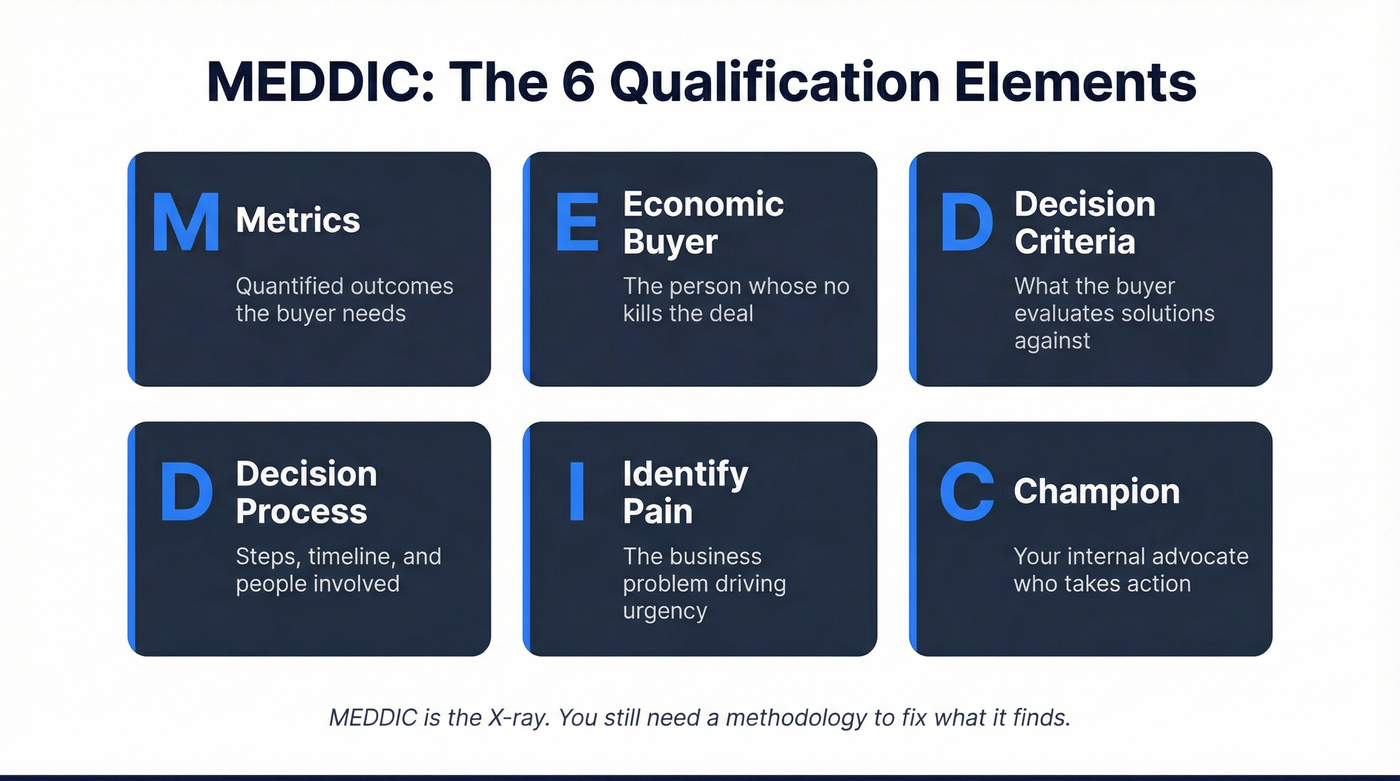
| Element | What It Means | Discovery Question |
|---|---|---|
| M - Metrics | Quantified outcomes the buyer needs | "What does success look like in 12 months?" |
| E - Economic Buyer | The person who can say yes or kill the deal | "Whose 'no' overrides everyone else's 'yes'?" |
| D - Decision Criteria | What the buyer evaluates solutions against | "What are your top 3 non-negotiables?" |
| D - Decision Process | Steps, timeline, and people involved in buying | "Walk me through how you've made similar purchases." |
| I - Identify Pain | The business problem driving urgency | "What happens if you don't solve this in 12 months?" |
| C - Champion | Your internal advocate who takes action | "Who's willing to present the business case internally?" |
The Champion vs. Coach distinction trips up most reps. A Coach gives you information - org charts, budget cycles, competitive intel. A Champion takes internal action on your behalf: they schedule meetings with the Economic Buyer, circulate your ROI deck, and fight for budget allocation. Here's the litmus test: if your "Champion" has never done something uncomfortable for you inside their organization, you have a Coach.
What MEDDPICC Adds
MEDDPICC bolts two elements onto the original six. Both address failure modes that the base framework leaves implicit.
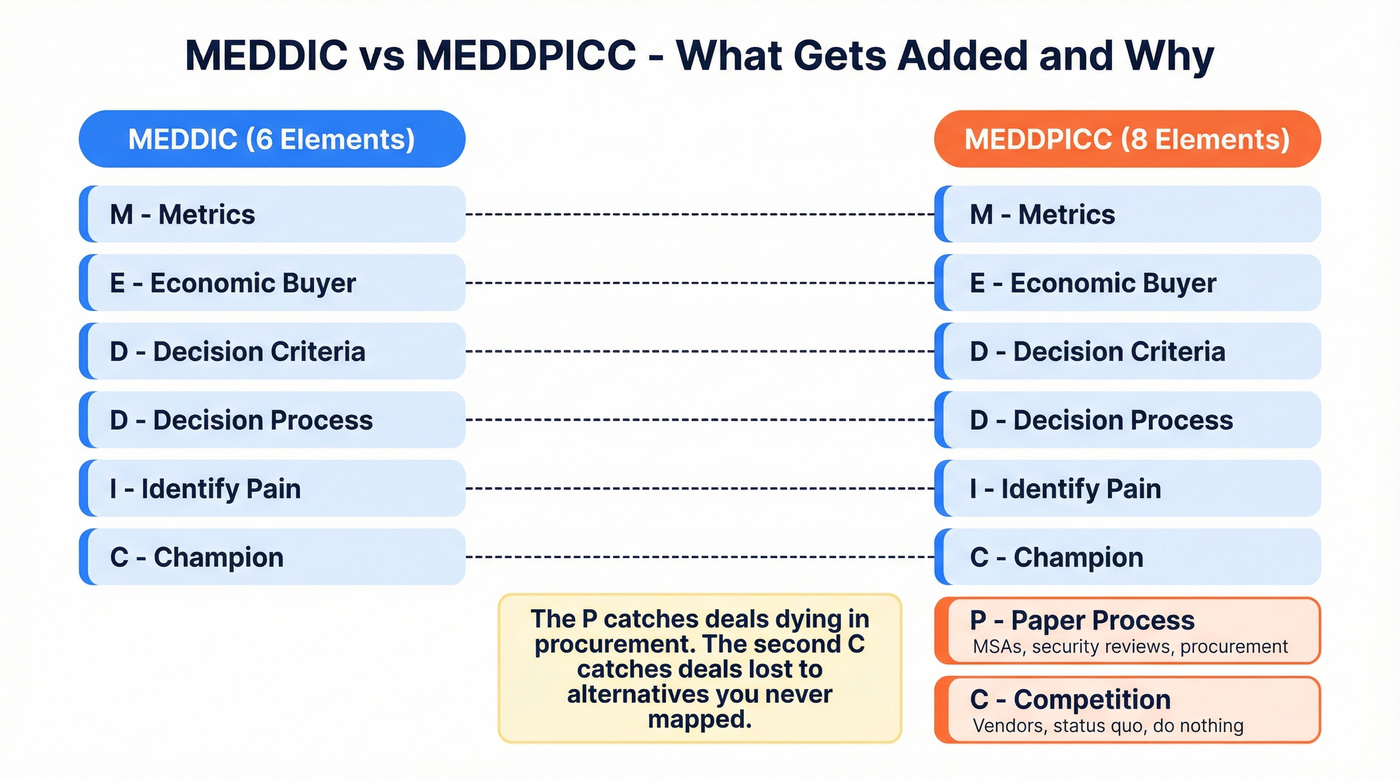
Paper Process is the graveyard of Q4 deals. It covers every legal, procurement, and administrative step between "verbal yes" and signed contract: MSA redlines, security questionnaires, DPAs, vendor onboarding forms, compliance reviews. We've seen Paper Process add 30-90 days to a close date. Front-loading these documents during discovery - not after the verbal commit - is the single highest-leverage move in enterprise sales.
Competition goes beyond vendor-vs-vendor bake-offs. In most enterprise deals, the real competition is "do nothing." Status quo has zero implementation risk, zero budget requirement, and infinite inertia. Your Competition field should capture the incumbent solution, alternative vendors, and the internal political forces favoring inaction.
There are intermediate variants worth knowing about. MEDDICC adds only Competition. MEDDPIC adds only Paper Process. MEDDPICC includes both. Use the full version if your deals regularly involve procurement teams and competitive evaluations. Skip it if you're in a category with few direct competitors and short procurement cycles - extra CRM fields nobody fills out just breed resentment.

You just mapped your Economic Buyer and Champion. Now you need to actually reach them. Prospeo gives you 98% verified emails and 125M+ direct dials so your MEDDIC discovery calls happen with real decision-makers - not gatekeepers.
Stop qualifying deals you can't even get on the phone.
How to Choose
| Factor | MEDDIC | MEDDPICC |
|---|---|---|
| Elements | 6 | 8 |
| Ideal ACV | Under $25K | Over $50K |
| Cycle length | Under 60 days | 90+ days |
| Stakeholders | 2-4 | 6-10+ |
| Procurement | Minimal | Legal, security, vendor mgmt |
The decision tree we use is simple. If your average deal involves a procurement team, you need the P. If you're consistently losing bake-offs or getting blindsided by competitors, you need the second C. If neither applies, the six-element version is enough.
Hot take: Most teams that adopt MEDDPICC don't actually need all eight elements. They need MEDDIC plus Paper Process. The Competition element only earns its keep if you're in a crowded category where reps genuinely lose deals to alternatives they didn't map. If your biggest competitor is inertia, a text field labeled "Competition" just collects dust.
Let's be honest about how this stacks up against other frameworks. BANT is transactional - it breaks down the moment budget gets created after the business case. MEDDIC is built for considered B2B purchases. MEDDPICC handles enterprise gauntlets. SPICED works well for customer-success-oriented teams where expansion revenue matters more than new logos.
The MEDDPICC Scorecard
Your prospect doesn't know you're running a qualification framework - and they shouldn't. The moment qualification feels like an interrogation, you've lost trust.
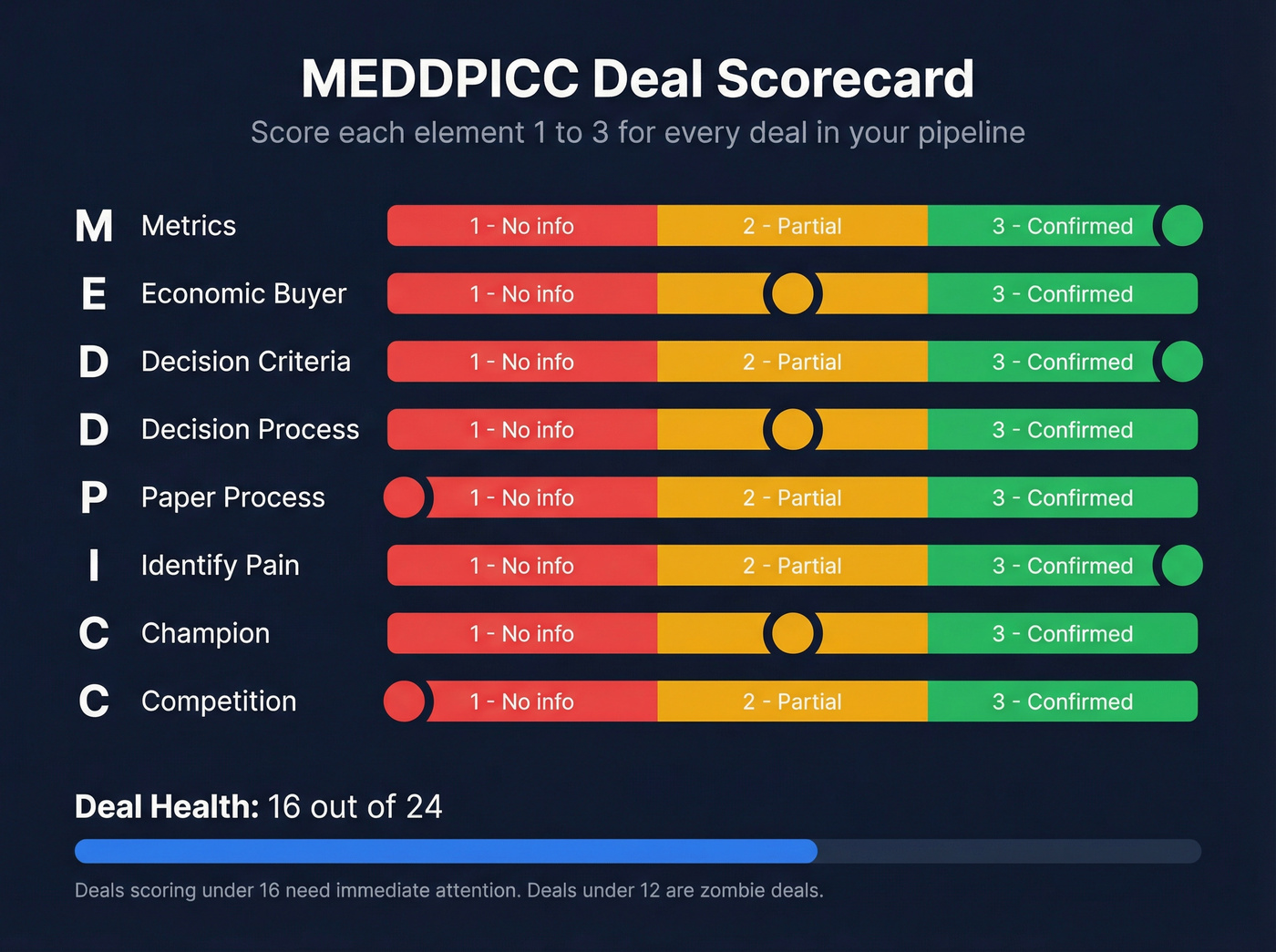
Score each element from 1 (red - no information) to 2 (yellow - partial or unverified) to 3 (green - confirmed and tested).
| Element | Discovery Questions | Score = 3 When... |
|---|---|---|
| Metrics | "What does success look like in 12 months? How do you measure it today?" | Buyer states specific KPIs with numbers |
| Economic Buyer | "Whose 'no' kills this? Have we met them?" | You've had a direct conversation with the EB |
| Decision Criteria | "What are your top 3 non-negotiables? How are you weighting them?" | Criteria are written down and shared |
| Decision Process | "Walk me through how you've made similar purchases. What surprised you last time?" | You have a timeline with named approvers |
| Paper Process | "What legal or security reviews should we anticipate? Typical timeline for contract approval?" | MSA and security docs are already in legal's hands |
| Identify Pain | "What happens if you don't solve this in the next 12 months?" | Pain is quantified in dollars or headcount |
| Champion | "Who's presenting the business case internally? What pushback do they expect?" | Champion has taken a specific internal action and reported back |
| Competition | "What else are you evaluating - including doing nothing?" | You know every alternative and have a positioning plan |
Notice the difference between robotic and conversational. Robotic: "Who is the Economic Buyer for this initiative?" Conversational: "If everyone on the evaluation committee says yes but one person says no, whose no matters most?" Same information. Completely different energy.
If your Champion scores a 3, they've taken a specific internal action - scheduling time with the CFO, circulating your security docs - and reported back. A Champion who agrees to help but never follows through is a Coach wearing a Champion costume.
Why Qualification Fails
MEDDIC doesn't fail because the framework is flawed. It fails because of how teams implement it. Four deadliest patterns:
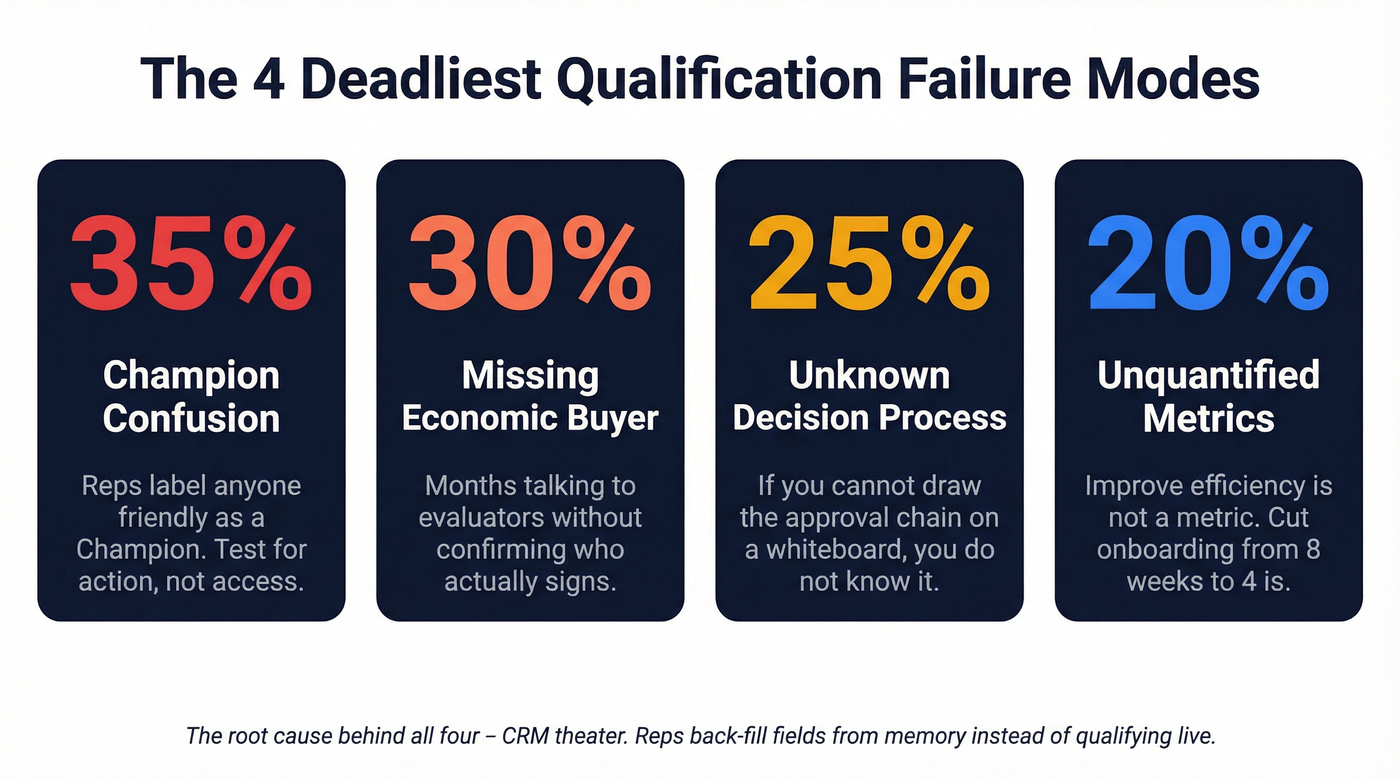
- Champion confusion (35% of failures): Reps label anyone friendly as a Champion. The test is action, not access. If they haven't done something politically risky for your deal, they're a Coach.
- Missing Economic Buyer (30%): Reps talk to the evaluation team for months without ever confirming who actually signs. By the time they find the real EB, priorities have shifted.
- Unknown Decision Process (25%): "We'll get back to you" isn't a decision process. If you can't draw the approval chain on a whiteboard, you don't know it.
- Unquantified Metrics (20%): "They want to improve efficiency" isn't a metric. "They need to cut onboarding time from 8 weeks to 4 weeks, saving $200K/year in ramp costs" - that's a metric.
The deeper problem is CRM theater. Reps back-fill fields from memory after calls, creating fictional qualification data. Managers only inspect these fields during forecast reviews - by then, the zombie deals have already poisoned the pipeline.
Look, your Economic Buyer field is only as good as your contact data. You can't identify the EB if your database shows a VP who left four months ago. You can't test your Champion if their email bounces. Prospeo refreshes 300M+ professional profiles every 7 days, so when you map the buying committee, you're working with current org charts and 98% verified email accuracy.
Implementing Without Checkbox Fatigue
The gap between "trained on MEDDIC" and "using MEDDIC" is where most implementations die. The consensus on r/sales is that most teams abandon qualification frameworks within 90 days because they feel like busywork. Here's how to avoid that.
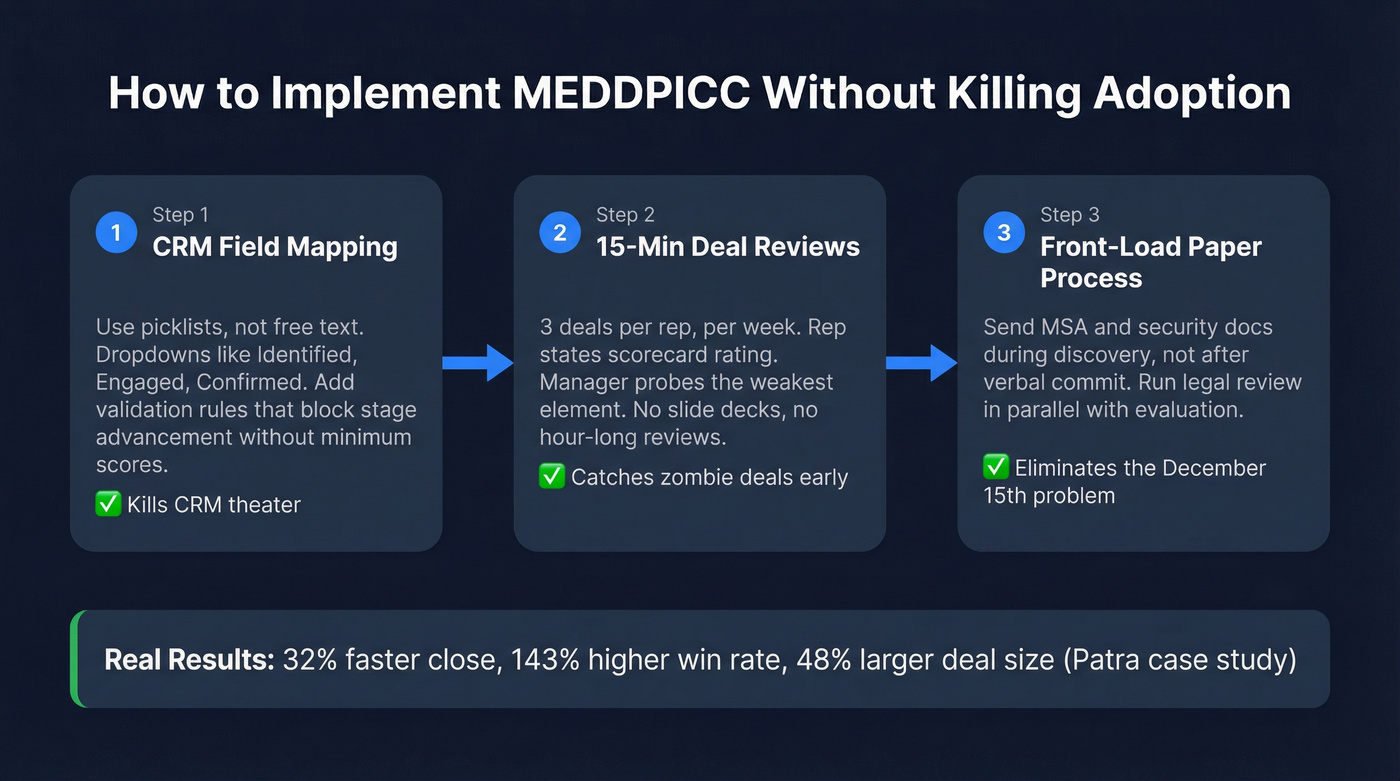
CRM field mapping: Use custom picklists, not free text. A dropdown with "Identified / Engaged / Confirmed" for Economic Buyer is infinitely more useful than a text field where reps type "talked to someone senior." Validation rules that block stage advancement without minimum scores force the discipline.
15-minute deal reviews: Pick 3 deals per rep, per week. For each deal, the rep states their scorecard rating and the manager probes the weakest element. No slide decks. No hour-long pipeline reviews. Fifteen minutes of focused inspection catches zombie deals before they metastasize. (If you want a tighter operating rhythm, borrow from an internal QBR format.)
Front-load Paper Process: Send your standard MSA and security documentation during discovery, not after the verbal commitment. This single habit eliminates the December 15th problem. If legal needs 6 weeks, you want those 6 weeks running in parallel with your evaluation - not starting after the handshake.
The results speak for themselves. At Patra, implementing structured qualification with value selling decreased time-to-close 32%, increased win rate 143%, and grew average deal size 48%. Those aren't theoretical gains - they're what happens when reps actually qualify instead of guessing.
Before your team fills in a single qualification field, enrich your pipeline contacts. Prospeo's CRM enrichment returns 50+ data points per contact with a 92% API match rate - job title, reporting structure, verified email, and verified mobile numbers. Clean data makes every qualification step faster because you're not chasing ghosts. (If you're fighting decay, start with B2B contact data decay and CRM hygiene.)
Paper Process kills deals when you can't identify every stakeholder early. Prospeo's 30+ filters - including department headcount, job changes, and org-level signals - help you map the full buying committee before procurement surprises you in Q4.
Map every stakeholder at $0.01 per verified contact.
FAQ
Is MEDDPICC better than MEDDIC?
Not inherently - it's heavier. MEDDPICC adds two qualification elements designed for complex enterprise deals with procurement teams and competitive evaluations. Use the lightest framework that covers your deal complexity. If you're selling sub-$25K deals with no formal procurement process, MEDDIC is enough. Adding unnecessary fields creates checkbox fatigue without improving win rates.
Can I combine MEDDIC with other methodologies?
Absolutely. MEDDIC is a qualification tool, not a selling methodology. Think of it as the X-ray that reveals what's broken in a deal. Pair it with Challenger, SPIN, or Command of the Message for the actual selling motions that move deals forward. BANT can work as a lightweight first-pass filter before deeper MEDDIC qualification kicks in at later stages.
How do I stop MEDDIC from becoming CRM theater?
Run 15-minute deal reviews weekly, probing the weakest scorecard element per deal - don't let reps narrate strengths while ignoring gaps. Make sure contact data is current so fields reflect reality, not last quarter's org chart. And never use scores as a gotcha in forecast calls. The moment reps feel punished for honest gaps, they'll fabricate green ratings every time.
When should I add Paper Process?
Add it the first time you lose a deal - or slip a quarter - because of procurement delays you didn't anticipate. For teams selling above $50K ACV into organizations with dedicated legal, security, or vendor management functions, include it from day one. Front-loading MSA and security docs during discovery instead of post-verbal-commit typically saves 30-90 days on close timelines.