

Enterprise Software Sales: What It Takes to Close Six-Figure Deals in 2026
Stop treating enterprise sales as a longer version of mid-market sales. The skills that make you a great mid-market closer - speed, volume, charm - will actively hurt you in enterprise software sales. Here's the operating manual nobody gave you on day one.
What You Need (Quick Version)
Selling complex software to large organizations means $100K+ deals, 8-12 stakeholders, and 6-24 month cycles. Median OTE is $265K, but only 40.9% of reps hit quota. The three things that separate closers from everyone else: structured qualification (MEDDPICC), a CFO-ready business case, and procurement prep before legal asks for it. The rest of this guide gives you the playbook.
What Defines Enterprise Software Sales?
Enterprise software sales is the practice of selling complex, high-value software solutions to large organizations - typically deals north of $100K, involving 8-12 stakeholders across departments, legal, IT, procurement, and the C-suite. Cycles run 6-24 months. Sometimes longer.
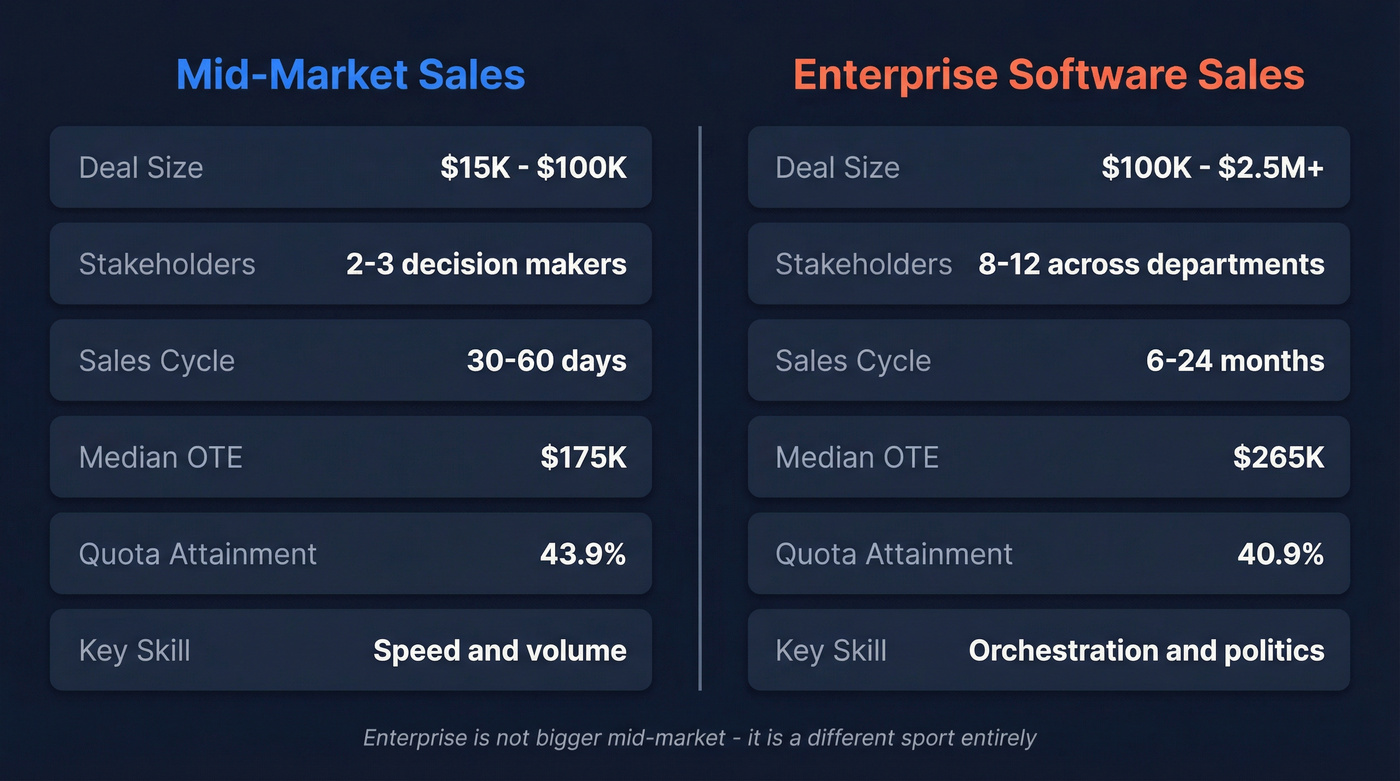
Compare that to mid-market, where a strong AE can run a deal from first call to close in 30-60 days with two or three decision-makers. Enterprise deals don't just take longer - they're structurally different. You're not selling a product. You're navigating an internal political process that happens to involve your software.
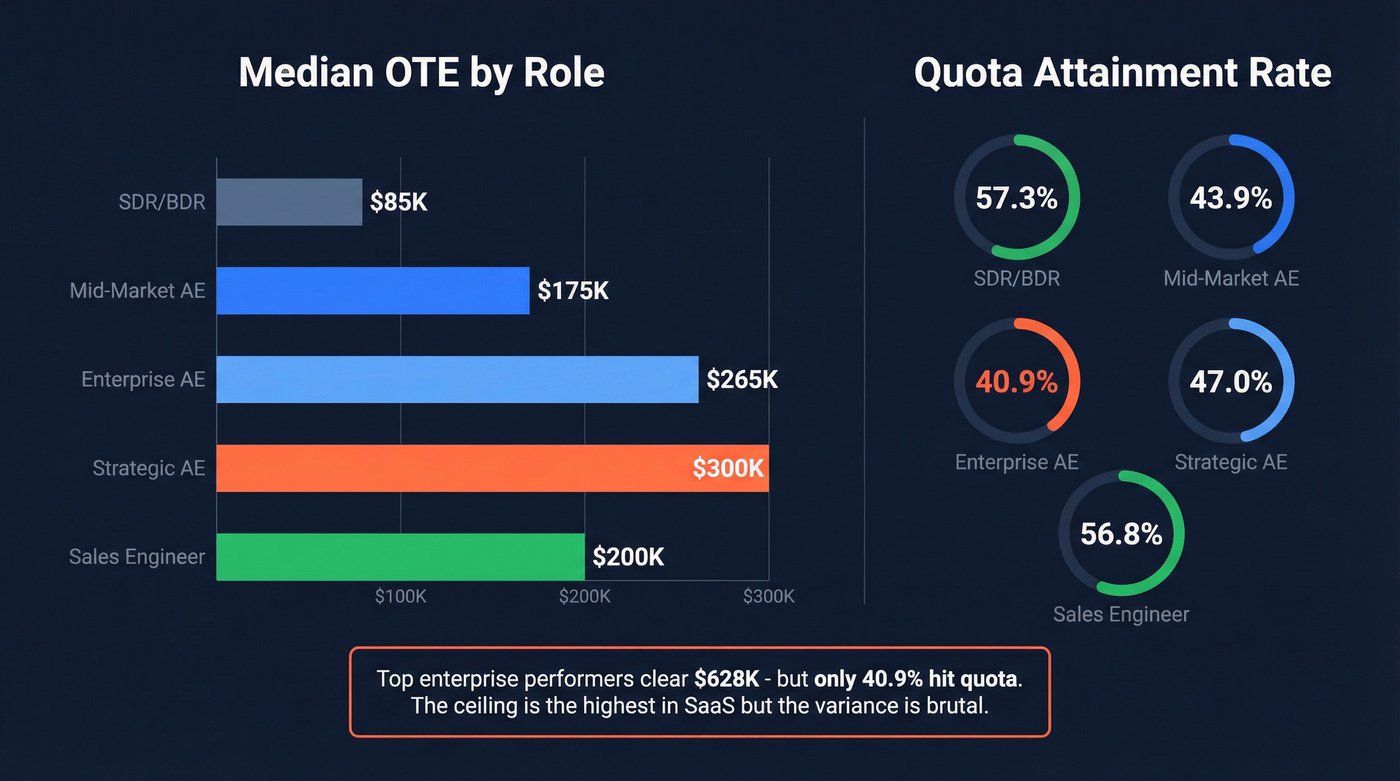
Pay reflects this complexity. A mid-market AE pulls a median OTE of $175K. An enterprise AE earns $265K at the median, with top performers clearing $627,527. But here's the trade-off most people don't talk about: mid-market AEs hit quota 43.9% of the time. Enterprise AEs? Just 40.9%. You're paid more because the job is harder, the ramp is longer, and the margin for error is thinner.
The typical career path runs SDR to Mid-Market AE to Enterprise AE to Strategic AE, with each jump requiring a 6-12 month ramp to full productivity. Hiring managers care less about your closing ratio and more about whether you can orchestrate a complex buying process across multiple stakeholders. If you've never managed a deal with procurement, legal, and a security review happening simultaneously, enterprise will humble you fast.
Enterprise isn't "bigger mid-market." It's a different sport entirely.
The 2026 Landscape
The macro environment isn't getting easier. Enterprise sales cycles have lengthened 36% since 2021. The average B2B win rate sits at just 21%. For enterprise-specific deals, it's almost certainly lower.
Reps spend roughly two hours per day actually selling - the rest goes to admin, internal meetings, and CRM hygiene. The good news: 81% of sales professionals say AI is reducing manual work, freeing up time for the high-value conversations that actually move enterprise deals. But AI doesn't fix bad qualification or weak multi-threading. Those are still human problems.
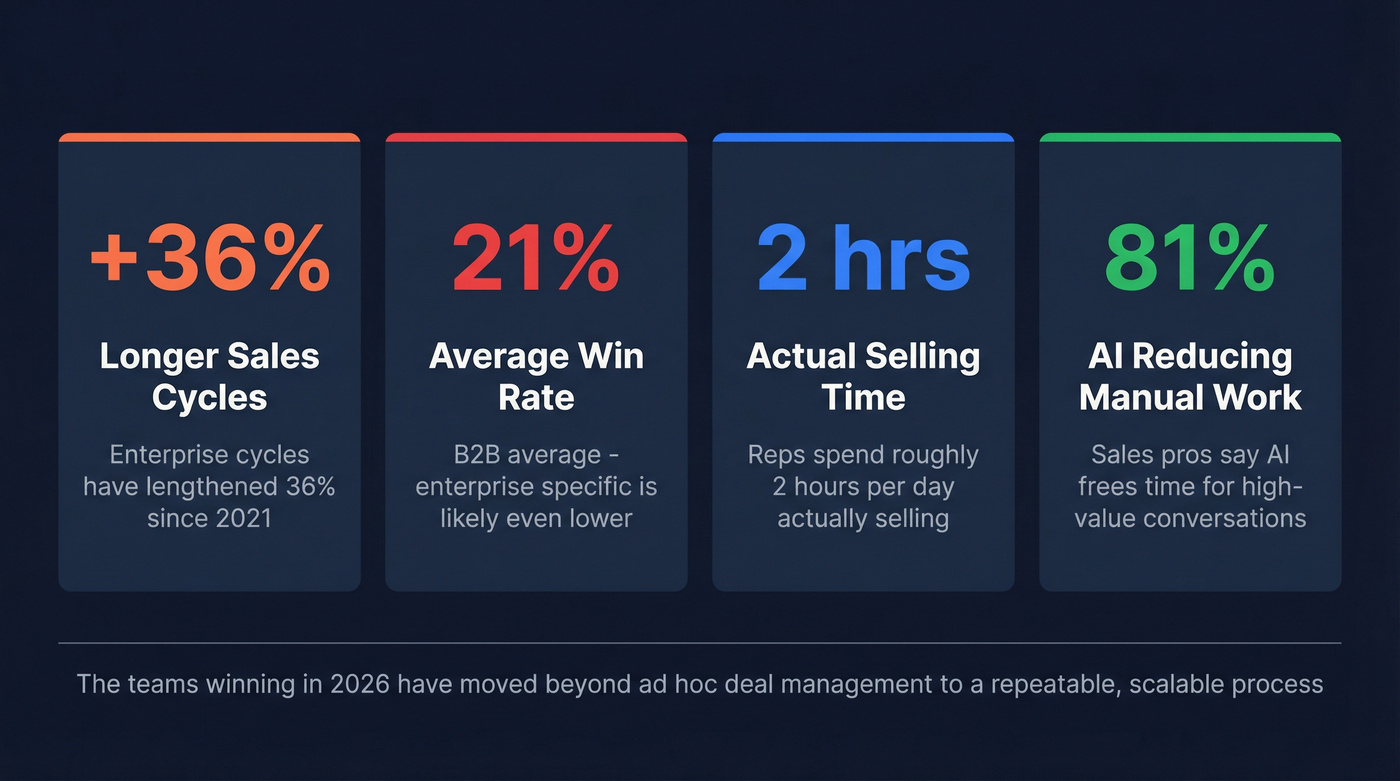
The buying side is shifting too. Enterprise prospects increasingly expect self-serve evaluation experiences, product-led trials, and transparent pricing before they'll even take a first call. The teams winning right now have moved beyond ad hoc deal management to a repeatable process that scales across their entire book of business. If you're still running enterprise like it's a volume game, you're leaving money - and quota - on the table.
Compensation Benchmarks
Let's talk money. This is the section every enterprise AE candidate bookmarks.
Pay by Role
| Role | Median Base | Median OTE | Top Performers | Quota Attainment |
|---|---|---|---|---|
| SDR/BDR | $60K | $85K | $128K | 57.3% |
| Mid-Market AE | $90K | $175K | $391K | 43.9% |
| Enterprise AE | $135K | $265K | $628K | 40.9% |
| Strategic AE | $150K | $300K | $705K | 47.0% |
| Sales Engineer | $145K | $200K | $327K | 56.8% |
Data from RepVue's salary guide. These are rep-reported medians, not recruiter wish lists.
Comp by Deal Size
| Title | Deal Size | Base | OTE |
|---|---|---|---|
| Enterprise AE | $250-500K | $150-165K | $300-330K |
| Strategic EAE | $500K-$1M | $165-175K | $330-350K |
| Director, Enterprise | $1M-$2.5M | $200-225K | $400-450K |
| VP, Enterprise | $2.5M+ | $250-275K | $500-550K |
Per Betts Recruiting's comp analysis, comp scales directly with deal complexity. An AE closing $250K deals and an AE closing $2.5M deals aren't doing the same job - and the market prices that accordingly.
Quota expectations scale with company maturity too. Enterprise AE quotas range from roughly $900K at Seed/Series A companies to $1.35M at Series D - about a 50% increase as the product matures and the market expands. Only 40.9% of enterprise AEs hit those numbers. Either quotas are unrealistic, territories are poorly designed, or enablement is broken. Usually all three.
The common refrain on r/sales and among enterprise AEs we've talked to: the ceiling is the highest in SaaS, but the variance is brutal. Top decile performers earn 4-5x the median. Bottom performers wash out in 12-18 months. If your average contract value sits below $15K, skip the enterprise motion entirely - a strong mid-market play will outperform an underfunded enterprise team every time.
The Deal Process, Stage by Stage
Enterprise deals follow a predictable arc, even when individual deals feel chaotic. Understanding each stage is what separates reps who forecast accurately from those who get blindsided by slipped deals.
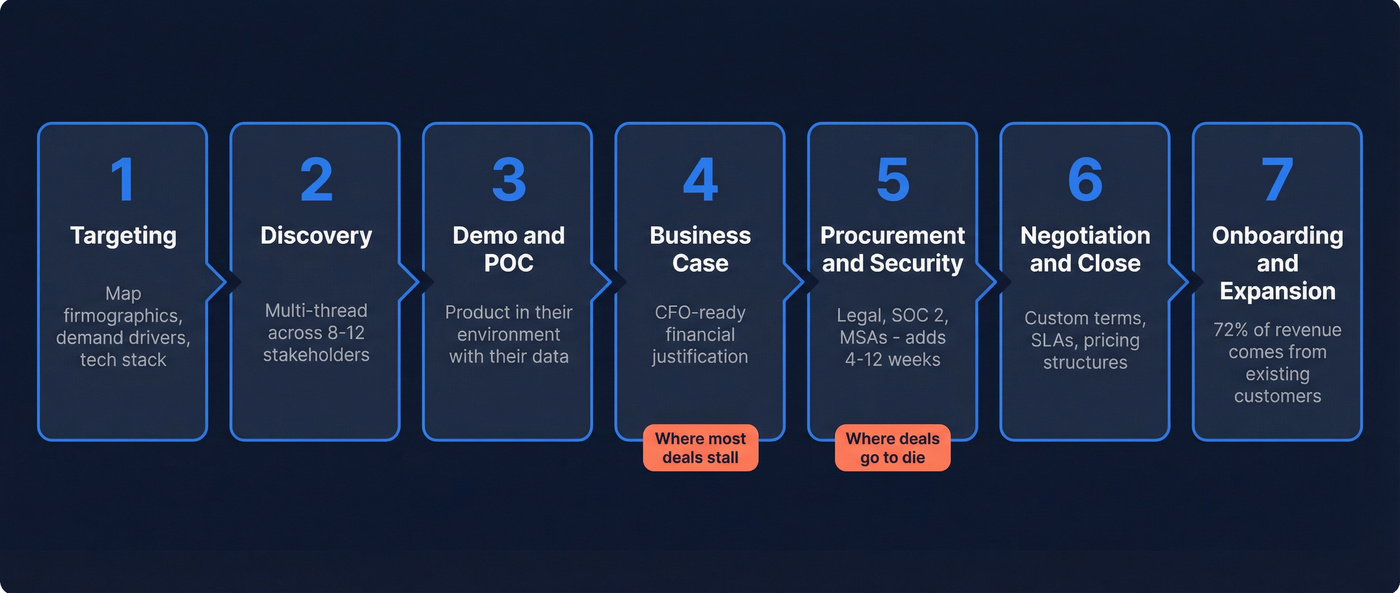
1. Targeting and account selection. Start with Gartner's Enterprise persona framework, which maps four dimensions: firmographics like industry, revenue, and headcount; demand drivers forcing change; technology environment including current stack and gaps; and decision process covering how the organization actually buys. Skip this step and you'll waste months on accounts that were never going to close.
2. Discovery and multi-threading. Your first call isn't with the economic buyer - it's with someone two levels down. The goal isn't to pitch. It's to map the org: who influences, who decides, who can kill the deal quietly. Enterprise deals with single-threaded relationships die at a rate that should terrify you. This is where verified contact data matters most - you need direct lines into procurement, IT security, and the business unit, not just the person who took your first meeting. Tools like Prospeo's 30+ search filters help you identify the full buying committee by department, seniority, and job function before your first discovery call.
3. Demo, POC, and pilot. Enterprise buyers don't trust slides. They want to see the product in their environment, with their data, solving their problem. A well-run POC with clear success criteria is worth more than ten executive dinners. More enterprise buyers now expect self-serve trials or sandbox environments before they'll commit to a formal evaluation - if your product doesn't offer this, you're already behind the vendors that do.
4. Business case development. This is where most mid-market AEs stumble. Enterprise buyers need a financial justification that survives CFO scrutiny. We'll cover this in depth below.
5. Procurement and security review. The deal isn't closed when the champion says yes. It's closed when legal, security, and procurement say yes. This stage adds 4-12 weeks to every enterprise deal, and most reps aren't prepared for it.
6. Negotiation and close. Enterprise contracts involve custom terms, SLAs, implementation timelines, and pricing structures that don't fit neatly into a standard order form. Flexibility here isn't weakness - it's how enterprise deals get done.
7. Onboarding and expansion. The close is the beginning, not the end. 72% of company revenue comes from existing customers. Your first enterprise deal at an account should be the smallest one you ever close there.

Multi-threading is the #1 predictor of enterprise deal velocity - but you can't multi-thread without verified contact data for every stakeholder. Prospeo's 30+ search filters let you map entire buying committees by department, seniority, and job function. 98% email accuracy means your outreach actually lands.
Stop single-threading six-figure deals with unverified data.
Why MEDDPICC Wins Deals
MEDDPICC isn't optional in enterprise. It's the qualification framework that separates reps who forecast accurately from reps who "feel good" about deals that slip quarter after quarter.
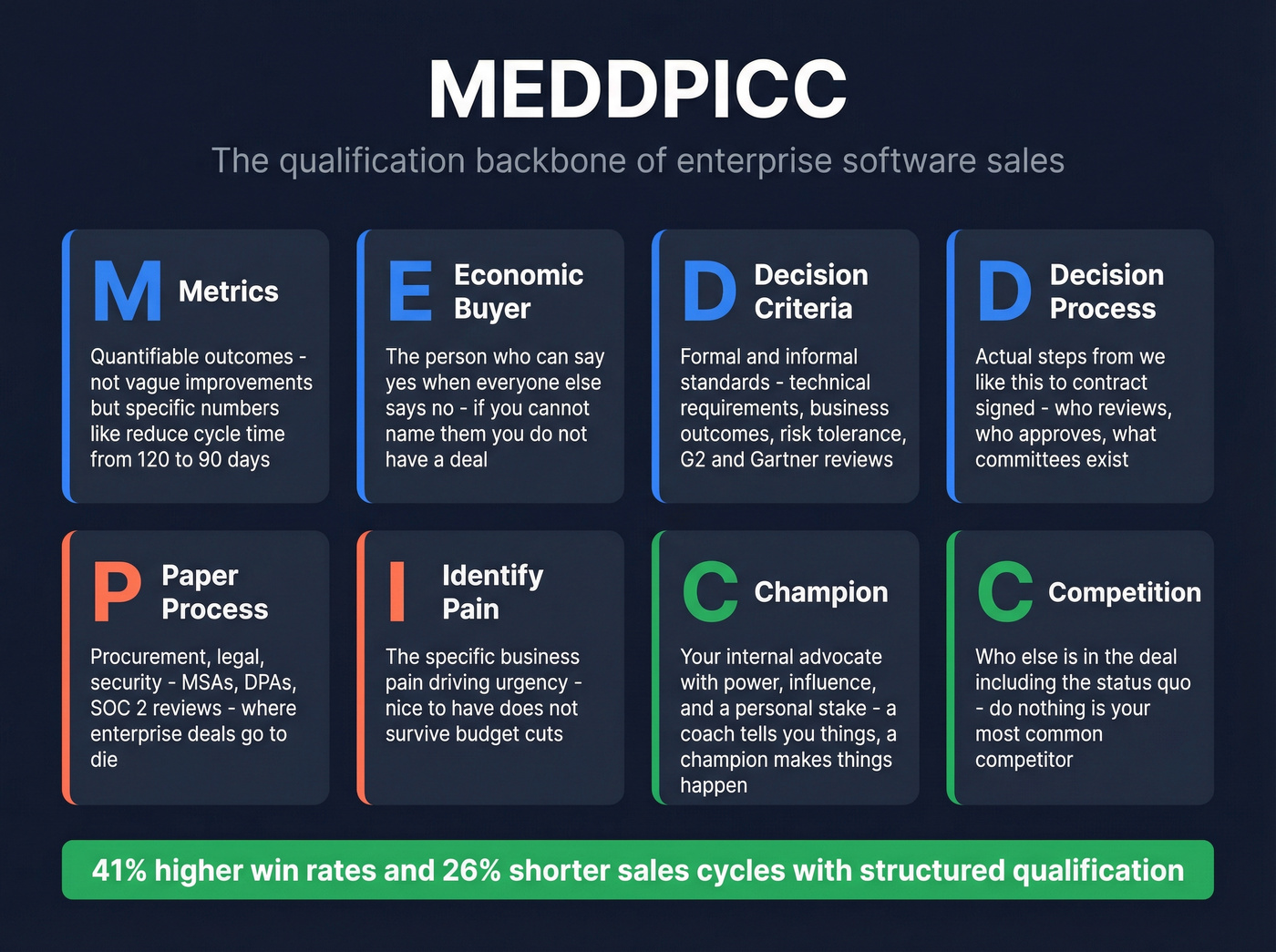
John McMahon created the framework at PTC in 1996, using it to help the company grow from $300M to $1B in sales. The original version - MEDDIC - covered six elements. The modern MEDDPICC adds Paper Process and Competition, reflecting the reality that procurement complexity and competitive displacement are now central to every enterprise deal.
Each element serves a specific purpose:
- Metrics - Quantifiable outcomes the buyer expects. Not "improve efficiency" but "reduce cycle time from 120 to 90 days."
- Economic Buyer - The person who can say yes when everyone else says no. If you can't name them, you don't have a deal.
- Decision Criteria - The formal and informal standards the buyer uses to evaluate vendors. Technical requirements, business outcomes, risk tolerance. Smart buyers also check G2 and Gartner peer reviews as part of this - make sure your product's third-party ratings support your narrative.
- Decision Process - The actual steps from "we like this" to "contract signed." Who reviews, who approves, what committees exist.
- Paper Process - The procurement, legal, and security path. MSAs, DPAs, security questionnaires, SOC 2 reviews. This is where enterprise deals go to die.
- Identify Pain - The specific business pain driving urgency. No pain, no deal. "Nice to have" doesn't survive budget cuts.
- Champion - Your internal advocate who has power, influence, and a personal stake in your solution winning. A coach tells you what's happening. A champion makes things happen.
- Competition - Who else is in the deal, including the status quo. "Do nothing" is your most common competitor.
Teams that implement structured qualification see 41% higher win rates and 26% shorter sales cycles. We've watched teams adopt MEDDPICC and see forecast accuracy jump within a single quarter - not because the framework is magic, but because it forces you to confront deal reality early instead of discovering gaps in week 16.
SPIN Selling and Challenger are complementary, not competing. SPIN gives you a discovery framework for surfacing pain. Challenger gives you a teaching methodology for reframing how the buyer thinks about their problem. MEDDPICC is the qualification backbone that ties it all together. Use all three.
Enterprise Account Planning
Not every account deserves the same investment.
| Tier | Accounts | Revenue Potential | Stakeholders | Review Cadence |
|---|---|---|---|---|
| Tier 1 | Top 10-15 | $200K+ | 5+ | Weekly |
| Tier 2 | Next 20-30 | $50-200K | 3-5 | Bi-weekly |
| Tier 3 | Remaining | <$50K | 1-3 | Monthly / signal |
For each Tier 1 account, you need intelligence across five dimensions: account context covering financials, strategy, and org changes; stakeholder mapping across power, influence, and sentiment; whitespace analysis showing where your product fits today and in 12 months; competitive positioning identifying who's incumbent and who's circling; and a concrete action plan with next steps and owners.
Traditional manual research runs 2-3 hours per account across five or more sources. That's 30-45 hours just to build initial plans for your Tier 1 book - and plans go stale within weeks if you're not refreshing them. This is where intent data and automated enrichment earn their keep, not as replacements for human judgment, but as ways to keep your account intelligence current without living in a spreadsheet.
Building the Business Case
Here's the thing: most enterprise AEs confuse ROI with a business case, and the distinction costs them deals. ROI validates spend - "is this worth the money?" A business case secures approval - "will this get funded, and why now?" A positive ROI doesn't guarantee a signed contract. Alignment, risk mitigation, urgency, and stakeholder priorities all have to line up.
A strong business case follows a clear structure: establish baseline metrics, identify impact levers, quantify cost inputs across license, implementation, training, and change management, then calculate outputs - payback period, NPV, and IRR.
Let's make this concrete. Say you're selling a revenue intelligence platform to a 50-rep sales org:
- Sales cycle time: 120 days to 90 days
- Win rate: 25% to 30%
- Average deal size: +10% from better qualification
- Deals per rep per year: 5 to 7
Run those numbers and you're looking at roughly $12M in annualized revenue impact, a 7-month payback period, and a $22M three-year NPV. That's a business case a CFO can approve, not a vague promise of "better efficiency." If you need a quick model, a simple sales ROI calculator can help you pressure-test assumptions.
Payback norms vary by category. SaaS investments typically need to show 6-12 month payback. Enterprise platforms can stretch to 12-24 months if the NPV is compelling enough. In our experience, the business case is where 80% of stalled deals can be unstalled - the problem is most reps hand this work to their champion instead of building it together. Elite sellers close 25-30% of qualified opportunities, and the business case is usually the reason they convert at that rate while everyone else stalls at 15-20%.
Navigating Procurement and Security
Your champion said yes. The VP of Engineering is on board. And then procurement sends a 47-page security questionnaire that sits in your inbox for three weeks because nobody on your team prepared for it.
Ask any enterprise AE what kills deals and they'll say procurement, not competitors. If you don't have these ready before procurement asks, your deal stalls 4-8 weeks:
SOC 2 Type II report - less than 12 months old. Type I shows controls exist; Type II proves they work over time. Developed by AICPA against five Trust Service Principles: Security, Availability, Processing Integrity, Confidentiality, and Privacy.
Encryption - AES-256 at rest, TLS/SSL in transit. Non-negotiable.
Access controls - SSO via SAML, role-based access control, MFA enforced.
GDPR/CCPA documentation - Data processing agreements, privacy impact assessments, data subject request procedures. (If you're selling into the EU, keep your outbound aligned with GDPR for Sales and Marketing too.)
Beyond these table-stakes items, expect questions about incident response plans with defined SLAs for notification, disaster recovery procedures with RTO/RPO targets, and failover architecture. Enterprise buyers increasingly evaluate Year 1 vs. Year 3 total cost of ownership, data residency requirements, and performance benchmarks with 1M+ records - come prepared with answers to all three.
Real talk: most deals don't die to competitors. They die in procurement. The rep who has a security packet ready on day one of the evaluation - before anyone asks - closes weeks faster than the rep who scrambles to pull SOC 2 reports in month four. Build your security readiness kit once, update it quarterly, and send it proactively. It's the highest-leverage thing you can do for deal velocity.
Tools and Tech Stack
The right stack amplifies everything above. The wrong stack creates busywork that masquerades as productivity.
CRM. Salesforce is the enterprise default, with Enterprise Edition running ~$165/user/month within a range of $25-500/user/month depending on tier. HubSpot works for teams under 50 reps at ~$150/user/month for their Enterprise tier. Your CRM should house dynamic playbooks - real-time, contextual guidance that updates as deals progress, not static PDFs that nobody reads after onboarding. If you're evaluating platforms, see HubSpot vs Salesforce.
Prospecting and data. This is where most enterprise stacks leak value. Enterprise AEs target named accounts with specific buying committees - every bounced email is a missed thread into the deal. We've tested most of the major data vendors, and bounce rates vary wildly. Prospeo covers 300M+ professional profiles with 98% email accuracy and 125M+ verified mobile numbers, all refreshed on a 7-day cycle. At roughly $0.01 per email with no annual contracts, it's a fraction of what legacy vendors charge for comparable data. If you're building your stack, start with a shortlist of sales prospecting platforms.

Conversation intelligence. Gong runs ~$1,360-1,600/user/year plus a ~$5K platform fee. Worth it for enterprise teams where deal review and coaching drive win rates.
Enablement. Seismic (~$30-65/user/month) and Highspot (~$35-75/user/month) centralize content, training, and buyer engagement analytics. If your reps are digging through shared drives for case studies mid-deal, you need one of these.
Sequencing. Outreach at ~$100/user/month is the standard for enterprise outbound cadences. Pair it with proven outreach email templates so reps aren't reinventing copy every quarter.
Forecasting. Clari at ~$30-60K/year gives revenue leaders visibility into pipeline risk. Essential once you're past $5M ARR. If your team keeps missing, start with deal forecast accuracy.
Enterprise AEs spend just two hours a day selling. The rest is admin, CRM hygiene, and hunting for contact data that bounces anyway. Prospeo delivers verified emails at $0.01 each and 125M+ direct dials with a 30% pickup rate - refreshed every 7 days, not every 6 weeks like the tools you're replacing.
Spend your two selling hours talking to real buyers, not chasing bad numbers.
Mistakes That Kill Enterprise Deals
Single-threading. Relying on one contact in an 8-12 stakeholder deal is the fastest way to lose. When your champion changes roles, gets overruled, or goes on parental leave, your deal evaporates. Multi-thread into at least three departments from week one. (If you want a tighter definition and examples, see multithreading in sales.)
Ignoring procurement until it finds you. If you wait for the security questionnaire to arrive before preparing your SOC 2 report and DPA, you've already lost 4-8 weeks. Proactive procurement prep is a competitive advantage that costs nothing but preparation time.
Overpromising on timelines. Telling a prospect you can implement in 6 weeks when the real number is 12 doesn't accelerate the deal - it creates a trust deficit that surfaces during reference checks. I've seen this kill seven-figure deals in the final week.
No ROI model when the CFO asks. If your champion has to build the business case without you, they'll get the numbers wrong and the deal will stall. Arm them with a model they can present confidently.
Bad prospecting data burning your domain. Bad data doesn't just waste time - it tanks your sender reputation. A 15% bounce rate on outbound sequences flags your domain with email providers, and recovery takes weeks. Verify your lists before every outbound campaign. One bad send can undo months of domain warming. Use an email checker tool and follow an email deliverability checklist.
Treating enterprise like "longer mid-market." Enterprise isn't about running the same playbook slower. The stakeholder dynamics, procurement processes, and political navigation require fundamentally different skills. We've seen strong mid-market AEs flame out in enterprise because nobody told them the game changed. A coherent strategy accounts for these differences from day one - it doesn't bolt them on after the first few lost deals.
FAQ
How long does an enterprise deal cycle take?
Enterprise software sales cycles run 6-24 months depending on deal size and complexity. Deals in the $100-250K range typically close in 3-6 months, while $500K+ deals average 6-12 months. Seven-figure contracts can stretch to 18+ months. Cycles have lengthened 36% since 2021.
What's a good OTE for enterprise AEs?
Median enterprise AE OTE is $265,000 per RepVue, with strategic AEs earning roughly $300K at the median. Top performers clear $627K+. Comp scales directly with deal size - AEs closing $2.5M+ deals earn $500-550K OTE at the VP level.
What's MEDDPICC?
MEDDPICC is a sales qualification framework covering Metrics, Economic Buyer, Decision Criteria, Decision Process, Paper Process, Identify Pain, Champion, and Competition. Created by John McMahon at PTC in 1996, teams using it see 41% higher win rates and 26% shorter sales cycles.
What prospecting tools do enterprise teams need?
At minimum: a CRM like Salesforce, a verified data platform for stakeholder discovery and multi-threading, conversation intelligence like Gong, and enablement software like Seismic or Highspot. Add Clari for forecasting and Outreach for sequencing as the team scales past $5M ARR.